




Abstract
The lack of progress in establishing ambitious and legally binding global mitigation targets means that the need for locally based climate change adaptation will increase in vulnerable localities such as Africa. Within this context, “ecosystem-based adaptation” (EBA) is being promoted as a cost-effective and sustainable approach to improving adaptive capacity. Experience with the ongoing development of Durban’s Municipal Climate Protection Programme indicates that achieving EBA in cities means moving beyond the conceptualization of a uniform, one-size-fits-all layer of street trees and parks to a more detailed understanding of the complex ecology of indigenous ecosystems and their resilience under climate change conditions. It also means engaging with the role that this “bio-infrastructure” plays in improving the quality of life and socioeconomic opportunities of the most vulnerable human communities. Despite the long-term sustainability gains of this approach, implementation in Durban has been shown to be both technically challenging and resource intensive. The close association between human and ecological systems in addressing climate change adaptation has also led to the development of the concept of “community ecosystem-based adaptation”.
Keywords
I. Introduction
There are growing calls in the literature, both in prominent global environmental change research pieces(1) and in the strategic and practical guidance given to institutions and practitioners(2) for biodiversity and ecosystems to be considered critical elements in any climate change response strategy. The growing awareness of the provisioning, regulating, supporting and cultural roles of ecosystem services(3) has also contributed to the emergence of the concept of “ecosystem-based adaptation” (EBA). EBA is defined as:
“…the use of biodiversity and ecosystem services as part of an overall adaptation strategy to help people to adapt to the adverse effects of climate change. Ecosystem-based adaptation uses the range of opportunities for the sustainable management, conservation and restoration of ecosystems to provide services that enable people to adapt to the impacts of climate change. It aims to maintain and increase the resilience and reduce the vulnerability of ecosystems and people in the face of the adverse effects of climate change. Ecosystem-based adaptation is most appropriately integrated into broader adaptation and development strategies.”(4)
The systemic and proactive approach of EBA contrasts with the interventionist and reactive nature of many existing adaptation proposals and plans(5) that portray adaptation as a tool of last resort in dealing with the threat of an unpredictable climate. This reactive approach supports the prioritization of “…already existing strategies”(6) and results in “end-of-the-pipe” infrastructural, land use planning and technological interventions that are responsive to only a narrow range of outcomes and probabilities. What is required is the development of conceptual frameworks that question how wealth, value and quality of life are understood and framed in relation to natural resource consumption over a broader range of scenarios.
In this regard, EBA builds on the premise that “…in most places in the world, nature is the single most important input into local economies and human well-being.”(7) This “beginning-of-the-pipe” role for ecosystems creates new opportunities for more flexible, systemic and responsive win–win–win outcomes(8) that address climate change (both adaptation and mitigation), biodiversity loss and the need for improved human well-being. It also increases the political agency of adaptation, making it a development response to the stimulus of climate change by harnessing the full potential of natural systems to ensure a sustained quality of life and by helping “…people, infrastructure and economies”(9) to adapt to variable conditions. Being less interventionist, EBA is also more cost-effective than other adaptation approaches(10) when assessed across a range of social, ecological and economic criteria. Recent research confirms that “…anticipatory adaptation measures and investments in adaptive capacity building”, such as EBA, “…should occur earlier than reactive adaptation interventions.”(11) In this regard, the Economics of Ecosystems and Biodiversity (TEEB) study concluded that:
“…ecosystem conservation and restoration should be regarded as a viable investment option in support of a range of policy goals, including food security, urban development, water purification and wastewater treatment, regional development, as well as climate change mitigation and adaptation.”(12)
Similarly, the Green Economy Report from the United Nations Environment Programme advocates investment in and building up of natural capital. For example, by:
“…investing 0.03 per cent of GDP between 2011 and 2050 in paying forest landholders to conserve forests, and in private investment in reforestation…”, it will be possible to raise the “…value added in the forest industry by more than 20 per cent as compared to business as usual. It could also boost formal employment in this sector and substantially increase carbon stored in forests.”(13)
Forest conservation will also have a range of adaptation co-benefits such as improved soil quality, increased water retention,(14) enhanced energy security and educational opportunities.
A critical co-benefit of EBA is the conservation of biodiversity. Current and projected rates of biodiversity loss rival those of the past five mass extinctions, but are driven by activities such as land use transformation, human-induced climate change, overexploitation, pollution and the introduction of alien species, rather than natural forcings.(15) The rate of species loss has resulted in the safe planetary boundary(16) for biodiversity loss being exceeded, thereby risking a “sixth extinction”.(17) The transgression of planetary boundaries “…may be deleterious or even catastrophic due to the risk of crossing thresholds that will trigger non-linear, abrupt environmental change within continental- to planetary-scale systems.”(18) EBA responds to this challenge by underscoring the need to prevent life- and development-sustaining ecosystems and biodiversity from tipping into undesired states.(19)
II. The Need to “Bounce Forward”
The acknowledgment that global development opportunities are defined by the thresholds of natural systems or limits to “environmental integrity” is an obvious, but still surprisingly provocative, world view, the implementation of which requires a “…bouncing forward”(20) type of mentality characterized by creativity, risk taking and innovation. The practical manifestation of this “bouncing forward” mentality would, for example, include addressing flood risk through the growth of a “green economy”(21) based on green infrastructure provision, “green-collar” jobs, the maintenance of healthy ecosystems,(22) catchment management, benefit sharing, community-based partnerships, full cost-accounting, the direct valuation of natural capital and payment for ecosystem services, rather than “bouncing back” to the canalization of rivers in ever-larger concrete channels. The notion of “bouncing back” is, however, implicit in many of the resilience-focused discussions occurring in the climate change debate. The IPCC’s 2007 Assessment for example, defines resilience as “…the ability of a social or ecological system to absorb disturbances while retaining the same basic structure and function, the capacity for self-organization and the capacity to adapt to stress and change.”(23) This concept of a return to a previous state and/or capacity level is an inappropriate starting point for increased adaptability, given that the flawed global economic and development status quo is the cause of existing unsustainability, vulnerability and risk, and is fuelled by the ongoing destruction of natural systems. Transformation, or “bouncing forward”, requires instead a re-conceptualization of biodiversity and ecosystem services as the “reserve currency” or foundation of a new, more adaptive “green economy” driven by an understanding of deep (as opposed to weak) sustainability,(24) offering greater flexibility, value for money and a challenge to the existing global development model.
A major challenge to this vision is that the loss of biodiversity and the degradation of ecosystem services are already significant barriers to achieving other global turn-key initiatives such as the Millennium Development Goals. This situation is likely to grow worse in the next 50 years(25) and therefore raises the possibility of a “perfect storm” scenario,(26) whereby a number of global events converge to produce globally destabilizing outcomes. For example, biodiversity loss exacerbating the world’s need for 50 per cent more food and energy and 30 per cent more available fresh water by 2030 (both requirements linked to a sustained supply of ecosystem services) at the same time as the world having to address the critical path requirements associated with climate change mitigation and adaptation. It is within this context of an ecologically turbulent and unpredictable outlook that cities must understand and plan their futures.
III. The Importance of Eba to Urban Areas
Urban centres are now home to more than half the world’s population; they are the seat of global decision-making and drive global consumption, production and resource allocation patterns. They are also at the forefront of both the climate change and the biodiversity challenge(27) given that “…the conversion of Earth’s land surface to urban uses is one of the most irreversible human impacts on the global biosphere…Worldwide, urban expansion is one of the primary drivers of habitat loss and species extinction.”(28) The landfall of the “perfect storm” is therefore likely to be predominantly urban. This poses unique challenges for cities of the Global South, where “bouncing back” from the “perfect storm” is not an option given the existing “…lack of adaptive capacity to deal with problems of climate variability and climate change.”(29)
This adaptation deficit is created by multiple factors, including the lack of “grey” infrastructure (e.g. drains, sewers, roads), the destruction of “green” infrastructure (e.g. wetlands, forests, grasslands, productive soils, etc.) and a lack of capacity as a result of poverty, underdevelopment, poor governance and lack of skills. The situation is further exacerbated by unprecedented levels of growth. Ninety per cent of the world’s urban population growth is currently taking place in low- and middle-income countries,(30) putting increasingly large numbers of people and ecosystems at risk and effectively urbanizing the poverty, climate change and biodiversity challenge. This is of particular concern in Africa, a continent that has one of the highest rates of urban land expansion globally.(31) The scale of the adaptation problem is outlined in two recent studies published by the World Bank, Economics of Adaptation to Climate Change(32) and Cities and Climate Change: An Urgent Agenda.(33) These reports estimate the cost of climate change adaptation at US$ 70–100 billion per annum, with 80 per cent of these costs likely to be borne by cities in the Global South.
Given that urban economies, infrastructure and lives (particularly those of the most vulnerable) in the Global South are likely to experience higher and earlier risk and damage than those in the Global North,(34) Southern cities require a dramatic break from the status quo. Because of their limited role in creating the climate change crisis, and their resource-scarce and risk-prone state, for many this will mean prioritizing adaptation.(35) This response is made increasingly probable by the fact that the “…guard rail” of 2°C global warming above pre-industrial temperatures first proposed in the 1990s is becoming increasingly unrealistic, as “…even with strong political will, the chances of shifting the global energy system fast enough to avoid 2°C are slim.”(36) “Trajectories that result in eventual temperature increases of 3°C or 4°C are much more likely.”(37) Simply put, we can no longer mitigate our way out of dangerous climate change.
In a world where the average global temperature increase is 4°C, the prospect exists (especially for continents such as Africa) that the role of early mitigation is primarily as an adaptation tool to avoid the worst effects of climate change and to reduce long-term adaptation costs. As noted by Anderson and Bows:
“…the rhetoric of 2°C is subverting a meaningful, open and empirically informed dialogue on climate change. While it may be argued that 2°C provides a reasonable guide to the appropriate scale of mitigation, it is a dangerously misleading basis for informing the adaptation agenda. In the absence of an almost immediate step change in mitigation…adaptation would be much better guided by stabilization at 650 ppm CO2e (i.e. approximately 4°C).”(38)
In a strictly non-cooperative international climate regime (such as the existing one), the possibility therefore exists that adaptation will become the main coping strategy.(39)
Prioritizing adaptation at city level is, however, contrary to the prevailing global and urban focus on mitigation and is likely to generate concern that this approach could undermine and reduce the pressure for mitigation action.(40) Currently, adaptation activities are considered less important, or as trade-offs to mitigation strategies, and are also disadvantaged by a carbon trading market that creates a financial bias in favour of mitigation action. The impression is that “…adaptation is costly with no monetary value to incentivize action…”, while “…mitigation offers financial compensation.”(41) This contrasts with the increasingly strong political focus placed on adaptation by groups such as the G77 and China and the African bloc within the international climate change negotiations. As noted by Tosi Mpanu-Mpanu (Chair of the Africa Group):
“We need to remember that the African continent only contributes 4 per cent of global greenhouse gases, it is the most vulnerable to climate change’s adverse effects, and for us the overriding priority is definitely adaptation. In whatever way we can contribute to mitigation efforts we will do so, but only when it makes sense because we have other major challenges – we need to reduce poverty. However, in no way should it be an obligation for us to achieve mitigation at this stage.”(42)
Adaptation is, however, not possible without appropriate financial and technological support, and the lack of adequate financing remains one of the major failings of the negotiations to date.(43) This shortfall is a clear indication that a more equitable balance between the mitigation and adaptation agendas must be struck if the on-the-ground realities of the Global South are to be effectively addressed – especially given that mitigation is likely to reduce the need to adapt by a lower margin in the Global South than the Global North.(44) Ideally, this balance should involve early and ambitious mitigation action by those parties responsible for creating the climate problem, and effective and appropriate adaptation action (ideally with mitigation co-benefits) by those parties already experiencing the “…equity adverse impact of climate change.”(45)
Key to achieving the desired balance between mitigation and adaptation is the acknowledgment that “…cities depend on nature”(46) and that EBA offers the opportunity for transformative and cost-effective change that results in a “leap-frogging” to a more “climate-smart” state. For the Global South, the concept of EBA is particularly appealing because many people (particularly the rural and urban poor) are still directly dependent on ecosystem services for their basic needs and well-being.(47) As such, ecosystem-based approaches are “…not simply about saving ecosystems, but rather about using ecosystems to help ‘save’ people and the resources on which they depend.”(48) Even in the cities of the Global North, there is a growing recognition of the critical role that biodiversity and ecosystem services play in ensuring long-term sustainability. New York’s US$ 462 million investment in protecting the integrity of the Catskill and Delaware watersheds is a minor investment compared to the costs of constructing and operating a filtration plant to achieve the same goals (US$ 10 billion to construct and US$ 100 million a year to operate), and avoids the additional environmental impacts associated with the extra energy and chemical use. It is thus “…the most cost-effective choice for New York.”(49)
The key question therefore is how to advance the EBA agenda in cities, particularly those of the Global South, in order to address urgent local level adaptation needs? Usually, a bigger challenge than identifying the problem is the development of the enabling conditions and processes by which responsive solutions can be identified and translated into practical planning and management tools. Existing global literature, while acknowledging and promoting the role of ecosystem services and EBA(50) in addressing climate change, often does not provide local, fine-scale practical guidance on implementation mechanisms.(51) There is thus an urgent need to understand how the EBA concept translates into a work programme that is manageable and appropriate for local governments. Some early insight is provided by the adaptation experiences of the city of Durban in South Africa.(52)
IV. Adaptation in Durban
Durban is addressing the complex challenges of climate change through the development of a citywide Municipal Climate Protection Programme (MCPP) initiated in 2004.(53) The strong and early focus on adaptation of the MCPP sets it apart from many other urban climate change initiatives globally.(54) The adaptation work stream within the MCPP is composed of three separate components: municipal adaptation (i.e. adaptation activities linked to the key line functions of local government); community-based adaptation (i.e. adaptation activities focused on improving the adaptive capacity of local communities); and a series of urban management interventions that address specific climate change challenges (e.g. the urban heat island, increased stormwater runoff, water conservation and sea-level rise). These adaptation interventions represent a “no-regrets” approach, as the majority are beneficial under a range of climate change scenarios. This versatility is important, for while there are high levels of uncertainty associated with climate change projections at the local level, “…uncertainty is not equivalent to ‘no change’…” and “…does not mean that adaptation is not possible.”(55)
Within each of the three adaptation components, a number of EBA-focused projects have been initiated. These have followed a “learning-by-doing” model of development and implementation, which has been necessitated by the different types, scales (spatial and temporal) and combinations of climate change impact that need to be considered. Because there are many possible adaptation options and points of entry, each with varying degrees of appropriateness depending on local conditions, there must be a “…willingness to experiment”(56) and an acceptance that the outcome is likely to be locally specific and often non-transferable. Because of this “wicked” complexity,(57) it has not been possible to define a clear and overarching vision for the adaptation work stream of the MCPP(58) – particularly as the assumptions, conditions and expectations at the start of each adaptation intervention are unlikely to remain true for its duration or beyond.(59) So while it is possible to identify the general direction of action, the detailed route to be followed (and often the destination itself) has not always been clear.(60) As a result, local level adaptation is proving to be an incremental, iterative and non-linear process that relies on experimentation, flexibility and innovation as the means of achieving progress. Using the lessons learned from both past failures and successes, future action is refined, planned and undertaken, and the cycle repeated as the understanding of the problems and solutions increases and deepens.
A recent critical review of the work being undertaken by the Environmental Planning and Climate Protection Department (EPCPD) has resulted in a refinement of the adaptation work stream of the MCPP around three priorities:
The need to prioritize and consolidate EBA work, particularly the need to better understand climate change impacts on Durban’s globally significant biodiversity, and to highlight how “climate-smart” biodiversity interventions can assist in socioeconomic improvement and the development of a green economy.
The need to prioritize community-based adaptation, particularly the need for social cohesion, and to better understand the socioeconomic benefits of existing adaptation projects. Aligned to this is the need to communicate climate change issues to a range of diverse communities.
The ongoing monitoring and development of the three pilot municipal adaptation plans in the water, health and disaster management sectors.(61)
The emergence of EBA as a critical priority for the MCPP has been driven by a number of considerations. First, the EPCPD is a biodiversity planning department so there is an inherent interest in EBA. Second, the EPCPD has already initiated a number of ecosystem-related interventions, driven either by climate change concerns or as part of the long-running biodiversity planning work of the department (with coincidental climate change adaptation co-benefits), which now require consolidation and alignment into a programmatic and structured EBA work stream. Third, given that Durban is located within the Maputaland–Pondoland–Albany global biodiversity hotspot (one of only 34 global biodiversity hotspots recognized by Conservation International(62)), there is a need to understand how local biodiversity will be impacted on, or will help increase, adaptive capacity in the city.
V. The Emerging Eba Road Map In Durban
The founding premise of the EBA work in Durban has been that the protection of indigenous biodiversity and the associated ecosystem services (here referred to collectively as bio-infrastructure(63)) will increase the adaptive range of the city. From this, important lessons emerge that provide some initial guidance on a possible EBA roadmap for local government. It must be stressed that this is not an attempt to provide a “recipe book”, but rather is an effort to better understand the building blocks that might make up the varied architecture of local level climate change adaptation programmes, particularly in cities of the Global South.
a. Step 1: Asking the climate question
A fundamental requirement of any EBA programme is the need to “ask the climate question”. In Durban, this translates into the need to understand the consequences of climate change for the design and management of the Durban Metropolitan Open Space System (D’MOSS). D’MOSS is the 80,000 hectare system designed to protect the city’s globally significant biodiversity and to ensure a sustainable supply of the related ecosystem services. These services were conservatively valued at R3.1 billion per annum(64) (US$ 387.5 million) in 2003 when the system was substantially smaller (63,115 hectares) than it is today. The continued provision of these ecosystem services is seen as a critical adaptation tool, replacing the need for expensive infrastructure (e.g. wetlands reducing the need for stormwater infrastructure) and providing a safety net for poor and vulnerable populations against natural disasters and the economic shocks likely to accompany climate change (e.g. providing food, shelter and energy). It is also acknowledged that the relative value of bio-infrastructure is likely to increase as the reliance upon ecosystem services grows under conditions of escalating global environmental change.
In order to understand the consequences of climate change on biodiversity, the impacts of changing temperature and precipitation regimes (and associated changes in landscape processes) on the distribution and status of key ecosystems and species were assessed using bioclimatic modelling.(65) Bioclimatic envelope models define the climate “envelope” that best describes the limits to a species’ spatial range by correlating current distribution with selected physiographic variables such as altitude, aspect, slope, soils and climatic variables (e.g. rainfall and temperature), and use this information to simulate future occurrence under climate change conditions.(66) Bioclimatic envelopes associated with five General Circulation Models (GCMs) both on an individual model basis and on an “average” of multiple GCMs basis were assessed.(67) This method is limited in that the variation attributed to climate change may not necessarily equate to vulnerability, as the integrity of an ecosystem may remain intact despite turnover in species composition. Individual species may also exhibit distinct and individualistic responses,(68) with the result that the models might only provide limited guidance to actual impact. Accuracy of the modelled output is also highly reliant on the number of variables considered, the availability of robust and diverse data sets and the intrinsic uncertainty of the models. As a result, the uncertainty of modelled projections can often overshadow their useful application.
Findings from the modelling process suggested that the majority of vegetation types are unlikely to continue to exist in their current form, with the areas of bioclimatic suitability decreasing or retreating for all but one vegetation type. For individual species, it was found that the projected warmer and wetter conditions generally appear to favour forest and tree species. Some bioclimatic envelopes currently suitable for certain vegetation types and species also seem to retreat inland, away from the coast, perhaps indicating that increasingly warm and moist conditions may not always be suitable(69) and that more moderate temperatures may continue to be favoured. In terms of invasive plant species, with the exception of two species(70) the warmer, wetter conditions appear to be beneficial (Figures 1A and 1B). This has potentially far-reaching implications, as the increased distribution of invasive plant species implies increased competition with indigenous vegetation and possible changes in distribution and ecosystem function(71) and thus the provision of ecosystem services. It also became clear that, in some instances, the modelled outcomes were not ecologically realistic due to limitations in the availability of distribution and occurrence data, and the data manipulation undertaken during the modelling to compensate for these shortfalls. Because of these uncertainties there was low overall confidence in the results and a research partnership has been established to improve the quality and coverage of datasets available for future modelling exercises.
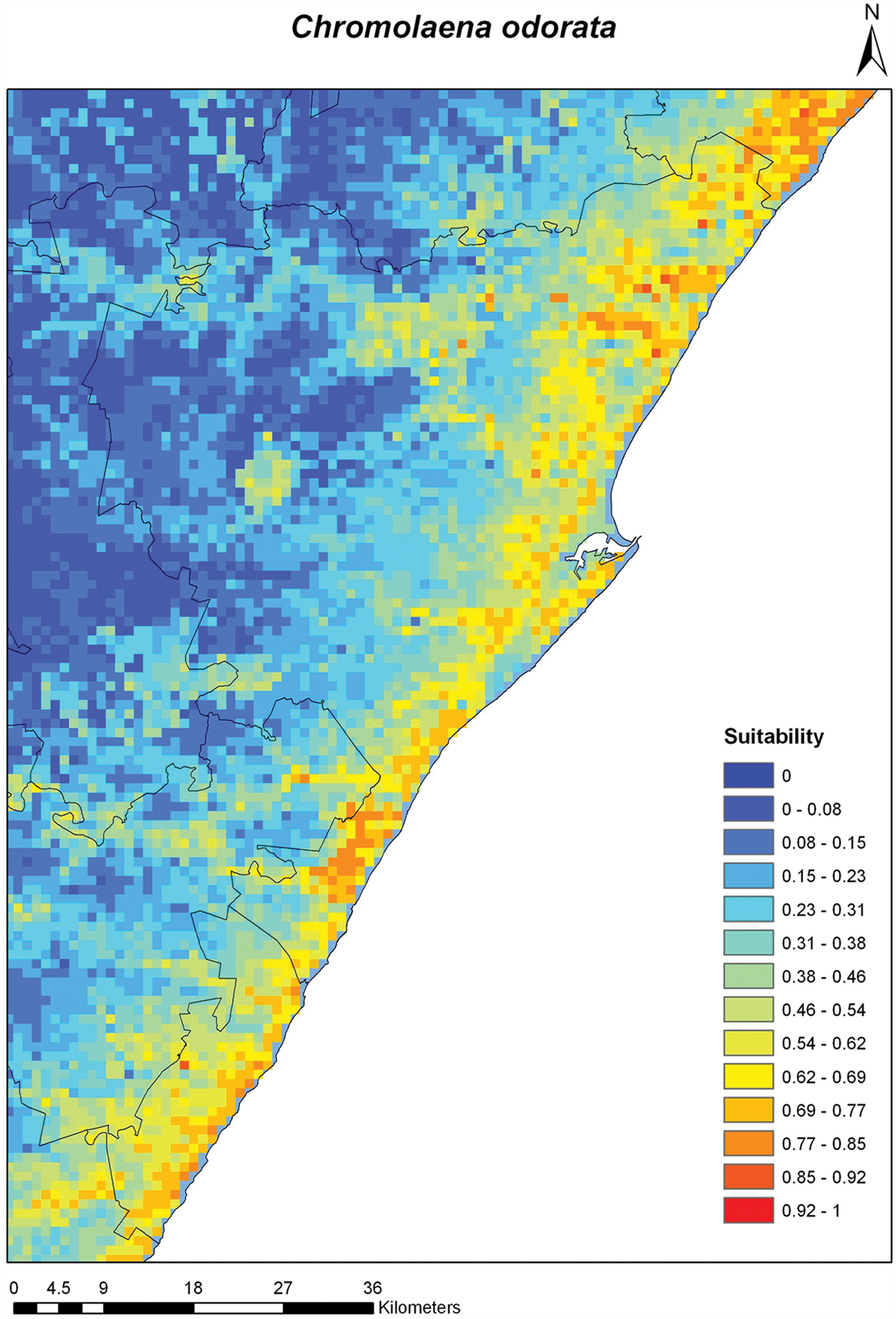
Current distribution of Triffid weed (Chromolaena odorata) (1971–1990)
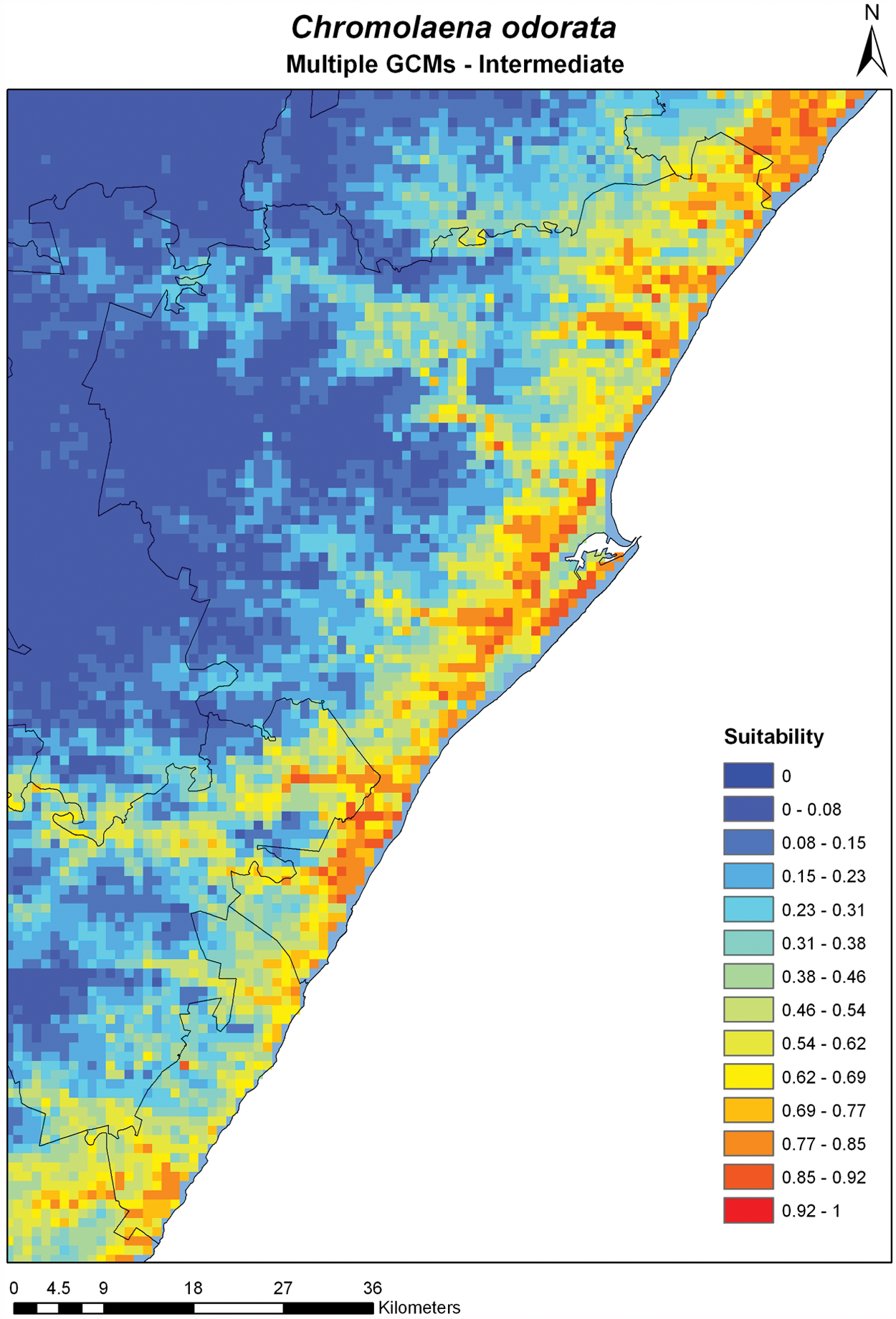
Projected distribution of Triffid weed (Chromolaena odorata) in the intermediate future (2046–2065)
Additional work has also been undertaken to better understand one of the key ecosystem services provided by D’MOSS, namely carbon storage. A carbon stock study indicated that in 2005, D’MOSS(72) “…had a store of 6.6 ± 0.2 million tonnes of carbon (Mt C), equivalent to 24.3 ± 0.9 million tonnes of carbon dioxide (Mt CO2)” and “…conservatively sequestered 8,400–9,800 tonnes of carbon per annum (tC/yr), or 31,000-36,000 tonnes CO2/yr”.(73) Although the carbon stock and rate of sequestration are small in comparison to the greenhouse gas (GHG) emissions estimated for the municipality, protection and restoration of the system is seen as important in ensuring that land cover change does not become a significant source of GHG emissions in the future.(74)
b. Step 2: Filling the gaps
The uncertainty associated with regional level climate change projections means that local government can no longer use only past experience to guide future planning. It has become necessary to invest in research partnerships capable of providing a steady flow of locally relevant and up-to-date impact data that can be used to assess likely future change. These partnerships may be difficult to establish in smaller centres where appropriate tertiary institutions do not exist or may not be well capacitated or where local governments are poorly resourced. In addition, some tertiary level institutions may be reluctant to undertake the applied research required by local government. In Durban, a research partnership has been developed between eThekwini Municipality(75) and the University of KwaZulu-Natal through a memorandum of agreement signed in May 2011. This focuses on advancing knowledge in biodiversity conservation and management within the context of global environmental change and includes an internship programme aimed at building human capital for the municipality in these areas. Seed funding has been provided for the research and internship programme by the municipality and is being used by the university to seek additional funding to expand the project scope and range of partners.
c. Step 3: Reducing the impact of non-climate stressors
Given the likely delay in climate change/biodiversity research outputs, there is a need to reduce the vulnerability of indigenous ecosystems in the short term as a precautionary measure.(76) The “act now” approach is premised on the fact that intact ecosystems will be required to maximize adaptation benefits, and that many existing methods, tools and strategies aimed at conservation and sustainable use of biological diversity can be used to mitigate the most deleterious effects of climate change by reducing and removing existing pressures, such as invasive alien species and altered fire and river flow regimes.(77)
In South Africa, climate change has been identified as the “…greatest looming threat to biodiversity”,(78) but “…the outright loss of natural habitat and ecosystems”(79) is seen as a more immediate threat. Determining which elements and how much of an ecosystem should be protected and managed to reduce this loss is a first key step in ensuring that biodiversity is able to adapt to the adverse impacts of climate change. In Durban, the principles of systematic conservation planning(80) have been utilized to identify priority biodiversity and ecosystem service areas (Figure 2).(81) This information is being used to update D’MOSS to produce one comprehensive plan that optimizes the representation and persistence of biodiversity and ecosystem services. The early indications emerging from this work are that the city’s ecosystems are under significant threat. Of the nine key vegetation types represented, it is already impossible to meet the conservation targets for three; a further three are close to target threshold; and the final three are located in areas experiencing high development pressures.
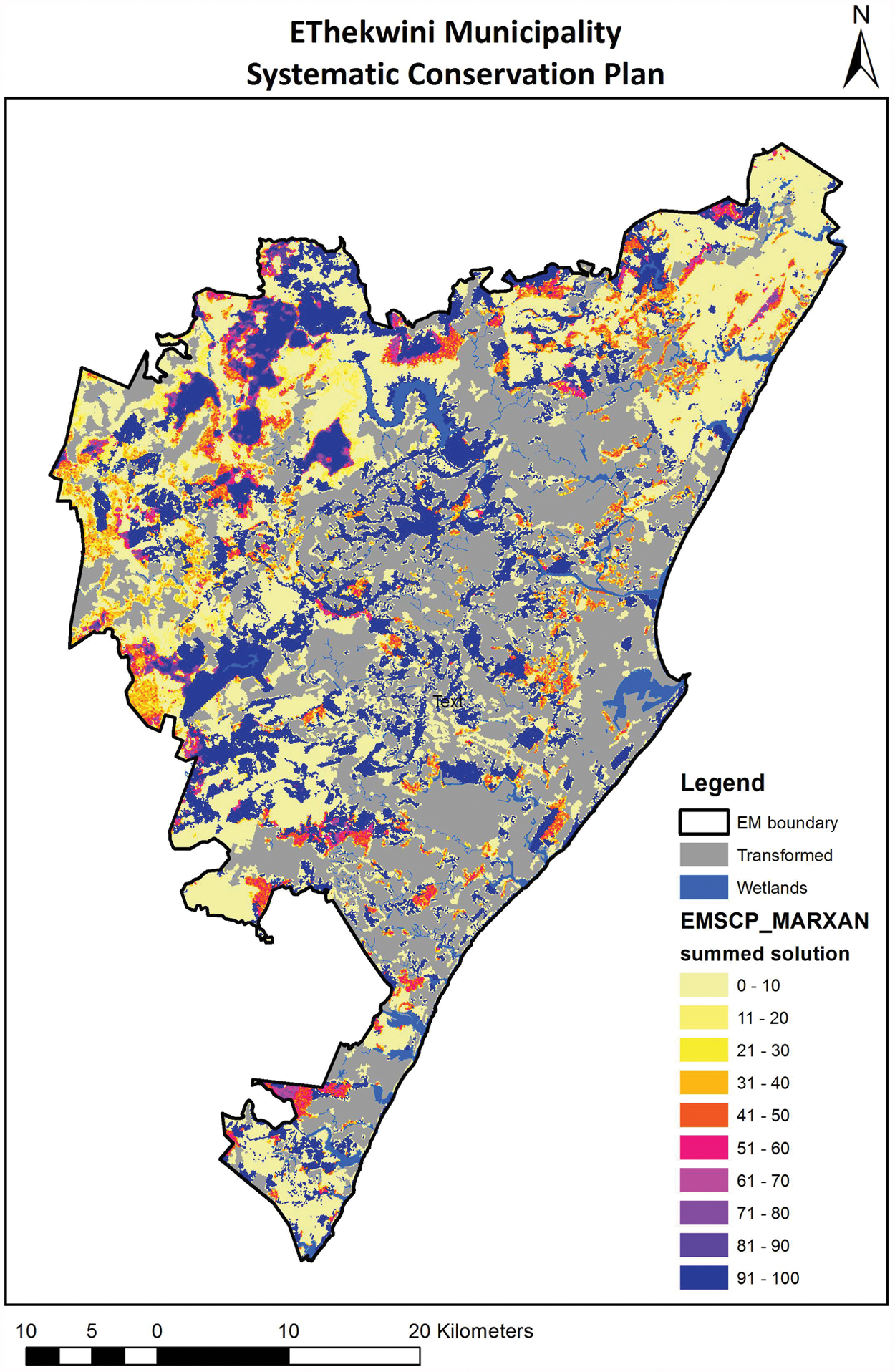
MARXAN output of the systematic conservation plan for Durban (high values indicate priority areas for conservation action)
The preparation of the systematic conservation plan has involved a broad spectrum of stakeholders, and includes a memorandum of understanding with the provincial conservation authority that makes provision for the municipal section of the less detailed provincial plan to be replaced by the locally developed fine-scale plan. The use of biodiversity processes (i.e. abiotic and biotic processes that provide the link between species, ecosystems and their environment) in systematic conservation planning also enables the incorporation of projected climate changes into the planning framework. This has resulted in a strong emphasis being placed on hydrological processes, namely runoff, flood attenuation, sediment supply and nitrogen and phosphorous processing.(82) Better understanding and quantification of these processes will enable the selection of areas that are important for the protection of the related ecosystem services. Work is also being done to improve the robustness of models that can predict the replacement costs of various ecosystem services through the calibration of generic models with local, fine-scale data. This information can then be used to build incentives, such as payment for ecosystem services, into “green economy” models with more certainty.
d. Step 4: Securing the conservation estate
Once critical areas have been identified, it is necessary to protect and manage them. This is the greatest challenge for any EBA process as, in most cases, the natural resources will not be owned by local government. In Durban, a variety of approaches have been used to address this challenge.
The Giba Gorge Environmental Precinct is focused on an area that contains numerous rare and range-restricted species and is one of the few remaining large open spaces in the highly populated and developed uMhlatuzana River catchment. Responding to the environmental degradation of the area, and following the declaration of the site as an SRA by the municipality, the surrounding residential community and the EPCPD established the 354-hectare environmental precinct in July 2009 (Photo 1). A working committee comprising of Giba Gorge landowners and an EPCPD staff member was formed to oversee the implementation of the conservation management plan for the area. This addresses issues such as invasive alien plant control, fire management, pollution monitoring, enforcement and communication. The Giba Gorge Environmental Precinct is significant in that it is the first SRA in South Africa created specifically for biodiversity management purposes. As the municipality owns land in the precinct, it contributes 50 per cent of the project’s management costs.
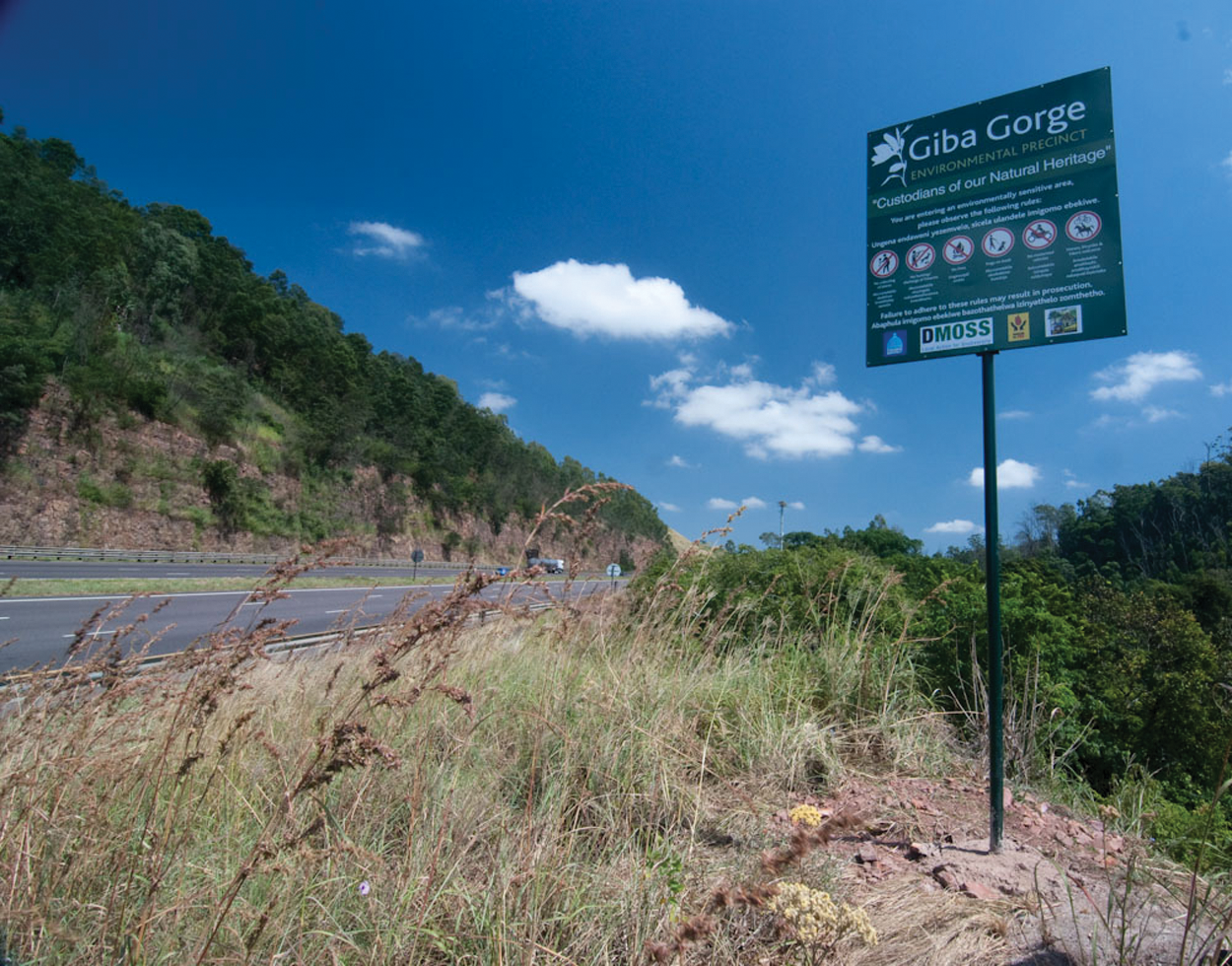
Giba Gorge Environmental Precinct signpost displaying regulations for certain activities
In order to address these issues and ensure that biodiversity concerns inform the development planning and assessment process, D’MOSS has now been included within the schemes through a number of interventions. These mark the first attempt by any South African city to formally incorporate an open space system into its town planning scheme. The first of these has resulted in D’MOSS being introduced into all schemes as a controlled development layer. This means that no D’MOSS area may be degraded and that all development applications in or adjacent to D’MOSS must be assessed.(86) This amendment to the schemes was approved by the city council in December 2010 after extensive public consultation involving approximately 18,000 properties. The second intervention, completed in October 2010, was a pilot scheme amendment (affecting approximately 1,800 properties) in an area containing endangered vegetation types and undergoing rapid development. The aim of the exercise was to reduce the potential impact of development through a number of new requirements: split-zoning private properties affected by D’MOSS into residential and conservation portions; increasing the minimum lot size possible adjacent to D’MOSS(87) in order to reduce the density of development; establishing a 25-metre buffer between the conservation area and any new development;(88) and identifying properties where the development potential is eliminated by the split-zoning, and embarking on a three-year programme to acquire these. A conservation zone for privately owned land and an environmental conservation reserve for state-owned land have also been created to ensure the protection of biodiversity and ecosystem services and to replace the use of the generic public open space reservation (which includes land uses such as swimming pools, stadia, formal parks and nature areas) on conservation-worthy land. Both town planning processes have been appealed and are likely to end up in court. The municipality, however, remains committed to ensuring that development occurs within the carrying-capacity of local ecosystems and plans to roll out the “split-zoning” amendment to all schemes.
Other approaches used to address the environmental shortfalls of the schemes include the nil property tax rating of environmentally sensitive properties that are protected and managed. The introduction of environmental considerations into the general valuation methodology is also being investigated, so that perverse incentives to develop sensitive land (e.g. vacant land is taxed more than four times higher than developed residential land) are removed and that land that can’t be developed because of its environmental characteristics is taxed nominally. The major challenge going forward, however, lies in providing more support to landowners affected by these amendments. For example through the provision of guidelines for biodiversity protection, assistance with fire and invasive alien plant management and the development of a “payment for ecosystem services” approach.
e. Step 5: Expanding the conservation estate
In parts of the city where biodiversity and ecosystem assets have been lost, it is necessary to expand and enhance the conservation estate. The first opportunity for large-scale restoration emerged during the “greening” of the FIFA Football World Cup™ in 2010. Internationally, event-greening initiatives usually focus on mitigation,(89) but given local level priorities, efforts were made in Durban to establish projects that had both mitigation and adaptation benefits. One of these involved the establishment of a large-scale community reforestation initiative in the buffer zone around the Buffelsdraai regional landfill site. The project was initiated in November 2008 and offers a win–win–win opportunity to address biodiversity loss, carbon sequestration and the provision of an increased supply of ecosystem services. It will eventually result in the reforestation of 521 hectares of land previously cleared for dry land sugar cane cultivation. The trees for the project are provided by adjacent rural communities who are trained by a municipally appointed NGO (Wildlands Conservation Trust) to become “treepreneurs”, sourcing seeds from local forest patches, which are then propagated at local homesteads (Photo 2). Project facilitators (also drawn from the community) collect the tree seedlings and issue credit notes that can be used at quarterly “tree stores” for food, building materials, school fees and other pre-ordered goods.
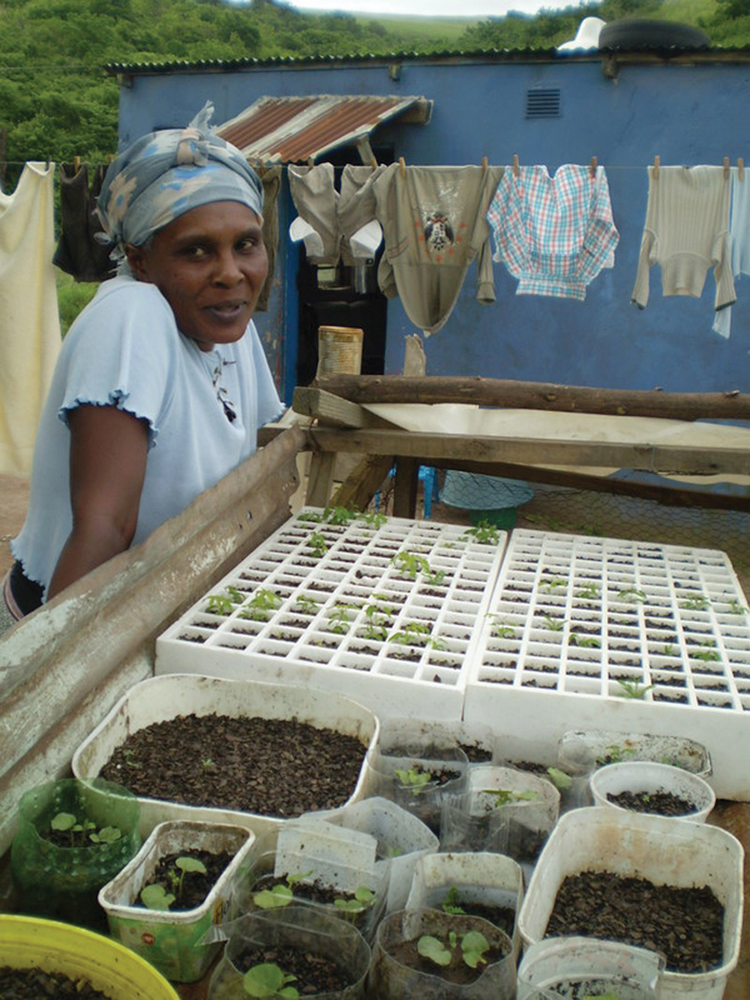
Community “treepreneurs” produce seedlings for the reforestation project at home
The communities involved are some of the most impoverished and vulnerable in Durban, and since its inception the project has created a total of 23 full-time, 10 part-time and 639 temporary jobs for members of the Buffelsdraai and Osindisweni communities. Over and above this, 583 community “treepreneurs” are engaged in producing and trading trees. Early indications are that the direct socioeconomic impact on the communities is significant, with increased and improved educational opportunities and food security reported as the most important benefits.(90)
Given the success of the Buffelsdraai project, a second reforestation project was established in June 2009 on communal land at Inanda Mountain. The 250-hectare project site is located in an area of severe forest degradation resulting from high levels of harvesting (mainly for firewood and building materials) and uncontrolled fires. Activities have centred on clearing and controlling invasive alien plants and managing the subsequent natural recruitment of indigenous species. Tree seedlings, produced by 76 “treepreneurs”, are planted in areas where natural recruitment is unlikely or does not occur timeously. Contracting options are currently being investigated to legally bind both the municipality and the community to the long-term protection and maintenance of the reforested area.
Both reforestation projects were initiated using Danish International Development Agency (DANIDA) funding, but are now fully funded by the eThekwini Municipality. In both, work is being undertaken to develop an effective model of enterprise development to ensure that community members can be employed in the ongoing management of the two forests once planting is complete. A research programme has also been initiated to measure the change in key ecosystem services (e.g. the enhancement of biodiversity refuges, water quality, river flow regulation, flood mitigation, sediment control, improved visual amenity and fire risk reduction) as a result of the reforestation activities. This will assist in understanding and better articulating the full range of benefits achieved against the costs incurred in this community-based implementation model. It will also help to identify the potential for “payment for ecosystem services” to fund ongoing maintenance, through the trading of improved ecosystem services (e.g. water quality and river flow regulation) with other users within the catchment.
A similar research programme will be established to monitor the socioeconomic impacts of the projects. Other areas requiring further work include achieving effective communication with local communities regarding the link between their actions (i.e. growing trees), the related co-benefits (jobs and access to goods) and the key issues of climate change and biodiversity, and determining how large-scale ecosystem-based projects can be accommodated while still creating a compact and densified city.
f. Step 6: Expanding green infrastructure
One of the most commonly cited forms of “green infrastructure” is the use of green roofs.(91) The Green Roof Pilot Project was initiated in 2008 on an existing municipal building to explore the benefits of green roof habitats in reducing temperatures and stormwater run-off and in enhancing the city’s adaptive capacity under climate change conditions (Photo 3). The project has also provided an opportunity to investigate the feasibility of bringing indigenous biodiversity (floral and faunal) back into the central area of the city. Measurements indicate that the green roof reduces stormwater run-off by approximately 60 ml/m2/minute during a rainfall event, releases water slowly over time and reduces temperature on the surface of the roof by up to 30°C. The rate of runoff is affected by the depth (in this case 50mm) and composition of the growing medium. Furthermore, crop trials undertaken suggest that green roof habitats can contribute to improved urban food sovereignty. Tomatoes, spinach, green peppers, chillies and cow peas were all found to be high-yield, low-maintenance crops. The Green Roof Pilot Project has highlighted the value of green roof habitats as an effective EBA tool for Durban and provided the opportunity for innovative interventions such as using air conditioner condensate for irrigation purposes.
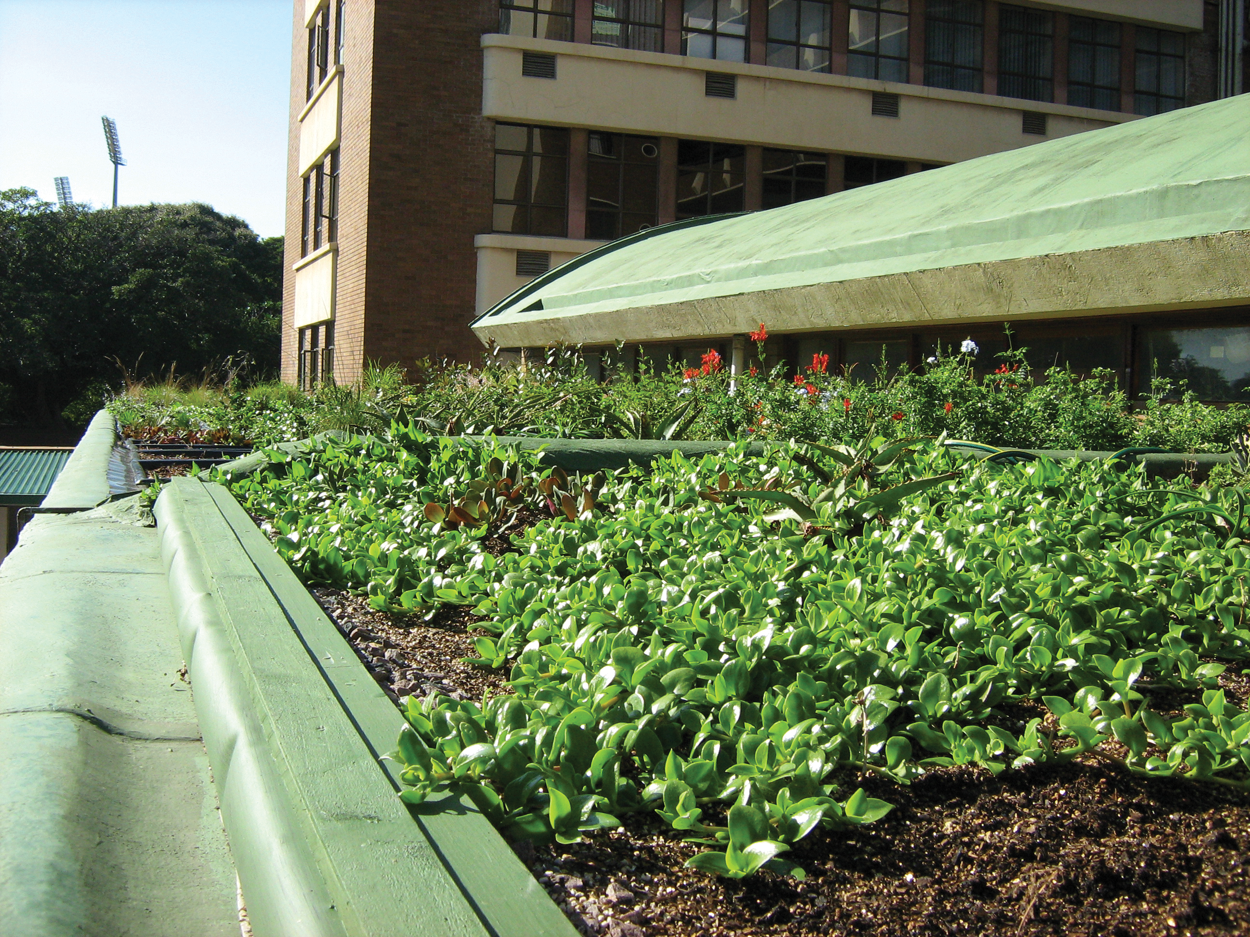
Extensive green roof, City Engineer’s complex, Durban
g. Step 7: Reducing the threat of invasive alien species and woody encroachment
Climate change and invasive alien species (IAS) represent “…two of the greatest threats to biodiversity and the provision of valuable ecosystem services.”(92) Increased temperatures and carbon dioxide concentrations are also likely to increase opportunities for invasive species “…because of their adaptability to disturbance and to a broader range of bio-geographic conditions and environmental controls.”(93) IAS are already widespread in South Africa(94) and have caused severe ecosystem transformation.(95) The negative impacts of invasive alien plants (IAPs) on water resources have been widely studied,(96) as have the benefits of strategic and well-run IAP control programmes (e.g. the South Africa’s Working for Water Programme).(97) For this reason, the control and management of IAS is essential in maximizing the adaptive capacity of local level biodiversity and is a key element of the city’s EBA strategy. Dealing with the IAS threat at the local level, however, is complex and in Durban a phased and multi-pronged approach has been adopted that includes: the development of an IAS Framework Strategy and Action Plan; a process for prioritizing areas for control; an IAP Control Training Programme; coordination of IAS control activities across municipal departments; control of emerging weeds; auditing of municipal propagation and storage nurseries and of some formal parks; and the development of a web-based data capture system to ensure improved monitoring, reporting and verification. The control of woody plant invasions that threaten the city’s biodiverse grasslands, linked in part to the increased growth rates of (often indigenous) plants with C3 photosynthetic pathways, is also a critical part of the overall strategy.
h. Step 8: Building the green economy
In the Global South, there can be no climate change adaptation without development. Ideally, this development should foster the transition to a “green” economy through two key interventions. Firstly, by making the existing economy “greener” through changes to production and consumption processes, transport systems, energy sources and urban planning, thereby reducing the demand for ecosystem services; and secondly, by building a new economy based on bio-infrastructure, which increases the supply of ecosystem services. The use of bio-infrastructure represents a strategic opportunity for local government in that it is locally controlled and can be expanded without creating additional strain on limited natural resources. In fact, it increases the supply of these resources.
EThekwini Municipality does not yet have a formal strategy to green the existing economy, but emerging national policy such as the final draft of the National Strategy for Sustainable Development and Action Plan 2011–2014(98) suggests that this will change in the future. Other positive signs at the local level include the new Energy Office’s stated goal of establishing Durban as the sustainable energy manufacturing hub of the Southern African Development Community (SADC). More progress has, however, been made in exploring the opportunities for the development of a bio-infrastructure-based economy that increases the supply of ecosystem services and provides the basis for sustainable socioeconomic development. In this regard, two existing expanded public works projects offer not only EBA advantages (through IAP control and ecosystem management) but also employment and skills development opportunities for previously unemployed members of local communities.
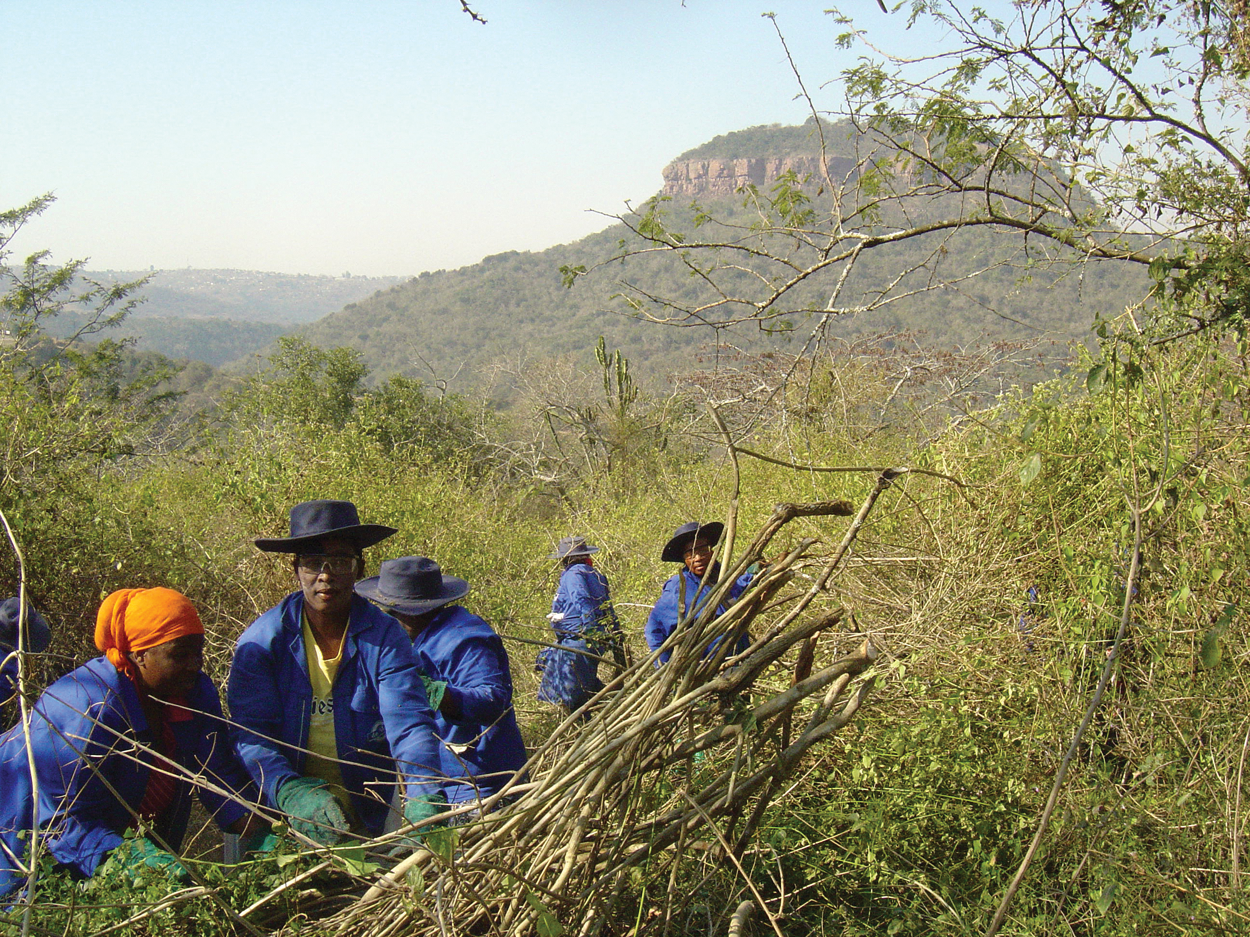
The municipal Working for Ecosystems (WfE) team undertaking invasive alien plant control in an important catchment area
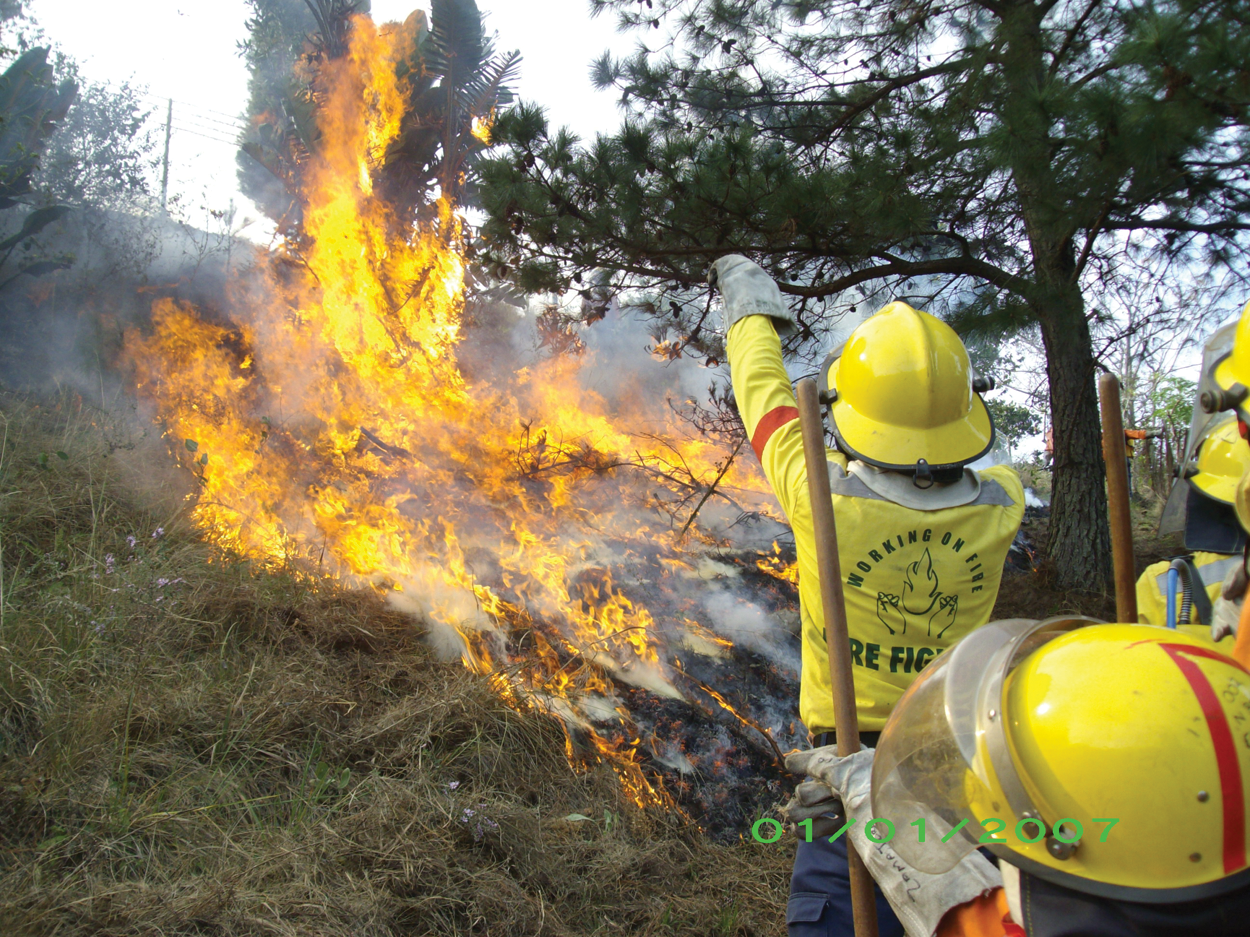
The municipal Working on Fire (WoF) team performing a controlled burn on a recently acquired grassland site
i. Step 9: Institutional change
Implementation of the programmes discussed above has necessitated a restructuring of the EPCPD on two levels. First, through the creation of a dedicated Climate Protection Branch in 2007, in acknowledgement of the fact that local government has a clear role in ensuring climate protection; and second, through the establishment of a dedicated Biodiversity, Climate and Green Project Implementation Branch in 2011, to manage large-scale, long-term projects. This will ensure that the research and implementation aspects of the adaptation workstream of the MCPP are comprehensively addressed.
j. Step 10: Exploring new directions
There is a pressing need to identify innovative opportunities to communicate and promote the links between biodiversity, ecosystem services and successful climate change adaptation. In Durban, an ecological event has been identified that could potentially deliver a powerful and comprehensible message across all elements of Durban’s diverse society. Every austral winter, large sardine shoals move up the east coast of South Africa, supporting a locally important beach-seine fishery and indigent coastal populations.(99) This biological phenomenon (locally known as the sardine run) has translated into the development of an economically significant eco-tourism industry.(100) The arrival of the fish is dependent upon coastal waters cooling to below 22°C,(101) and the strengthening of the Agulhas Current, as a result of ocean warming linked to climate change,(102) threatens to negatively impact upon the sardine run. The potential to improve the general public’s understanding of the role of ecosystem services in supporting local people and economies (e.g. through food, income from tourism, nutrient replenishment for coastal waters and prey for migrating predators) is significant given that this event attracts extensive public interest and is a well-known global phenomenon. It also offers a unique opportunity to communicate a clear link between the phenomenon, its value and the possible impacts of climate change on local communities.
VI. Conclusions
So do the early EBA experiences in Durban respond to the challenge of “bouncing forward” rather than “bouncing back”? By framing biodiversity as bio-infrastructure which underpins the development of a new, more sustainable “green economy”, EBA is put at the heart of the development debate in Durban. Within this context, the concept of “community ecosystem-based adaptation” (CEBA) is being developed to highlight the mutually beneficial and positively reinforcing relationship that exists between ecosystems and human communities.
Many questions nevertheless remain unanswered. The assumption that EBA offers an easier alternative to “hard engineering” solutions is too simplistic an analysis.(103) Experience in Durban has shown that designing and implementing an ecologically functional and well-managed bio-infrastructure network can be as data hungry, technologically taxing and skills intensive as the provision of “grey” infrastructure. The benefit of pursuing the bio-infrastructure route, however, is that the outcomes are likely to be more cost-effective, more adaptable and have multiple co-benefits across a range of scenarios and time lines. But it is not cost-free(104) and that means that resource scarcities will often pose challenges to EBA implementation at the local government level.
Lobbying for the use of EBA is also difficult as climate change adaptation is a much newer science than engineering, so it is harder to build viable arguments around ecosystem services than it is for time-tested engineering “solutions”. The emergence of an official remit to address climate change impacts and the need to sustain ecosystem services at the city level in the recently released National Climate Change Response White Paper,(105) however, creates new opportunities for action, as does the acknowledgement that EBA provides “…one of the key responses available to the country to adapt to climate change.”(106) A clear local government mandate around EBA is vital as cities are affected by the decisions and management regimes of upstream and surrounding municipalities. All local governments must therefore invest in protecting, restoring and managing ecosystems to enhance adaptive capacity in order to achieve the most sustainable and cost-effective outcome. Durban as a coastal city, for example, cannot produce its own water resources except through desalination. So if the upstream authorities do not manage their ecosystems appropriately, Durban could experience water shortages regardless of the local level of EBA achieved.
It is also clear from Durban’s early experiences that while EBA may have multiple, long-term benefits, these can only be realized if a number of pre-conditions are met. These include the development of structured and resourced programmes that have direct and immediate development co-benefits for local communities and that ensure integration across institutional and political boundaries. Substantial knowledge gaps must also be addressed, such as determining where the limits or thresholds to EBA lie. Ecosystems do not provide a silver bullet for the climate change challenge, a fact compounded by the “…growing evidence that many ecosystems have already been degraded to such an extent that they are nearing critical thresholds or tipping points, beyond which their capacity to provide useful services may be drastically reduced.”(107) It is therefore not possible to reduce the climate change vulnerability of cities to zero through the use of EBA – even pristine ecosystems cannot supply endless demands. In this regard, recent research suggests that by 2100, residual damage could account for up to 73 per cent of climate change costs, with the remaining 27 per cent being the cost of adaptation.(108) Cities must therefore think beyond adaptation needs and begin focusing on surviving residual damage. This will require that they actively seek out new, more sustainable and cooperative development paths that will ensure their viability in an increasingly unstable global economy. EBA will be a critical part of this package – but not the whole package.
A large gap remaining in Durban’s existing EBA programme is the need to monitor and evaluate the overall effectiveness of adaptation interventions to determine whether they are successful in achieving their objectives; in other words, “…tracking the adaptation difference”.(109) Processes are only just being put in place to monitor the biodiversity, ecosystem services and socioeconomic impacts of flagship EBA projects. A significant difficulty in this regard is that adaptation is part of the overall city development process, therefore the “…attribution gap”(110) will be large and it may be difficult to ascribe adaptation outcomes to any one intervention. This highlights the inappropriateness of international discussions that look to link adaptation funding to the concept of “…additionality”,(111) when adaptation has to be treated as part and parcel of the local development reality.(112)
The critical final message emerging from Durban’s EBA work is that the new big climate idea is actually a series of small actions at the local level. For Africa’s cities, this means Africanizing the concept of adaptation in a way that ensures the conservation and management of the continent’s rich biodiversity, and supports and protects the populations of one of the world’s most rapidly urbanizing continents. Durban has taken a first step in this regard and will continue working towards a better understanding of the realities and opportunities associated with EBA through the further development of the MCPP.
Footnotes
This paper represents the views of the authors and does not necessarily represent the views of eThekwini Municipality.
1.
See Millennium Ecosystem Assessment (MEA) (2005), Ecosystems and Human Well-being: Synthesis, Island Press, Washington DC, 137 pages; also The Economics of Ecosystems and Biodiversity (TEEB) (2009), TEEB Climate Issues Update, September, 32 pages; The Economics of Ecosystems and Biodiversity (TEEB) (2010a), The Economics of Ecosystems and Biodiversity: For Local and Regional Policy Makers, Progress Press, Malta, 209 pages; and United Nations Environment Programme (UNEP) (2011), Towards a Green Economy: Pathways to Sustainable Development and Poverty Eradication – A Synthesis for Policy Makers, available at  , 44 pages.
2.
Second Ad Hoc Technical Expert Group on Biodiversity and Climate Change (AHTEG) (2009), Connecting Biodiversity and Climate Change Mitigation and Adaptation, Report of the Second Ad Hoc Technical Expert Group on Biodiversity and Climate Change, CBD Technical Series No 41, CBD Secretariat, Montreal, 126 pages; also The Nature Conservancy, Adaptation Working Group (2010), Climate Change and Conservation: A Primer for Assessing Impacts and Advancing Ecosystem-based Adaptation in The Nature Conservancy (unpublished), available at http://conserveonline.org/workspaces/climateadaptation/documents/a-primer-for-assessing-impacts/documents/a-primer-for-assessing-impacts-and-advancing-eba/@@view.html, 55 pages; ICLEI–Local Governments for Sustainability (2010), ICLEI–Local Governments for Sustainability Preparing for Tomorrow Strategy 2010–2015, available at http://www.iclei-europe.org/fileadmin/templates/iclei-europe/files/content/ICLEI_IS/Policy_and_Advocacy/ICLEI_Strategy_2010-2015.pdf; Deutsche Gessellschaft für Internationale Zusammenarbeit (GIZ) GmbH, Climate Protection Programme (2011), Adaptation to Climate Change: New Findings, Methods and Solutions, Deutsche Gessellschaft für Internationale Zusammenarbeit (GIZ) GmbH, Climate Protection Programme, Eschborn, Germany, 35 pages; and The Economics of Ecosystems and Biodiversity (TEEB) (2011), TEEB Manual for Cities: Ecosystem Services in Urban Management, available at , 41 pages.
3.
The direct and indirect contributions of ecosystems to human well-being. The concept “ecosystem goods and services” is synonymous with ecosystem services; see , The Economics of Ecosystems and Biodiversity: Mainstreaming the Economics of Nature: A Synthesis of the Approach, Conclusions and Recommendations of TEEB, Progress Press, Malta, 36 pages; also see reference 1, MEA (2005).
4.
See reference 2, Second Ad-hoc Technical Expert Group on Biodiversity and Climate Change (AHTEG) (2009), page 41. This is a group established by the Secretariat for the Convention on Biological Diversity to provide biodiversity-related information to the United Nations Framework Convention on Climate Change.
5.
For example, London Climate Change Partnership (LCCP) (2006), Adapting to Climate Change: Lessons for London, Greater London Authority, London, 158 pages; also Awuor, C B, V A Orindi and A O Adwera (2009), “Climate change and coastal cities: the case of Mombasa, Kenya”, in J Bicknell, D Dodman and D Satterthwaite (editors), Adapting Cities to Climate Change: Understanding and Addressing the Development Challenges, Earthscan, London, pages 77–91; and Mehrotra, S, C Rosenzweig, W D Solecki, C E Natenzon, A Omojola, R Folorunsho and J Gillbride (2011), “Cities, disasters and climate risk”, in C Rosenzweig, W D Solecki, S A Hammer and S Mehrotra (editors), Climate Change and Cities: First Assessment Report or the Urban Climate Change Research Network, Cambridge University Press, Cambridge, UK, pages 15–42.
6.
Heinrichs, D, R Aggarwal, J Barton, E Bharucha, C Butsch, M Fragkias, P Johnston, F Krass, K Krellenberg, A Lampis, O G Ling and J Vogel (2011), “Adapting cities to climate change: opportunities and constraints”, in D Hoornweg, M Friere, M J Lee, P Bhada-Tata and B Yuen (editors), Cities and Climate Change: Responding to an Urgent Agenda, The World Bank, Washington DC, page 216.
7.
See reference 1, TEEB (2010a), page 13.
8.
9.
Webbe, J (2011), “Using links and synergies: the expert’s view in Adaptation to Climate Change: new findings, methods and solutions”, Gessellschaft für Internationale Zusammenarbeit (GIZ) GmbH, Climate Protection Programme, Eschborn, Germany, page 27.
10.
See reference 1, TEEB (2009).
11.
Bosello, F, C Carraro and E De Cian (2011), “Adaptation can help mitigation: an integrated approach to post-2012 climate policy”, Working Paper No 69, Fondazione Eni Enrico Mattei (FEEM), Milan, Italy, page 4.
12.
See reference 3, TEEB (2010b), page 28.
13.
See reference 1, UNEP (2011), page 6.
14.
See reference 1, UNEP (2011).
15.
Rockström, J, W Steffen, K Noone, Å Persson, F S Chapin III, E Lambin, T M Lenton, M Scheffer, C Folke, H Schellnhuber, B Nykvist, C A De Wit, T Hughes, S van der Leeuw, H Rodhe, S Sörlin, P K Snyder, R Costanza, U Svedin, M Falkenmark, L Karlberg, R W Corell, V J Fabry, J Hansen, B Walker, D Liverman, K Richardson, P Crutzen and J Foley (2009), “Planetary boundaries: exploring the safe operating space for humanity”, Ecology and Society Vol 14, No 2, available at , 33 pages.
16.
This is the boundary that should not be transgressed if unacceptable global environmental change is to be avoided and if a safe operating space for humanity is to be ensured.
17.
See reference 15.
18.
See reference 15, page 1.
19.
See reference 15.
20.
Shaw, K and K Theobald (2011), “Resilient local government and climate change interventions in the UK”, Local Environment Vol 16, No 1, page 2.
21.
UNEP defines a “green economy” as one that “…results in improved human well-being and social equity, while significantly reducing environmental risks and ecological scarcities. In its simplest expression, a green economy can be thought of as one which is low carbon, resource efficient and socially inclusive. In a green economy, growth in income and employment should be driven by public and private investments that reduce carbon emissions and pollution, enhance energy and resource efficiency, and prevent the loss of biodiversity and ecosystem services. These investments need to be catalyzed and supported by targeted public expenditure, policy reforms and regulation changes. The development path should maintain, enhance and, where necessary, rebuild natural capital as a critical economic asset and as a source of public benefits, especially for poor people whose livelihoods and security depend on nature.” See reference 1, UNEP (2011), page 1.
22.
A healthy ecosystem is one in which the system is able to maintain “…its structure (organization) and function (vigour) over time in the face of external stress (resilience). A healthy system must also be defined in light of both its context (the larger system of which it is part) and its components (the smaller systems that make it up).” See Costanza, R and M Mageau (1999), “What is a healthy ecosystem?”, Aquatic Ecology Vol 33, page 106. Climate change and other large-scale environmental changes (biotic and abiotic) are, however, likely to drive the emergence of “…novel systems”, which comprise “…different species, interactions and functions” and “…will require significant revision of conservation and restoration norms.” See Hobbs, R J, E Higgs and J A Harris (2009), “Novel ecosystems: implications for conservation and restoration”, Trends in Ecology and Evolution Vol 24, No 11, page 599.
23.
Parry, M L, O F Canziani, J P Palutikof, P J van der Linden and C E Hanson (editors) (2007), Climate Change 2007: Impacts, Adaptation and Vulnerability. Contribution of Working Group II to the Fourth Assessment Report of the Intergovernmental Panel on Climate Change, Cambridge University Press, Cambridge, UK, page 880; also Lowe, A, J Foster and S Winkelman (2009), Ask the Climate Question: Adapting to Climate Change Impacts in Urban Regions, Report by the Centre for Clean Air Policy: Urban Leaders Adaptation Initiative, Washington DC, 41 pages; United Nations Human Settlements Programme (UN–Habitat) (2011), Cities and Climate Change: Global Report on Human Settlements 2011, Earthscan, London, 279 pages; and Kithiia, J and A Lyth (2011), “Urban wildscapes and green spaces in Mombasa and their potential contribution to climate change adaptation and mitigation”, Environment and Urbanization Vol 23, No 1, April, pages 251–265.
24.
Strong sustainability derives from an understanding that “…substitutability of manufactured for natural capital is seriously limited by such environmental characteristics as irreversibility, uncertainty and the existence of ‘critical’ components of natural capital, which make a unique contribution to welfare.” See Ekins, P, S Simon, L Deutsch, C Folke and R De Groot (2003), “A framework for the practical application of the concepts of critical natural capital and strong sustainability”, Ecological Economics Vol 44, No 2–3, page 168. Whereas weak sustainability holds that all or most forms of natural capital can be substituted by manufactured human-derived capital.
25.
See reference 1, MEA (2005).
26.
Beddington, J (2009), “Food, energy, water and the climate: a perfect storm of global events”, available at .
27.
Rosenzweig, C, W D Solecki, S A Hammer and S Mehrotra (2011), “Urban climate change in context”, in C Rosenzweig, W D Solecki, S A Hammer and S Mehrotra (editors), Climate Change and Cities: First Assessment Report of the Urban Climate Change Research Network, Cambridge University Press, Cambridge, UK, pages 3–11.
28.
Seto, K C, M Fragkias, B Guneralp and M K Reilly (2011), “A meta-analysis of global urban land expansion”, PLoS ONE Vol 6, No 8, page 1.
29.
Satterthwaite, D, S Huq, H Reid, M Pelling and P Romero Lankao (2009), “Adapting to climate change in urban areas: the possibilities and constraints in low- and middle-income nations”, in J Bicknell, D Dodman and D Satterthwaite (editors), Adapting Cities to Climate Change: Understanding and Addressing the Development Challenges, Earthscan, London, page 9.
30.
See reference 23, UN–Habitat (2011).
31.
See reference 28.
32.
34.
See reference 11.
35.
Roberts, D (2008), “Thinking globally, acting locally – institutionalizing climate change at the local government level in Durban, South Africa”, Environment and Urbanization Vol 20, No 2, October, pages 521–537.
36.
New, M, D Liverman, H Schroder and K Anderson (2011), “Four degrees and beyond: the potential for a global temperature increase of four degrees and its implications”, The Philosophical Transactions of the Royal Society A Vol 369, page 6.
37.
See reference 36, page 9.
38.
Anderson, K and A Bows (2008), “Re-framing the climate change challenge in light of post-2000 emission trends”, The Philosophical Transactions of the Royal Society A Vol 366, page 18 (online version).
39.
See reference 11.
40.
Bulkeley, H, H Schroeder, K Janda, Z Zhao, A Armstrong, S Y Chi and S Ghosh (2011), “The role of institutions, governance and urban planning for mitigation and adaptation”, in D Hoornweg, M Friere, M J Lee, P Bhada-Tata and B Yuen (editors), Cities and Climate Change: Responding to an Urgent Agenda, The World Bank, Washington DC, pages 125–159; also see reference 6.
41.
Somorin, O A, H C P Brown, I J Visseren-Hamakers, D J Sonwa, B Arts and J Nkem (2011 in press), “The Congo Basin forests in a changing climate: policy discourses on adaptation and mitigation (REDD+)”, Global Environmental Change, page 5.
43.
44.
See reference 11.
45.
See reference 11.
46.
See reference 1, TEEB (2010a), page 65.
47.
48.
Burgiel, S W and A A Muir (2010), “Invasive species, climate change and ecosystem-based adaptation: addressing multiple drivers of global change”, Global Invasive Species Programme (GISP), Washington DC and Nairobi, Kenya, page 4.
50.
See reference 23, UN–Habitat (2011); also see reference 1, TEEB (2010a).
51.
Künkel, N (2011), “Being prepared: the expert’s view in Adaptation to Climate Change: new findings, methods and solutions”, Deutsche Gessellschaft für Internationale Zusammenarbeit (GIZ) GmbH, Climate Protection Programme, Eschborn, Germany, pages 14–15.
52.
See reference 35; also Roberts, D (2010), “Prioritizing climate change adaptation and local level resiliency in Durban, South Africa”, Environment and Urbanization Vol 22, No 2, October, pages 397–413.
53.
See reference 35.
54.
See reference 52, Roberts (2010); also Carmin, J, D Roberts and I Anguelovski (2009), “Planning climate resilient cities: early lessons from early adapters”, Paper prepared for the World Bank 5th Urban Research Symposium: Cities and Climate Change: Responding to an Urgent Agenda, Marseille, France, 28–30 June, 27 pages.
55.
Todd, M (2011), “Knowing what will happen: the expert’s view in Adaptation to Climate Change: new findings, methods and solutions”, Deutsche Gessellschaft für Internationale Zusammenarbeit (GIZ) GmbH, Climate Protection Programme, Eschborn, Germany, page 6.
57.
Fünfgeld, H and D McEvoy (2011), “Framing climate change adaptation in policy and practice. VCCCAR project: framing adaptation in the Victorian context”, Working Paper 1, RMIT University, Melbourne, 65 pages.
58.
This contrasts with mitigation, where it is possible to identify a clear, singular goal (i.e. reducing greenhouse gas emissions and increasing carbon sinks) and where the methods for achieving this goal are well developed, widely known and generally applicable.
59.
Porsché, I and H McCray (2011), “Tracking effectiveness: the expert’s view in Adaptation to Climate Change: new findings, methods and solutions”, Deutsche Gessellschaft für Internationale Zusammenarbeit (GIZ) GmbH, Climate Protection Programme, Eschborn, Germany, pages 30–31.
60.
See reference 57.
62.
63.
TEEB defines “ecological infrastructure” as including both “natural ecosystems” and “nature within man-made ecosystems”. In cities, it is necessary to further distinguish between the types of nature found in human-made ecosystems. In urban areas “green” or “ecological infrastructure” includes street trees, formal parks, green roofs and agricultural lands, whereas “bio-infrastructure” refers exclusively to the services provided by the remaining indigenous and endemic ecosystems; see reference 1, TEEB (2009).
64.
Exchange rate US$ 1 = Rand 8.
65.
Using the MaxEnt software package.
66.
67.
See reference 66.
68.
Ackerly, D D, S R Loarie, W K Cornwell, S B Weiss, H Hamilton, R Branciforte and N J B Kraft (2010), “The geography of climate change: implications for conservation biogeography”, Diversity and Distributions Vol 16, pages 476–487.
69.
See reference 66.
70.
Black Wattle and Seringa (Melia azedarach).
71.
See reference 66.
72.
At the time of the study, the size of D’MOSS was 64,037 hectares.
73.
Glenday, J (2007), Carbon Storage and Sequestration Analysis for the eThekwini Environmental Services Management Plan Open Space System, Report for the Environmental Planning and Climate Protection Department, eThekwini Municipality, Durban, South Africa, pages 3 and 4.
74.
See reference 73.
75.
EThekwini Municipality is the local government responsible for planning and managing Durban.
76.
See reference 9.
78.
79.
Cadman, M, C Petersen, A Driver, N Sekhran, K Maze and S Munzhedzi (2010), “Biodiversity for development: South Africa’s landscape approach to conserving biodiversity and promoting ecosystem resilience”, South African National Biodiversity Institute, Pretoria, page 37.
80.
Also known as systematic biodiversity planning; see reference 79.
81.
Margules, C R and R L Pressey (2000), “Systematic conservation planning”, Nature Vol 405, pages 243–253.
82.
Glenday, J (2011), Preliminary Hydrologic Ecosystem Services Assessment for the eThekwini Municipal Area with Invest 2.0, Report for the Environmental Planning and Climate Protection Department, eThekwini Municipality, Durban, South Africa, 14 pages.
83.
Press, D, D F Doak and P Steinberg (1996), “The role of local government in the conservation of rare species”, Conservation Biology Vol 10, pages 1538–1548.
84.
Heller, N E and E S Zavaleta (2009), “Biodiversity management in the face of climate change: a review of 22 years of recommendations”, Biological Conservation Vol 142, pages 14–32.
85.
86.
This has been a policy for some years, but has now been given legal standing.
87.
From 1,800 square metres to 3,600 square metres.
88.
This setback was determined through an investigation into the impacts of wastewater from on-site sanitation systems and stormwater on grasslands ecosystems on nutrient poor soils. A maximum disturbance zone of 25 metres was identified – although the cause of the disturbance could not be limited to wastewater.
89.
Diederichs, N and D Roberts (2010), Greening Durban 2010: Summary Review of the eThekwini Municipality’s 2010 FIFA World Cup™ Event Greening Programme, Environmental Planning and Climate Protection Department, eThekwini Municipality, Durban, South Africa, 24 pages.
90.
91.
See reference 5, London Climate Change Partnership (2006); also Foster, J, A Lowe and S Winkelman (2011), The Value of Green Infrastructure for Urban Climate Adaptation, Report by the Centre for Clean Air Policy, available at .
92.
See reference 48, page 4.
93.
See reference 48, page 4.
94.
See reference 78.
95.
Richardson, D M and B W van Wilgen (2004), “Invasive alien plants in South Africa: how well do we understand the ecological impacts?”, South African Journal of Science Vol 100, pages 45–52.
96.
Le Maitre, D C, B W van Wilgen, C M Gelderblom, C Bailey, R A Chapman and J A Nel (2002), “Invasive alien trees and water resources in South Africa: case studies of the costs and benefits of management”, Forest Ecology and Management Vol 160, pages 143–159.
97.
See reference 78.
98.
99.
Myeza, J, R B Mason and V M Peddemors (2010), “Socioeconomic implications of the KwaZulu-Natal sardine run for local indigenous communities”, African Journal of Marine Science Vol 32, No 2, pages 399–404.
100.
Dicken, M L (2010), “Socioeconomic aspects of boat-based eco-tourism during the sardine run within the Pondoland marine protected area, South Africa”, African Journal of Marine Science Vol 32, No 2, pages 405–411.
101.
O’Donoghue, S H, L Drapeau, S F J Dudley and V M Peddemors (2010), “The KwaZulu-Natal sardine run: shoal distribution in relation to near-shore environmental conditions, 1997–2007”, African Journal of Marine Science Vol 32, No 2, pages 293–307; also O’Donoghue, S H, L Drapeau and V M Peddemors (2010), “Broad-scale distribution patterns of sardine and their predators in relation to remotely sensed environmental conditions during the KwaZulu-Natal sardine run”, African Journal of Marine Science Vol 32, No 2, pages 279–291.
102.
Rouault, M, B Pohl and P Penven (2010), “Coastal oceanic climate change and variability from 1982 to 2009 around South Africa”, African Journal of Marine Science, Vol 32, No 2, pages 237–246.
106.
See reference 105, page 19.
107.
See reference 3, TEEB (2010b), page 7.
108.
See reference 11.
109.
See reference 59, page 30.
110.
See reference 59, page 31.
111.
Persson, Å, R J T Klein, C K Siebert, A Atteridge, B Müller, J Hoffmaister, M Lazarus and T Takama (2009), Adaptation Finance under a Copenhagen Agreed Outcome, Stockholm Environment Institute, Sweden, page 66.
112.
See reference 59.