



Abstract
This paper presents the development of membrane structures in China. It begins with a historical review of the early applications of membrane structures in the country, highlighting pivotal events and engineering endeavors that contributed to the development. Subsequently, recent advancements in the realm of membrane structures in China are succinctly summarized. The past decade has witnessed notable progress in the implementation of membrane structures, particularly within expansive stadiums and indoor sports arenas. Additionally, cases exemplifying the diverse applications of membrane structures in various projects are presented. Noteworthy among these are the incorporation of membrane structures in building facades, suspended ceilings for indoor spaces, and the utilization of ETFT membrane structures. Furthermore, applications of air-supported membrane structures are explored, especially in the areas of sports facilities and environmental protections. Technical standards and specifications that have played an important guiding role in the development of membrane structures in China are introduced in the last. Finally, 8 issues for the future research and development of membrane structures are pointed out in the conclusion part. It is expected that this paper can serve as a catalyst for further advancement and practical implementation of membrane structures in China.
Keywords
Historical review
Membrane structure is such a type of structural system that integrates architecture and structure as a whole. It uses high-strength flexible membrane material and auxiliary structure to generate pre-tensioning stress in a certain way, and forms a required spatial shape under stress control. Membrane structures, with unique beautiful surface shapes, perfect combination of simplicity, brightness, rigidity, and flexibility, have received increasing attention during the past few decades around the world. Nowadays, membrane structures have been applied to various types of buildings like stadiums, indoor sports halls, exhibition pavilions, airport terminals, commercial and cultural venues, and many others.
Compared with the developed countries, the development of membrane structures in China started relatively late. The first large-scale membrane structure project in China emerged until 1997, when fabric materials were used in a large-scale canopy roof in the Shanghai Stadium1,2 (Figure 1). This successful application aroused people’s attention to membrane structures, brought membrane structures into people’s vision, and led to the development of membrane structures in China. From 1997 to 2000, some small and medium-sized membrane structure projects began to be built. After 2000, several large membrane stadiums were successfully built, 3 like the Qingdao Estong Stadium in 2000 (Figure 2), the Weihai Stadium in 2001 (Figure 3), the Wuhu Stadium in 2002 (Figure 4), and others. In these early applications, the membrane used was mostly PVC material. In 2003, PTFE membrane began to be used in some projects in China, 4 like the Nanning Exhibition Center (Figure 5) and the Shanghai F1 Circuit (Figure 6).
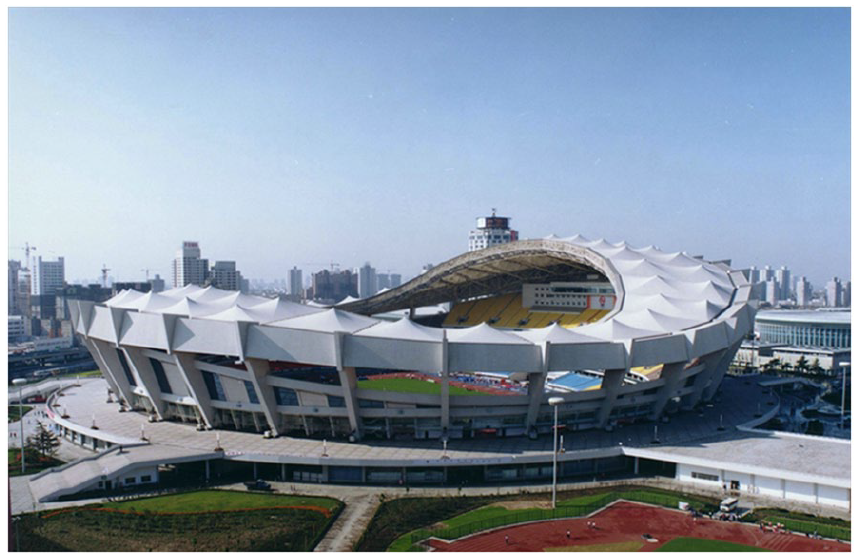
Shanghai Stadium.
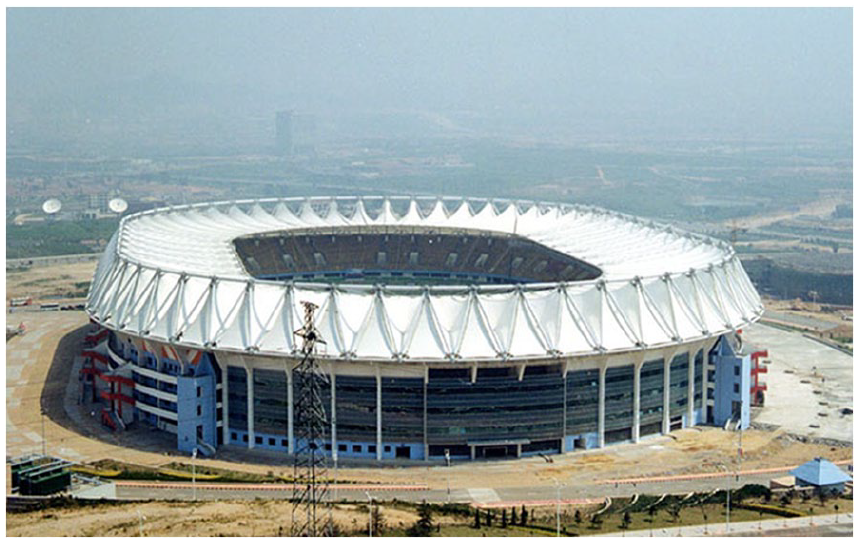
Qingdao Estong Stadium.
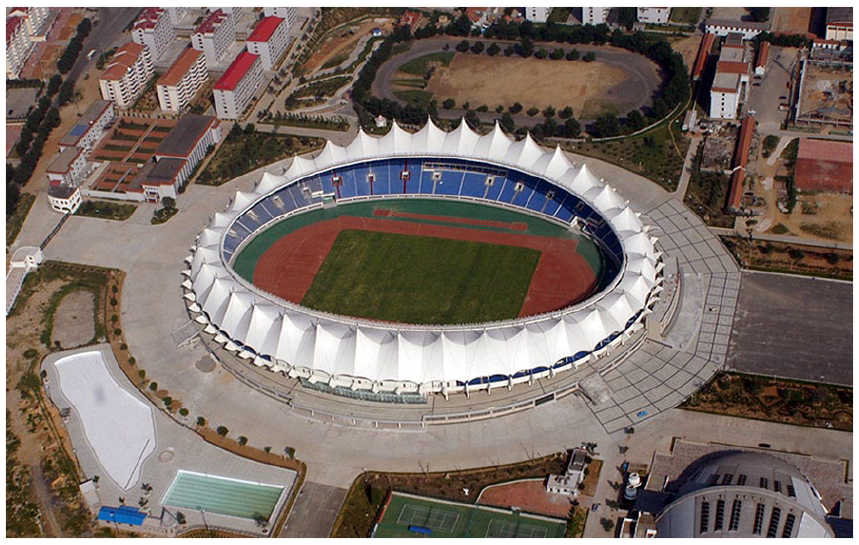
Weihai Stadium.
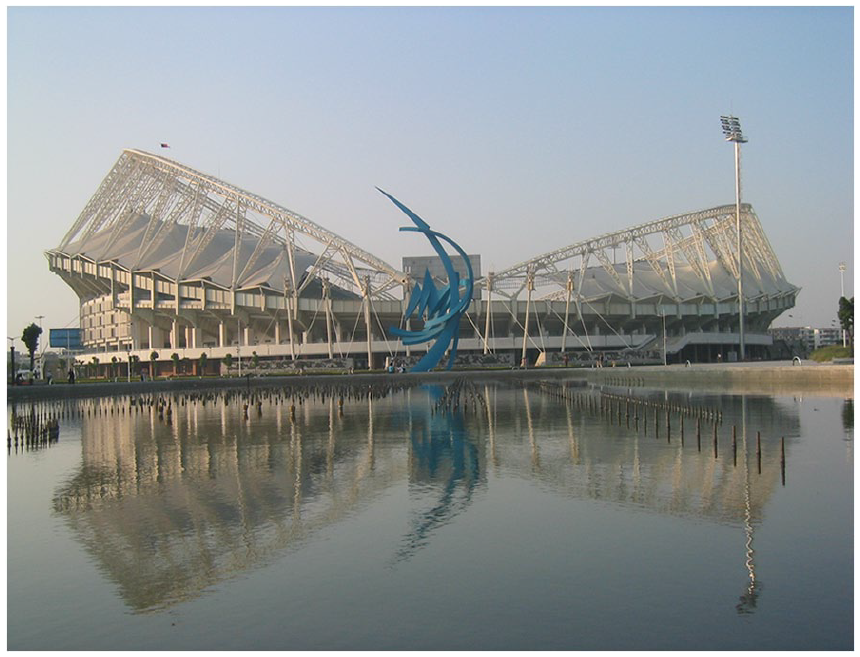
Wuhu Stadium.
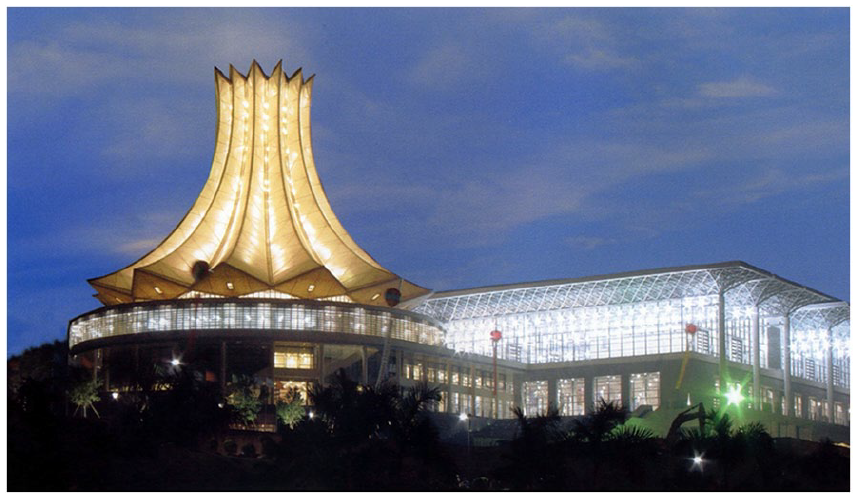
Nanning Exhibition Center.
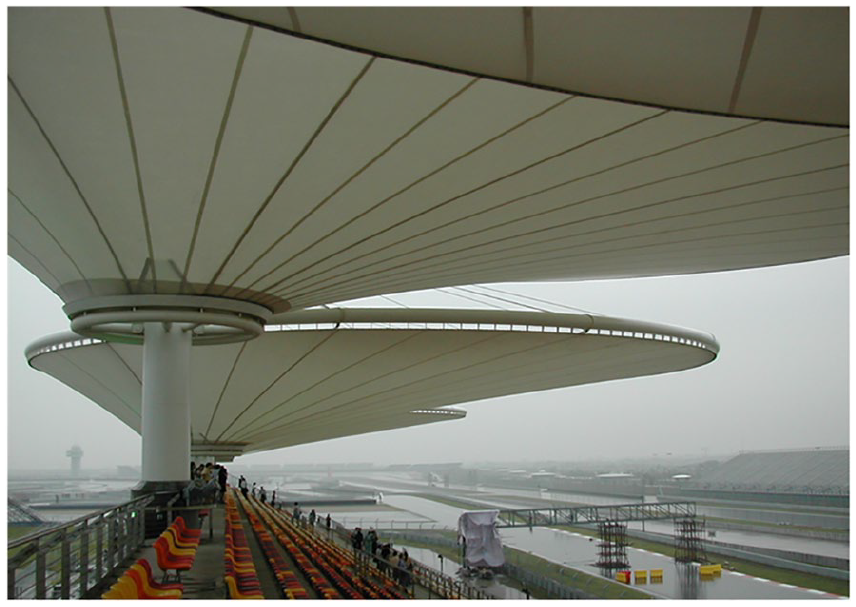
Shanghai F1 Circuit.
In order to promote the development of membrane structures in China, the Membrane Structures Committee was founded in 2002 under the sponsorship of China Association for Spatial Structures. An important contribution made by the Committee was the promulgation and implementation of China Engineering Construction Standards “Technical Specification for Membrane Structures” in 2004, 5 which served as a good guide for architects and engineers who were undertaking the design and construction of membrane structures. In this Specification, four membrane structure types are classified, that is, integrally pre-tensioned membrane structure, frame-supported membrane structure, cable-supported membrane structure, and air-inflated membrane structure. The air-inflated membrane structure can be further divided into air-supported membrane structure, air-cushion membrane structure, and air-rib membrane structure, and so on, according to its configuration.
In the above mentioned large membrane stadiums, most of them belong to the type of integrally pre-tensioned membrane structure or the combination of frame-supported and integrally pre-tensioned membrane structure. Foshan Century Lotus Stadium (Figure 7), completed in 2006, was the first cable-supported membrane structure built in China. 6 The roof of the stadium has a circular plane with diameters of 310 m for outer ring beam and 125 m for inner ring cable. There are altogether 80 membrane units covering the wheel-spoke cable-net system. Nantong Stadium in 2006, designed in frame-supported membrane structure with a movable cover in open and closed area of 105 × 190 m, was the first retractable membrane roof structure in China. 7 (Figure 8). The structural system for the fixed section of the roof is a single-layer lattice shell supported by arches. The largest arch span for the stadium is 278 m in the main arch dirention and 280 m in the secondary arch direction. The movable cover is comprised of two pieces of single-layer lattice shells stiffened along their borders. PTFE membrane materials are used to cover the surface of the movable roof. Also in the year 2006, Beijing Chaoyang Park Tennis Hall (Figure 9), an air-supported membrane structure, was successfully built and led to the development and application of air-supported membrane structures in China. 8
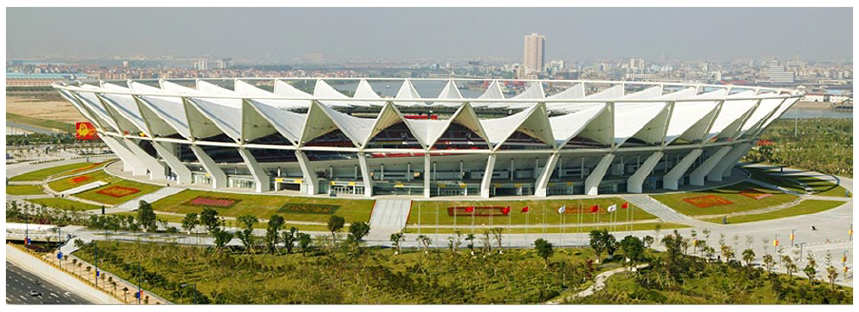
Foshan Century Lotus Stadium.
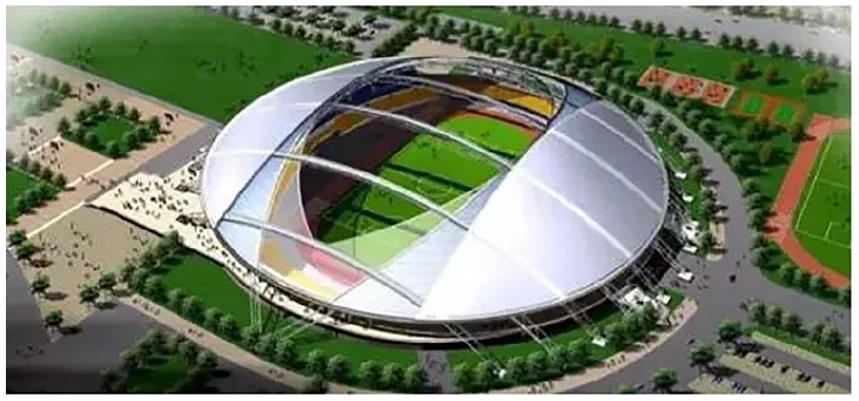
Nantong Stadium.
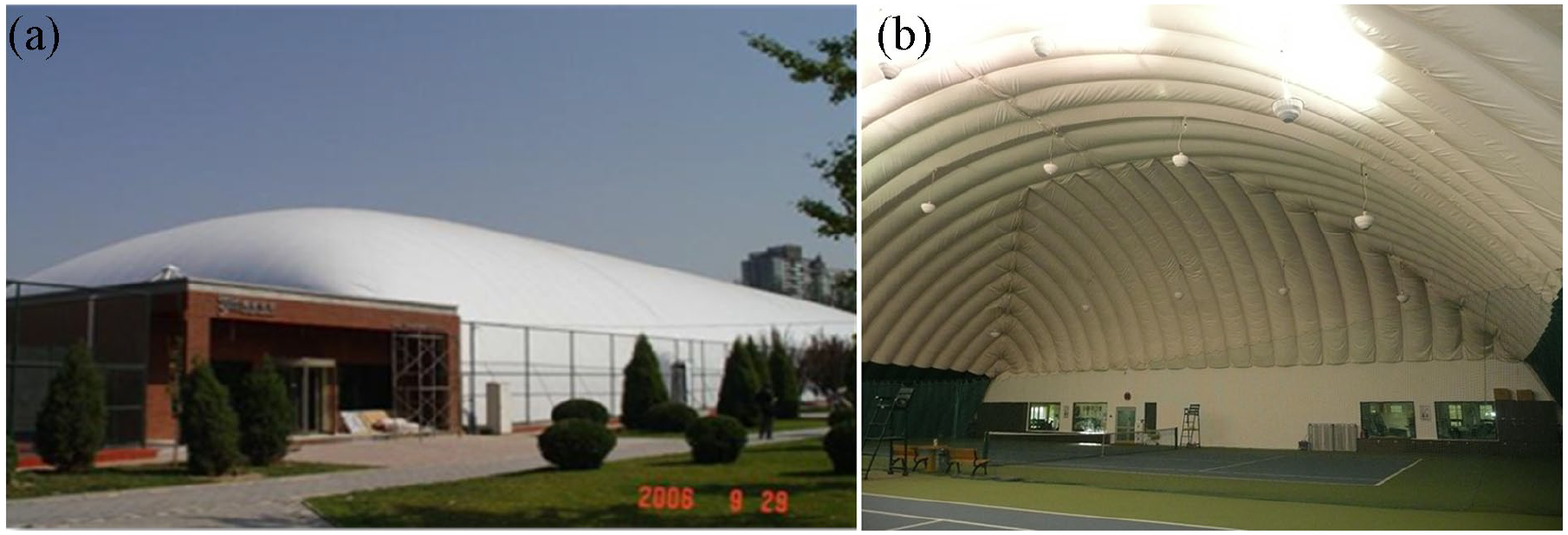
Beijing Chaoyang Park Tennis Hall: (a) exterior and (b) interior.
The 2008 Olympic Games in Beijing and the 2010 World Expo in Shanghai were two important events that brought a fast developments of membrane structures in China. 9 Both PTFE and ETFE membranes were used for the canopy and enclosure of the National Stadium,10,11 the main stadium for the Olympic Opening and Closing ceremonies (Figure 10). The National Aquatics Center (Figure 11), one of the landmark buildings of Beijing 2008 Olympic Games, was the first successful application of large ETFE air-cushion membrane structure in China. 12 This further drives the application and development of ETFE air-cushion membrane structures in China. The Expo Axis (Figure 12) in 2010 World Expo in Shanghai was the biggest landscape building and the major walking passage of the Expo Park. The structure of the Expo Axis was composed of integrally pre-tensioned cable-membrane roof and free surface sun valley steel structure, which covers areas of 1045m in longitudinal and 99.5–110.5 m in lateral.13,14 In addition, many other membrane structures were successfully built for the Shanghai Expo. These successful applications have greatly promoted the development of membrane structures in China. After that, membrane structures were widely used in all kinds of buildings.
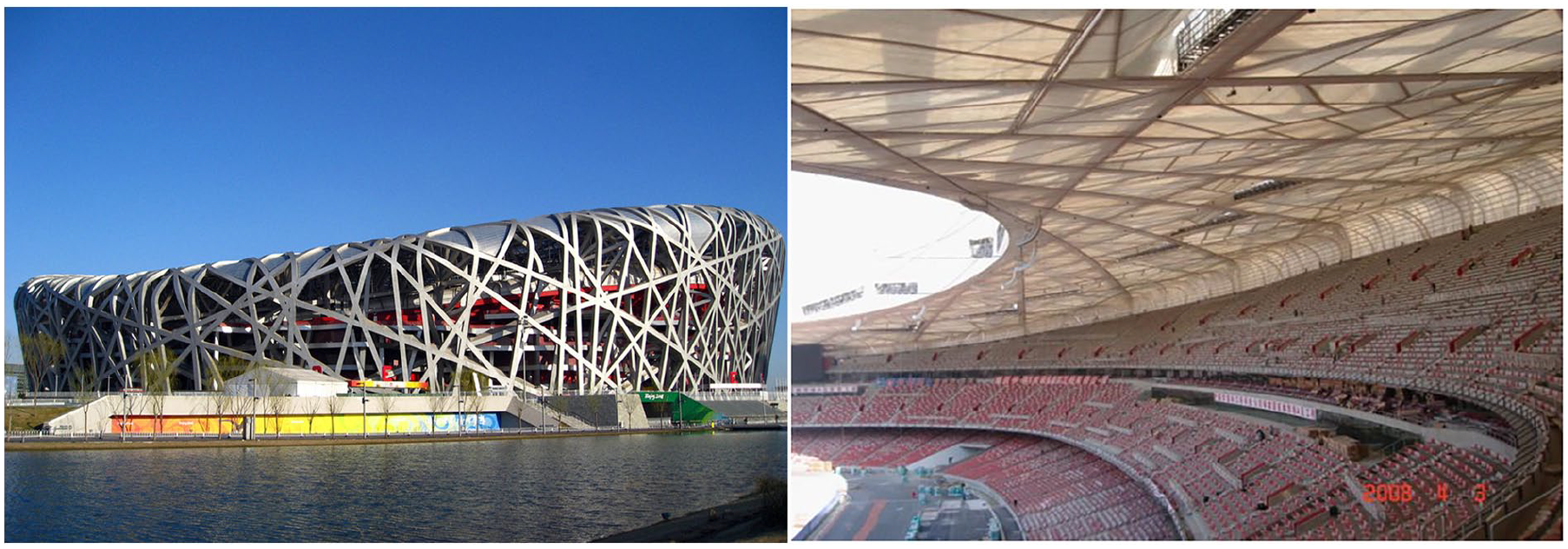
The National Stadium.
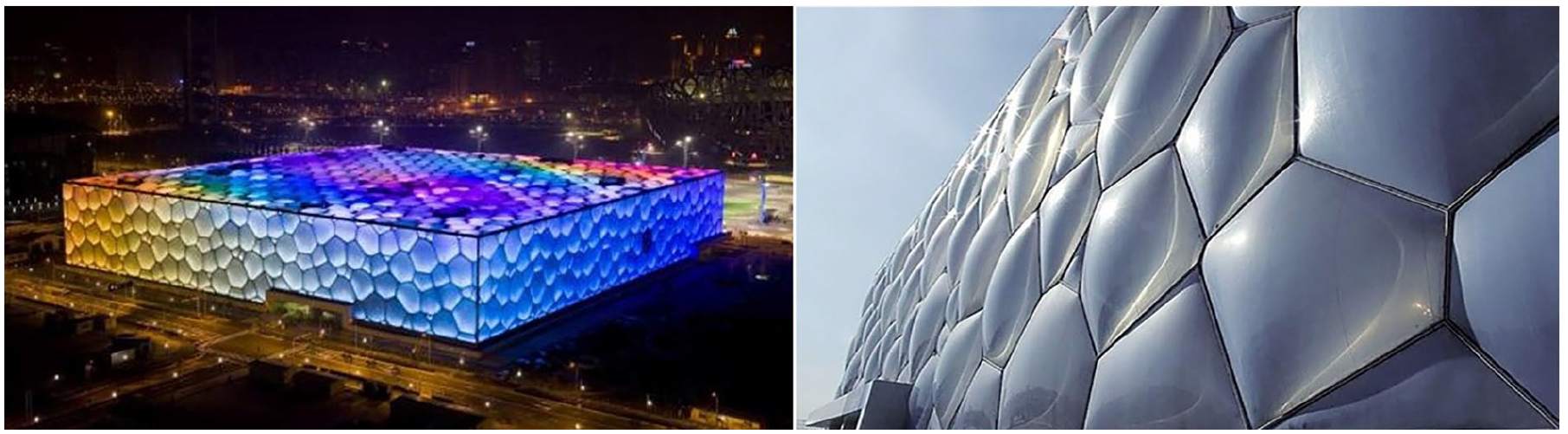
The National Aquatics Center.
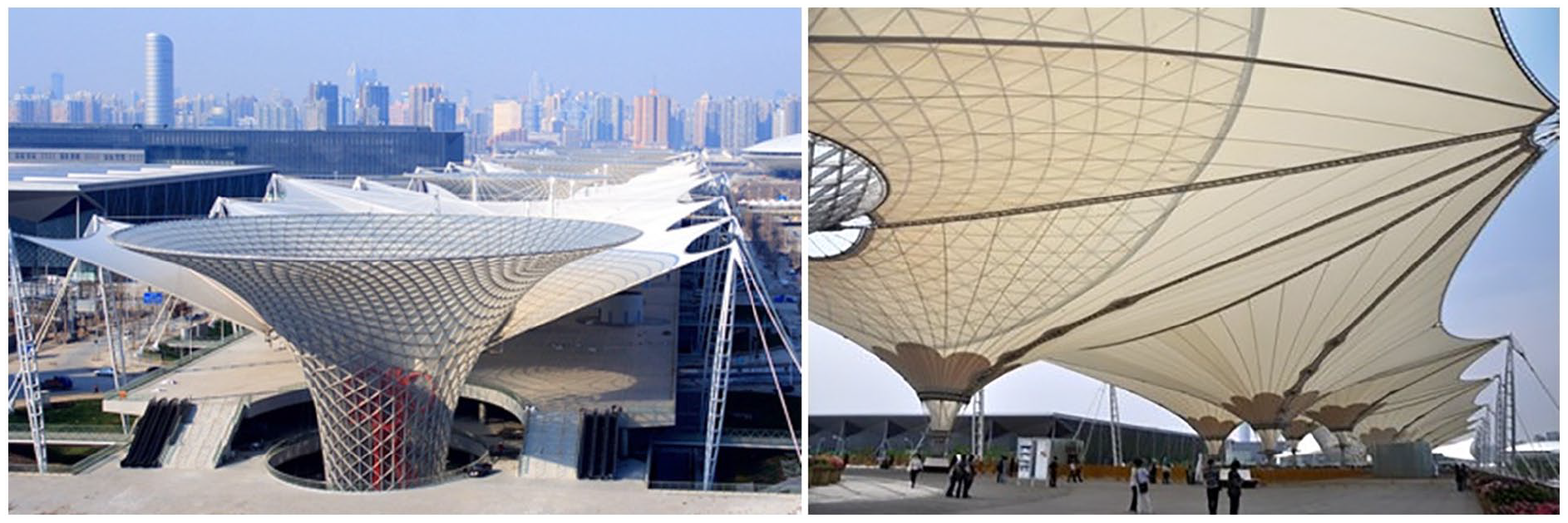
Expo Axis in 2010 World Expo.
Recent development
At present, membrane structures have been extensively applied to various types of building structures in China. Among these applications, the use of membrane as canopy roof covers for large and medium-sized stadiums is a popular choice in recent years. Table 1 summarizes some large-scale membrane structures in stadiums in recent 10 years. From these projects we can see that membrane roof covering can be well used for the canopy of stadium grandstand. The membrane structure types can be cable-supported membrane structure, frame-supported membrane structure, and integrally pre-tensioned membrane structure, depending on roof structure systems. The membrane material used is mainly PTFE, however, ETFE membrane material is also applied to some stadiums to meet their architectural and structural requirements, such as ETFE air-cushion membrane structure for the Stadium of Dalian Sports Center, single-layer ETFE membrane films for Fenghuangshan Stadium, Longxing Football Stadium, Qingdao Youth Football Stadium, Bailu Stadium, and so forth. In addition, a combination of PTFE and ETFE membrane is employed in Dalian Suoyuwan Football Stadium.
Recent examples of large-scale membrane structures in stadiums.
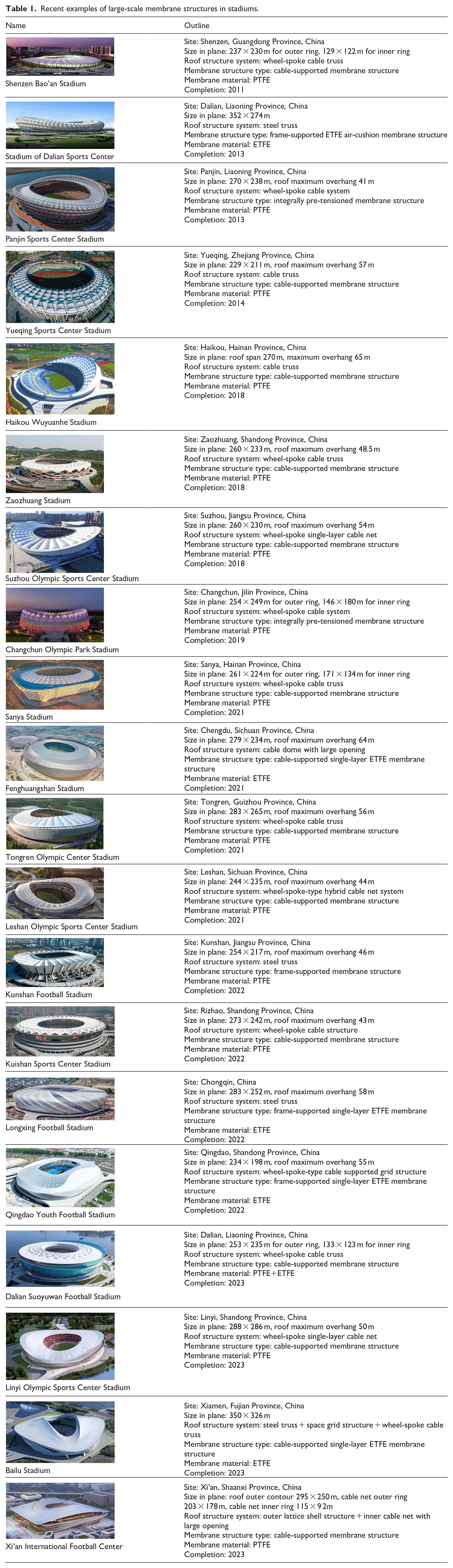
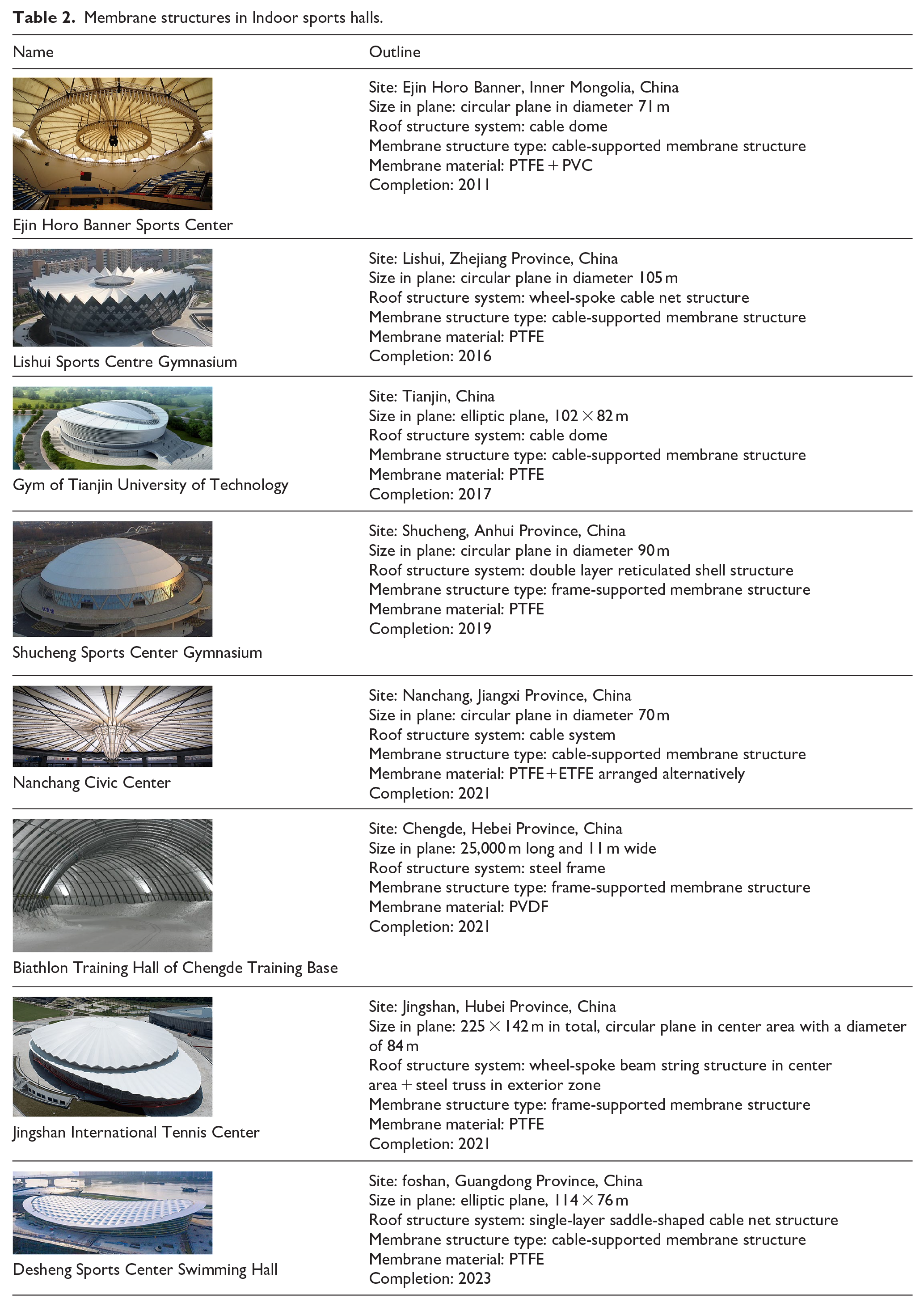
In addition to the applications to stadiums, membrane structures have also been well used in indoor sports halls, convention and exhibition centers, performance and entertainment venues, airport terminals, transport hubs, commercial plazas, environmental protection facilities, and many others. Table 2 gives typical applications in indoor sports halls in the last 10 years. Figure 13 shows some examples of membrane structures in other applications.
Membrane structures in Indoor sports halls.
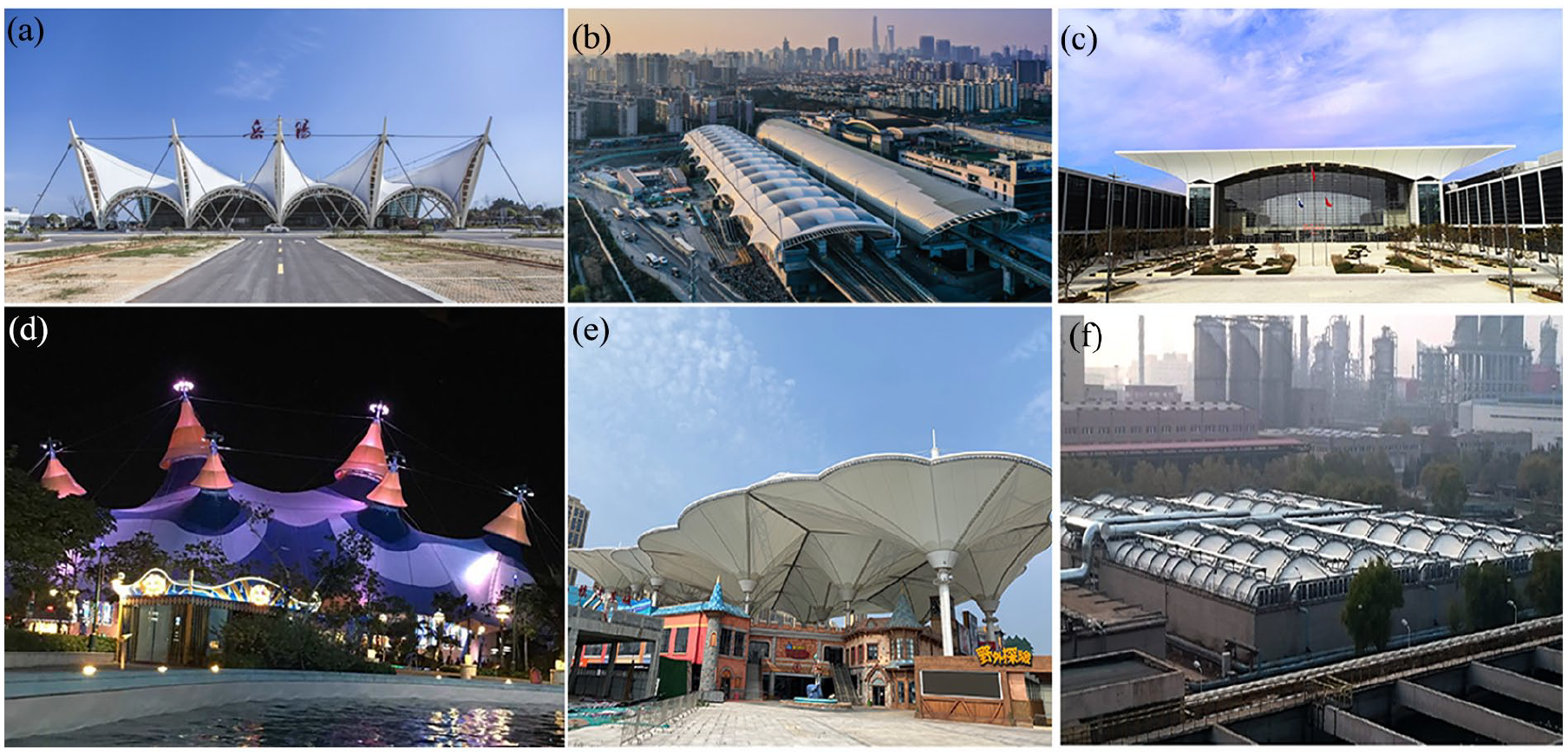
Application examples of membrane structures in various projects: (a) Yueyang Airport Terminal (2018), (b) Shanghai Longyang Road Light Rail Station (2014), (c) Hongdao International Convention and Exhibition Center (2019), (d) Zhuhai Chimelong International Circus City (2015), (e) Wanda Happy Town in Shandong Liaocheng (2020), and (f) Sewage treatment system of Liaoyang Petrochemical Plant (2015).
Not only for roof covering, membrane structures are also used in building facades and indoor suspended ceilings. For instance, red mesh membranes are used for the facade of Panjin Sports Center Stadium (Figure 14). Similarly, the external facade of Sanya Stadium is composed of 972 frame-supported PTFE membrane units, resembling flying egrets (Figure 15). The facade of Dalian Suoyuwan Football Stadium consists of cable-ETFE membrane structure and flood lighting system, in which 7823 single-layer ETFE membrane units in nine kinds of blues are employed (Figure 16). The overall structure of the fabric curtain wall of the facade of Shaoxing International Convention and Exhibition Center is comprised of 30 pieces of irregular space steel structure support system and PTFE mesh membranes (Figure 17). The National Speed Skating Oval (Figure 18), the main venue of Beijing 2022 Winter Olympic Games, is a saddle-shaped cable net roof structure with an elliptic plane of 198 × 124 m. It is now the largest single-layer cable net structure in the world. Membranes are used for the ceiling system of the roof in order to obtain good properties of low radiation and sound absorption. Also, for the roof ceiling system of Shanghai Pudong Football Stadium, the reverse tensioned membranes are employed (Figure 19).
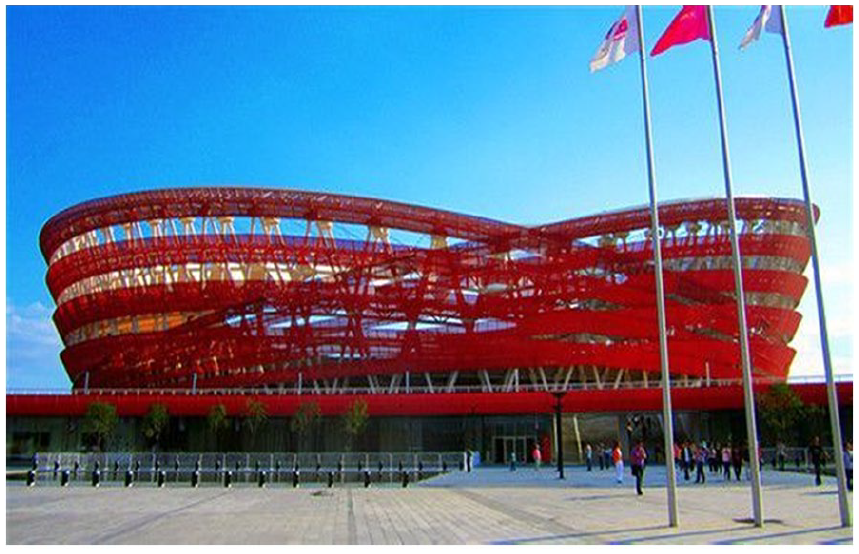
Facade of Panjin Sports Center Stadium (2013).
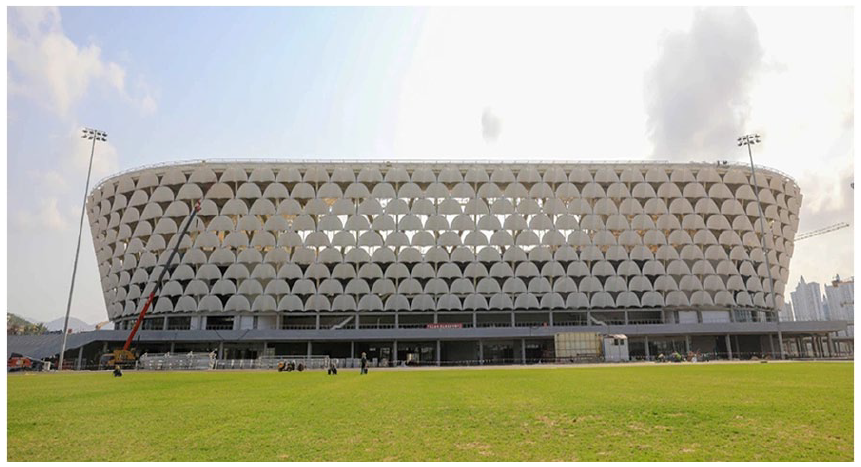
Facade of Sanya Stadium (2021).
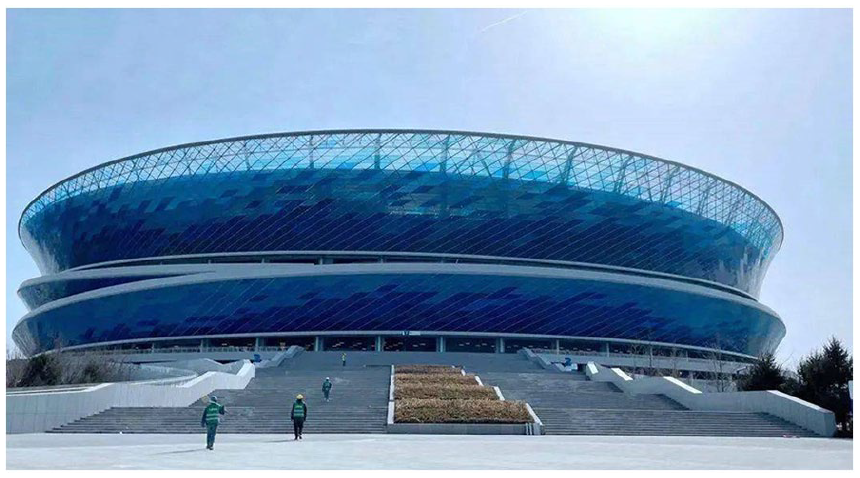
Facade of Dalian Suoyuwan Football Stadium (2023).
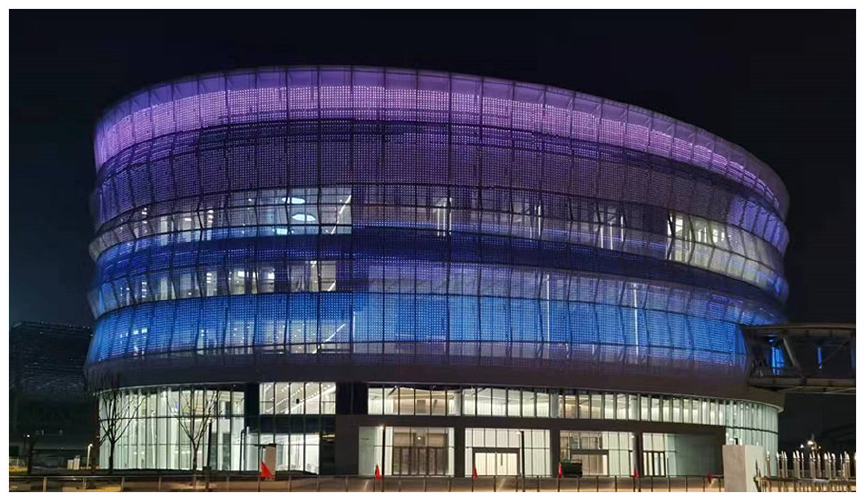
Facade of Shaoxing International Convention and Exhibition Center (2021).
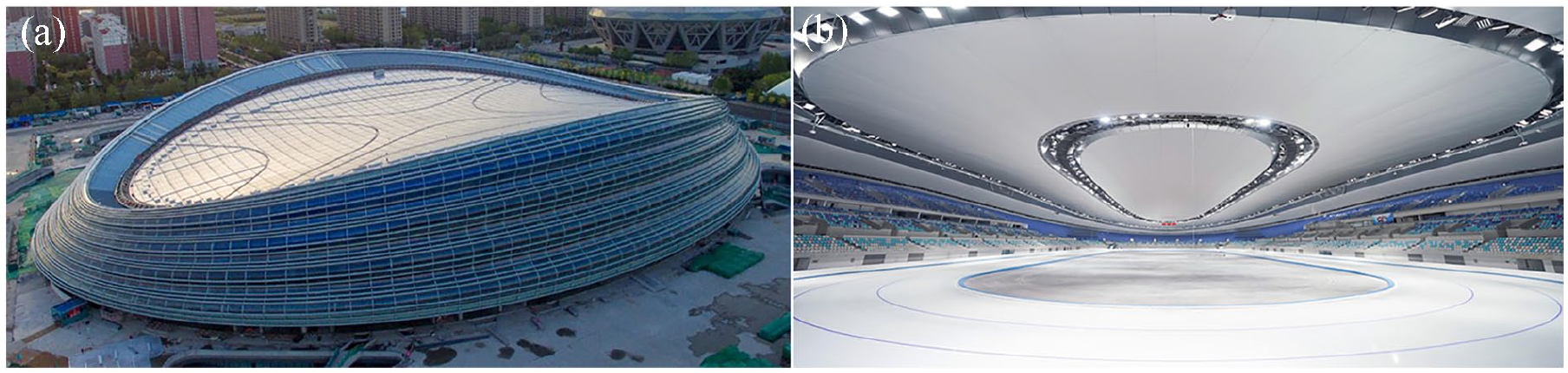
National Speed Skating Oval (2021): (a) exterior and (b) interior roof ceiling.
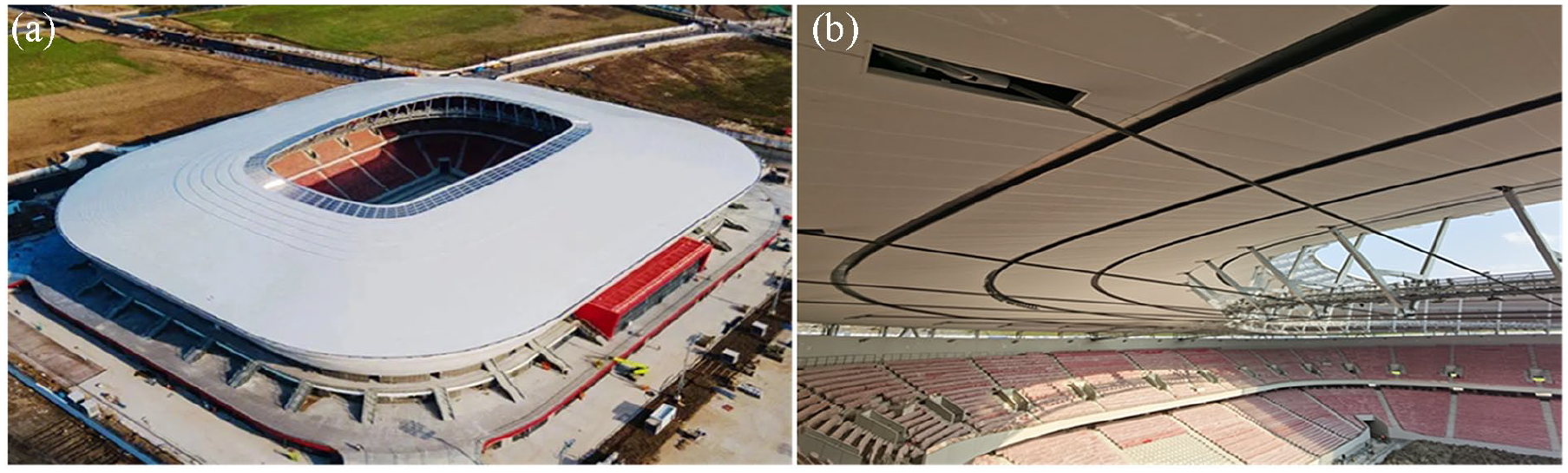
Shanghai Pudong Football Stadium (2021): (a) exterior and (b) interior roof ceiling.
ETFE membrane, due to its unique features of light weight, high transparency, superior flexibility, good performance of self-cleaning, weather ability, and corrosion resistance, has received great attentions by architects and engineers since its successfully application in the National Aquatics Center for the 2008 Olympic Games.15,16 Various ETFE air-cushion membrane structures have been successfully built in recent years in China, such as Yujiapu Railway Station in 2015, TRON structure in Shanghai Disney Resort in 2016, Kunming Fukang City Shopping Center in 2019, and the central light hall of Beijing Fengtai Railway Station in 2022, as shown in Figure 20. In addition, single-layer ETFE membrane structures are also applied to various projects, such as Xiangtan Bubugao Plaza in 2015, Suizhounan Railway Station in 2019, Langfang Toll Station of Daxing Airport North Line in 2021, and the Main Hall of Tianfu Agricultural Expo in 2021, as shown in Figure 21. Furthermore, in the field of environmental protection, single-layer ETFE membrane structure was used in the sump covering of the Golmud Sewage Treatment Plant in 2020 (Figure 22), which was the first attempt for the cover of sewage pool using ETFE membrane.
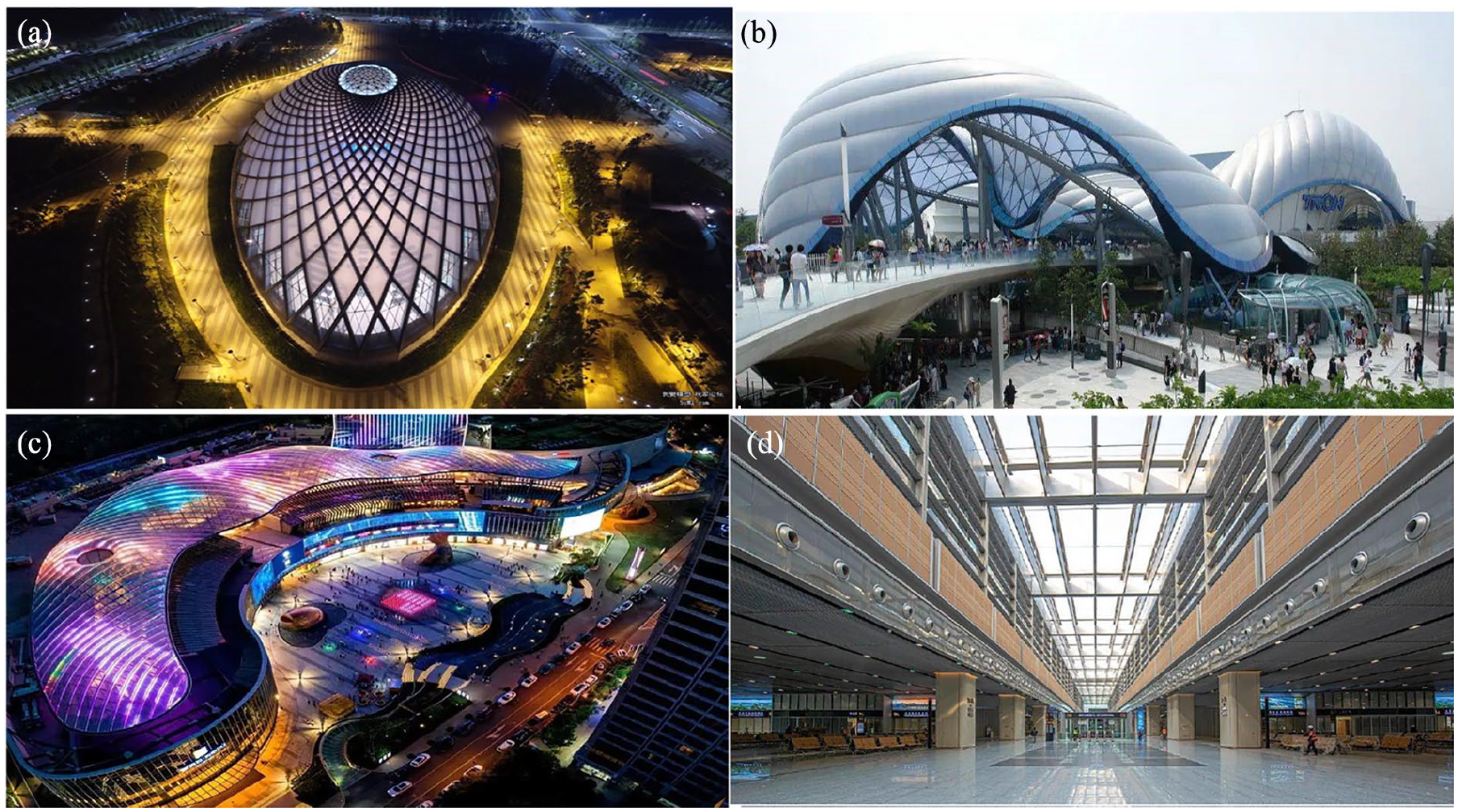
Examples of ETFE air-cushion membrane structures: (a) Yujiapu Railway Station (2015), (b) TRON structure in Shanghai Disney Resort (2016), (c) Kunming Fukang City Shopping Center (2019), and (d) Beijing Fengtai Railway Station (2022).
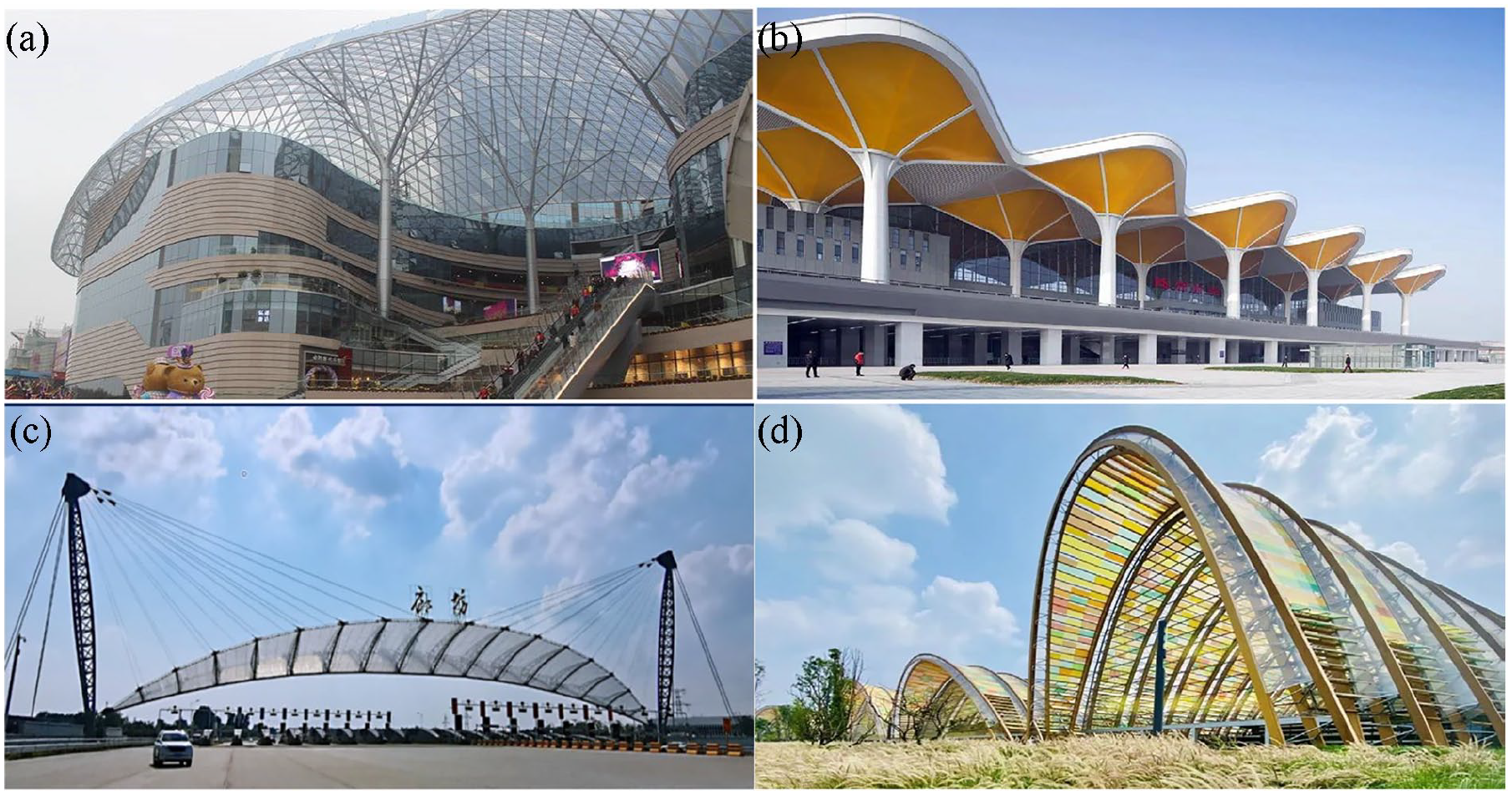
Examples of single-layer ETFE membrane structures: (a) Xiangtan Bubugao Plaza (2015), (b) Suizhounan Railway Station (2019), (c) Langfang Toll Station (2021), and (d) Main Hall of Tianfu Agricultural Expo (2021).
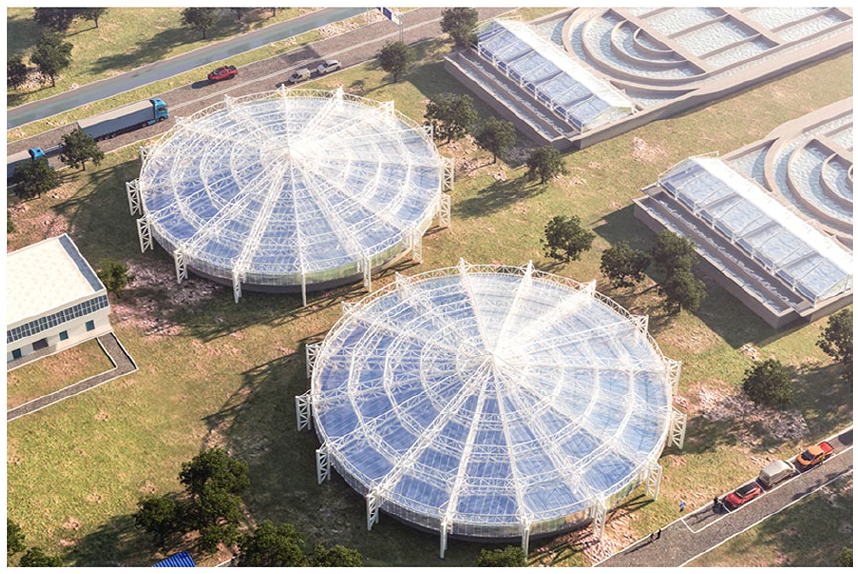
Sump covering of the Golmud Sewage Treatment Plant (2020).
Application of air-supported membrane structures
The real development of air-supported membrane structure in China started in 2006 when Beijing Chaoyang Park Tennis Hall was successfully built. 8 Shortly afterwards, several domestic companies specializing in the production and construction of air-supported membrane structures were founded, which further promoted the application of air-supported membrane structures in China. At present, air-supported membrane structure has become popular and has been well applied in many fields.
In recent years, requirements of national fitness and environmental protection have greatly promoted the rapid development of air-supported membrane structures in China. It is estimated that more than 150 air-supported membrane structures are currently constructed each year. 9 Zhengzhou Longhu National Fitness Center (Figure 23), completed in 2018, is now the largest air-supported membrane structure sports hall complex in China. It is composed of three independent sports halls that include ball games hall, swimming hall and children’s playground hall. Figure 24 shows the inside view of the air-supported membrane structure water polo arena for the second National Youth Games in Shanxi Province in 2019. And Figure 25 is the inside of air-supported membrane structure ice skating hall at Beijing Capital Institute of Physical Education, completed in 2020. It can be seen that air-supported membrane structure can not only be used for daily fitness venues, but also meet the needs of competition.
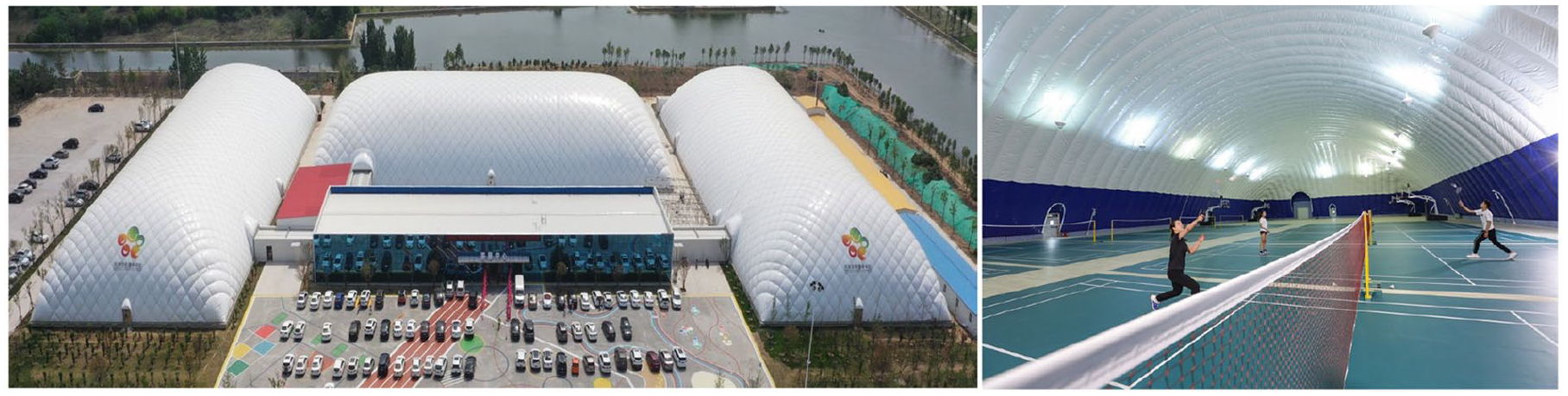
Zhengzhou Longhu National Fitness Center.
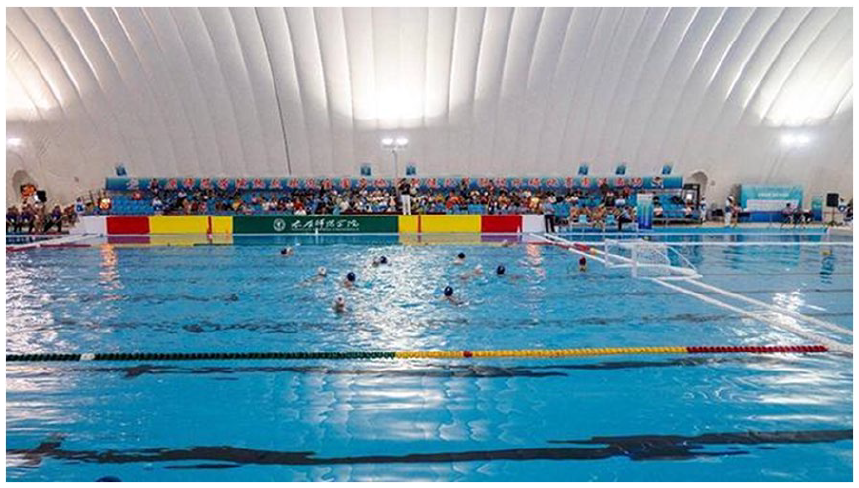
Water polo arena in Shanxi.
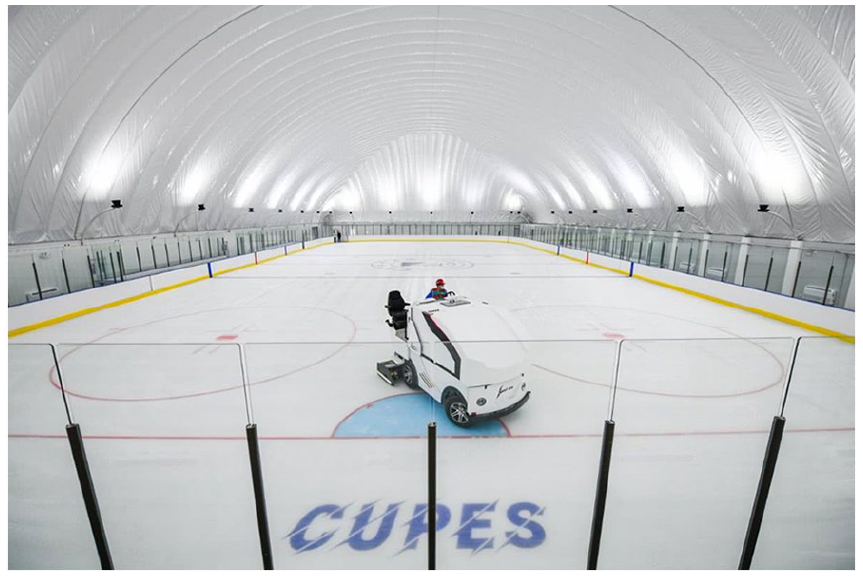
Ice skating hall at Beijing Capital Institute of Physical Education.
Air-supported membrane structure has the characteristics of fast construction, low cost and strong span ability. It has been therefore well applied in the field of environmental protection, such as in coal yard sheltering, contaminated site coverage, chemical or sewage plant protection, and so on. In order to meet the needs of industrial environmental protection, the construction scale of air-supported membrane structure continues to expand. The maximum span for the air-supported membrane structure coal shed of Daihai Power Plant in Inner Mongolia of China has reached to 200 m (Figure 26). The maximum length of the air-supported membrane structure strip silo of No.36 to No.40 coal berths in Jingtanggang District of Tangshan Port reaches 1130 m (Figure 27).
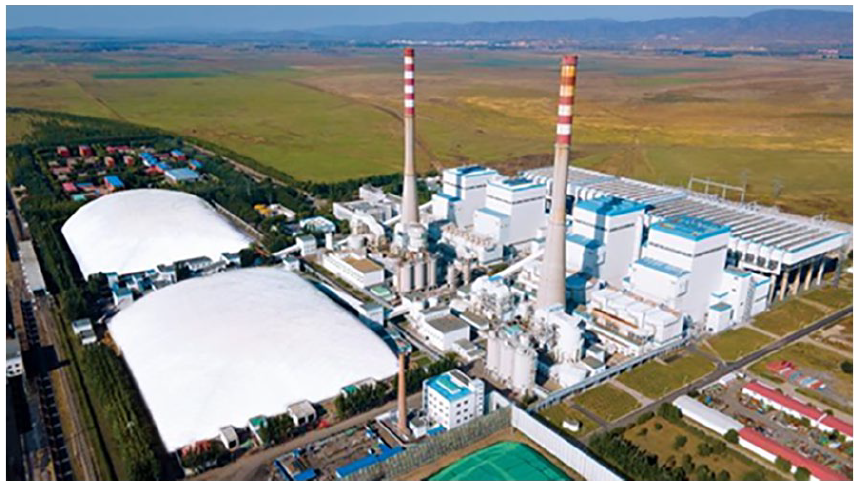
Coal shed of Daihai Power Plant (2021).
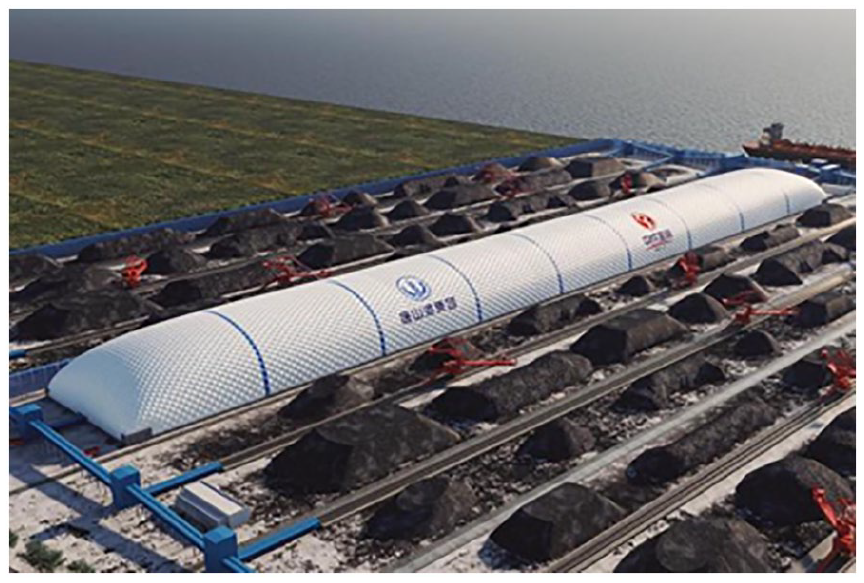
Strip silo in Jingtanggang (2022).
Besides the use in sports facilities and environmental protection, air-supported membrane structures are also utilized in many other areas like cultural and recreational facilities, convention and exhibition venues, industrial and agricultural sites, and so on.
Technical standards for membrane structures
Different from conventional structures, membrane structures have their own particularity, and their design and construction need corresponding standards to guide. In the process of membrane structure development in China, the formulation of membrane structure technical standards has played an active role in promoting the application of membrane structures. In recent years, the China Association for Spatial Structures has carried out a lot of effective work in the standard system of membrane structures, and compiled a series of membrane structure technical standards. In 2004, the first edtion of “Technical Specification for Membrane Structures.” 5 was promulgated and implemented, in which the main contents include general provisions, terms and symbols, basic requirements of design, materials, structural calculation, details for connections, manufacture, erection, acceptance, and maintenance. This specification provided important guidance for the early development of membrane structures in China. After about 10 years of successful operation, the second version of “Technical Specification for Membrane Structures” was revised and published in 2015, 17 where some new contents were added based on latest research findings and engineering practices. The national standard “Coated Fabrics for Membrane Structures” was promulgated in 2013 and implemented in 2014, 18 which specifies the technical requirements, test methods, inspection rules, packaging, and marking of coated membrane materials. In order to unify the membrane structure construction quality acceptance criteria, “Specification for Acceptance of Construction Quality of Membrane Structures” was enacted in 2020. 19 With the rapid development of membrane structures in China, the cost standard of membrane structures is urgently needed in the process of bidding, contract signing and project settlement, therefore, “Engineering Consumption Standard for Membrane Strcutures” was released in 2022 and implemented in 2023. 20 In recent years, the inflatable membrane structures have been rapidly developed in China. In order to standardize technical requirements and improve engineering quality, “Technical Specification for Air-inflated Membrane Structures” was issued in 2023. 21 In addition, other technical standards that are being formulated include architectural atlas of membrane structures, technical specification for operation, maintenance and safety of air-supported membrane structures, technical standard for membrane structure detection and monitoring, and others. The establishment of the above technical standards reflects the progress of membrane structures in China, and has played a positive role in ensuring the quality of membrane structure projects and promoting the high-quality development of membrane structures in China.
Concluding remarks
A current review on the development of membrane structures in China has been presented. It is shown that after more than 20 years of development, great progress has been made for membrane structures in China. The successful construction of various membrane structure projects shows that China already has good independent capabilities in the research, design, production and installation of membrane structures, and has reached the international advanced level. Membrane structure has a rich and colorful architectural shape and structural form, which can be used in a variety of fields such as culture, sports, industry, agriculture, environmental protection, emergency response, and military, and has broad application prospects. It is expected that, with the rapid development of the Chinese economy and the continuous enrichment of social and cultural life, there will be more demanding for building various types of membrane structures in China. All these opportunities will certainly bring inspiring ideas and promote the further developments of membrane structures in China.
In the future research and development of membrane structures, the author suggests the following issues that should be paid attention to:
(1) New membrane materials that meet the special needs of building functions.
(2) Development of integrated and prefabricated membrane structure building products.
(3) Rapid membrane structure construction techniques that meet emergency and environmental requirements.
(4) Development of new membrane structure types and systems.
(5) Renovation and performance improvement of existing membrane structures.
(6) Fire protection measures and operational maintenance of membrane structures.
(7) In-depth study of membrane structure analysis theory and design method.
(8) Technical standards and specifications for membrane structures.
Footnotes
Acknowledgements
The author appreciates members from China Association for Spatial Structures who offer the photos and materials.
Declaration of conflicting interests
The author declared no potential conflicts of interest with respect to the research, authorship, and/or publication of this article.
Funding
The author received no financial support for the research, authorship, and/or publication of this article.
