




Abstract
Purpose
Entrepreneurship is being seen as a core driver of economic revival. Consequently, organizations and institutions, including universities, are being called upon to accelerate their role in an increasingly entrepreneurial environment. The sub-streams of entrepreneurship are manifold; yet, there is still the notion that entrepreneurship is solely about making profits. Within this context there are questions, within and without librarianship, regarding whether a library, which is a non-profit entity, can be an entrepreneur. As such, this paper purposed to examine the extent to which the terms library and entrepreneurship harmonise, through a case study of a large Caribbean university library, with the objective of highlighting practice, possibilities and lessons.
Design/Methodology
Employees of the understudy library were purposively sampled and surveyed.
Findings
The theo-practical lens through which one views entrepreneurship, determine perceptions regarding the status of the understudy library as an entrepreneur.
Research Limitations/Implications
This paper examined one of the largest indigenous university library in the English-speaking Caribbean; it is possible that the situation for other types/sizes of Caribbean university libraries may vary. Therefore, it would be useful to study other Caribbean university libraries.
Originality/Value
This paper contributes to the growing body of literature on “libraries and entrepreneurship” and evidence for “value of libraries” albeit from a Caribbean perspective. It also highlights the status of entrepreneurship in libraries in general, and a Caribbean university library in particular, and in this regard offers a case for strengthening entrepreneurship in other Caribbean university libraries. Additionally, it is the first scholarly paper on Caribbean university library entrepreneurship.
Practical & Social Implications
There is a gap in the literature on practical examples and scholarly papers on building a Caribbean entrepreneurial university library. Using the response of the understudy Caribbean university library, this paper seeks to fill this gap, albeit incrementally, through proposing a broad “Entrepreneurial University Library Framework for building an entrepreneurial university library within the context of the Caribbean.
Although this study was conducted within a Caribbean context, hence the phrase entrepreneurial Caribbean university library, its model can be used by other comparable institutions worldwide, struggling with increasing demands to be entrepreneurial.
Keywords
Introduction
“The latest financial crisis has caused nations, organizations, and individuals to have considerably less money to utilize for development and training. In this light, entrepreneurship can be seen as a key factor in the revitalization of an economy” (Seeking Social, 2016: 9). Barrack Obama, former president of the United States of America (USA) articulated the importance of entrepreneurship in universities. “Obama not only acknowledged the need for universities to lay the groundwork for future innovators and entrepreneurs, but also implicitly called on the individuals who maintain the operation of these universities, library and information science scholars included, to consider their role in an increasingly entrepreneurial environment” (Restivo, 2014: 32). The United States Department of Commerce (2013) report on “The Innovative and Entrepreneurial University”, indicates universities have responded positively to Obama.
In the Caribbean, the understudy university has also responded to entrepreneurship. The Vice-Chancellor, approved a Ten in Two Strategy, October 2019; calling on all campuses and Regional Headquarters/Vice-Chancellery administration to cut expenditures by 10% and increase top line revenue-generation by 10% over the subsequent 2 years, to achieve a university-wide savings of approximately US$30 million. In furthering this mandate, the executive management seeks to achieve five new targets over the next 2 years of the current strategic plan. Of note is target number four, which reads: Fast track strategies to develop the entrepreneurial culture across … and to cultivate “…Corporate” as an effective brand. The Vice Chancellor also mandated the Pro Vice-Chancellor, Graduate Studies & Research, to promote innovation and entrepreneurship across the university. Towards fulfilment of this mandate, the Pro Vice-Chancellor, Graduate Studies & Research has been meeting with entities across the campuses to discuss ideas and obtain feedback. One such meeting was the Institute for Gender and Development Studies (IGDS) Board Meeting, 14 December 2018, where the PVC presented on making the university entrepreneurial, and invited the understudy library to participate, via Zoom. Following this, The Office of the PVC, Graduate Studies & Research, launched the university’s Innovation and Entrepreneurship Webinar Series, March 2019.
These initiatives have raised questions on the role of the understudy library in an entrepreneurial university because of the nature of the academic library -- it being part of the university, its parent institution, and whose primary role is to support the educational programmes and research activities of its parent institution. There is the tacit intimation that the library should follow in the direction of its parent institution; and in this instance, the direction is entrepreneurial; but can it? According to Seeking Social (2016) “Non-profit organizations such as libraries can become integral to the development of entrepreneurship” (p. 11); while this may readily appear true to some, who may argue the library is already entrepreneurial by virtue of its role and mission and its innovative services and products; others viewing through a different lens may argue -- unless these innovative services and products are monetised, the library is not entrepreneurial. And still, others may ask -- do the terms library and entrepreneurship even harmonise? Whichever lens are used, it must be noted that there is a real need for libraries to innovate, monetize the innovations, and articulate their value in profits, despite being a non-profit organization traditionally offering non-market goods and services not being bought or sold as a commodity in the market. “The financial crisis has caused some libraries to have to seek a for-profit structure in order to stay open” (Seeking Social (2016): 9). Additionally, authorities are requiring universities and their constituents, including libraries, to cut expenditure, innovate and generate revenue to offset a proportion of their costs. Consequently, libraries are now turning to economic tools (for example, ROI and market analogy inter alia) and entrepreneurial practices to articulate their value, monetise their contribution/innovation, rationalise their existence, and in doing this, secure continued funding and by extension, their existence.
Within this strategic direction, the understudy library, being a constituent of the university, and serving all university entities, must align itself to this entrepreneurial strategic direction. Accordingly, this paper documents the entrepreneurial practice, possibilities and lessons of the understudy library based on a qualitative survey of the Heads of Sections (HoS) of the understudy Library. The results present a picture of what an entrepreneurial university library should look like, which is instructive to the understudy library, and serves as a useful guide for other university libraries within the Caribbean region, and other comparable university libraries with and without an entrepreneurial mandate. To this end, the paper is arranged as follows: background of the understudy library and its parent institution, literature review, design/methodology, data presentation and analysis, practical implications, conclusion, and references. Refer to Appendix 2 for a definition of key terms used throughout this paper.
Background of the understudy caribbean university library and its parent institution
The Caribbean, also referred to as the West Indies, is a diverse region located within the Americas, consisting of 30+ countries, including a group of tourist destination islands, surrounded by the Caribbean Sea. There are various geographical divisions within the Caribbean, for example: the Greater Antilles versus the Lesser Antilles; the Windward Islands versus Leeward Islands; English-speaking versus Dutch-speaking vs. French-speaking. Also, while the Caribbean region shares a similar history and culture, there are general heterogeneities amongst the islands. Like the Caribbean region, the parent institution is multi-part and multi-national, with physical campuses in four islands of the Caribbean region as well as an online campus -- whose core is online teaching and learning. Consistent with the university, the library system is also multi-part and multi-national. Consistent with the multi-part, multi-national characteristic feature of the university, each campus has a library, with branches -- in some instances. Each campus library has a campus librarian, who is in charge of the campus library system. At the head of the campus librarians, is a university librarian, who provides the overall leadership, and seeks to integrate the activities of the campus librarians and their respective libraries into one university library system.
The understudy library, the founding library of the university, was established in the 1940s and began as a single library in a one storey building; in the early 1950s it was moved to the current site. With the university achieving independent degree-granting status in the early 1960s, its structure and offerings expanded. In keeping with this, there were expansions to the understudy library’s collections, which resulted in extensions to the building and the establishment of four subject specific branches.
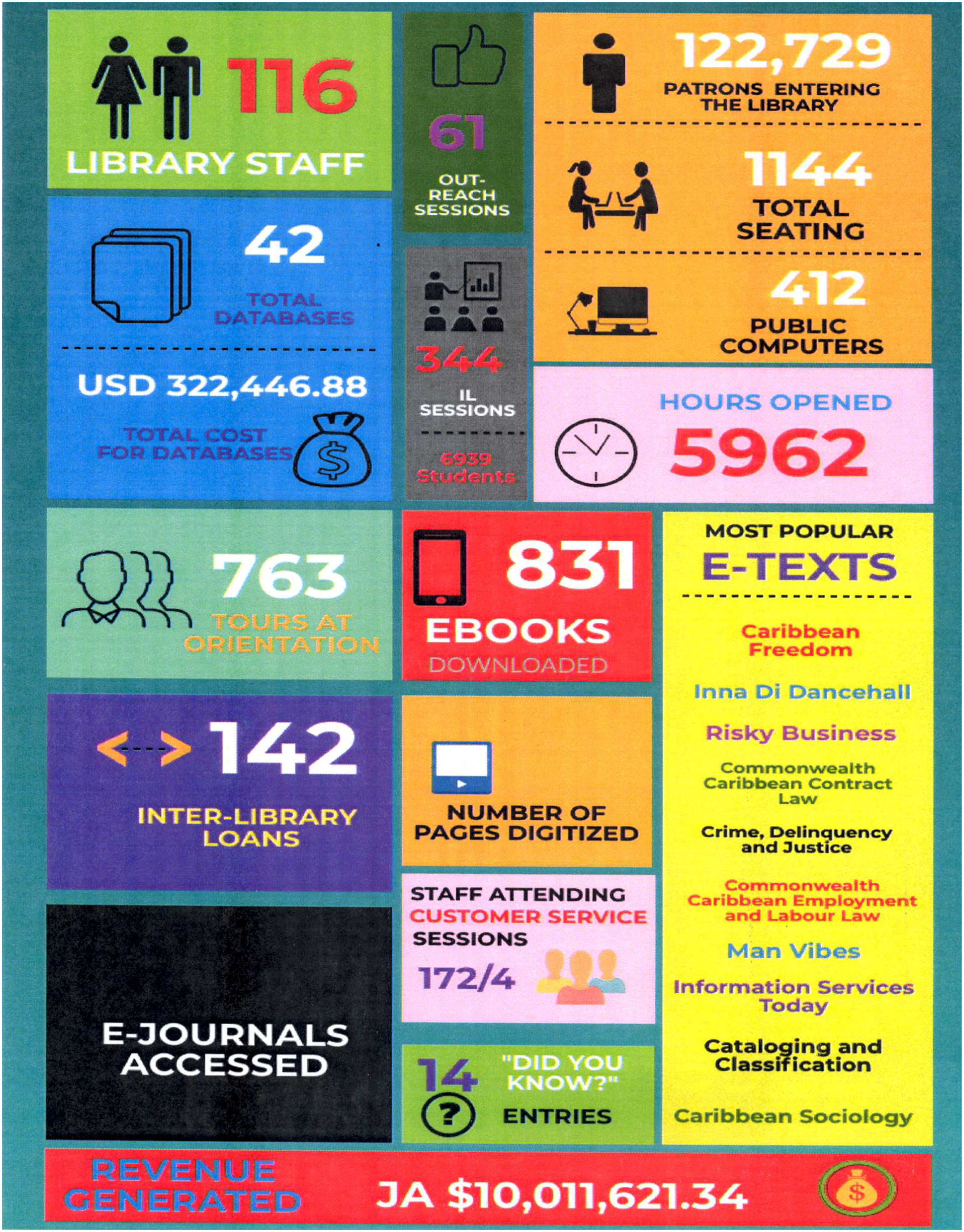
As per Library Annual Report 2018/19, the understudy library has social and financial value to the university community. The following figures, Figure 1 and Figure 2 present a graphical summary of this. The financial and social value of the understudy library 2019/20 The financial and social value of the understudy library 2018/19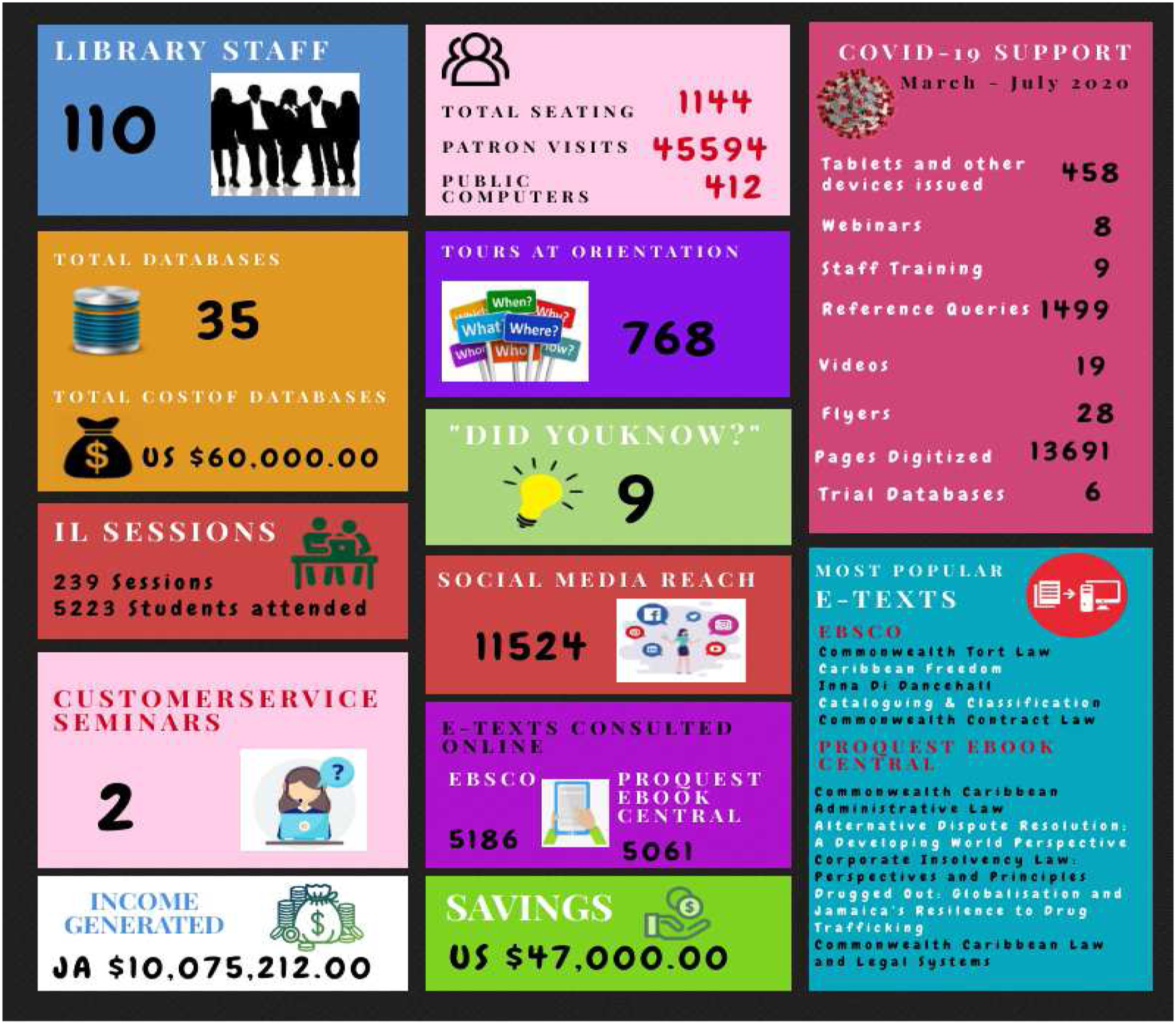
Literature review
Brief summary of entrepreneurship in the Caribbean
The region is multi-racial and multi-ethnic. Arguably, race, prejudice, ethnic hierarchy, and colonialism impact the development of entrepreneurship during the colonial and postcolonial periods in Caribbean society (University of the West Indies. Institute of Social Economic Research et al., 1994: 6). “The colonial state played a key role in inhibiting the emergence of indigenous entrepreneurs” (University of the West Indies. Institute of Social Economic Research et al., 1994: 43). It is argued “Caribbean economies have been shaped historically to be low value-added producers, responsive to the needs in the industrialised countries.” (University of the West Indies. Institute of Social Economic Research et al., 1994: 11). University of the West Indies. Institute of Social Economic Research et al. (1994) edited volume submits certain ethnic groupings and race as more entrepreneurial. It is further debated the dominant Afro-Caribbean families in general are not enamoured of the value orientations and resources necessary for the emergence of an entrepreneurial culture. Afro Caribbean families tend not to pass on wealth to succeeding generations; East Indians and the other minority ethnic groups in the region, in contrast, tend to have more stable family forms with the male and breadwinner being central rather than marginal to the home (University of the West Indies. Institute of Social Economic Research et al., 1994: 45). It is this commitment to the family as an economic unit and the tendency to pass on wealth to succeeding generations that accounts for the relatively greater economic power of other minority ethnic groups (University of the West Indies. Institute of Social Economic Research et al., 1994: 45). If this is accepted, there is a role for the Caribbean academic library seeking to become entrepreneurial: there is a role for Caribbean academic libraries to enamour an entrepreneurial culture particularly amongst Afro Caribbean people, through for example awareness initiatives such as: talks/seminars, spaces to exhibit the products of Afro Caribbean entrepreneurs, collection management practices with an entrepreneurial focus. Additionally, the Caribbean academic library seeking to become entrepreneurial could offer research support services to small and medium AfroCaribbean enterprises, as done by university libraries in Uganda who offered research support services to small and medium Afro enterprises in Uganda (Buwule and Mutula, 2017). Bieraugel (2019) variety of methods for institutions to assess their spaces as they relate to creative, entrepreneurial thinking provides another possibility of role to be played to stimulate entrepreneurship.
The Caribbean Tech Entrepreneurship Programme (CTEP) is a virtual hub for Caribbean start-ups and entrepreneurs, helping small businesses to unlock economic transformation through digital innovation platforms. This is done through a series of business incubation and acceleration activities, where Caribbean entrepreneurs in CDB’s 19 borrowing member countries connect online with mentors and facilitators, who are experts in their respective fields. Another aim of CTEP “is to help Caribbean countries address unemployment and underemployment by leveraging opportunities within the virtual economy” (Nurse 2019). The Caribbean academic library seeking to become entrepreneurial could play a supportive role in this regard by aligning its programs and services accordingly, through for example, mobile projects, digital innovation, access to finance information resources, virtual library economy.
Additionally, the Entrepreneurship Program for Innovation in the Caribbean (EPIC) seeks to build a supportive ecosystem for high-growth and sustainable enterprises throughout the Caribbean. The 7 year $20 million program is funded by the government of Canada and implemented by infoDev and the World Bank Group. EPIC initiatives include: Accelerate Caribbean; Access to Finance; Caribbean Climate Innovation Center; Caribbean Mobile Innovation Project; and Women Innovators Network in the Caribbean (InfoDev, 2017).
According to University of the West Indies. Institute of Social Economic Research et al. (1994: 43) there are five distinct entrepreneurial types in the Anglophone Caribbean: expatriate entrepreneur, commercial entrepreneur, state entrepreneur, family entrepreneur, guerrilla entrepreneur. “For most of the known history of the Caribbean the leading entrepreneurs have been expatriate to the region” (University of the West Indies. Institute of Social Economic Research et al., 1994: 43). There is the tacit intimation that libraries could promote activities to build the other entrepreneurial types. Academic libraries go beyond supporting student entrepreneurs through traditional channels such as information resources, library guides and librarian consultations by also providing unique spaces for entrepreneurial work. Designing library spaces for entrepreneurs to think, learn and innovate at a higher level is emphasized as an important way to demonstrate a commitment to student learning, and communicate the library’s value to stakeholders (Edens and Malecki 2020).
University of the West Indies. Institute of Social Economic Research et al. (1994: 17–18) argue that for Caribbean entrepreneurship to develop successfully, certain basic elements need to be present: capital; information on existing and potential markets, knowledge for decision-making, business organization, and marketing of products; strategies for exploiting opportunities and dealing with competition; commitment and drive to succeed and willingness to work long, hard hours. What are the implications for academic entrepreneurial library? Perhaps the academic library could serve as an information hub for existing and potential markets, knowledge for decision-making, business organization. Aagaard and Arguello (2015) study addresses the use of library business resources for entrepreneurial activities; Caribbean libraries seeking to become entrepreneurial could explore this.
Harmonizing the terms library and entrepreneurship
The question - Do academic libraries have the capacity to adopt entrepreneurship as a feature of their strategy and management style (Schauder, 1988: 36)? This is an old question in academia from the 1980s, which has carried to today. This can be answered by examining the following responses: ✓ ✓ ✓ ✓
“An academic library is a library that belongs to an institution of higher education, and whose primary role is to support the educational programmes and research activities of its parent institution. Academic staff and students are its primary clientele” (Schauder, 1988: 36). Added to this is:
The ideology of the free library with a mission to provide everyone with all the information they require is one which most librarians have helped to promote, but it has perilous consequences when libraries try to engage in commercial activities. Giving service priority to those who can afford to, or are prepared to, pay is generally unacceptable, even if ultimately this approach might benefit all users in the form of enriched bibliographic resources and more powerful information technology. The academic libraries have a clearly identified primary clientele - the staff and students of the institution - but to the extent that academic libraries are supported by tax-revenue they are regarded like public libraries, as resources which should be freely available to the community at large (Schauder, 1988: 45).
Entrepreneurship is still viewed by some library staff as a business: an independent entity or person offering goods and services to make a profit; within this context, entrepreneurship within the library is viewed with pessimism because of the nature of the academic library -- it being part of an institution (the university), the academic staff and students being the primary clientele, and the free library ideology. This points to a lack of understanding of the full nature of entrepreneurship.
Conversely, the academic library -- it being part of an institution (the university) harmonizes with the term entrepreneurship, specifically, corporate entrepreneurship (intrapreneurship), which is entrepreneurship inside of an established organization; the library need not be separate. Additionally, its fee-based services, viewed purely through the lens of economic entrepreneurship theories could be viewed as having elements of entrepreneurship. But one may ask -- does the provision of fee-based services constitute real entrepreneurship? According to Glosiene (2002): For many librarians, entrepreneurship is directly connected with the introduction or provision of fee-based services. Libraries have long incorporated a number of cost- control mechanisms, including cost recovery charges, such as fee-based photocopying and (more recently) printing (p.5).
Glosiene (2002) truthfully notes though that: These charge-backs, while helpful, do not begin to put a dent in the expanding costs of the materials and technology, nor are they designed to do so. In fact, they may not cover cost centers they address. Placing the revenue-generating burden upon a single service creates enormous stress on that service; it also limits markets and revenue (p.5).
To a large extent this bears truth, especially within the context of enormous database cost and staff salaries, which are often the largest expenses for academic libraries. The users of and purpose of academic libraries, particularly in respect of the original profit/dollar notions of entrepreneurship, do not hinder the possibility of entrepreneurship and libraries harmonizing, a point which Glosiene (2002) underscores. He asserts the entrepreneurial library is not just a library that has fee-based services. Citing the Helsinki City Library, he points out, entrepreneurship can be a driving force in the library that is absolutely free of charge for its users. Entrepreneurship in libraries is rewarded more through increased attention of donors and grant-making foundations, larger and more diverse applicant pools for position within the community or organization, and inquiries from prospective partners than the revenue generated from the users’ charges (Glosiene, 2002: 5). In this regard he alludes to a higher dimension of entrepreneurship; one that surpasses monetization. Glosiene (2002) goes on to add that entrepreneurship is an attitude of mind, noting that it begins by a redefinition of the physical, expertise, and intellectual infrastructure, and with a new understanding of innovation. He contends it is a difference in management, culture and atmosphere that makes a difference (Glosiene, 2002: 5). Similarly, “Seeking Social” (2016) states, “non-financial services are integral to entrepreneurship, and they can be offered by libraries in the way of the provision of technological management transfer skills. The transfer of knowledge is something libraries are better placed to do than anywhere else” (p.9).
Examples include: o Using the former iSpace (now CATalyst) at the University of Arizona as a case study, Nichols and Dewland examine the role of makerspaces in academic libraries in fostering interdisciplinary collaboration, especially between the seemingly disparate disciplines of digital humanities and business-related entrepreneurship. iSpace is a secure, entrepreneurship-focused coworking space with maker technologies, housed within the library. iSpace is home to InnovateUA, a partner program that facilitates student startups. The authors note that digital humanities use technology to get at the central core questions of humanities, making libraries an ideal laboratory. Students that come to iSpace for digital humanities work often branch out into startup projects with InnovateUA. This coworking arrangement facilitates hybridization between humanities and business (Edens and Malecki 2020). o Libraries are increasingly offering entrepreneurs access to and training in the use of 3D printers to build prototypes of new products (ALA 2015). The University of Toronto Libraries (UTL) is an example.
This brings this sub-section to the second response, which suggests the terms library and entrepreneurship harmonise, because libraries can be viewed as cultural entrepreneurs, creative entrepreneurs and social entrepreneurs, a view which extends beyond the traditional profit/dollar notion of entrepreneurship.
This response is supported by the Creative Class Theory by Richard (2002); resource-based entrepreneurship theories, specifically social capital or social network theory and human capital entrepreneurship theory. “A creative entrepreneur is someone who uses their creative or intellectual knowledge and skills to earn a living, usually in a business or as a freelancer” (Truex 2018). Similarly, Bujor & Avasilcai (2016) state “the creative entrepreneur is the type of entrepreneur concerned with the creation and exploitation of creative or intellectual capital. He or she is an investor in his or her talent, but also in that of others” (p.21). This suggests, as Nijboer (2006) aptly puts it, “it is creativity, not the traditional trading in goods and services that is the force behind economic growth” (p. 436). He adds “growth is mainly determined by the ability to attract creative people, develop a creative atmosphere and build creative clusters” (Nijboer, 2006: p.434). Libraries can be viewed as centres of creativity as they provide spaces and resources for entrepreneurial creativity, as well as services to support creativity; and in doing this, attracts creative people and foster creativity in people.
Examples include: o Academic libraries go beyond supporting student entrepreneurs through traditional channels such as information resources, library guides and librarian consultations by also providing unique spaces for entrepreneurial work. Designing library spaces for entrepreneurs to think, learn and innovate at a higher level is emphasized as an important way to demonstrate a commitment to student learning, and communicate the library’s value to stakeholders. Academic libraries must work to provide six distinct kinds of spaces to encourage student entrepreneurship to flourish: 1. Collaborative space 2. Communal Table 3. Computer Lab 4. Green Space 5. Makerspace 6. Solo Space (Edens and Malecki 2020). o Many libraries serve as centers to establish, sustain, and promote entrepreneurship and small businesses (ALA, 2015). 30 million people use library computers and internet access for employment or career purposes in a year (ALA, 2015). o The UTL joined forces with the MaRS Discovery District, “a hub for entrepreneurial activity in Canada,” (Fitzgerald et al., 2010) to form a market intelligence team, which helped over 130 clients find information related to markets, industries, companies, intellectual property and finance (Hoppenfeld and Malafi, 2015: 386). o Supporting business incubators or accelerators is another way the library offers support. Texas A&M created a campus incubator called Startup Aggieland, which was designed by students as part of a class. The librarian has presented to the class multiple times to show library resources that they and the incubator residents may find useful for entrepreneurial research. The librarian has also created a LibGuide for the class/incubator and purchased numerous books from the National Business Incubation Association (NBIA) that can be checked out for use at the incubator (Hoppenfeld and Malafi, 2015: 388). o Libraries assist entrepreneurs with starting their business (Pyne, 2008). o Libraries support entrepreneurs’ intellectual property research needs. Entrepreneurs or entrepreneurship students will often go to their local libraries for assistance with their patent and trademark research, which may involve searching databases to see if their idea already exists or acquiring knowledge on the process of applying for a patent or trademark (Hoppenfeld and Malafi, 2015: 388, 388) o The Miller Center formed a partnership with the Hauppage Industrial Association (HIA) to share resources. This partnership enabled members of the HIA access to many specialized business resources as well as the expertise of the business librarians, who answer over 500 reference requests per year from HIA members. The Miller Center used this cooperative to reach beyond its local business community and become involved in the region as a whole (Hoppenfeld and Malafi 2015: 386, 386) o National Entrepreneurship Week. This is an annual Congressionally-chartered week dedicated to showcasing and supporting entrepreneurship throughout the United States. It is used to help more entrepreneurs, innovators, and starters connect with their librarians (EveryLibrary Action, 2019)
Cultural entrepreneurship in libraries is in line with a new and dominant trend seen in many countries in which cities promote themselves as centres of creativity (Nijboer, 2006: 434). According to social capital or social network theory “an individual may have the ability to recognize that a given entrepreneurial opportunity exists, but might lack the social connections to transform the opportunity into a business startup. It is thought that access to a larger social network might help overcome this problem” (Shane and Eckhardt, 2003: 333). “Other researchers have suggested that it is important for nascent founders to have access to entrepreneurs in their social network, as the competence these people have represents a kind of cultural capital that nascent ventures can draw upon in order to detect opportunities” (Aldrich & Cliff, 2003; Gartner et al., 2004; Kim, Aldrich & Keister, 2003 as cited in Simpeh, 2011). An examination of the practice of libraries reveals the implementation of this entrepreneurial sub-stream, through enabling access to, for example, entrepreneurial social networks and connections.
Examples include: o Libraries creating their own entrepreneurial networking groups and “Entrepreneur’s Club”, to give entrepreneurs and potential entrepreneurs a forum to facilitate meeting and the exchange of ideas and contacts (Weiss et al., 2011). o In 1999, the Miller Business Resource Center started its own networking group called Miller Business Mornings, which provides a forum for local businesses to meet, exchange information, share resources and participate in educational presentations. The program begins with a light breakfast and networking amongst the attendees (Hoppenfeld and Malafi, 2015: 386). o The Miller Business Resource Center also holds two trade shows per year to encourage and promote networking (Hoppenfeld and Malafi, 2015: 386, 386) o The Miller Center’s largest event, the annual Women’s Expo, features women entrepreneurs who are just beginning; it gives them the opportunity to network with local businesswomen and organizations who can help their businesses grow. This event is a showcase and marketplace, attracting over 2500 attendees who enjoy a wide array of products from over 80 women-owned businesses (Hoppenfeld and Malafi, 2015: 386). o Librarians provide support to disabled veterans in the Entrepreneurship Bootcamp for Veterans with Disabilities (EBV) program. This program, which is affiliated with eight different universities, helps veterans achieve their dreams of starting their own businesses and, at the same time, making connections with potential business partners (Hoppenfeld and Malafi, 2015: 382). o Some libraries in the Netherlands facilitate business community/clubs, where various business topics, for example finance, are discussed (Koren, 2014). o In the University of Toronto Libraries (UTL), a librarian has been cross-appointed to the market intelligence team at Toronto’s MaRS Discovery District. The librarian and her team of information specialists and industry analysts deliver research and information services, publish articles and reports, conduct outreach and instruction, organize events, and work on digital projects to support business start-ups. o In the Netherlands, unconventional partnerships are noted. For example, the Public Library Nieuwegein partnering with the Local Centre for Information and Opinions; and City Information System (Koren, 2014).
Underlying the human capital entrepreneurship theory are two factors: education and experience (Becker, 1975). How do libraries engage entrepreneurs in education and experience to produce knowledge, which is a resource central to opportunity identification and exploitation? Libraries provide entrepreneurial workshops, instructions and other experiences.
Examples include: o The University of Toronto Libraries (UTL) offer a number of workshops related to entrepreneurship research. Topics range from an introduction to business research to UX design to social innovation. Additionally, Faculty and instructors can request instructional support on library market research resources by contacting the Entrepreneurship Librarian. o The British Library Business & IP Centre National Network provides a programme of free and low-cost events and workshops on a range of topics including business planning, marketing and intellectual property (British Library Business and Centre, 2019) ⁃ British Library (London): Ask an Expert; Business & IP information clinics ⁃ Library of Birmingham: Enterprise Club; IP consultations ⁃ Cambridge Central Library: Workshops, one to ones and events for start-ups, SMEs and inventors; A dedicated space for people to come together and network; Business information resources including market research intelligence, UK and global company data ⁃ Liverpool Central Library: Patents Clinic; Specialist partner workshops; Entrepreneur in residence drop-in clinics o The Brooklyn Public Library’s (BPL) Entrepreneur Assistance Program provides participants with 15 weeks of intensive classroom training, as well as one-on-one instruction, in how to write a business plan (ALA, 2015). o An “economic gardening project” in Michigan that combines business coaching with research assistance (Hoppenfeld and Malafi, 2015: 382, 382) o Brooklyn Business Library introduced a business plan contest, where participants had the opportunity to win seed money, membership in the local chamber of commerce, free marketing assistance and tuition for business classes (Stich, 2008). o Purdue University business librarians also work with students on a business pitch competition that focuses on creating a new product made from soybeans. Collaborations with specialized programs are featured: one for disabled veterans, a business accelerator program called Purdue Foundry, and an initiative that supports women entrepreneurs in Indiana. Purdue librarians also completed a comprehensive entrepreneurship mapping project that collected data on all campus stakeholders and determined projects and partnerships already in place. The mapping project led to the development of a series of recommendations that emphasized coordinating efforts to allow Purdue Libraries to better allocate resources and define new opportunities (Edens and Malecki, 2020: 110, 110)
Schumpeter’s theory of innovation, opportunity-based theory, and Peter Drucker’s innovation & entrepreneurship, provide a useful frame. Schumpeter’s definition of entrepreneurship embodies a characteristic of entrepreneurship that is widely recognized today, namely, innovation (Ahmad & Seymour, 2008: 10). Although entrepreneurship was born and is dwelling within the economy, entrepreneurship is by no means limited to the economic sphere (Glosiene, 2002: 1). It pertains all spheres of human activity (Glosiene, 2002: 1) According to Drucker, innovation is “…whatever changes the wealth-producing potential of already existing resources”. The best innovations can be alarmingly simple, and often have little to do with ‘technology’ or ‘inventions’. Many of the greatest innovations are some kind of social value creation, such as insurance, the modern hospital, buying by instalment, or the textbook. According to Drucker, entrepreneurship is “innovation – the effort to create purposeful, focused change in an enterprise’s economic or social potential” (Drucker, 1995: 149). Glosiene (2002) puts the question well – If innovation and risk are fundamental features of the entrepreneur, can they find favorable conditions in a traditional library environment and mentality (p.1)? According to management guru Peter Drucker, “the forces that impede entrepreneurship and innovation in a public-service institution are inherent in it, integral to it, inseparable from it”. Is it still possible to hope that the mission of library and information centers can be harmonized with the entrepreneurial spirit (Glosiene, 2002: 1)? Maybe libraries are somewhat different from other public service institutions as they are information/knowledge/learning institutions per se? (Glosiene, 2002: 1). But Glosiene (2002) also answers the question very well; he states “entrepreneurship is based on the same principles, whether it is in an existing large organization or this is an individual starting a new business. It makes little difference whether entrepreneurship is a business or a non-business public-sector organization, nor even whether it is a governmental or non-governmental institution” (p.4). There is the intimation then that innovation in libraries can be interpreted as entrepreneurship, because “The specific tool of entrepreneurship is innovation” (Drucker, 1985: 19). There are numerous examples of innovation in libraries, for example, those innovative (non-traditional) services and projects aforementioned, in support of entrepreneurship.
Examples include: o Academic libraries go beyond supporting student entrepreneurs through traditional channels such as information resources, library guides and librarian consultations by also providing unique spaces for entrepreneurial work. Designing library spaces for entrepreneurs to think, learn and innovate at a higher level is emphasized as an important way to demonstrate a commitment to student learning, and communicate the library’s value to stakeholders. Academic libraries must work to provide six distinct kinds of spaces to encourage student entrepreneurship to flourish: Collaborative space; communal tables; computer Lab; green space; makerspace; solo space (Edens and Malecki 2020)
Resource-based theories of entrepreneurship are instructive in this regard. Types of resources entrepreneurs might leverage include social networks and the information they provide, as well as human resources. Libraries provide these resources in support of entrepreneurship.
Examples include: o Libraries provide resources to business owners and employees to support their small businesses; 2.8 million times every month. (ALA, 2015) o “Libraries are already associated with big data, functioning as depositories of high volume information and large collections, with the ability to collect, collate, and distribute information. As such, they are seen as amply able to incorporate information relating to social entrepreneurial activity into their databases for others to use. In this way libraries are able to directly transfer knowledge to the market place, confirming their position as integral to the overall functioning of society” (“Seeking Social,” 2016: 10) o Hoppenfeld & Malafi (2015) study on engaging with entrepreneurs in academic and public libraries found both types of libraries serve current and potential entrepreneurs, as well as students, who are looking for similar data in the same kinds of resources (p.379). o Some libraries in the Netherlands also provide start up information and services; free business information, advice and planning (Koren, 2014). o The British Library Business & IP Centre National Network provides entrepreneurs and SMEs across the UK with free access to databases, market research, journals, directories and reports worth thousands of pounds (British Library Business and Centre, 2019) o “Ensimetri method allows for libraries to contribute substantially toward the development of the economy without having to resort to seeking profit through utilizing their social entrepreneurial skills. They are able to provide invaluable information on local and global markets, industries, competition, information technology use and potential resources that are available. Examples in Texas and Florida, USA, have shown considerable promise already in the adaptation of libraries for this purpose” (“Seeking Social,” 2016: 9) o Libraries, for example, Massachusetts Institute of Technology (MIT), University of Toronto Libraries, and the University of Pittsburgh, have begun to hire entrepreneurial librarians to provide dedicated support for courses and programs across the university that have entrepreneurship elements. o use of library business resources for entrepreneurial activities (Edens and Malecki 2020) o Buwule and Mutula (2017) call for research and innovation information to be disseminated to small and medium-sized businesses in Sub-Saharan Africa to bolster entrepreneurship and contribute to the economic health of their communities. While some technologically-heavy modes (3D printing and testing laboratories are given as examples) remain unaffordable to academic libraries, other modes of cooperation such as consulting services and distribution of R&I information should be within reach (Edens and Malecki 2020)
Additionally, Krautter et al (2012) collection of essays:
Illustrates how librarians are infusing entrepreneurial principles in a variety of arenas, including public, private, academic, and special libraries. It chronicles how entrepreneurial librarians are flourishing in the digital age, advocating social change, responding to patron demands, designing new services, and developing exciting fundraising programs. Applying new business models to traditional services, they eagerly embrace entrepreneurship in response to patrons’ demands, funding declines, changing resource formats, and other challenges. By documenting the current state of entrepreneurship in libraries, this volume upends the public image of librarians as ill-suited to risky or creative ventures and places them instead on the cutting edge of innovations in the field.
Based on the literature, it seems libraries are entrepreneurial because: o They deliberately practice traditional entrepreneurship, which is popularly viewed as the ultimate; o They are deliberate in providing support to entrepreneurs, entrepreneurial centres and departments on campus in various organised and purposed ways, for example, information, resources, services, networks, clubs, workshops, training, equipment, space, information, skills, inter alia; consequently, they hire entrepreneurial librarians/incubators, who have a dedicated focus on entrepreneurship; o They automatically/deliberately practice the other sub-streams of entrepreneurship (cultural, creative and social entrepreneurship) by virtue of their nature and mission as a library.
It would have been useful to have explicit examples of academic library entrepreneurship in the Caribbean to add to this discussion; it would have revealed the extent to which Caribbean academic libraries are entrepreneurial, comparisons could be made, and lessons drawn. This paper attempts to respond to this gap, albeit incrementally, through an examination of one of the largest and oldest library in the Caribbean. Accordingly, this paper seeks to examine the following:
Research questions
1. To what extent is the understudy Caribbean library entrepreneurial? a. Do the employees (of the understudy library) perceive the understudy library as entrepreneurial? i. If yes: describe the practice, possibilities and lessons ii. If no: why, and what are the recommendations? b. What are the practical implications of this research for building an entrepreneurial university library within a Caribbean context?
Design/methodology
Survey, specifically, the interview method was used to collect and document the perceived practice, possibilities and lessons of the understudy library in this qualitative research. The staff of the understudy library are spread across approximately 12 sections, namely: administration, cataloguing, acquisitions, public service, systems development, reprographics, science & engineering, medical, law, bindery, and others. Each section has a staff in charge, referred to as the Head of Section (HoS), who reports to the Campus Librarian. The Heads of Sections (HoS) of the understudy library prepare the programme of work, set targets, conduct staff appraisals, provide direct daily supervision, management and leadership, they are in direct daily contact with staff in their respective section. The heads together provide a total representative picture of what obtains on ground; together, the HoS are therefore representative of the entire understudy library staff as a collective. Consequently, they were purposively selected to form the sample; nine of the 12 HoS participated; the remaining three were on leave/did not have the time/interest to participate in the telephone interview. The interview method was selected because it offers the possibility of obtaining detailed information (a goal of this study) and on-the-spot clarification. Accordingly, an interview guide, comprising six items, was developed to steer the collection and recording of data from the interviews. Given this paper’s research questions and the particular focus the interview guide was purpose-built to uncover practice, possibilities and lessons (refer to Appendix 1).
The guide was sent to the participants a few days before the interview to ensure familiarity with questions, adequate preparation, and fulsome responses.
The nine interview transcripts were typed using Microsoft word. Given the research questions, the a priori codes (themes): (a) practice, (b) possibilities and lessons were used to code the data. The transcript for each HoS was reviewed, and the a priori codes used to code the data. These codes became buckets into which segments of the text were cut and pasted. For example, the responses from HoS 1 was reviewed with the objective of identifying and cutting the texts that expressed practice, possibilities and lessons. Then, the responses from HoS 2 was combed through with said objective of identifying and cutting the texts that expressed practice, possibilities and lessons. In a separate word document, all the texts coded practice were pasted/grouped together, all the texts coded possibilities were grouped together, all the texts coded lessons were grouped together. Being informed by Glaser and Strauss (1967: 111) I ensured that the list of categories became theoretically saturated through repeated re-reading of the transcripts. It is also during this stage that I utilised Gorman and Clayton (2005: 218), Marshall and Rossman (2006: 160 and Glaser and Strauss (1967: 107) recommendation to write memos as I code the data. Accordingly, I made further use of the comments function in my word processing program to add descriptive and theoretical memos to segments of the transcripts. No new codes (themes) emerged; however, the following sub-themes/codes emerged under practice, possibilities and lessons: (a) Practice: o structural challenges o human resources challenges (b) Possibilities & Lessons: o Training & Awareness, o Human & Physical Resources, o Internal Systems/Structure o Policy o Collaboration o Product/Service Offerings
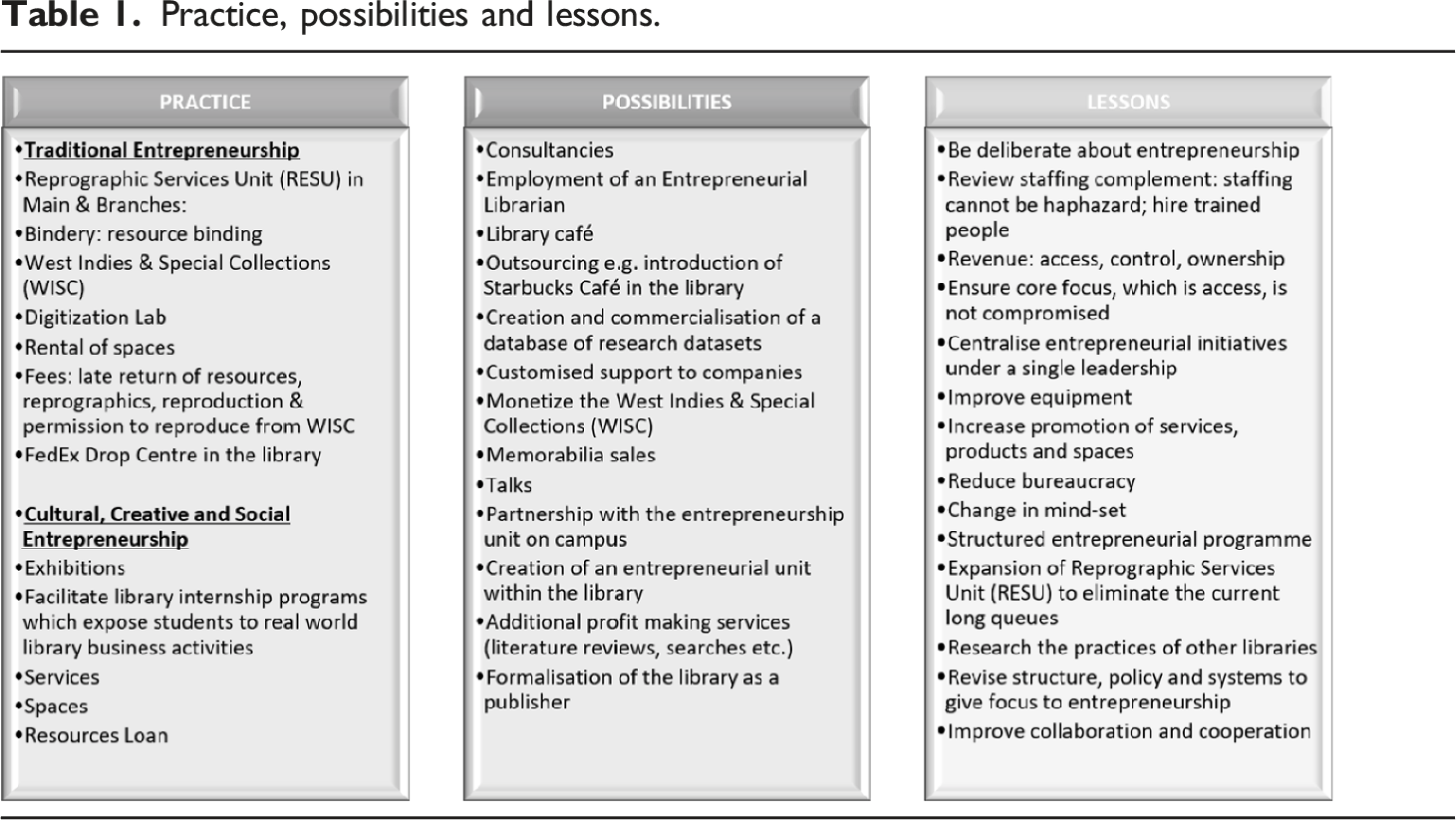
Practice, possibilities and lessons.
Data presentation
Data analysis/discussion
Practice
Perceptions of the understudy library as an entrepreneurial department are heterogeneous and are informed by ideations of entrepreneurship as having a social/creative/cultural/innovative/economic (profit-generating, income-directing and self-sustaining) value. Those who perceive the understudy library as entrepreneurial, hold to notions of entrepreneurship as social/creative/cultural/innovative/economic. Within this context, the profit generating output of entities such as the Reprographic Services Unit (RESU) and the Bindery, are indicators of entrepreneurship and as such are perceived as business resource entities of the understudy library. Additionally, rental of spaces, for example the Multifunction Room; fees charged for late return of resources, reproduction & permission to reproduce from the West Indies & Special Collections (WISC), and the utilization of the FedEx Drop Center, are viewed as evidence of the library being entrepreneurial. These are considered innovative business ideas implemented into library practice, which have translated into a level of profit for the library. The library’s plans to extend the facility to add services and products, for example, a library café, is an entrepreneurial thought. The understudy library is also perceived as entrepreneurial in the creative, cultural and social sense because it mounts a range of displays; hosts library internship programs, which expose students to real-world library business activity; houses a rich collection of resources, and gives support to students and faculty interested in entrepreneurship, all of which is thought to engender the cultural, social and creative sub-streams of entrepreneurship.
Where the understudy library is outrightly perceived as not being entrepreneurial, the view that entrepreneurship is profit generating and that the operations should run as a business, inform this perception. Those who are uncertain of the state of entrepreneurship in the understudy library, are also informed by the notion that an entrepreneurial library should operate as a business and should be making a profit. For both views, the understudy library falls short. Consequently, through this lens, generating profit through fees and services are not considered innovative by some, particularly because the fees and fines collected are insufficient to cover the full range of expenses of the library and also because of the inability to direct personal income power. This is a view underscored by Glosiene (2002) who argued: These charge-backs, while helpful, do not begin to put a dent in the expanding costs of the materials and technology, nor are they designed to do so. In fact, they may not cover cost centers they address. Placing the revenue-generating burden upon a single service creates enormous stress on that service; it also limits markets and revenue (p.5).
Although the perceptions of the understudy library as an entrepreneurial department are heterogeneous, there is homogeneity in the view that the understudy library is not yet fully entrepreneurial; it is believed entrepreneurship would need to be practiced on a deeper level. To get to a deeper level of entrepreneurial practice, buy-in is needed; and while the majority believes the understudy library should pursue entrepreneurship, there is the minority view that the library should: never pursue it; wait to pursue it; should only practice a particular sub-stream of entrepreneurship by way of a supporting role, namely: through the provision of resources and opportunities for training in resource discovery.
Those who believe entrepreneurship should be pursued contend it has the capacity to take the library beyond its current state; it offers a solution for the current financial challenge; it is a good marketing strategy; and it will enhance the library’s relevance in a changing environment. The library is however cautioned to ensure that the core mission of the library is not jeopardised in the pursuit of entrepreneurship. Conversely, it is believed that entrepreneurship should not be pursued because it is not at the core of what the library should do; certain human, intellectual and physical structures are not in place; the progress made with income generation is very limited, and the absence of control over revenue generated.
Structural and human resources issues also present a challenge to the understudy library’s entrepreneurial state.
Structural challenges
The understudy library does not have direct control and management of the revenue it generates. The understudy library’s revenue is deposited into the university’s central fund, which is referred to as “the blackhole”. It is believed that the absence of control over income generated, creates challenges in respect of purchasing and re-purchasing needed resources, which have the potential of expanding entrepreneurial practice and furthering profits. This lack of control of its income also contributes to low levels of staff motivation and entrepreneurial spirit. It is therefore difficult for the understudy library to do more within this environment.
Additionally, while there is an entrepreneurial mandate, there is no university or library policy on entrepreneurship. Further, some of the rules of the library do not allow for innovation; and delighting the customers, without negative consequences. The understudy library’s response to customers is limited to what the system allows.
Human resources challenges
The sample had conflicting views regarding their role in building an entrepreneurial library. Some believe everyone has a role to play in building an entrepreneurial library, while others contend there is a need for dedicated entrepreneurial staff, citing as example, the employment of a librarian with only an entrepreneurial portfolio. There is agreement that the current staff complement is not supportive of growing entrepreneurship; pulling staff from all sections to engage entrepreneurship is not ideal, as this ensures burn-out and contributes to aspects of entrepreneurship being left behind. Additional human resources are needed to expand the library’s commercial service offerings.
Entrepreneurial awareness and education are necessary: the term is still fuzzy for some; some believe entrepreneurship is solely income generation and profits. Additionally, knowledge of what obtains in other university libraries, which could be used to inform practice within the understudy library, is very low.
Possibilities & lessons
What would a more Entrepreneurial Library Look Like? The following were suggested:
Training & awareness
• Training is needed to create awareness of what it means to be an entrepreneurial library. Research into practices of entrepreneurial libraries with a view to determining possibilities would help to realise this.
Human & physical resources
• Staffing cannot be ad hoc. The library needs to be more strategic about staffing: it should seek to increase the staff complement, with emphasis on hiring persons trained in the areas of entrepreneurial need. Currently, there are aspects of entrepreneurship which are scattered across the various sections of the understudy library; all entrepreneurial initiatives should be centralised under one manager/leader; an entrepreneurial librarian is needed. The entrepreneurial librarian could centralise and manage all the components of entrepreneurship. • The Information Communication Technology (ICT) should be significantly improved.
Internal systems/structure
• The library should have full access, control and management of its revenue; the library’s income should not be placed in the central fund. The library should be able to direct and control its earning potential; it should own its profits and be able to re-invest as it desires. • A stronger thread of entrepreneurship should be woven throughout the university system in general, and the library system in particular, for example, entrepreneurship needs to inform the library rules. • Systems and structures should be reviewed, to allow persons to take action outside the box, and without sanctions. • Entrepreneurship should be deliberate; a structured programme is needed. • Everyone’s role should be clearly defined. • Bureaucracy should be eliminated.
Policy
• A university-wide entrepreneurial policy is needed to ensure direction, focus and agreement. This should inform the creation of a library strategic plan for entrepreneurship. • The politics of the university/library can dictate everything; this should be managed.
Collaboration
• The understudy library should collaborate with departments offering training in areas that can advance the entrepreneurial state of the library, for example, the Entrepreneurial and Commercialization Centre.
Product/service offerings
• The library should establish and formalise its role as a publisher. • Additional self-help kiosks should be introduced to reduce the need for staff and to reduce overhead costs. • The Reprographics Services Unit (RESU) should be expanded physically, to better accommodate the large number of customers who seek its services, and by extension, improve its earning power. • Digitization and intellectual property have the potential to generate income; these should be properly developed to maximise its entrepreneurial potential. • A database of research datasets should be created and commercialised for profits. • The promotion of services and products should be increased and regularised to achieve greater utility.
Practical/social implications of this research
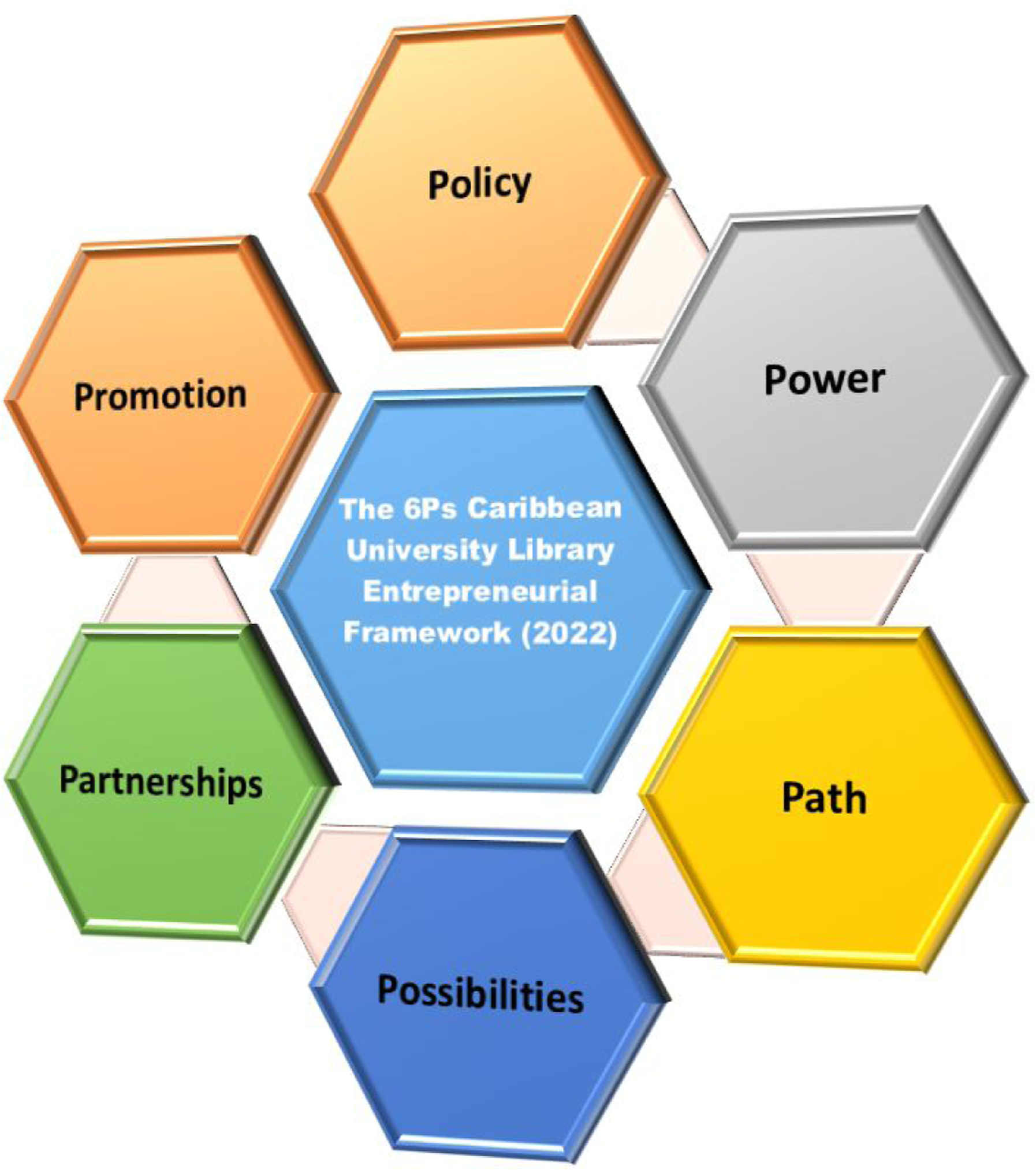
The findings of this study has practical implications for building an entrepreneurial academic library within a Caribbean context. The following figure (Figure 3) indicates the response activities or top priorities that university libraries could consider, and engage, for building an entrepreneurial library within the context of the English-speaking Caribbean. This framework is by no means exhaustive, and response activities/top priorities are only recommendations based on this study’s findings, and the literature reviwed; if adopted, these may need revision and a planning team for each of the 6Ps. • Policy. A university policy on entrepreneurship is essential. This should inform the creation of a library policy on entrepreneurship. The policy should facilitate the library having a deep level of access to, control and management of its revenue. • Power. All entrepreneurial activities should be centralised under an entrepreneurial librarian or an entrepreneurial unit/section within the library. The library should have deep control of its profits. • Path. Engender consensus on the entrepreneurial path(s) to be taken. This will require a deliberate programme of entrepreneurial awareness in general, and library entrepreneurship in particular. A review of the initiatives of other libraries is useful as well as those of the Caribbean; regarding the latter, possible paths include: access to finance, digital innovation, virtual economy, sustainable development (gender equality, climate action) The path could also be profit-making and/or innovation etcetera. • Possibilities. Identify the library’s possible markets: economic potentials/social potentials/creative potentials for entrepreneurship within the context of the core mission of the library. The entrepreneurial path selected will inform the possibilities. Additionally, based on the literature on Caribbean entrepreneurship, Caribbean libraries with a focus on entrepreneurship could seek out and develop the following possibilities: mobile information projects/services; digital innovation; virtual library economy; crowdfunding; Caribbean climate change information projects/services; library greening initiatives; projects/services empowering women/gender equality; access to finance initiatives, for example, provision of information resources in the area of finance, and/or spaces facilitating access to finance discussions/seminars, for example, the establishment of an access to finance information commons. Possibilities herein this paper will be fluid, consequently, tracking and staying abreast of Caribbean entrepreneurial activities and global library entrepreneurial activities will be critical. To this end, an information pool on existing and potential markets would be of value. • Partnerships. Key partners within and without the university should be identified and engaged to maximise gain and possibilities. For Caribbean entrepreneurial libraries, possibilities include: Climate change organisations/groups, technology innovation partners (for example, PitchIT Caribbean, as well as the leading communication providers, namely, Digicel and Flow). Other partnership possibilities include those empowering gender equality or those with a focus on women -- for example, Women Innovators Network in the Caribbean. Other possible partnerships include: LINK-Caribbean. • Promotion. The library’s image and value should be carefully planned, managed, and articulated quantitatively and qualitatively. Entrepreneurial products, services and spaces should be promoted using a combined traditional and contemporary approaches. The 6Ps caribbean university library entrepreneurial framework.
Conclusion
The status of the understudy library as an entrepreneurial department lacks consensus because of the varying notions of what constitutes entrepreneurship generally, and the entrepreneurial university library in particular. There is still the notion that entrepreneurship is about making profits, running a business (but the library is not considered as a business) and that entrepreneurship that is not profit-generating is inferior/less ideal. Notwithstanding this view, there is evidence of a number of the sub-streams of entrepreneurship within the understudy library, which can be strengthened and formalised to have greater impact. And although profit generating initiatives are needed and should be emphasized because of the library’s funding reality and the need to monetise and articulate quantitative value, this is a limited perspective as it does not allow for focus on the depth and breadth of entrepreneurial librarianship. The absence of consensus from the narratives points to the need for intralibrary entrepreneurial dialogue, entrepreneurial awareness and entrepreneurial library consciousness, particularly in respect of the various sub-streams of entrepreneurship and entrepreneurship engagement. The implementation of a university policy on entrepreneurship, human resources support, mindset-reset, buy-in, consensus on the entrepreneurial way forward, deliberate entrepreneurial thought and action, revised and re-aligned systems and structures to better facilitate implementation, would serve to strengthen entrepreneurship and have a greater development impact.
Footnotes
Declaration of Conflicting Interests
The author(s) declared no potential conflicts of interest with respect to the research, authorship, and/or publication of this article.
Funding
The author(s) received no financial support for the research, authorship, and/or publication of this article.
Interview Guide
1. Do you perceive The Mona Library as an entrepreneurial entity? a. If Yes: i. State the ways in which The Mona Library is entrepreneurial. ii. How can The Mona Library improve its entrepreneurial state? b. If No: i. Why? ii. What strategies can The Mona Library implement to become an entrepreneurial entity? 2. Do you believe The Mona Library should pursue entrepreneurship? If Yes, Why? If No, Why not? 3. What is the state of entrepreneurship in your section? 4. What are your views on the state of entrepreneurship in The Mona Library? 5. Do you believe you have a role to play in the practice of entrepreneurship in The Mona Library? a. If Yes: i. Why/How? b. If No: i. Why? 6. What are your general views on entrepreneurship in university libraries?
Key Terms and Definitions
• Academic library: a library within an educational institution of higher learning whose core function is to support the programme offerings of the institution to which it belongs. Its main clientele are faculty and students. • University library: a library within an educational institution of higher learning whose core function is to support the programme offerings of the institution to which it belongs. Its main clientele are faculty and students. • Entrepreneurial librarian: an information professional with at least a degree at the masters level in library and information science, who has the requisite skills, competencies and expertise in providing information services, products and spaces in support of the various sub-streams of entrepreneurship. • Economic entrepreneurial librarianship: the creation and leveraging of innovative services, spaces and products to generate financial gain within the context of the core mission of libraries • Creative entrepreneurial librarianship: the exploitation of the library’s creative or intellectual capital; the leveraging of services, products and spaces to stimulate creativity within customers, to drive development. • Cultural entrepreneurial librarianship: the promotion of the library as a centre of creativity: the provision of social connections, networks, spaces, services, projects and products to stimulate creativity within customers to drive growth.