

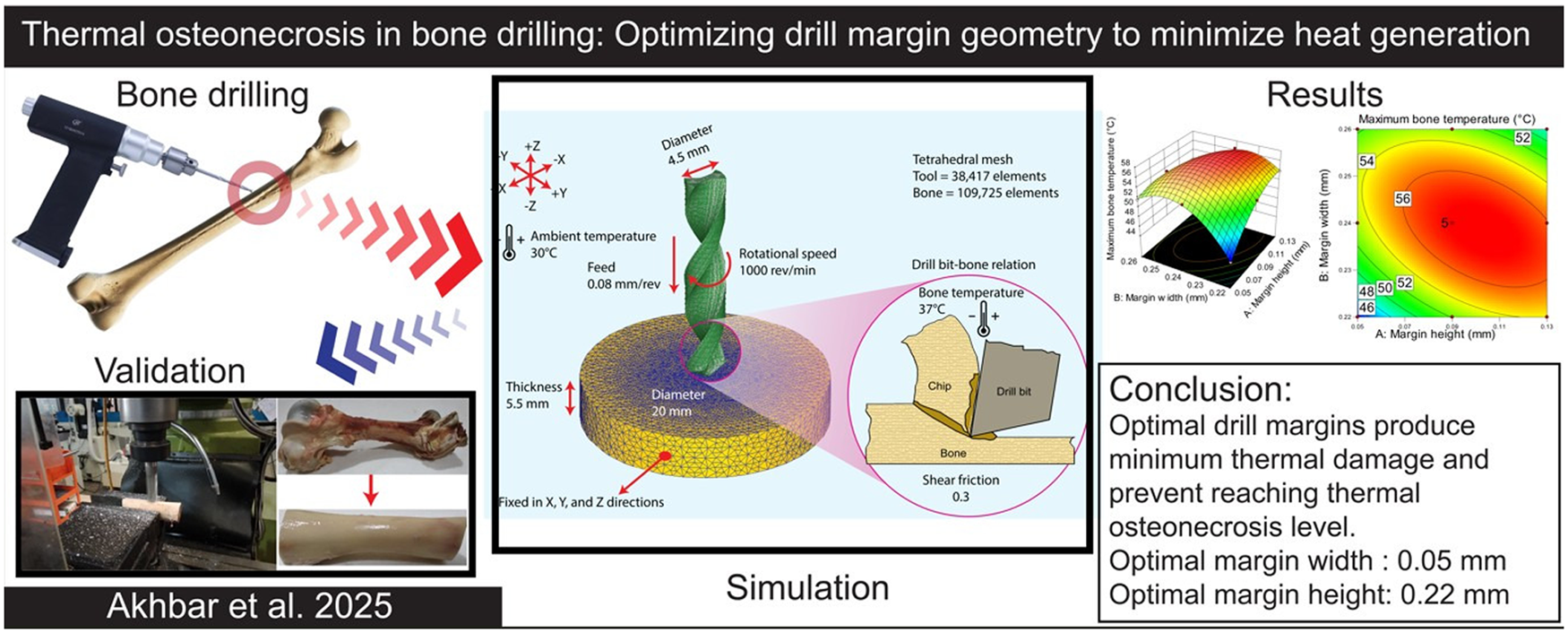
Excessive heat generation during bone drilling causes thermal osteonecrosis, posing a significant risk in orthopedic and dental procedures. While various aspects of drill design have been studied, the specific influence of margin geometry remains underexplored in the context of thermal engineering. This study integrates drilling simulation, experimental validation, and statistical optimization to evaluate the thermal impact of drill margin width (Mw) and height (Mh) during cortical bone drilling. A validated thermo-mechanical model was developed using commercial software DEFORM-3D. The simulation results were validated with experimental bone drilling with small temperature prediction errors (2.4% and 8.0%). Key thermal metrics (maximum temperature (Tmax), osteonecrosis diameter (OD), and osteonecrosis depth (OH)) were optimized using a central composite design (CCD) of response surface methodology (RSM) and desirability-based multi-objective optimization. Results revealed that Mw had the most significant second-order influence on Tmax (47.2%), while Mh dominated OD (41.1%) and OH (47.8%). The optimal drill margins (Mh = 0.05 mm and Mw = 0.22 mm), which achieved a desirability score of 0.985, could reduce Tmax by up to 44.8°C, which is below the osteonecrosis threshold. This work highlights drill margins as a critical yet previously underutilized design variable, offering an alternative pathway for the thermally optimized development of surgical tools and next-generation robotic-assisted drilling systems.
WessapanTRattanadechoP.Thermal effects of metal implants embedded in different layers of human tissues exposed to electromagnetic fields. Case Stud Therm Eng2024; 53: 103771.
2.
KitahamaYShizukaHNakanoY, et al. Advancements and challenges in robot-assisted bone processing in neurosurgical procedures. Neurospine2024; 21: 97–103.
3.
YuanDWuZYangL, et al. Biomechanical analysis of the drilling parameters for early osteonecrosis of the femoral head. Comput Methods Programs Biomed2022; 219: 106737.
4.
LiuHWangWZhaoY, et al. Effect of stimulation sites on the performance of electromagnetic middle ear implant: a finite element analysis. Comput Biol Med2020; 124: 103918.
5.
CellesCASFerreiraIValenteMDD, et al. Osseointegration in relation to drilling speed in the preparation of dental implants sites: a systematic review. J Prosthet Dent2025; 133: 394–401.
6.
KungP-CHeydariMTsouN-T, et al. A neural network framework for immediate temperature prediction of surgical hand-held drilling. Comput Methods Programs Biomed2023; 235: 107524.
7.
ZhangJGuoSTaoM, et al. Automatic planning and geometric analysis of the drilling path in core decompression surgery for osteonecrosis of the femoral head. Comput Methods Programs Biomed2024; 247: 108059.
8.
AkhbarMFASulongAW. Surgical drill bit design and thermomechanical damage in bone drilling: a review. Ann Biomed Eng2021; 49: 29–56.
9.
DolanEBHaughMGVoisinMC, et al. Thermally induced osteocyte damage initiates a remodelling signaling cascade. PLoS One2015; 10: e0119652.
10.
FieldJRSumner-SmithG.Bone blood flow response to surgical trauma. Injury2002; 33: 447–451.
11.
AkhbarMFA. Thermomechanical damage in cortical bone caused by margins of surgical drill bit: a finite element analysis. Comput Methods Programs Biomed2023; 231: 107361.
12.
AkhbarMFAYusoffAR. Fast & injurious: reducing thermal osteonecrosis regions in the drilling of human bone with multi-objective optimization. Measurement2020; 152: 107385.
13.
ZhaiYHanGGaoQ, et al. Experimental investigation on longitudinal torsional ultrasonic vibration milling for cortical bone. J Manuf Process2024; 120: 529–541.
14.
GokKGokAKisiogluY.Optimization of processing parameters of a developed new driller system for orthopedic surgery applications using Taguchi method. Int J Adv Manuf Technol2015; 76: 1437–1448.
15.
EinafsharMMRajaeiradMBabazadeh GhazijahaniA, et al. On the importance of precision in cortical bone drilling: integrating experimental validation and computational modeling. J Orthop2024; 56: 70–76.
16.
PazarcıÖGündoğduF. Temperature change during orthopedic drilling procedures: an experimental surgical internal fixation simulation study. J Orthop2023; 46: 58–63.
17.
SchofieldEAReissSLReyAE, et al. Tool parameters to minimize temperature changes in bone drilling. Injury2023; 54: 904–909.
18.
AkhbarMFAYusoffAR. Multi-objective optimization of surgical drill bit to minimize thermal damage in bone-drilling. Appl Therm Eng2019; 157: 113594.
19.
AkhbarMFAYusoffAR. Drilling of bone: effect of drill bit geometries on thermal osteonecrosis risk regions. Proc Inst Mech Eng H2019; 233: 207–218.
20.
SorianoJGarayAAristimuñoP, et al. Effects of rotational speed, feed rate and tool type on temperatures and cutting forces when drilling bovine cortical bone. Mach Sci Technol2013; 17: 611–636.
21.
SorianoJGarayAAristimuñoP, et al. Study and improvement of surgical drill bit geometry for implant site preparation. Int J Adv Manuf Technol2014; 74: 615–627.
22.
HilleryMTShuaibI.Temperature effects in the drilling of human and bovine bone. J Mater Process Technol1999; 92-93: 302–308.
23.
TreeceGMGeeAHMayhewPM, et al. High resolution cortical bone thickness measurement from clinical CT data. Med Image Anal2010; 14: 276–290.
24.
MelnisAÉKnetsIV. Effect of the rate of deformation on the mechanical properties of compact bone tissue. Mech Compos Mater1982; 18: 358–363.
25.
AkhbarMFAYusoffAR. Comparison of bone temperature elevation in drilling of human, bovine and porcine bone. Procedia CIRP2019; 82: 411–414.
26.
MellalAWiskottHWBotsisJ, et al. Stimulating effect of implant loading on surrounding bone. Comparison of three numerical models and validation by in vivo data. Clin Oral Implants Res2004; 15: 239–248.
27.
AkhbarMFAYusoffAR. Drilling of bone: thermal osteonecrosis regions induced by drilling parameters. Biomed Phys Eng Express2019; 5: 065003.
28.
KohlesSS.Applications of an anisotropic parameter to cortical bone. J Mater Sci Mater Med2000; 11: 261–265.
29.
HuiskesR.Some fundamental aspects of human joint replacement: analyses of stresses and heat conduction in bone-prosthesis structures. Acta Orthop Scand1980; 185: 1–208.
30.
DEFORM 3D Version 11.0, User’s Manual. Version 11. Scientific Forming Technologies Corporation, 2545 Farmers Drive, Suite 200 Columbus, Ohio, 2014, pp. 1–4224.
31.
AkhbarMFAMalikMYusoffAR.Effects of drilling parameters in numerical simulation to the bone temperature elevation. AIP Conf Proc2018; 1948: 020002.
32.
AkhbarMFAMohd AshriMFYusoffAR, et al. Optimization of drill bit geometries for minimum thermal damage in bone drilling. J Adv Res Fluid Mech Therm Sci2024; 122: 22–37.
33.
Freire BalsecaDACastro ReyesKSMaldonado RodríguezME.Optimization of an alternative culture medium for phycocyanin production from Arthrospira platensis under laboratory conditions. Microorganisms2024; 12: 363.
34.
AdelekeAORoyahuCOAhmadA, et al. A novel oyster shell biocomposite for the efficient adsorptive removal of cadmium and lead from aqueous solution: synthesis, process optimization, modelling and mechanism studies. PLoS One2024; 19: e0294286.
35.
BbumbaSKigoziMNabatanziJ, et al. Response surface methodology: a review on optimization of adsorption studies. Asian J Chem Sci2024; 14: 106–113.
36.
KolbadinejadSGhaemiA.Optimization of atmospheric leaching parameters for cadmium and zinc recovery from low-grade waste by response surface methodology (RSM). Sci Rep2024; 14: 1490.
37.
AgarwalRSinghJGuptaV.Prediction of temperature elevation in rotary ultrasonic bone drilling using machine learning models: an in-vitro experimental study. Med Eng Phys2022; 110: 103869.
38.
ZhangYXuLWangC, et al. Mechanical and thermal damage in cortical bone drilling in vivo. Proc Inst Mech Eng Part H: J Eng Med2019; 233: 621–635.
39.
ShakouriEGhorbani NezhadMGhorbaniP, et al. Investigation of thermal aspects of high-speed drilling of bone by theoretical and experimental approaches. Phys Eng Sci Med2020; 43: 959–972.