



Abstract
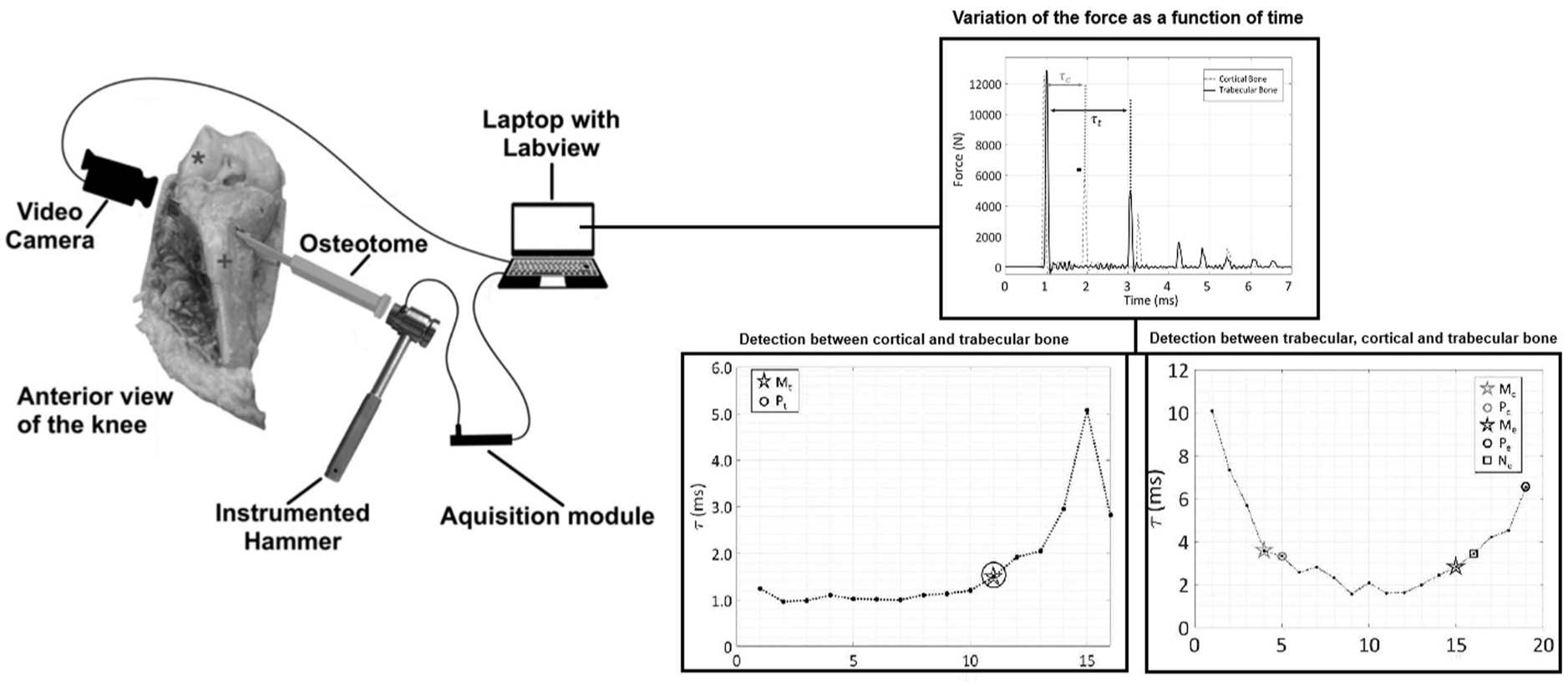
Open-wedge High-Tibial Osteotomy is the most commonly employed technique addressing varus knee osteoarthritis. During this procedure, the osteotome passes through cortical and trabecular bone. A common complication is lateral hinge fractures, which depends upon when the surgeon stops impacting the osteotome. The aim of the present study is to determine whether an instrumented hammer can be employed to detect (i) the bone type (cortical or trabecular) surrounding the osteotome tip and (ii) when bone is fractured by the osteotome. Seventeen lower-limb specimens were obtained from nine fresh human anatomical subjects. The osteotome was impacted using the instrumented hammer until rupture. Each impact signal was recorded and analyzed. An algorithm was developed to detect the transitions between cortical and trabecular bone and vice versa. Detection was based on the relative variation of τ derived from the force signal as a function of time as the time difference between the second and first impact peaks. The values of τ were significantly lower in cortical bone compared to trabecular bone. Considering the arrival of the osteotome tip in trabecular bone during a medial, a difference of less than 2 impacts between the surgeon and the algorithm was obtained for 71% of the cases. For the lateral osteotomy it was obtained in 81% of the cases. This cadaveric study demonstrated that the instrumented hammer could prevent impacts leading to hinge rupture, which suggests that future clinical trials are warranted.
Get full access to this article
View all access options for this article.