




Abstract
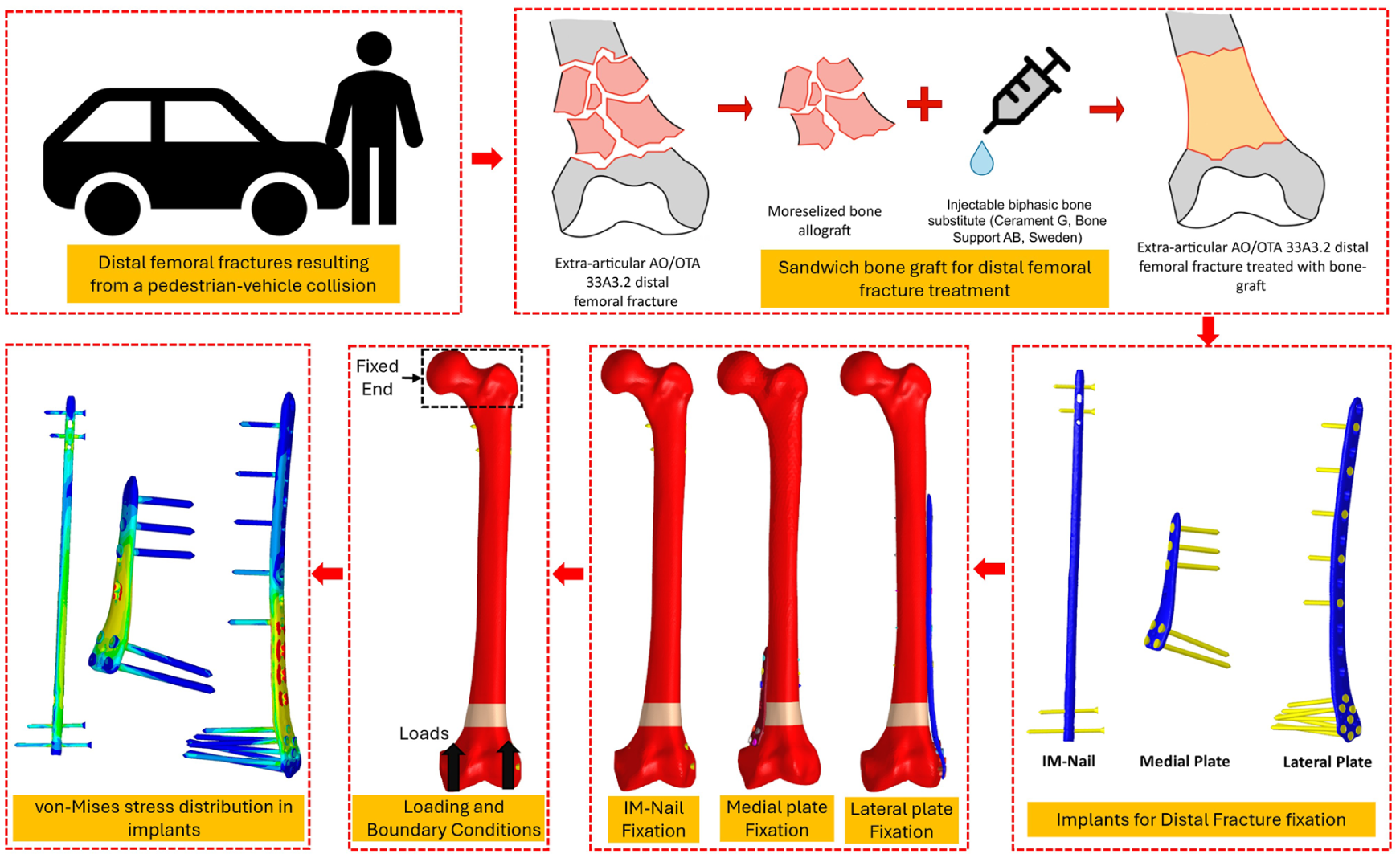
In case of extra-articular fractures, internal fixation is usually performed using implants such as Intramedullary nails (IMN), medial plates (MP), and lateral plates (LP). Recently, an innovative “sandwich” technique has been introduced for treating acetabular defects. The efficacy of such a technique to treat comminuted extra-articular distal femoral fractures has never been investigated. Therefore, the current study aims to compare the biomechanical performances of three implants, that is, medial plate, lateral plate, and IM nails, with and without the “sandwich” bone grafts. A CAD model of composite bone was used in the study. An extra-articular comminuted distal femoral fracture (2.5 cm) was virtually created in the intact femur using the Materialize 3-matics™ software. The fracture fixation was performed using three implant systems (IMN, MP, and LP) with and without bone graft. A tetrahedral volume mesh was generated, and simulations were performed corresponding to the loading condition of the single leg stance of a person. The use of “sandwich” bone grafts was observed to reduce implant stresses by 4.4%, 57.3%, and 66.2%, and displacements by 17.4%, 56.6%, and 59.7%, in the cases of IMN, MP, and LP, respectively. The Finite Element results showed that the IM nail provided the best results regarding the von Mises distribution, displacement of the implant bone assembly, displacement of the fracture fragments, and contact sliding. Furthermore, the use of Cerament®-filled bone grafts considerably reduced von Mises stresses in the implants and the displacements of the implant-bone assembly.
Keywords
Get full access to this article
View all access options for this article.