



Abstract
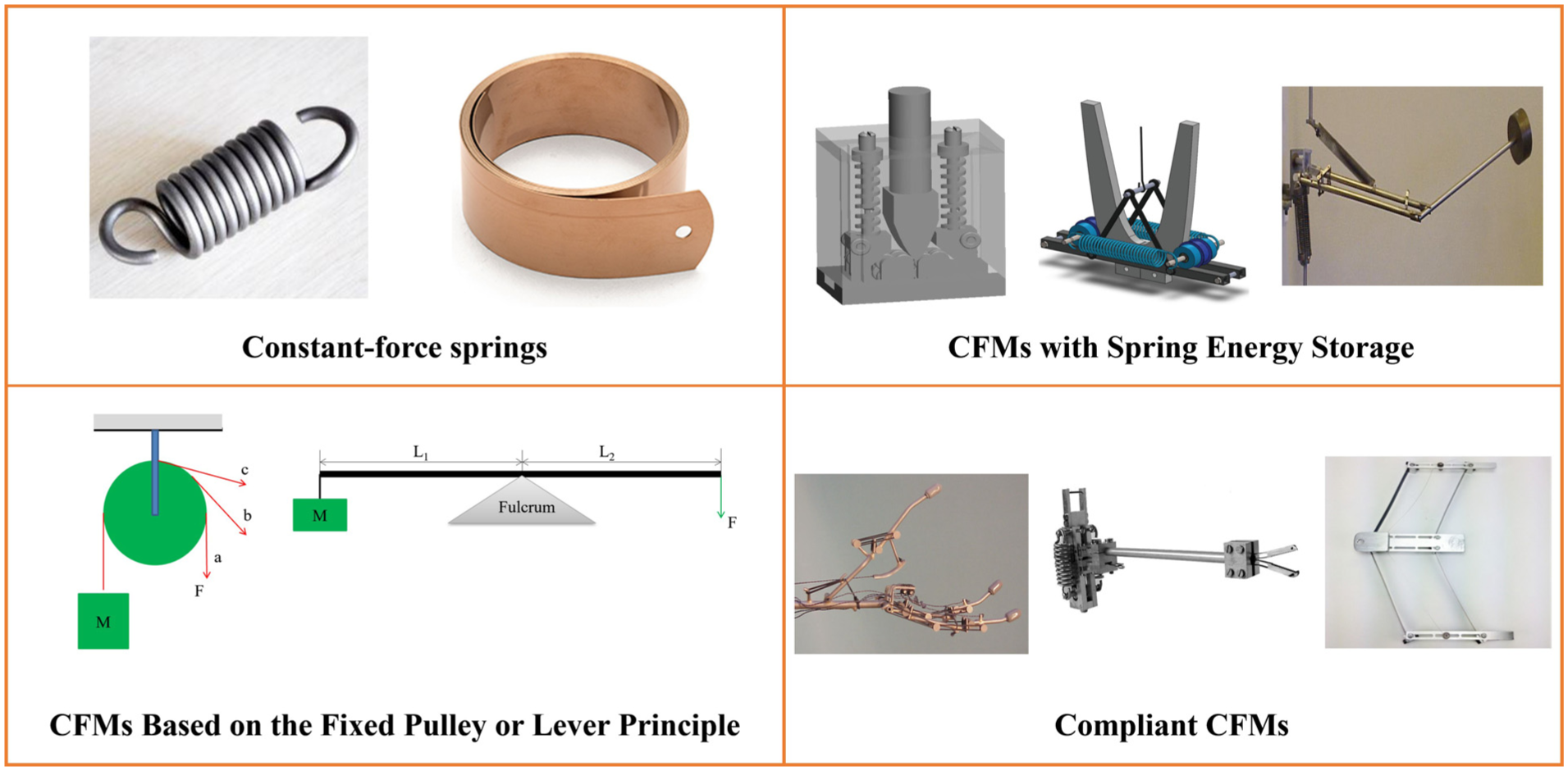
Constant force mechanisms have been widely applied in various industrial fields but encounter challenges in medical applications due to the risk of soft tissue injuries caused by clamping devices exerting excessive pressure. This study reviews existing design methods for constant force mechanisms through a comprehensive search of databases such as Google Scholar, ScienceDirect, and IEEE Xplore. The reviewed methods include constant force springs, mechanisms based on fixed pulleys, mechanisms utilizing spring energy storage, and compliant mechanisms. However, these designs have limitations, particularly in achieving miniaturization and adapting to the delicate environment of the human body. To address these issues, an emerging design approach combines the superelasticity of shape memory alloys (SMAs) with structural optimization. This method reduces structural complexity, weight, and size, making it highly suitable for medical applications that require simplicity and consistent force output. This approach holds significant potential for advancing the development of safe and effective medical clamping devices.
Keywords
Get full access to this article
View all access options for this article.