



Abstract
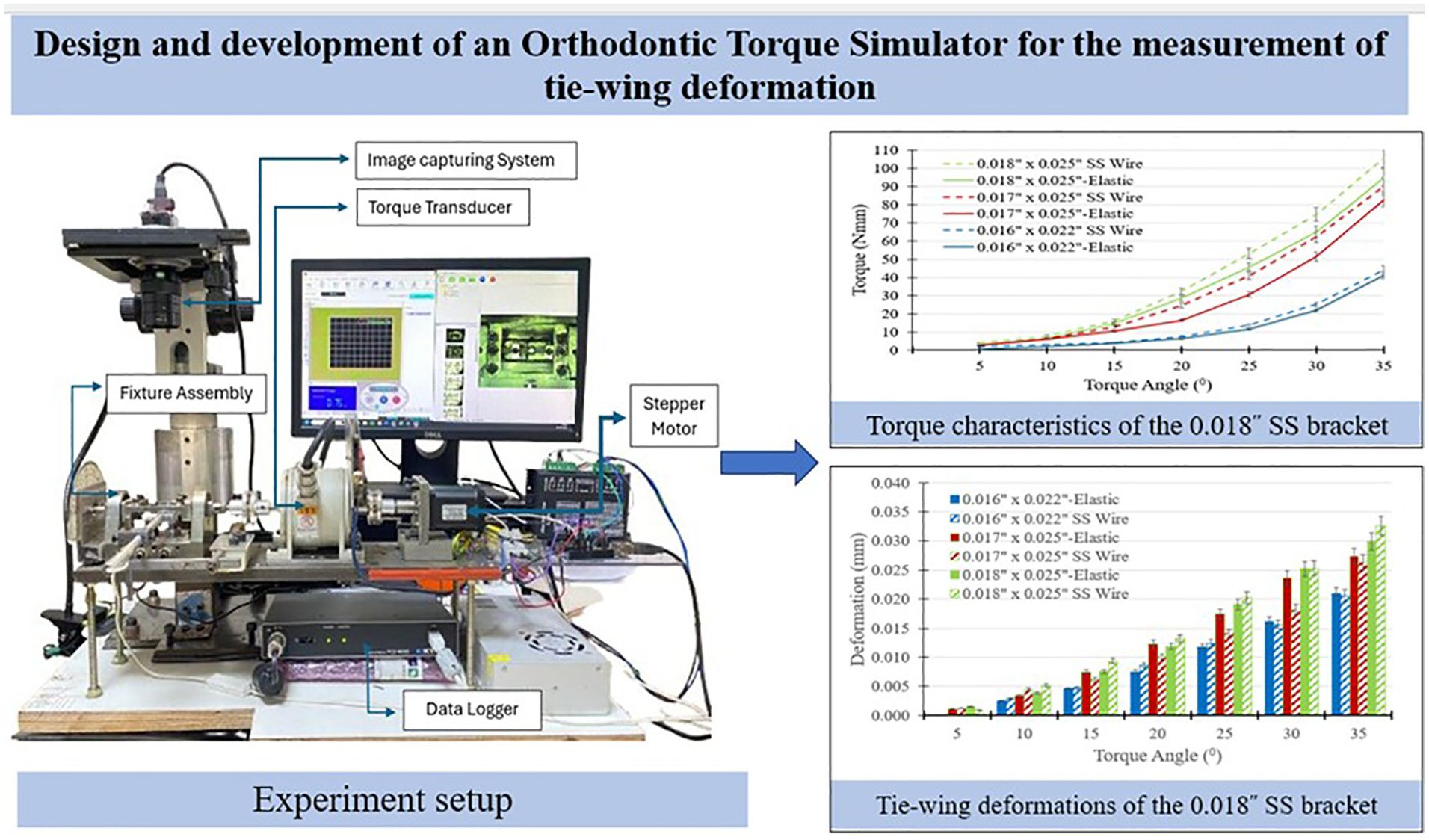
In fixed appliances, archwire rotation transfer the applied forces to the bracket which causes repositioning of the crown or roots of a tooth. Understanding this process is difficult due to the complex geometry and miniature dimensions of the bracket and archwire. In this work, an experimental setup was designed, and fabricated to measure the torque induced in the bracket-archwire-ligature combinations and to find the tie-wing deformation for varying archwire rotations. The developed setup has four components, namely, fixture assembly to position and hold the bracket-archwire-ligature combination; torque measurement system; vision capture system to calculate the deformation of bracket tie-wings; and drive system to rotate the archwire. The fabricated setup was validated with different sizes of stainless steel (SS) bracket-archwire-ligature combinations. The developed experimental setup was used to measure the torque and tie-wing deformation of 0.018″ and 0.022″ conventional brackets with three different archwires and ligatures and 15 trials each. The clinically effective torque angle required for the orthodontic treatments were analyzed along with tie-wing deformation. The test results were compared with the literature and validated. The torque moment of both 0.018″ and 0.022″ bracket systems increased as the archwire width and archwire rotation increased. The torque moment with SS wire ligation was significantly larger than that of elastic ligature for all the archwires tested in both systems. Each bracket-archwire-ligature combination tested had shown significantly different torque characteristics and tie-wing deformations. This study would be of clinical importance to find the tie-wing deformation along with torque on various bracket-archwire-ligature combinations.
Get full access to this article
View all access options for this article.