



Abstract
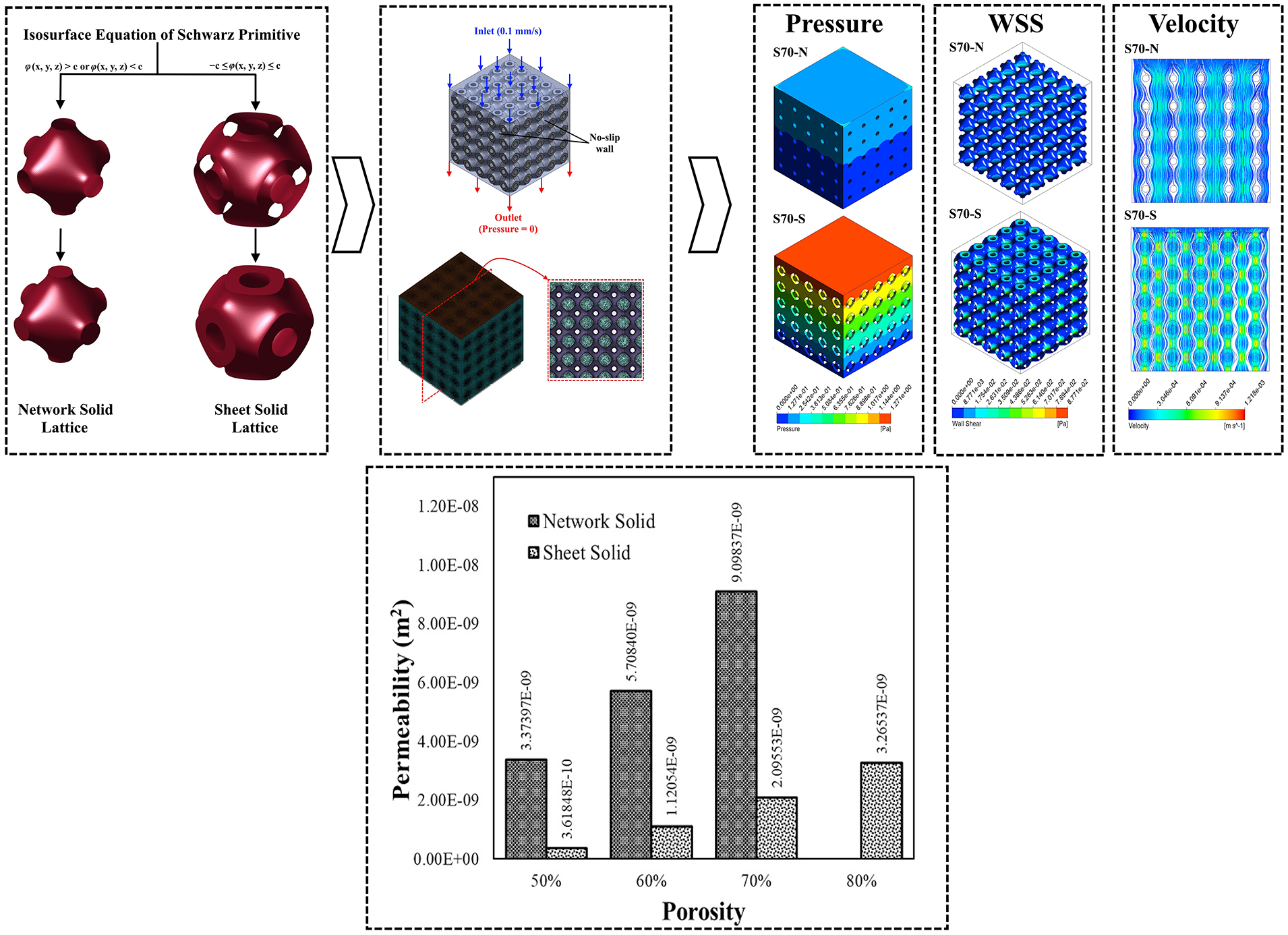
Scaffolds developed from Triply Periodic Minimal Surface (TPMS) structures effectively mimic the geometric, mechanical, and fluid transport characteristics of human bones. These porous architectures facilitate fluid flow and augment bone cell adhesion and proliferation through their substantial surface area. In this study, the potential of network solid and sheet solid TPMS scaffolds with the same Schwarz Primitive architecture was compared for bone regeneration. Both types were modeled at 50%, 60%, 70%, and 80% porosity. A computational fluid dynamics (CFD) analysis was conducted to assess parameters such as surface area, pore size, permeability, wall shear stress, and flow rate. These parameters are known to exert a significant influence on the behavior of bone cells. The results demonstrated that network solids exhibited enhanced permeability and augmented pore sizes, thereby facilitating cell migration and nutrient delivery. Conversely, sheet solids exhibited elevated surface areas, thereby fostering cell adhesion and proliferation. Despite exhibiting equivalent porosity, the two structures manifested discernible disparities in geometry and flow performance. Network solid structures generally provided more favorable conditions for fluid flow and mechanical stimulation. Nevertheless, the selection of network or sheet architectures should be informed by specific clinical needs and tissue requirements. The findings demonstrate that architectural differences significantly affect scaffold performance, and understanding these effects can help optimize scaffold design for bone tissue engineering applications.
Get full access to this article
View all access options for this article.