



Abstract
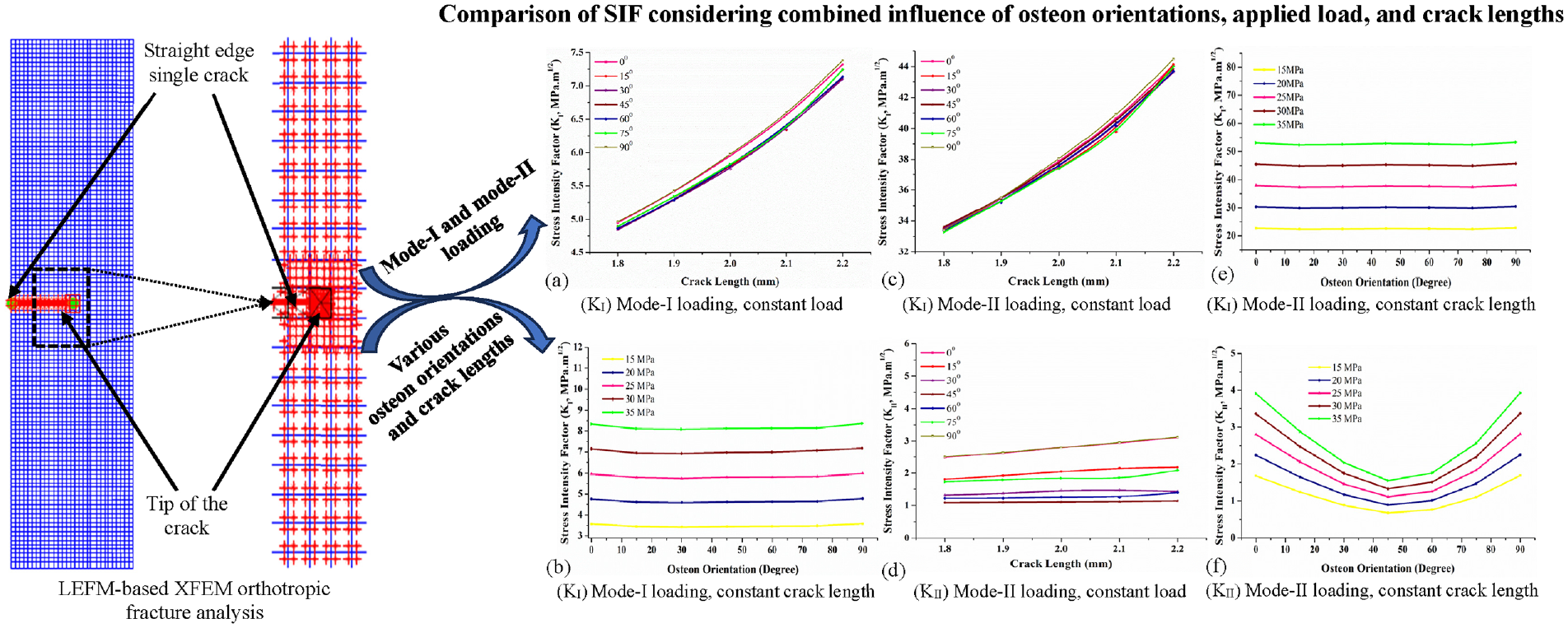
Similar to how fiber orientation affects composite materials, osteon orientation affects the elasticity and fracture behavior of cortical bone. The objective of this work is to predict the combined effect of orientations of the osteon, applied load, and various crack lengths on the fracture characteristics of cortical bone. Orthotropic modeling and analyses of cortical bone were carried out using the linear-elastic fracture mechanics (LEFM) based extended finite element method (XFEM). Five values of applied mode-I and mode-II load, five distinct crack lengths, and seven angular osteon orientations were taken into consideration to predict the change in SIF. In this work, the 2-D plane stress assumption with a straight-edge crack was taken into consideration. It was found that the values of SIF significantly increased when the load (15–35 MPa) and fracture length (1.8–2.2 mm) increased. SIF (KI) values under mode-I loading were discovered to be substantially lower than SIF (KI and KII) values under mode-II loading. Results of this study showed that osteon orientations with different crack lengths and applied loads had a significant impact on cortical bone fracture characteristics. Only the crack’s opening was discovered to be caused by mode-I loading; however, both the opening and shearing of the crack were found to be caused by mode-II loading. Despite differences in applied loads, crack lengths, and osteon orientations, the values of the SIF predicted in this work (under mode-I loading) using LEFM-based XFEM exhibited good agreement with the prior published experimental and numerical data.
Get full access to this article
View all access options for this article.
References
Supplementary Material
Please find the following supplemental material available below.
For Open Access articles published under a Creative Commons License, all supplemental material carries the same license as the article it is associated with.
For non-Open Access articles published, all supplemental material carries a non-exclusive license, and permission requests for re-use of supplemental material or any part of supplemental material shall be sent directly to the copyright owner as specified in the copyright notice associated with the article.
