



Abstract
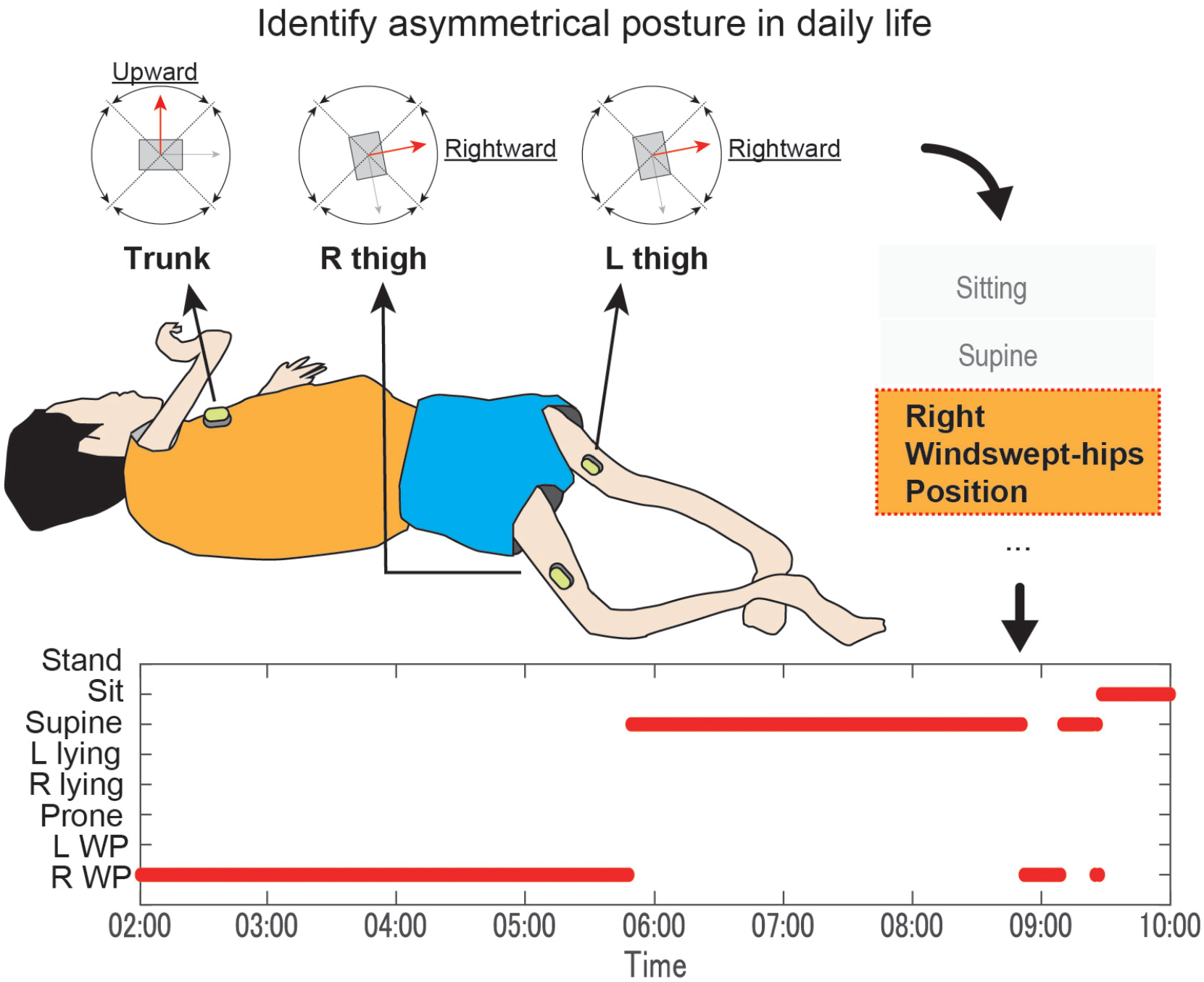
An asymmetric windswept posture is often seen in children with severe cerebral palsy (CP). However, it is still unclear how long children with CP remain in the windswept posture in daily life. Thus, we developed a triple-accelerometer system for detecting windswept posture. The aim of this study was to assess the validity of a system for classifying various body postures and movements. We assessed the accuracy of our system in nine healthy young adults (age range, 21–23 years). The participants wore acceleration monitors on the sternum and both thighs, then spent 3 min each in eight different positions and three physical activities. Once accuracy was confirmed, we assessed the posture and movements for 24 h in six healthy young adults (age range, 21–23 years) in their home environments. The body postures and activities were correctly detected: the agreement across the subjects were 100% compatible with the subjects’ activity logs at least 68% of the time, and at least 96% of the time for recumbent positions. We concluded that the proposed monitoring system is a reliable and valid approach for assessing windswept hip posture in a free-living setting.
Keywords
Get full access to this article
View all access options for this article.
References
Supplementary Material
Please find the following supplemental material available below.
For Open Access articles published under a Creative Commons License, all supplemental material carries the same license as the article it is associated with.
For non-Open Access articles published, all supplemental material carries a non-exclusive license, and permission requests for re-use of supplemental material or any part of supplemental material shall be sent directly to the copyright owner as specified in the copyright notice associated with the article.
