



Abstract
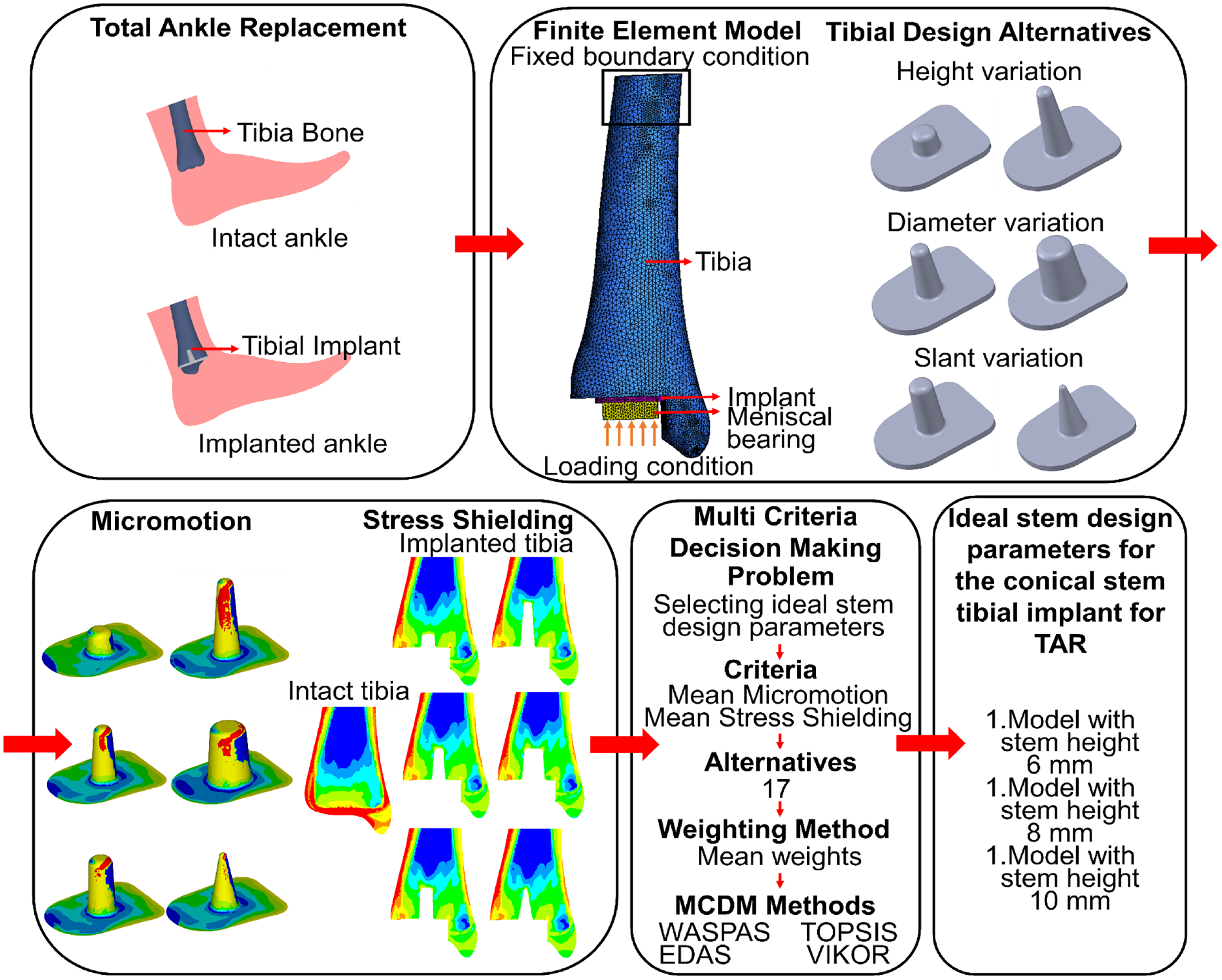
The conical stem tibial design of total ankle replacement (TAR) has high implant-bone micromotion. This may lead to aseptic loosening which can be avoided by improving the tibial design. The objective was to propose the best stem design parameters to reduce implant-bone micromotion along with minimizing stress shielding using an integrated Finite Element-Multi Criteria Decision Making (FE-MCDM) approach. FE models of implanted tibia bones were prepared by changing the height of the stem, the diameter of the stem, and the slant of the stem. Weighted Aggregated Sum Product Assessment (WASPAS), Technique for Order of Preference by Similarities to Ideal Solution (TOPSIS), Evaluation based on Distance from Average Solution (EDAS), and VIseKriterijumska Optimizacija I Kompromisno Resenje (VIKOR) MCDM techniques with equal weights for micromotion and stress shielding were considered. The micromotion and stress shielding were greater when the height of the stem was increased. Whereas, the increase in diameter and slant affected them marginally. The best-performing design was the Model with stem height 6 mm (diameter 6.4 mm and slant 4°) and after that was the Model with stem height 8 mm (diameter 6.4 mm and slant 4°), and then the Model with stem height 10 mm (diameter 6.4 mm and slant 4°). The height of the stem is the most important stem design parameter. Shorter height, moderate thickness, and moderate slanting stem designs are recommended.
Keywords
Get full access to this article
View all access options for this article.
References
Supplementary Material
Please find the following supplemental material available below.
For Open Access articles published under a Creative Commons License, all supplemental material carries the same license as the article it is associated with.
For non-Open Access articles published, all supplemental material carries a non-exclusive license, and permission requests for re-use of supplemental material or any part of supplemental material shall be sent directly to the copyright owner as specified in the copyright notice associated with the article.
