



Abstract
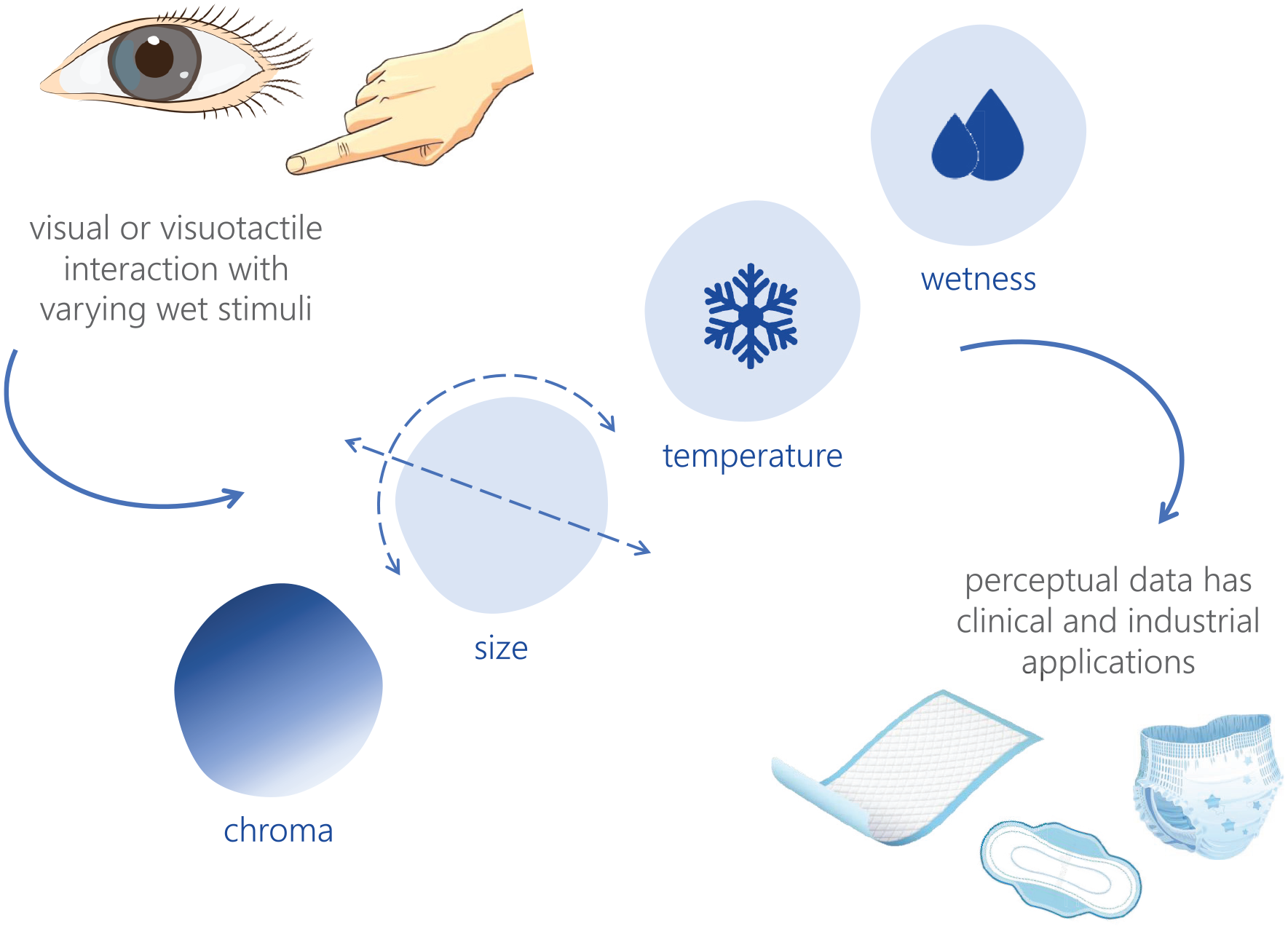
A multitude of sensory modalities are involved in humans’ experience of wetness, yet we know little of the integratory role of vision. Therefore, the aim was to quantify the effect of physical stain volume, chroma and size on wetness perception, and to compare wetness perception under different sensory conditions, including visuotactile and visual only interactions. Eighteen participants visually observed and/or used their index fingerpad to dynamically interact with stimuli varying in physical wetness (0, 2.16 × 10⁻⁴ or 3.45 × 10⁻⁴ ml mm−2), stain chroma (clear, light, dark) and stain size (1150 or 5000 mm2). After interaction participants rated wetness perception using a visual analogue scale (very dry to very wet). In visual only conditions participants were able to differentiate between dry and wet stimuli, and could also discriminate between different magnitudes of wetness with the addition of tactile cues. In both visual only and visuotactile conditions greater stain chroma resulted in increased wetness perception. Stain size did not have a significant effect in either condition. These results show that visual cues influence wetness perception (R2 = 0.29), but indicate that visual dominance does not apply in these sensory integrations. Findings are relevant for the design of products with wetness management properties.
Get full access to this article
View all access options for this article.
References
Supplementary Material
Please find the following supplemental material available below.
For Open Access articles published under a Creative Commons License, all supplemental material carries the same license as the article it is associated with.
For non-Open Access articles published, all supplemental material carries a non-exclusive license, and permission requests for re-use of supplemental material or any part of supplemental material shall be sent directly to the copyright owner as specified in the copyright notice associated with the article.
