




Abstract
The aim of this study was to assess whether the mechanical properties of mitral valve chordae tendineae are sensitive to being cross-linked under load. A total 64 chordae were extracted from eight porcine hearts. Two chordae (posterior basal) from each heart were subjected to uniaxial ramp testing and six chordae (two strut, two anterior basal and two posterior basal) were subjected to dynamic mechanical analysis over frequencies between 0.5 and 10 Hz. Chordae were either cross-linked in tension or cross-linked in the absence of loading. Chordae cross-linked under load transitioned from high to low extension at a lower strain than cross-linked unloaded chordae (0.07 cf. 0.22), with greater pre-transitional (30.8 MPa cf. 5.78 MPa) and post-transitional (139 MPa cf. 74.1 MPa) moduli. The mean storage modulus of anterior strut chordae ranged from 48 to 54 MPa for cross-linked unloaded chordae, as compared to 53–61 MPa cross-linked loaded chordae. The mean loss modulus of anterior strut chordae ranged from 2.3 to 2.9 MPa for cross-linked unloaded chordae, as compared to 3.8–4.8 MPa cross-linked loaded chordae. The elastic and viscoelastic properties of chordae following glutaraldehyde cross-linking are dependent on the inclusion/exclusion of loading during the cross-linking process; with loading increasing the magnitude of the material properties measured.
Keywords
Introduction
Chordae tendineae connect papillary muscles, attached to the left ventricle, to the anterior and posterior leaflets of the mitral valve.1,2 There are four types of chordae, characterised by their insertion points and corresponding geometry.1,3–6 Marginal chordae, which insert into the free edge of the leaflet, are often thinner and less extensible than other chordae. 3 Basal (referred to as rough zone chordae by Lam et al. 1 ) and strut chordae are thicker in diameter and insert between the free edge of the leaflet and the annulus. 5 Commissural chordae branch radially and insert into both leaflets.1,7 Strut chordae are thick basal chords which insert into the anterior leaflet, whereas both marginal and basal chordae insert into both the anterior and posterior leaflets.1,3 Marginal chordae are important in ensuring the mitral valve retains its competence, 8 while strut chordae enable physiological mitral valve leaflet motion9–11 and may have a role in valve competence during annular dilation. 12
Failure of chordae is associated with mitral valve prolapse, regurgitation and billowing. 5 Repair of the valve or its chordae13–15 or surgical replacement are two possible clinical procedures. 5 Repair can be performed so as to retain native chordae, resulting in a less invasive procedure.3,5,16–18 Full replacement could use either a bioprosthetic or mechanical replacement valve. 19 Studies into heart valve bioprosthetics have largely been oriented around aortic valve replacements where tissues are treated with glutaraldehyde as a fixative.20,21 Studies assessing the feasibility of performing mitral valve replacement with a mitral valve bioprosthesis 22 would ideally include the mitral subvalvular apparatus, leading to glutaraldehyde cross-linked chordae.
Cross-linking of heart valves with glutaraldehyde has typically been associated with increased tissue stiffness.21,23 However, glutaraldehyde treatment of porcine tissue valves has shown contradictory results. For instance, under bending and shear, tissue stiffness has been observed to increase.21,24 Under tension, either glutaraldehyde has little impact on tissue stiffness 25 or only alters part of the stress-strain relationship 26 ; alternatively, it decreases in tissue extensibility 27 and reduces the ultimate tensile strength of marginal chordae. 19 A recent study of ours on dynamic viscoelasticity found that glutaraldehyde treatment decreased both storage and loss moduli of chordae 28 ; paradoxically, our in vitro observations of glutaraldehyde-treated mitral valves identified limited (not increased) mobility. 22 Although the mechanical properties of natural mitral valve chordae are well documented,6,29–33 there are inconsistencies in findings from studies of chordae which focus on glutaraldehyde treatment.
The aim of this study is to evaluate whether glutaraldehyde cross-linking under tension, or in the absence of loading, alters the mechanical properties of mitral valve chordae tendineae. Chordae in tension were cross-linked in situ within an intact mitral valve. 22 Chordae cross-linked in the absence of loading were cross-linked following excision from the mitral valve. Material properties have been evaluated using a uniaxial ramp based elastic characterisation test, 34 and through dynamic mechanical analysis (DMA). The latter is a technique used to determine the storage and loss moduli of a viscoelastic material,7,35–37 which characterise the ability of a material to store and dissipate energy, respectively. In this study, data recently published 28 on the viscoelastic properties of basal chordae following glutaraldehyde fixation are compared to the mechanical behaviour of equivalent basal chordae from porcine mitral valves in Part-1 of this study. 22
Methods
Mitral valve specimens
A total of 64 chordae (n) were extracted from eight porcine hearts (N). Two chordae (posterior basal) from each heart were subjected to uniaxial ramp testing and six chordae (two strut, two anterior basal and two posterior basal) were subjected to DMA testing. Hearts were frozen upon extraction and delivered frozen and sealed by Fresh Tissue Supplies (Fresh Tissue Supplies, East Sussex, UK). They were stored at −40°C wrapped in tissue paper coated in Ringer’s solution following standard procedure.7,38 Freezing the tissues using this method has mostly not been found to adversely affect the mechanical properties of soft biological connective tissues.39,40
Viscoelastic data from four of the hearts (N = 4) forms the basis of a previous study on glutaraldehyde cross-linked chordae (under no loading). 28 The other four hearts (N = 4) were used for Part-1 of this study (i.e. cross-linked under tension). 22 Chordae from the former study were used as a measure of chordae cross-linked in the absence of loading; their dynamic viscoelastic properties are available in literature 28 and are hereby referred to as ‘cross-linked unloaded’; that study includes control data. Chordae from this current study, instead, were cross-linked under tension. This tensile load resulted from their attachment to a papillary muscle annular ring. 41 Chordae cross-linked under tension are hereby referred to as ‘cross-linked loaded’; their mechanical properties have not been reported elsewhere. Both ‘cross-linked unloaded’ and ‘cross-linked loaded’ chordae have undergone mechanical testing using the same testing procedure. The ‘cross-linked loaded’ chordae were excised following the full testing undertaken during Part-1 of this study. 22 Therefore, this current study reports on the mechanical behaviour of cross-linked unloaded and cross-linked loaded chordae tendineae as outlined in Table 1.
Number of test chordae (n) used for each test. For each test category the test specimens were obtained from four hearts (N). AL-S refers to anterior leaflet strut chordae, AL-B to anterior leaflet basal chordae, PL-B to posterior leaflet basal chordae.
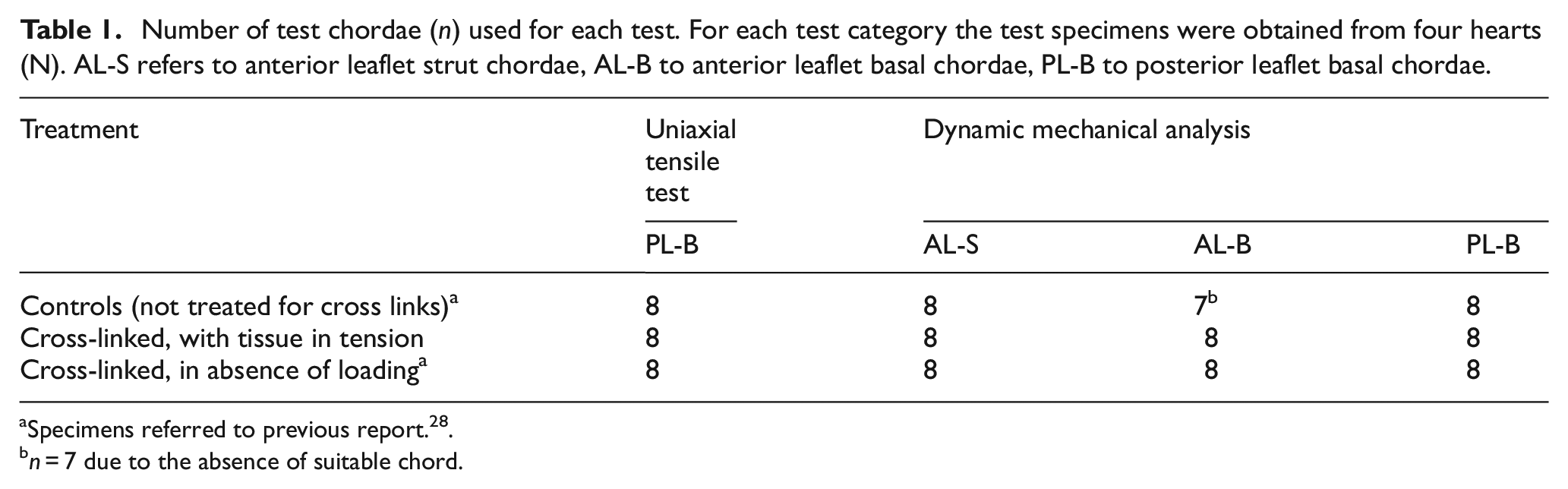
Specimens referred to previous report. 28
n = 7 due to the absence of suitable chord.
Cross-linking of chordae
Cross-linked unloaded chordae were fixed using 0.6% glutaraldehyde (Fluka Analytical, Sigma Aldrich, St Louis, MO, USA) solution diluted with 0.2 M phosphate buffered solution (PBS; Sigma Aldrich, Darmstadt, Germany).21,26,42 The glutaraldehyde concentration was chosen since it is often used for bioprosthetic replacements.19,26,27 Samples were submerged within 5 ml of the glutaraldehyde solution for 1 h. Preliminary testing confirmed that no differences were identifiable when chordae were fixed for 1 and 24 h. Following fixation, specimens were washed three-times in 0.2 M PBS for 10 min to remove excess glutaraldehyde.
The cross-linking procedure for cross-linked loaded chordae is described fully in Part-1 of this study. 22 Briefly, full mitral valves were fixed with 0.6% glutaraldehyde diluted with 0.2 M PBS for 24 h, while loaded under tension. Extracted chordae were refrigerated in 0.6% glutaraldehyde until used for materials testing. 43
Materials testing
Elastic characterisation
Mechanical testing was performed using a Bose ElectroForce 3200 testing machine (Bose Corporation, Electroforce Systems Group, Minnesota, USA).3,7,44 Emery paper was used to coat the grips, which held the chordae in place. The grips were then attached to the testing machine ready for uniaxial testing along the length of the chord (Figure 1).
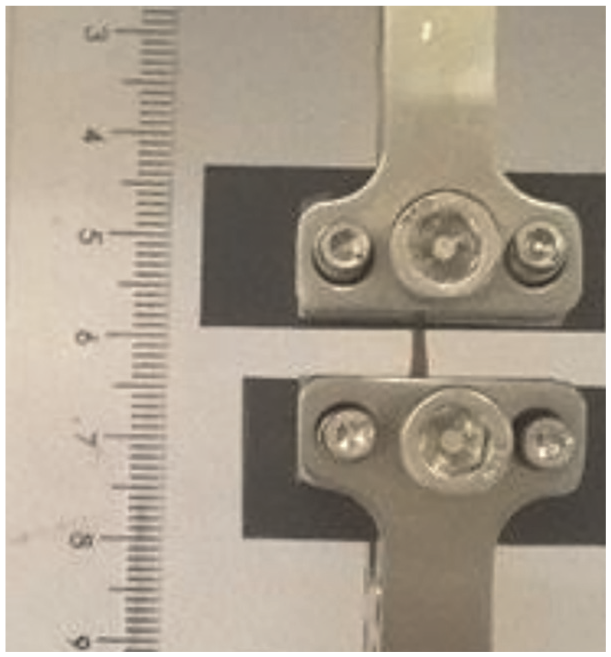
Experimental set-up for uniaxial testing. A chord is attached to the grips. The top grip is attached to the cross-head of the testing machine, which applied a load, while the bottom grip is fixed to the base of the testing machine.
Two posterior basal chordae from each heart (i.e. totaling n = 8 specimens per cross-linked group) were subjected to uniaxial ramp testing. Each chord was severed at the level of the leaflet and at the level of the papillary muscle, so that each specimen consisted only of the chord. Chordae were gripped and then mounted to the materials testing machine resulting in a gauge length for material’s testing of 5 mm and a preload of 0.1 N. Length and chordal diameter were measured using ImageJ 1.0 software (ImageJ, Maryland, USA). A constant displacement rate of 0.1 mm/s was applied up to a limit of 4 N to prevent chordal rupture. 6 Each chord was loaded ten times with a resting time of 1 min between tests. Force and displacement were measured using WinTest 4.1 software (Bose Corporation, Electroforce Systems Group, Minnesota, USA). Specimens were maintained hydrated throughout testing using Ringer’s solution.7,38,45
Tangent moduli (E) were calculated according to equations (1) and (2). Tangent moduli were calculated for both an initial high-extension phase and a subsequent low-extension phase for each chord. These two phases are typically referred to as pre- and post-transitional moduli. 34


Where F is the applied tensile load, δl the extension and S is a shape factor, approximated to be cylindrical for chordae and defined by:

Where d is the average diameter of the chord and l is its gauge length (i.e. 5 mm; see above).7,38
Visco-elastic characterisation
DMA was performed on six basal chordae from each heart (i.e. n = 24 specimens; not previously subjected to uniaxial ramp tests) using a Bose ElectroForce 3200 testing machine (Bose Corporation, Electroforce Systems Group, Minnesota, USA).7,38 A frequency sweep of 0.5, 1, 1.2, 3.5, 5, 7 and 10 Hz was used.7,28 Specimens were preloaded sinusoidally at 1 Hz for 100 cycles. 7 Chordae were loaded to a mean tensile force of 2 N (with an oscillating force of 1–3 N); ensuring that viscoelastic properties were measured in a post-transitional linear elastic range. 34
During DMA, an oscillating force was applied to a specimen and the out-of-phase displacement was measured.35,46 Fourier analyses of the recorded force and displacement waves, at each frequency, is performed. From this, the complex stiffness (k*) and the phase angle (δ), between force and displacement waves is calculated. Storage (E’) and loss (E’’) moduli were then derived using equations (4) and (5). Further details on DMA are available elsewhere. 35


Where S is a shape factor defined in equation (3).
Data analysis
Statistical analysis was performed using SigmaPlot v12.0 (SYSTAT, San Jose, CA, USA). The hypothesis (hereafter known as the tension-crosslink hypothesis) was that tension applied to chordae tissue during glutaraldehyde cross-linking alters the viscoelastic properties of the tissue. To test this hypothesis storage and loss moduli were evaluated for cross-linked loaded and cross-linked unloaded chordae using a Wilcoxon rank sum tests for unpaired, non-parametric data. Dunn’s multiple comparisons test was used to evaluate significant differences between the cross-linked loaded chordal specimens. Differences due to the treatment were considered significant if p < 0.05. Full explanation on the statistical analysis for viscoelastic data on cross-linked unloaded chordae is available elsewhere. 28
Results
Elastic characterisation
Ramp testing revealed differences between untreated and glutaraldehyde cross-linked posterior basal chordae. Untreated chordae transitioned at a lower strain than cross-linked unloaded chordae (0.15 and 0.22, respectively; Figure 2(a) and (b)). However, cross-linked loaded chordae transitioned at a strain of 0.07 (Figure 2(c)); the data was spread over a much narrower range too (cf. Figure 2(a) and (b) against Figure 2(c)). The mean pre-transitional modulus for cross-linked unloaded posterior basal chordae was 5.78 MPa, as compared to 30.8 MPa for cross-linked loaded posterior basal chordae. The mean post-transitional modulus for cross-linked unloaded posterior basal chordae was 74.1 MPa as compared to 139 MPa for cross-linked loaded posterior basal chordae.
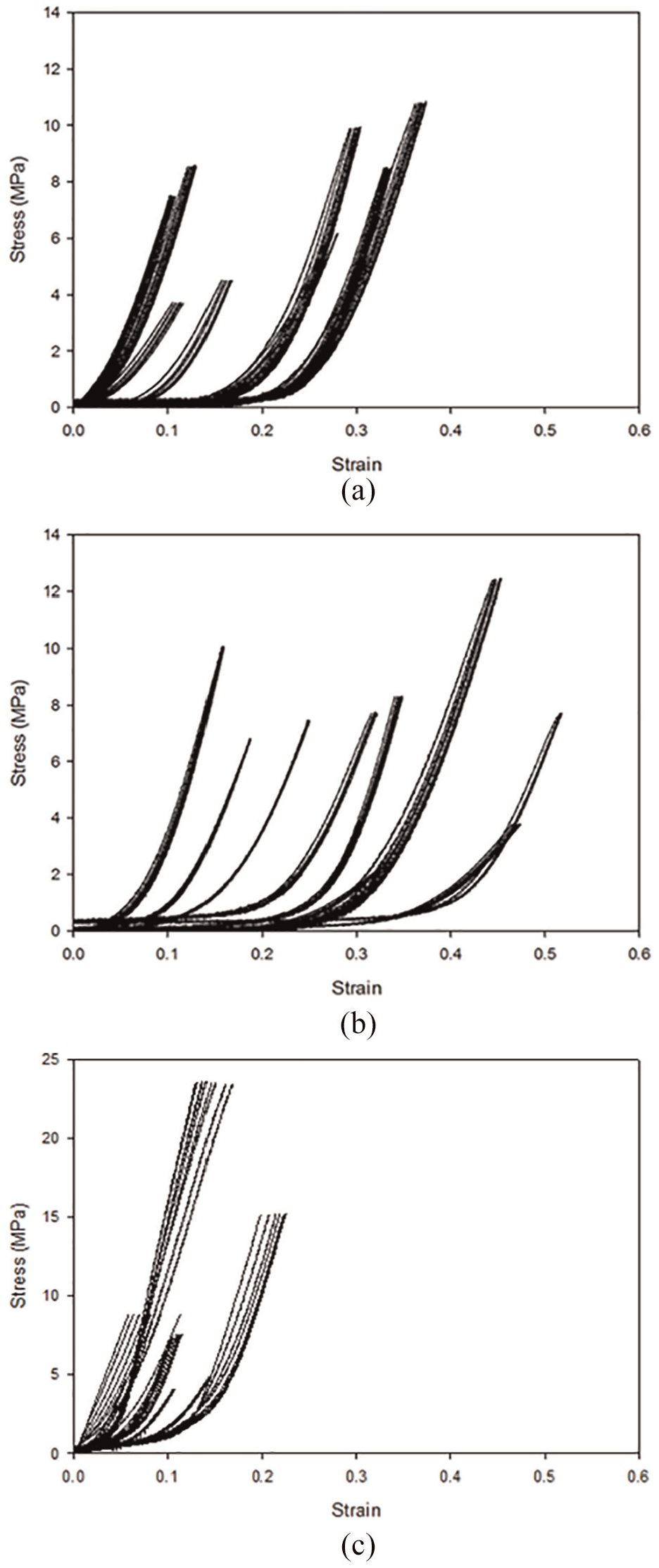
Uniaxial ramp test data excluding outliers for (a) untreated chordae (58 results), (b) cross-linked unloaded (63 results) and (c) cross-linked loaded (70 results) chordae. The data presented includes up to nine repeats per chord, with each graph including data for eight basal chordae obtained from the posterior leaflet of four hearts.
Dynamic viscoelasticity
Wilcoxon rank sum tests revealed that cross-linked loaded chordae typically had larger storage moduli than cross-linked unloaded chordae over the frequency range tested (Figure 3; Table 2; p < 0.05). The mean storage modulus of anterior strut chordae ranged from 48 to 54 MPa over the frequency range tested, for cross-linked unloaded chordae as compared to 53–61 MPa for cross-linked loaded chordae. The mean storage modulus for anterior basal chordae ranged from 67 to 76 MPa for cross-linked unloaded chordae as compared to 109–126 MPa for cross-linked loaded chordae. Dunn’s multiple comparisons test revealed that the difference is significant (p < 0.05) at 1 Hz and at frequencies above 3.5 Hz. For posterior basal chordae the ranges were 78–87 MPa for cross-linked unloaded chordae as compared to 177–207 MPa for cross-linked loaded chordae. The difference is significant (p < 0.05) for all frequencies.
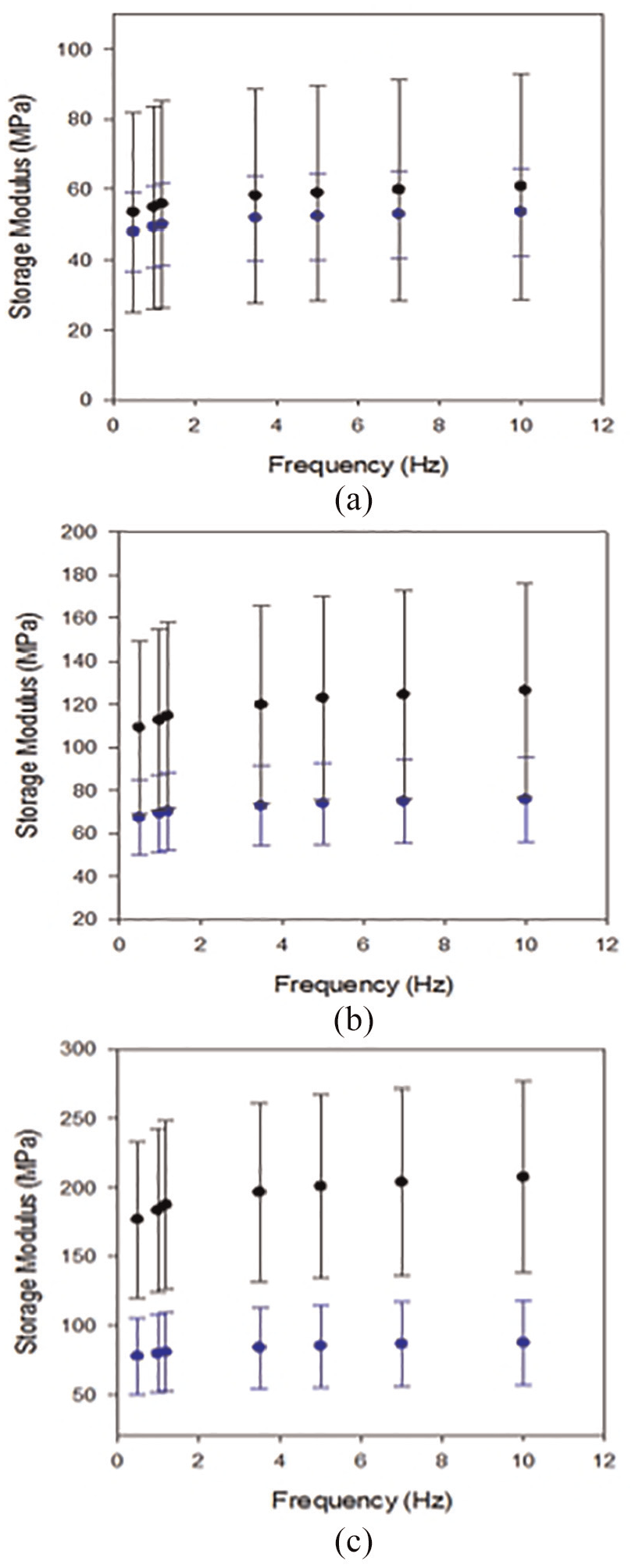
A comparison of storage moduli of (a) anterior strut, (b) anterior basal and (c) posterior basal chordae fixed with glutaraldehyde while unloaded (blue dots) and loaded (black dots). Means and 95% confidence intervals are presented.
Viscoelastic properties of cross-linked loaded chordae under a sinusoidally varying load across a range of frequencies.
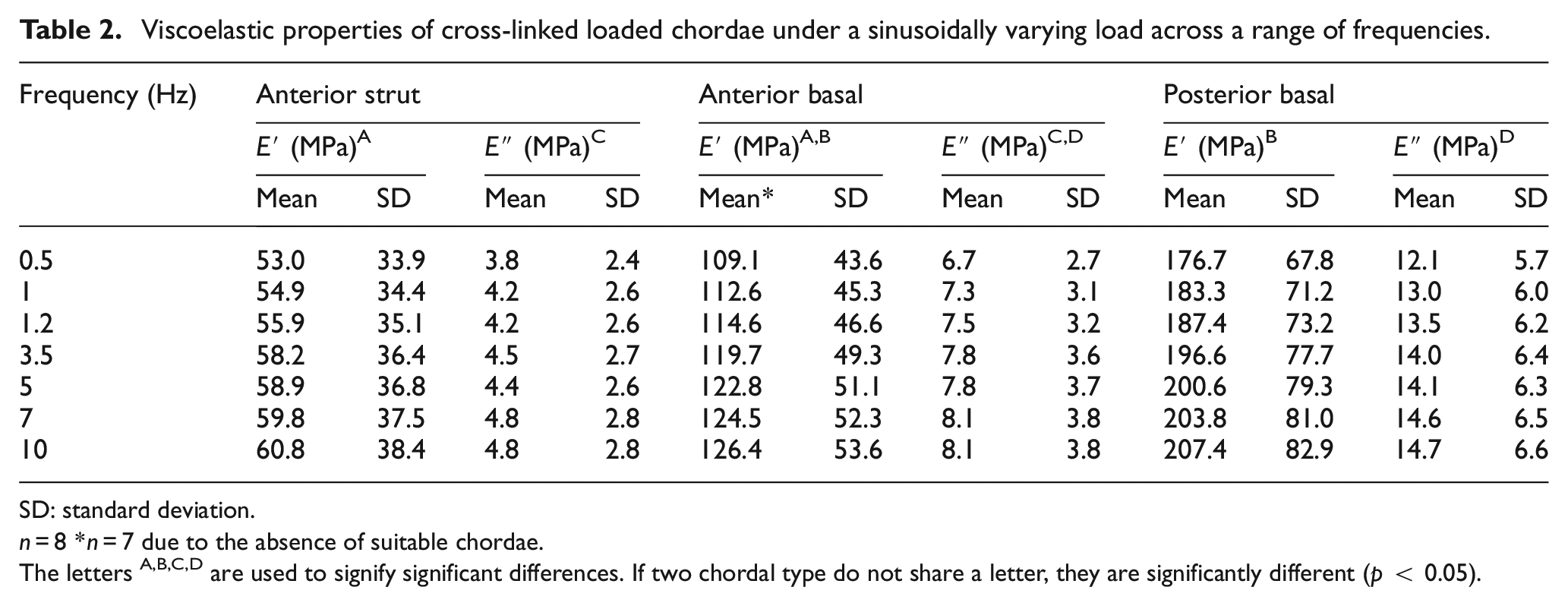
SD: standard deviation.
n = 8 *n = 7 due to the absence of suitable chordae.
The letters A,B,C,D are used to signify significant differences. If two chordal type do not share a letter, they are significantly different (p < 0.05).
Cross-linked loaded chordae typically had greater loss moduli than cross-linked unloaded chordae over the frequency range tested (Figure 4). The mean loss modulus of anterior strut chordae ranged from 2.3 to 2.9 MPa, over the frequency range tested, for cross-linked unloaded chordae as compared to 3.8–4.8 MPa for cross-linked loaded chordae. The mean loss modulus for anterior basal chordae ranged from 3.6 to 4.1 MPa for cross-linked unloaded chordae as compared to 6.7 to 8.1 MPa for cross-linked loaded chordae. The difference is significant (p < 0.05) for frequencies below 7 Hz. For posterior basal chordae the ranges were 4.3–4.9 MPa for cross-linked unloaded chordae as compared to 12.1–14.7 MPa for cross-linked loaded. The difference is significant (p < 0.05) for all frequencies.
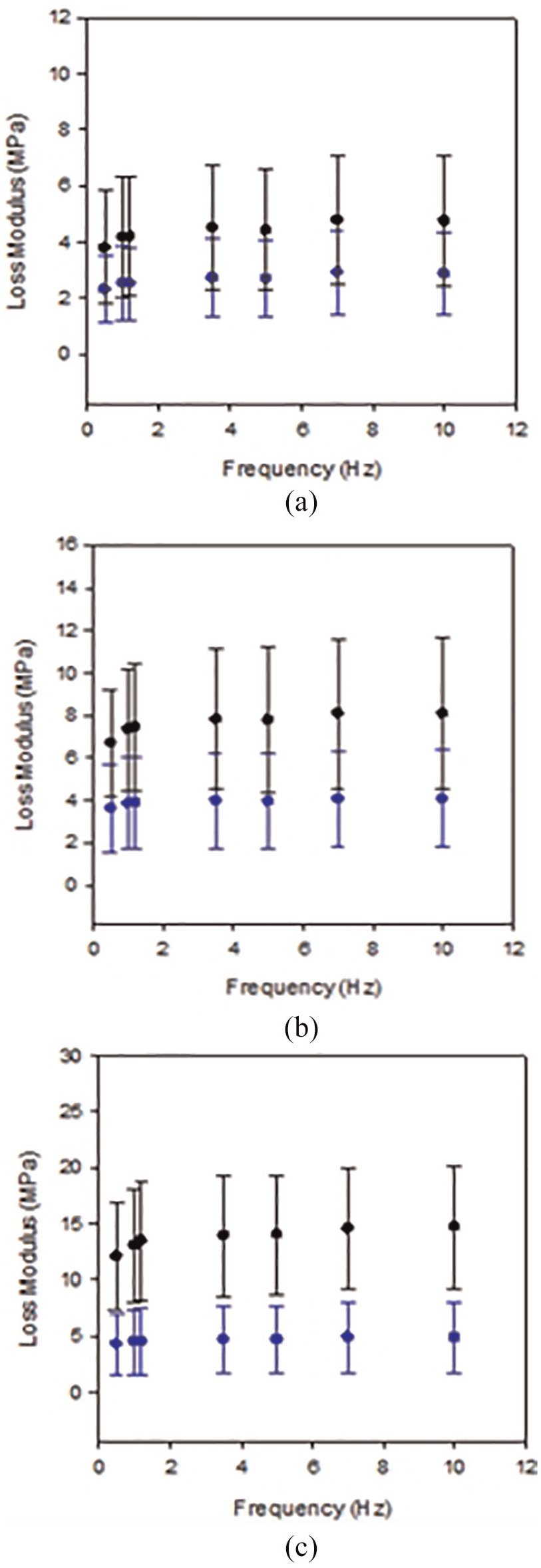
A comparison of loss moduli of (a) anterior strut, (b) anterior basal and (c) posterior basal chordae fixed with glutaraldehyde while unloaded (blue dots) and loaded (black dots). Means and 95% confidence intervals are presented.
Discussion
This study has tested the tension-crosslink hypothesis, that applying tension to the chordae tissue during glutaraldehyde cross-linking alters their viscoelastic properties. The findings include that the storage and loss moduli of the loaded tissue were greater than those of the unloaded tissue, supporting the tension-crosslink hypothesis. Viscoelastic data recently published 28 demonstrated that both the storage and loss modulus decreased following glutaraldehyde unloaded fixation. However, in this study we demonstrate that changes in viscoelastic properties are dependent on the application of tension during fixation. Elastic characterisation of posterior basal chordae demonstrated that when chordae were loaded during the cross-linking procedure, the average strain at which they transitioned from high-extensibility to low-extensibility was 7%, as compared to 22% when cross-linked unloaded. The pre- and post-transitional modulus were greater when cross-linked loaded too.
Cross-linked loaded chordae were fixed with glutaraldehyde while chordae were held under tension, which would be expected to align fibrils and uncrimp collagen. Though little is known about the impact of glutaraldehyde treatment under tension, the effects of dynamic fixation have been investigated. 47 Dynamic fixation can affect the fibril crimp of collagen, and consequently minimise the differences between fixed and normal tissue. 48 Although the cross-linked loaded chordae were not fixed dynamically, dynamic fixation would induce tension into the tissue, thus, causing the collagen to uncrimp. Assuming that one source of variability in mechanical behaviour between chordae is the uncrimping of collagen, then fixing chordae under tension would be expected to reduce this source of variability. Indeed, cross-linked loaded chordae displayed greater repeatability in elastic behaviour than samples which were cross-linked unloaded; increased cross-linking would be expected to occur in a state of lower crimp.
Kayed et al. 49 have found that glutaraldehyde cross-linked tissues resulted in a wider range of orientation of fibrils than untreated tissues. Analysis of the fibril extension, based on observation of the change in the D-period spacing, revealed higher fibril strain in the cross-linked tissue as compared to untreated tissue, for given strain in the tissue. 49 There are two different reasons why the fibril strain is higher. First, glutaraldehyde links act as a constraint to further alignment and the fibrils are less able to slide past each other, so the deformation of the tissue is attributed considerably to fibril stretching. 49 Second, for a given tissue strain, Kayed et al. 49 found that there is always a proportion of fibrils which are not recruited into alignment, in both glutaraldehyde-treated and untreated tissue. In particular, the orientation of these non-recruited fibrils were more spread out in treated tissue as compared to the untreated tissue. 49 The reinforcing efficiency, η, of a tissue is defined as the stiffness of the tissue in a given direction expressed as a fraction of what its stiffness would have been if all its fibrils had been oriented in that direction. 50 Hence, η takes on a value between 1 and 0 where the upper and lower limit, respectively, implies that all the fibrils are oriented in the direction of, or perpendicular to, the applied force. 50 Thus, the proportion of the non-recruited fibrils in the glutaraldehyde-treated tissue would modulate η resulting in a value less than 1. It, therefore, seems likely that cross-linking the tissue while loaded under tension enables fibrils to become aligned and recruited into tension, before the process of cross-linking. Thus, η for glutaraldehyde-treated tissue loaded under tension is greater than tissue glutaraldehyde-treated under no load.
The material stiffness of glutaraldehyde-treated chordae under tension is greater than glutaraldehyde-treated unloaded in most cases of the DMA frequency studied. However, there were some cases, namely 0.5 and 1.2 Hz (anterior basal chordae, storage modulus) and 10 Hz (anterior basal chordae, loss modulus) where the results were not compatible with the fibril orientation argument, presented above. In these isolated subsets of the results, other factors, such as fibril straining and fibril-fibril sliding, have not been considered in the development of our arguments and these could interplay with fibril alignment. Interfibrillar sliding generates interfibrillar shear stress and this facilitates load-transfer to the fibrils.51,52 Kayed et al. 49 have found that initial tissue straining could cause substantial reorientation of the fibrils as well as fibril straining. At large strains where no further change in orientation occurs, further contribution to the tissue deformation could be attributed to relative sliding between fibrils or even other tissue components. 49
Glutaraldehyde fixation is assumed to cause a chemical reaction between the aldehyde groups of glutaraldehyde and the ε-amine groups of lysine and hydroxylysine present in collagen.48,53 The result of this reaction is the formation of cross-links between the collagen fibres. Fixation with glutaraldehyde has resulted in differences between the pre-and post-transitional regions of aortic valves with the pre-transitional region of the curve affected more than after the transition. 25 Our results for mitral valve basal chordae suggest that such findings depend on the state of crimp at which the cross-linking takes place.
The viscoelastic properties of mitral valve chordae have previously been characterised by their storage and loss moduli.7,28,54 Knowledge about the effects of glutaraldehyde treatment on the dynamic viscoelasticity of mitral valve chordae is limited, however, a link between the fibril crimp of collagen and their extensibility has been characterised. 3 It was shown that thicker chordae had a smaller crimp period than thinner chordae, and thus were more highly crimped. This has been used to characterise differences between the storage modulus of thick and thin chordae. 7 Since fixation is thought to increase the fibril crimp, and assuming fixation causes the chordae to become more crimped, one would expect the storage modulus to decrease due to fixation. 28 However, if chordae are under tension then less crimp is present at the initial state of fixation, leading to a much higher storage modulus than for cross-linked unloaded chordae. In addition, Liao and Vesely 3 found that the smaller the diameter, the greater number of fibril linkages that can occur; hence, the magnitude of fibril linkages that could occur within basal chordae would be larger than strut chordae. This would explain the greater change in storage (and loss) moduli for basal than strut chordae.
It is clear from our findings that glutaraldehyde fixation has altered both the elastic and viscoelastic properties of basal chordae. Clinically, this will affect the functionality of bioprosthetic replacements. 22 Though marginal chordae were not considered during this investigation, it is likely that fixation would affect the tissues similarly. This is of importance due to the function of marginal chordae in ensuring valve closure.7,32,55 Further evaluation of the effect of fixation under tension would also provide an insight into the effect of fixation on the internal structure; our current study strongly supports such further research. Since alternative fixatives are under investigation, considering the effect of these alternatives on the dynamic properties would also be of importance for bioprosthetic functionality. 19
Limitations
The two main limitations of this study are clinical relevance and sample size. There is limited direct clinical relevance of this current study, beyond potential effects on the mechanical behaviour of any natural neo-chordae which might be considered for chordal replacement. However, the key outcome from this study is that the mechanical behaviour of collagen reinforced, soft connective tissues which undergo cross-linking will be dependent on the loading conditions used during cross-linking. For this current study, priority has been given to viscoelastic characterisation, to match the baseline data-set (for unloaded, cross-linked chordae) previously published. 28 For this reason 24 basal chordae underwent viscoelastic characterisation; sub-divided according to location of insertion within the mitral valve. Eight chordae underwent elastic characterisation per group, which ensured that chordae which underwent elastic and viscoelastic characterisation were obtained from the sample porcine heart samples.
Part-1 22 and Part-2 (hereby presented) of this study report a range of pre-cycling regimes. In Part-1, 22 preliminary testing demonstrated that after the first two loading cycles, repeatable data was obtained for the heart valve; the data reported is important in demonstrating the competence of mitral valves. In Part-2 we report on material’s characterisation, which is not directly comparable to the in vitro testing reported for full valves. However, the pre-cycling reported for elastic and viscoelastic characterisation differ. Viscoelastic characterisation followed a published protocol for pre-cycling and testing for the same type of porcine heart specimens, 28 this has enabled direct comparison of the data obtained in this study with that already published.
No elastic characterisation was reported by Constable et al., 28 and so a full data-set is reported in this study (i.e. cross-linked unloaded, cross-linked loaded and control data). However, only the first loading cycle was excluded from analysis. The rationale behind this was two-fold. Firstly, from the data obtained, it was clear that only the first cycle differed from the subsequent nine repeats tests. Further, the shift in the stress-strain data when cross-linked under load is immediately evident (Figure 2(c) cf. Figure 2(a) and (b)): the transition point from low to high modulus clearly occurs at a much lower strain, and the variability between stress-strain of test samples becomes very narrow. It is this trend which has been critical in aiding our assessment of the tension-crosslink hypothesis, in terms of collagen and its mechanics. Finally, it is worth noting that for elastic characterisation of soft connective tissues, stress-strain data only requires one or two pre-cycling loads to become repeatable,34,56 dynamic loading can require many more pre-conditioning cycles, around 100 for chordae, but for tissues such as articular cartilage this can exceed 1000 cycles.57,58
Conclusion
Glutaraldehyde cross-linking alters the elastic and viscoelastic properties of mitral basal chordae tendineae. However, the use of loading during the cross-linking increases the post-transitional moduli, storage and loss moduli, and reduces the transition strain of basal chordae, as compared to cross-linking in an unloaded state. Therefore, the resultant material properties of chordae following glutaraldehyde cross-linking is dependent on the inclusion/exclusion of loading during the cross-linking process.
Footnotes
Declaration of conflicting interests
The author(s) declared no potential conflicts of interest with respect to the research, authorship and/or publication of this article.
Funding
The author(s) disclosed receipt of the following financial support for the research, authorship and/or publication of this article: HEB was funded through an Engineering and Physical Sciences Research Council scholarship [M114612B]. This study was partly funded by an Innovation and Research Award from the Institute of Physics and Engineering in Medicine. The materials testing equipment used in this study was funded by an Arthritis Research UK Grant [H0671; now a part of Versus Arthritis].
Statement involving human and animal rights
This study did not involve any human participants or animal studies, and no animals were sacrificed specifically for this study. It is noted that animals from which porcine hearts obtained were otherwise destined for the food chain. Ethical approval was granted for this study by the University of Birmingham Research Support Group [ERN_15-0032].
