




Abstract
Ceramic-on-ceramic bearings have become of great interest due to the substantial improvements in the manufacturing techniques and material properties and due to polyethylene wear debris–induced osteolysis and the issues with metal wear debris and ion release by metal-on-metal bearings. Edge loading conditions due to translational malpositioning (microseparation conditions) have been shown to replicate clinically relevant wear mechanisms and increase the wear of ceramic-on-ceramic bearings; thus, it was necessary to test new bearing materials and designs under these adverse conditions. The aim of this study was to assess the effect of increasing head size on the wear of BIOLOX® delta ceramic-on-ceramic bearings under edge loading conditions due to rotational (steep cup inclination angle) and translational (microseparation) malpositioning. In this study, six 36-mm ceramic-on-ceramic bearings (BIOLOX delta, CeramTec, Germany) were tested under standard and edge loading conditions using the Leeds II hip simulator and compared to the 28-mm bearings tested and published previously under identical conditions. The mean wear rate under standard gait conditions was below 0.1 mm3/million cycles for both the 28-mm and the 36-mm ceramic-on-ceramic bearings, and increasing the inclination angle did not affect the wear rates. The introduction of microseparation to the gait cycle increased the wear rate of ceramic-on-ceramic bearing and resulted in stripe wear on the femoral heads. Under microseparation conditions, the wear rate of size 36-mm bearings (0.22 mm3/million cycles) was significantly higher (p = 0.004) than that for size 28-mm bearings (0.13 mm3/million cycles). This was due to the larger contact area for the larger bearings and deprived lubrication under edge loading conditions. The wear rate of BIOLOX delta ceramic-on-ceramic bearings under microseparation conditions was still very low (<0.25 mm3/million cycles) compared to earlier generation ceramic-on-ceramic bearings (BIOLOX forte, 1.84 mm3/million cycles) and other bearing materials such as metal-on-metal bearings (2–8 mm3/million cycles).
Keywords
Introduction
Ceramic-on-ceramic (CoC) bearings possess superior wear properties when compared to other bearings such as metal-on-metal and metal-on-polyethylene bearings. Ceramic in total hip replacements was originally introduced as a pure alumina (Al2O3) material, 1 which then underwent substantial improvements to produce a hot isostatically pressed (HIPed) alumina 2 (BIOLOX® forte). The latest developments of ceramics have taken advantage of the superior properties of alumina and zirconia materials to create an alumina matrix composite. 3 This material, which is also known as zirconia-platelet toughened alumina (ZPTA), is composed of 75% alumina, 24% zirconia and 1% of other oxides. 4 ZPTA is as hard as alumina; it is toughened by phase transformation and reinforced by the presence of the platelets in the alumina matrix. This innovation has extended the design flexibility of the CoC bearings by allowing the production of larger size femoral heads. A size 28-mm bearing is designed to allow a range of motion of at least 120o, which is required to comfortably perform standard daily activities. However, with a small bearing, there is a higher probability of impingement, subluxation or luxation of the joint. Increasing the head size will technically increase the range of motion and reduce the chances of impingement and meet the demands of more active patients. A clinical study showed a significant reduction in dislocation rate when using 36-mm bearings compared to 28-mm bearings. 5
The in vitro wear of size 28-mm BIOLOX forte CoC bearings under standard gait conditions was below 0.1 mm3/million cycles. 6,7 To put this into perspective, size 28-mm metal-on-metal bearings tested under similar conditions had a wear rate of around 1 mm3/million cycles, 8 –10 metal-on-conventional polyethylene had a wear rate of 35–50 mm3/million cycles 11,12 and metal-on-cross-linked polyethylene had a wear rate of 5–10 mm3/million cycles. 13 In addition, ceramic bearings generate wear debris with the lowest biological activity when compared to the other bearing types. 14
Although there have been reports of earlier generation CoC femoral head fracture and acetabular cup chipping, 15,16 more recent clinical studies have shown high mid-term survival rates for CoC bearings, with some centres reporting survival rates between 95% and 100%. 17 –19
Retrieval studies of early-generation CoC bearings showed stripe-like wear on the femoral head with rim wear on the acetabular cup; evidence of occurrence of edge loading. 7,20 There was a good correlation between this wear mechanism and steep cup inclination angle. 20 Excessive cup inclination angle (rotational malposition) allowed the contact area between the head and the cup to intersect with the edge of the acetabular cup (rim) and to increase the contact stresses. In vitro studies, however, showed no increase in wear when the acetabular cup of the CoC bearing was set up at a steeply inclined angle (65°). 6 Edge loading that resulted in the formation of stripe wear similar to that seen on retrievals was achieved when the centres of rotation of the head and the cup were separated, a condition defined as microseparation (translational malpositioning). 21 Microseparation conditions may occur when the centres of the head and the cup are mismatched by a value greater than the radial clearance. It was shown that microseparation conditions (0.4–0.5 mm) generated wear rates, wear mechanisms and wear particles similar to those seen in retrievals. 7,20 –24 This was the only laboratory condition where bimodal micron- and nanometre-sized ceramic wear particles were generated, which have been observed in tissue retrieved at revision. 22,23 Edge loading due to microseparation conditions could occur clinically due to head offset deficiency, medialised cup, impingement, subluxation, stem subsidence or laxity of the joint. In addition to the validation study mentioned above, this condition has caused the fracture of yttria stabilised tetragonal zirconia polycrystal (3Y-TZP) femoral heads, which was also observed in vivo. 25 Finally, edge loading resulted in the elevation of wear rates and simulation of wear mechanisms in metal-on-metal bearings, similar to those observed in retrievals. 26,27
A recent study investigated the influence of edge loading due to increased cup inclination angle and microseparation conditions on the wear of size 28-mm ZPTA (BIOLOX delta). 28 The results showed no increase in wear under edge loading due to increased cup inclination angles; however, increased wear rate and stripe wear were achieved under edge loading due to microseparation conditions. The aim of this study was to investigate the influence of increasing the femoral head size on the wear of BIOLOX delta CoC bearings under standard and edge loading conditions using the same simulator and methodology as the 28-mm study described above. Edge loading will be achieved by rotational malpositioning (steep cup inclination angle), translational malpositioning (microseparation) and the combination of both conditions.
Materials and methods
Six 36-mm CoC bearings (BIOLOX delta, CeramTec, Germany) were tested under different adverse in vitro conditions using the Leeds II physiological anatomical hip joint simulator. The six bearing couples had diametrical clearances in the range of 76–85 µm. Four in vitro conditions were investigated including standard gait conditions, steep cup inclination angle (rotational malpositioning), microseparation conditions (translational malpositioning) and the combination of the latter two conditions. Two clinical cup inclination angles were considered, in vivo equivalence of 45° (n = 3) and 65° (n = 3). The first 2 million cycles were performed under standard gait conditions and a subsequent 3 million cycles were performed under microseparation conditions. 21,24 A standard gait cycle included a twin peak load (peak load of 3000 N), extension/flexion (−15°/+30°) and internal/external rotation (±10°). Microseparation was achieved by applying a 0.4- to 0.5-mm medial displacement to the cup relative to the head during the swing phase of the standard gait cycle resulting in edge loading at heel strike. 21,24 The lubricant was 25% (v/v) new-born calf serum supplemented with 0.03% (v/v) sodium azide to retard bacterial growth. The lubricant had a protein concentration of 15 g/L and was changed approximately every 330,000 cycles and replaced with fresh serum. The wear volume was ascertained through gravimetric analysis every million cycles using a Mettler AT201 (Mettler-Toledo Ltd, UK) balance (0.01 mg resolution).
Surface measurements of the components were undertaken at the beginning and the end of each gait protocol using a two-dimensional contacting profilometer (Form Talysurf series, Taylor Hobson, UK). Further wear stripe analysis was undertaken when the microseparation conditions were introduced; three two-dimensional Talysurf measurements were taken on each head and cup across the wear scar 5 mm apart. The mean maximum penetration depths of the wear stripe were determined.
A coordinate measuring machine (CMM; Legex 322, Mitutoyo, UK) was used to reconstruct three-dimensional representations of the wear stripes on the femoral heads. This machine has a 0.8 µm resolution; however, this changes depending on the size of the stylus and the set-up configuration of the measuring probe. All six 36-mm femoral heads from this study and the six 28-mm femoral heads were measured by taking 72 traces over each femoral head surface with 5° spacing about the vertical axis (Figure 1). Each trace started at the pole of the component and had a 0.2-mm pitch resulting in a total number of 12,024 points on the 36-mm head and 9864 points on the 28-mm head. In order to get the best resolution out of the CMM machine, for these particular measurements, a 3-mm stylus was used with a vertical probe set-up. The femoral heads were positioned on a taper vertical to the horizontal plane. SR3D software (Tribosol, UK) was used to visualise the size, shape and penetration depth of the wear areas. Statistical analysis was performed using one-way analysis of variance (ANOVA; significance taken at p<0.05), and 95% confidence limits were calculated.
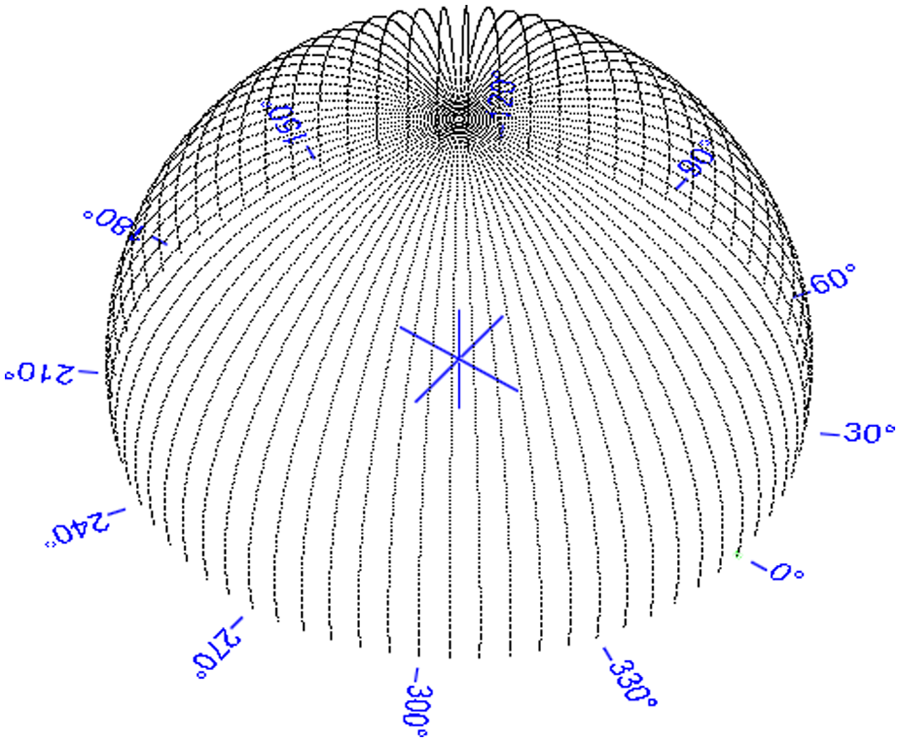
Data points taken on the surface of a femoral head consisting of 72 traces. Each trace had several points with 0.2 mm spacing (pitch) between each point, starting at the pole and ending 3.5 mm below the equator.
Results
Under standard gait conditions, the wear rates of the 36-mm CoC bearings were very low (0.01 mm3/million cycles, within the resolution of measurement method) under both cup inclination angles. Increasing the cup inclination angle from 45° to 65° had no detectable effect on the wear rates. However, after introducing microseparation conditions to the gait cycle, stripes of wear were formed on the femoral head with a corresponding wear area at the rim of the acetabular cup, and the wear rates significantly increased to 0.23 mm3/million cycles for the 45° cup inclination angle condition (p = 0.02) and 0.20 mm3/million cycles for the 65° cup inclination angle. There was no significant difference (p = 0.5) in the wear rates for both cup inclination angles under microseparation conditions (Figure 2). There was a wide variation in the wear volumes of the six bearing surfaces when tested under microseparation conditions with no sign of biphasic (bedding-in and steady-state) wear mechanisms (Figure 3).
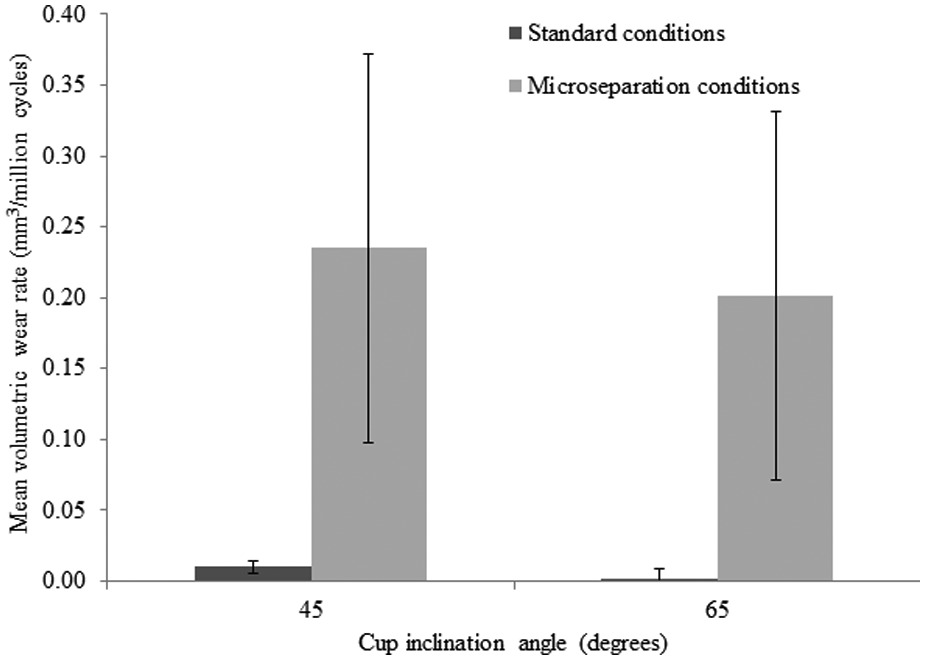
Mean volumetric wear rates for the 36-mm ceramic-on-ceramic BIOLOX delta bearings for the different cup inclination angles under standard (2 million cycles) and microseparation conditions (3 million cycles). Error bars represent 95% confidence limit.
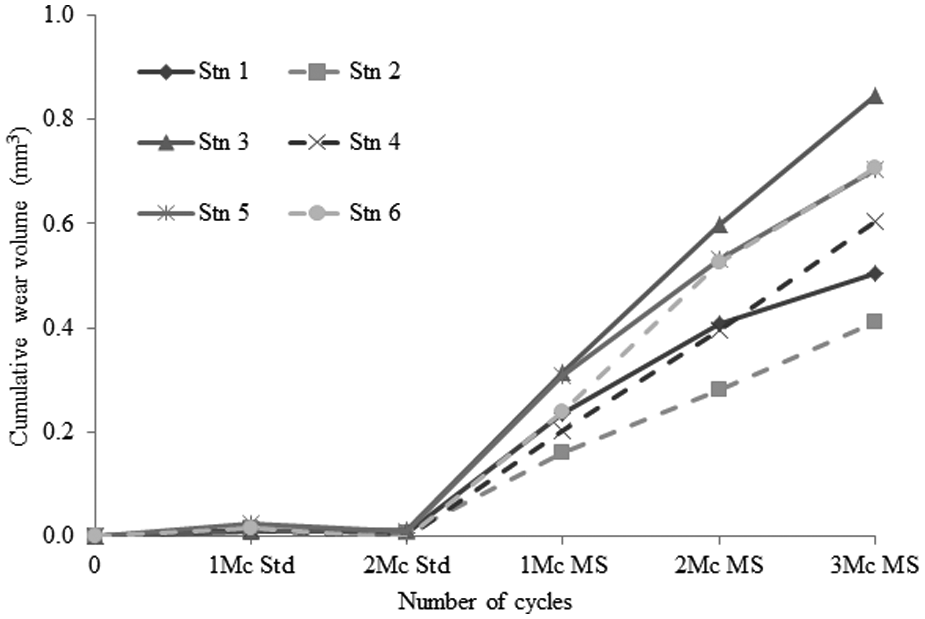
Cumulative wear volume under standard and microseparation conditions for individual stations. Odd-numbered stations included components with 45° cup inclination angles (solid lines) and even-numbered stations included components with 65° cup inclination angles (dashed lines).
The surface roughness did not change after 2 million cycles of testing under standard gait conditions; however, under microseparation conditions, the surface roughness over the wear stripe significantly (p = 0.0001) increased from a mean below 0.010 µm Ra to 0.016 µm Ra for both cup inclination angle conditions.
Under edge loading conditions, the mean penetration depth obtained by taking three traces 5 mm apart over the middle of the wear stripe on the femoral heads using the form Talysurf was 7.0 µm for the 45° cup inclination angle conditions and 7.2 µm for 65° cup inclination angle conditions, with no significant difference between the two cup inclination angle conditions (p = 0.9).
An unworn ceramic femoral head showed a sphericity deviation (form error) of ±1 µm, which was a combination of form errors of both the stylus and the ceramic head and the accuracy of the machine (Figure 4). This means that a wear area with a penetration depth below 1 µm could not be detected. All the femoral heads showed a stripe of wear with penetration depth greater than the sensitivity of the measurement techniques. The CMM measurements showed the size and shape of the wear stripes produced under edge loading conditions due to microseparation (Figure 5). The maximum penetration occurred when the head was in contact with the rim of the acetabular cup during heel strike, at the position of the highest flexion (30°) and an external rotation of 2° of the gait cycle. These corresponded to the left part of the wear stripes formed on all the femoral heads (Figure 5). There was no significant (p = 0.5) difference in the maximum penetration depth between the two cup inclination angle conditions (9 µm for the 45° inclination angle conditions and 10 µm for the 65° cup inclination angle conditions); however, the wear stripes on the heads articulating against the steeply inclined acetabular cups (65°) were slightly closer to the pole of the heads than the ones articulating against the 45° inclined acetabular cups.
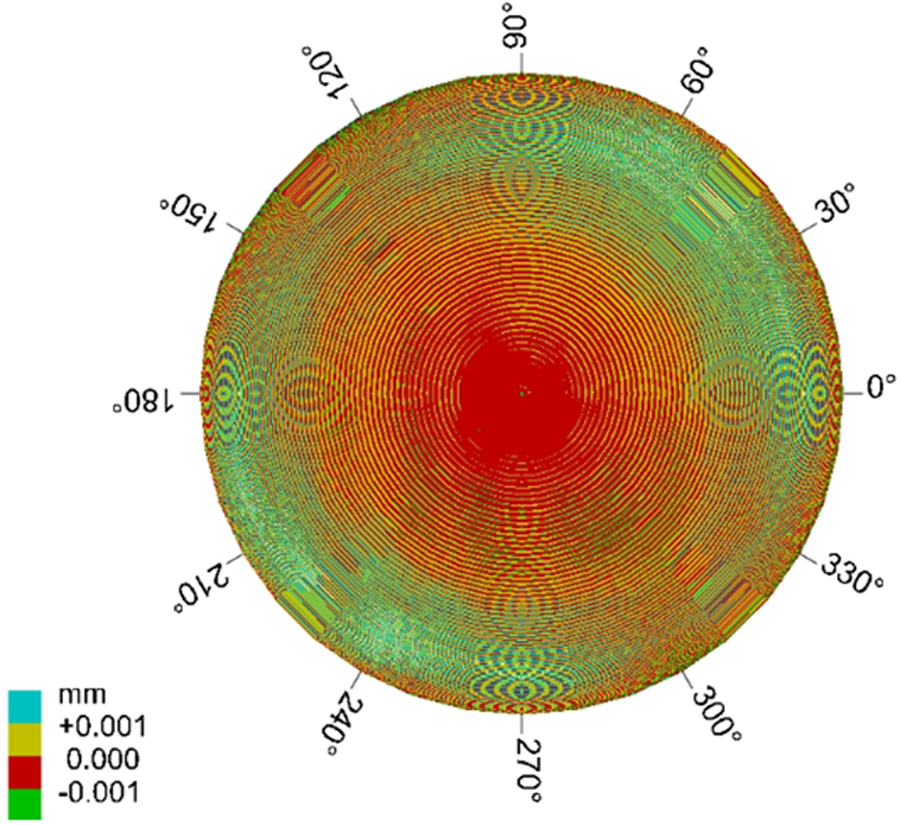
Three-dimensional reconstruction of an unworn ceramic head. The contours shown are relative to a perfect sphere.
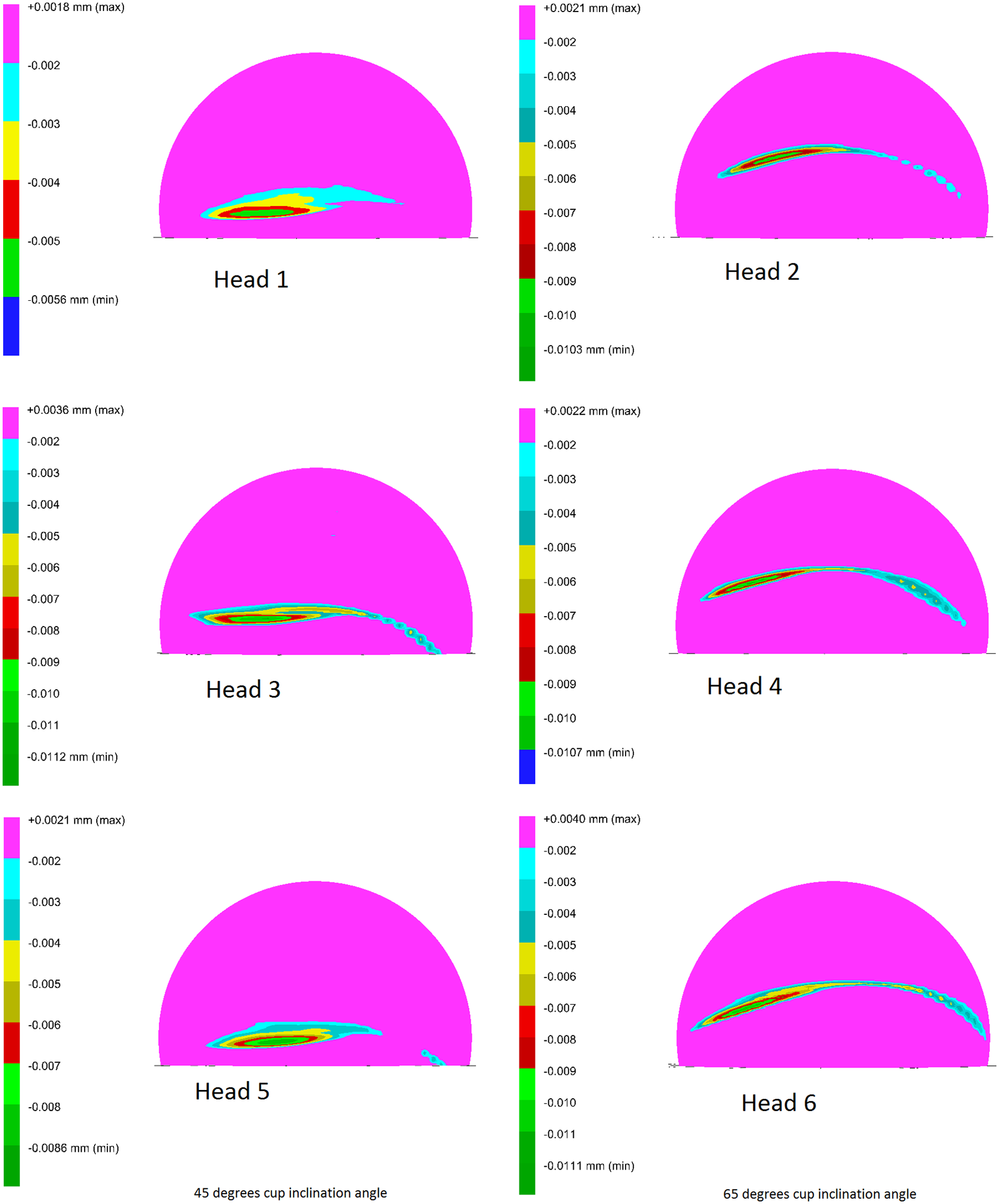
Wear stripe areas on the 36-mm femoral heads after 3 million cycles of testing under microseparation conditions. Odd-numbered heads articulated against acetabular cups inclined at 45°, whereas the even-numbered heads articulated against acetabular cups inclined at 65°.
Discussion
Larger CoC bearings offer a larger range of motion, thus reducing the risk of impingement and subluxation, providing more flexibility for the active patient. 5 The wear of CoC bearings is very low under standard in vitro simulator testing conditions. 6,7,29 However, retrieval studies have shown stripe wear that was not replicated using these standard conditions. 20 Stripe wear was replicated under edge loading conditions, which resulted from translational malpositioning, a condition termed ‘microseparation’. 21 The aim of this study was to investigate the wear resistance of large diameter (36 mm) BIOLOX delta CoC bearings under the microseparation edge loading conditions and compare their performance to the 28-mm BIOLOX delta CoC bearings tested under the same set of adverse conditions. 28
In this study, cup inclination angle did not influence the wear of CoC bearings under either standard gait or microseparation conditions. Under standard gait conditions, the wear rate of size 36-mm bearings was significantly lower than size 28-mm bearings tested on the same simulator. 28 This was reversed when microseparation conditions were introduced to the gait cycle, where the wear rate of the larger size bearings was approximately twice as high (0.23 mm3/million cycles for the 36-mm bearing compared to 0.12 mm3/million cycles for the 28-mm bearing). This was thought to be due to the larger contact area for the larger bearings and deprived lubrication under edge loading conditions.
The wear stripes formed on the 36-mm heads were similar in shape, orientation and depth to those formed on the 28-mm heads (Figures 5 and 6). The wear stripes on the 28- and 36-mm heads had mean maximum penetration depths of 9 and 10 µm, respectively (p = 0.6), obtained using the CMM. The location and the maximum penetration depth could be easily visualised on the reconstructed surfaces using the CMM. This showed the advantage of using the CMM over the two-dimensional profilometry to determine the penetration of the wear area, which was determined using the Talysurf by averaging three traces, 5 mm apart, taken across the middle of the wear area. The CMM measurements were done by scanning the whole surface and recoding thousands of data points. The lengths of the wear stripes were proportional to femoral head size covering similar percentage areas. Hence, the higher wear rate of the larger size bearing was due to the larger wear area on the larger bearing.
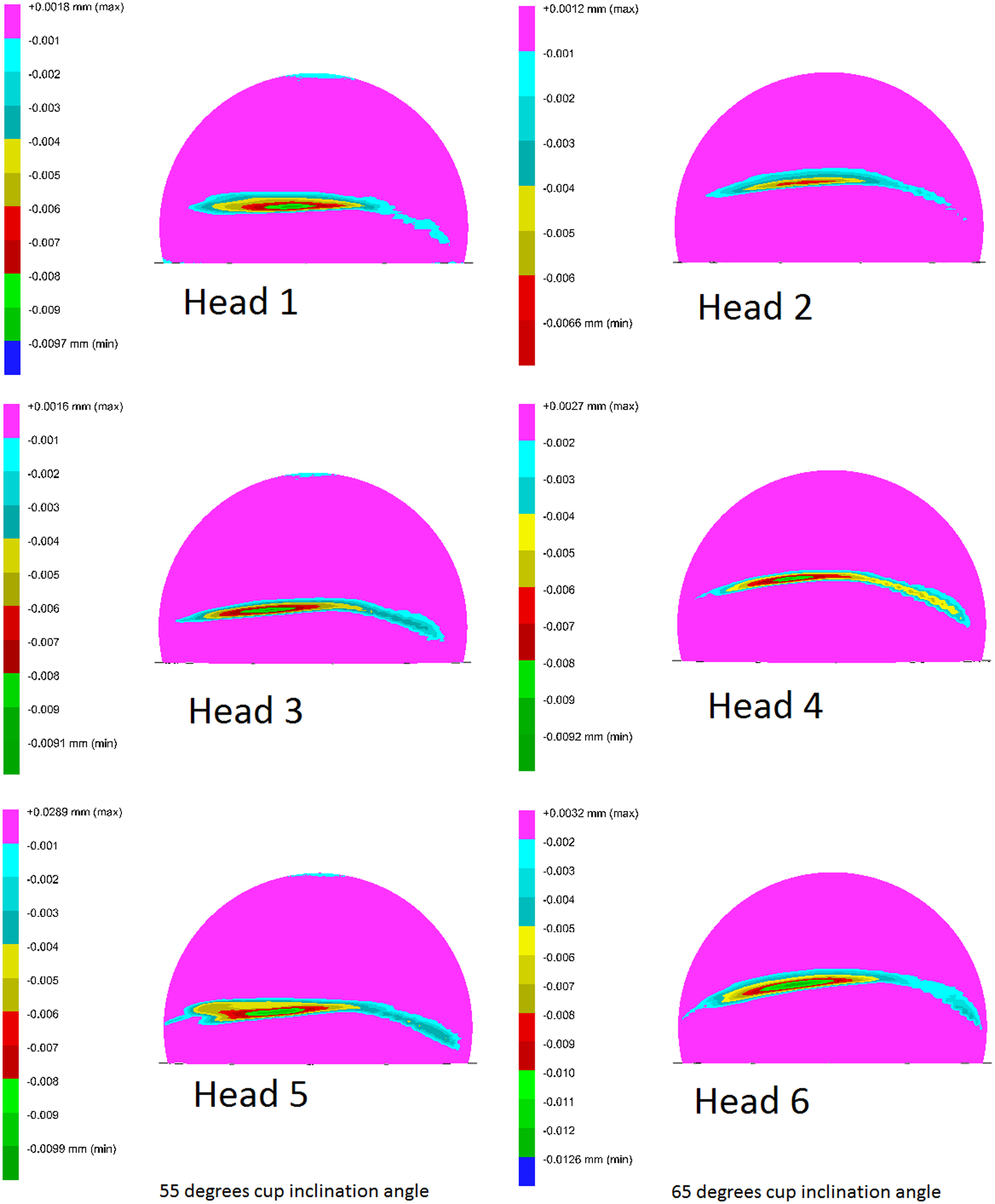
Wear stripe areas on the 28-mm femoral heads after 3 million cycles of testing under microseparation conditions. Odd-numbered heads articulated against acetabular cups inclined at 55°, whereas the even-numbered heads articulated against acetabular cups inclined at 65°.
The wear rate of BIOLOX delta bearings under microseparation conditions was much lower (<0.25 mm3/million cycles) compared to the third-generation alumina CoC bearings 24 (1.84 mm3/million cycles) and other bearing materials such as metal-on-metal bearings 30 –32 (2–9 mm3/million cycles). Also the mean penetration of the wear stripe, measured by the two-dimensional profilometry (Talysurf), was lower for the BIOLOX delta ceramic bearings tested in this study (7 µm at 3 million cycles) compared to the alumina-on-alumina bearings tested under the same in vitro conditions (∼90 µm at 5 million cycles). 24 A metal-on-metal bearing showed linear penetration of approximately 41 µm on the femoral head at 2 million cycles when tested under the same conditions. 32
The improved wear properties of the fourth-generation ceramic materials under adverse conditions, even with a larger head size, highlight the resistance of the material to the harsher conditions, which younger and more active patients may exert on a hip prosthesis. It also showed that this material, where wear is concerned, is more forgiving to surgical malpositioning than metal-on-metal bearings. BIOLOX delta CoC bearings showed no increase in wear under rotational malpositioning and improved wear rates under translational malpositioning when compared to earlier generation ceramics, 24,28 whereas metal-on-metal bearings showed significant increase in wear rates under edge loading conditions due to both rotational (steep cup inclination angles) and translational (microseparation) malpositioning. 10,32,33
Although BIOLOX delta CoC bearings have shown improved wear resistance, with both bearing sizes under adverse conditions, optimum component positioning and avoidance of edge loading cannot be overemphasised. Increased frictional forces and squeaking phenomena have been associated with implant malpositioning. Sexton et al. 34 have concluded, after investigating 2406 primary total hip replacements with CoC bearings implanted between 1997 and 2008, that high acetabular cup angle, high femoral offset, lateralisation of the hip centre and either high or low acetabular cup anteversion angle were conditions associated with squeaking. Other reports have shown that increased frictional forces 35 and roughening of the bearings surface, 36 which are mainly associated with stripe wear in CoC bearings caused by edge loading due to translational malpositioning, were factors that contribute to squeaking. Current clinical reports related to CoC fracture are mainly related to alumina ceramics, and further clinical data are needed to determine the relative fracture risk of the improved BIOLOX delta material; however, early results are encouraging. 37
This study has shown that increasing the femoral head size of CoC bearings resulted in increased wear rates only under microseparation conditions from 0.12 mm3/million cycles for the 28-mm bearings to 0.22 mm3/million cycles for the 36-mm bearings. BIOLOX delta showed superior wear performance when compared to earlier generations of ceramic materials and current metal-on-metal bearings and this was only distinguished when advance adverse microseparation conditions were used as a testing methodology. This indicates the necessity of using adverse simulator conditions for preclinical assessments of hip replacement bearings beyond the current International Organization for Standardization (ISO) standards.
Footnotes
Funding
The work reported in this article was supported by Orthopaedic Research UK (ORUK), the National Institute of Health Research (NIHR) and Leeds Musculoskeletal Biomedical Research Unit (LMBRU). J.F. is an NIHR senior investigator, a co-director and supported by the NIHR LMBRU, director and supported by the Centre of Excellence in Medical Engineering funded by WELMEC Wellcome Trust and EPSRC, WT088908/z/09/z, and director and supported by the Innovation and Knowledge Centre in Regenerative Therapies and Devices (IKCRTD) funded by Technology Strategy Board, EPSRC, and BBSRC.