




Abstract
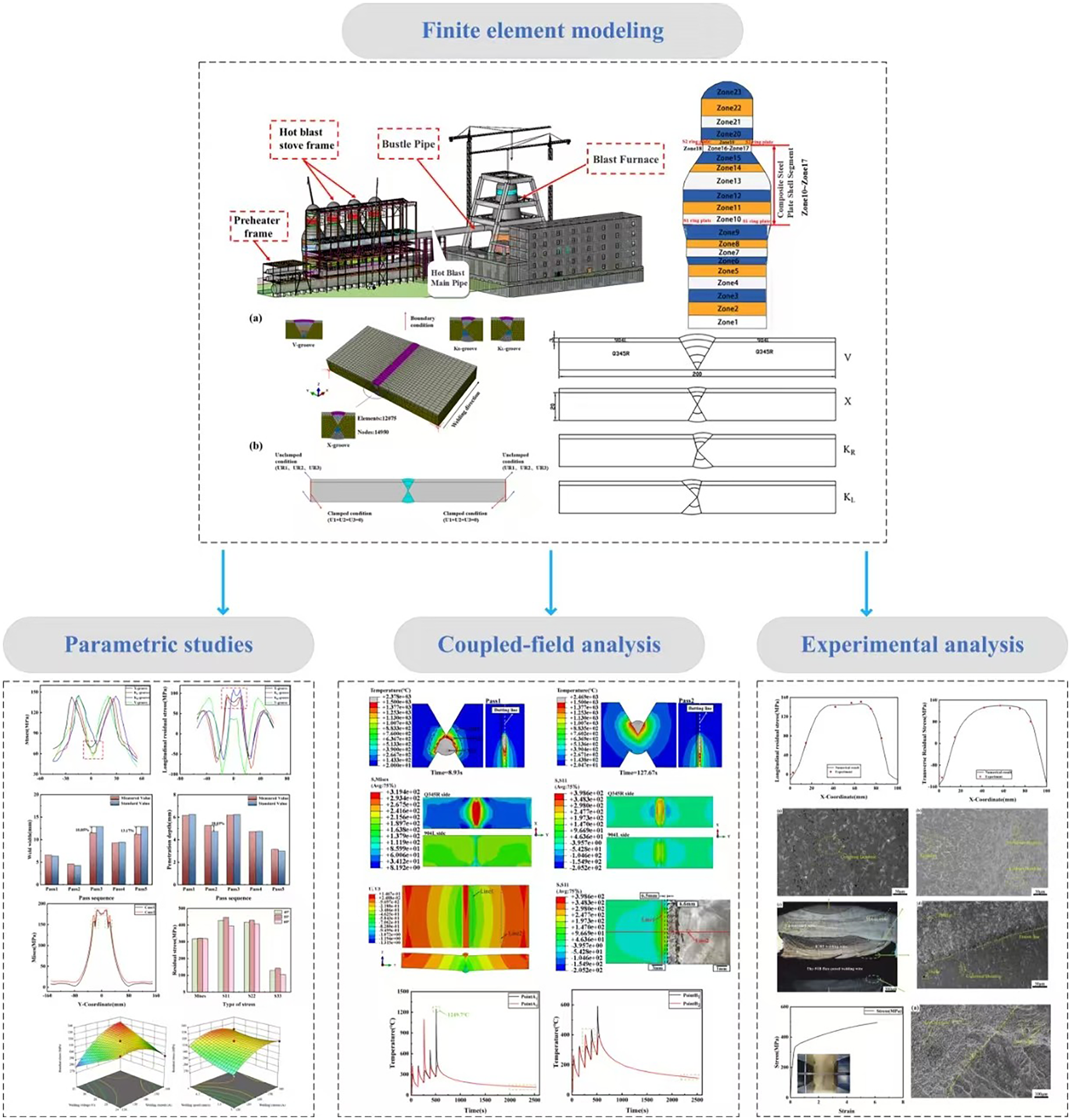
Stainless steel/carbon steel (SS/CS) composite plates find wide application in large-scale equipment such as hot blast furnaces, where the strength of welded joints constitutes a critical factor affecting structural stability and safety. Utilising ABAQUS software, a thick-plate multilayer multi-pass welding finite element model was established, incorporating the “element birth and death technique” and employing FORTRAN programming to develop the DFLUX subroutine for simulating the volumetric heat flux distribution of a double ellipsoidal heat source. This study systematically investigates the quantitative relationship between different welding procedure parameters and the mechanical properties of composite joints. By integrating response surface methodology (RSM) into a multilayer, multi-pass welding numerical simulation framework, the requirement for costly and time-consuming full-factorial parametric simulations is substantially reduced. This approach achieves multi-objective optimisation of the welding procedures for both the transition layer and cladding. Residual stress distribution analysis demonstrates high agreement between finite element simulation data along characteristic paths and experimental measurements obtained via X-ray diffraction (XRD). Metallographic analysis combined with selective etching reveals sound metallurgical bonding at the joint interface. Tensile testing confirms that the welded joint strength of the composite plate meets engineering application requirements and exhibits favourable structural load-bearing capacity. Fracture morphology analysis indicates uniformly distributed equiaxed dimples on the 904L steel fracture surface, while the Q345R steel side exhibits characteristic fibrous shear dimples.
Keywords
Get full access to this article
View all access options for this article.
References
Supplementary Material
Please find the following supplemental material available below.
For Open Access articles published under a Creative Commons License, all supplemental material carries the same license as the article it is associated with.
For non-Open Access articles published, all supplemental material carries a non-exclusive license, and permission requests for re-use of supplemental material or any part of supplemental material shall be sent directly to the copyright owner as specified in the copyright notice associated with the article.
