




Abstract
Developing soft magnetic materials with high saturation magnetization, low coercivity, and excellent mechanical properties remains a challenge. This study investigates the FeCoNiMn0.25Al0.25 high-entropy alloy fabricated via vacuum arc melting. To analyze the effect of strain path, unidirectional and bidirectional cold rolling were applied with thickness reductions of 20%, 50%, and 90%. X-ray diffraction confirmed a face-centered cubic phase in cold rolling samples, while annealing at 900 °C led to a dual-phase structure (face-centered cubic + minor body-centered cubic). Deformation texture analysis revealed α-fiber components in unidirectional-cold rolling samples and normal direction-rotated brass components in bidirectional-cold rolling samples, with annealing twins influencing the final recrystallization texture. The Ms values increased to ∼114.6 and 111.8 emu/gram, while Hc decreased to ∼242.3 and 231.7 A/m for 90% cold rolling followed by annealing in unidirectional and bidirectional samples, respectively. Mechanical testing showed high hardness, yield strength, and tensile strength in cold rolling conditions, with improved plasticity after annealing. The unidirectional-annealed samples exhibited the best balance of magnetic and mechanical properties, making this high-entropy alloy a strong candidate for electrical machinery, transformers, magnetic shielding, and power generation applications.
This is a visual representation of the abstract.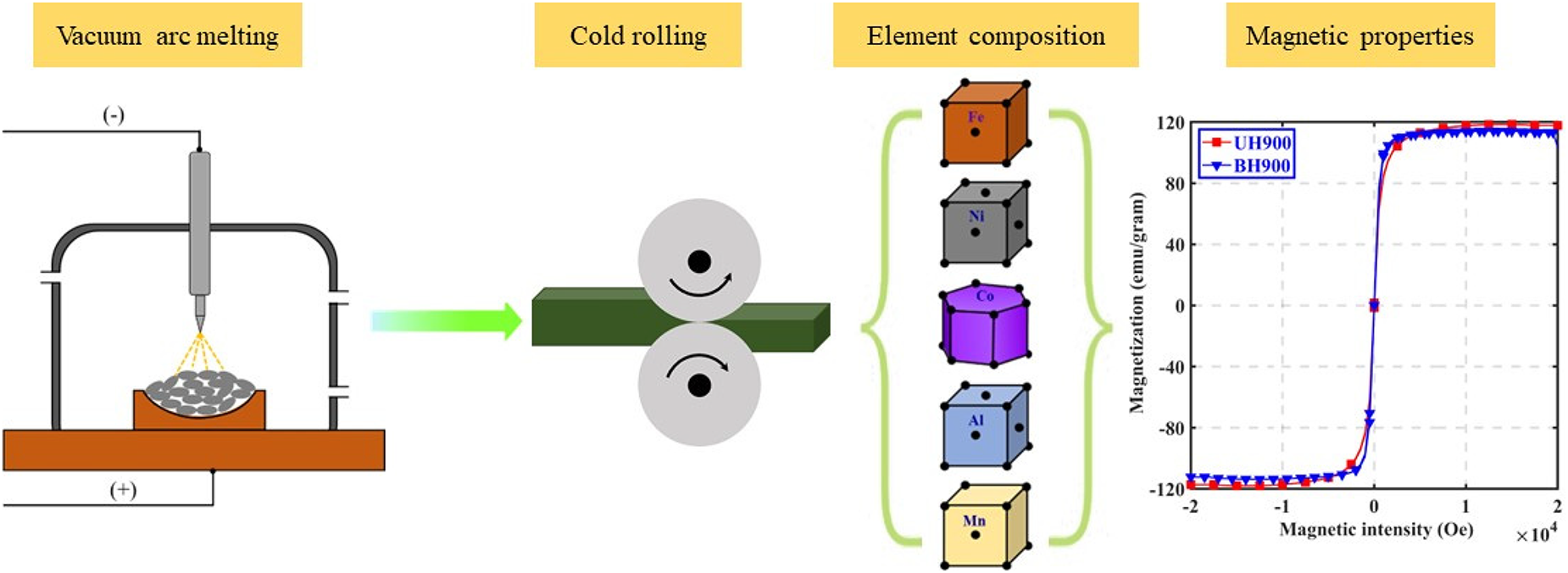
Get full access to this article
View all access options for this article.