




Abstract
The primary function of windscreen wipers is to remove water and debris from the windscreen, ensuring the driver has a clear view of the road ahead. Predicting wiper performance at the design stage is therefore important to ensure their safe operation. There is hence a need to develop physics-based models of wiper performance that can be used as evaluative tools early in the design stage. This paper presents an analysis of the impact of changing screen curvature on the contact force distribution of a wiper blade and the subsequent effects on the transient dynamics. The contact distributions for three distinct screen curvatures and three loading points are calculated via FEA (finite element analysis) and subsequently analysed via multiple connected mass spring dampers to model the wiper blade lip transient dynamics. By analysing time and frequency domain data for several calculated contact distributions it is found that decreasing the screen curvature reduces the contact force at the centre of the blade, however, increases the amplitude of vibrations and range of frequencies observed. Additionally, it is found that moving the loading point towards the tip of the blade reduces the amplitude of vibrations, a result analogous to that of increasing the screen curvature. Based upon the understanding gained through this work the influence of design criteria on wiper blades can now be assessed, and several suggestions made as to how to reduce windscreen wiper noise.
Keywords
Introduction
Over the last two decades the automotive industry has seen vast developments in vehicular safety, in particular ADAS systems becoming a common standard feature. However, windscreen wiping systems, in particular the wiper blade design, have remained principally unchanged since 2000, 1 despite the key role that they play in securing a clear view for the driver. In addition to safety, the vehicle occupants can also see and potentially hear the wiper blades when in operation. With the primary focus of many automotive manufacturers being electrification, this poses a unique problem for luxury vehicles as the typical engine noise that would normally distract from other ambient noise is no longer present. There is hence a need to improve windscreen wiper design to maintain visibility and reduce the generation of perceptible vibrations and noise.
Almost all aspects of vehicle design and pre-production testing is now carried out digitally. In line with this there is a requirement to also predict and fine-tune wiper behaviour virtually, using simulation. High fidelity models can potentially provide faithful predictions, but require extensive and expensive parameterisation, while also being computationally very expensive. In addition, due to the large number of states and complex interactions, it is often difficult to identify important design parameters and behaviours, to improve general understanding of the problem. In contrast, simpler models can provide useful insights into important interactions and can also be used at an early stage of development when fewer parameters are known with certainty, hence allowing for data informed design decisions to be made.
Many studies have been conducted on the contact distribution of windscreen wiper blades, with only a small number considering the dynamics of a wiper blade. The majority of studies that model the contact distribution employ finite element analysis.2,3 Typically, the analysis is conducted using contact with a flat surface, and subsequently the blade design factors are investigated as to how they affect the contact distribution. There have been mathematically focused studies on the contact distribution using a dynamic beam bending equation and a Winkler foundation, validating the mathematical approach with experimental measures. 4 Additionally, previous FE (finite element) and mathematical studies of the contact distribution have considered a whiffletree style wiper blade, a blade that is now not commonly used within the automotive sector with manufacturers preferring the newer flat style wiper blades.2,4 Previous FE studies have focused on the prediction of the contact force distribution but do not attempt to relate this to the dynamic response of the entire length of the wiper blade.5,6
Solely modelling the contact distribution shows nothing of the dynamic behaviour of a wiper blade. While the mechanisms that govern elastomer glass interactions are complex, 7 a mechanical analogy of a mass spring damper system is commonly employed to model the rubber-glass contact.8–10 This type of model has been used to determine key phases in the dynamics of a wiper blade by studying the ratios of static and kinetic friction, oscillatory frequencies and the amplitude of oscillations. 11 However, these studies typically consider only a single mass spring damper system and normal force value. Thus, implying both a uniform load across a blade and a single velocity, neither of which are true for a wiper blade.
The aim of this work is to study the evolution of the contact distribution and its effects on the dynamics of the wiper blade tip as it transitions through a full arc of wipe. A finite element (FE) analysis that considers the non-linearities of the contact distribution, whilst linear material properties are employed to calculate the contact distribution in a quasi steady manner. In order to capture the dynamics a mechanical analogy of a mass spring system is adopted, however, unlike previous simplified dynamics models that use a single mass and vertical load, this model uses multiple masses and a realistic load distribution. This is used to show the dynamic response changes when the screen geometry is adjusted, something which cannot be captured using a single mass model.
The section FE Modelling presents the finite element model used in this work and the simplifications made to increase the computational efficiency. The Section ‘Mass spring damper (MSD) system’ shows the formulation of the multiple mass spring damper system used to evaluate the transient dynamics of the wiper blade. The Section ‘Results and discussion’ presents the findings from this study and discusses the implications of the findings. Finally, the Section ‘Conclusions’ concludes and summarises the presented work, highlighting the benefits of using the multiple mass model to capture the transient dynamics.
FE modelling
The windscreen wiper used in this work is a simplified model of the currently available flat style wiper blades, with a length of
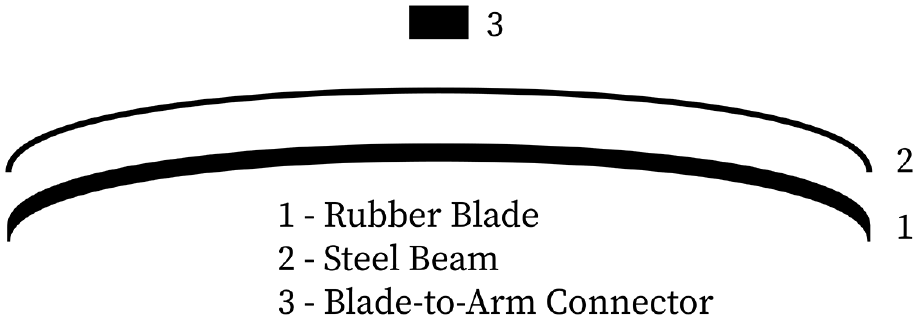
Exploded view of windscreen wiper blade.
The displacement of the entire wiper blade when deformed is relatively large, however, modern flat style wiper blades do not pin the rubber blade element. This allows for it to slide on the steel element when deformed. As such a linear elastic set of properties for the rubber, steel and glass are used. Curved edges were used at the heel and tip of the wiper blade to avoid singularities arising from the point contact, Figure 2 shows the blade construction within Abaqus.
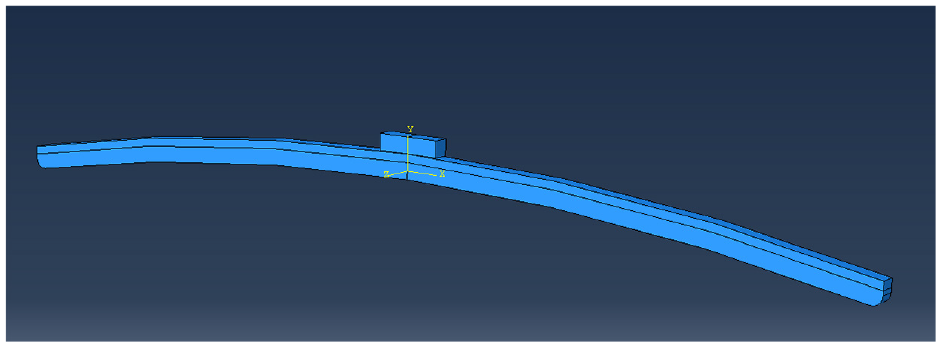
Wiper blade construction within Abaqus.
The windscreen referenced within this work is also commercially available, and is approximately

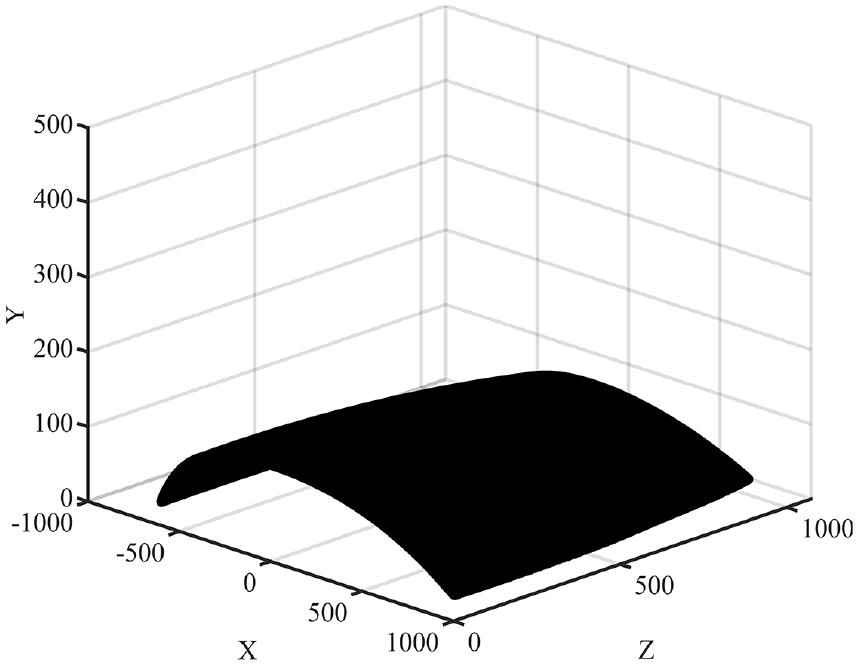
Three dimensional plot of the windscreen geometry used to determine the windscreen mathematical expression.
Equation (1) has an R-squared value of
The typical vertical load that a stationary wiper blade is subjected to ranges from
To analyse the contact distribution, a contact pair was established between the bottom surface of the rubber blade element and the top surface of the screen geometry. The contact friction coefficient between the wiper blade and the underlying screen geometry can be as large as

All components were meshed using hexahedral solid elements. The rubber blade was defined as the slave element within the contact interaction due to the mesh being finer than that of the screen which was assigned as the master surface. For all simulations presented in this paper, the mesh used 308 nodes on the underside of the rubber element. The mesh density was selected as a result of a mesh convergence study and the discretisation of commercially available tools to experimentally measure the contact distribution of automotive wiper blades. The distance between each node on the underside of the blade is
Mass spring damper (MSD) system
To model the effect of the contact distribution on the dynamics of a wiper blade, a mechanical analogy of a MSD system on a conveyor is used. By using a conveyor the angular velocity of the blade can also be considered, thus allowing the prediction of variations in the friction coefficient as described by a Stribeck curve. To represent the length of the blade, a discretised approach with multiple connected MSDs is considered. To account for the variation in angular velocity along the blade relative to the screen, each MSD rests upon an individual conveyor that moves with a specified velocity.
Figure 4 shows the cross-section of a wiper blade and the point of interaction between a blade screen surface. The MSD shown in Figure 4 does not represent the full cross-section, but instead models purely the contact interaction. Additionally, when considering the displacement of the blade tip, a zero measure of displacement is taken as the point at which the blade tip in its vertically deformed state would be resting.
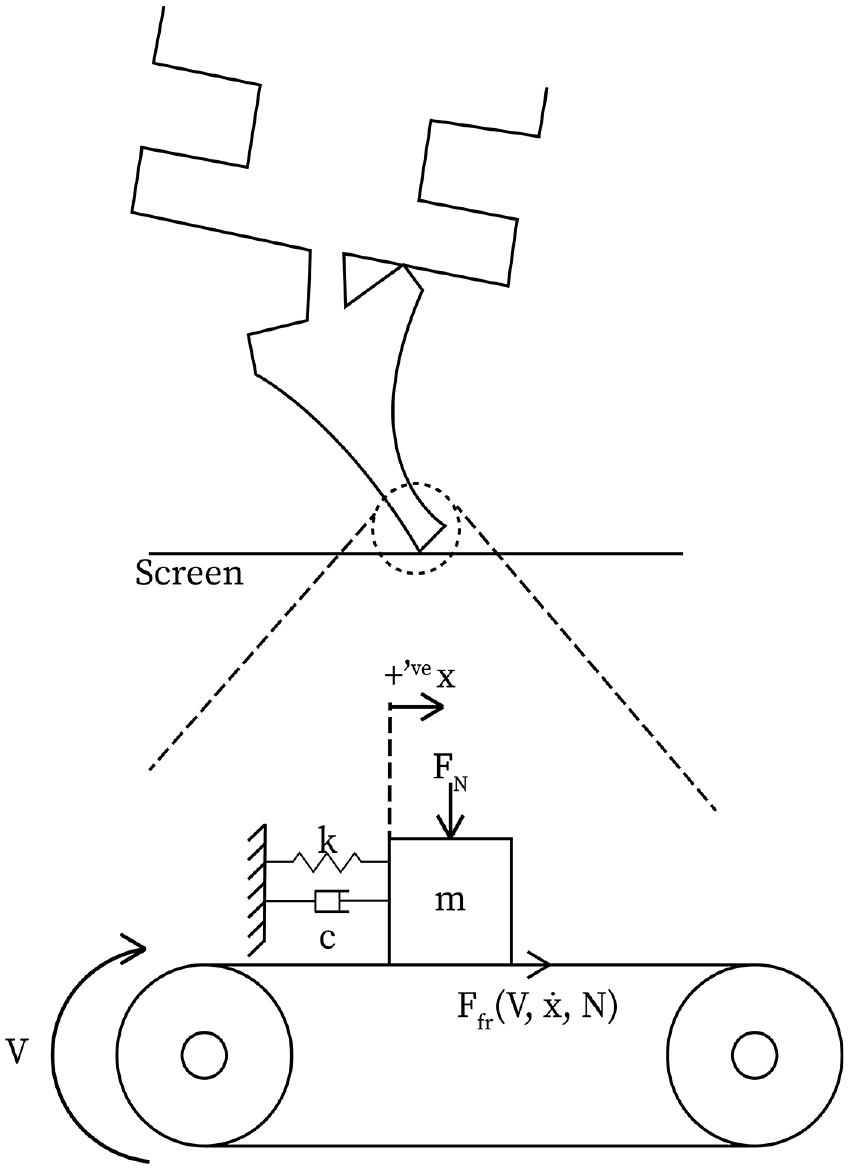
Complex cross section of windscreen wiper blade represented by a mechanical analogy of a mass spring damper on a conveyor.
The transverse motion of the MSD shown in Figure 4 is governed by the following equation.

However, we consider the full length of the blade and as such must include the forces that each adjacent discretised element exerts upon its neighbours as shown in Figure 5.

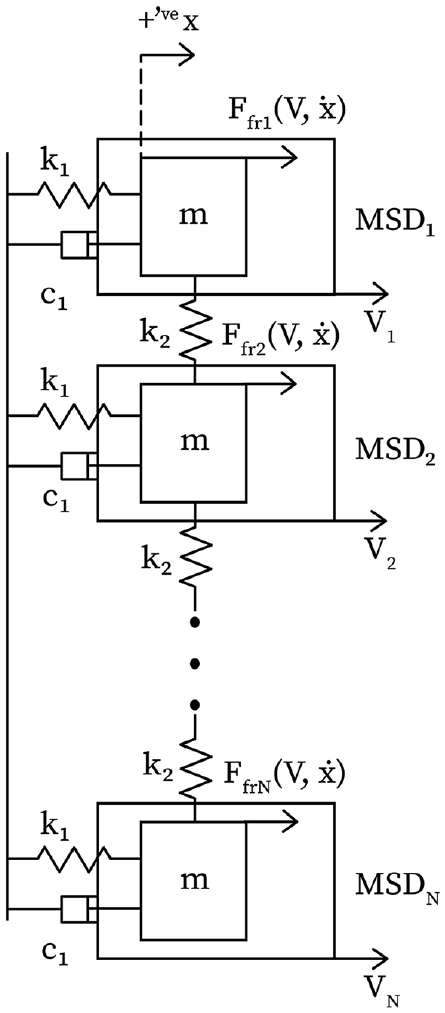
Multiple discretised MSD systems to represent full length of wiper blade.
As such, our equation for the transverse motion becomes:

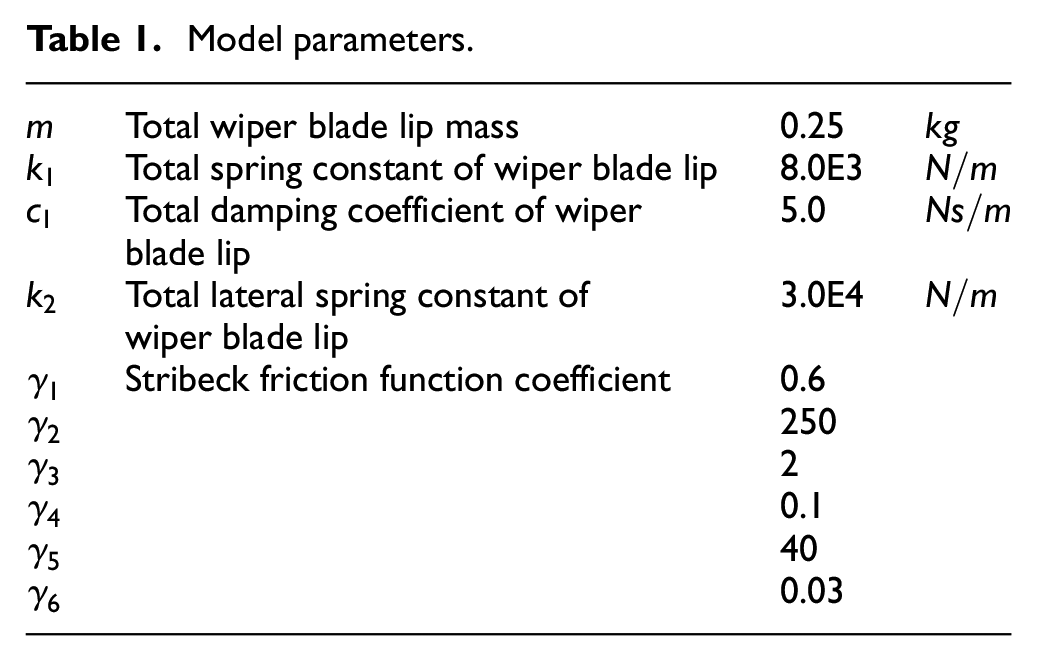
The normal load,
Model parameters.
As with any system subject to surface contact, friction between the surfaces determines the dynamic behaviour. Although the exact mathematical description for the transition between static and kinetic friction raises some questions, 20 a widely utilised description of friction is the steady-state Stribeck Law. Furthermore, experimental measurements of friction while a steady sliding motion is observed, often take the form of a Stribeck curve 21 which relates the sliding velocity to a friction coefficient.
Makkar et al. 22 captured the Stribeck behaviour in the following non-linear form:

Where
The initial region of the Stribeck curve represents the boundary lubrication regime which is typically associated with the static Coulomb friction. The subsequent negative gradient represents a region of thin film lubrication typically associated to a mixed friction regime, and the subsequent minima and shallow positive gradient correspond to hydrodynamic or full film lubrication.8,23
Windscreen wipers primarily operate within the regions associated with thin film lubrication and hydrodynamic lubrication. As such, the constants in Table 1 are tuned to provide a friction coefficient range of
The numerical simulations used MATLAB’s ODE45 ordinary differential equation solver. Solving with a sample rate of
Results and discussion
In this section the results of the work are presented and discussed, highlighting key trends and phenomena observed.
Finite element calculation of contact force distributions
Figure 6 presents the contact force distributions calculated by the FE model described in Section ‘FE Modelling’. Curvature ‘G’ quoted in Figure 6 is the nominal screen curvature determined from the windscreen geometry presented in Figure 3 and used as reference throughout the presented study. Figure 6 shows that an increase in windscreen curvature (from
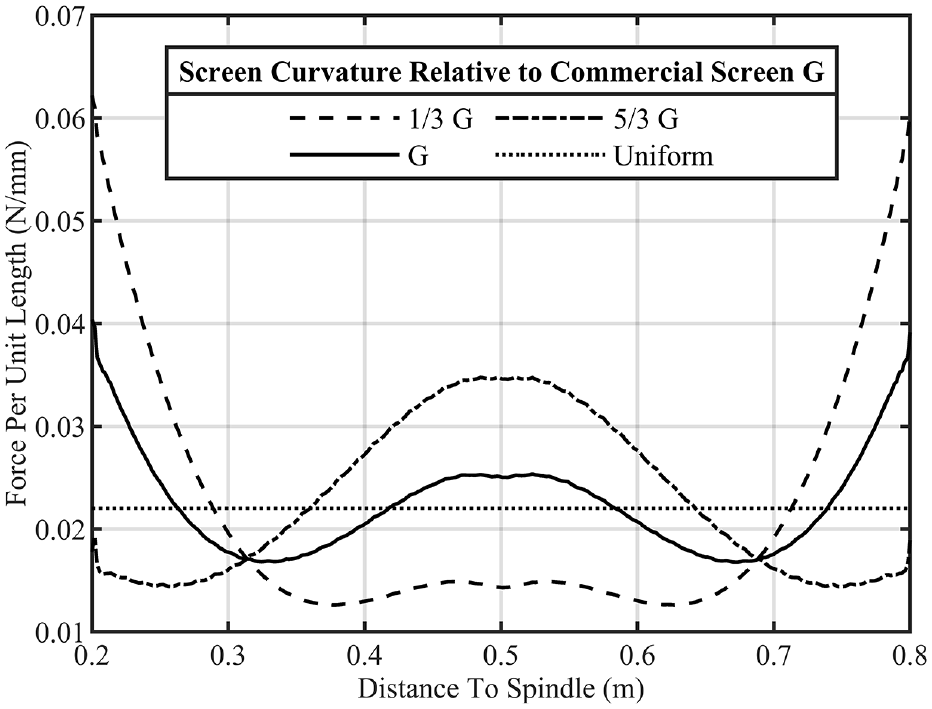
Contact force distributions for varied screen curvatures.
Additionally we find that the Blade-to-Arm connector affects the contact force distribution at the central point. This is due to the increase in rigidity spanning the length of the connector. The influence of this is significantly more pronounced on the nominal curvature case,
One notable feature present in Figure 6, is the common intersection points of the contact distributions which are symmetric about the centre. These common intersection points occur at the midpoint between the end of the blade-to-arm connector and the tip or heel on each respective side. This common intersection point occurs at approximately the points of inflection of our nominal curvature case. This suggests that at a given load, for a range of curvatures, a constant contact force will be observed at these points. This is a feature that is determined by the geometry of the wiper blade (blade length and blade to arm connector length).
Figure 7 presents three contact distributions, each with a different applied normal load. As the normal load is increased, the contact force increases in the central region of the blade, much like when considering a case of increasing the curvature of a screen. Additionally, the contact force at the blade tip and heel increases as the normal load decreases, much like when reducing the screen curvature. From this observation one could make the assumption that an equivalency can be drawn between increasing the curvature and increasing the normal load applied, when considering solely the distribution shaping and not the numerical value of the contact force.
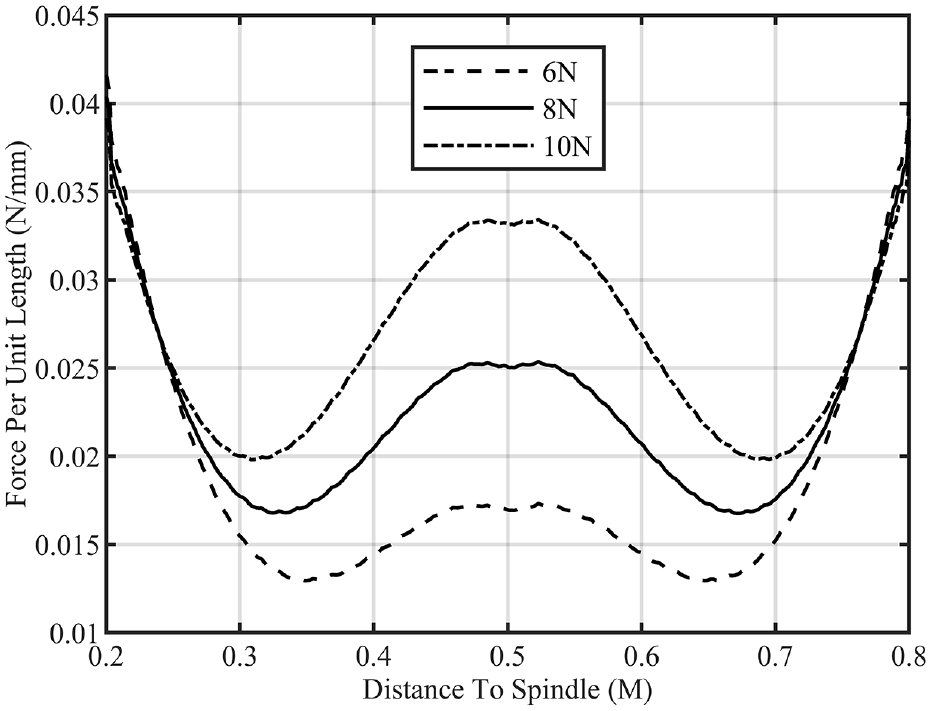
Contact force distributions for varied normal loads.
However, when considering the quantitative changes in the distributions, we find that the greatest discrepancies occur at the blade extremities as shown in Figure 8. Therefore, we can not make an assumption between the equivalency of load and curvature, thus both elements need to be considered individually when constructing a wiper system.
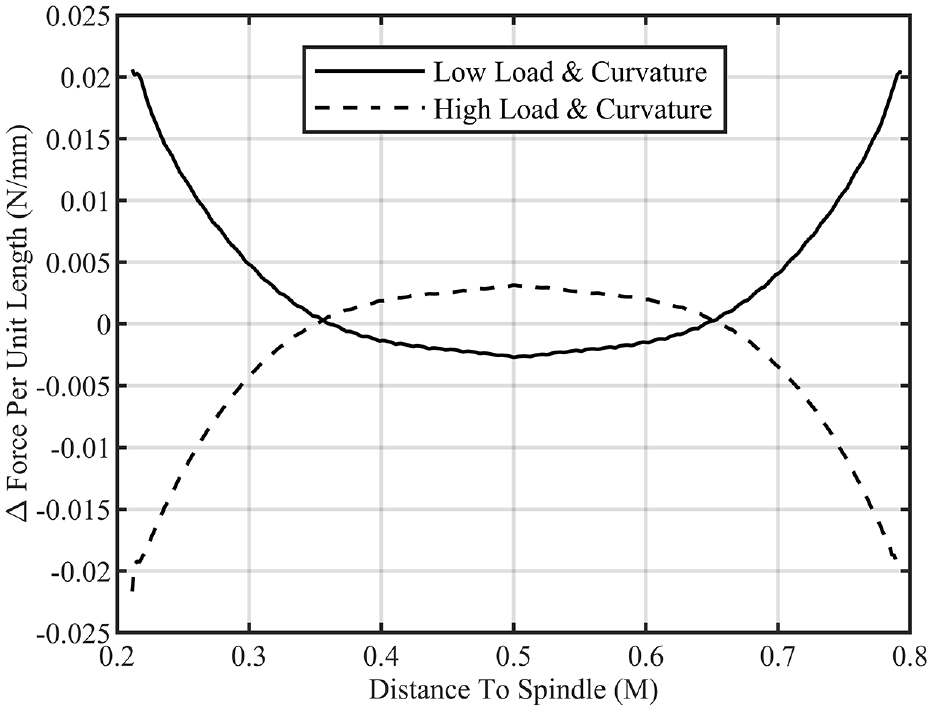
Difference in contact distributions when considering load and curvature.
Figure 9 shows the contact distributions for different arm attachment locations. As the attachment location is biased towards either the heel or tip of the blade, the distribution becomes asymmetric. The contact force at the heel and tip of the blade increase as the attachment location is moved closer to the respective point. Additionally the local minima inflection points show increased contact force when the attachment is moved closer to the tip or heel respectively.
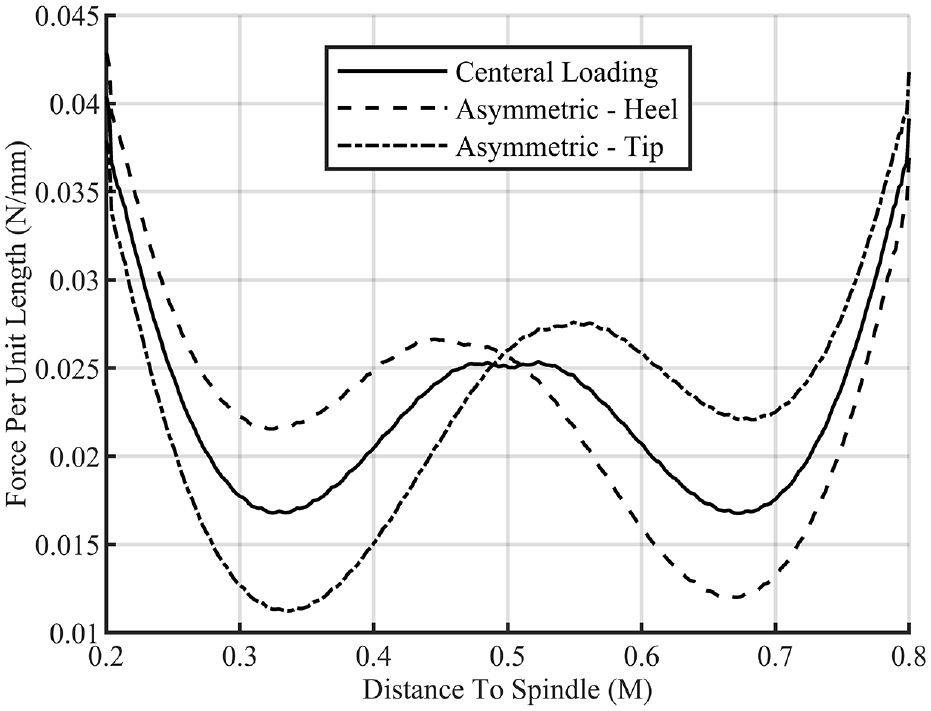
Contact distributions when considering asymmetric loading.
Dynamic response of wiper to non-uniform loading
Figure 10 shows the blade’s displacement at the centre point of the wiper as a function of time, when considering the three different curvatures and a step-speed input to achieve
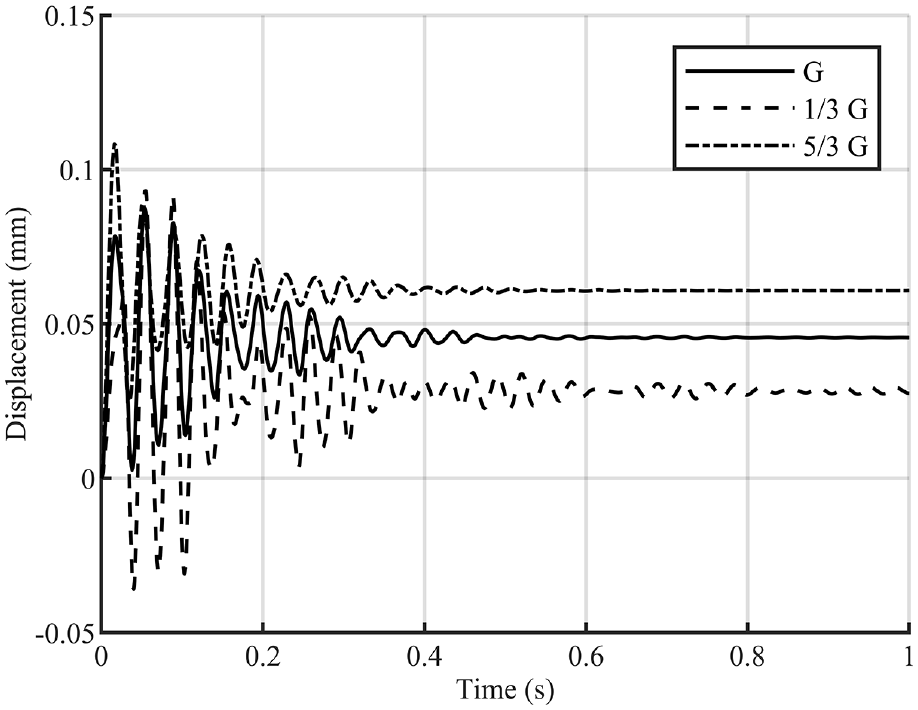
Displacement of the blade lip at the centre point.
The low curvature
A distinct area of interest is the section of the blade closest to the spindle, the heel of the wiper blade, as this area sits in the negative gradient section of the Stribeck curve and thus operates in a high friction regime. Figure 11 shows the tip displacements at the heel of the blade for the three curvatures considered. We find that the oscillations in each case continue for a longer time period as a consequence of the increased friction coefficient from the Stribeck curve.
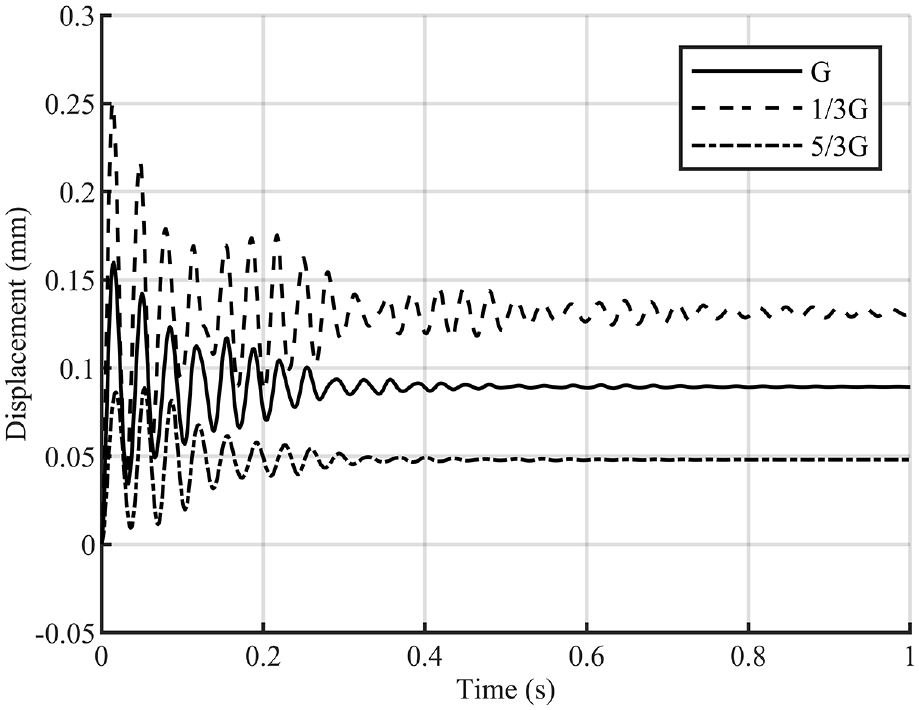
Displacement of the blade lip at the heel.
Additionally, we find that the nominal and low curvature cases have a higher amplitude compared to that of the high curvature case. This is a result of the differences in the contact distribution, as in the high curvature case there are low contact forces at the blade extremities, whereas with the low curvature case there are high contact forces at the extremities. This trend is also continued when considering the tip of the blade, with the high curvature case showing the smallest amplitude of oscillations and fastest settling time.
While the displacement data provides insight into the time to reach equilibrium, and the amplitude of oscillations give an indication of the noise/vibration produced by the system, an additional insight is provided by considering the frequency response of the blade.
Figure 12(a) shows the Fourier decomposition for the full length of wiper blade for our three distinct curvature cases. The dominant frequency in each of these cases is
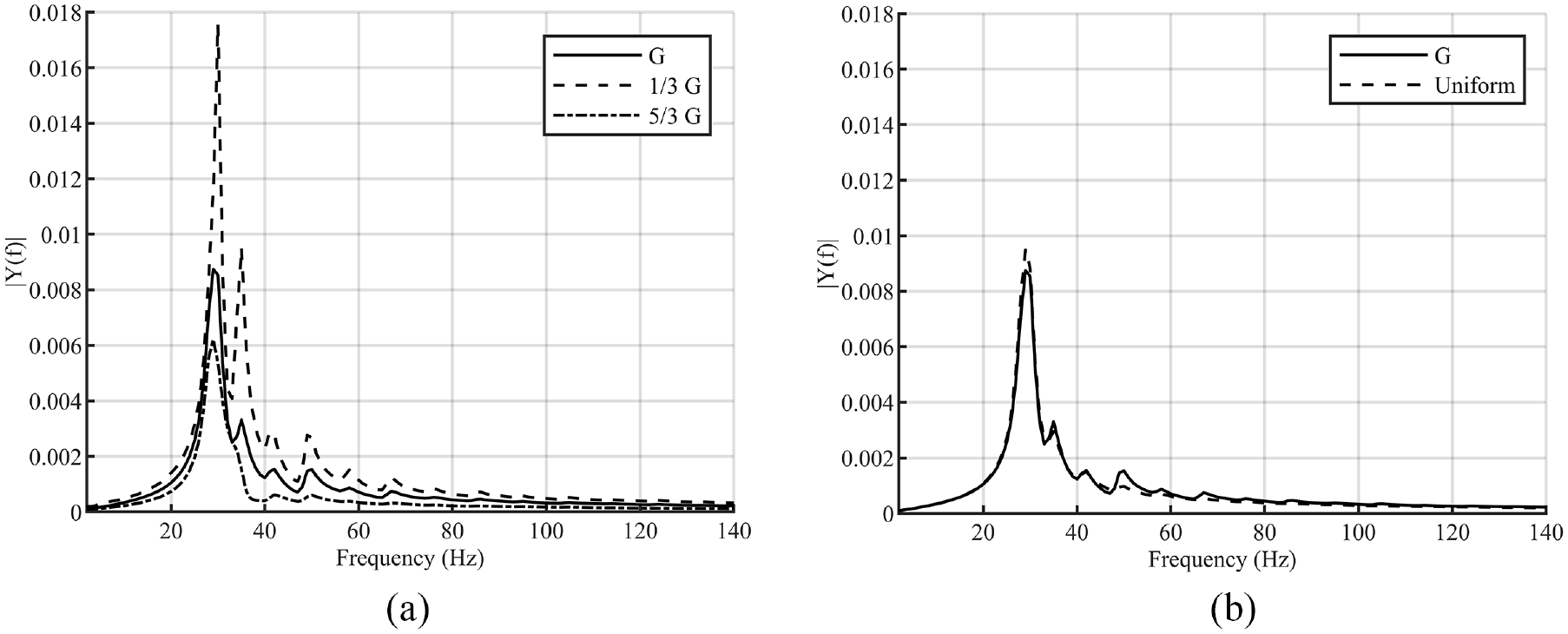
Fourier decomposition of the time displacement data for the full wiper blade: (a) comparing the nominal curvature to
To confirm whether the additional frequencies in the Fourier decomposition are a result of interference from neighbouring elements a single mass spring damper system can be considered. Using single values for the normal load which are taken from the calculated contact distributions and considering a single point along the length of the blade we can use the Stribeck function to determine the friction coefficient at the point of interest. As the
Figure 13 shows the displacement of the wiper lip as a function of time for a single MSD. The displacement data shows no evidence of the interference observed in the multiple mass model. This confirms that the neighbouring elements in the multiple mass model are providing a perturbation that is propagating along the length of the blade lip resulting in the additional frequencies observed in the Fourier decomposition and the pulses of displacement observed in the displacement-time data.
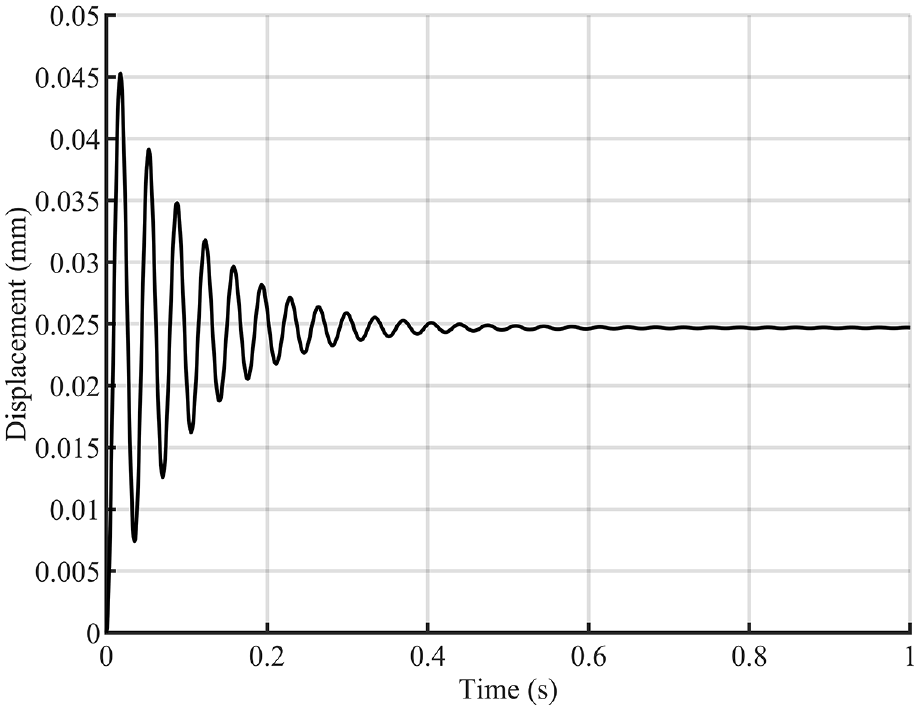
Displacement of the blade lip at the centre point using a single MSD.
Many in the automotive industry aim for a uniform distribution when designing and commissioning wiper systems, with the assumption that a uniform distribution will yield a more desirable wiper performance. 2 Figure 12(b) shows the frequency response obtained when implementing a uniform contact distribution. The high frequency content in the uniform case is because of differential frictional loading. Without differential loading one should observe only a single frequency because higher order modes of the multi MSD system would not be excited. So, those who aim for a uniform distribution are not right because they should aim for uniform friction, not uniform vertical load.
A feature present in all the time displacement results is that the heel of the blade has a greater level of displacement compared to that of the tip of the blade despite the symmetrical distributions. This result is due to the dynamic modelling using a Stribeck curve, and as such the elements closest to the centre of rotation experience a higher level of friction compared to those furthest from the centre. This poses the following question: can we shape the distribution such that the contact force is reduced closest to the centre of rotation and increased towards the tip of the blade, thus achieving a more uniform friction force along the length of the blade. Using an asymmetric distribution as in Figure 9, a more uniform friction force is established. When implementing the asymmetric loading into our MSD model and obtain the Fourier decomposition, as presented in Figure 14, we find that a heel biased load increases the amplitude of the frequencies present, with an emphasis on the peak at
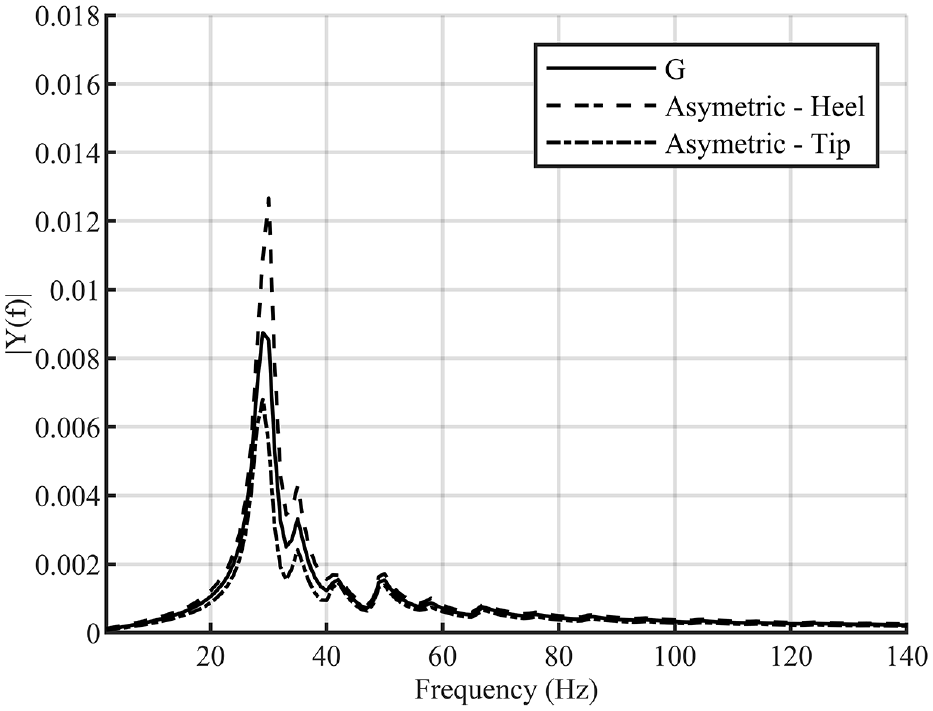
A graph of the Fourier decomposition of the time displacement data for the full wiper blade asymmetric loading.
The work presented in this study compares well to experimental data captured using accelerometers. The accelerometers were mounted to the wiper of a vehicle with the corresponding screen geometry and wiper blades as used within this study. The accelerometers were mounted on the wiper blade as close to the blade-to-arm connector as possible as to minimise the impact of any freeplay in the joint on the experimental measurements. The accelerometers sampled at the same rate as the simulation,
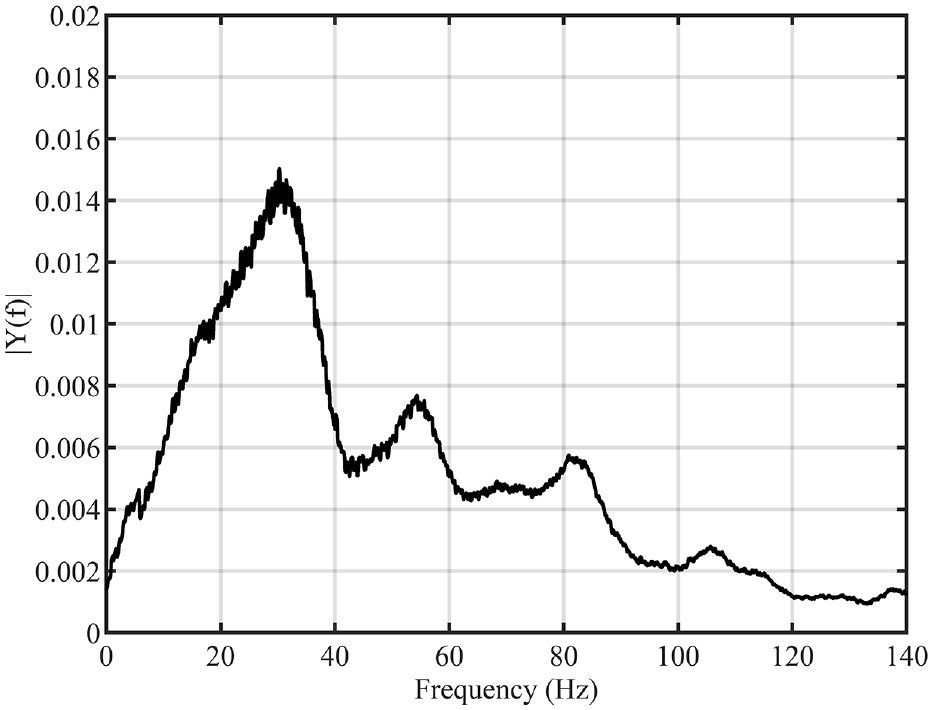
Fourier decomposition of experimental data captured using accelerometers.
Conclusions
The influence of screen curvature on the contact distribution of a wiper blade was investigated, using a finite element model that considers the material characteristics and geometric non-linearities of the wiper to windscreen contact. The distributions were subsequently used to examine the effect of screen curvature and thus contact distribution shaping on the transient dynamics of a wiper blade through the use of a multiple interconnected mass spring damper model. The MSD model included a Stribeck curve which was manipulated to reflected known limits of wet sliding friction for automotive windscreen wipers. A nominal curvature,
By increasing the screen curvature, the central contact force of the blade is increased and the contact forces at the heel and tip of the blade are decreased. The inverse of this is true for a screen of a lower curvature than that of the nominal case,
Furthermore, by using a multi mass model as oppose to a singular mass model it has been shown that much more of the complex dynamics are captured. Notably, the influence of the variation of friction coefficient along the blade and the interference this creates when considering the dynamics of the wiper lip. Such interference is not captured by a single MSD, thus not providing accurate details of the wiper blade dynamics.
Future work investigating how the contact distribution excites vibrations as a result of component freeplay within the wiper system would be interesting to identify the root cause of self sustaining vibrations. Additionally, studying how these parameters affect the stability of a wipe-cycle will provide good insight for future wiper system design.
Combined finite element and multi-physics models, such as the ones presented in this work can help automotive designers understand the physical phenomena that occur during wiper operation and thus provide insight into improving wiper performance and provide informed decisions at a vehicle design stage as to wiper optimisation. Additionally, the same models can be used at a pre-production testing phase to help identify the cause of poor wiper performance from a particular design.
Footnotes
Declaration of conflicting interests
The author(s) declared no potential conflicts of interest with respect to the research, authorship, and/or publication of this article.
Funding
The author(s) disclosed receipt of the following financial support for the research, authorship, and/or publication of this article: This work is sponsored by an EPSRC and Jaguar Land Rover ICASE award.
