




Abstract
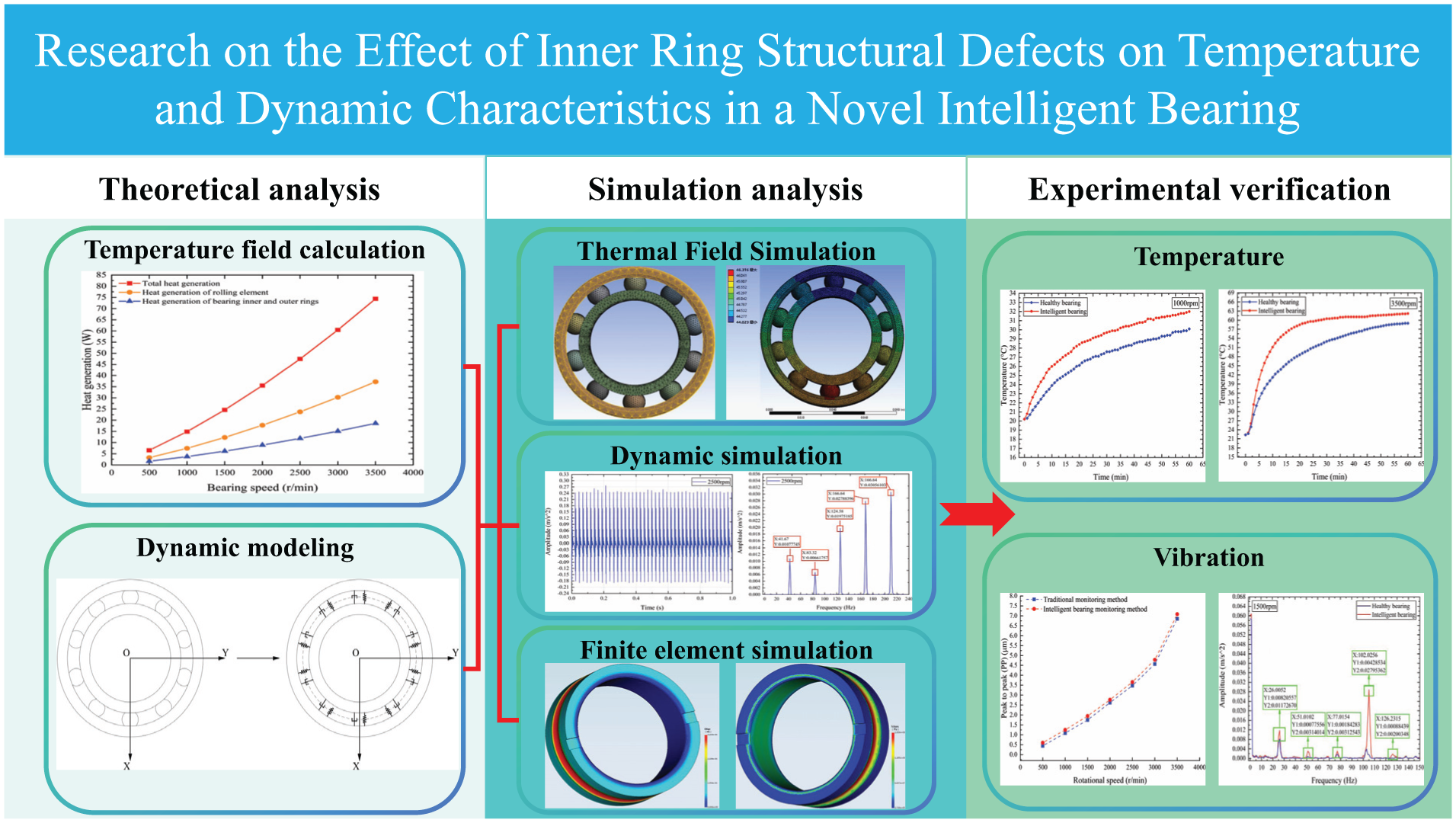
The existing bearing condition monitoring methods are not easy to identify the early bearing fault characteristics. As a frontier field in condition monitoring, intelligent bearings show considerable promise for the early fault diagnosis of rotating machinery and are progressing toward practical application. However, structural imperfections introduced during their design and manufacturing may adversely affect their thermal and dynamic performance. To tackle this problem, this paper study the effect of intelligent bearing structure defects on temperature and vibration characteristics. Firstly, the heat generation of an intelligent bearing is calculated using the Palmgren friction torque empirical equation, and the healthy bearing is modeled based on Hertz contact theory. Secondly, the temperature field is simulated using Ansys, and the temperature distribution is obtained. Finite element simulation is conducted using Simdroid, and the deformation and stress distribution are obtained. Finally, a comparative experiment analyzing temperature and vibration signals is conducted at rotational speeds ranging from 500 to 3000 rpm. The results demonstrated that the intelligent bearings exhibited a temperature profile closer to the simulation values with a temperature rise rate of less than 1.2, compared to healthy bearings. Additionally, the frequency domain analysis of the vibration signals revealed no obvious fault characteristics. This work lays a theoretical foundation for early fault diagnosis of intelligent bearings.
Keywords
Get full access to this article
View all access options for this article.