



Abstract
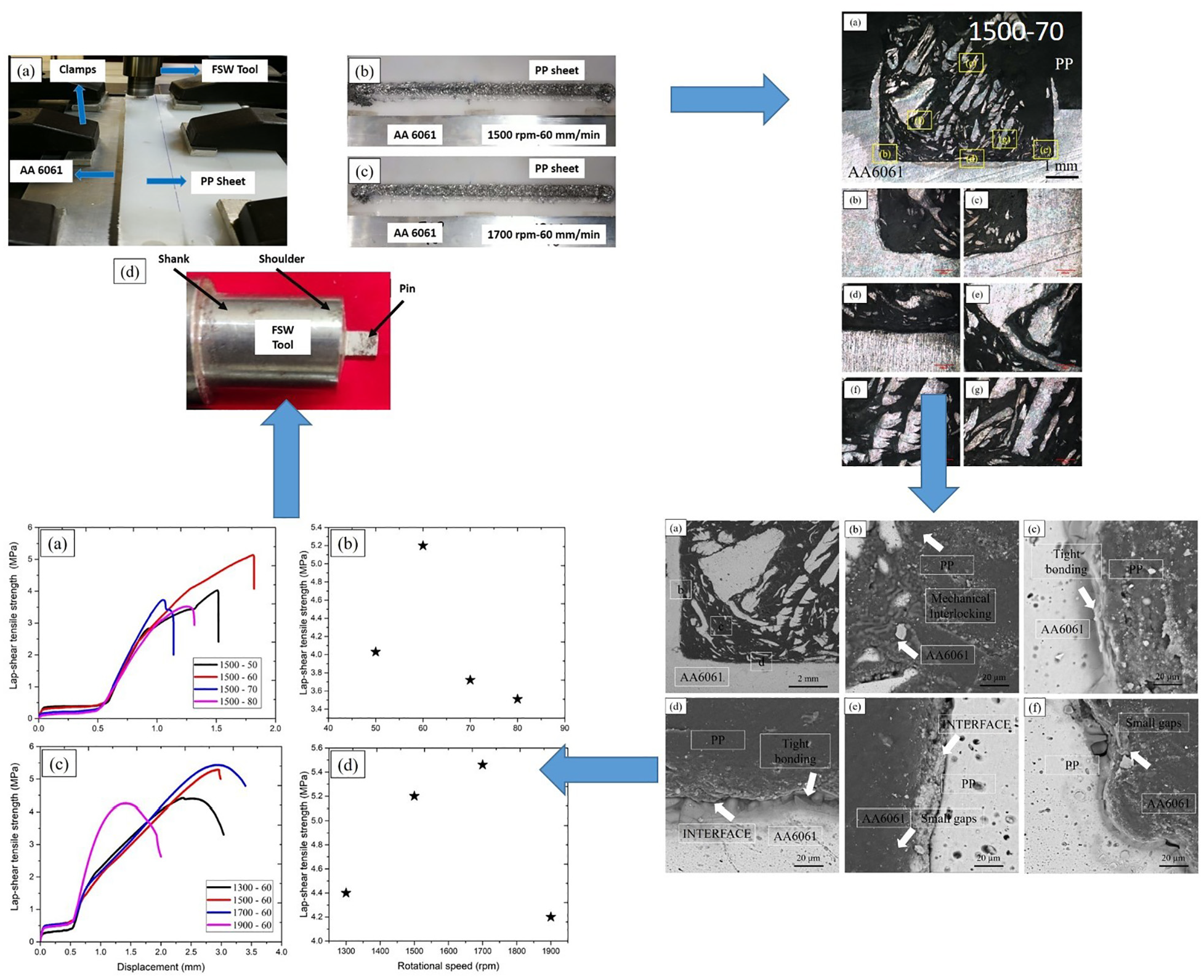
Investigating the robust bonding between dissimilar materials such as aluminium alloys and polymers is vital in welding processes. This research delves into the structural interface and mechanical attributes achieved through aluminium alloy 6061 (AA6061) and Polypropylene (PP) friction stir welding by varying traverse and rotational speeds. A travel speed was varied with a range of 50–80 mm/min, and the tool rotational speed between 1300 and 1900 rpm was investigated to analyse their impact on mechanical properties. The lap joint configuration in which the PP is at the top and AA6061 is at the bottom was chosen from trial experiments. A scanning electron microscope observed that many locations had a tight bond in most interface areas. The average hardness values at the stir zone in the joints at different rotational speeds initially increased up to 1700 rpm due to fine fragmentation and proper distribution of these aluminium chips, and then reduced after rising to 1900 rpm. Evaluation of weld quality encompassed assessments of weld nugget hardness and lap tensile shear strength, elucidating the mechanical interlocking mechanism between AA6061 particles and PP as a critical factor contributing to joint stability. The intersection of aluminium chips and solidified polymer contributes to enhancement in the shear strength due to the phenomenon known as mechanical interlocking. The highest tensile shear strength of 5.4 MPa was observed at a rotational speed of 1700 rpm and a traverse speed of 60 mm/min, signifying optimal process conditions for enhancing mechanical integrity.
Get full access to this article
View all access options for this article.