




Abstract
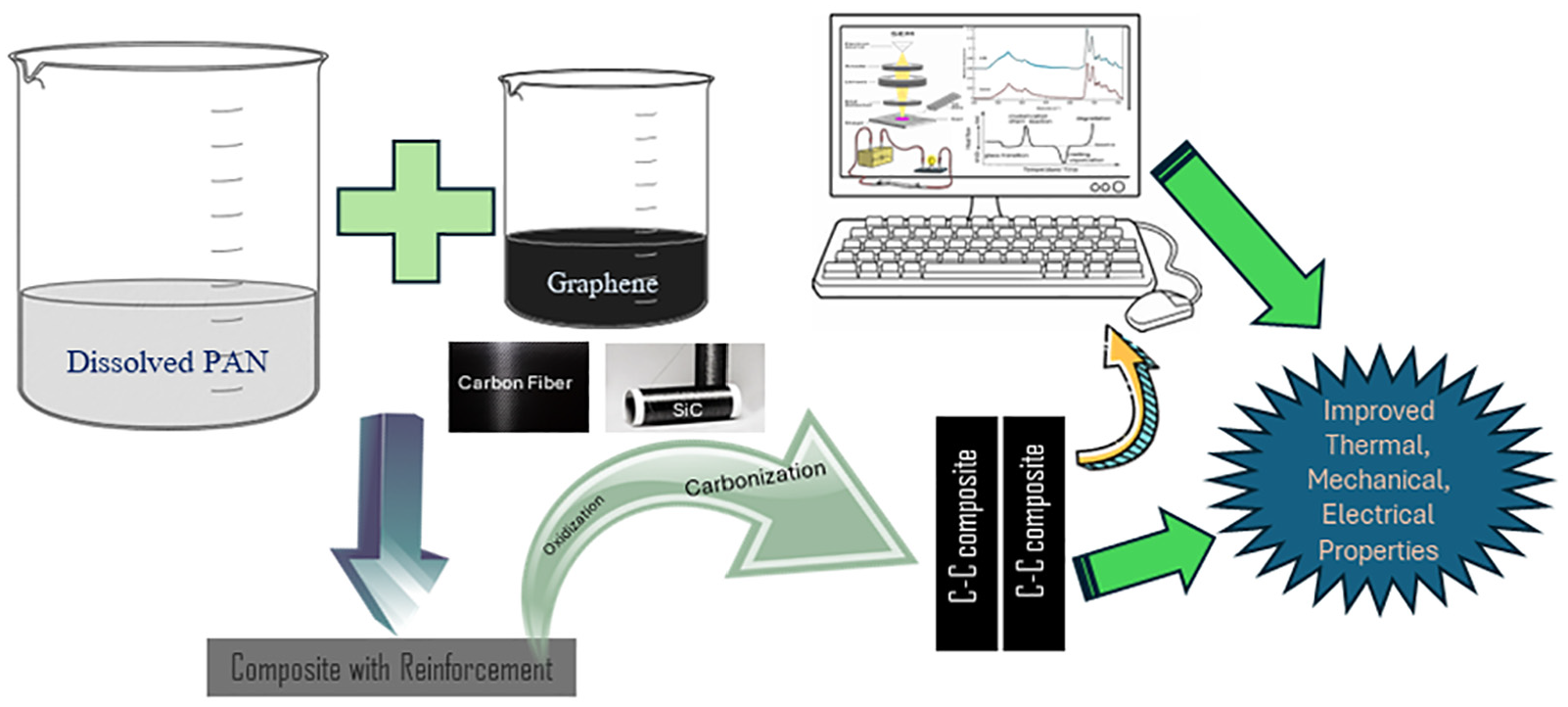
Polymeric nanocomposites and carbon-carbon composites were primarily developed for aerospace, wind energy, and civil and military applications due to their outstanding properties. The study introduces an innovative process to develop carbon-carbon and carbon-silicon carbide (SiC) fiber nanocomposites incorporated with various percentages of graphene inclusions into a polyacrylonitrile (PAN) solution to enhance their mechanical, thermal, and electrical properties. To prepare the nanocomposite coupons, a mixing ratio of 20:80 was employed for PAN and dimethylformamide (DMF) solvent, ensuring the effective dissolution of PAN powder. Subsequently, graphene powder was incorporated into the solution at a ratio of 0–4 wt%, forming the resin solution. This prepared mixture was poured into an aluminum (Al) casting groove to fabricate the nanocomposite coupons, which were reinforced with carbon and silicon carbide (SiC) fibers. After drying at room temperature, the developed composite coupons were oxidized at 200°C for 2 h in the air and then carbonized at 650°C for an additional 2 h in the presence of argon (Ar) gas. The oxidized coupons of carbon fibers (CFs) containing 4% graphene in PAN can withstand a maximum load of 9469.9 N and an ultimate tensile strength (UTS) of 632.8 MPa at fracture. Moreover, carbonized coupons were electrically conductive, with a mean value of 344 S/m, and highly fire retardant by passing UL94 tests. The test results of FTIR, DSC, and SEM results confirmed that the fibers and inclusions were well integrated with the new bonds, and properly oriented in the composite structures. This research recommends a promising possibility for manufacturing advanced composites with outstanding properties against extreme environmental conditions.
Keywords
Get full access to this article
View all access options for this article.