




Abstract
This paper aims to numerically investigate the protective efficiency of multilayered and boil-and-bite mouthguards on orofacial hard and soft tissues subjected to impact loadings. To the best of our knowledge, this is the first attempt which studies the protective efficacy of mouthguards on orofacial injuries including both hard and soft tissues such as articular disks, stylomandibular and sphenomandibular ligaments, that are commonly neglected in clinical and numerical studies. To address this issue, a finite element based numerical framework has been proposed using the Abaqus finite element software. This study considers three different situations of the craniofacial structure, without any mouthguard, with the customized multilayered mouthguard and with a boil-and-bite mouthguard. The protective effectiveness of mouthguards is numerically evaluated based on pressure and displacement distributions on the orofacial hard and soft tissues under two different actual impact loadings. In all cases the results revealed that the customized multilayered mouthguard can more effectively reduce the stress concentration on orofacial hard and soft tissues which is the key factor to evaluate the protective efficiency of different types of mouthguard. As an example, a comparison between the protective efficiency of multilayered and boil-and-bite mouthguards reveals that under uppercut punch impact loading, the multilayered mouthguard performs 18.45% and 21.32% more effective respectively for upper and lower teeth and stylomandibular ligament. Furthermore, the simulation results for stylomandibular ligament and articular disk enable us to conclude that wearing a customized multilayered mouthguard cannot be replaced by a boil-and-bite mouthguard, since it causes more harm in comparison to the unprotected case.
Keywords
Introduction
Orofacial injuries are a growing cause of concern in body contact sports and require serious attention. These injuries cannot completely be prevented but can significantly be reduced by using protective devices such as mouthguard. It must be emphasized that mouthguards are one of the most important and commonly used protective devices in body contact sports such as hockey,1–3 rugby,4,5 basketball,6,7 and boxing.8,9 Considering that mouthguards are generally classified in three groups including stock, boil-and-bite, and custom made, 10 the performance assessment of each type requires precise analysis. For this purpose providing the required clinical data confront us with major limitations due to the experimental restrictions and costs. Experimental constrains can be emerged from three different sources, (i) ethical issues regarding in vivo testing, 11 (ii) inability to examine all of the craniofacial components, and (iii) inability of the equivalent phantoms to predict the behavior of all facial components 12 when subjected to impact loading conditions. The last mentioned point (iii) refers to the fact that the equivalent phantoms can only provide a rough and imprecise comparison, since the phantoms are not capable to replicate the response of facial components such as soft tissues. The numerical simulation using finite element method (FEM) is a suitable alternative framework in order to avoid encountering the limitations imposed by clinical investigations. FEM facilitates to examine the behavior of all orofacial parts as well as mouthguard which can lead to the modification and optimization of mouthguard design. In fact FEM is a powerful numerical approach, which provides an approximate numerical solution for physical and biophysical problems. In this technique the biophysical body is divided into a finite number of simpler geometries, which are called finite elements. These elements are connected to each other through nodes and the collection of finite elements and nodes is called mesh. 13 The commercial FEM software ABAQUS (version 2016) has been employed to conduct the comprehensive assessment of protective efficacy, pressure and displacement distributions on both hard and soft orofacial tissues based on real 3D geometry of the skull and mouthguard.
The conducted numerical investigations in most literature are restricted to limited aspects of the mouthguard design, 14 special loading conditions,15–18 simplified geometries,15,16,18 and studying only some of the orofacial component such as teeth.15,19 In the present study, a comparative FEM investigation has been carried out to indicate clearly the advantages of custom made multilayered mouthguard over boil-and-bite one and the unprotected situations. The comparison is made in terms of impact injury reduction for two different actual impact loadings, which are uppercut and straight punches. In the present study in addition to the behavior of orofacial hard tissues such as maxillary bone, teeth and mandibular bone, the orofacial soft tissues such as articular disk, stylomandibular and sphenomandibular ligaments have been studied for the first time.
Material and methods
In the biomechanical systems, especially systems consisting of hard and soft tissues, besides the component geometries, and their related material characteristics, the position and orientation of the tissues play a significant role in quantifying the deformation mechanisms associated with impact injuries of tissues under impact loading. For this reason, the CBCT images of the craniofacial structure have been acquired in three different situations, without any mouthguard, with the customized multilayered mouthguard and with a boil-and-bite mouthguard to capture the position and orientation of tissues precisely. CBCT or cone beam computed tomography is an imaging methodology that has widely been used in dental clinics, due to the ability to provide 3D visualization of orofacial tissues in high resolution.20,21 The mentioned CBCT images had been taken of young female athlete for an otorhinolaryngology purpose and were used for this study. A total of 3786 images have been obtained through a CT scanner (120 K 70 mA) with the field of view of 23 × 16 cm and voxel size of 0.39 mm. Images have been saved as DICOM data files. Informed consent was obtained from the participant in agreement with the Declaration of Helsinki. To construct the 3D CAD models for the FE software based on the DICOM data files, the CBCT images have been introduced into the commercial image processing software, MIMICS (version 21; Materialize, Leuven, Belgium). Then, Threshold segmentations for hard and soft tissues have been determined from the Hounsfield unit (HU) values. The 3D models of tissues have been separated as a sole mask through region of interest extraction. In MIMICS software, tissue 3D models represented as triangular meshes have been created based on the masks. Although, FEM calculation requires volume mesh models, the triangular meshes are only surface models. To form volume meshes with high quality, tissue 3D models have been imported into 3-MATIC (version 13.0, Materialize, Leuven, Belgium) software. Also, the 3D-scanned images of both mouthguards have been added to 3-MATIC software and assembled to create the CAD models of two situations, that is, with customized and boil-and-bite mouthguards. The finalized volume mesh models of skull and orofacial hard and soft tissues together with discretized 3D geometries of mouthguards have been directly transferred into the commercial finite element software ABAQUS. The described procedure of introducing the skull, hard and soft orofacial tissues into the numerical tool has been briefed in a schematic diagram shown in Figure 1. A schematic diagram of 3D scanning process to generate 3D geometry of mouthguards has been illustrated in Figure 2.
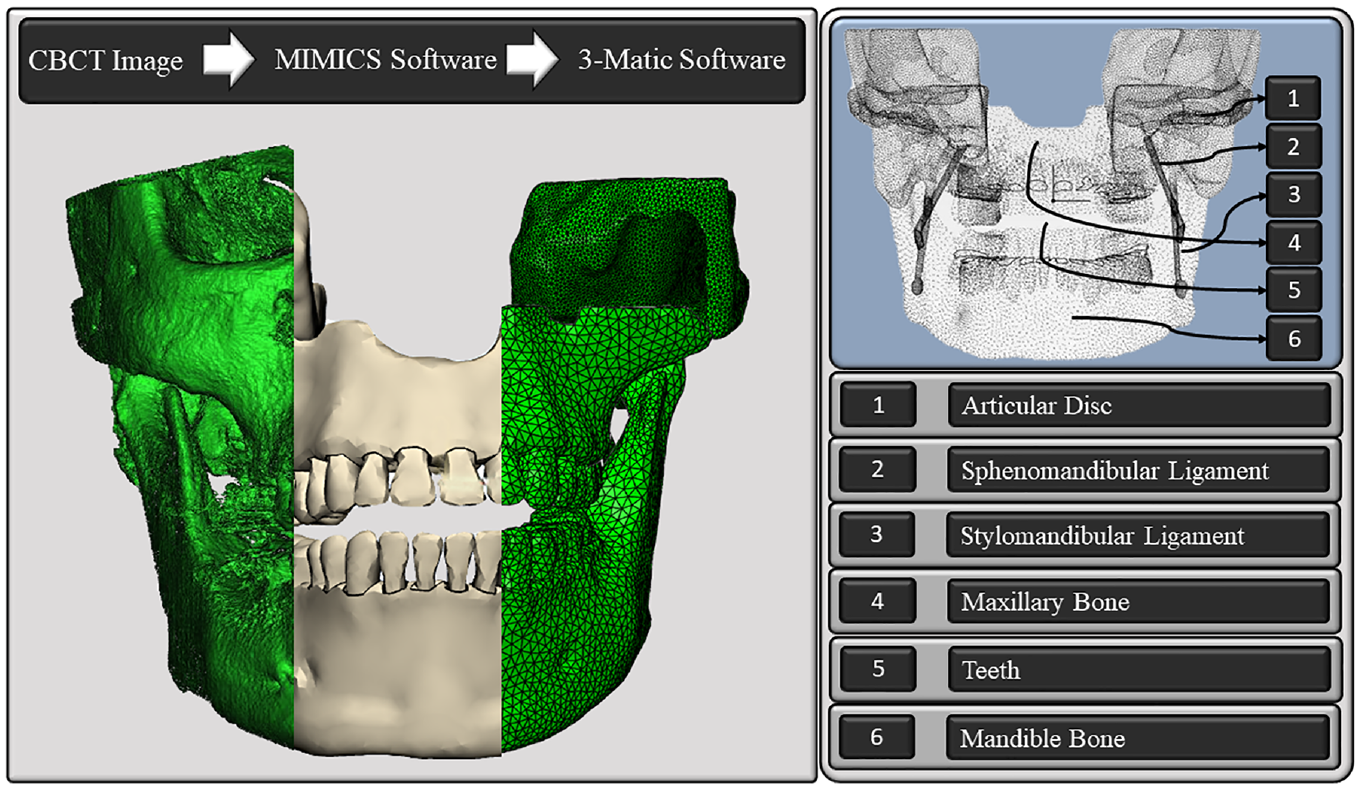
The procedure of introducing the orofacial hard and soft tissues into the numerical tool.
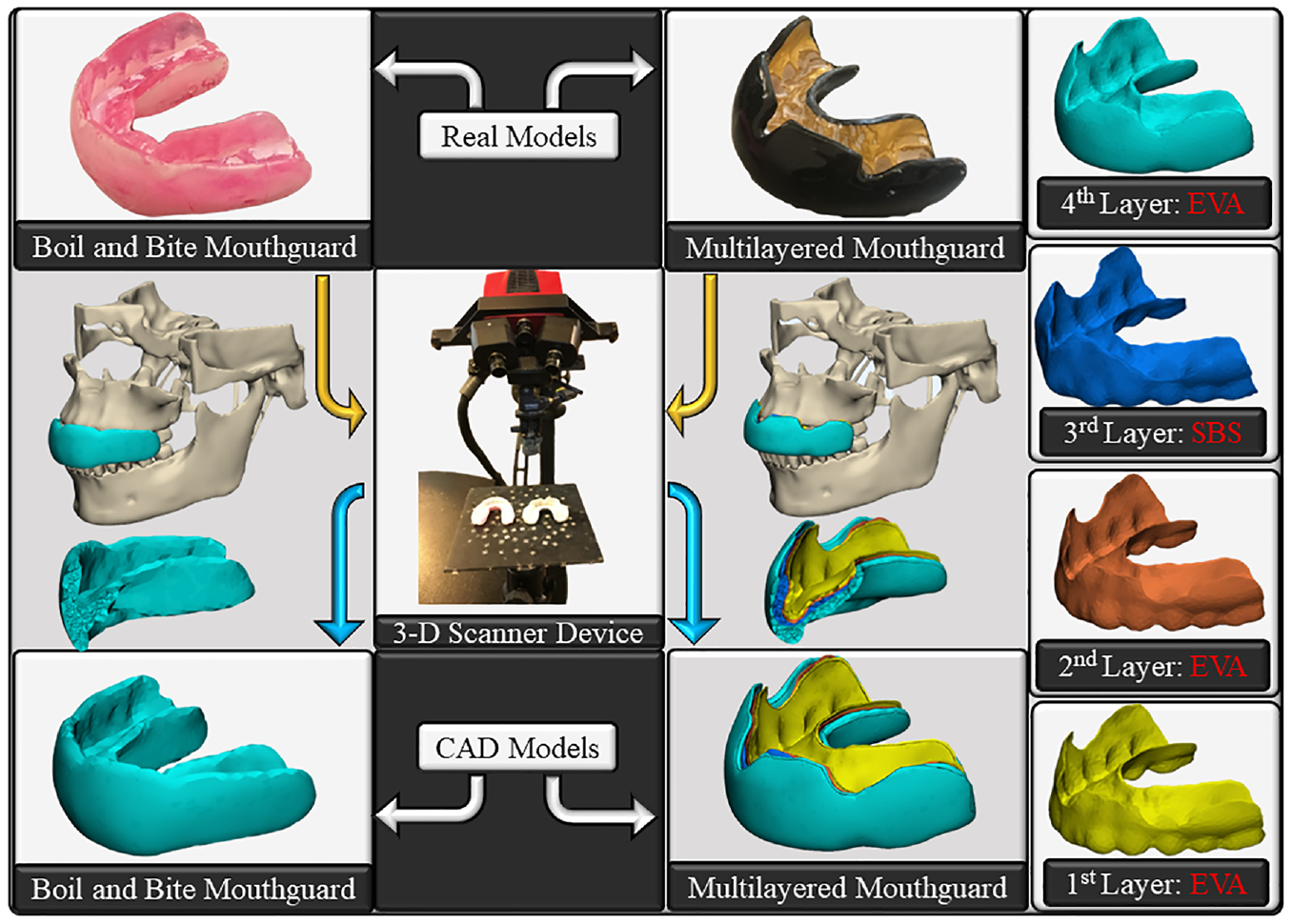
The 3D scanning process to generate 3D CAD model of mouthguards.
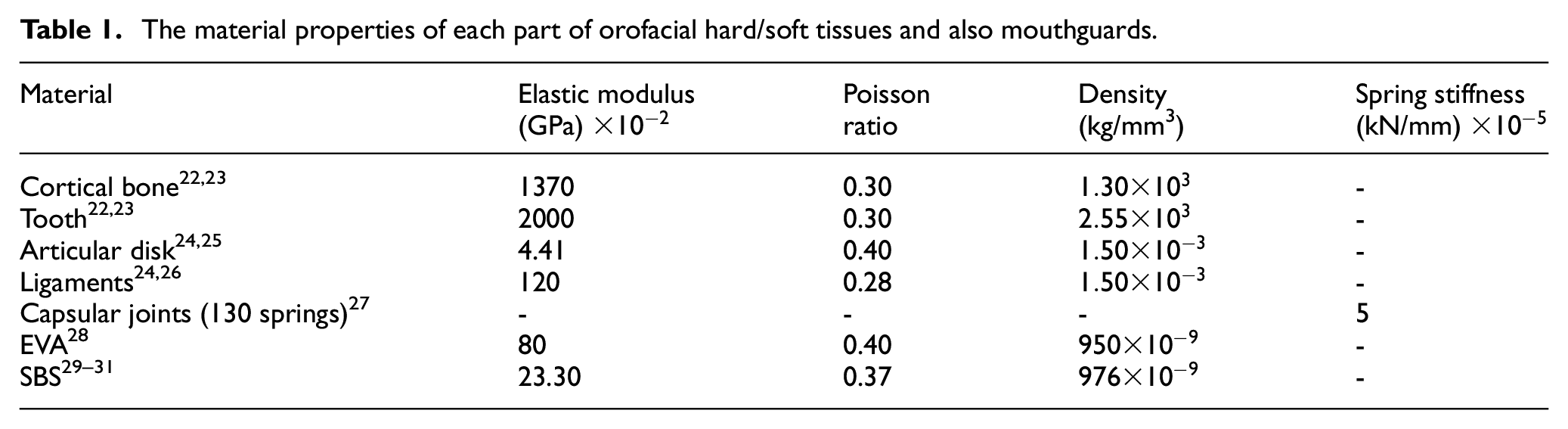
As depicted in Figure 2 the boil-and-bite mouthguard is a single layer made of ethylene-vinyl acetate (EVA) similar to the first, second and fourth layers of the customized multilayered mouthguard while its third layer material is styrene-butadiene-styrene (SBS). The material properties of each component of orofacial hard, soft tissues and mouthguards assigned in the process of numerical simulation have been obtained from multiple literature sources,22–31 which are tabulated according to Table 1. It should be mentioned that the average thicknesses of the first, second, third and fourth layers of the multilayered mouthguard are respectively equal to 1.50, 0.60, 2, and 1 mm, and the average thickness of the boil-and-bite mouthguard is equal to 5.10 mm. All the geometrical sections are assumed solid homogeneous. All the numerical simulations have been conducted by utilizing the dynamic explicit solver. Furthermore, 4-node linear tetrahedron elements, C3D4, are used to discretize the skull and orofacial hard and soft tissues and mouthguards. Illustrated according to Figure 3 describes the minimum number of elements for the skull, orofacial hard and soft tissues, and mouthguards in the current study which are required to guarantee mesh convergency. Moreover, in all conducted numerical simulations, the top surface of the upper part of the skull, which is depicted according to Figure 3, has been encastered. Based on the previous numerical studies the capsular joints can be simulated using equivalent spring system. 27 The applied loadings in two directions, which are the uppercut punch and straight punch, have been obtained from the empirical data reported in the literature of Olympic boxing study. 32 Note here that the loadings, which are the impact punches with an effective mass of 1 kg and 10.70 mm/ms velocity, are scaled-down versions of data reported in Walilko et al. 32 to be consistent with the selected case study who is a 32-year-old female athlete. Furthermore, as the current analysis is a comparative study between protective the efficiency of mouthguards, scaling of loadings does not affect the final results of the investigation. In the present study, the equivalent pressure has been presented as von Mises stress in order to elucidate potential tissue injury threshold. The criterion of von Mises stress is commonly used in numerical simulations for determination of yielding or fracturing of a given material; in the other word, the severity and extent of injuries are directly related to maximum von Mises stress values. In addition, the pressure and displacement distributions have been employed to examine the overall orofacial injury risk more precisely. Finally, the results have been determined for the behavior of hard and soft orofacial tissues under two different impact loading conditions (uppercut and straight punches). The resulting measurements have been recorded every 0.001 s, in the way that first the results for unprotective situation have been extracted. Then, the time increment and the location with the maximum applied load for each tissue have been saved. After that, to have a proper comparative study, the saved time increments and the locations have been employed for extracting the results of other two situations; the presence of boil-and-bite mouthguard and customized multilayered mouthguard.
The material properties of each part of orofacial hard/soft tissues and also mouthguards.
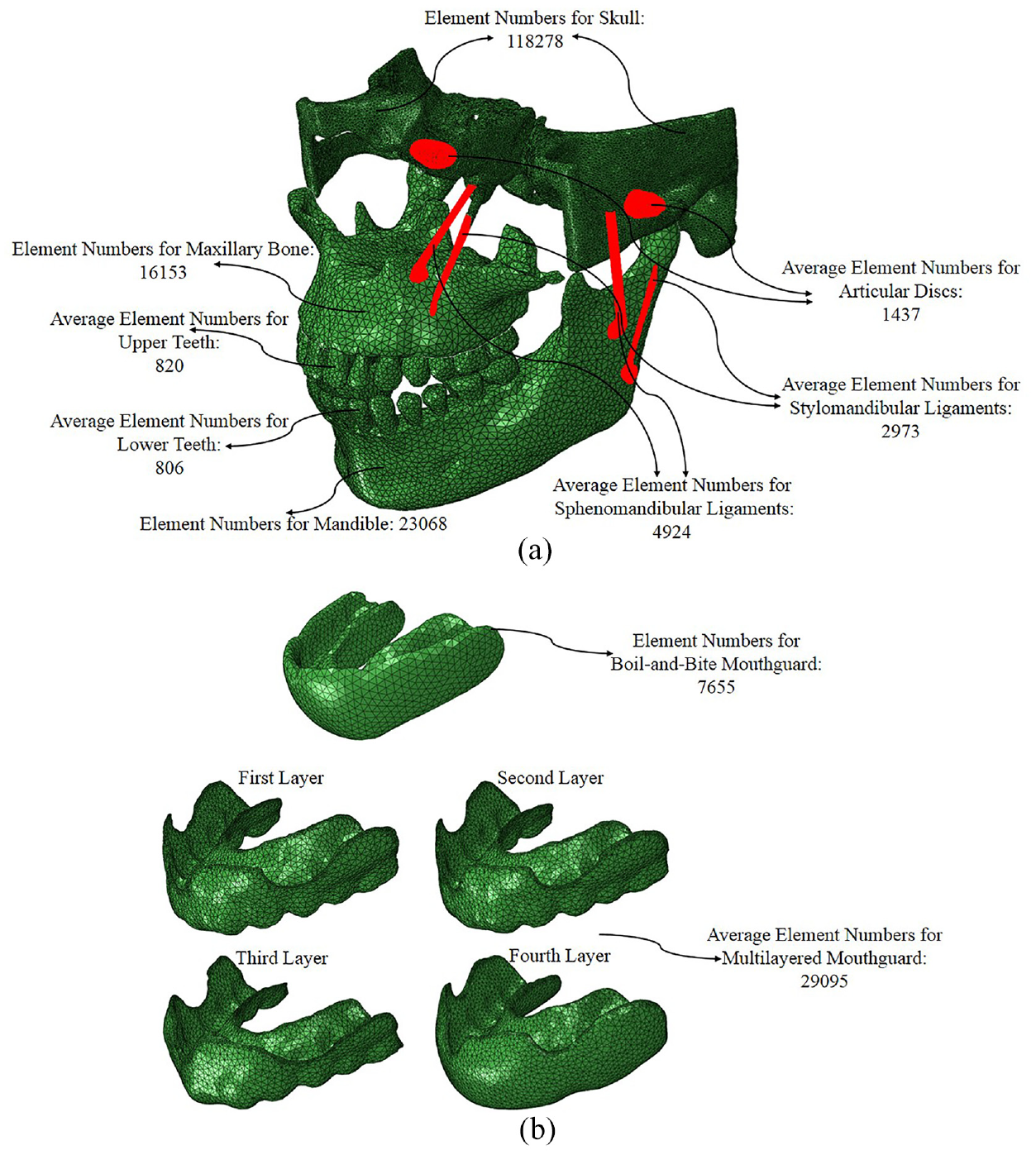
The volume mesh models of skull and orofacial hard and soft tissues together with discretized mouthguards: (a) the volume mesh models of skull and orofacial hard and soft tissues and (b) the utilized element numbers to discretize boil-and-bite and multilayered mouthguards.
Results
Overall protective efficiency
Figure 4 declares a comparison between the overall protective efficiency of two kinds of mouthguard on hard tissues under different impact loadings. The protective efficiency has been calculated as
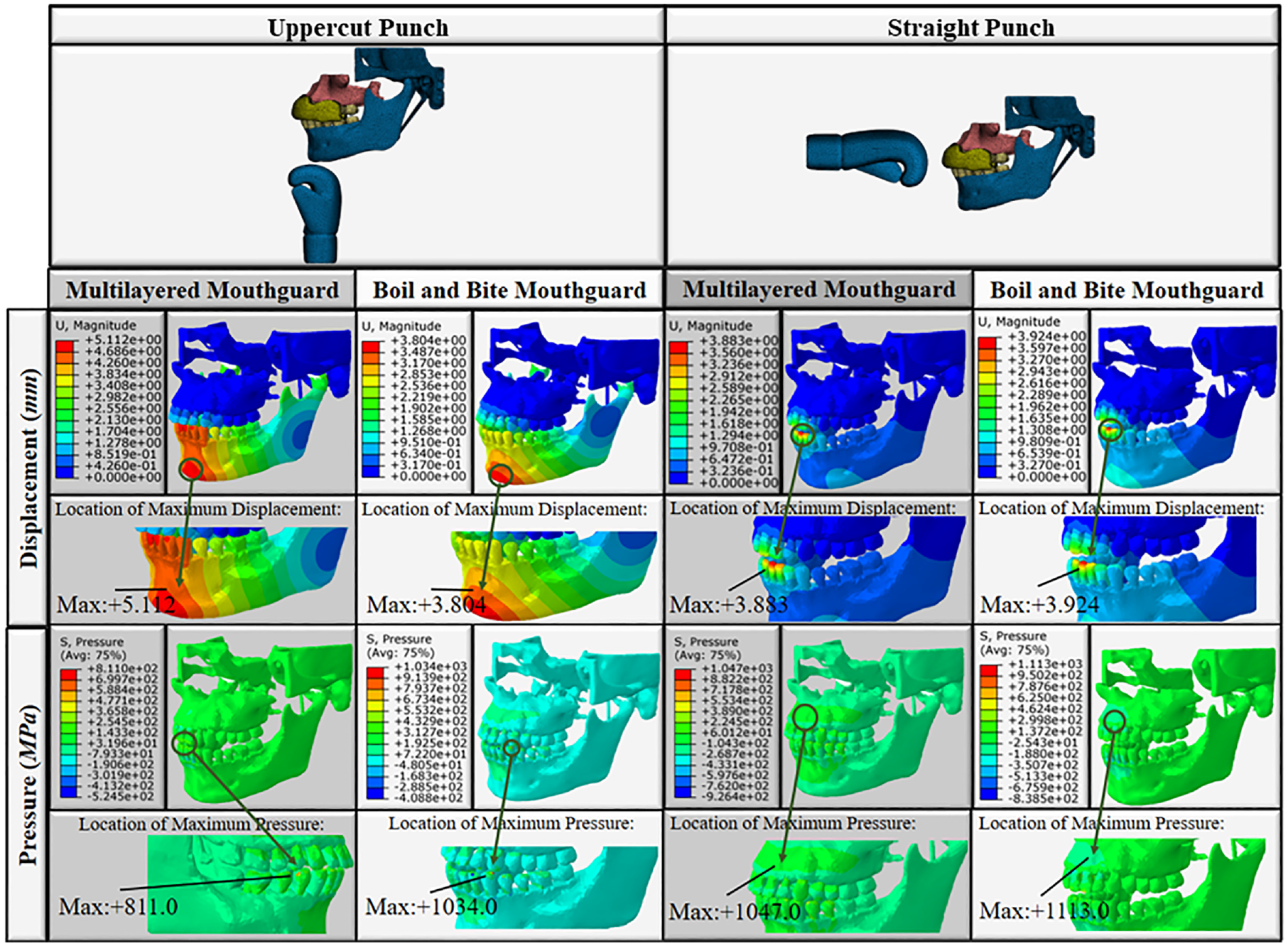
The displacement and pressure (von Mises stress) on hard tissues for uppercut and straight punches loadings.
Protective efficiency in the orofacial hard tissues
As shown in Figure 5, the considered structures for inspection of the orofacial injuries includes upper and lower teeth, maxillary and mandibular bones. The vertical axis in Figure 5 represents the protective efficiency (PE) of each mouthguard, where the horizontal axis placed at 0% stands for unprotected case (i.e. without mouthguard). As an example, in uppercut punch the protective efficiency column of lower teeth denoted by “A 1 ” for the boil-and-bite and by “A 2 ” for customized mouthguard, which are 38.97% and 52.54% respectively. The results of Figure 5 confirm that in most cases the likelihood of dental injuries is greatly decreased when the customized mouthguard has been worn. While despite the common belief that wearing over-the counter mouthguards such as boil-and-bite would be better than unprotected case, the result reveals that the boil-and-bite mouthguard has a negative effect on the lower teeth for straight punch. According to the obtained results in the case of straight punch, while the presence of boil-and-bite mouthguard, more von Mises stress is imposed to lower teeth. This arises due to the incompatibility of the boil-and-bite mouthguard and the lower teeth. Also, in most cases, mouthguards fully cover only the upper teeth. 33 In contrast, due to the individual design of the customized multilayered mouthguard, it covers the upper and lower teeth. So, as it can be seen, the presence of the customized multilayered mouthguard decreases the von Mises stress acting on lower teeth. The upper teeth results, point out that wearing a customized mouthguard provides high degree of protection in comparison to the situation of no mouthguard and its protective effect for both uppercut and straight punches cases is quite considerable. Thus the simulation of both maxillary and mandible bones indicate that the customized mouthguard provides a higher level of protection by altering the severity of stress distribution.
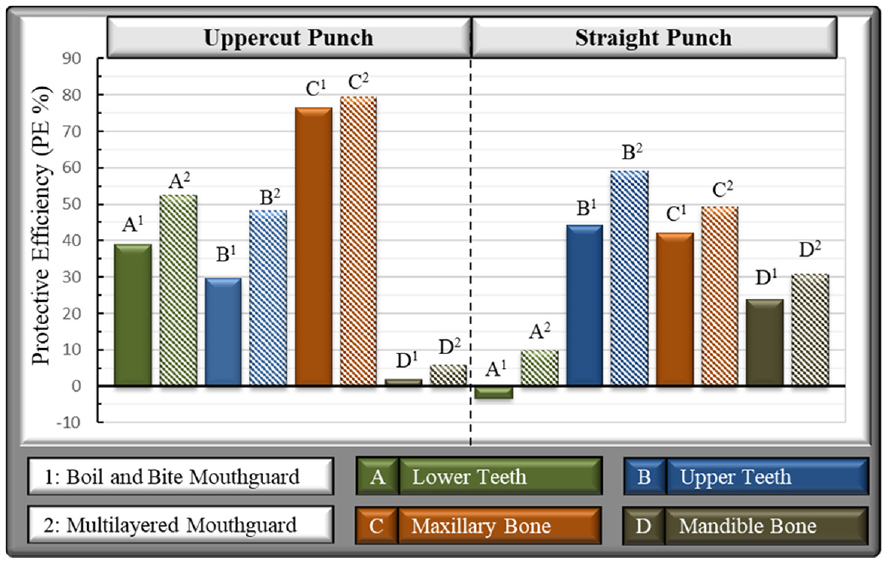
The protective efficiency in lower and upper teeth, maxillary, and mandible bones based on the transmitted maximum von Mises stress.
Protective efficiency in the orofacial soft tissues
As shown in Figure 6, the considered soft tissues for inspection of the orofacial injuries include articular disk, stylomandibular and sphenomandibular ligaments. Simulation results of the uppercut punch show that the customized mouthguard performs more effectively on all considered soft tissues. It is worth mentioning that according to the obtained results in the case of straight punch, wearing the boil-and-bite mouthguard may have much more negative effect on some of the orofacial structures such as articular disk and stylomandibular ligament in comparison to the multilayered one. Based on the obtained results in the case of straight punch, using both customized multilayered mouthguard and boil-and-bite mouthguard lead to increase the von Mises stress in the articular disk and stylomandibular ligament. In the human facial skeleton, mandible bone is the only movable tissue of the skull. 34 Stylomandibular ligament and sphenomandibular ligament attach to the mandible bone. 35 Also, the disk articulates with the mandibular fossa of the temporal bone above and the condyle of the mandible below. 36 So, the movement pattern of mandible bone determines the amount of von Mises stresses (or the protective efficiency of the mentioned mouthguards) applied to these tissues during the impact loading. For sphenomandibular ligament, in the closed-mouth position, this tissue is slack, 37 then, as it can be seen in Figure 6, there is no significant difference in protective efficiency between the two kinds of mouthguards. Although, because of more compatibility of the customized multilayered mouthguard with upper and lower teeth in comparison with the boil-and-bite one, mandible movement is further restricted. It increases the protective efficiency of the customized multilayered mouthguard. For articular disk and stylomandibular ligament at the same closed-mouth position, due to the clenching force and more friction coefficient between upper and lower teeth in the unprotective situation compared with the situation of using mouthguards, the movement of mandible is more restricted, so the imposed von Mises stress is increased by using mouthguards. Howbeit, mismatching of the boil-and-bite mouthguard makes the mandible movement more active, and it arises further negative protective efficiency.
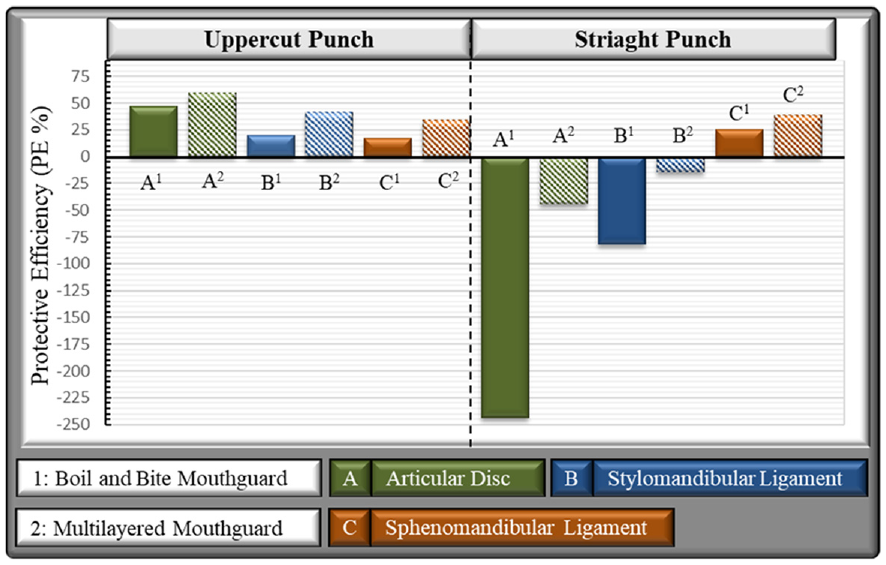
The protective efficiency on articular disk, stylomandibular and sphenomandibular ligaments based on the transmitted maximum von Mises stress.
Disscusion
The majority of previous studies have been mainly focused on dental injuries,38–41 while in the present work other orofacial injuries were additionally taken into consideration. The present paper studies the possible injuries that may seriously affect teeth, maxillary and mandible bones, stylomandibular and sphenomandibular ligaments, and articular disks. Thus the conducted numerical results in the present paper confirm the positive effect of using a customized multilayered mouthguard on the orofacial hard tissues reported in the previous studies.19,42,43
Protective characteristics of the customized multilayered mouthguard
Customized multilayered mouthguard versus unprotective situation
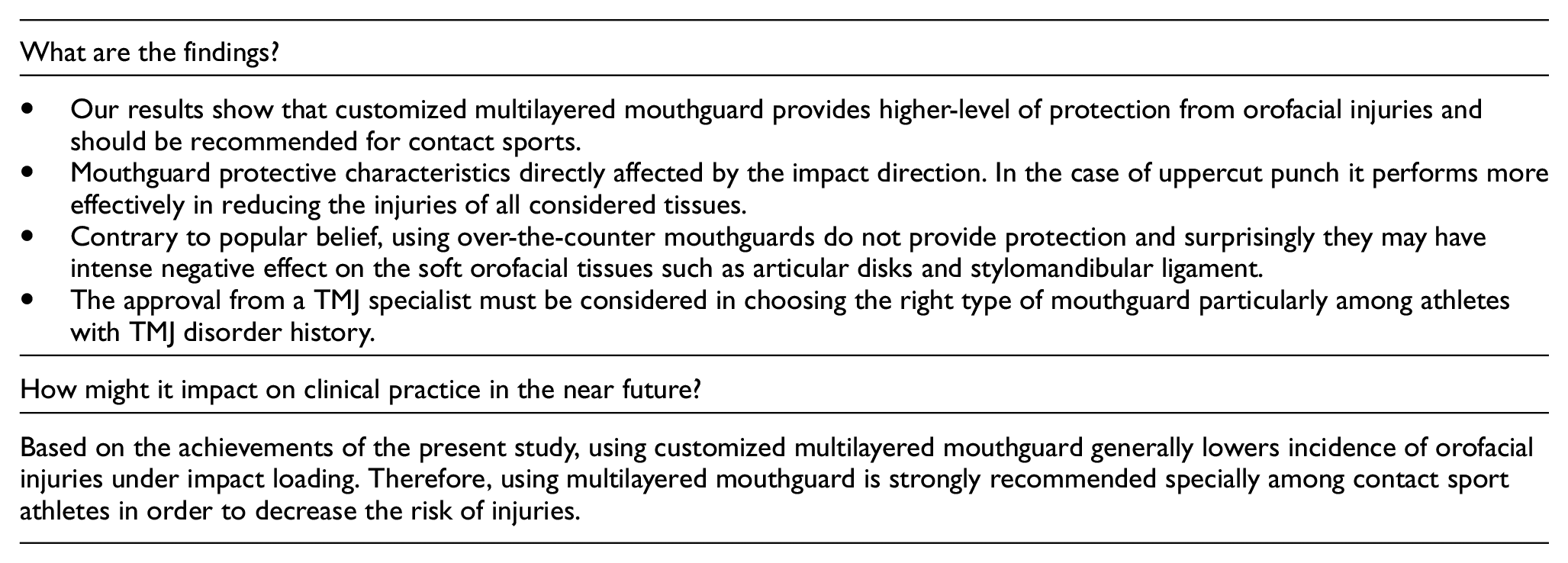
Findings of our studies reveal that under the first impact loading condition (uppercut punch), the customized multilayered mouthguard perform 48.25%, 54.54%, 79.49%, 59.49%, 05.89%, 41.01%, and 17.18% more effective respectively for upper and lower teeth, maxillary bone, articular disk, mandible bone, stylomandibular and sphenomandibular ligaments compared with unprotected situation. Additionally, under the second impact loading case (straight punch), the multilayered mouthguard perform 59.18%, 09.96%, 49.48%, 30.97%, and 38.79% more effective respectively for upper and lower teeth, maxillary bone, mandible bone, and sphenomandibular ligament in comparison to not wearing any mouthguard. Therefore in general the customized multilayered mouthguard would be more preferable as it offers a greater margin of safety when it comes to protecting orofacial soft tissues. 44
Customized multilayered mouthguard versus boil-and-bite one
The comparison between multilayered and boil-and-bite mouthguards simulation results state that under uppercut punch impact loading, the multilayered mouthguard perform 18.45%, 15.57%, 2.85%, 13.34%, 3.95%, and 21.32% more effective respectively for upper and lower teeth, maxillary bone, articular disk, mandibular bone, and stylomandibular ligament. Furthermore, under the straight punch impact loading, the multilayered mouthguard perform 14.80%, 13.20%, 7.16%, 199.78%, 6.94%, 67.89%, and 13.45% more effective respectively for upper and lower teeth, maxillary bone, articular disk, mandibular bone, and stylomandibular and sphenomandibular ligaments. For the case of uppercut punch loading, the impact loading has been applied to the mandible bone, 45 which is one of the most frequently fractured orofacial bone when orofacial tissues are subjected to an impact loading 46 ; after that, it has been transmitted from the mandible bone into other tissues through mouthguard if the mouthguard were used. So, the protective efficiency of mouthguard on hard and soft tissues is related to the movement of mandible bone, its material 47 and geometrical characteristics. 48 The customized multilayered mouthguard has been made from an anatomical basis so that it can fit the athlete’s mouth precisely. 33 This causes the mandible to be more prevented against eccentric movements. 19 Hence, as it can be seen in the results, using the customized multilayered mouthguard provides more protective efficiency than the boil-and-bite mouthguard. Moreover, the distribution of von Mises stress becomes more uniform by using a layer made of SBS. For the straight punch loading, the impact loading has been applied to the mouthguards and then transmitted to the hard and soft tissues. Additionally, in the human facial skeleton, the mandible bone, which is considered the only movable orofacial tissue 34 is separated from maxillary bone and upper teeth. Whereas stylomandibular and sphenomandibular ligaments attach to the mandible bone 35 and it holds the lower teeth in place, 49 also the disk articulates with the condyle of the mandible bone. 36 So, regarding the loading direction, the protective efficiency of a mouthguard for maxillary bone and upper teeth is related to its material and geometrical characteristics and compatibility with upper and lower teeth. In these tissues, because of more compatibility of the customized multilayered mouthguard with upper and lower teeth and its SBS layer, the von Mises stress has been more decreased in comparison the situation of using boil-and-bite mouthguard. In the following, the movement pattern of mandible bone evaluates the protective efficiency of a mouthguard for stylomandibular ligament, sphenomandibular ligament, and articular disk and based on the more restriction in the mandible movement in the presence of customized multilayered mouthguard, the protective efficiency has been increased compared to the situation of wearing boil-and-bite mouthguard.
Are the simulation results in consistent with the previous analytical studies?
The reported analytical studies confirm that use of the multilayered mouthguard lead to impact injury reduction of the orofacial tissues due to 10 :
the shock absorbing feature of SBS layer reduces the localized transmitted impact force into the teeth.
utilizing EVA material as outer layers minimizes the distributed force on orofacial structures.
As depicted in Figure 7, the present study has numerically approved the above-mentioned points by calculating of von Mises stress distribution for the fourth and third layers of the multilayered mouthguard. The numerical results validate that the outermost EVA layer distributes the localized applied impact loading. Moreover the von Mises stress significantly diminishes by the third layer made of SBS due to its shock absorbing capability.
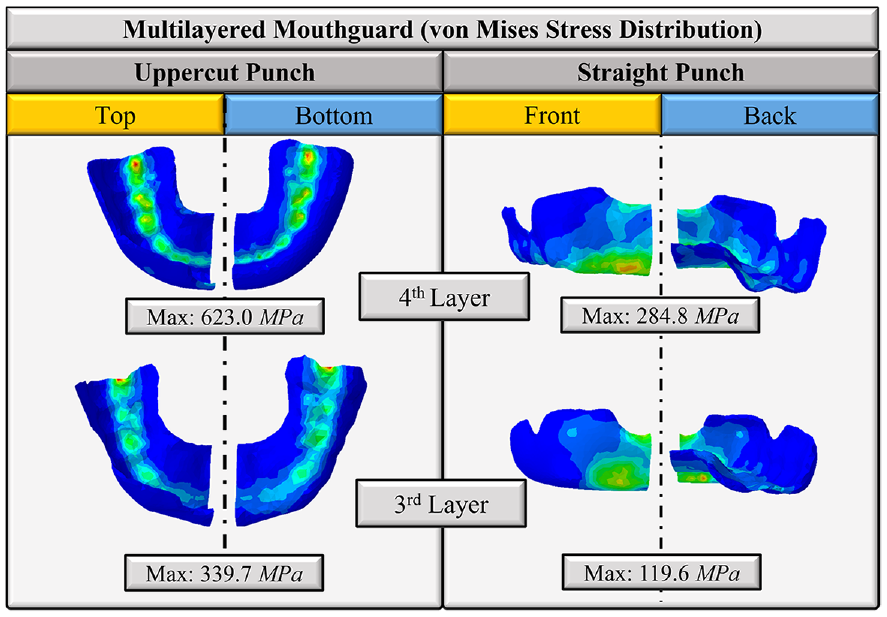
The von Mises stress distribution of fourth and third layers of multilayered mouthguard.
The results of straight punch, show the negative protective efficiency of customized mouthguard on articular disk and stylomandibular ligament but it is still significantly less negative than boil-and-bite mouthguard, That is, −244.25% in comparison to −44.47%. Note that −244.25% means that wearing the boil-and-bite mouthguard increased the value of maximum von Mises stress (damage criterion) by ∼2.44 times on articular disks. However the multilayered mouthguard still shows little signs of undesirable protective effect on articular disk and stylomandibular ligament, but in overall it provides notably more protection on other studied orofacial hard and soft tissues. Therefore the simulation results enable us to conclude that wearing a customized multilayered mouthguard cannot be replaced by a boil-and-bite mouthguard at all since it causes more harm in comparison to the case with no mouthguard.
Strengths and limitations
For the first time in the literature, a detailed numerical analysis was performed to evaluate the occurrence of injuries in some of the orofacial soft tissues in addition to hard tissues, in the case of wearing two different types of mouthguard and unprotected situation in boxing. Most of the reported studies are focused on the protective role of mouthguard on the orofacial hard tissues such as maxillary bone, teeth and mandibular bone and to the best authors’ knowledge there is no literature presenting the protective effect of mouthguard on orofacial soft tissues including articular disks, stylomandibular and sphenomandibular ligaments. The considered orofacial structures include lower and upper teeth, maxillary and mandibular bones as hard orofacial tissues and articular disks, stylomandibular and sphenomandibular ligaments as soft orofacial tissues. Furthermore, a multilayered custom-made type of mouthguard with specific protective features has been suggested. Specifically it confirms that using SBS material in the design of multilayered mouthguard reduces the localized transmitted impact force into the targeted tissues.
Despite the reasonable results of numerical analysis, other soft tissues like gum and lip structures were not included in numerical analysis, which can be considered as one of the limitations. By including these tissues into the proposed CAD model, it may result in improvement of the prediction accuracy of injuries incidence such as lip and gum injuries. Finally the finite element model of the capsular joints, which has been employed by using the equivalent spring system, can be replaced by a more realistic 3D geometry of capsular joints, which requires a high resolution Magnetic Resonance Imaging of temporomandibular joint (TMJ).
Conclusion
Overall results show that mouthguards are crucial to mitigate the risk of orofacial injuries in contact sports. Although mouthguards intensify the injuries in some tissues (especially the soft ones) caused by mandible excessive movement, the overall performance of mouthguards is convincing enough for their utilization. Based on the simulation results, in high risk contact sports like boxing, athletes with TMJ problems who had a history of sports injuries related to lower teeth and soft tissue regions must be wary of using boil-and-bite mouthguards due to their extensive negative effects on the mentioned regions. Finally, despite the higher price, the performance of multilayered customized mouthguard has been proved to be much more effective than boil-and-bite.
Footnotes
Acknowledgements
We thank Mr Fabio Fantozzi for his assistance and collaboration during the course of this research.
Declaration of conflicting interests
The author(s) declared no potential conflicts of interest with respect to the research, authorship, and/or publication of this article.
Funding
The author(s) received no financial support for the research, authorship, and/or publication of this article.
References
 .
.