




Abstract
A method for optimising the design of systems and processes has been introduced that consists of interpreting the left- and the right-hand side of a correct algebraic inequality as the outputs of two alternative design configurations delivering the same required function. In this way, on the basis of an algebraic inequality, the superiority of one of the configurations is established. The proposed method opens wide opportunities for enhancing the performance of systems and processes and is very useful for design in general. The method has been demonstrated on systems and processes from diverse application domains. The meaningful interpretation of an algebraic inequality based on a single-variable sub-additive function led to developing a light-weight design for a supporting structure based on cantilever beams. The interpretation of a new algebraic inequality based on a multivariable sub-additive function led to a method for increasing the kinetic energy absorbing capacity during inelastic impact. The interpretation of a new inequality has been used for maximising the mass of deposited substance during electrolysis.
Keywords
Introduction
Algebraic inequalities have been used extensively in mathematics and a number of useful non-trivial algebraic inequalities and their properties have been well documented.1–11
In mathematics, for a long time, simple inequalities are being used to express error bounds in approximations and constraints in linear programming models. In physics and engineering, applications of inequalities have also been considered.3,12,13 In engineering design, design inequalities have been widely used to express design constraints guaranteeing that the design will perform its required function. More recently, in non-linear programming problems, systems of inequalities have been used to present non-linear goal and non-linear resource constraints. 14
This paper shows that the use of algebraic inequalities in engineering is far reaching and is certainly not restricted to specifying constraints. The meaningful interpretation to generate knowledge and improve the design of systems and processes is a new dimension in the use of algebraic inequalities.
Inequalities have also been used in reliability and risk research to characterise reliability functions.15–21
Algebraic inequalities are particularly suitable for handling unstructured uncertainty. Most of the conventional approaches deal with structured uncertainty. Handling uncertainty is usually done through probabilities assessed by using a data-driven approach or by using the Bayesian, subjective probability approach. A major deficiency of the data-driven approach is that probabilities cannot always be meaningfully defined. These deficiencies cannot be rectified by using the Bayesian approach which is not so critically dependent on the availability of past failure data since it uses assigned subjective probabilities. The Bayesian approach however, depends on a selected probability model that may not be relevant to the modelled phenomenon/process. 22 In addition, the assigned subjective probabilities depend on the available knowledge and vary significantly among assessors. Furthermore, weak background knowledge at the basis of the assigned subjective probabilities often results in poor predictions. Although the info-gap theory 23 deals with unstructured uncertainty by not making probability distribution assumptions, it still requires assumptions to be made about designer’s best estimate.
Despite that some publications on algebraic inequalities 3 claim treatment of engineering applications, these publications are focused on using inequalities to create upper and lower bounds or investigate the behaviour of mathematical functions and are not related to optimising engineering systems or processes. In these publications, no attempt has ever been made to interpret the different parts of an inequality as alternative design options of a system or process and use the inequality to establish the superiority of one of the competing options.
Single-objective optimisation strategies in engineering revolve about determining the optimum of an objective function, commonly by using an exact analytical method or an heuristic algorithm.24, 25 In multi-objective optimization strategies, the best compromise among possible designs is found. When the objectives are functions of a single design variable, Pareto-optimal solutions are sought. 26 In both cases however, in order to formulate the objective function, the values of the controlling parameter entering the objective function must be known.
Algebraic inequalities do not require the distributions or the values of the variables entering the inequalities or any other assumptions. This advantage permits using algebraic inequalities to handle deep unstructured uncertainty.27,28 In this respect, algebraic inequalities avoid a major difficulty in most of the conventional models for handling uncertainty – lack of meaningful specification of frequentist probabilities or lack of justification behind the assigned subjective probabilities and probabilistic models.
Thus, by using inequalities two systems can be compared without knowing the reliabilities of their components and the more reliable system selected. 27 Algebraic inequalities also provide a strong support for risk-critical decisions under deep uncertainty. Despite that the distributions of the risk-critical parameters remain unknown, the method of algebraic inequalities can still establish the intrinsic superiority of one of the competing options.
Suppose that a particular system/process, performing a certain function can be developed in two different configurations and that the two sides of an algebraic inequality represent the outputs of these two configurations. Unlike algebraic equalities, which establish that two different configurations of a system or a process are equivalent, the algebraic inequality establishes that one of the compared configurations is superior. In this way, the use of algebraic inequalities opens wide opportunities for enhancing the performance of systems and processes.
This is the essence of the forward approach to using algebraic inequalities
27
which includes the following steps: (i) detailed analysis of the system or process, (ii) testing the conjectured inequality by using Monte-Carlo simulation and (iii) proving the conjectured inequality rigorously (Figure 1(a)). This way of exploiting algebraic inequalities has already been demonstrated27,29 through comparing systems with unknown reliabilities of their components. Deriving new knowledge/properties by using the method of algebraic inequalities: (a) forward approach; (b) inverse approach.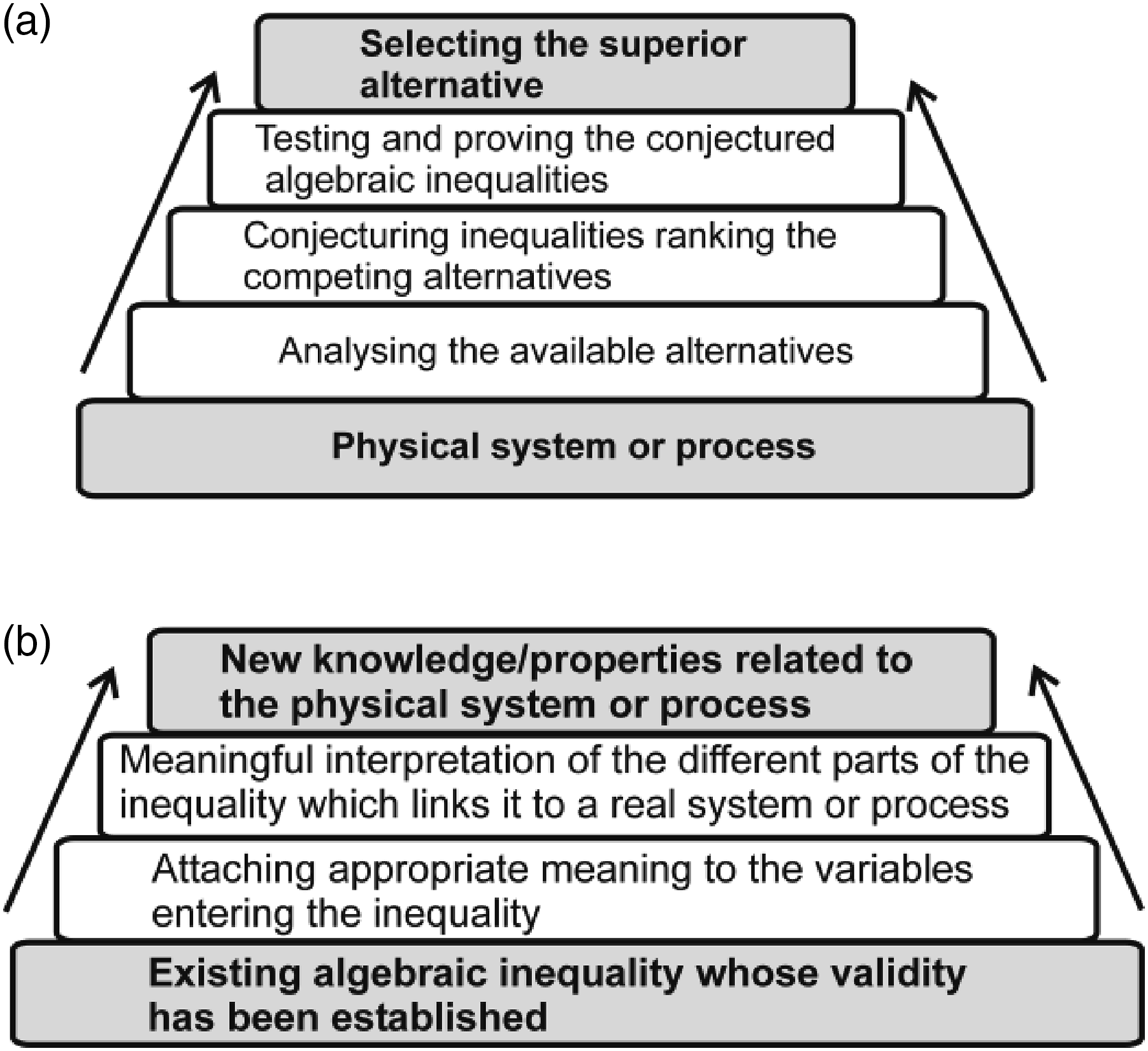
Another formidable advantage of algebraic inequalities is that they also admit meaningful interpretation that can be attached to a real system or process. Furthermore, depending on the specific interpretation, knowledge applicable to different systems from different domains can be released from the same inequality. This is the essence of inverse approach (Figure 1(b). In contrast to the forward approach, the inverse approach moves in the opposite direction. It starts with a correct algebraic inequality, continues with creating relevant meaning for the variables entering the inequality, followed by a meaningful interpretation of the different parts of the inequality, and ends with formulating undiscovered properties/knowledge about the system or process. This approach has been illustrated in Figure 1(b).
The meaningful interpretation of algebraic inequalities is rooted in the principle of non-contradiction 27 : if the variables and the different terms of a correct algebraic inequality can be interpreted as parts of a system or process, in the real world, the system or process exhibit properties or behaviour that are consistent with the prediction of the algebraic inequality. In short, the realization of the process/experiment yields results that do not contradict the algebraic inequality.
The inverse approach effectively links existing correct abstract algebraic inequalities with real physical systems or processes and not only opens opportunities for enhanced performance of systems and processes but also leads to the discovery of new fundamental properties. The present paper focuses on the inverse approach only.
The inverse approach related to creating meaningful interpretation for existing non-trivial abstract inequalities and attaching it to a real system or process has only been partially explored. 29
Selecting among competing design alternatives is central to the engineering design and to the design of processes in any application domain. The key idea of the method proposed in this paper is to interpret the left- and right-hand side of a correct algebraic inequality as a particular output related to two different design options, delivering the same required function. The algebraic inequality then establishes the superiority of one of the compared design options with respect to the chosen output.
The applications considered range as follows: (i) light-weight design by interpreting an algebraic inequality, (ii) increasing the absorbed kinetic energy during a perfectly inelastic collision, (iii) increasing the mass of substance deposited during electrolysis and (iv) increasing the stiffness of a mechanical assembly.
All algebraic inequalities presented in the paper have been validated by using a Monte-Carlo simulation algorithm. 27 Its essence is generating random combinations for the values of the variables entering the inequalities and checking whether the conjectured inequality has been contradicted. The absence of a single contradiction for millions of random combinations of values for the variables entering the inequality is a strong indication that the conjectured inequality is probably true. After passing the simulation test, the inequality can be proved rigorously.
The knowledge extracted from the interpretation of non-trivial inequalities is non-trivial and cannot be reached intuitively. Furthermore, depending on the specific interpretation, knowledge applicable to different systems from different domains can be released from the same algebraic inequality.
Algebraic inequalities based on sub-additive functions
In the Euclidean space of one dimension, consider the function

Consider n points with positive coordinates a
i
from the definition domain of the function f (x). It will be shown that from definition (1), the next inequality follows:

Inequality (2) obviously holds for

It can be shown that inequality (2) also holds for
Indeed, for

Substituting
It can be shown that if
In the Euclidean space of two dimensions, consider the multivariable function


Similar to Inequality (3), inequality (6) can be obtained by mathematical induction and details are omitted.
Inequalities (3) and (6) do not change their direction upon any permutation of

Inequalities (3), (6) and (7) have a number of powerful potential applications in various domains of science and technology for increasing/decreasing the effect of additive quantities (factors). Inequality (6), for example, effectively states that the effect of the additive quantities
The limitation in applying inequalities (3), (6) and (7) is the requirement the variables
Extensive quantities are typical additive quantities. They change with changing the size of their supporting objects/systems.32,33 DeVoe 32 for example, introduced ‘extensivity’ test which consists of dividing the system by an imaginary surface into two parts. Any quantity characterising the system that is the sum of the same quantity characterising the two parts is an extensive quantity and any quantity that has the same value in each part of the system is an intensive quantity.
Examples of extensive quantities are mass, weight, amount of substance, number of particles, volume, distance, energy (kinetic energy, gravitational energy, electric energy, elastic energy, surface energy and internal energy), work, power, heat, force, momentum, electric charge, electric current, heat capacity, electric capacity, resistance (when the elements are in series), enthalpy and fluid flow.
In contrast, intensive quantities characterise the object/system locally and do not change with changing the size of the supporting objects/systems. Such properties are ‘temperature’, ‘pressure’, ‘density’, ‘concentration’, ‘hardness’, ‘velocity’, and ‘surface tension’.
Inequalities similar to (3), (6) and (7) can be generalised for any number of factors.
Consider the general inequality

Although, inequality (8) is not based on a sub-additive function, it can also be used for increasing/decreasing the effect of additive quantities. Note that inequality (6) is a special case of the general inequality (8) when
Light-weight design by interpretation of an algebraic inequality based on a single-variable sub-additive function
Consider the sub-additive algebraic inequality

If the variable a in inequality (9) is interpreted as magnitude of a load on a cylindrical cantilever beam (Figure 2(a)), then (a) A cylindrical cantilever beam with length L loaded with a single concentrated force with magnitude a; (b) two identical cantilever beams with smaller radii, loaded with two forces with magnitudes 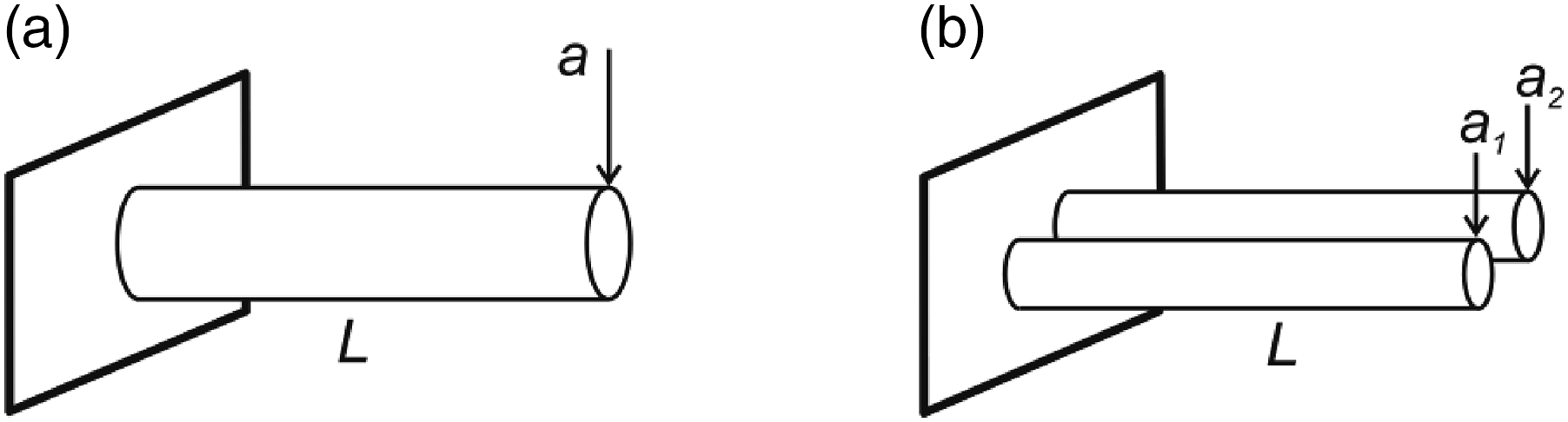
Indeed, the volume of a cylindrical cantilever beam with radius r [m] of the cross section and length L [m] is given by
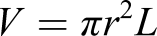
If



Supporting the load with magnitude a, can also be done by an alternative design option consisting of two cantilever beams with length L, loaded with forces with magnitudes
The two design options with the same function of supporting a total load with magnitude ‘a’, depicted in Figures 2(a) and 2(b) can now be compared through inequality (9). The comparison shows that the combined volume of the beams necessary to support the loads
Indeed, according to inequality (9)

Since
Light-weight design developed by using an algebraic inequality will be illustrated by a numerical example. Suppose that the cantilever beam has a length of
From
From
The effect from aggregating the loads is greater for a larger number of aggregated beams. Thus, for a supporting structure consisting of three cantilever beams with length L, each loaded with force of magnitude

Since
In each case, the same required function (supporting a total load with magnitude a) is delivered by two different design options (Figure 2). The two design options however, result in a different required volume of material and the two sides of algebraic inequality (9) represent the output quantity related to the compared design options: ‘the minimum volume of material needed for supporting the total load’. Inequality (9) predicts that the single-beam design option is associated with a smaller volume of material necessary to support the load.
As a result, inequality (9) can be used with success for producing light-weight designs in mechanical and structural engineering.
Increasing the absorbed kinetic energy during a perfectly inelastic collision by interpretation of an algebraic inequality based on a multivariable sub-additive function
A special case of the general sub-additive function (6) is the algebraic inequality

For

The special case (14) corresponding to
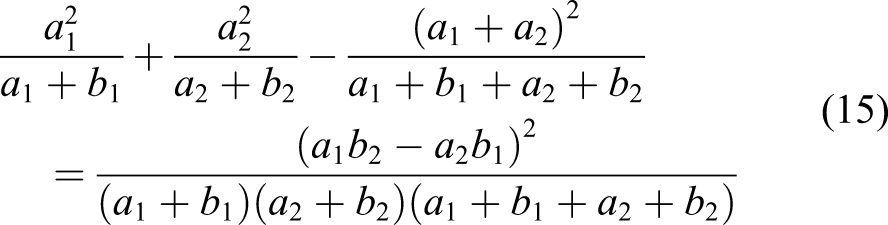
Now the inequality 13 can be proved for
To do so, the already proved base case corresponding to

Introducing the new positive variables
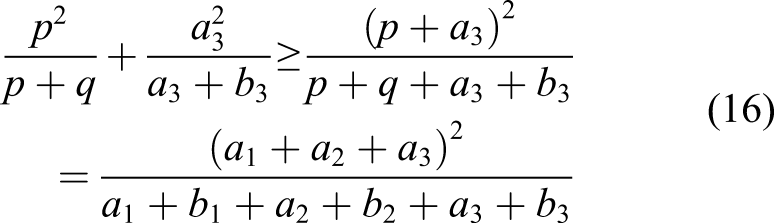

The left- and right-hand side of inequality (13), multiplied by an appropriate factor, can be interpreted as ‘kinetic energy immediately after a perfectly inelastic collision’.
Indeed, if an object with mass a, moving parallel to the ground with velocity (a) A perfect inelastic collision between an object with mass a, moving with constant velocity 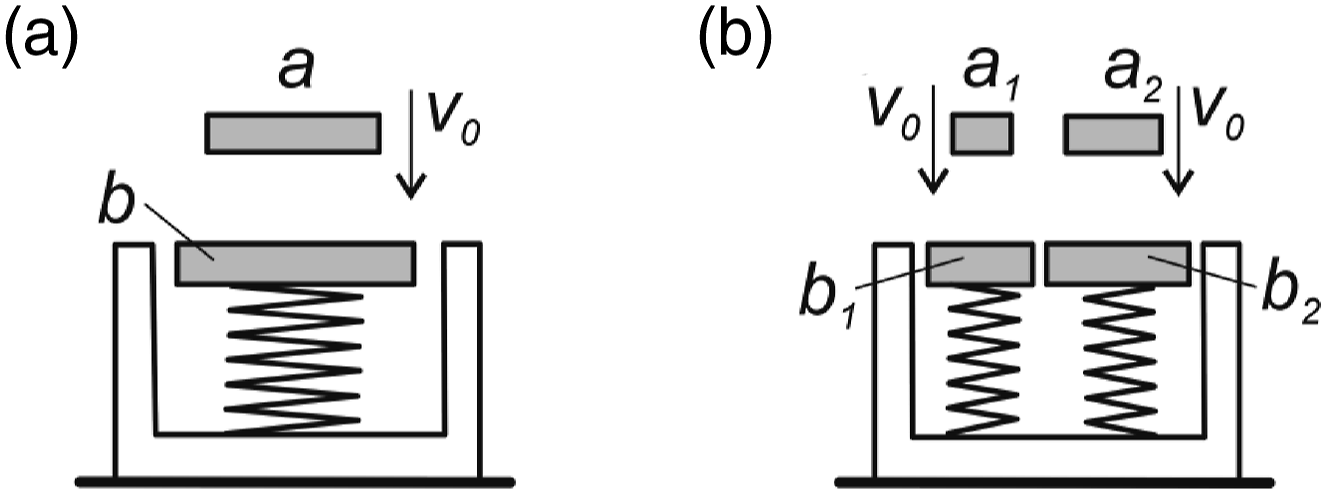
According to the law of conservation of the linear momentum,
36
the sum of the two momenta before collision is equal to their sum immediately after collision


The kinetic energy of the system, immediately after the inelastic collision, is equal to
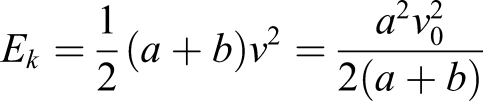
Therefore, the right-hand side of inequality (14) multiplied by the constant
Suppose that the object with mass a has been segmented into two objects with masses

Both sides of inequality (19) effectively describe the same output (total kinetic energy) associated with the two design options in Figures 3(a) and 3(b). The left-hand side of inequality (19) corresponds to the design option in Figure 3(b). It represents the total kinetic energy immediately after a perfectly inelastic collision of two objects with masses
Inequality (19) predicts that the aggregation of objects colliding perfectly inelastically, results in a smaller total kinetic energy after the inelastic collision.
Now consider the total kinetic energy

Multiplying inequality (19) by −1 and adding to both sides equation (20) results in the inequality
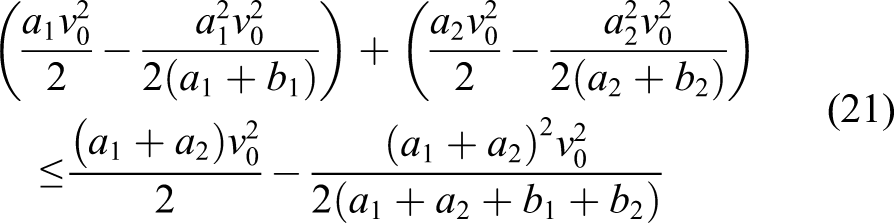
Both sides of inequality (21) represent the same chosen output: the absorbed kinetic energy during inelastic collision, characterising the design options in Figures 3(a) and 3(b).
The left-hand side of inequality (21) is the absorbed kinetic energy during the inelastic collision of the two pairs of objects while the right-hand side is the absorbed kinetic energy during the inelastic collision of the single objects.
Inequality (21) yields the interesting prediction that a perfectly inelastic collision between single objects is associated with a greater amount of absorbed kinetic energy than a perfectly inelastic collision between the parts of the segmented objects. The prediction from inequality (21) can be applied as a basis of a strategy for mitigating the dynamic force due to inelastic impact between a moving object and immobile obstacle.
It may seem that the systems in Figure 3 are two different systems. In fact, Figures 3(a) and 3(b) are alternative design options of the same shock absorbing system. Aggregating the colliding masses increases the absorbed kinetic energy during inelastic collision hence, the design option in Figure 3(a) should be preferred.
It needs to be pointed out that aggregation does not always achieve an increase of the absorbed kinetic energy for the system in Figure 3. Thus, if
Asymmetry must be present for an increase of the absorbed kinetic energy to occur. The requirement for asymmetry to increase the absorbed kinetics energy is rather counterintuitive and makes this prediction difficult to obtain intuitively, bypassing inequality (13).
Ranking the stiffness of alternative mechanical assemblies
A special case of the general super-additive function (7) is the algebraic inequality
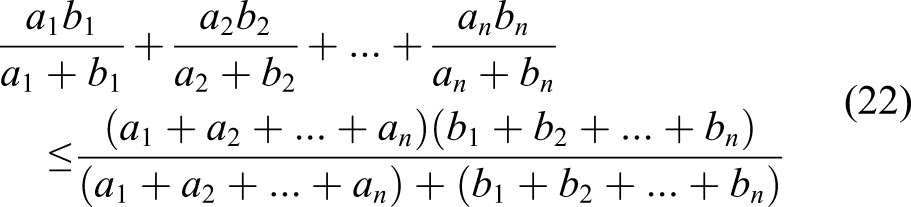
To prove inequality (22), the Bergström inequality
11


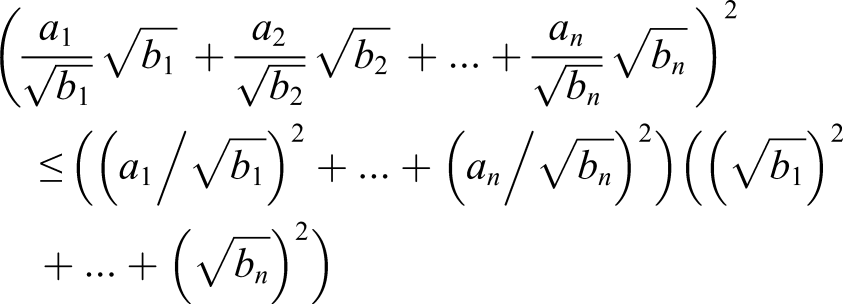
Going back to the original inequality (22), the inequality can be proved by direct manipulation which reduces it to a standard inequality. The left-hand side of inequality (22) can be presented as
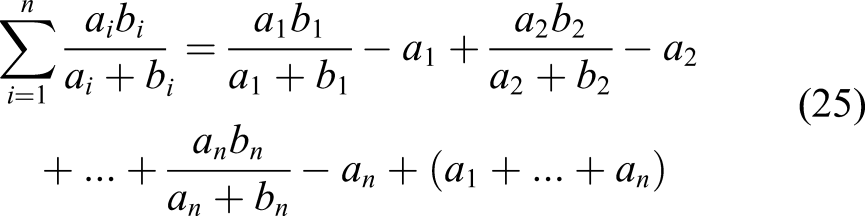
Conducting the subtractions
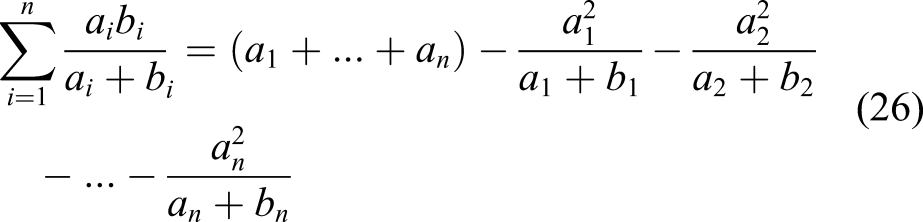
Applying the Bergström inequality (23) to the expression
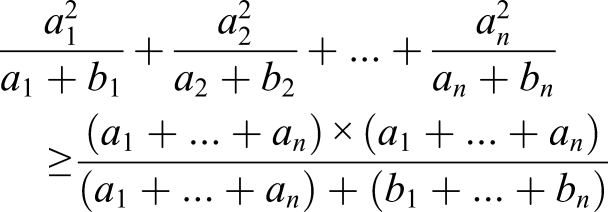
Now, if the expression
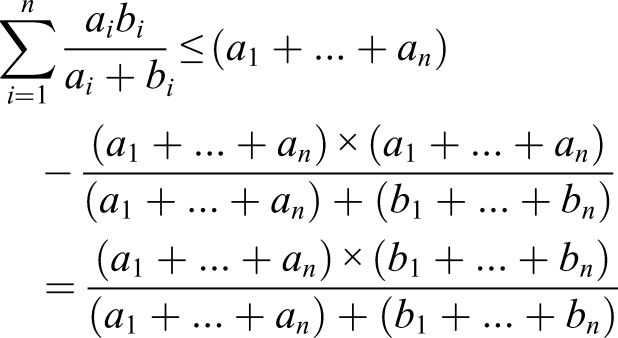
Inequality (22) has an interesting interpretation. Suppose that there are n-pairs of elastic elements Two alternative assemblies with different arrangement of the elastic elements (a) without bracing plates in the middle, (b) with bracing plates in the middle connecting elastic elements working in parallel. However, for 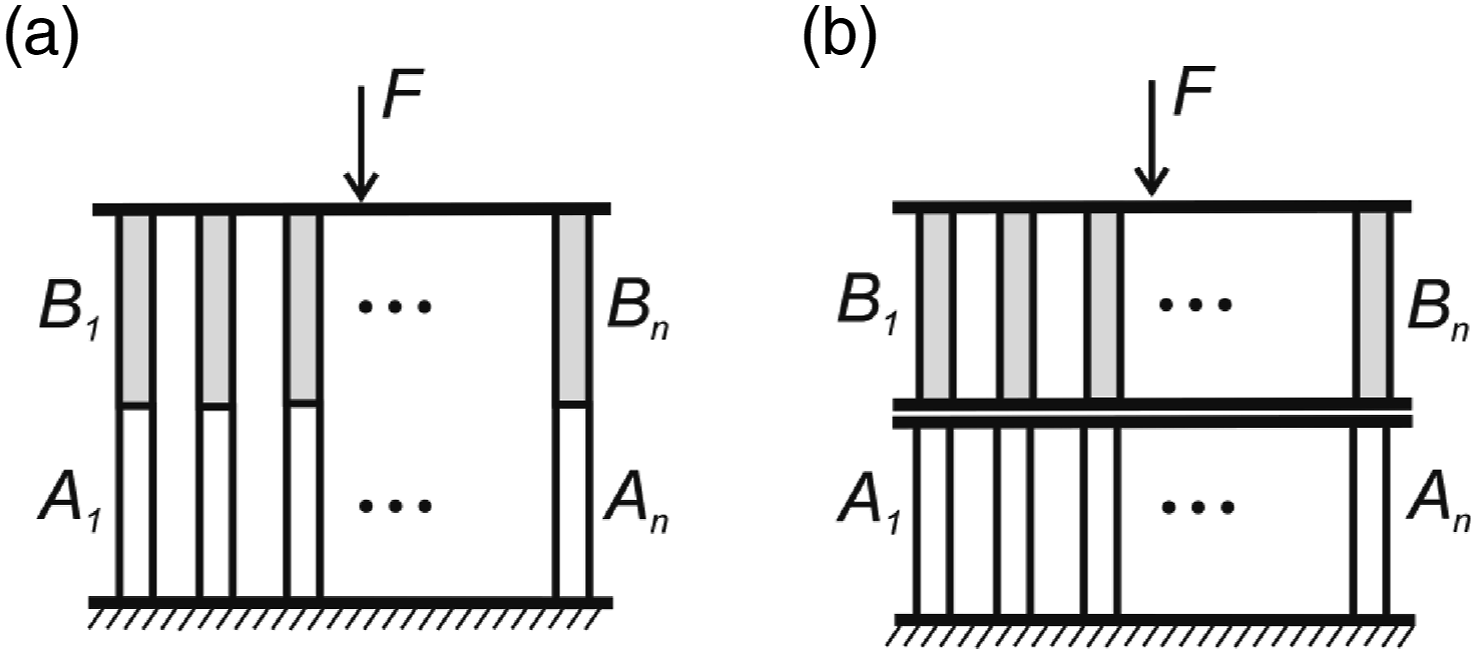
However, for

and the substitution in the right-hand side of inequality (22) results in
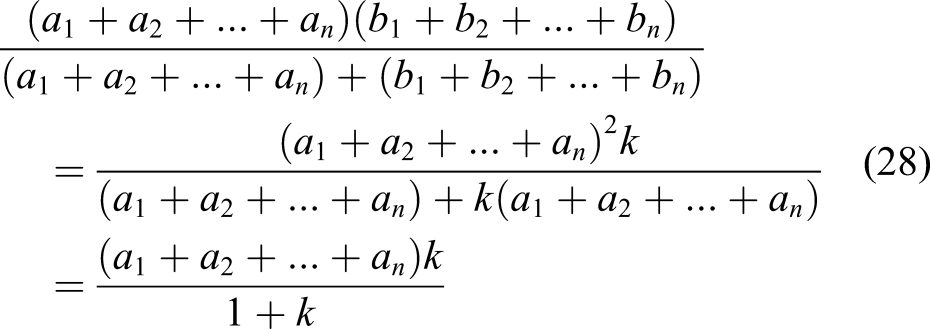
The right-hand sides of equalities (27) and (28) are identical, therefore the left-hand sides are also identical. The two assemblies in Figure 4(a) and 4(b) are equivalent (have the same stiffness).
The important conclusion from the interpretation of inequality (22) is that the increase of stiffness associated with the assembly in Figure 4(b) is lost completely if the ratio ai/bi of the stiffness values of the individual elastic elements in the pairs is the same.
This is a counter-intuitive statement which can be demonstrated on two pairs of elastic elements Alternative assemblies with different arrangement of the elastic components.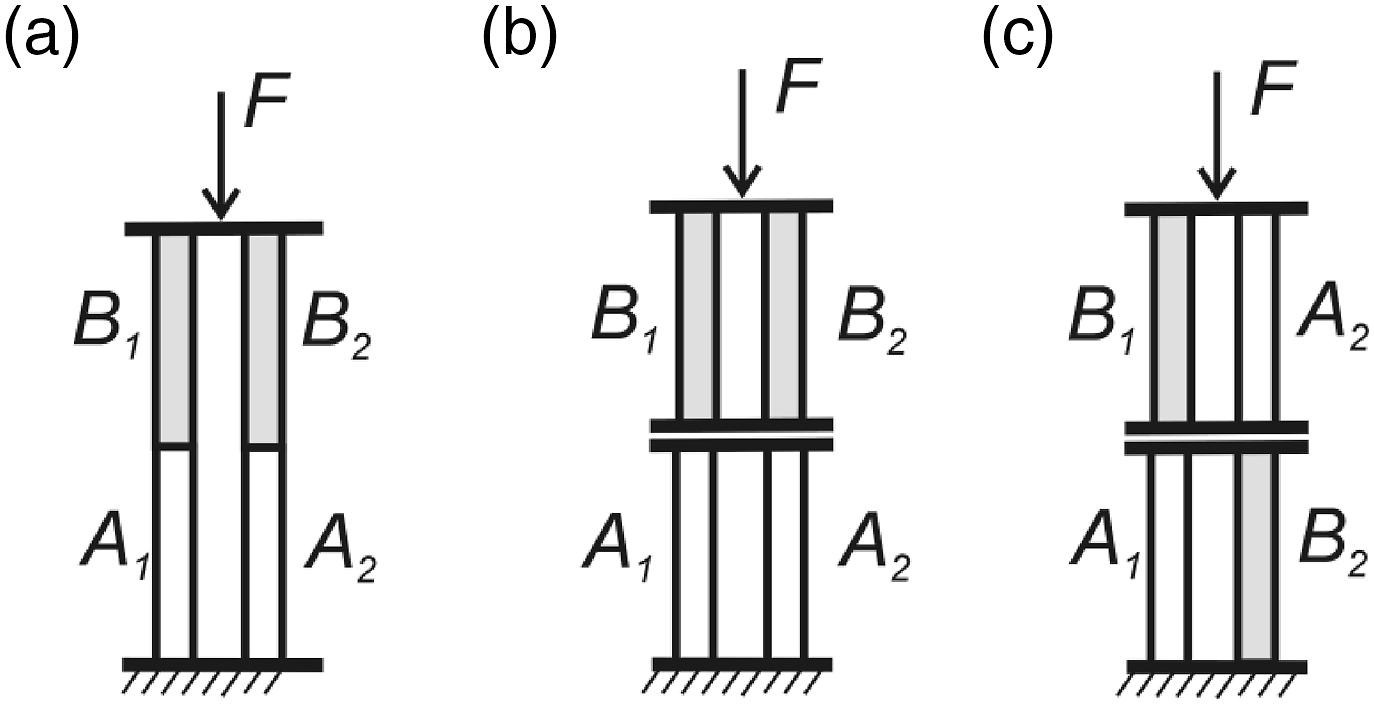
Because
As a result, the two sides of inequality (22) are no longer equal:

Inequality (22) can be applied as a basis of a strategy for increasing the stiffness of mechanical assemblies similar to the ones in Figures 4(a) and 4(b).
Note that the Bergström inequality (23) is also a special case of the general sub-additive inequality (6) The role of the sub-additive function
Inequality (23) has a universal application in science and technology as long as the variables
Optimising a process based on the interpretation of a new algebraic inequality
There are algebraic inequalities, which, although not based on sub-additive functions still provide the basis for a segmentation of additive factors and increasing their impact. Consider the algebraic inequality

Inequality (29) can be proved by applying the Chebyshev’s inequality, the AM-GM (Arithmetic mean – Geometric mean) inequality and the technique ‘strengthening of an inequality’. The classical Chebyshev’s sum inequality
9
states that for the sequences of real numbers

Let the setting

For any sequence



From the AM-GM inequality,


Inequality (29) provides a mechanism for increasing at least n times the effect of the aggregated additive quantities
Presence of asymmetry is vital for inequality (29) to hold. For proportional ratios
Indeed, in this case, the left-hand side of (29) becomes
Despite that inequality (29) is not based on a sub-additive function, it still offers the possibility for a segmentation of additive factors and has a number of interesting potential applications.
If
An alternative way of formulating this requirement is to be able to present the additive quantity

It is important to note that inequality (29) can be applied to each of the individual terms
Increasing the mass of substance deposited during electrolysis
Inequality (29) will be applied to increase the mass of substance deposited on electrodes during electrolysis. The Faraday’s first law of electrolysis
36
states that the mass m of substance deposited at an electrode in grams is directly proportional to the charge Q in Coulombs

By using the relationship between charge Q, current I [A] and time t in seconds, equation (36) can be re-written as

Consider now a process of electrolysis induced by voltage of magnitude V, applied to a cell with resistance R. Since the current I is determined from the Ohm’s law


Consider an alternative design for which the electrolysis is conducted after segmenting the initial cell with resistance R into two smaller cells with smaller resistances

Multiplying both sides of inequality (40) with the positive value

The right and left parts of inequality (41) can be interpreted as total mass of deposited substance associated with two design options of the process: (i) electrolysis conducted in a single electrolytic cell and (ii) electrolysis conducted in two smaller cells.
The left-hand side of (41) can be interpreted as the sum of masses
Inequality (41) predicts that, as a result of the cell’s segmentation, the mass of deposited substance can be increased more than twice. With respect to the total mass of deposited substance, the second design option of the process is to be preferred.
Again, the presence of asymmetry in inequality (41) is a condition for improved performance. For
CONCLUSIONS
1. A method for optimising the design of systems and processes has been introduced that consists of interpreting the left- and the right-hand side of a correct algebraic inequality as outputs of two alternative design configurations delivering the same required function. In this way, the superiority of one of the configurations is established immediately by the algebraic inequality. The proposed method opens wide opportunities for enhancing the performance of systems and processes from diverse application domains. 2. Inequalities based upon sub-additive functions can always be interpreted meaningfully if their variables and separate terms represent additive quantities. The generated new knowledge can then be used for optimising systems and processes in diverse areas of science and technology. 3. The meaningful interpretation of an algebraic inequality based on a single-variable sub-additive function led to developing a light-weight design for a supporting structure based on cantilever beams. 4. The interpretation of a new algebraic inequality based on a multivariable sub-additive function led to a method for increasing the kinetic energy absorbing capacity during inelastic impact. As a result, the inequality can be applied as a basis of a strategy for mitigating the dynamic force due to inelastic impact between a moving object and immobile obstacle. 5. The interpretation of a new algebraic inequality can be used as a basis of a strategy for maximising the mass of deposited substance during electrolysis. 6. The requirement for asymmetry to achieve beneficial effects from segmentation based on sub-additive algebraic inequalities is vital. This is rather counterintuitive and makes the presented results difficult to obtain by alternative methods bypassing the use of algebraic inequalities. 7. The developments presented in this paper can be expanded significantly by interpreting known inequalities in the context of various specific domains: electric engineering, manufacturing, all areas of physics, economics and operational research. A very promising class of algebraic inequalities suitable for this purpose are the inequalities based upon sub-additive and super-additive functions. These can be easily interpreted meaningfully if their variables and terms represent additive quantities.
Footnotes
Declaration of conflicting interests
The author(s) declared no potential conflicts of interest with respect to the research, authorship, and/or publication of this article.
Funding
The author(s) received no financial support for the research, authorship, and/or publication of this article.
