



Abstract
In this paper, the influence of functional elastomeric substrate-supported layers for enhancing potential resistance capability against localized plastic failure of advanced high strength steels is considered based on a localized necking model of vertex theory. Application of this structure leads to postponing the plastic instability of the metallic part. By defining diffuse and localized modes of deformation in a general framework, the theoretical models are developed to predict necking limits at several stress states. In addition, the results of the Hookean and neo-Hookean elastomers are compared in terms of strain hardening with the anisotropy parameter of Hill’s yield criteria. Since necking band angle (NBA) is a principal factor for the necking prediction, its effect on bifurcation events is evaluated specifically for different ratios of stress rate, and quadratic and non-quadratic yield criteria. This analysis is performed by proposing a supported and yield-dependent necking bound angle (YD-NBA). All considerations are done by providing equilibrium conditions governed over the NBA. Finally, obtained results indicate good agreements between several theoretical considerations and experimental data.
Keywords
Introduction
In the past decades, interest in studies on plastic instability events in sheet metalworking processes has been increased to optimize formability and prevent performing defective parts. 1 The plastic flow may be typically limited through the necking, rupture, and wrinkling phenomena during the large deformations. Each of those cases could be a detector for creating faulty specimens. Forming limit diagram (FLD) is a useful tool to predict forming limits by expressing the relationship between major and minor strains. The metal forming processes are mainly subjected to stretching conditions of plane-stress states. Actually, in highly ductile material, a fracture phenomenon can occur due to severely bounded strain localization at the thinning mode. As known, many theoretical models have been developed as powerful substitutive techniques, instead of using expensive and time-consuming experimental observations. Some advanced models for anticipating the forming limit curves have been reviewed by Banabic.2,3
After gradual growth of the neck in diffuse mode, a sharply necking initiates localization of the forming a shear-wakening bound. In particular, Marciniak and Kuczyński 4 introduced a localized necking model which was known afterward as the M–K model. In that model, the thickness reduction has been evaluated utilizing a micromechanically oriented defect. Afterward Marciniak 5 described a complete mechanism of the strain localization of FDM developing a fundamental model initiated by Marciniak and Kuczyński. 4 More detailed discussions about the M–K model can be found by Banabic.2,6 The M–K model is based on assuming an initial thickness imperfection as a groove in the sheet with a definite oblique angle. Uniform pressure field is applied from the beginning of the stretching process, while the boundary of the sheet is subjected to monotonic proportional straining parallel with the symmetry axes. According to this hypothesis, two regions of the sheet metal should be distinguished: the non-defective zone and groove. 7 Also, based on the M–K model, the FDM of Al-Cu two-layer metallic sheets was considered by Hashemi and Karajibani 8 and Yuan et al. 9 used anisotropic coefficients of the Yld2000-2d yield criterion by incorporating the M–K model to optimize numerically the shape of cruciform specimen thinned at the center region under different loading paths and reducing shear stress. Hu et al. 10 introduced a new robust algorithm for the M–K model by combining the modified Newton–Raphson (N–R) with an incremental method. Recently, the M–L model has been extended for various case studies.11–20
Alternately, Stören and Rice 21 assumed that the mechanism of the localized necking is defined in such a way that the distinction between nominal stress rates is zero inside and outside of the necking band. Therefore, a vertex model that supports the deformation theory of physical property was introduced within the necking band in that work. The NBA is limited by the strain magnitude. In this regard, Zajkani and Bandizaki 22 studied the transition of diffuse to localized necking in the context of an efficient rate-dependent bifurcation model. Another rate-dependent model can be found for evaluation of the non-linear strain paths. 23
Alternately, Lumelskyj et al. 24 proposed a finite element consideration of the sheet metal forming to detect strain localization by including the overall amounts of the strain paths. Another simple theoretical work for the localized thinning has been done for adhesively bonded steels based on a thickness gradient-dependent necking which incorporates a typical criterion in terms of the effective strain rate. 25 It is usually emphasized that the thickness magnitude relation could be a very important parameter to research a particular instability alongside the material characteristics. Applying an associate elastomeric layer will be thought about as a proper tool to increase the capability of loading exposed to plastic deformation before rupture prevalence. Dick et al. 26 introduced a path-independent model for the case of multi-stages forming techniques. Recently, Rad and Zajkani 27 introduced a stress state-based coupled plasticity-ductile damage model for aluminum alloys considering the influence of high-rate impulsive preload. In this work, a fully nonlinear FEM is developed to capture the corresponding stress state, hardening, and damage evolutions during experiments of high-velocity pressure pules done by shock tubes. Also, Mansoub et al.28,29 performed extensive experiments and proposed a rate-dependent vertex model coupled with the ductile damage context to predict the forming limits and then control those at different strain rates. Etemadi et al. 30 introduced a hybrid modeling of phenomenological damage evolution in low carbon steels during Equal Channel Angular Extrusion (ECAE) process.
In addition, applications of Advanced High Strength Steels (AHSS) have grown up in this decade due to their valuable properties of high strength to weight ratio. 31 But, their formability is a considerable factor for engineering designers as well as springback phenomenon.32–34 Therefore, obtaining the capacity of deformations without any rupture will be so interesting to consider. On the other hand, the formability of metallic-based composite sheets has been investigated for various materials, theories, and properties. For instance, the polymer-coated metal layers can take more plastic deformation before the final rupture. Therefore, they recorded the high mechanical energy absorbed within the structural components subjected to the high-intensity impulses. Amirkhizi et al. 35 introduced a constituent model to consider sensitivity analysis of polyuria under temperature and pressure treatments on experiments. Recently, Zajkani and Bandizaki 36 presented a growth model organized on a linear perturbation framework to study the stability of the substrate-supported structures. In Nazir and Khan, 37 we can find good literature reviewing theoretical techniques for the film-substrate systems.
In the present decade, the importance and efficiency of applying the Hookean and neo-Hookean substrate-supported materials have been explored comprehensively in different loading and conditions. For example, Refs.38–41 present considerations of wrinkling of stiff films and sheets; the work of Long et al. 42 formulate adhesively contact mechanics of large deformation in substrate-supported sheets and Refs.43–45 analyze the instabilities and bifurcation events in the presences of substrate materials. Moreover, the effects of pre-stretch, compressibility and material constitution on the period-doubling secondary bifurcation of a film/substrate bilayer have been investigated in Cai and Fu. 46 Diab and Kim 43 investigated the Ruga-formation instabilities arising in a graded stiffness boundary layer of a neo-Hookean half-space, caused by lateral plane-strain compression. Competition among film-buckling, local film-crease and global substrate-crease modes of energy release produce the diverse Ruga-phase domains. In Jai and Li, 45 an all-wavelength bifurcation analysis was proposed to find instability of substrate/metal bilayers under arbitrary biaxial tensile loadings; from the equi-biaxial tension and the plane-strain tension to the uniaxial tension. Two representative bilayer structures were investigated, namely, a metal layer supported by a plastic substrate and a metal layer supported by an elastomer substrate. In Bettaieb and Abed-Meraim, 47 a ductility bifurcation theory with an initial imperfection approach was conducted to consider the localized necking in the substrate-supported metal layers based on a rate-independent crystal plasticity framework. In that work, the mechanical behavior of the elastomer substrate follows the neo-Hookean model. In addition, a full-constraint Taylor scale-transition scheme was implemented to describe microscopic constituents of a representative volume element (RVE) of the metal layer. It was demonstrated that predicted limit strains by the initial imperfection tend toward the bifurcation predictions as the size of the geometric imperfection in the metal layer reduces. Varatharajana and DasGupta 44 showed that anisotropy of a neo-Hookean material can significantly change the jump behavior from subcritical to supercritical in the bifurcation of a pressurized hyperplastic membrane tube enclosed by a soft substrate.
Due to the importance of forming metals in different industries, their considerations are of great importance. Therefore, the study of strategies to increase their productivity will greatly contribute to the development of metal forming processes. The use of reinforcing substrates, while increasing the surface resistance and resistance to environmental conditions, significantly increases its strain without significantly altering the metal mass. This can be effective in producing parts from deep drawing as well as the parts that require large deformations.
In this paper, we can see that by exploiting the reinforce-layers on the sheets, a retarding at the plastic instability takes place. Moreover, the reinforcing effects are explored for the various loading and anisotropic conditions. Each Hill’s yield criteria, that is, quadratic and non-quadratic types will be studied for anisotropic conditions. Since an NBA could also be one of the important parameters for necking prediction supported by the bifurcation analysis, the angle is investigated for the various stress rate ratios subjected to different yielding influences. The consequences of the Hookean and neo-Hookean elastomers are compared for various strain hardening values. The elastomeric part of the substrate-bolstered sheet is represented as incompressible material having a low elastic modulus (in comparison with the metal layers). Also, the energy absorbed is investigated, specifically for the neo-Hookean reinforced layers that cause an additional delay in plastic instability, raising the panel’s strength. All issues are performed by exposing the equilibrium conditions fixed at the necking band. The obtained results are compared to the experimental and other theoretical models proposed by others.
The vertex localized instability; extension on the S–R (Stören–Rice) hypothesis
Schematic of the elastomer-metal based structure is shown in Figure 1. Here, the localized plastic instability analysis of substrate-supported through elastomeric functional layers is considered. Also,
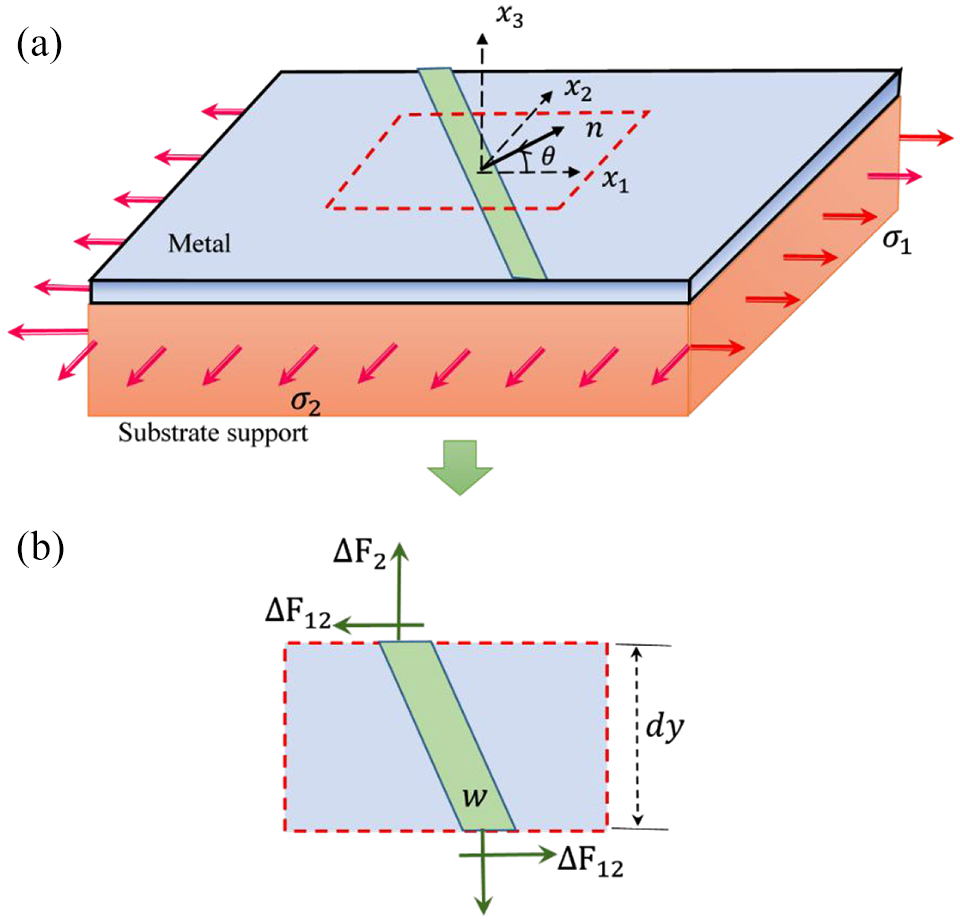
The vertex theory schematic is presented in Figure 1 with a substrate in part (a) and part (b) is a element of a metallic sheet that shows the free diagram of the theory.
As indicated in the investigations by Stören and Rice 21 for the plates subjected to the bi-axially stretch tests, it is prescribed that the weakened necking band has no difference between its both sides. For a plane-stress state, it is expected that inside a thin neck, increments of velocity are allowed to take different values than their uniform qualities outside the neck. Since the flow field is limited to shift over the neck, the distinction in speed is:

where

Therefore, the strain rate inside the weakened bound can be expressed in terms of the Eulerian context of the deformation field as follows:

After beginning the localization mechanism for the necking, the principal directions coincide with the stress directions. It means that shear stress vanishes at the beginning phase. Although the principal directions do not remain permanently at the similar positions and practically, the shear stress may be present impressively. In this case, the normal stress directions may be separate from the principal directions due to variation inside the weakened bound. Nonetheless, the plane-stress state imposes the following condition for the plate of thickness

In above, it is assumed that the stress values at the thickness direction stay constant. Here, it is worth mentioning applying the equilibrium moments for an arbitrary element without involving influence of the shear stress at the necking zone leads to extract the following equations:

In previous studies, which predict forming limits through the vertex model, the Hill zero extension was employed to determine the necking angle. By assuming that the necking angle is zero in the +ve major strain side of the FLD’s, the Hill hypothesis can be used effectively for the −ve major strain side of the FLD’s. The Hill zeros extension is obtained through a different approach. It was investigated by using an elastoplastic modulus and solving the quartic equation for the negative ratio of strain. Therefore, the Hill zero extension is as

In the equation (6), the angle is obtained in a proportional loading using
Constitutive equations
It is worth remembering that plastic instability can occur in large strains dependent on different conditions. This behavior in vertex model
21
is associated with the stress rate and the strain rate. The stress rate that has been used by Stören and Rice

In equation (7),

That the

Zhu et al.,
48
neglected the shear stress at the state of the plane-stress. In the similar case, it can be concluded that principal stresses act only in the deformation mechanism. Also, it is clear that


Metal layer
However, in the initially recognized assumptions of the Hill criteria, it can be found that anisotropy axes are coincident with the principal stress directions. A standard anisotropic factor that normalizes the rolling path is used for a general concept of anisotropy. For obtaining the loading constants, the flow rule is used with an anisotropic yield criterion. Also, an instantaneous modulus associated with the metal layer dependent on the material and loading conditions is introduced. So, the instantaneous modulus of the metal layer is evaluated as
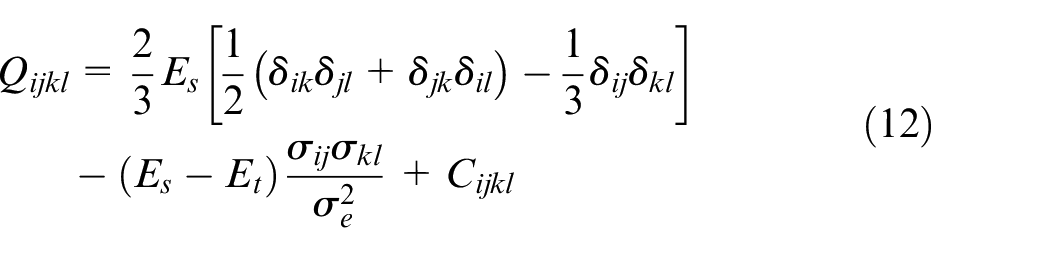

In the above equations,


Here, by according to incompressibility condition;



According to the power-law hardening, the strain energy for the freestanding metal layer is calculated as follows

Functional reinforce elastomeric layer
The material behavior of reinforce-layer is characterized by the main parameters. Selection of proper material and thickness for the elastomeric layer is essential. Espinosa et al. 49 observed strain localization in aluminum and polycrystalline copper films. Jia and Li 50 studied the delocalizing strain in a thin metal film substrate-supported through a polymer layer.
Hookean reinforce-layer
In this section, the elastomer behavior is based on a Hooke law that for incompressible materials the Poisson coefficient is

where



Neo-Hookean reinforce-layer
According to the studies by Biot and Romain, 51 the strain energy for the neo-Hookean reinforcing layer is expressed as

Now, the sign of

We can use equation (25) for the single layer of the neo-Hooken. So, by combining differentiation of relations (24) and (25) leads to find the stress field of the neo-Hookean reinforce layers as

In above, it is assumed an incompressible deformation
Therefore, an exponential function can define principal stretching as



where

Considering equations (26) to (30), help us to extract the instantaneous modulus


On the other hand, the Hookean reinforce layers have linear behavior while the neo-Hookean reinforce layers have nonlinear behavior (according to the principal stretching). For an incompressible material (
Equilibrium equations
According to Figure 1, necking instability in a multi-layered structure imposed to the plane-stress is evaluated in the context of the vertex theory. By considering an incompressibility assumption, we can draw that the strain values in the structure are equal with the different layers as

The equation (33) is related to the general forms of the metal layer, Hookean and neo-Hookean reinforced structures. It is extracted by taking into account the incompressibility of the structure, neglecting each separation of the layers. Alternatively, this equation regards the main assumption of the vertex theory that the rate of variations of the nominal traction in the necking layer should be zero. Parameters of a, b, and c are characterizations of the layer numbers for the metal, Hookean and neo-Hookean material, respectively. Also,

Combining the above relations results:

which,


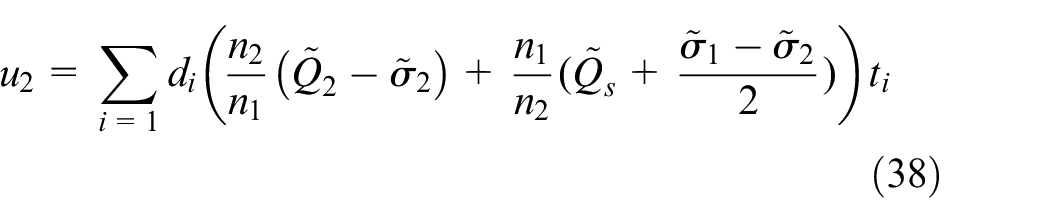
In above,
Accordingly, the total absorbed energy is evaluated through summation of the obtained energy density


In the above equation,

Subsequently, the energies in bilayer


In the plastic deformation of the substrate-supported structure, the absorbed energy includes the plastic dissipation of the metal layer and the recoverable elastic energy before necking occurrence. Indeed, it is the energy limitation before instability at the reinforce-metal bilayer composites. Consider the condition that the reinforced layer is delaminated under severe plastic deformation of the metal layer. The related energy of delaminated substrate-supported can be obtained through dropping the reinforce layer energy at equation (42) as equation (43). So, the equations (42) and (43) present the energy limitation of the substrate-supported structure before necking.
Results and discussion
The vertex equations are based on the principal stresses. Since the position of the localized necking or in other words, the necking layer is the most critical part of the analysis. Therefore, it is important to determine the values and parameters associated with this layer. Since the elements of the layer are likely, rotate during deformation; the corresponding stresses values depend on their rotation angle, emphasizing that the angle of the necking layer plays this role. According to the literature, it can be concluded that the Hill zeros extension at the right-hand side (RHS) of the FLD plays the main role to attribute the NBA equal to zero. However, this angle is obtained via equation (7) for the LHS of the FLD. Nevertheless, the Hill zeros extension predicts only the NBA based on strain ratio. According to equation (7), the localized NBA in the uniaxial tension

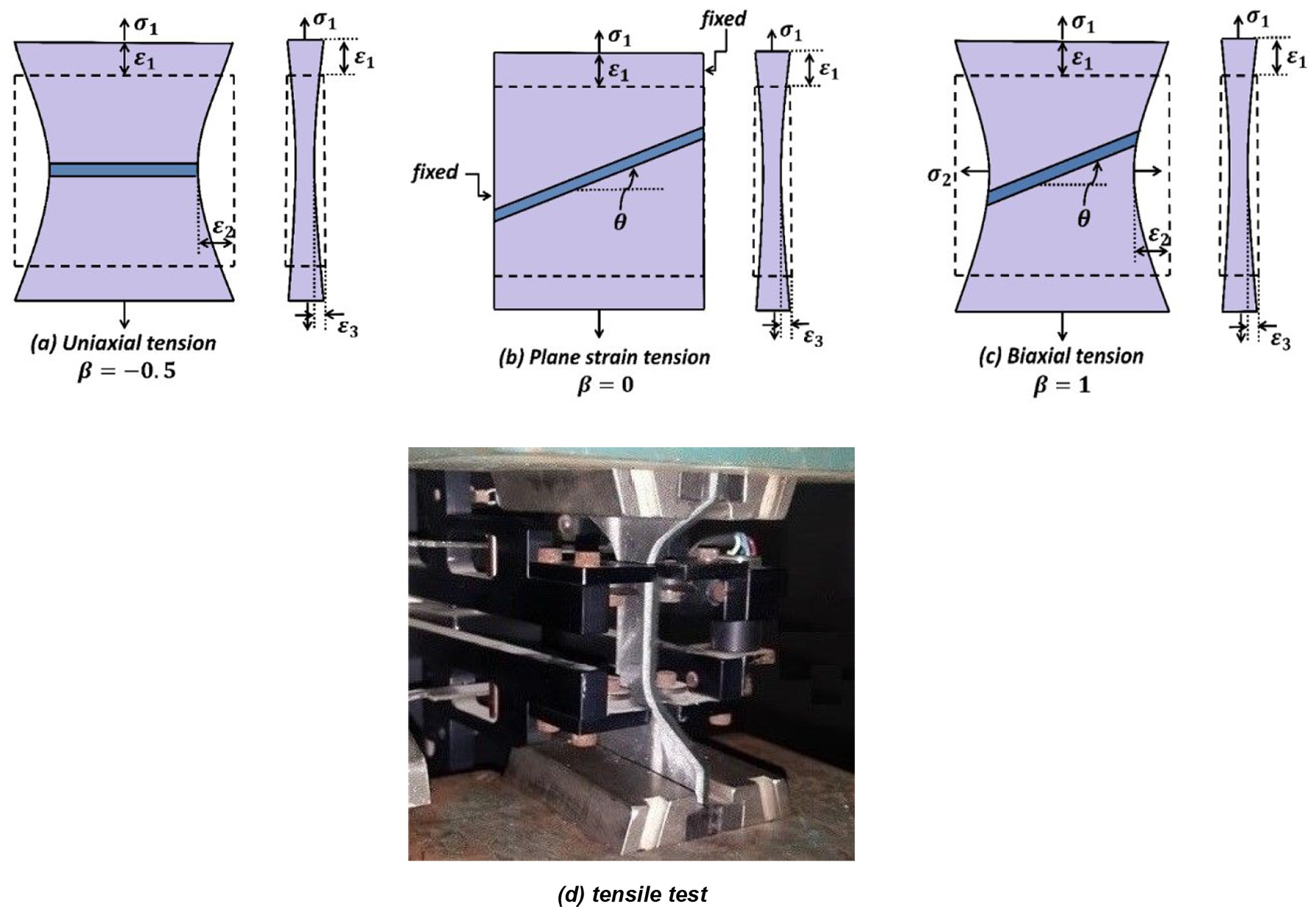
Schematics of critical cases in tension test for the NBA of vertex theory related to the YD-NBA (a–c) and (d) bilayer substrate-supported tensile test.
By substituting the equation (6) into equation (44), for the proportional loading and also the strain ratio and strain rate ratio as

where
Figure 2 shows the schematics of the YD-NBA angle assumption for the three critical loading conditions. Indeed, the YD-NBA improves the FLD results by imposing the different useful parameters on the NBA as the anisotropy, loading conditions, and the strain rate. In the mentioned state from experimental observations, it will be assumed that in the uniaxial tension, the NBA is zero (Figure 2(a)). Besides, it is supposed that the NBA is not zero in both the plane-strain and equi-biaxial tensions (Figure 2(b)). On the other hand, according to Figure 2(c), the NBA in the biaxial tension cannot be zero, necessarily. The related results to the YD-NBA angle are presented in Figure 2. The effects of anisotropy and yield criteria on the YD-NBA are presented in Figure 3. The most remarkable point is the independence of the equiaxial tension to the NBA. We can show that in the equi-biaxial tension in both yield criteria and any standard anisotropic factor, the neck angle is equal. Considering stress ratio for the case of equi-biaxial tension (
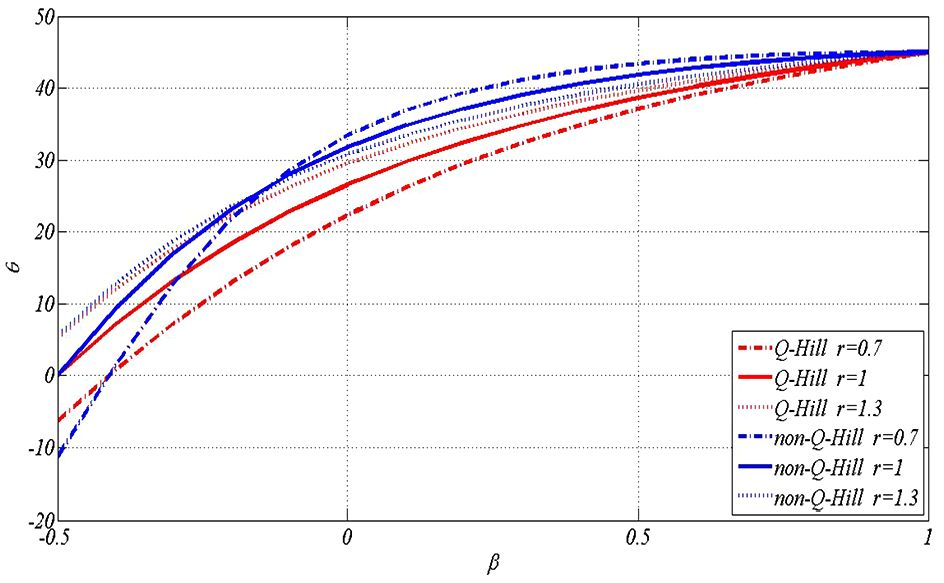
The YD-NBA results from the effects of the NBA on quadratic and non-quadratic Hill.
In Figure 4, several approaches have been compared with empirical data for the advanced high-strength steel DP780 with
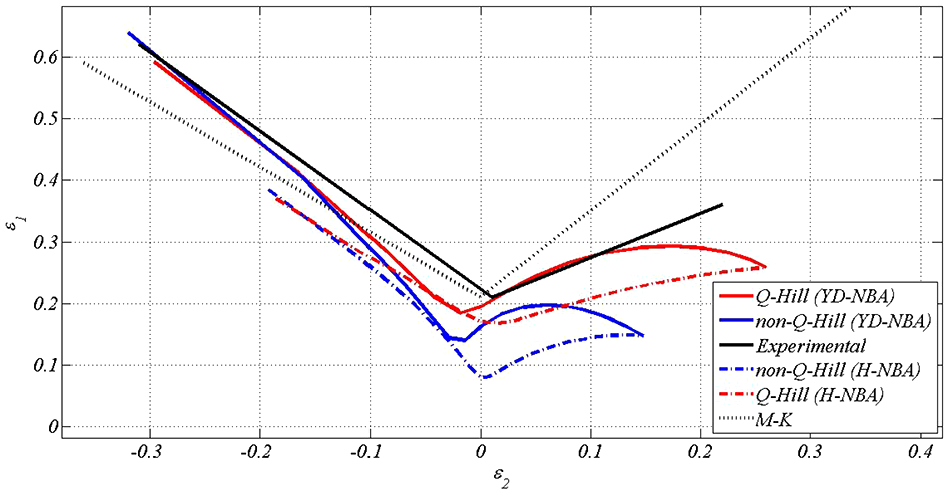
Validation of results with practical data and others theories. 50
It is shown that the quadratic Hill function indicates better accuracy by comparing the results of the quadratic and non-quadratic yield surfaces together. Since the effects of yield function are significantly dependent on the natural texture of the materials, this function describes the distribution of stresses on the materials. It is suitable to apply the quadratic Hill’s for the DP7800 steel as compared to the non-quadratic yield function. Its effect is entirely tangible on the RHS of the FLD. On the other hand, according to YD-NBA, the localization angle is strongly dependent on the yield function.
The illustration of Figure 4 confirms the mentioned claim for the YD-NBA. Firstly, we should focus on the comparisons of the M–K and vertex theories. Obviously, at the LHS, the present vertex model with a quadratic Hill surface and incorporating the YD-NBA has excellent agreements with the M–K model and experiments. Nevertheless, in the RHS, the vertex model has considerably more accurate results when it is compared with the M–K model in Panich et al. 52 Moreover, in order to investigate the influence of yield surface and the localized NBA on the AHS steel, comparing the quadratic Hill with the YD-NBA is somewhat worthwhile to show sufficient accuracy of the model. In the uniaxial tension, the results are almost near together for both yield criteria. In the plane-strain tension, both yield and angle criterion include a significant difference on the FLD’s. When the samples are stretched axially at equal loads in two directions, the minor and major strains of the FLD are associated only with the yield surface, in spite of being independent of the necking angle. Indeed, in the equi-biaxial tension, the stress ratio is constant and independent of the anisotropy. Here, the effects of the linear and nonlinear reinforcement in the plastic instability are investigated.
If the elastic modulus of any reinforcing layer is denoted by
According to Figure 4, when we use the Hill zeroes extension-NBA, the localization will occur at smaller strains. The experimental results show larger amounts of strains. So, by using the YD-NBA for considering loading conditions on FLD’s, the obtained necking strains will be closer to the experiments.
In Figure 5, the influence of reinforcing layers on the bifurcation analysis of the substrate-supported materials are compared with another investigation reported by Ben Bettaieb and Abed-Meraim. 53 The obtained results show the good agreement between present study and the data of LHS-FLD in Ben Bettaieb and Abed-Meraim 53 developed over the flow theory, which uses the Hill zeros extension of the forming limit strain. Also, the equi-biaxial tension (independence of NBA) in both studies almost has same the strains. When it is used the Hill-NBA, it will be the results same as the obtained results by Ben Bettaieb and Abed-Meraim 53 and the major reason for the observed difference is the used NBA. Subsequently, the more effective substrate-supported structure is presented at YD-NBA and it is validated with the flow theory in Bettaieb and Abed-Meraim. 47 in LHS and in the equi-biaxial with the deformation theory of bifurcation analysis by Ben Bettaieb and Abed-Meraim. 53

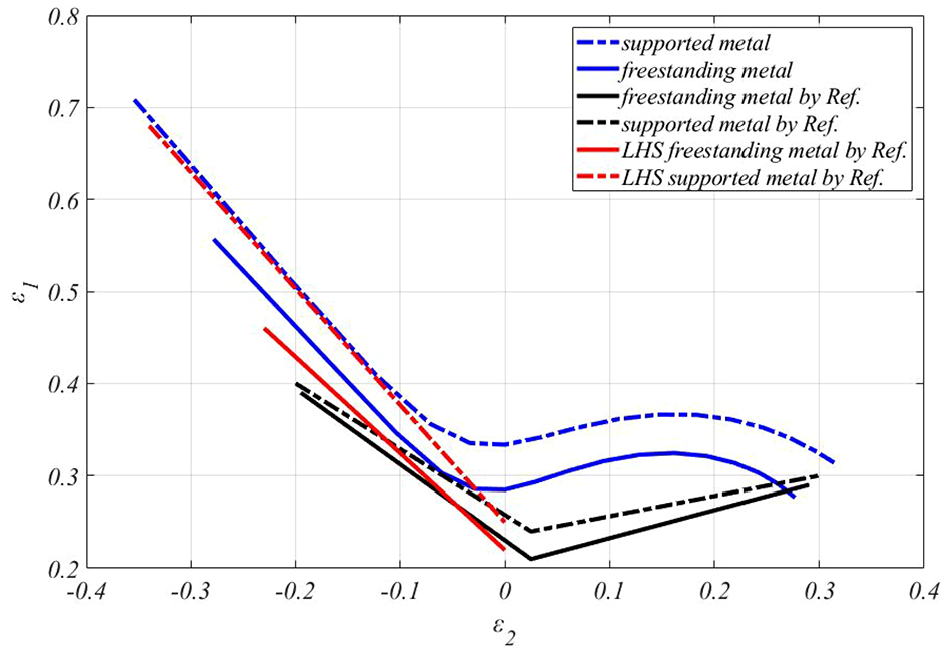
Comparison of the bifurcation analysis of the freestanding and supported metal layer with Biot and Romain
51
at n = 0.22 and
Therefore, as shown in Figure 6, by YD-NBA, the effect of reinforcements on the vertex localization will be more than the Hill-NBA. As mentioned, by independence of the localized strains of equi-biaxial tension, the effect of reinforcements is equal for both NBA relations. In another hand, as expected, the YD-NBA includes more reinforcement for the necking delay. It is clearly observed in Figure 6 especially in the uniaxial tension, whatever the material and thickness ratio be larger.
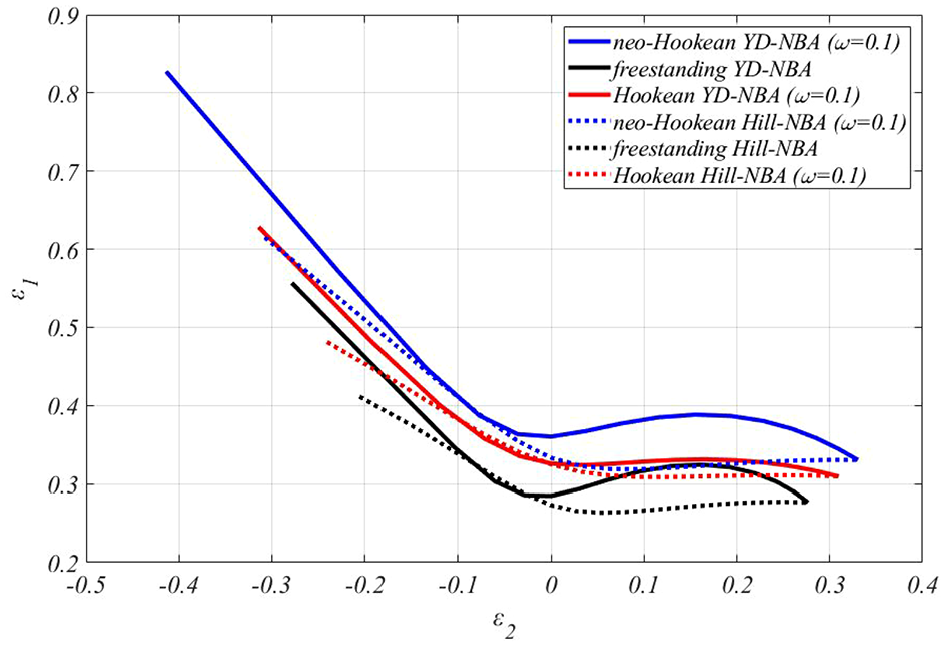
Comparisons of the Hookean and neo-Hookean reinforce layer effects.
As demonstrated in Figure 6, the necking instabilities of the metallic sheets supported by the neo-Hookean material delay, especially at the RHS of the FLDs. For considering reinforced layer type, the effects of the Hookean and neo-Hookean layers have been investigated over the metallic sheets. The Hookean material can be regarded as a bilayer metallic composite that is most developed for high temperature applications. Although it is possible to include other materials at any application. Nevertheless, the neo-Hookean material usually are rubber-like material that have been recently encouraged to be used in the wide cases of metal forming processes. According to Figure 6, it is observed that in the cases of the similar material and thickness, evoked for both Hookean and neo-Hookean reinforce layers, the instability strains occur in the larger amounts. So that, the Hookean reinforce layer plays an insignificant role in some of the loading conditions as
In addition, the strain-hardening index has been investigated for different volume fractions of the supporting metal in Figure 7. Results in this illustration show the effects of linear and nonlinear reinforce layers for three critical loading conditions. For the small strain hardening indexes, the results of the Hookean and neo-Hookean reinforces are the same. For the higher values of
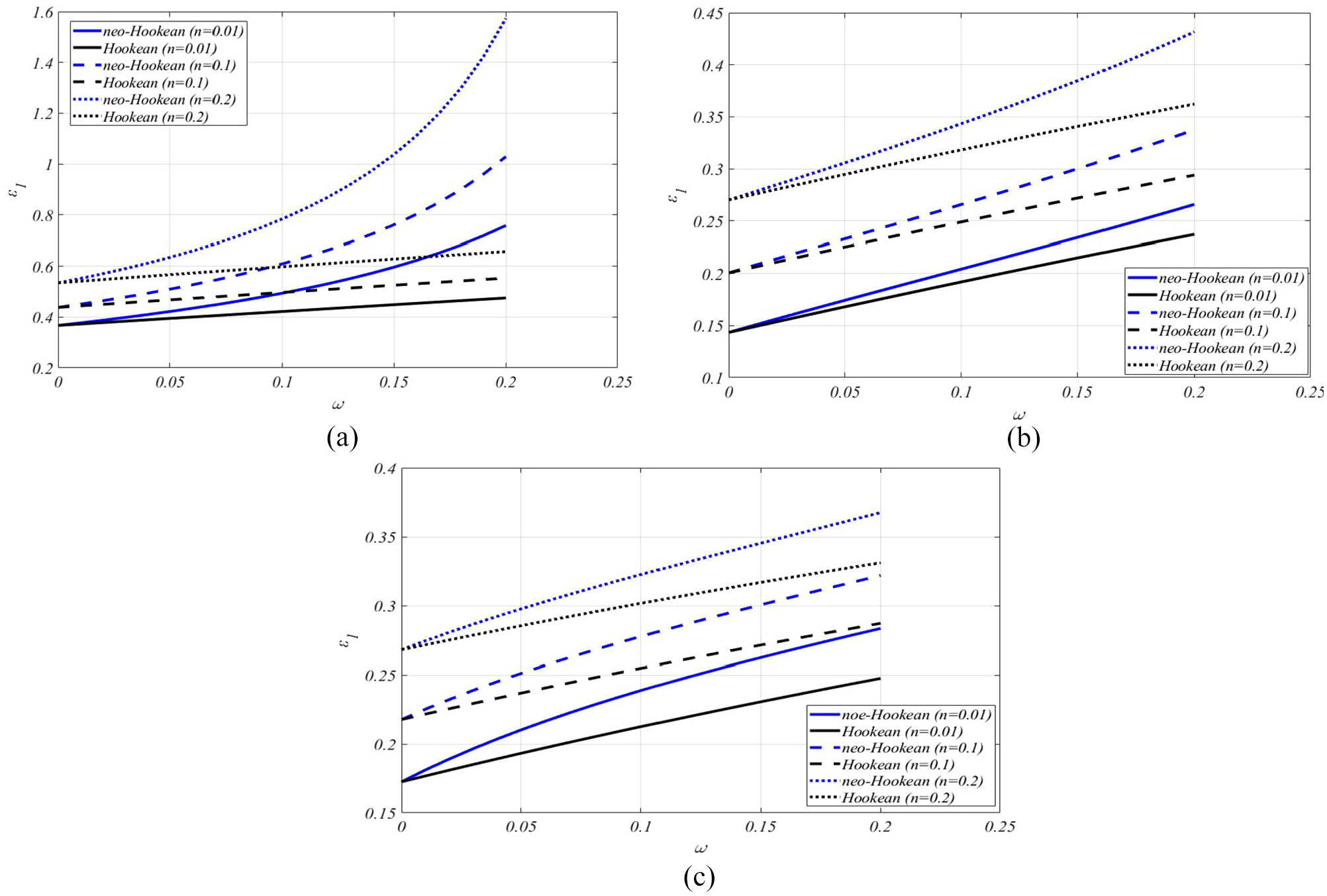
Comparing the effects of neo-Hookean and Hookean reinforce layers for different strain hardening indexes: (a) uniaxial tension, (b) plane-strain tension, and (c) equi-biaxial tension.
By exploring the influences of each reinforcing layer on the necking instability strains, the neo-Hookean layer is preferred due to its higher material ratio and hardening index. Normally, for the general materials with a little strain-hardening index, this issue plays a significant role in the comparing efficiency. Although, both stress states of the equi-biaxial and plane-strain tensions have almost the same amounts of reinforcing effect on the small material and thickness ratios.
For a freestanding or pure metallic sheet, we regard
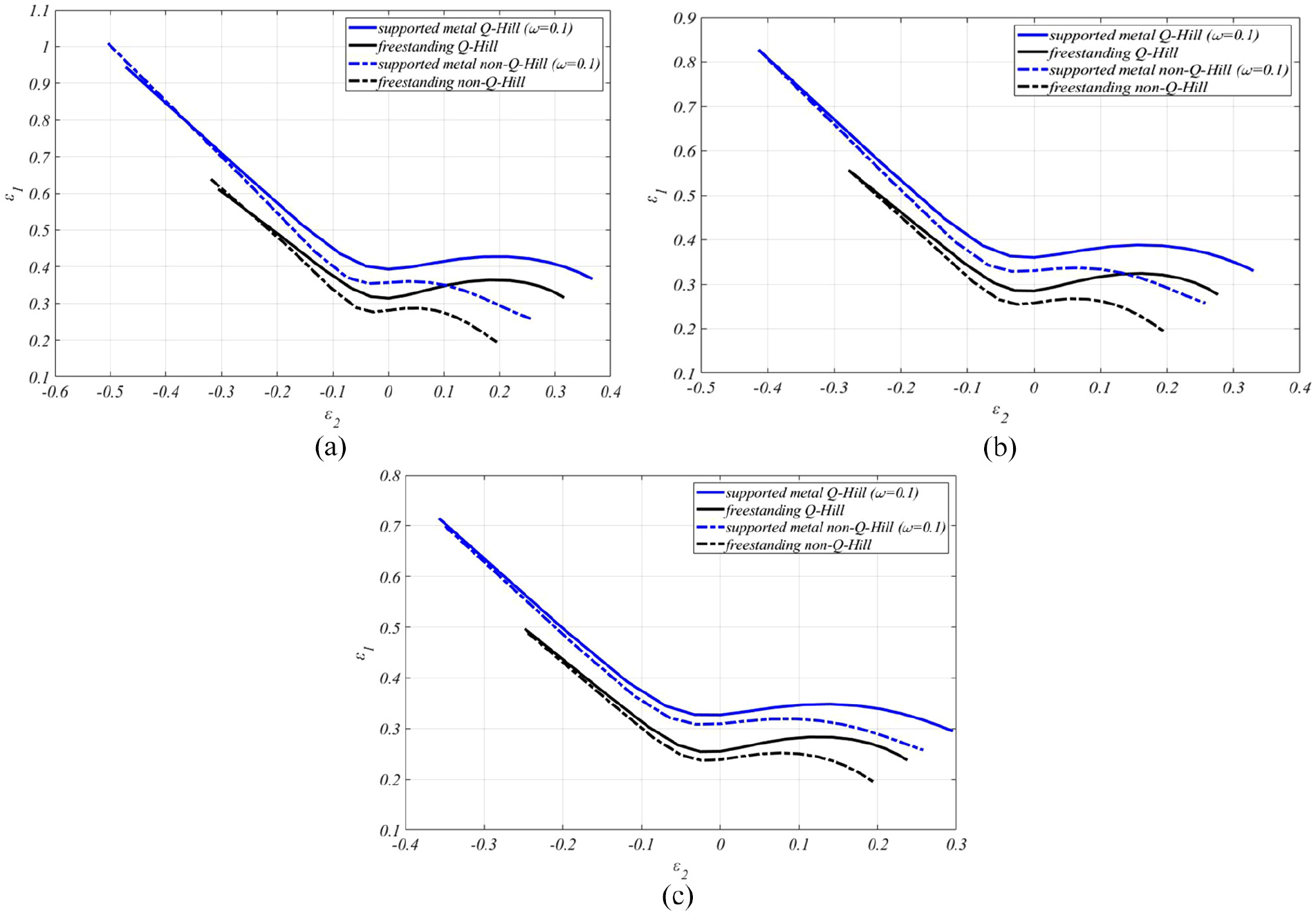
Comparison of the quadratic and non-quadratic Hill’s criteria on the substrate-supported (reinforced) n = 0.22: (a) r = 0.8, (b) r = 1, and (c) r = 1.2.
For the pure metallic sheet without a reinforcing layer, the thickness ratio is
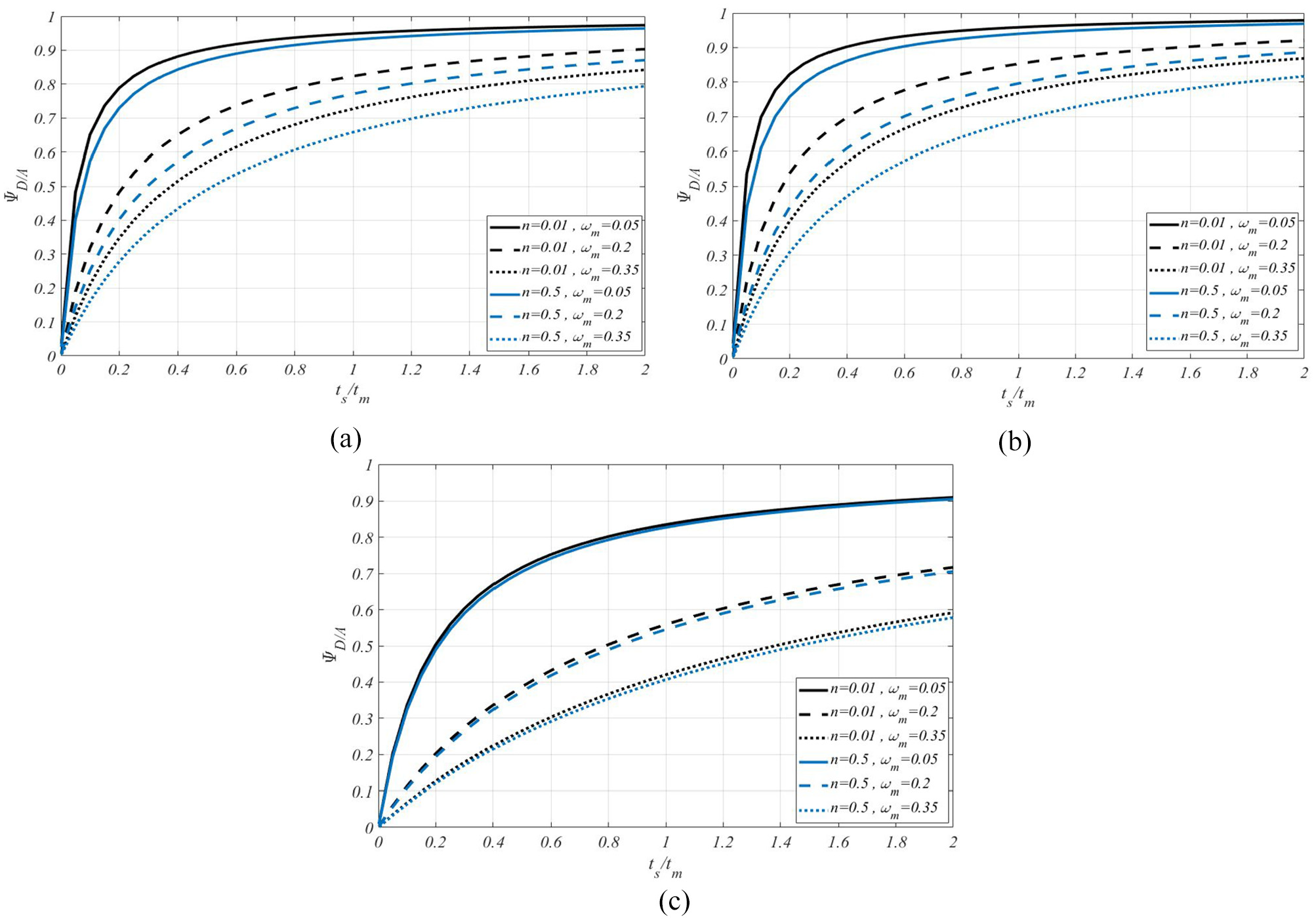
The effect of thickness ratio and
Conclusions
Here, the plastic failure analysis of substrate-supported metals through the elastomeric layers is considered with concentrating on necking band angle. Two yield criteria were compared together by controlling the anisotropic parameters. In addition, a new necking angle was presented to improve the limit strains. The main concluded remarks are outlined as follow:
The proper NBA can occur at values other than the achievements from the Hill zero extension. The YD-NBA can be known as an efficient approach to consider the influence of the yield criteria to extract reliable limit strains as compared to the general Hill hypothesis.
By reducing normal anisotropic factors, the strains limit increased. There were few differences between both versions of the yield surfaces. In addition, results for two sets of the quadratic and non-quadratic criteria have the maximum discrepancies in the RHS. Consequently, for the DP780, it is useful to use quadratic Hill with the YD-NBA. The effect of reinforce-layer on the LHS of the FLDs is entirely tangible on the non-quadratic Hill model.
Using the neo-Hookean substrate presented the more accurate results for the tension as the plastic instability occurred at the larger strains. Actually, the positive role of the reinforcing layer to make desirable delay in the necking instability becomes tangible if the amounts of
Footnotes
Appendix
Usually, using the Hill yield criterion expresses satisfactory results. The non-quadratic Hill is a general concept of the Hill criterion be dependent on the anisotropy power of related stresses. Ordinary, definition of the anisotropic value or rolling direction can be related to the strain ratio as follows
where
In the above equations, subscribers of
The above relation can be rewritten for the in-plane isotropic case; (
In this criterion, the power
Indeed, the Hill criterion can be transformed into the quadratic Hill and Von Mises models. In the case of the in-plane isotropic stress state, equation (A3) decreases to equation (A4). In the quadratic Hill criterion, by increasing the normal anisotropy coefficient, the more significant larger yield locus is obtained at the plane-strain condition and bi-axially tension. However, in the uniaxial tension, it is usually equal. However, the case of plane-strain tension emerges from a larger yield surface for the non-quadratic criterion by increasing the anisotropic factor. According to the earlier studies in literature, it can be found that the value of
Also, incompressible condition with the associated flow rule led to obtain the following ratios for the single layer
That, according to equations (A7) and (A8), we can write:
that
In addition, according to yield test, we have:
The equations (A4) to (A11) will be related to the quadratic Hill’s criterion at
Declaration of conflicting interests
The author(s) declared no potential conflicts of interest with respect to the research, authorship, and/or publication of this article.
Funding
The author(s) received no financial support for the research, authorship, and/or publication of this article.
