




Abstract
Socialized product design (SPD) mode, enabled by advanced internet technologies and sharing economic trends, has the capability of utilizing the design resources from large numbers of socialized designers (SDs) to carry out the design tasks that used to be participated by only the internal R&D staffs of companies. During SPD projects, different kinds of mechanisms can be applied to organize the SDs. Some of them tend to be centralized control (e.g. crowdsourcing design) and some are more of distributed autonomy (e.g. opensourcing design). Both centralized control and distributed autonomy have their strengths and limitations for SPD. Centralized control enables more organized, focused, and efficient project execution, but it limits the emergence of collective intelligence among the SDs. Distributed autonomy helps to explore the innovation potential of SDs by granting them the freedom of communication and mutual inspiration, but it may cause the problem of unreliable and unpredictable design process. To complement the advantages of centralized control and distributed autonomy in SPD, an integrated model of Blackboard and Bayesian network is established in this paper. The Blackboard, whose Control modules are specially customized for human Knowledge sources, is for guaranteeing overall control of the distributed design process and at the same time permitting certain level of autonomy to the SDs. The Bayesian network, built with an improved Bayesian causal map method, is an embedded Control module of the Blackboard which evaluates design solutions according to the incomplete collective judgments from SDs. The operability of the integrated model has been verified through a case study of 3D printer conceptual design project.
Keywords
Introduction
Advanced internet technologies and sharing economic trend enabled the success of a new kind of design mode in which the collective intelligence from large number of socialized designers (SDs) can be utilized to carry out the design tasks that used to be participated by only the internal R&D staffs of companies.1–3 Successful examples include Local Motors automobile crowdsourcing design project, 4 opensource software projects on GitHub, Threadless garment crowdsourcing design and decision making projects. 5 These examples demonstrate SDs’ capabilities in design solution generation and design evaluation. 6 Here, this new kind of design mode that utilizes the collective intelligence from SDs for product design is defined as socialized product design (SPD).
Different kinds of SPD projects have different mechanisms in utilizing the collective intelligence from SDs. Some of them tend to be centralized control and some tend to be distributed autonomy. For example, crowdsourcing design projects, in which the stakeholders dominate the entire design process from design requirements publishing to design solution selection,7,8 are more of centralized control. By contrast, opensource design projects, in which the SDs do all the work according to their own wishes with no centralized control from the project sponsors, 9 are more of distributed autonomy.
Both centralized control and distributed autonomy have their strengths and limitations for SPD. For example, centralized control SPD projects are relative more organized, efficient, and predictable, because stakeholders have better control of project execution and the SDs all focus on the same target. However, centralized control mechanism usually limits the freedom of communication and mutual inspiration among SDs, and therefore it has negative influence on the emergence of collective intelligence among SDs during SPD process. 10 On the contrary, distributed autonomy allows the communication and mutual inspiration among SDs, but it usually has the problem of unreliable and unpredictable project execution because the SDs may develop the project into many different directions. 10 Another common problem in distributed autonomy projects is edit war, which indicates the situation that SDs make too many modified versions of a design and sometimes these versions may interference with each other, and thus makes it difficult to effectively identify the most optimal ones (e.g. the edit war in Wikipedia project 11 ).
On this basis, an integrated model of Blackboard and Bayesian network is established in this paper to combine the strengths of centralized control and distributed autonomy for SPD. The Blackboard, whose Control modules are specifically customized for human Knowledge sources, is to guarantee overall control of the collaborative design process among SDs, and at the same time permit certain level of autonomy to them. The Bayesian network, built with an improved Bayesian causal map method which includes both network structure building and probability parameters acquiring techniques, serves as a Control module of the Blackboard model, and it can evaluate design solutions according to the incomplete collective judgments from SDs. The model would be particularly suitable for crowdsourcing design projects in which companies utilize the collective intelligence from SDs to increase the innovation power of their R&D departments.
Related works and research gaps
Blackboard model
Blackboard model is a structured and centralized controlled problem-solving procedure. 12 It has mainly three components, which are Knowledge sources, Blackboard panels, and Control modules. 12 The Knowledge sources, which can be human experts, databases, algorithms, artificial agents, etc., provide knowledge and information for problem solving. The Blackboard panels are common databases that show the problem solving progress and are accessible to all the Knowledge sources and Control modules. The Control modules control the problem solving process with predefined control rules and constraints. 13 The input of Blackboard based problem solving process is the description of the problem solving task, and the outputs are the solutions for the problem. 12 The entire process is like a jigsaw puzzle game solved piece by piece through the indirect collaboration among multiple Knowledge sources under the control of the Control modules.14,15 Note that the components of Blackboard model are configurable, that is, different Blackboard panels, Knowledge sources, and Control modules can be customized for different tasks. 15 Note that Knowledge sources cannot directly modify the contents on the Blackboard panel, they have to go through the Control modules first. 16
It can be seen that Blackboard model can be applied to support ordered collaboration among the SDs and R&D staffs of companies. However, currently few researches have been devoted to Blackboard based design collaboration, and the commonly studied Control modules are usually for nonhuman Knowledge sources 13 and therefore cannot be directly applied for design collaboration.
Bayesian network and Bayesian causal map method
Bayesian network (BN) is developed based on graph theory, probability theory, and statistics. 17 It models the conditional independence and quantitative reasoning relationships among a set of variables in the form of nodes, directed links, and conditional probability tables (CPTs). 17 It can predict the posterior probabilities of some of its variables being at certain states given the known states of some other variables. 18 When used for decision making tasks, BN is explicit and descriptive, and can handle uncertain and incomplete inputs. 19
Bayesian causal map (BCM) method is a knowledge-based BN construction method. It starts by drawing a causal map (CM) which represents modeler’s understanding of the causal relationships among concerned variables, and then transforms the CM structure into BN structure.20,21 A CM uses causal nodes, directed causal links, and causal values (CVs) to express the causal relationships among concerned variables. 22 The nodes represent the variables, the links represent the causal relationships among the variables, and CVs indicate the strengths and directions of causal relationships. The fundamental difference between CM structure and BN structure is that BN satisfies conditional independent statements among its variables,20,23 that is,

where x1, x2, …, xn are the random variables in the BN, p(xi|xPi) represents the conditional probability distribution of xi, Pi is the set of the parent nodes of xi (Pi can be empty if xi has not parents). On this basis, BCM method uses a four-step procedure to transform CM structure into BN structure, during which the conditional independent relationships among the variables are guaranteed.20,21 The four-step procedure can be concluded as:
BCM method is more systematic and operable compared with commonly used knowledge-based BN building process, 21 but it does not consider if the acquired BN structure is suitable for quantitative probabilistic reasoning, and it does not devote much to CPT acquiring.
Methodology
In this section, a Blackboard model with four Blackboard panels, four Control modules, and two types of Knowledge sources is established for design solution generation and evaluation among SDs and R&D staffs. The framework of the model is shown in Figure 1.
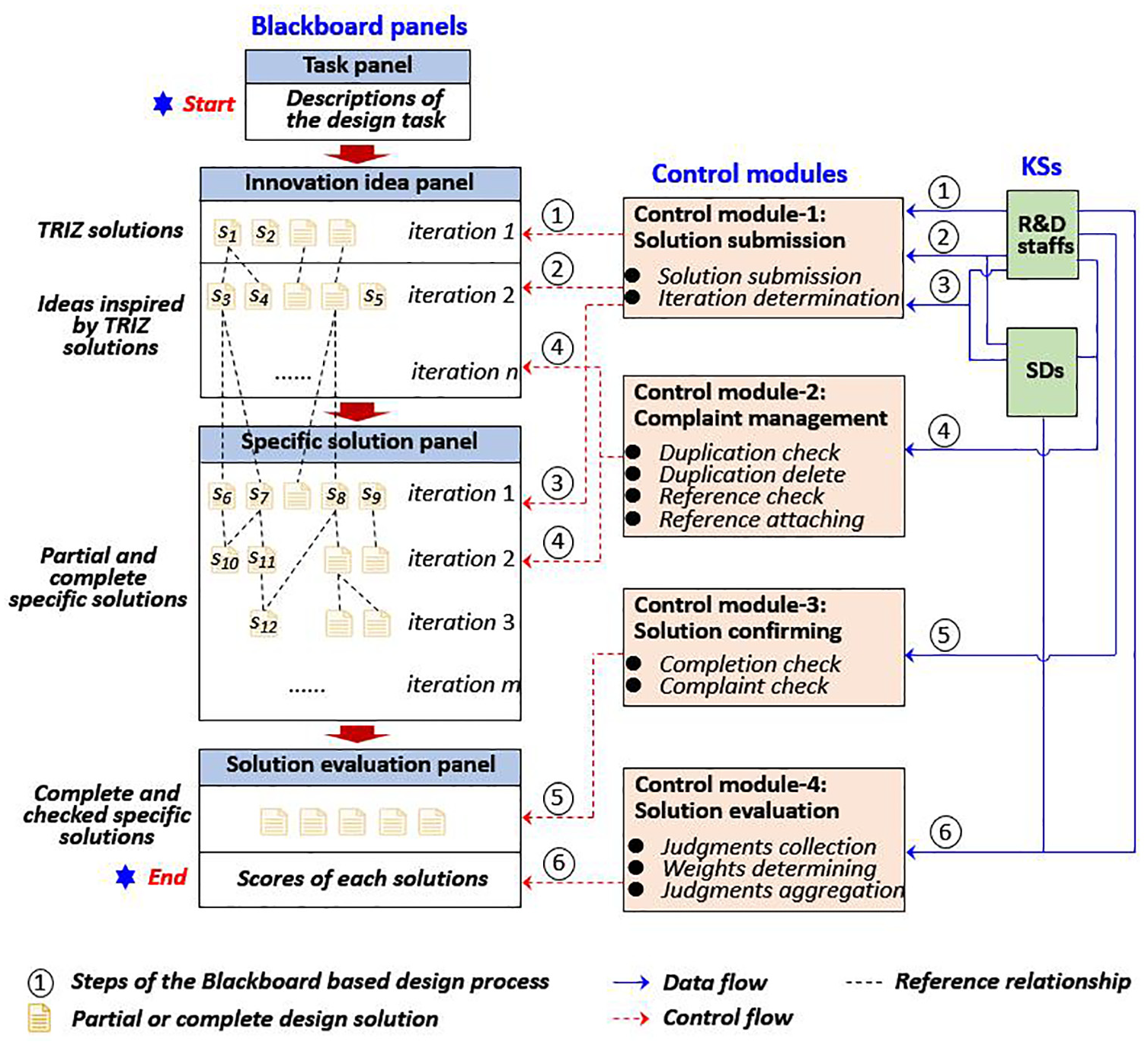
A customized Blackboard model to support the collaborative design and evaluation process among the Knowledge sources.
Blackboard based crowdsourcing design model
The process starts with a design task published by crowdsourcing stakeholder, and ends with design solutions that contain the contributions from the Knowledge sources (including SDs and R&D staffs). The process includes mainly six steps.
Steps 1–3 is controlled by Control module-1, and Control module-1 has mainly two functions. The first is updating the contents on the Innovation idea panel and Specific solution panel according to the submissions from the Knowledge sources. The second is separating all the submissions into multiple iterations according to the reference relationships among them. For example, on the Innovation idea panel, the TRIZ solutions are recorded as iteration 1, and the ideas inspired by the TRIZ solutions are recorded as iteration 2, and so on (as shown in Figure 1), and the solutions on the Specific solution panel are separated in the same way. Note that some iterations may not be further developed (e.g. s2 in Figure 1), and Knowledge sources may propose ideas or solutions without referencing earlier iterations (e.g. s5, s9).
Note that the Control modules above can be realized automatically with embedded algorithms or manually by human experts, depending on the complexities and requirements of the tasks.
Bayesian network based solution evaluation
In this subsection, an improved BCM method is established and used to build a BN based evaluation model to support the execution of Control model-4, and the BN model embodies the quantitative probabilistic reasoning relationships between the possible quality of a solution and a group of evaluation criteria.
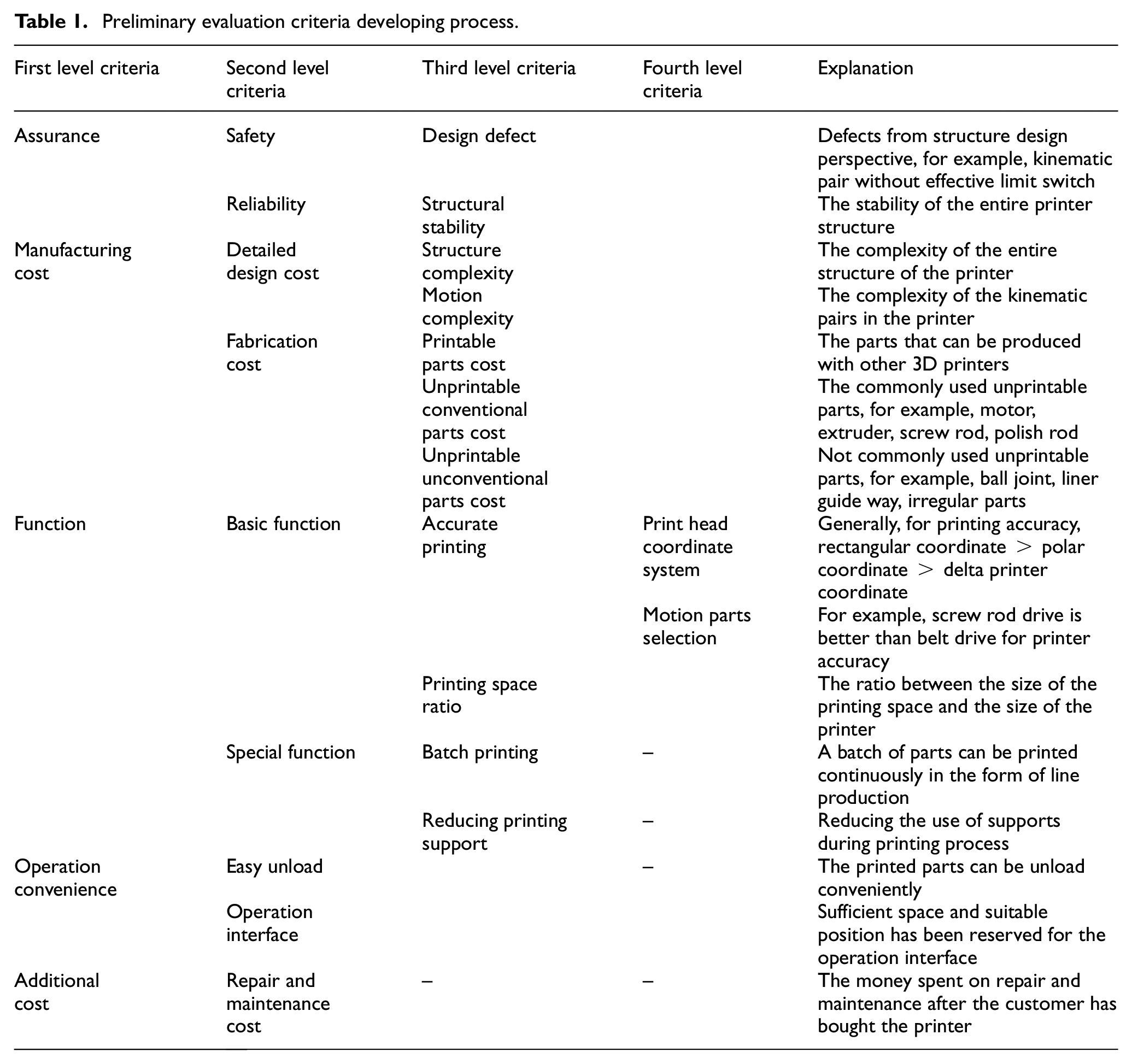
The improved BCM method is developed based on the original BCM method, and it has mainly five steps.
Preliminary evaluation criteria developing process.
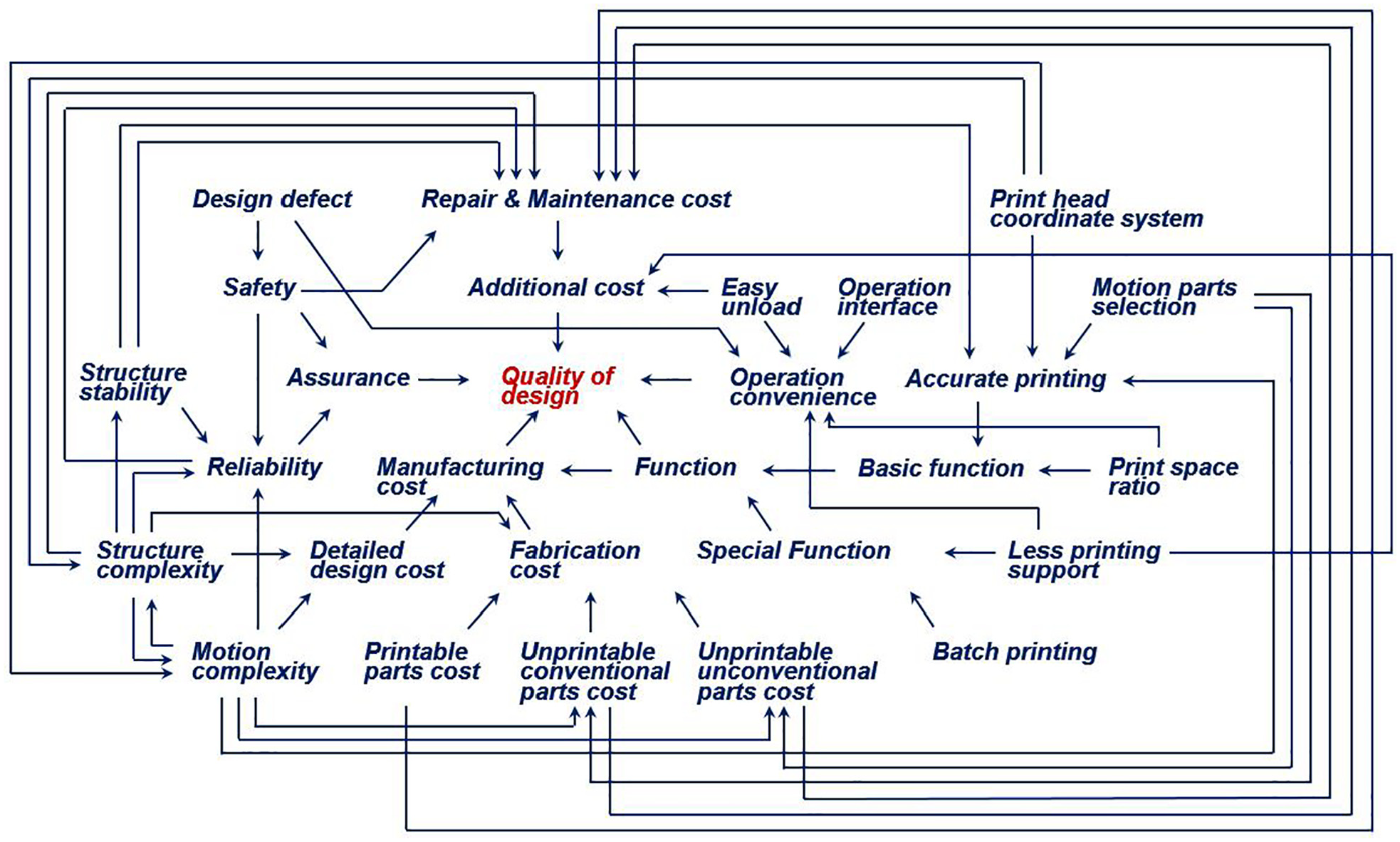
The CM structure which represents the causal influence relationships among the preliminary evaluation criteria and the evaluation target.
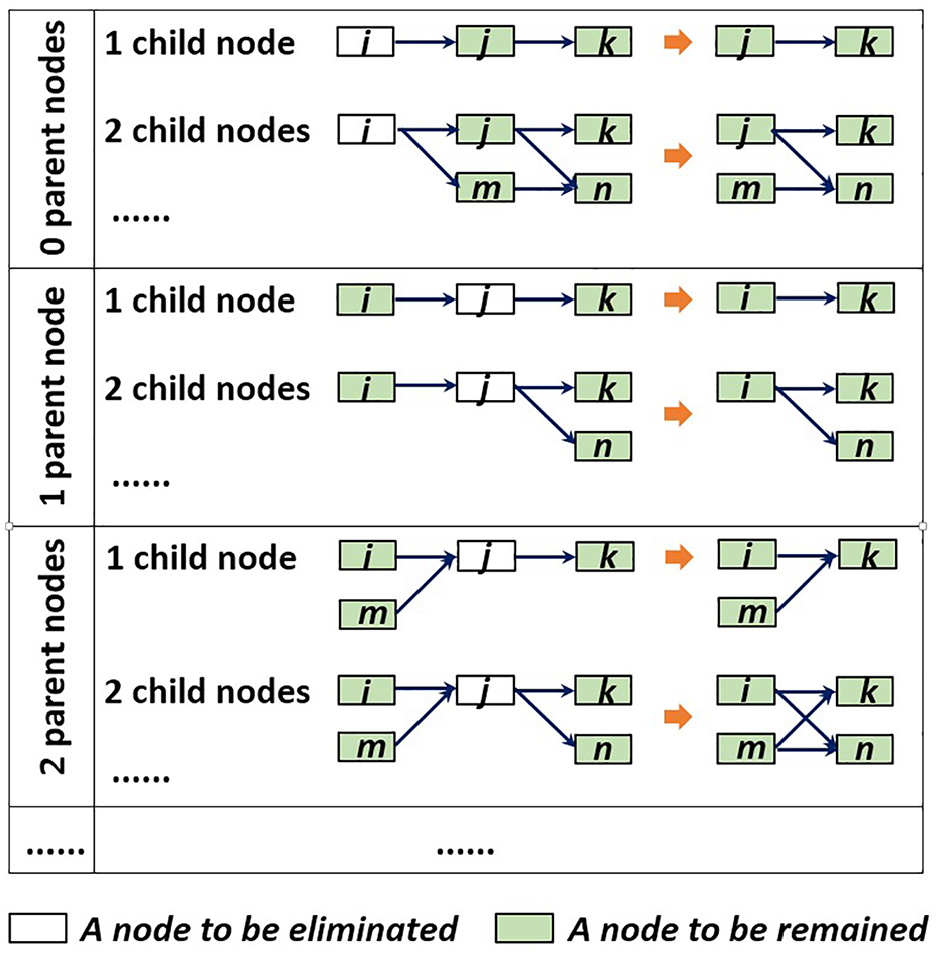
Nodes simplification rules in different situations. Note that the situation when the node to be eliminated has zero child node does not exist, because it would be the evaluation target node.
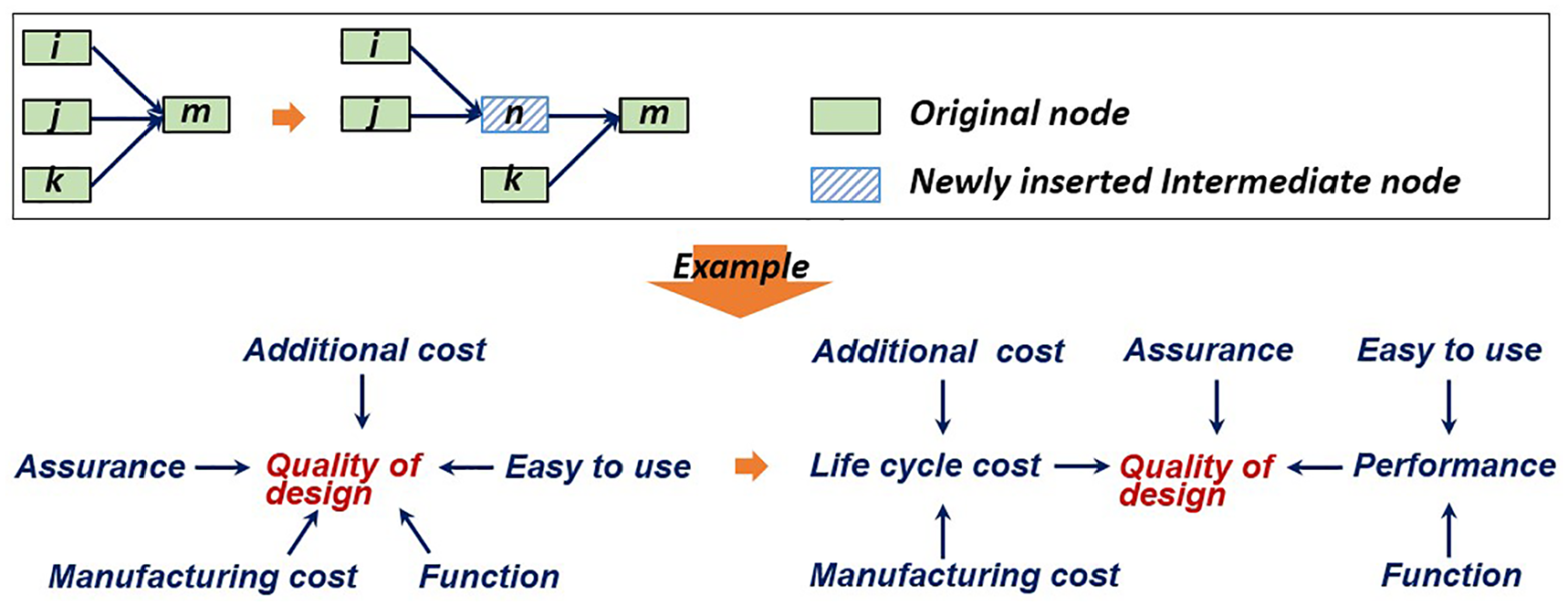
An example of parents divorcing, where the maximum number of parent nodes has been reduced from five to three.
Using the original four-step procedure and the three additional simplification rules, the CM structure from Figure 2 is transformed into a BN structure in Figure 5. Note that, rules 1 and 2 should be applied before the original procedure, and rule 3 should be applied after to avoid wasted efforts.
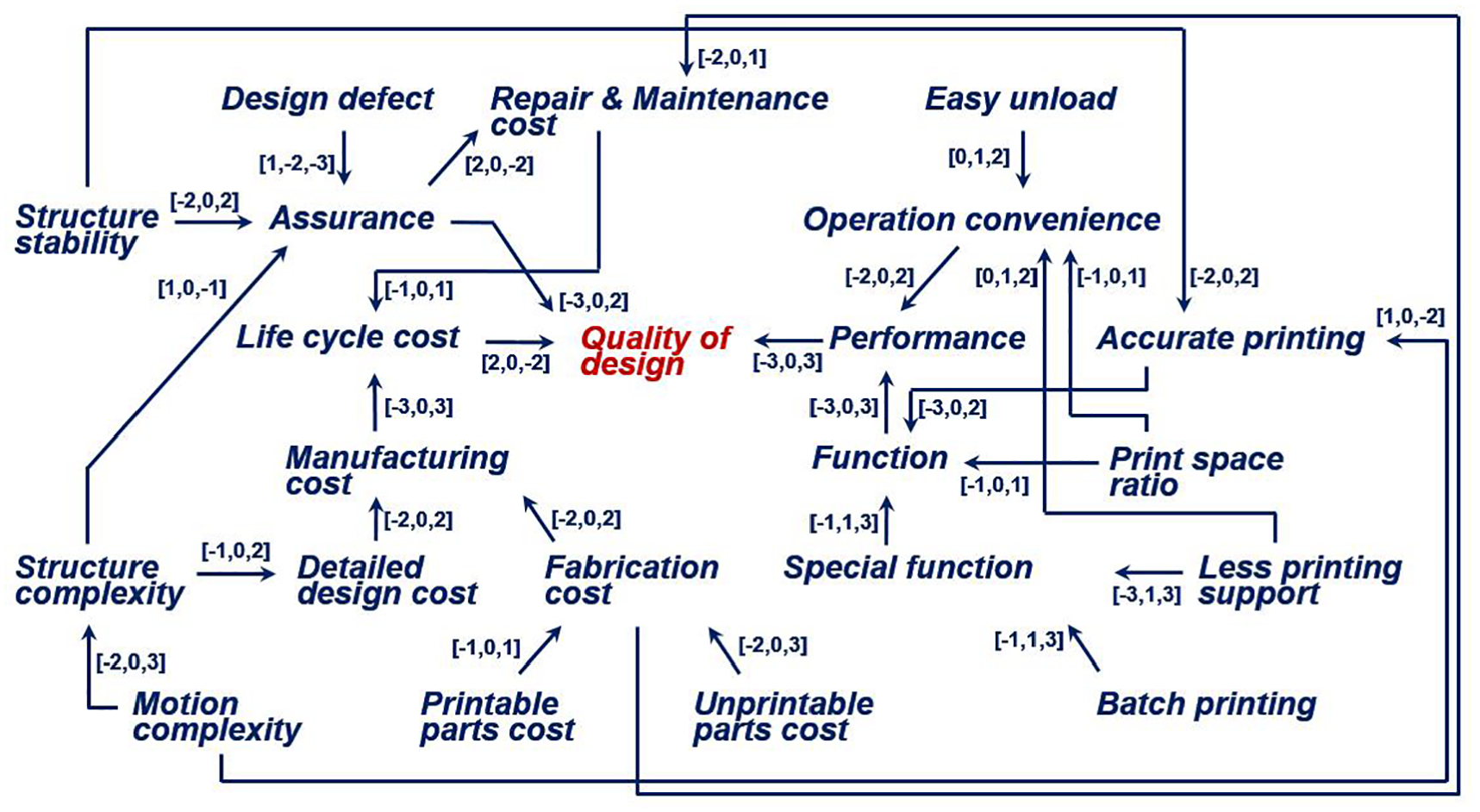
The BN structure that represents the conditional independence relationships among the final evaluation criteria.
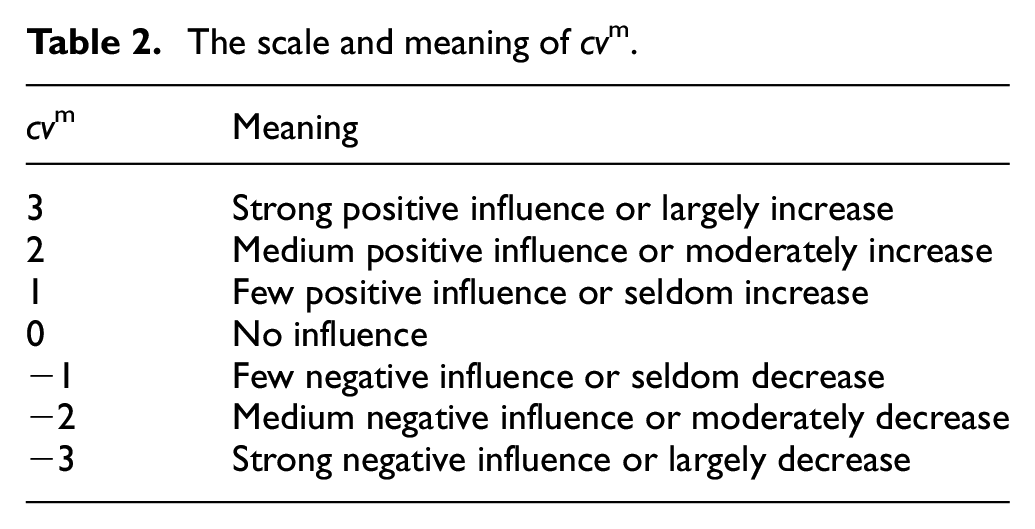
The scale and meaning of cvm.
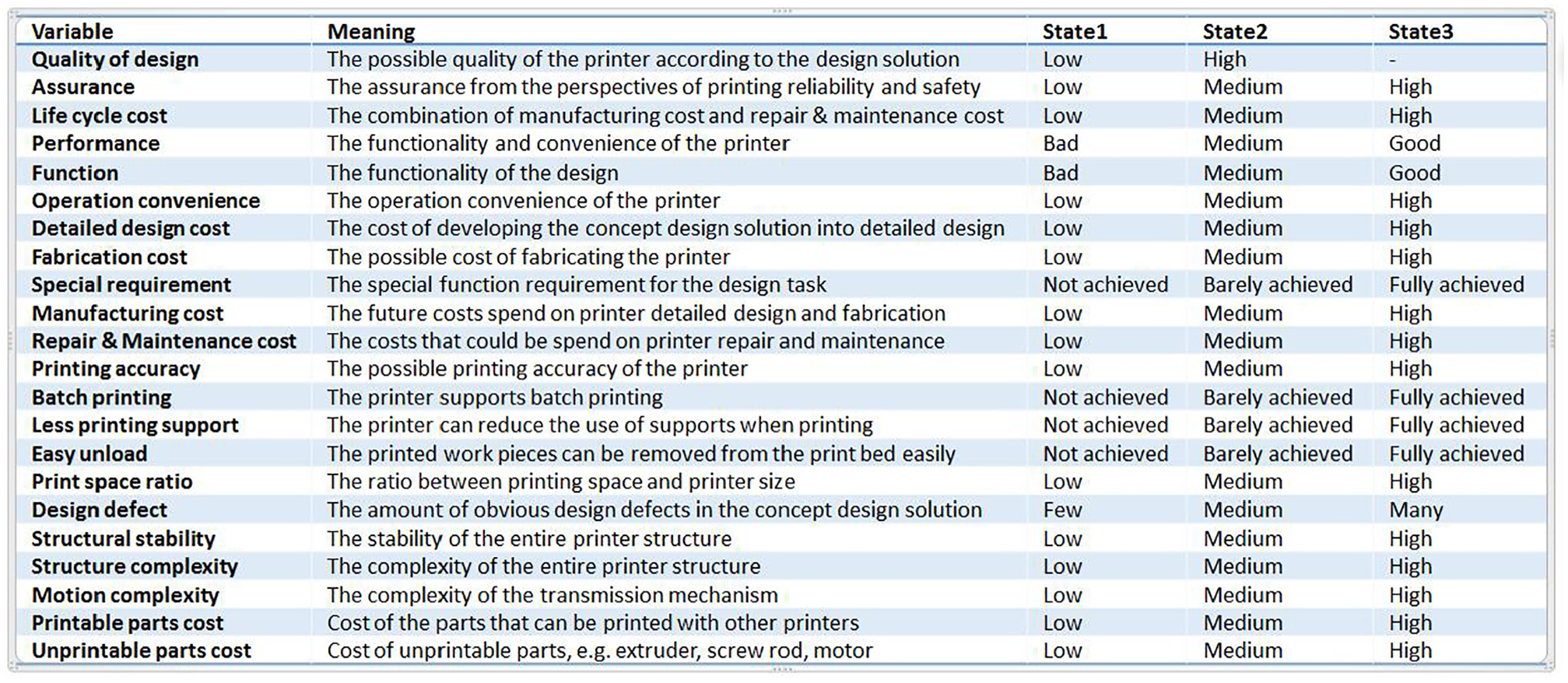
The meanings and states of the variables in the BN.
Assume p1, p2, …, pn, …, pN are the parent nodes of child node c, the states of pn include [staten1, staten2, …, staten m , …, staten Mn ] where Mn is the number of states for pn, the states of c include [statec1, statec2, …, statec m , …, statec Mc ] where Mc is the number of states for c, CVn = [cvn1, cvn2, …, cvn m , …, cvn Mn ] is the CV from pn to c. Define cvnmax and cvnmin as the maximum and minimum values among [cvn1, cv n 2, …, cvn m , …, cvn Mn ], respectively. The CPT of a child node would contain many parents’ states combinations (PSC). For example, p1 and p2 are the two parent nodes of c. Node p1 has two states (state11 and state12), p2 has two states (state21 and state22), and c has two states (statec1 and statec2). Then the CPT of c would have four PSCs, which are PSC c 1 = [state11, state21], PSC c 2 = [state11, state22], PSC c 3 = [state12, state21], PSC c 4 = [state12, state22]. Thus, acquiring the CPT of c is to acquire the posterior probabilities of c at each of its states in the situations of different PSCs (i.e. the CPT of c include P(c = statec1|PSC c x) and P(c = statec2|PSC c x) where x = 1, 2, 3, 4).
The method here is based on an idea that the probability of child node at each of its states is determined by the influence values from its parents. Define CIV i as the combination of the influence values from the parents to the child when the parents are at PSC i . Then CIVi > 0 indicates that the integrated influence from the parents to the child is positive, and larger CIV i indicates stronger positive integrated influence, vice versa. The maximum value of CIV i (denoted as CIV max ) can be calculated as

The minimum value of CIV i (denoted as CIV min ) can be calculated as

Then, separate the range from CIV min to CIV max into Mc equal width intervals, and each interval is corresponding to a state of c, and the center value of the interval for statec m is denoted as C m , as shown in Figure 7. Then, the probabilities of the child at each of its states in PSC i can be predicted according to CIV i as follows.
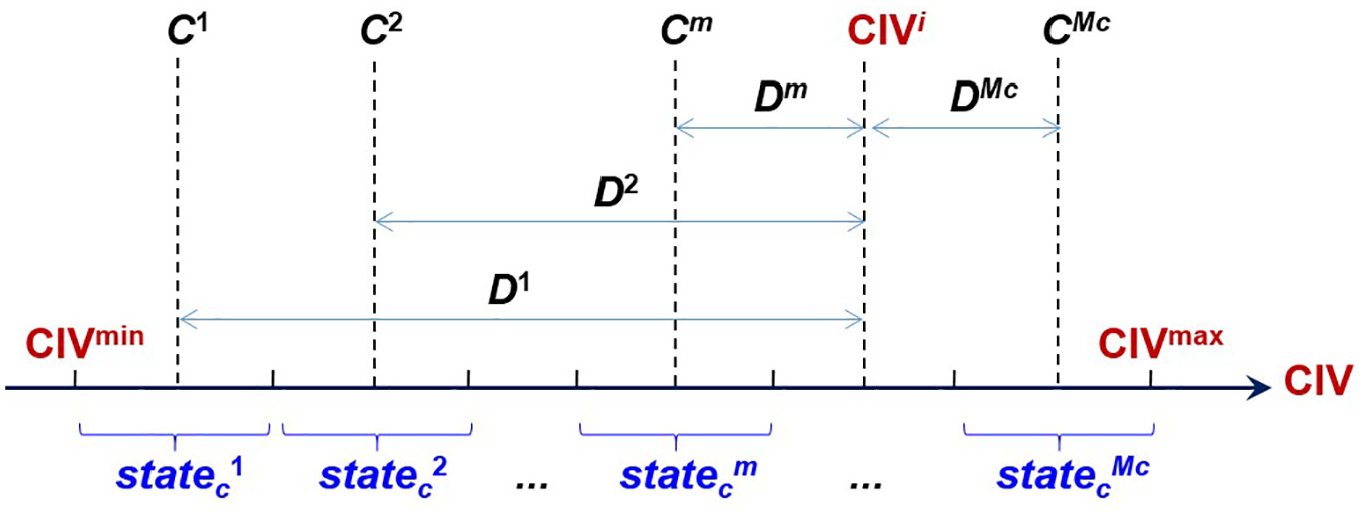
The variables involved in the probability value calculation.
For any m∈ (1, 2, …, Mc):
if CIV i > C Mc :

else if CIV i < C1:

else if D m = 0:

else:

where P(child = statec m ) indicates the probability of the child node at statec m , D m indicates the absolute difference between CIV i and C m . The values of C m and D m can be calculated as follows.


Here, node Assurance in Figure 5 is used for demonstration. The CPT of Assurance contains 27 PSCs, and the probabilities in these PSCs are shown in Figure 8, which is the screenshot of a python-based CPT calculator program developed according to the aforementioned calculation method.
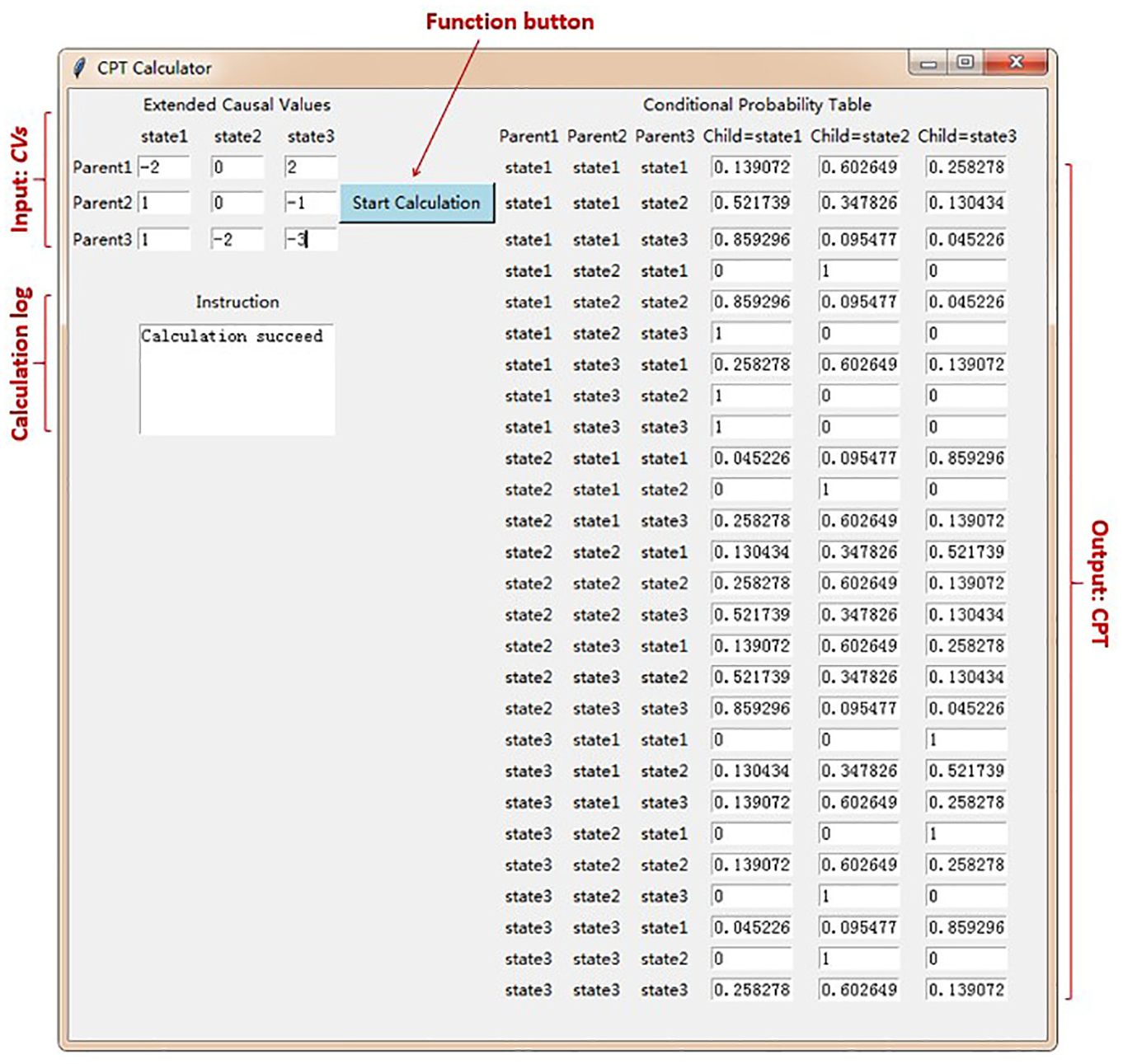
The CPT of assurance, calculated with a Python program developed based on the calculation method in subsection “Bayesian network based solution evaluation” Step 5.
Finally, after acquiring the BN structure and all its CPTs, a complete BN evaluation model can be built, as show in Figure 11 (the BN model is implemented with Netica, which is a Bayesian network analysis software). An evaluator can input his/her judgments on the evaluation criteria for a design solution into the model, and then the probability of Quality of design at High state would be predicted, and this probability would be taken as the synthesis evaluation score of the solution according to the personal judgments of this evaluator.
Case study
A 3D printer conceptual innovation design project (which is a typical SPD project 28 ) was used as case study to demonstrate the methodology. A group of students were mobilized to carry out the project. Doctoral students participated as R&D staffs, and undergraduate students participated as SDs. The project followed the procedure in section “Methodology,” and eventually six complete design solutions were generated, and the synthesis evaluation scores of the six solutions were acquired.
Design solution generation
This subsection is corresponding to Steps 1–5 in subsection “Blackboard based crowdsourcing design model.”
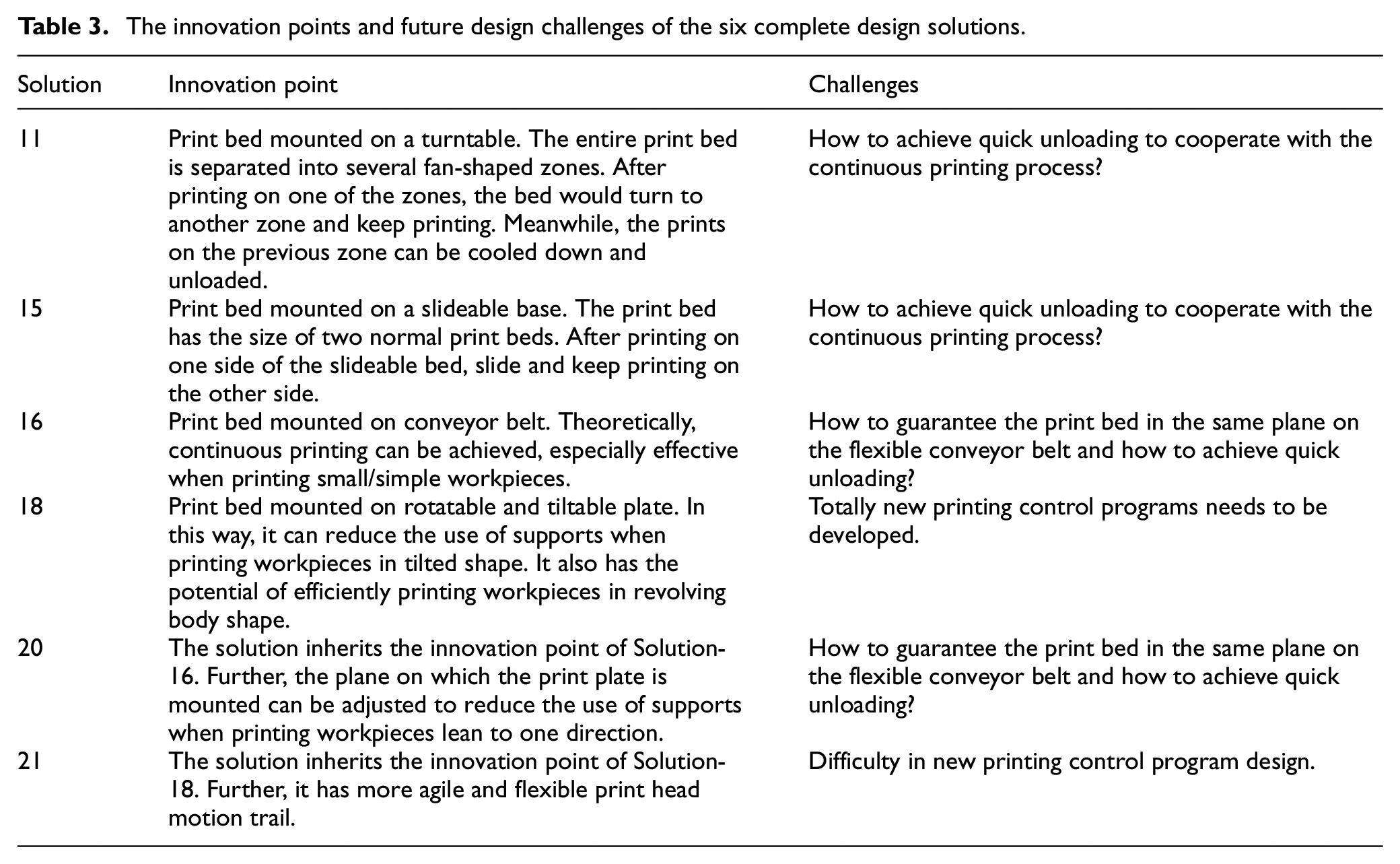
Firstly, the design task was published on Task panel, as shown in Figure 9. Then, R&D staff 1 and 2 submitted four groups of TRIZ solutions for the special innovation requirements (Figure 10–Innovation idea panel– iteration 1). After that, three of the four TRIZ solutions were developed into four innovative ideas (Figure 10–Innovation idea panel– iteration 2). Later on, many partial and complete specific design solutions were developed by the R&D staffs and SDs according to these innovative ideas (Figure 10–Specific solution panel). Eventually, six complete solutions were generated, and their basic characteristics are listed in Table 3.
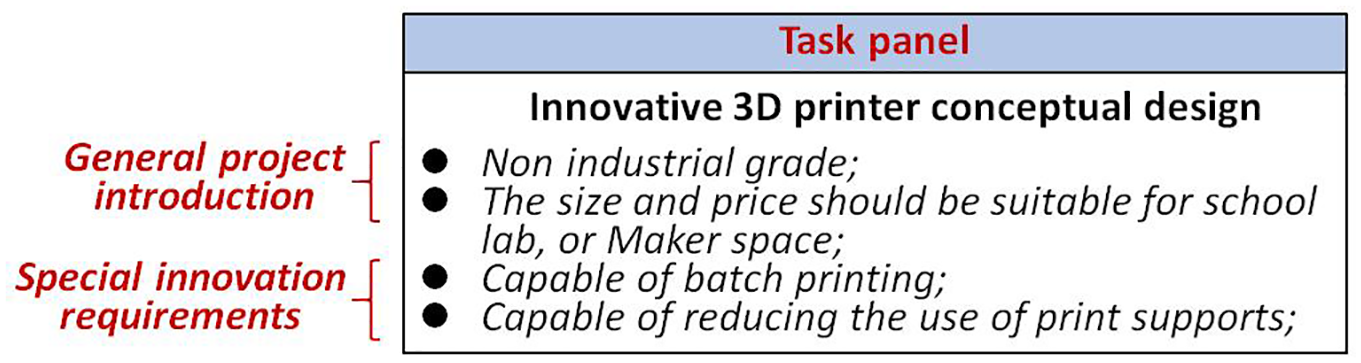
Description of the design task, published on Task panel and can be read by all the Knowledge sources.
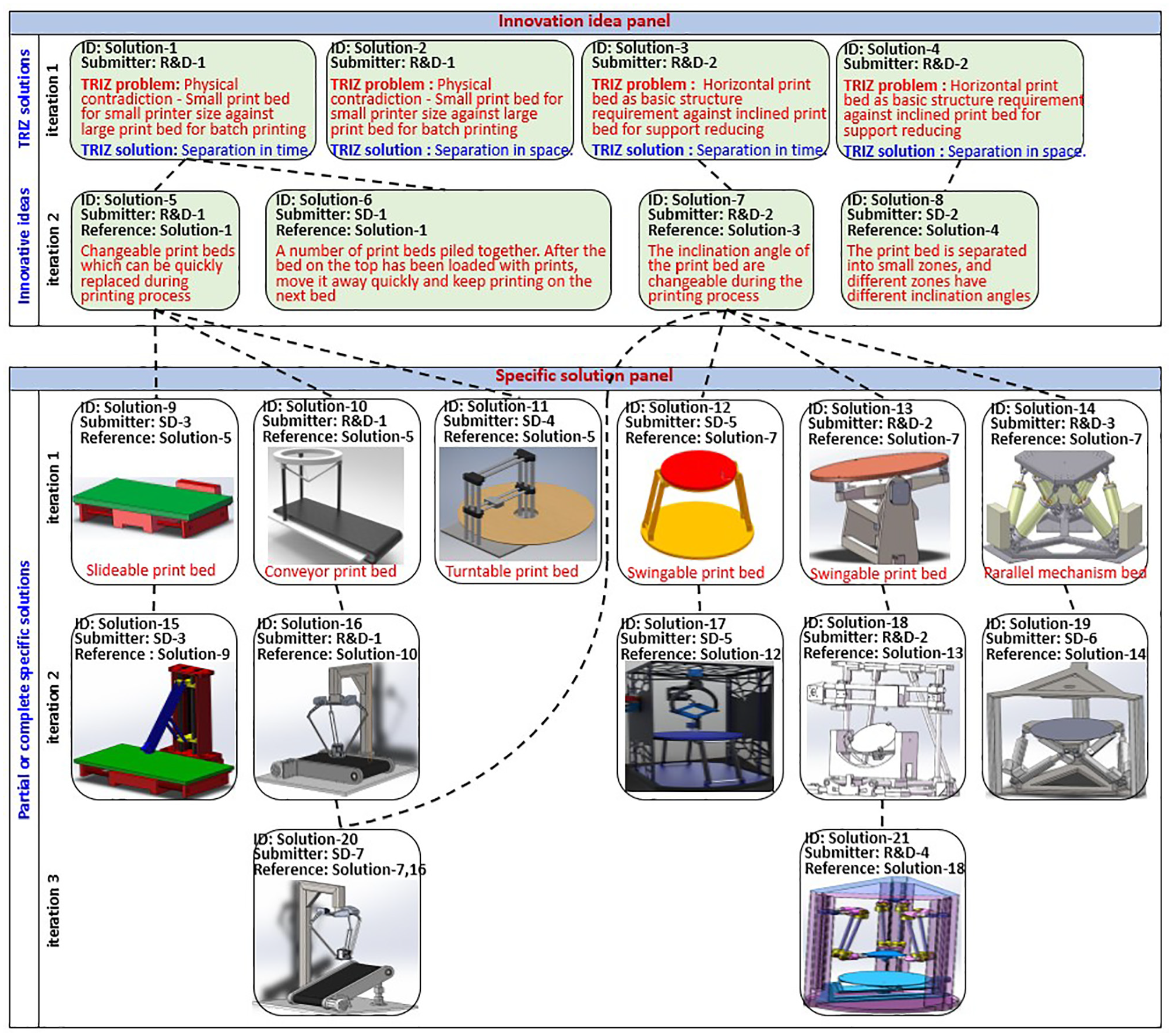
The entire iterative design process from TRIZ solutions to innovative ideas to partial and complete specific solutions (dash lines indicate the reference relationships among them).
The innovation points and future design challenges of the six complete design solutions.
Design solution evaluation
This subsection is corresponding to Step 6 in subsection “Blackboard based crowdsourcing design model.”
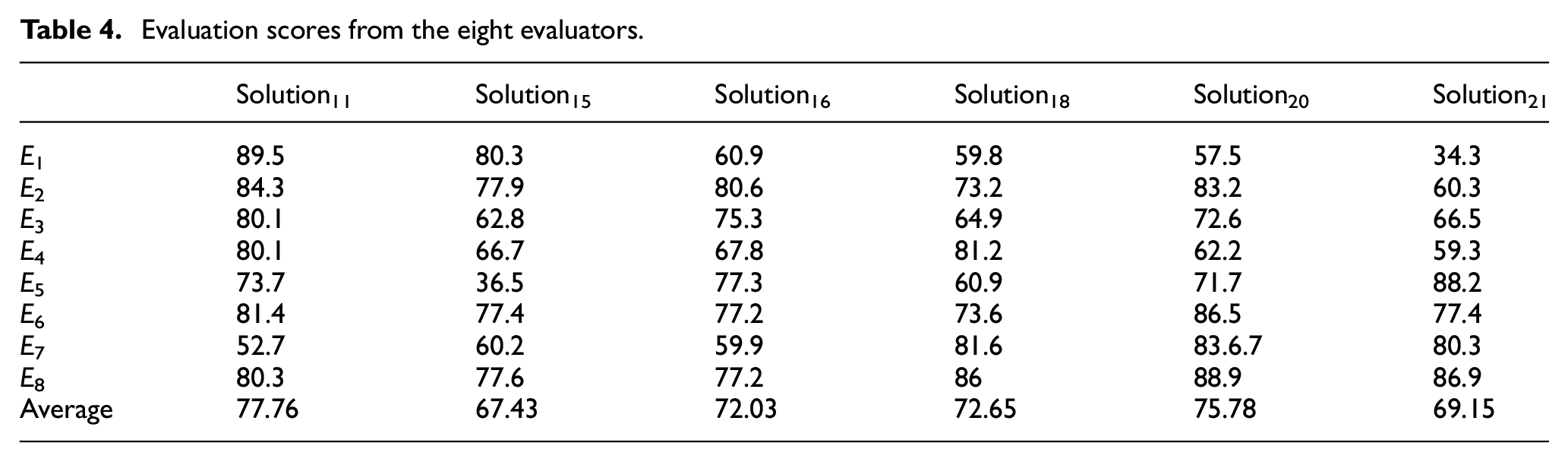
Totally eight evaluators participated the evaluation, each evaluator provided six groups of judgments, and each group of judgements was for one of the six solutions. Here, the first evaluator’s (E1) judgements on Solution11 and Solution15 are used for demonstration, as shown in Figures 11 and 12. It can be seen that the posterior probability of Quality of design at High state for these two solutions are 89.5% and 80.3%, and these two values are taken as the synthesis evaluation scores of Soluiton11 and Solution15 according to E1 (as recorded at upper left of Table 4). Similarly, the evaluation scores on the other solutions according to the other seven evaluators can be acquired, as shown in the rest part of Table 4. Finally, according to the average values of the scores from the eight evaluators, the preference order among the six solutions was Solution11 > Solution20 > Solution18 > Solution16 > Solution21 > Solution15.
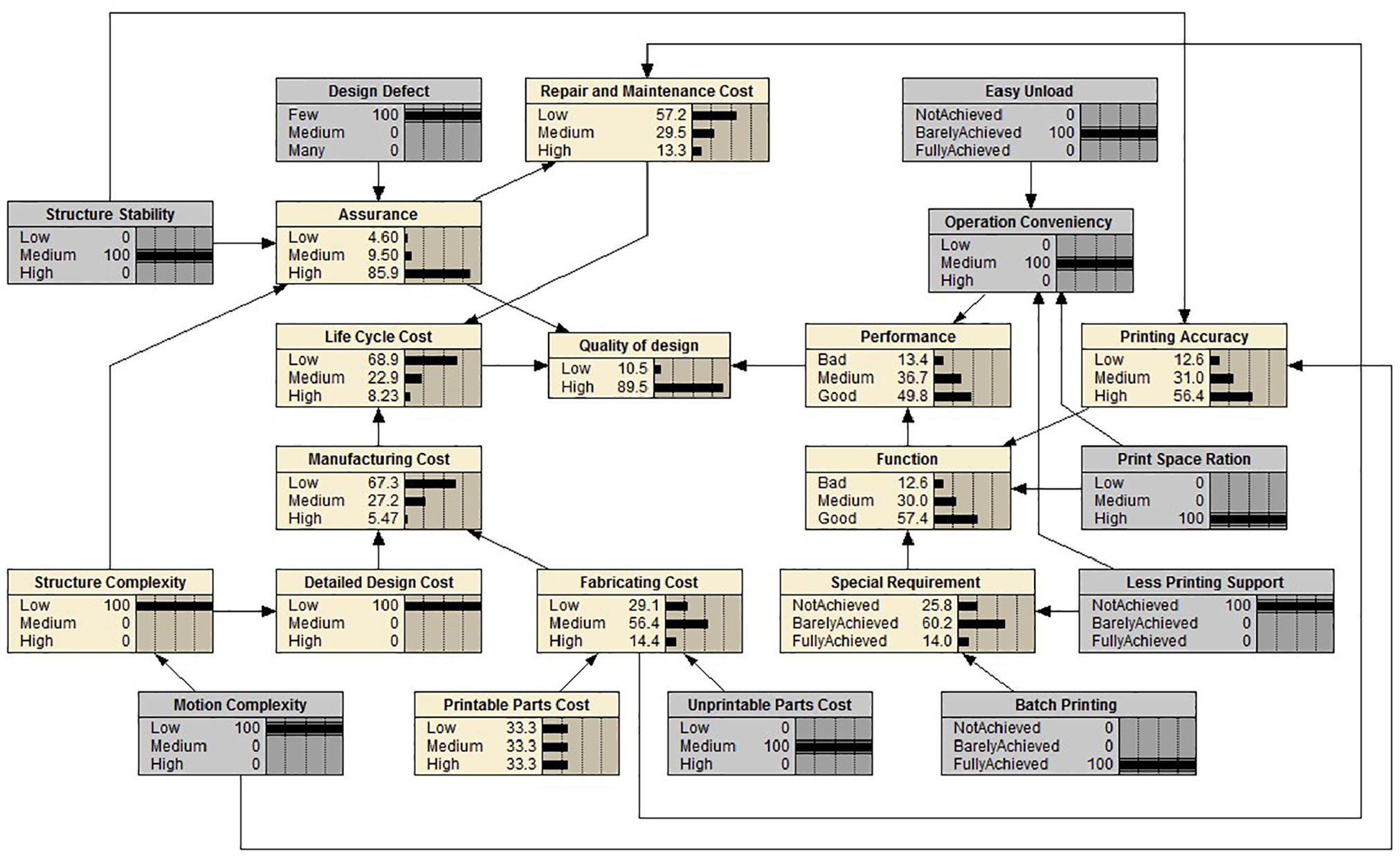
Personal judgments from E1 on the evaluation criteria for Solution11, and the predicted probability of Quality of design at High state is 89.5%.
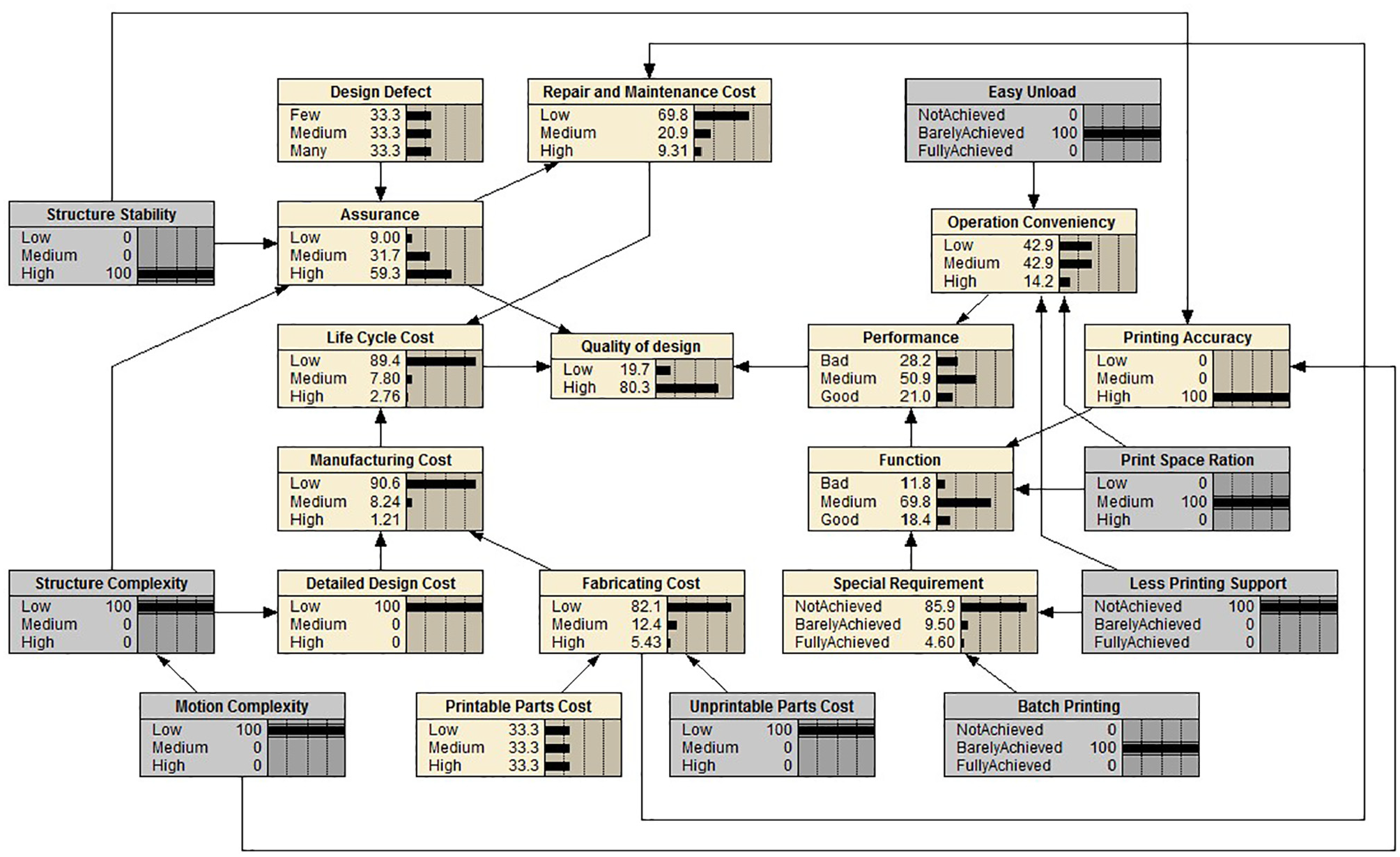
Personal judgments from E1 on the evaluation criteria of Solution15, and the predicted probability of Quality of design at High state is 80.3%.
Evaluation scores from the eight evaluators.
Discussion
Contributions
SPD also follows the general six-step product design procedure (i.e. requirement analysis, feasibility study, conceptual design, detailed design, production, consumption and service), but the difference is that in SPD projects SDs are involved in the first four steps. A common problem in SPD is that when the design project is relatively complicated, one SD cannot deliver it along while a group of SDs would have problems in design cooperation and intellectual property sharing. The customized Blackboard model mitigates this problem by combining the strengths of centralized control (which is helpful for the execution of design cooperation) and distributed autonomy (which is helpful for the emergence of collective intelligence), and the model is particularly suitable for crowdsourcing conceptual design.
The BN based solution evaluation model, which is embedded in one of the Control modules of the Blackboard model, is for multi-criteria group decision-making among SDs and R&D staffs. Compared with other methods such as AHP and VIKOR, BN based evaluation has the advantage in handling incomplete inputs 19 (e.g. in the case study the evaluators only provided judgements on the criteria that he/she familiar and confident with, as shown in Figures 11 and 12). This is particularly suitable for the situation that SDs may not willing or capable of providing complete evaluation information.
The improved BCM method mitigates some of the drawbacks of the original BCM method. The original method mainly focuses on BN structure building, but it does not consider the situations of oversized BN structure and the situation of one child node with too many parent nodes. These situations reduce the readability and reasoning efficiency of BN 27 and cause difficulty in CPT acquiring. 29 Three additional structure simplification rules are established to solve these problems. Further, a method to acquire probability parameters based on extended CVs is developed. The method reduces the difficulty of knowledge based CPTs acquiring because there are much less CVs than probability values to be determined (e.g. nine CVs are used to acquire 81 probability values in Figure 8), and the CVs are relatively easier to be determined by experts with a linguistic CV determining table (Table 2).
Limitations and future directions
SDs’ participation motivation, which is a precondition for successful project execution, is not considered. Another Control module which records the contribution of each participator during the iterative design process might be developed in our future work for motivation stimulation.
A potential problem in probabilistic reasoning can be caused by inconsistent judgments from an evaluator on the evaluation criteria. A feedback Control module might be considered in our future work to suggest the evaluators to readjust their judgments when inconsistence happens.
Implementation perspectives
Under the context of advanced internet technologies, sharing economic, mass customization, etc., it becomes a prevailing trend that large numbers of SDs participating into product design process, heading toward highly personalized and innovative product realization.30,31 The Blackboard model supports this trend by making it possible to guarantee efficient cooperation and emergence of collective intelligence among SDs at the same time. After some further refinement and customization, the Blackboard model can be implemented with web applications, and applied in the design projects of not only simple, software and highly modularized products, but also relative complicated and high-valued physical products. In this way, the advantages of SPD in high-level innovation, fast innovative design process, deep customer involvement, and low product development cost can be better realized.
Conclusion
An integrated model of Blackboard and BN is established to combine the strengths of centralized control and distributed autonomy in SPD. The Blackboard contains customized components for design collaboration among SDs and R&D staffs. The BN, which supports one of the Control modules of the Blackboard, is built with an improved BCM method.
Footnotes
Appendix
Declaration of conflicting interests
The author(s) declared no potential conflicts of interest with respect to the research, authorship, and/or publication of this article.
Funding
The author(s) disclosed receipt of the following financial support for the research, authorship, and/or publication of this article: The research in this paper is under the support of the National Natural Science Foundation of China (NSFC, No. 51975464).
