




Abstract
In recent years, system of systems resilience has been widely studied. System of systems has obvious resilience properties when considering dynamic reconfiguration in the following four parts: avoidance, survival, adaption and recovery. System of systems can be downgraded and recovered by reconfiguring resources to keep the performance output enough to satisfy the threshold under internal failure or external shocks. In other words, because of dynamic reconfiguration, system of systems has obvious characteristics of resilience. In this study, first, a new resilience model for systems and system of systems based on the performance threshold is proposed. Second, military system of systems is decomposed hierarchically, including system of systems–level, platform-level and system-level top-down, respectively. Third, a radar network of military system of systems is taken as a typical case. A performance model for a radar network under internal or external shocks is established based on the linear-Gauss-Poisson process in system of systems, and its parameters are discussed in detail. Finally, a typical 5-node radar network of formation air defense military system of systems is taken as an example to demonstrate proposed models and methods. The reliability and resilience loss are achieved by considering internal failure or external shocks, which can serve as a reference for evaluating and improving the effectiveness of system of systems.
Introduction
As a member of an expanding family of system-level attributes, resilience is the ability of a system or system of systems (SoSs) to respond to, survive and recover from defects and shocks. While resilience has always been the focus of research in many fields, in the case of SoSs, dealing with resilience is still extremely challenging and interesting, 1 examples being the cases of infrastructure SoSs and military SoSs. Research on resilience can better ensure the safe and effective operation of a system or SoSs.
With the recognition and transformation of the world by human beings, there has been an increasing interest in a class of complex “giant systems” called SoSs whose constituents are themselves complex. The performance optimization, robustness, safety, reliability and resilience of SoSs have become the focus in various applications including military, 2 security, aerospace, space, manufacturing, environmental systems, disaster management, and social and technological systems. There are many different definitions of SoSs, such as Pei’s definition 3 : SoSs integration is a method to pursue development, integration, interoperability and optimization of systems to enhance performance in future battlefield scenarios. In this article, SoSs is the collection of various systems to achieve or accomplish a specific goal or mission. An example of naval warfare operations is shown in Figure 1, which is the US air transportation system and tactical SoSs. These SoSs usually have characteristics such as high cost, operational and managerial independence of the constituent systems, evolutionary nature, emergent behavior and geographic distribution. 4
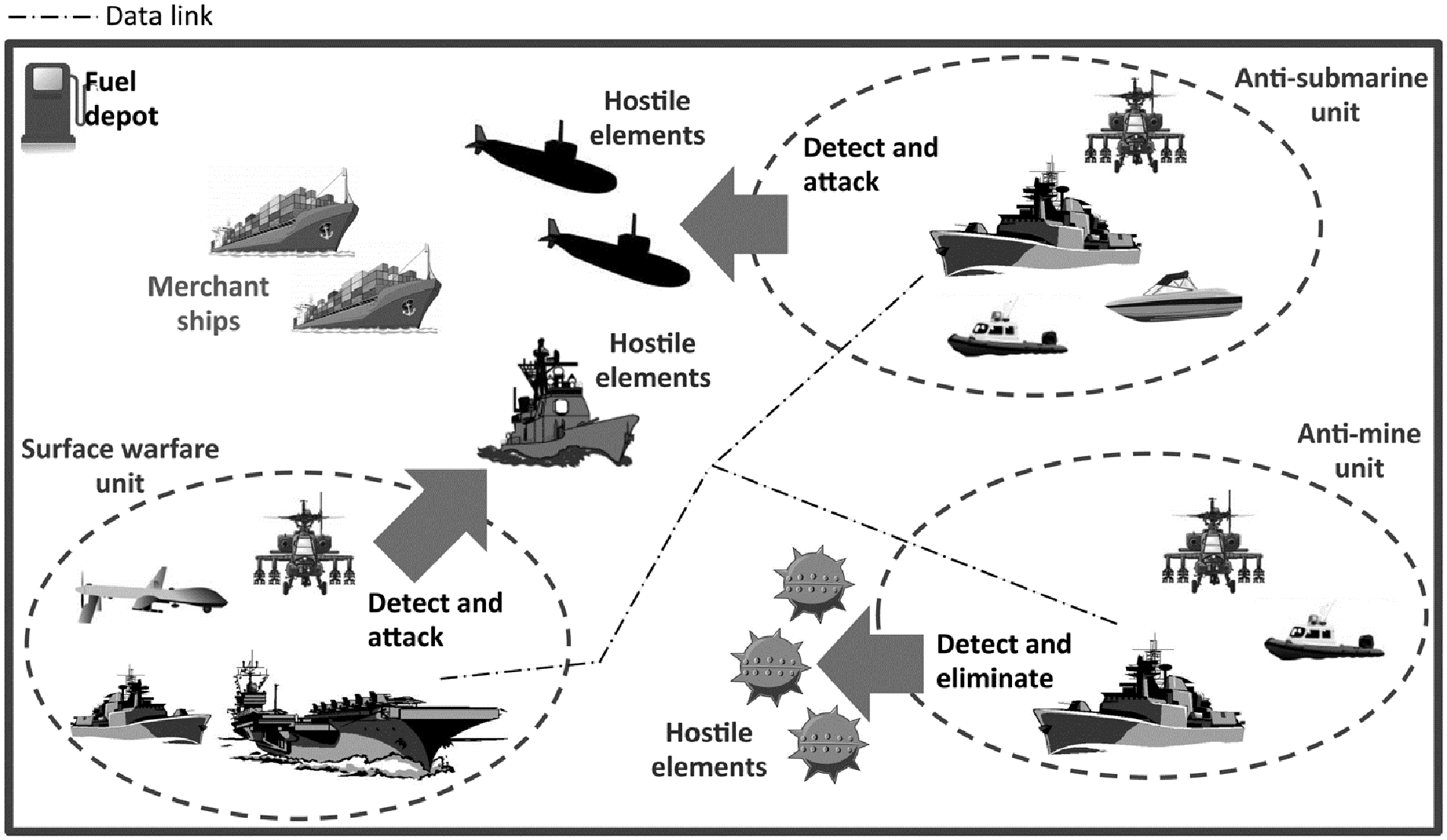
Illustrative naval warfare SoS. 1
The military is one of the earliest fields of SoSs study, and C4ISR system is a typical SoSs. Levis and Wagenhals 5 proposed the development and design process of C4ISR architecture. They applied a multi-view approach to describe the C4ISR systems and developed a methodology for architecture design. Then, Wagenhals and his colleagues6,7 presented two companion papers, in which they presented a process of developing C4ISR architectures based on structured analysis, and showed how the executable model can be used to analyze the logical and behavioral characteristics of the architecture. Architectures: III 7 proposed an object-oriented, UML-based process for architecture design. Campbell et al. 8 gave a report about SoSs modeling and analysis of “the SoSs Modeling and Analysis” project, the objective of which was to put forward an integrated modeling and simulation environment.
In recent years, many studies have investigated the resilience or reliability of SoSs, because of its significance and wide application. Early investigations of the resilience concept and theory were performed by Hollnagel et al. 9 in the engineering domain, and resilience is defined as the “ability of a system or organization to react to and recover from disturbances at an early stage with minimal effect on its dynamic stability.” Researchers have mainly considered the following methods in the resilience analysis of SoSs: Markov chains, discrete event simulation, Petri net models, system dynamics, 10 complex networks11,12 and so on.
Many reviews are discussing the resilience and other properties of SoSs, such as papers.1,13–19 Uday and Marais 1 reviewed metrics and methods of designing resilient SoSs and provided some challenges: (a) indicated significant differences between resilience and various related system properties; (b) proposed an evaluation method for the current reliability and risk in addressing SoSs resilience; and (c) discussed the application of recent multidisciplinary research, which can guide the design of resilient SoSs. They also 20 presented a family of system importance measures that rank the constituent systems based on their effect on the whole SoSs performance and considered the combination of heterogeneous systems to achieve a common goal. Engell et al. 13 introduced preliminary findings and suggestions which were made through extensive consultation with experts from industry and academia and thorough analysis of the state of the art of cyber-physical SoSs. Francis and Bekera 14 reviewed various definitions and assessment methods of resilience and presented a metric and frameworks for resilience analysis. Eusgeld et al. 15 used SoSs methods to model and describe critical interdependent infrastructures. They described critical infrastructures from system-level to SoSs-level and evaluated some advanced modeling and simulation techniques. Harvey and Stanton 16 discussed 10 key safety challenges regarding SoSs based on the current academic definition. Then, they studied the military SoSs “Hawk Jet missile simulation activity” to illustrate the key challenges in detail.
Recently many studies have also investigated the resilience of various types of SoSs, because of its significance and wide application. Pan and Jiang 21 established an effective SoSs architecture evaluation method to analyze component importance measures based on resilience. Mansouri et al. 22 defined the Maritime transportation SoSs as an integration of interdependent constituent systems and applied the Systemigrams Tool to study the resilience and security by understanding its systemic interrelationships more effectively. Madni and Sievers 18 studied the key considerations and challenges of SoSs integration. They summarized the unique characteristics, ontology, typology, modeling and some challenges of SoSs. Ayyub 23 explored the resilience of social-technology SoSs and put forward some methods for valuation and benefit-cost analysis based on concepts from risk analysis and management. Filippini and Silva 24 presented a modeling framework for resilience analysis of critical infrastructures of SoSs based on functional dependencies, and then analyzed the structure and dynamic properties. McWilliam et al. 25 presented a two-layer design-based resilience strategy for electronic systems and subsystems by creating self-configuring logic. Ed-Daoui et al. 26 used resilience assessment as a foundation for SoSs safety evaluation, and also proposed risk monitoring design and structural analysis approaches. Most studies on the resilience evaluation model haven’t considered resource sharing and information fusion between systems. Due to the characteristics of the network center, systems functions can be substituted and complement each other. That means the specific performance of SoSs can be downgraded and recovered by dynamic reconfiguration. Therefore, we should not only consider the similar constituent systems as a whole, but also consider the interaction between these systems.
In this article, the SoSs resilience with performance threshold and dynamic reconfiguration is studied. The SoSs can reconfigure its resources dynamically to keep the output satisfying the performance threshold under internal failure or external shocks. First, a resilience model for continuous and discrete systems and SoSs is established by considering the resource sharing and performance threshold, and then the cumulative resilience loss and loss rate of SoSs are defined. Second, the architecture hierarchy of military SoSs is decomposed, including SoSs-level, platform-level and system-level top-down, respectively. The radar network of a formation air defense military SoSs (FAD-SoSs) is used as an example. According to the shock and degradation failure model, a linear-Gauss-Poisson distribution is presented. Then, the detection performance model of the radar network is established under the dynamic reconfiguration, and its parameters are discussed in detail. Finally, a 5-node radar network of FAD-SoSs is considered as an example to illustrate the detection performance model and resilience model.
The rest of the article is organized as follows. The resilience model of SoSs is established in section “Performance-threshold-based resilience model.” The detection performance model for radar networks under dynamic reconfiguration is presented in section “Architecture analysis and performance modeling.” The case study is examined, and the performance and resilience of FAD-SoSs are analyzed in section “Case study.” The conclusions are presented in section “Conclusion.”
Performance-threshold-based resilience model
As one of the most typical system attributes, resilience has been extensively studied in recent years. According to the definition and model of resilience triangle, 27 resilience loss and so on, concepts and definitions about resilience are given by considering the common effects of system or SoSs downgrading, performance thresholds and recovery processes.
SoSs resilience is the ability of SoSs to adjust its resource allocation mode under internal and external shocks through dynamic reconfiguration. This study proposes a resilience model based on a performance threshold in discrete and continuous-time states. When the system fails or encounters an external disruption, the resilience event process is divided into m stages and the system performance threshold is k; when the system output performance is lower than k, the system cannot meet its own minimum operating conditions. As is shown in Figures 2 and 3, the gray shaded part is the system resilience loss, and
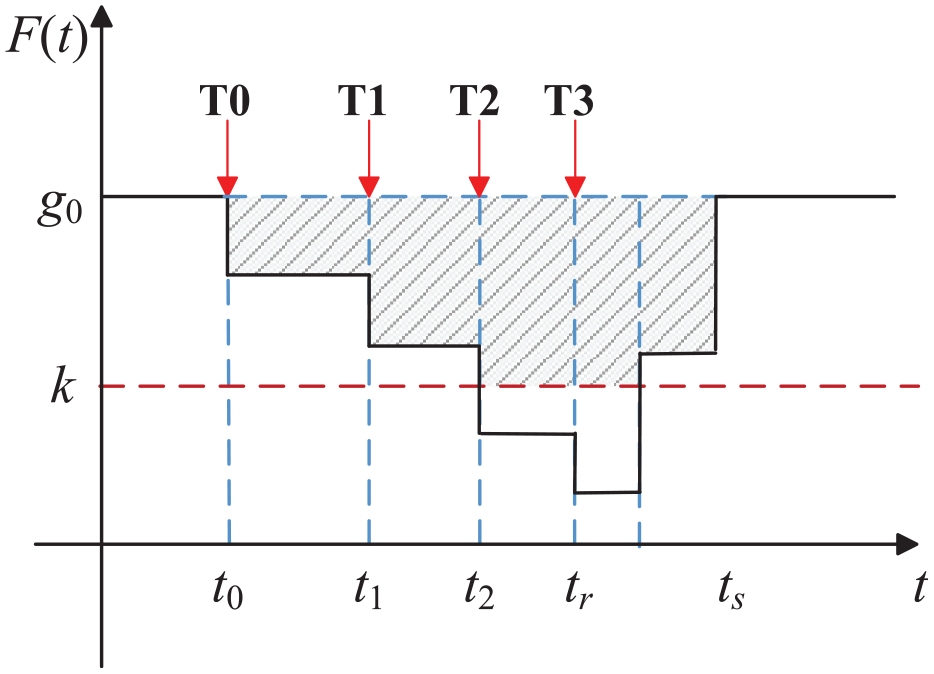
Discrete system performance under internal and external shocks.
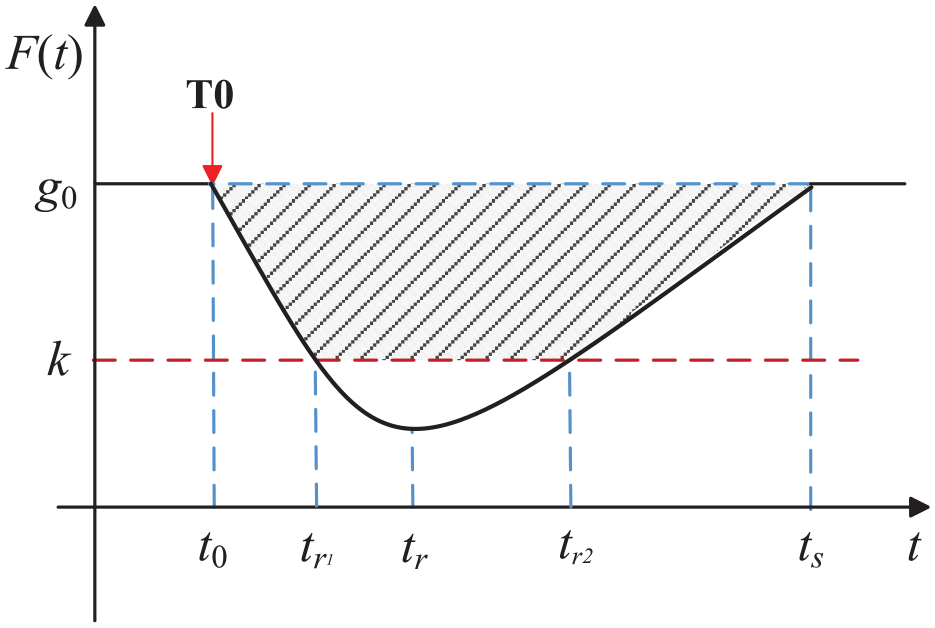
Continuous system performance under internal and external shocks.
The cumulative resilience loss is defined as the sum of performance loss of a system or SoSs after shock (SoSs can suffer multiple internal and external shocks) during the mission, as is shown in the shadow area of Figures 2 and 3. When system performance is lower than the minimum performance requirement k, it means that the system is not resilient, so the part below the threshold k is not included in cumulative loss.
Therefore, the cumulative resilience loss

where m is the total number of time steps for the resilience event;
As is shown in Figure 3, the area of gray shade is the cumulative resilience loss

where
The resilience margin

The resilience loss rate

where
Architecture analysis and performance modeling
Architecture analysis of SoSs
While resilience has always been the focus of research in many fields, in the case of SoSs, addressing resilience is particularly interesting and challenging. From the perspective of safety and providing service without interruption, it is important to measure and improve the resilience of SoSs. While the resilience of SoSs depends on the reliability and robustness of their constituent systems, traditional reliability and risk assessment approaches cannot adequately quantify their resilience. The division of the hierarchy is also the embodiment of the SoSs characteristics, such as emergent and evolutionary.
According to the different views (macroscopic, mesoscopic and microcosmic) and architecture of SoSs, the system is decomposed into SoSs-level, platform-level and system-level, as is shown in Figure 4. According to our multi-level assessment framework of SoSs, an overall evaluation process of SoSs resilience is given as follows: (a) architecture analysis of SoSs; (b) defining measurement criteria; (c) performance analysis with reconfiguration; (d) choosing resilience index; (e) resilience modeling or simulation; and (f) resilience analysis. This process can be applied to analyze the performance-based resilience analysis of a system or SoSs. Then, the FAD-SoSs architecture is analyzed and the network-centric diagram is shown in Figure 5. The platform-level includes early warning airplanes, frigates and destroyers. The system-level includes radar systems, command and control (C2) systems, weapon systems and communication systems. The data link, which consists of the communication systems of various platforms, is used to achieve communication between platforms and information fusion. System resources are shared with other platforms through the data link. The radar system is taken as an example of a resilience analysis of SoSs. Radar is one of the most important operational resources in the SoSs. The radar of each platform can form a radar network, and each platform can acquire the detection information of all radars at the same time.
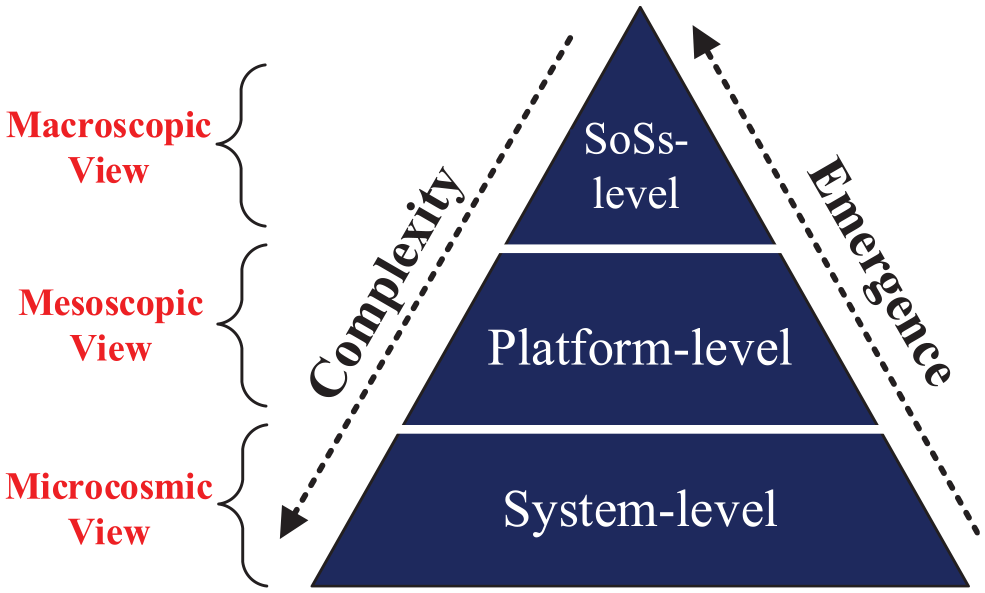
Multi-level assessment framework of SoSs.
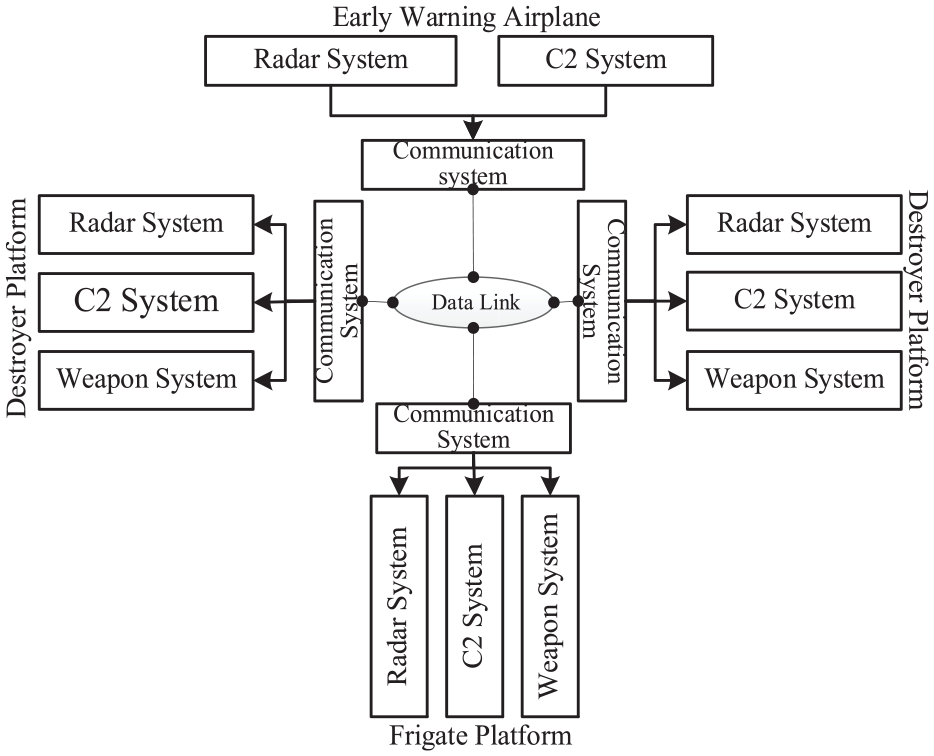
FAD-SoSs network-centric diagram.
Calculating the radar detection airspace for the whole SoSs is highly complex, and the calculation process is very cumbersome and difficult to solve. Therefore, there are many works of literature that use the maximum detection area of the radar network as an important indicator of radar network detection performance. 28 According to the characteristics of FAD-SoSs, radar performance requirements are the ability to track enemy targets accurately, early warning detection and other functions realized by ground radar and early warning aircraft. The performance-threshold-based resilience model is a general model for quantitative evaluation. It can be used to calculate the resilience for discrete and continuous systems or SoSs. Because of space limitations, radar systems, which are some of the key elements of military SoSs, are taken to explain the calculation process of resilience. Therefore, this article takes the maximum radar detection area as a key performance indicator of the radar detection capability.
This article assumes that the radar of each platform in the FAD-SoSs is a uniform circular scan. The communication distance of the data link of each platform (destroyer and frigate) in the FAD-SoSs is less than 20 km. To maintain a good communication state, the cooperative distance of each platform cannot exceed 20 km, and the maximum detection distance
Performance model under internal or external shocks
Due to the uncertainty of the operational environment in which the radar is located, the number of disturbances and the amount of performance loss caused by each external shock in the presence of its environmental location and external enemy target attack is unknown. Therefore, SoSs suffers from internal and external shocks, so the effect of different types of shocks for the radar network are considered, including the changes in an internal relative position of radar and external electromagnetic and fire shocks. The maximum detection area of the radar network is affected by the distance between each platform. Each platform will approach the target when encountering an enemy threat, meaning the relative position of each radar is closer; therefore, the relative position change reduces the detection performance of the radar network during the mission process. Therefore, we assume that the maximum detection area of the radar network obeys dynamic linear-Gauss distribution due to relative position change. And we usually assume that the number of external shocks or attacks obeys the Poisson process. This section applies probability theory and stochastic processes to establish a mathematical model for radar performance and other related parameters.
Therefore, the basic assumption of radar network modeling is given as following:
the performance degradation of the radar network is mainly caused by its internal relative position change and external random shocks;
when the maximum detection area of the radar network is lower than the threshold k, it is determined that the entire radar network cannot meet the minimum requirements of the mission, and the mission is completely failed;
the number of external shocks
the time interval
the effect of each shock on the radar performance loss
according to the type of shocks and failure characteristics of the radar, the radar performance
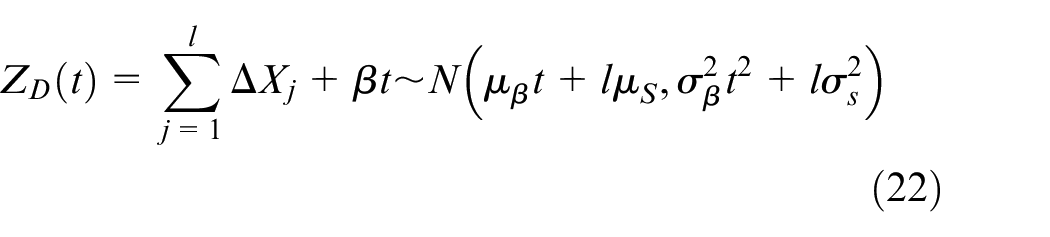
In summary, a performance model under internal or external shocks is suitable for a radar network. The performance degradation amount of the radar network is the sum of degradation caused by internal relative position change and catastrophic degradation caused by external shock. According to the shock and degradation failure model, a new distribution is presented to describe the performance of the radar network. Random variable

The detection performance threshold of the radar network is k, and the reliability of the radar network at time t is
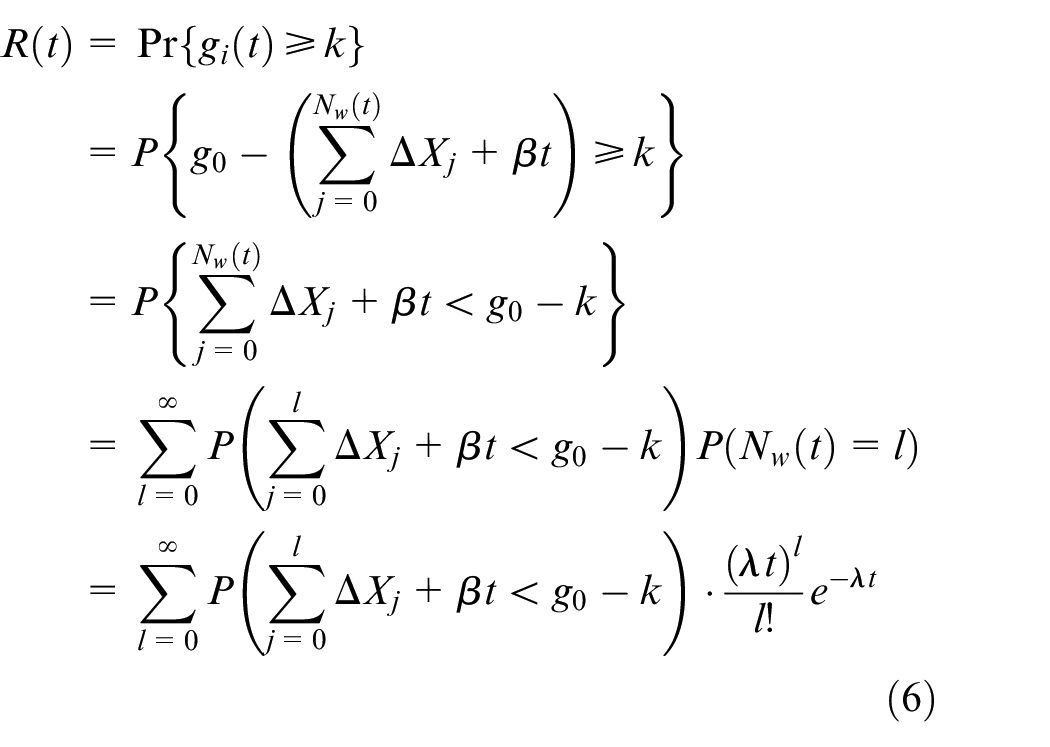
Since both



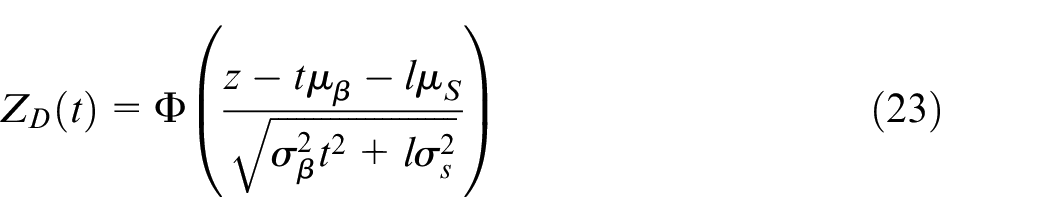
According to the above formulas, we can achieve
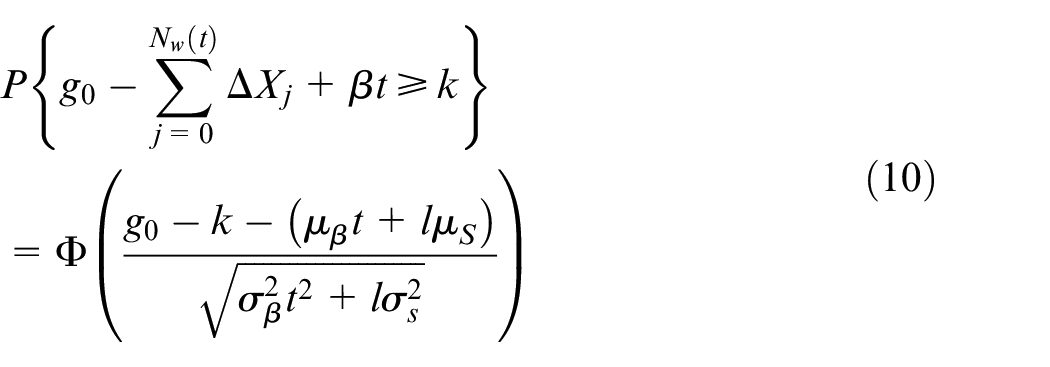
where
According to equations (11) and (12), the reliability of the radar network detection performance is
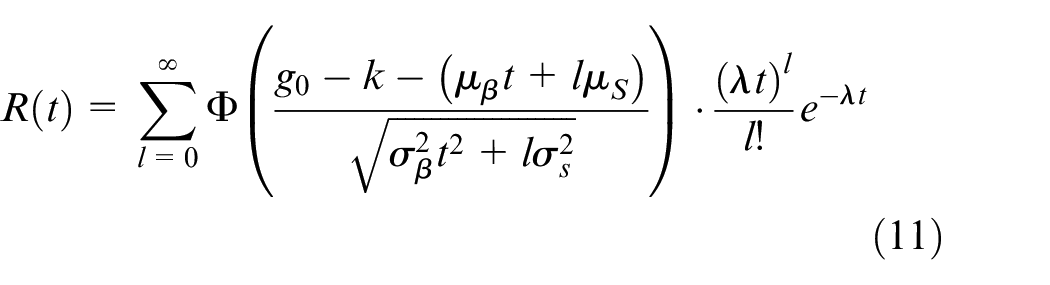
At time t, the total number of shocks
The failure distribution function of radar network
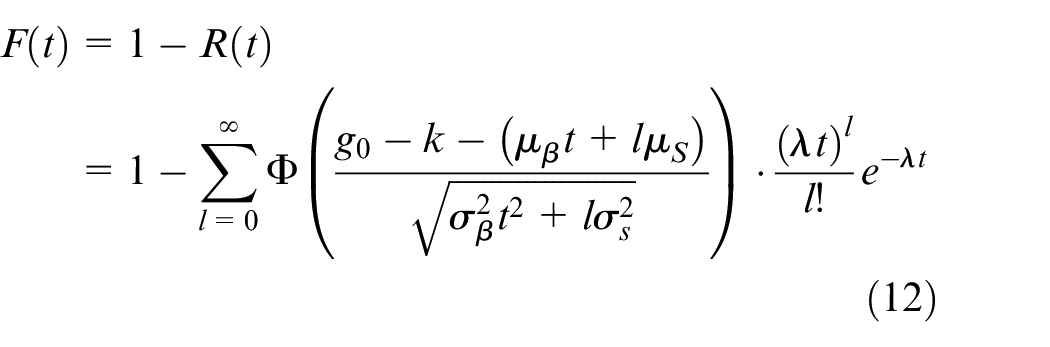
and
Model parameters analysis
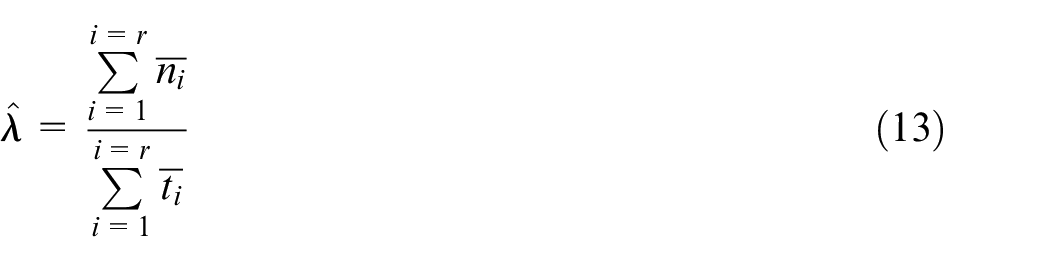
According to the analysis of previous sections, detection performance loss is achieved under the effect of the Poisson process and a reliability model is established by considering two types of shocks. The failure distribution function of radar network
Estimation of
Because of
Estimation of
If external shocks are ignored, the radar network detection performance is affected by relative position changes of constituent radars and is in a slow decline process. For example, in the case where all four radars are in a perfect state, the relative distance of the radars is between
Estimation of
and
This article assumes that each effect on radar detection performance loss is independent and identically distributed, that the number of external shocks


Due to



According to the above,


Case study
In this section, a typical 5-node FAD-SoSs with four radar systems is taken as an example. It has four ship platforms to form a coordinated radar network, and four radars are deployed on the square vertex of the farthest distance to form a radar network with the largest detection area, which achieves real-time resource sharing and information fusion. When a radar fails, the remaining radar ships are deployed on a coordinated radar network at the apex of an equilateral triangle with a side length of 20 km. The maximum detection radius of a radar is
Since the relative distance between the platforms in the FAD-SoSs fluctuates during the mission process, and the distance range of each platform is
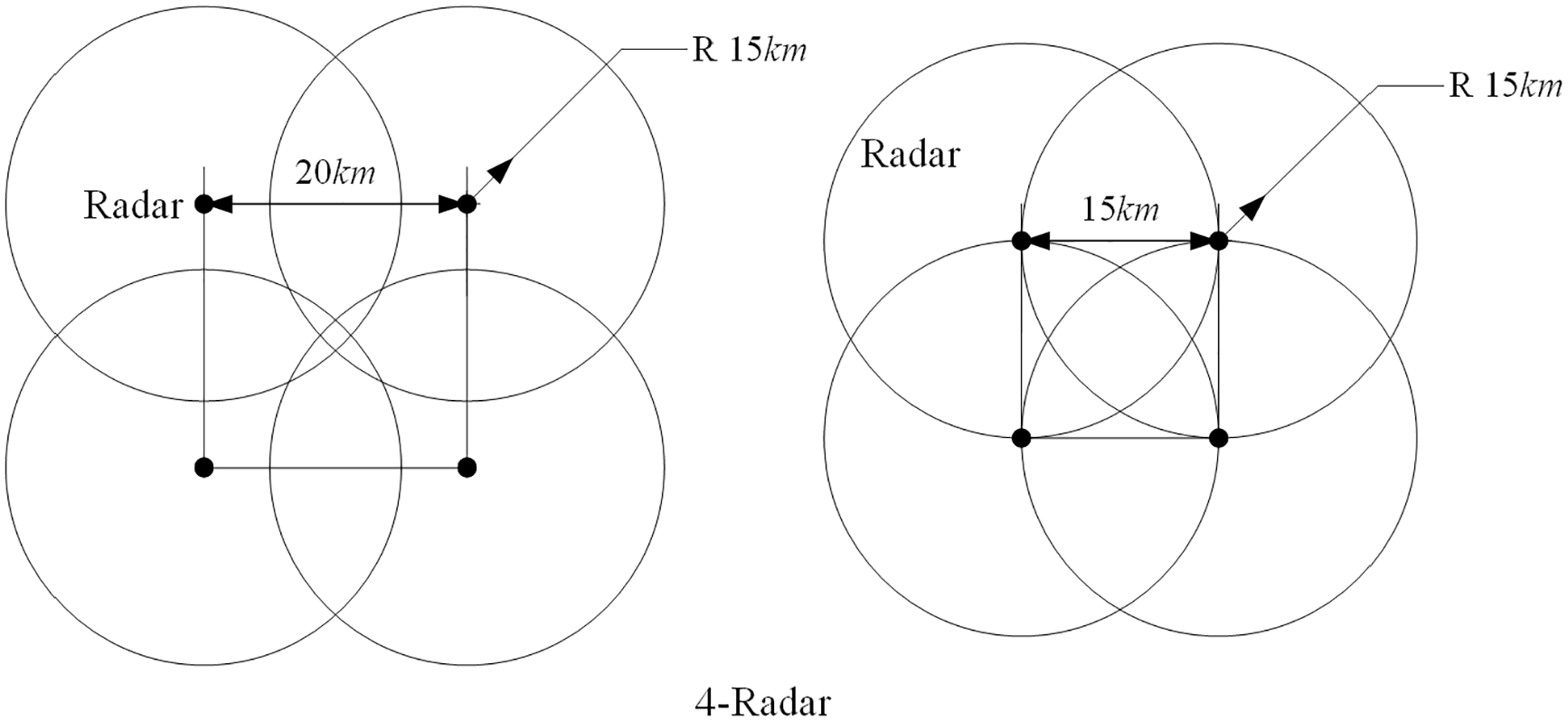
Detection area change diagram of a 4-radar network.
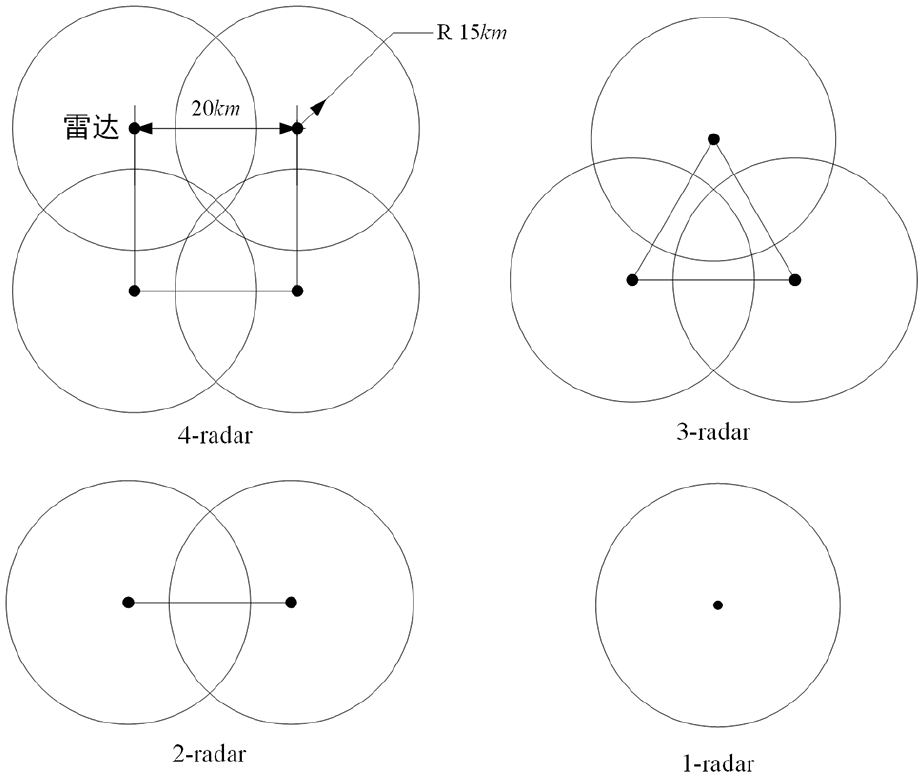
The maximum detection area of the radar network with different radar numbers.
The maximum detection area of the radar network at time t is

When the mission time is 8 h, and the relevant parameter values are
With the given parameters, we can achieve
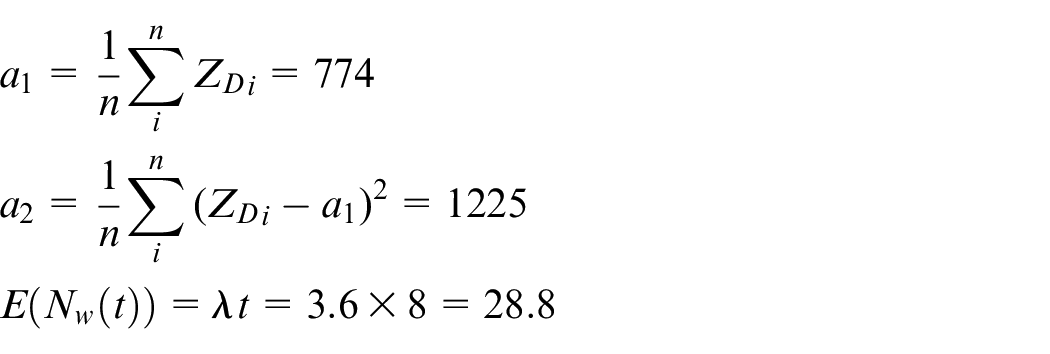
where
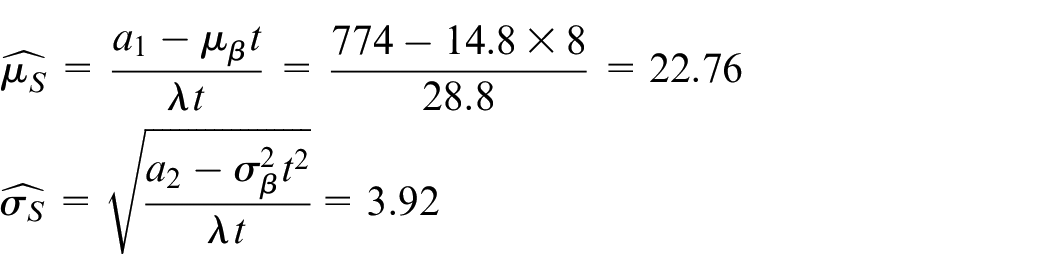
Then, the failure rate function of the radar network is
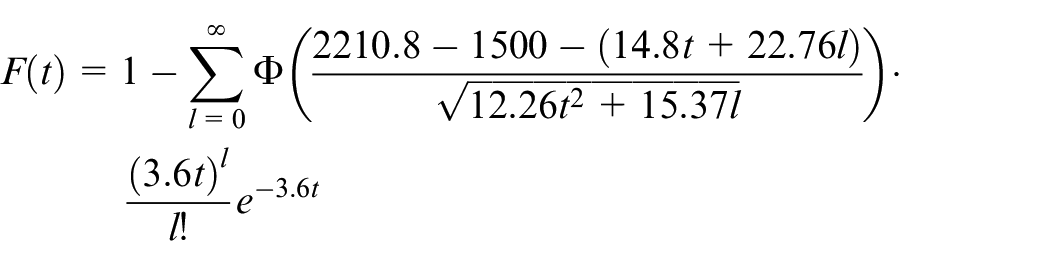
The radar network failure rate in the air defense mission phase is as shown in Figure 8.
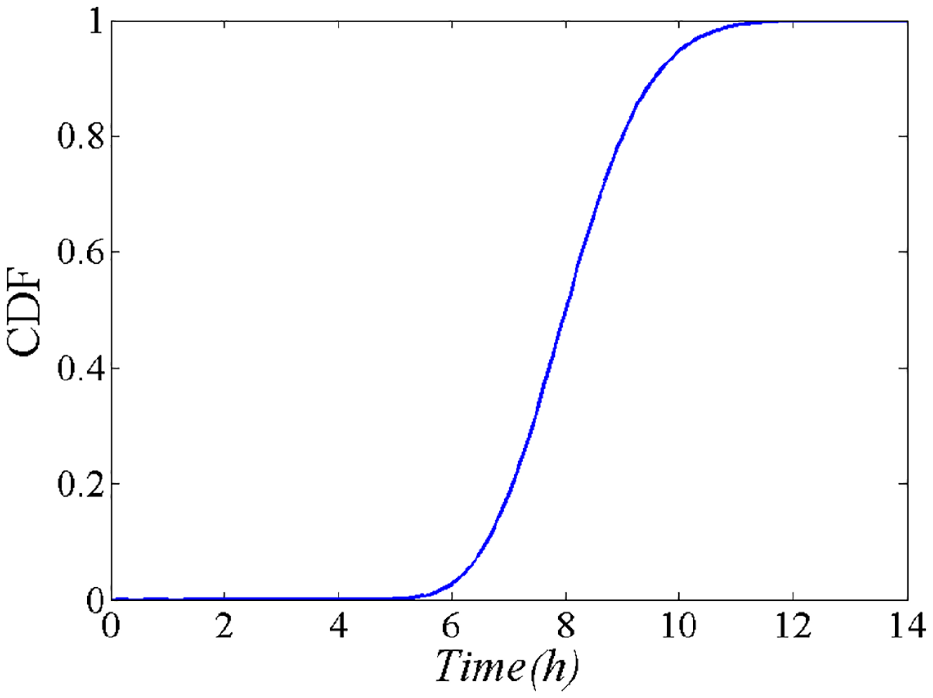
The failure rate of radar network.
Because of

The reliability of the radar network is shown in Figure 9.
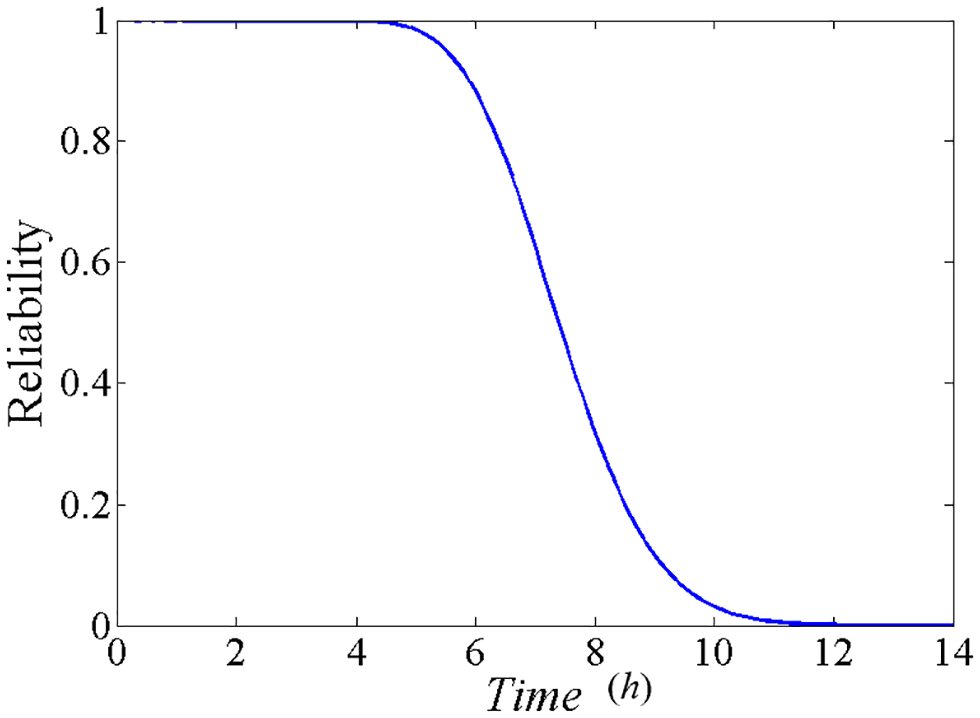
The reliability of radar network.
Then, the Monte Carlo simulation algorithm is used to simulate the number of shocks and performance margins of the radar network during the mission phase, and the simulation results are shown in Figure 10.
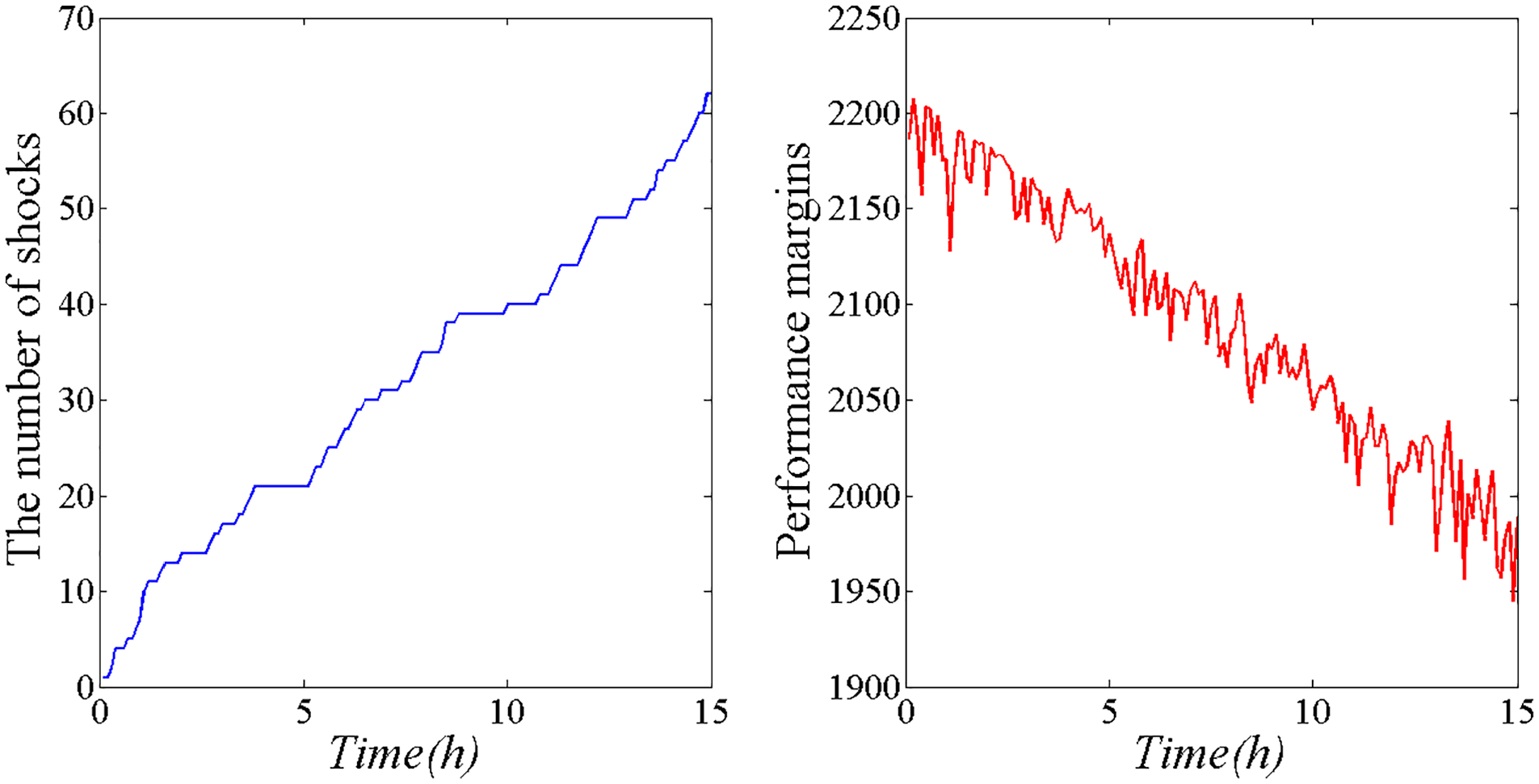
The number of shocks and performance margins of the radar network.
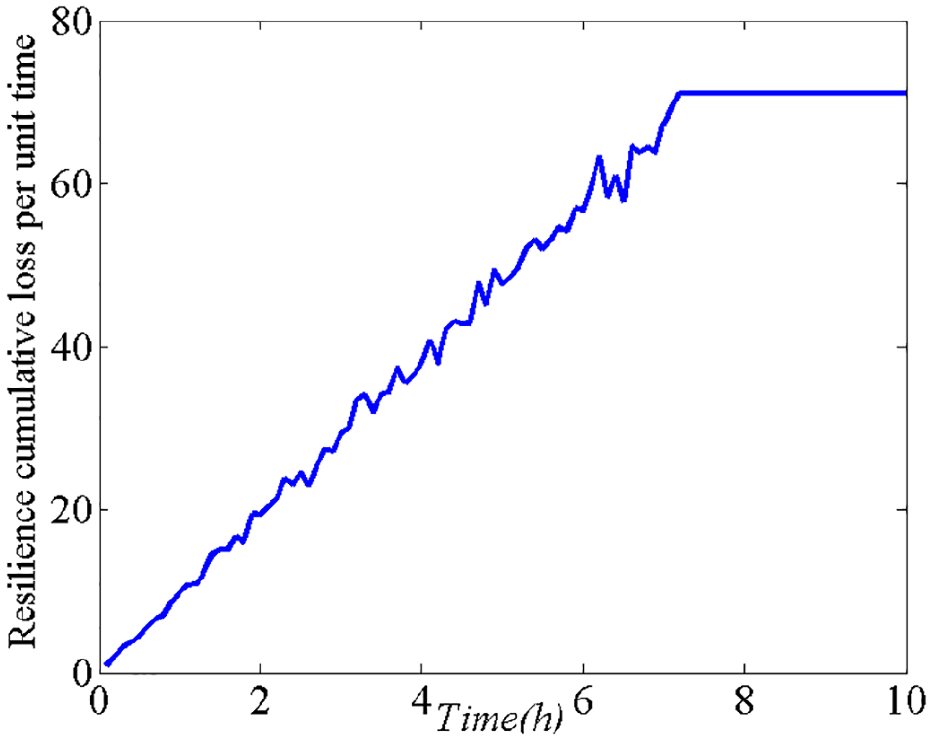
According to the performance-threshold-based system resilience model, the radar network resilience during the mission phase is analyzed. The Monte Carlo simulation results show that the probability density of cumulative resilience loss changes with time as shown in Figure 11.
Probability density of cumulative resilience loss of a radar network.
According to equations (3) and (4), the cumulative resilience loss

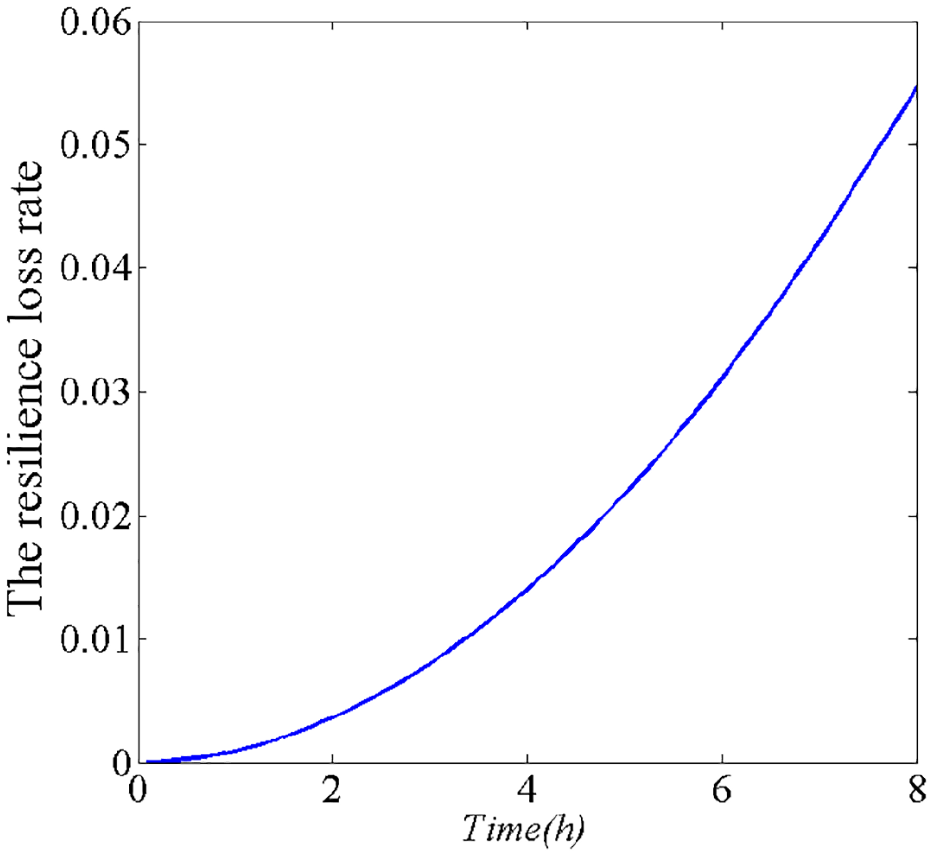
Then, the resilience loss rate

The resilience loss rate changes with time as shown in Figure 12.
The resilience loss rate of the radar network.
As is shown in Figures 10–12, cumulative resilience loss per unit time increases with time, when t = 7.2 h, it reaches a steady state. The reliability of the radar network undergoes a sharp decrease after t = 5 h. Similarly, resilience loss rate increases with time, when the mission is completed (t = 8 h),
Conclusion
In this article, a new resilience evaluation model, which considers “resource sharing and information fusion” characteristics of SoSs, is established based on the performance threshold. Then, a detection performance model under internal or external shocks for a radar network of FAD-SoSs is proposed and its parameters are discussed in detail. Finally, a case study for a radar network of FAD-SoSs is presented to illustrate how to evaluate SoSs performance and resilience.
The SoSs maintains a normal condition through dynamic reconfiguration under the effect of internal and external shocks. Therefore, this article mainly considers the resilience of the SoSs in the case of dynamic reconfiguration. First, the architecture hierarchy of a FAD-SoSs is decomposed, including SoSs-level, platform-level and system-level. Second, the performance and reliability model of the radar network is established by considering relative position change and external shocks. Then, the detection performance loss
Footnotes
Declaration of conflicting interests
The author(s) declared no potential conflicts of interest with respect to the research, authorship, and/or publication of this article.
Funding
The author(s) disclosed receipt of the following financial support for the research, authorship, and/or publication of this article: This work was supported by the Academic Excellence Foundation of BUAA for PhD Students.
