




Abstract
In this article, a new controllable and near net low-stress bar fine-cropping system was proposed and developed by combined using the stress concentration effect of the prefabricated V-groove and the propagation crack. The bar fine-cropping experiments were successfully carried out using a new proposed cropping load control strategy. Although the level of the stress intensity factor range
Introduction
The metal bar cropping process, which separates the bars into segmented billets or pieces, is the first and one of the most important operations in the forging industry.1,2 As known, performing a good cropping process is the first step to begin the forging process with reasonable quality and cost. However, the still widely used traditional shearing and sawing methods have some disadvantages, such as bad cross-section quality, low efficiency and flexibility, short tool life, low material utilization, high noise pollution and energy consumption.3–7
Besides, as known, the V-groove can induce the stress concentration effect.8–11 The cropping time and the cropping load, which directly affect the efficiency and the energy consumption, can be greatly reduced by the stress concentration effect. Some new different low-stress bar fine-cropping methods have been proposed based on the stress concentration in the last two decades.4,12–16 Although some of the disadvantages have been improved in some extent, the cross-section quality and the efficiency are still required to be improved indeed. Besides, due to lack of the correct and appropriate cropping mechanism, the optimal cropping load control strategy of the existing low-stress fine-cropping methods still remains unclear. Therefore, a new controllable and near net bar fine-cropping system with high cross-section quality, reasonable efficiency should be developed.
System structure and working principle
The idea of the new system originally comes from a radial forging system and the principle of reciprocating bending fatigue fracture of wire. It skillfully utilizes the stress concentration of the V-groove and the low-cycle fatigue fracture of the metal. The system structure mainly includes an electrical control system, a mechanical execution component and a corresponding pneumatic system. Moreover, the electrical control system mainly consists of a Mitsubishi programmable logic controller, an Advantech multifunction signal acquisition card and a computer. The mechanical execution part mainly includes a holding device, six circumferential uniform distributed strike hammers and six matched cylinders. The schematic diagram of the working principle of the new system is shown in Figure 1.
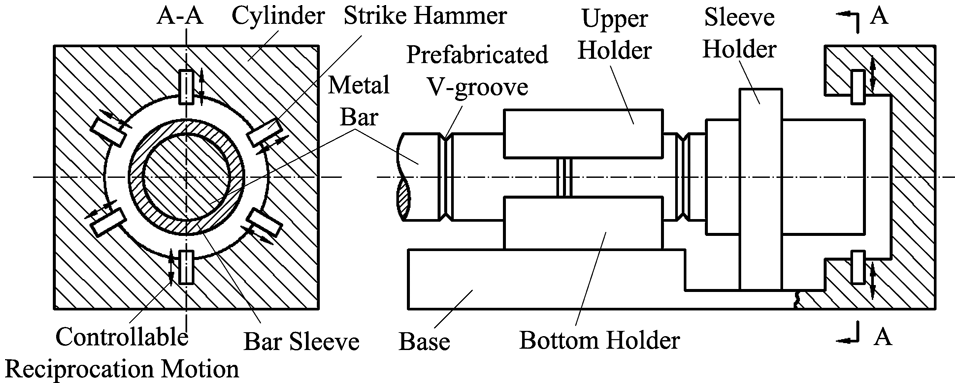
Schematic diagram of the working principle.
When the V-grooved metal bar is cantileveredly fixed between the upper and the bottom holder, the pneumatic system starts to supply the compressed air into six cylinders in a specific order according to the control of the linked two-position five-port electromagnetic valve. After then, six strike hammers run in a corresponding order and generate equivalent displacement load. Once the strike hammer impacts on the bar sleeve, the stress wave produces and spreads out towards the bar through the bar sleeve. With the stress concentration effect, the material close to the V-groove root first meets the damage initiation criterion. In other words, it means the microcracks have already initiated. Under the continuous controlled power supply, the microcrack becomes the macrocrack rapidly and steadily. And the macrocrack propagates like the opening mode crack until the unstable propagation occurs. Finally, the metal bar is cropped into the billets.
Experiments and results
According to the working principle, the new fine-cropping system was developed as shown in Figure 2 in detail. All the subsequent fine-cropping experiments were performed on the new system at room temperature. The 304 stainless steel (SUS 304) with a diameter of 30 mm was selected for the experiments. And the geometric parameters of the V-groove were all prepared in accordance with the previous works. 17
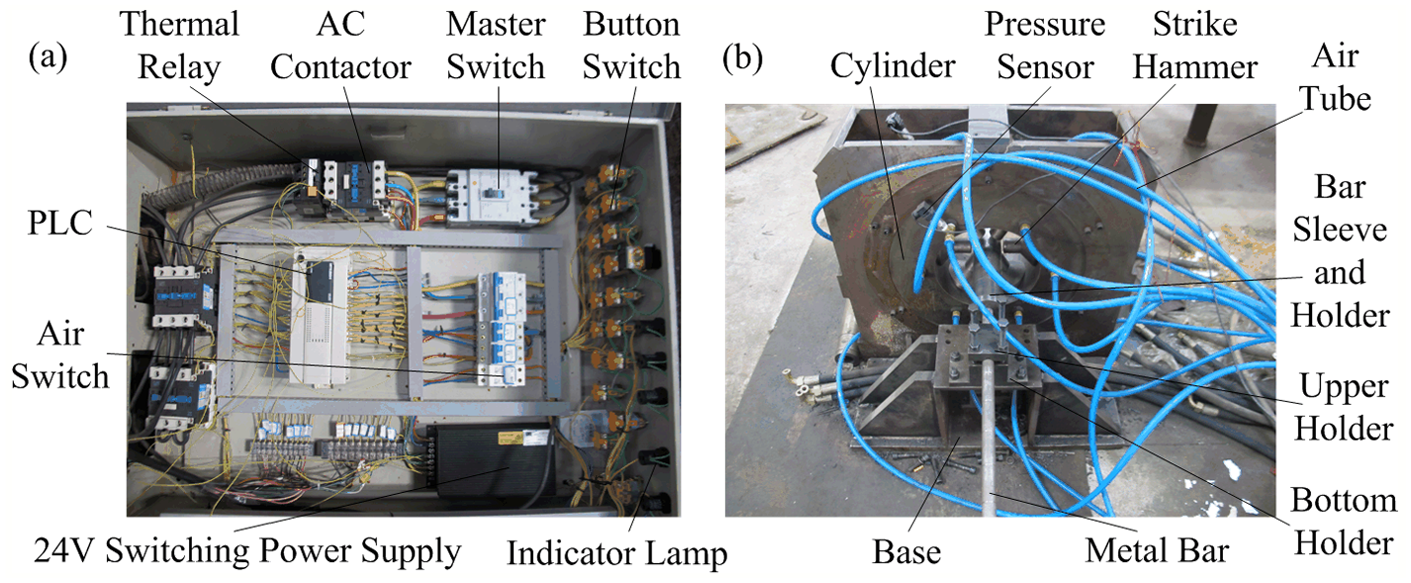
Prototype photo of the fine-cropping system: (a) the electrical control system and (b) the mechanical execution component.
It is clear that the equivalent displacement load and the frequency of the strike hammers are, respectively, controlled by the pressure of the pneumatic system and the switching frequency of the valve. The switching frequency is 5 Hz. Furthermore, an ideal pressure–time control curve with a constant crack-tip stress intensity factor range
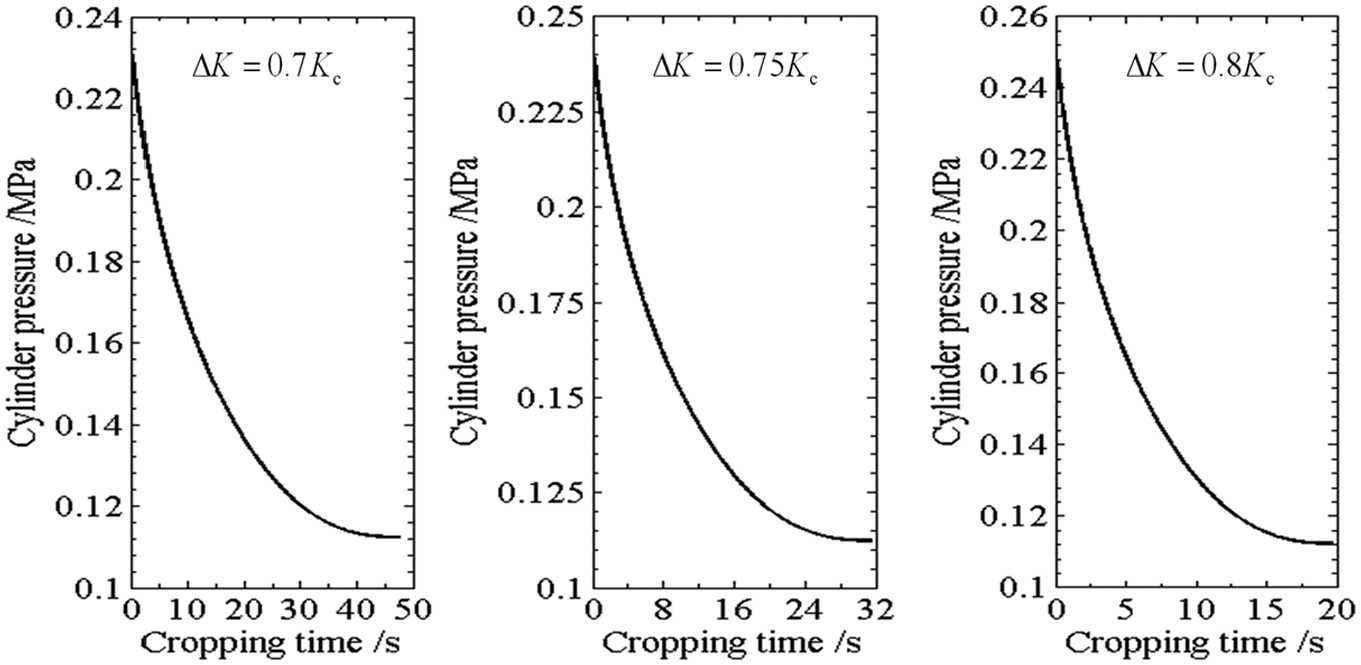
Ideal control curves with different levels of ΔK.
The cross sections of the cropped-billets with different levels of
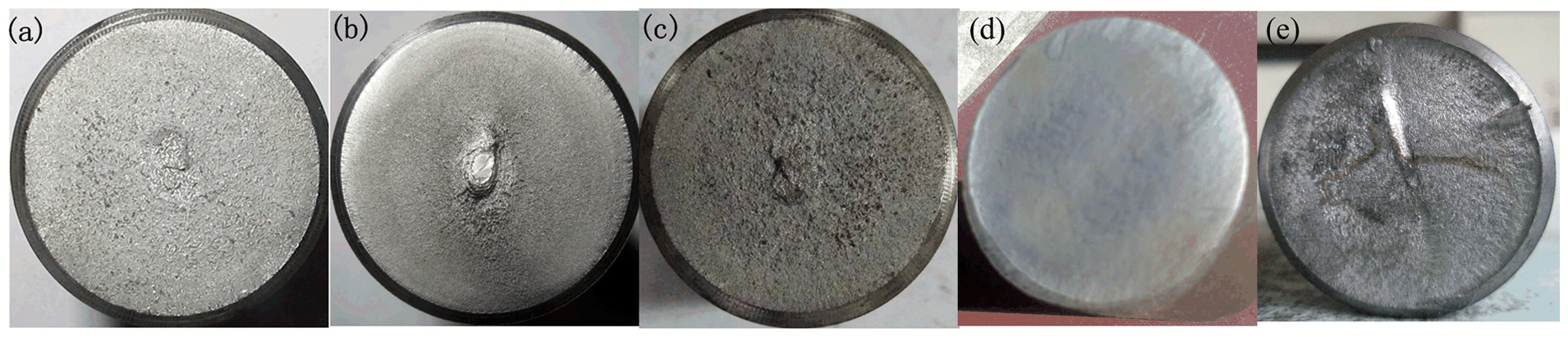
Cross section of the cropped-billets using different cropping methods: (a–c) new proposed method, (d) traditional shearing and (e) rotary bending cropping.
The experimental results show that the cropped-billets can be successfully obtained by the new proposed fine-cropping method and the new proposed cropping load control strategy. In contrast with the traditional shearing, the new system needs lower power supply due to the stress concentration of the V-groove and the propagation crack. As known, the cross-section quality is one of the most important key factors for the fine-cropping industry. Obviously, the new proposed cropping method obtains a better cross-section quality, such as distortionless, smooth without burr, high material utilization and geometric accuracy, and no horseshoe-shaped section and shear-lip. However, there always exists an instant-rupture zone on the cross section because of the fluctuation of the pneumatic system, especially near the end of the cropping process. The good thing is that the size of the instant-rupture zone can be well controlled by the level of
Conclusion
A new controllable and near net bar fine-cropping system is proposed and developed in this article. The system structure and its working principle are both introduced in detail.
The bar fine-cropping experiments can be well performed on the new proposed system using the new proposed load control strategy. Because of the stress concentration effect of the prefabricated V-groove and the propagation crack, the new system needs lower power.
The characteristics of the cross section obtained by the new system are very different from the traditional ones. The cropping time and the cross-section quality are greatly affected by the level of
Footnotes
Appendix 1
Declaration of Conflicting Interests
The author(s) declared no potential conflicts of interest with respect to the research, authorship and/or publication of this article.
Funding
The author(s) disclosed receipt of the following financial support for the research, authorship, and/or publication of this article: This study is financially supported by the National Natural Science Foundation of China (No. 51175413) and the PhD Start-up Fund of Xi’an University of Science and Technology (Nos 6310115028 and 201628).