




Abstract
Unlike previous studies that have revealed a link between quality improvement programs and organizational culture typologies in individual companies, this study describes organizational culture dimensions that affect the use of quality improvement tools and methodologies and how both affect supply chain company performance. Structural equation modeling methods are applied to a sample of 200 organizations in the supply chain of a Canadian multinational company. The results show that employee promotion and investment constitutes the most influential cultural dimension. Organizational objectives and an employee reward system individually affect Kaizen. When the level of formalization in an organization is high, Kaizen and total quality management tools are used more intensively. When the level of formalization is low, lean manufacturing and internal audits are used more intensively. Superior communication in an organization causes plan–do–check–act approaches, lean manufacturing methods, corrective actions and internal audits to be used less intensively. Generally speaking, most quality improvement tools and methodologies positively influence business performance. These results suggest that organizations can improve business performance levels by selecting appropriate quality improvement programs depending on existing organizational culture dimensions and may thereby develop an organizational culture that enables successful quality improvements in a supply chain context.
Keywords
Introduction
The failure of effective quality improvement initiatives has led scientists, experts and practitioners to examine and provide recommendations on how this outcome may be avoided in the future.1,2 While there are numerous reasons for this result, existing organizational cultures constitute an easily recognizable factor that explicitly influences quality improvement processes.3–6 Thus, organizational cultures should be compatible with quality improvement tools and methodologies such that their achievement is supported.3,6,7 However, few empirical studies have attempted to identify dimensions of organizational culture that affect quality improvement program outcomes. 8
Furthermore, it is widely recognized that several quality practices were first developed in Japan, where cultural norms differ significantly from those of other countries; hence, these practices may not prove as effective in other countries due to the existence of differing cultural values.9,10 Nevertheless, to be successful, suppliers must use the same quality management practices for their customers regardless of their location. 11 Additionally, business performance levels may vary from region to region, even when the same quality improvement initiatives are employed. 12
At present, competition has moved beyond the scale of single firms to the supply chain level, and if a company wishes to achieve an essential advantage in the market, it must effectively leverage supplier relationships 13 and ensure that its suppliers are high performers 14 to increase quality and productivity levels and cut costs. 15 Accordingly, supply chain members do not act independently, 16 but as supply chain “partners” who offer quality products that are of value to customers. 17 Supplier selection constitutes a key issue in supply chain management and is related to the success of the entire supply chain. 18 As no standard constructs of supply chain management are presented in the literature 19 (especially with respect to quality), further academic research on supply chain quality management is needed.20,21 This trend will serve as a major challenge within the realm of quality management. 22 Additionally, existing concepts of organizational culture should be placed within an extended supply chain network context,23,24 although research focused on cultural dimensions has been limited thus far.24,25
According to Zu et al. 26 and Gimenez-Espin et al., 27 even in the context of individual companies, quantitative relationships between organizational cultures and quality improvement initiatives have not been researched sufficiently.
This study thus aims to identify an empirical relationship between organizational cultures and quality improvement tools and methodologies and to reveal their mutual effects on the business performance of supply chain partners. The study findings will prove equally important and beneficial to all organizations in a supply chain, as they pertain to one integrated system.
This study was performed in two stages. First, quality improvement tools and methodologies, organizational culture dimensions and business performance indicators were classified into groups via factor and reliability analysis. Second, a model that considers organizational culture dimensions, quality improvement tools and methodologies, and business performance indicators was developed and tested via structural equation modeling (SEM) using data collected from a Canadian multinational company’s (Bombardier, Inc.) manufacturing sites and suppliers across six continents. Using the model, organizational culture dimensions that significantly affect quality improvement tools and methodologies and business performance levels were identified as “quality culture dimensions” within the supply chain context. The study aims to determine which organizational culture dimensions affect quality improvement tool and methodology usage and how such tools and methodologies affect supply chain company performance.
Literature review and hypothesis development
Only a few studies have surveyed organizational cultures in a supply chain context. Additionally, although quality management is universally recognized, the academic community requires a more focused approach for evaluating quality management issues within supply chain contexts. 17 Several studies have applied cultural models to examine principles of supply chain management,23,25,28 but without connecting these principles with issues of quality improvement. Additionally, quality managers must integrate firm practices with supply chains; 29 however, supply chain management concepts based on quality management perspectives remain limited. 20
A number of surveys have examined the effect of organizational culture on quality management mechanisms in a firm.6,28,30,31 However, fewer surveys provide empirical support for relationships between organizational culture and quality improvement tools and methodologies.5,26
In previous studies that have analyzed the relationship between organizational culture and quality management at the company level, organizational culture typologies have often been used to describe this relationship4,32 although company cultures typically have more than one typology characteristic. The prevailing organizational culture of a firm should be compatible with the values and basic principles of its total quality management (TQM) approach if significant quality improvements are to be realized.3,7,31,33,34 Organizational culture is a prerequisite of TQM practices; however, the TQM approach can also be used to change an organizational culture. 4 To be successful, TQM practices must involve specific elements of a culture that support such practices and must be employed throughout an organization 8 (especially employee involvement and development and realistic quality goals). 6 Detert et al. 8 believe that “clan cultures” based on flexibility and an internal focus best support improvement initiatives (such as TQMs) through an emphasis on teamwork, 35 while in other companies, “adhocratic cultures” improve initiatives.4,26,28 One survey 28 proposed the presence of a “mixed culture” between “adhocratic” and “clan” cultures. Yusuf et al. 16 state that organizational cultures strongly influence infrastructure quality management practices, and that “management practices have a significant effect on manufacturing performance.”
Cultural dimensions related to supply chains have not been researched sufficiently,24,25 and it has been argued that organizational cultures within the context of supply chains must be studied in detail.23,24 One study examined organizational culture effects on supply chains by examining relationships between them 24 and found that “development,” “group” and partially “rational” cultures positively affect supply chains and that “flatness organizational culture profiles” achieve the highest levels of supplier integration. 21
Cultural dimensions should be consistent throughout both horizontal and vertical levels of an individual firm and across key supply chain partner firms. 25 However, in practice, several diverse organizational cultures typically must work together; 36 thus, subsets of significant common cultural dimensions for all supply partners should be identifiable. With regard to supplier selection issues, quality performance and improvements are extremely important.17,37
Robinson and Malhotra 20 and Fynes et al. 38 have found quality tools to be essential to supply chain contexts. One rare study focused on quality methodologies 26 examined relationships between organizational culture typologies and TQM/Six Sigma practices 26 unrelated to supply chains. This study aims to address this knowledge gap and to identify significant cultural dimensions that influence quality tools and methodologies used in a supply chain. Thus, the following hypothesis is proposed:
H1: Organizational culture dimensions are positively related to the application of quality tools and methodologies in supply chain companies.
Several authors have found positive effects of effective TQM management practices on innovation, employee, financial and operational performance39–43 without examining specific quality improvement tools and methodologies used. Using quality tools as an essential part of quality improvement has been proven to be an important element of a successful quality management practice, such that different quality tools influence different business performance indicators. 44 Six Sigma methods may improve company performance levels because they better address organizational needs, 45 while other companies may benefit from lean manufacturing practices in terms of firm profitability levels 46 and other forms of business performance. 47 One rare study on manufacturing company supply chain management quality levels is presented in Sila et al., 48 while Kannan and Tan, 13 Yeung 14 and Robinson and Malhotra 20 show that quality management practice usage among supply chain partners improves business performance. Additionally, a survey on supply chain quality practice effects on performance is presented in Foster. 21 Thus, the following hypothesis can be proposed:
H2: The use of quality tools and methodologies is positively related to supply chain company business performance.
Organizational cultures affect organization performance,49,50 and the presence of a strong and adaptive organizational culture is positively related to company success.51,52 A number of authors such as Denison and Mishra 49 examined organizational culture effects on business performance using a model of cultural traits and found a positive correlation with financial performance. Others 53 have examined organizational culture effects on business performance using employee development and fair rewards measures as organizational culture dimensions, and one survey 54 employed a culture profile on results and people orientation levels. Similarly, Xenikou and Simosi 55 showed that work environments that encourage goal setting and the accomplishment of objectives exhibit higher performance levels. According to Skerlavaj et al., 56 organizational cultures affect employee and customer satisfaction, whereas their effect on financial performance is indirect. Several authors such as Ginevicius and Vaitkunaite 57 have used the organizational culture dimensions to examine their effects on business performance. According to Roh et al., 23 organizational cultures especially influence supply chain business performance, and it is proposed that relationships between supply chain organizational cultures and system effectiveness levels be examined in future surveys 36 given their effects on business development trends. A shared culture of norm-based trust and openness in a supply chain may reduce conflict and uncertainty levels in the supply chain, resulting in better outcomes. 58 Thus, the following hypothesis can be proposed:
H3: Organizational culture dimensions shared in a supply chain are positively related to business performance levels through the use of quality tools and methodologies.
Although all of the studies listed in this literature review focus on organizational cultures, quality improvement tools and methodologies, and business performance levels, no studies have yet examined relationships between all three entities within the context of a supply chain.
Research methodology
Research operationalization and framework
Thus, in this article, a model that considers organizational cultures,8,23,49–51,53,57,59–64 quality improvement tools and methodologies,26,44,65–71 and business performance levels16,17,28,39,41,44,56,62,72,73 is presented. Most survey questions used were drawn from existing surveys.
Organizational culture typologies have been commonly used in studies on organizational culture,26,27 as they define a number of ideal types of culture that are easy to envision against assessed cultures; however, their use is problematic, as organizations are typically associated with a dominant typological orientation. 59 Hence, organizational culture dimensions are preferable when assessing organizational cultures. Organizational culture dimensions are thus used in this study, as they focus on particular aspects of organizational behavior (e.g. employee rewards, which are related to quality improvement tool and methodology usage). Organizational culture dimensions and their descriptions were modified from different literature sources and were used in this research, as shown in Table 1. For example, for the “focus on objectives and goals” organizational culture dimension, the following statements (modified from O’Reilly et al., 50 Xenikou and Simosi, 55 Ankrah and Langford 59 and Denison et al. 60 ) can be used:
“business goal achievement is the most important measure,”
“objectives are very specific, measurable, achievable, realistic and time-targeted,”
“a key performance system exists that allows one to monitor and correct performance levels in accordance with objectives,”
“goal setting facilitates company progress” and
“goals and objectives further a company’s vision, mission, values and strategies in the desired direction.”
Organizational culture dimensions.
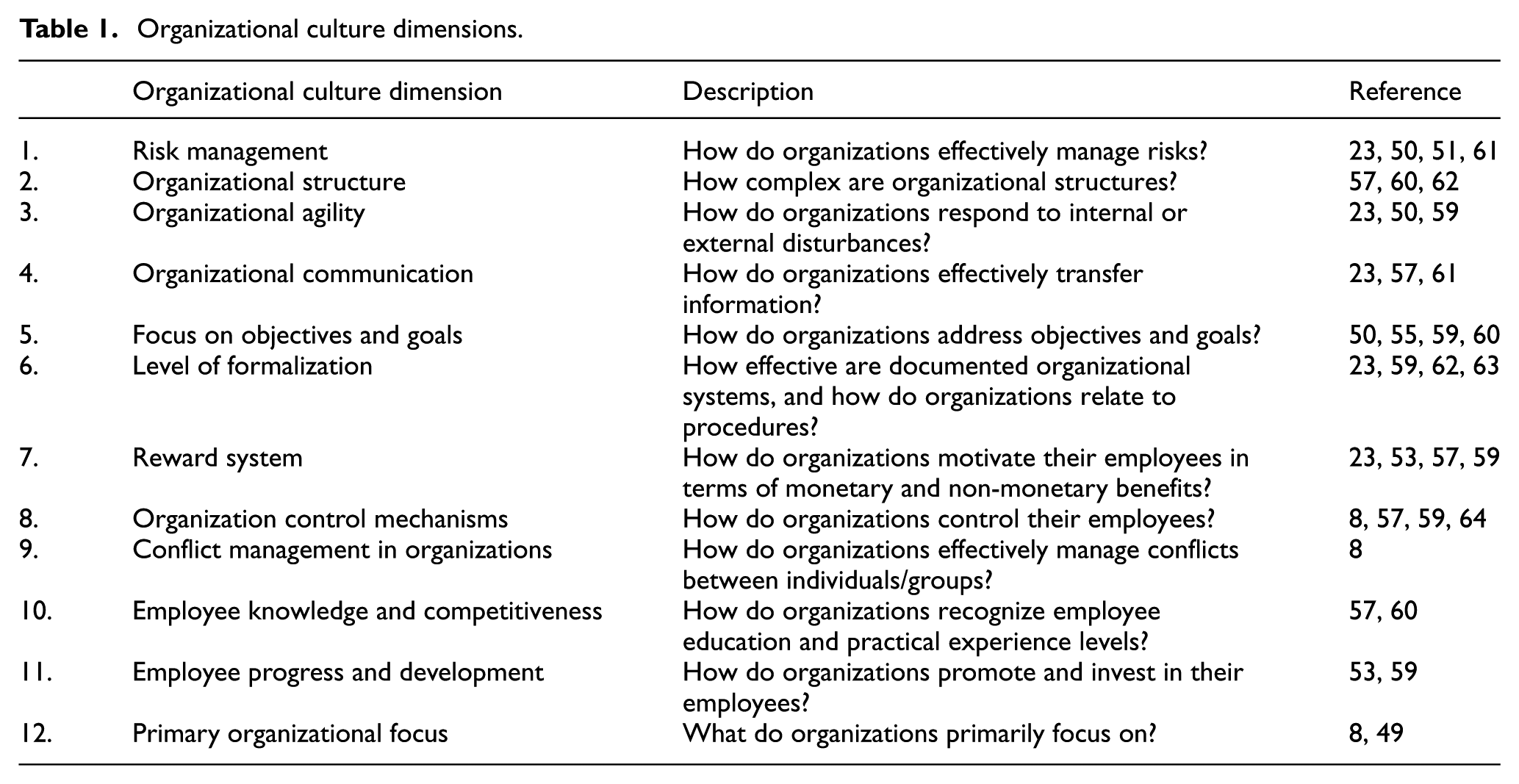
Quality improvement tools and methodologies of various theoretical persuasions were selected based on a preliminary data analysis of samples drawn from 30 companies. The same analysis shows that certain companies included in the sample use quality tools as part of quality improvement methodologies; however, most of them use different quality improvement tools separately. A number of popular quality improvement methodologies (i.e. lean Six Sigma) were also considered for inclusion in the survey; however, following an initial analysis of available information, the final sample was determined. Quality improvement tools and methodologies with descriptions were modified from different literature sources and were used in this study, as presented in Table 2.
Quality improvement tools and methodologies.
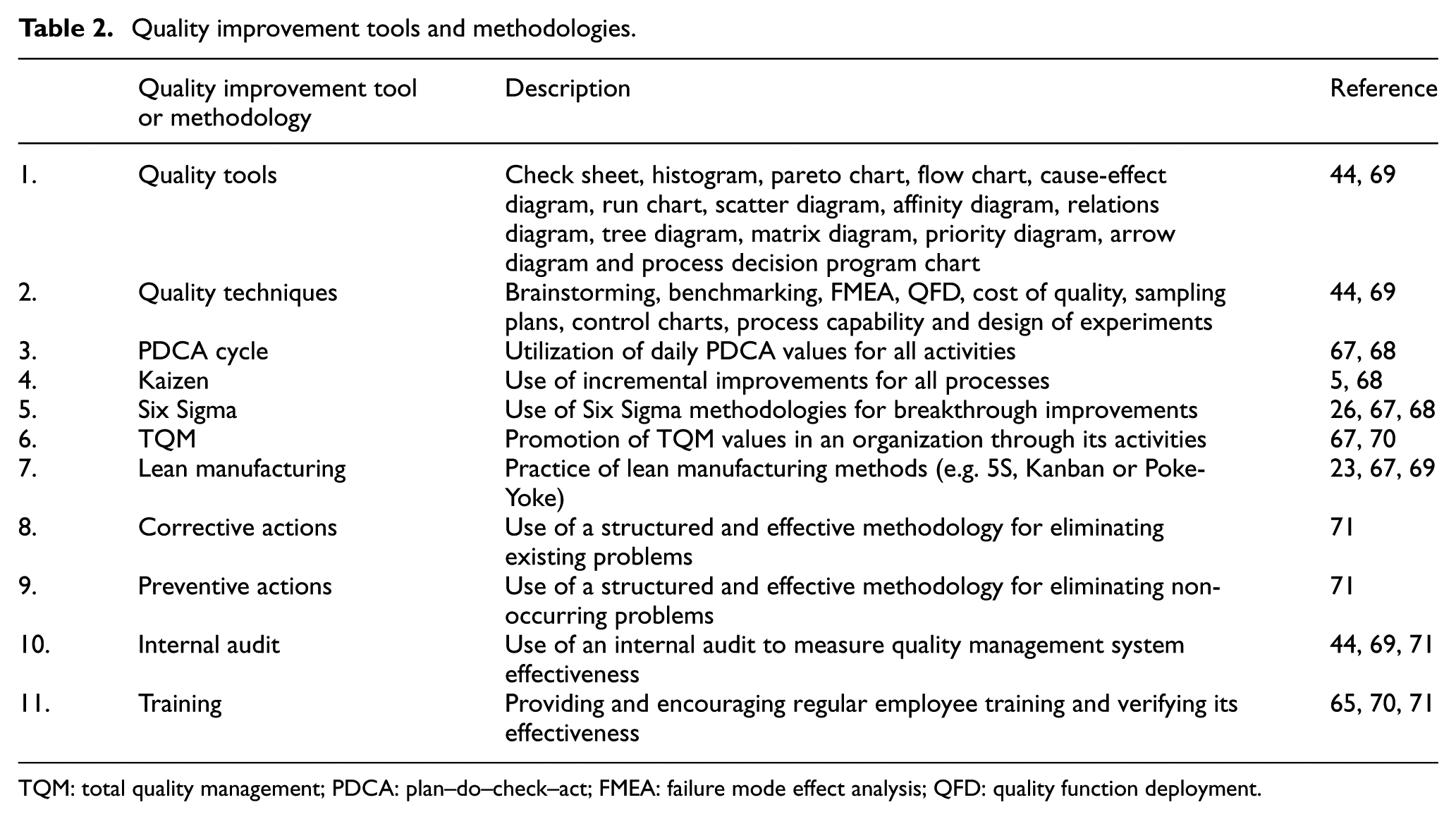
TQM: total quality management; PDCA: plan–do–check–act; FMEA: failure mode effect analysis; QFD: quality function deployment.
For items 1 and 2, one statement was used for each tool, whereas for items 3–11, three statements were used, as recommended in related literature.26,65,66 For example, for the Six Sigma methodologies, the following statements were used (modified from Mello and Stank, 25 Dahlgaard and Dahlgaard-Park 67 and Senapati 68 ):
“the Six Sigma methodology is used to achieve breakthrough improvements,”
“Six Sigma projects are conducted following a DMAIC (Define, Measure, Analyze, Improve and Control) format” and
“Six Sigma projects are selected based on the expected financial results.”
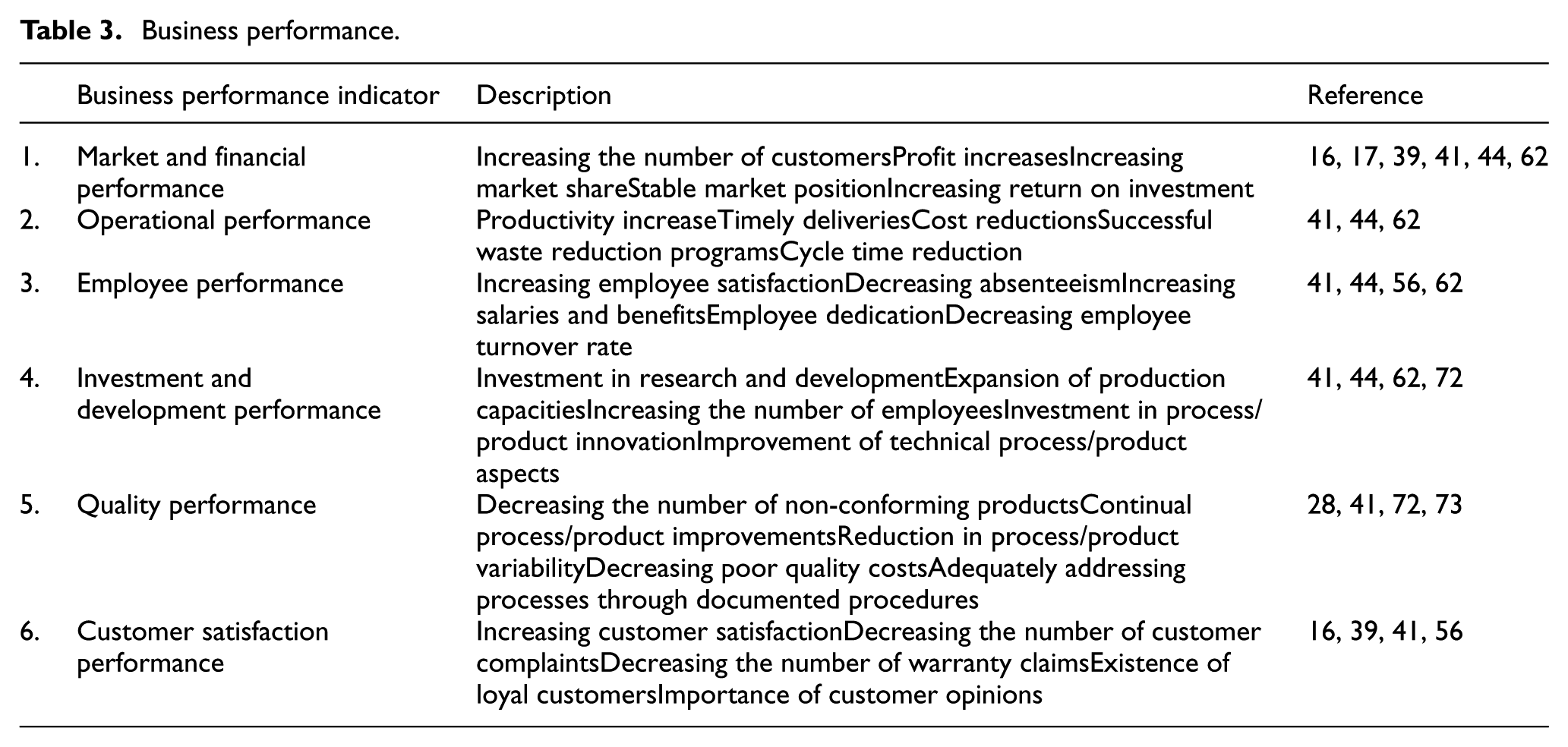
Business performance indicators were measured as changes in their levels over time or as levels of business activity accomplishment against business objectives. Business performance indicators and their descriptions were modified from various literature sources, as presented in Table 3, with five items allocated for each. Certain features specific to the supply chain performance indicators were included from the literature 13 as well. Quality and customer satisfaction performance indicators were added to determine quality improvement effects on business performance, while environmental performance, which is important in green supply chains and which have been emphasized in various surveys, 72 was not considered due to the quality context of the surveyed topic. For example, for the investment and development business performance indicators, the following statements can be used (modified from York and Miree, 39 Sadikoglu and Zehir 41 and Spasojevic Brkic et al. 62 ):
“there is frequent investment in research and development,”
“company manufacturing capacities are extended regularly,”
“the number of employees increases constantly,”
“the company constantly invests in process/product innovation” and
“technical features of processes/products are regularly improved.”
Business performance.
Survey construction
To collect data needed for the study, a survey based on information presented in Tables 1–3 measured over a discrete, 5-point Likert scale was developed. Respondents were asked to determine their level of agreement or disagreement with statements regarding the application of an organizational culture dimension, quality improvement tool or methodology, and business performance indicator. Totally, 25% of the questions included in this survey were recoded and presented in reverse order to mitigate respondent bias effects. The survey was initially sent to two employees in the same company, generating a total sample of 30 companies. An analysis of each pair of responses revealed an extremely high level of correlation between the answers. One survey was then sent to each company. Summaries of the research results and free consultations were offered to increase response rates. Surveys were sent to contact persons, who were asked to have the survey completed by the appropriate company representative.
Sample and data collection
In the first phase of the study, the survey was emailed to all 87 Bombardier Inc. manufacturing sites, and responses were received from 62 of the sites (response rate of 71.3%). Based on the responses received, during the second phase, suppliers worldwide were contacted, and responses were received from 143 Bombardier supplier companies, denoting a lower response rate (common for international studies). 74 In total, 205 survey responses were received; however, five were rejected due to the presence of control question mistakes.
The respondents were “general managers,” “quality managers,” “production managers,” “operational managers,” “Six Sigma experts,” “continual improvement specialists,” “change agents,” etc. Approximately 5.5% of the plants examined employed 100 or fewer employees, 26.5% of the plants employed between 101 and 500 workers, 39% of the plants employed 501–1000 workers and 29% of the plants employed more than 1000 employees. Approximately 68% of the sampled companies generated annual sales of up to US$100 million, 17% achieved annual sales of between US$101 and US$500 million, 10% achieved annual sales of between US$501 and US$1000 million, and 5% achieved annual sales exceeding US$1 billion. Based on the distribution of the parameter results, the sample accurately reflects characteristics of the Bombardier Inc. supply chain population.
Responses were drawn from respondents based across six continents (North America, 55.5%; Europe, 32.0%; Asia, 8.0%; Australia, 2.0%; South America, 1.5%; and Africa, 1.0%) and across 32 different countries, thus generating response variations, as expected. 10 Significant differences in organizational cultures between the developed countries (80%) and developing countries (20%) examined were also confirmed through a t-test based on a significance level of p ≤ 0.05.
Data were collected in 2011 and 2012. To evaluate potential response bias levels, we determined the difference in available variances of responses received in 2011 and 2012 via the t-test and assuming equal variances. We found no significant differences between the means of these two groups of responses for both organizational culture and quality improvement tools and methodologies at a 95% confidence level, confirming that there was no response bias in the collected sample.
Research results
Descriptive statistics and correlation analysis
Descriptive statistics (means, standard deviations and correlations) for all organizational culture dimensions, quality tools and methodologies, and business performance indicators are provided in Table 4.
Means, standard deviations and correlations of the organizational culture dimensions, quality improvement tools and methodologies, and business performance indicators.
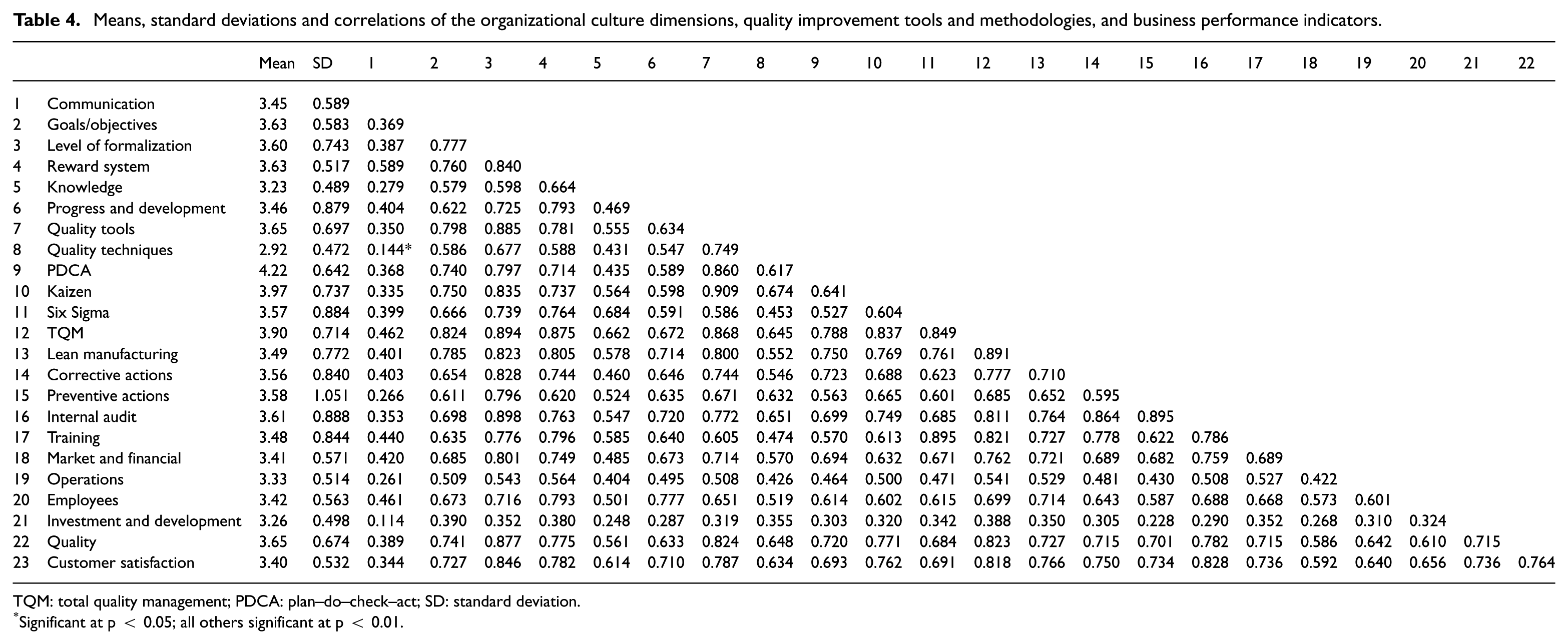
TQM: total quality management; PDCA: plan–do–check–act; SD: standard deviation.
Significant at p < 0.05; all others significant at p < 0.01.
A data reduction strategy was used to eliminate constructs that did not show a significant correlation with the other elements examined. The following variables that were not significantly correlated with the other variables examined at a threshold level of 0.3 75 were eliminated from further analysis: “Organizational structure,” “Organizational agility,” “Organization control mechanism” and “Primary organizational focus.” These variables were not found to have a considerable effect on the quality improvement tools and methodologies, and thus, they were not deemed significant.
Reliability and validity tests
A factor analysis was initially performed, although it did not reduce the number of variables. An internal consistency reliability assessment was performed by computing the Cronbach’s α reliability coefficient for each measurement scale. The Cronbach’s α reliability coefficient is an indicator of the amount of random error present in a measurement scale; 29 thus, a reliability analysis was performed to ensure that the scale items measured the corresponding variables consistently and to confirm that they were free of measurement error. 75
Although a Cronbach’s α reliability coefficient value of 1 denotes perfect reliability, 75 and a Cronbach’s α reliability coefficient value exceeding 0.70 is recommended, 76 a Cronbach’s α value of 0.60 was used as an acceptable level in this exploratory study. 75 In addition, Cronbach’s α reliability coefficient values of less than 0.70 are used in other studies.43,44
The reliability analysis excluded “risk management” (Cronbach’s α value of 0.351) and “conflict management” (Cronbach’s α value of 0.329) variables as culture dimensions from further analysis, as items that describe these two dimensions do not serve as reliable predictors. All of the other dimensions passed the analysis test (Table 4).
Data analysis
An SEM was performed via LISREL 8.80 for the establishment of a model that describes relationships between 6 organizational culture dimensions, 11 quality improvement tools and methodologies, and 6 business performance indicators. We sought to develop a model for organizational culture dimensions, quality improvement tools and methodologies, and business performance indicators that makes theoretical sense and that offers an acceptable degree of fit with the data. In turn, we identified the most important relationships between the three groups of variables. In all, 22 paths were found to be significant between organizational cultures and quality improvement tools and methodologies, 41 paths were found to be significant between quality improvement tools and methodologies and business performance, and 80 paths were found to be significant between organizational culture and business performance. Effects of organizational culture on business performance were measured using the Sobel test. 77 Figure 1 presents significant results obtained from the SEM (levels p ≤ 0.01 and p ≤ 0.05). Based on model fit indices and recommended values presented in the literature (Table 5), the model demonstrates good fit.
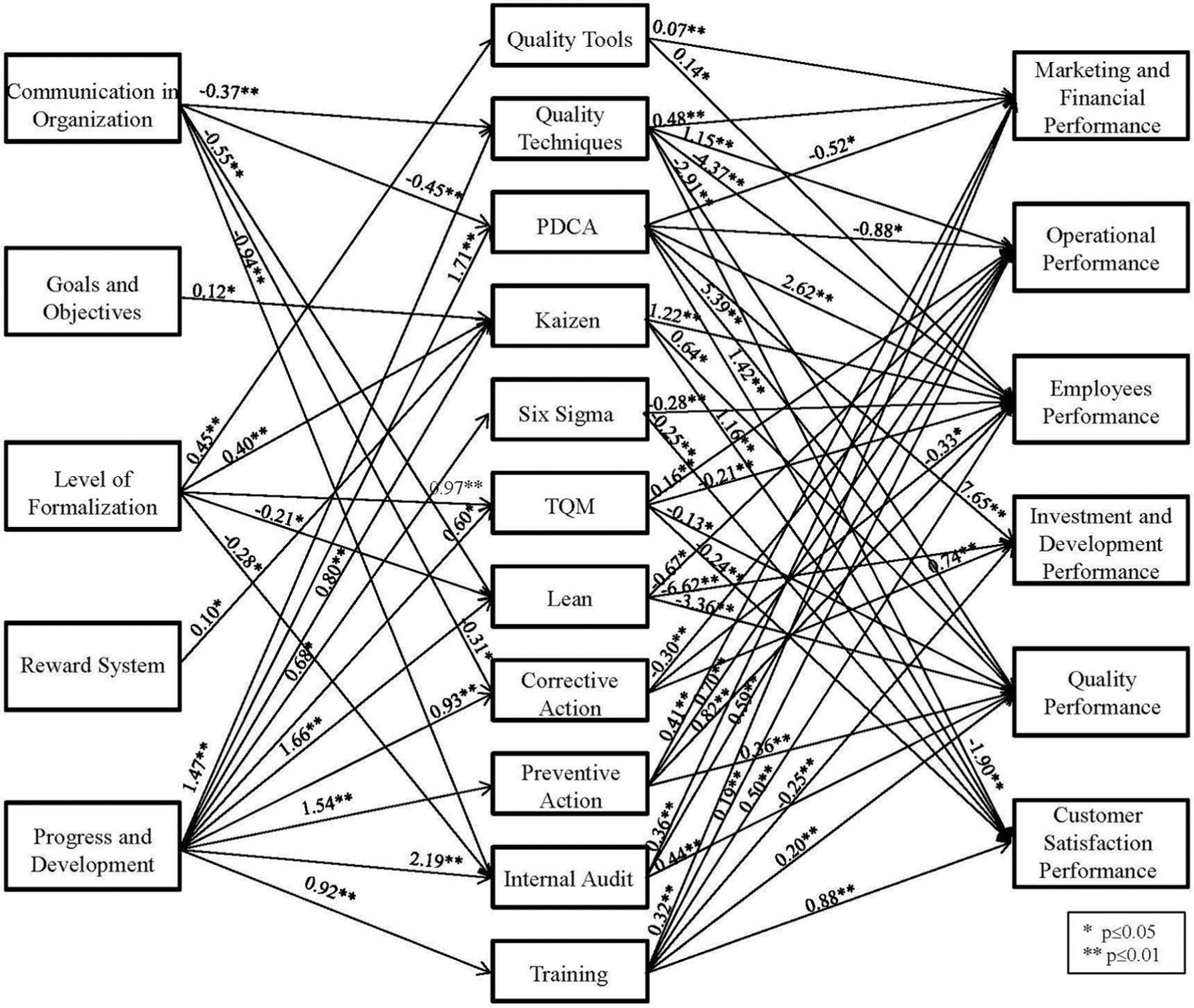
SEM results of the organizational culture dimensions, quality improvement tools and methodologies, and business performance indicators.
Model fit indices.
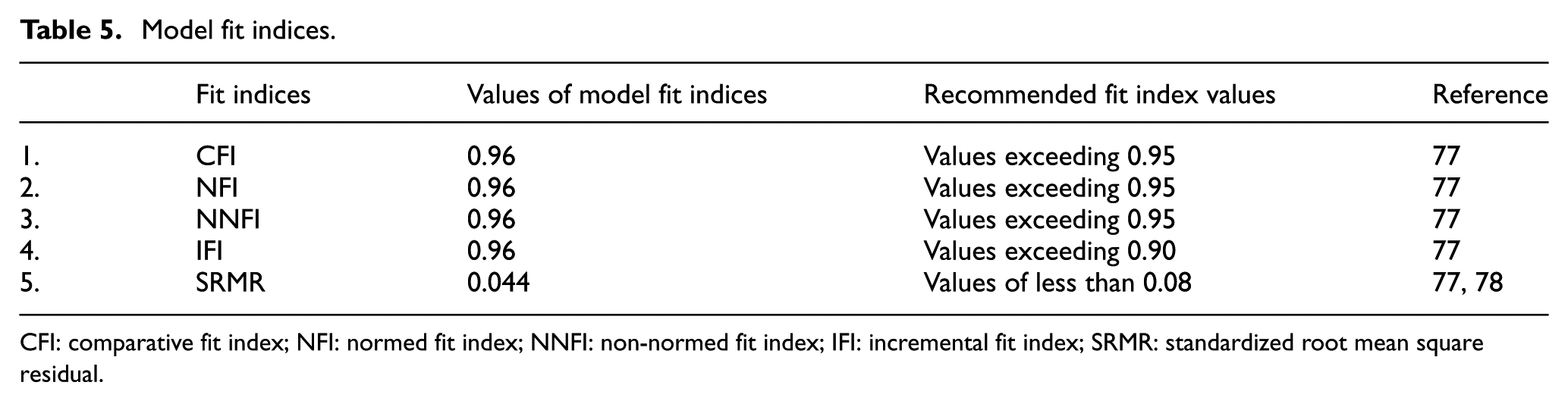
CFI: comparative fit index; NFI: normed fit index; NNFI: non-normed fit index; IFI: incremental fit index; SRMR: standardized root mean square residual.
Our hypothesis on the relationship between organizational culture and quality tools and methodologies (H1) was confirmed in that a primarily positive empirical relationship exists between these two entities. The results show that employee progress and development as a cultural dimension affects nearly all of the quality improvement items, with the exception of quality tools. Organizational goals and objectives and reward systems solely and positively influence Kaizen values. Formalization levels, through documented organizational systems, positively affect TQM, quality tools and Kaizen values and negatively affect internal audits and lean manufacturing. Better organizational communication results in a less intensive use of internal audits, lean manufacturing approaches, plan–do–check–act (PDCA) methods, quality techniques and corrective actions.
Our hypothesis on the relationship between quality improvement tools and methodologies and business performance (H2) was confirmed, as a largely positive empirical relationship was found between these two entities. The use of quality tools results in superior marketing, financial and employee performance, while high-quality techniques positively affect operational, marketing and financial performance and negatively affect employee, quality and customer satisfaction performance. Intensive PDCA use negatively affects operational, marketing and financial performance but positively affects the other performance measures. Intensive Kaizen use increases employee, customer satisfaction and quality performance levels, while Six Sigma use decreases employee and customer satisfaction performance. The TQM positively affects operational performance levels and negatively affects customer satisfaction, employee and quality performance. Tools such as 5S, Kanban or Poke-Yoke negatively affect investment, development, quality and operational performance levels. The intensive use of corrective actions facilitates investment and development, but decreases operational and employee performance. Internal audit implementation increases operational, quality, marketing and financial performance, and preventive actions positively affect employee performance as well. Training positively influences all of the business performance indicators, with the exception of investment and development outcomes, given costs associated with this activity.
Our hypothesis on the relationship between organizational culture and business performance through the application of quality improvement tools and methodologies (H3) was confirmed, as a largely positive empirical relationship exists between these two entities, as most of the organizational culture dimensions, which are important to the application of quality tools and methodologies that serve as relationship mediators, positively affect the business performance indicators. Employee progress and development positively affects all six of the identified business performance indicators. Organizational goals and objectives and reward systems positively and significantly affect employee, customer satisfaction and quality performance. Formalization levels negatively influence marketing and financial performance and positively affect employee, investment and development, quality, customer satisfaction and operational performance. Superior communication negatively influences marketing, financial, operational, investment and development performance and positively affects employee, quality and customer satisfaction performance.
Discussion and conclusion
We attempted to provide a more detailed understanding of culture–quality management relationships through a comprehensive assessment of relationships between cultural dimensions, quality improvement tools and methodologies and firm performance in a supply chain. Organizational cultures affect quality improvement tools and methodologies through a subset of (5 out of 12) “quality culture” dimensions that include the following: organizational communication, objective and goal focuses, organization formalization, and employee reward systems and development. These “quality culture” dimensions of supply chain companies reinforce the importance of creating new culture-based elements that support a quality orientation in a company, as noted by Gimenez-Espin et al. 27 This concept indicates that quality improvement programs require quality-oriented organizational cultures (as provided in Rad 7 ); thus, an adequate culture serves as a prerequisite of a company’s effective functioning (as proven in Mathew 34 ) and must prioritize company goals and employee development (as proposed in Corbett and Rastrick 6 ). Our survey is also consistent with findings presented in Zu et al., 26 which shows that culture reinforces employee rewards based on their contributions to quality outcomes through TQM and Six Sigma application.
Furthermore, Spasojevic Brkic et al. 44 reveal a positive influence of internal audits son financial performance. However, our results are not in agreement with York and Miree 39 and Lemak et al., 42 which show that TQM significantly influences financial performance. A number of authors such as Hendricks and Singhal 40 provide a possible explanation for our results, that is, that the TQM does not significantly affect financial performance, as TQM effects on financial performance are greater when companies are smaller, more labor intensive and less capital intensive. This was not the case for organizations included in our sample, which have used the TQM for long periods and which are primarily large companies. We found higher levels of performance with less intensive PDCA use and better organizational communication. The results also show that operational performance is higher when quality techniques, preventive actions, internal audits, training mechanisms, TQM strategies, corrective actions, PDCA methods and lean manufacturing strategies are employed. The TQM practice presented herein is in accordance with survey results presented in Samson and Terziovski, 43 exhibiting positive effects on operational performance.
Employee performance levels improve when PDCA, Kaizen, preventive action, training and quality tools are used. Performance levels are higher when quality, Six Sigma, TQM and corrective actions are employed. These results partially support findings presented in Samson and Terziovski 43 (which are not based on supply chain contexts) in terms of quality tool effects on employee performance. To achieve significant results, Six Sigma strategies must entail strong leadership, management commitment, communication, education and training, 79 and such strategies negatively affect employee performance, as teams are generally disbanded after improvements have been implemented, potentially leading to employee dissatisfaction. 45 Investment and development performance levels are higher when PDCA and corrective actions are employed intensively and when lean manufacturing and training are used less intensively, whereas quality performance levels are higher when PDCA, internal audit, preventive action, training and Kaizen strategies are used more intensively. Quality performance levels can also be improved through a less intensive use of quality techniques, lean manufacturing and TQM. Quality techniques are not always effective if they are applied automatically without consideration of all influencing factors and may generate unexpected results. 80 Additionally, such techniques are dependent on various factors (e.g. organization infrastructures and data collection and application methods). 81 Managers who promote lean manufacturing without utilizing supportive non-financial manufacturing performance measures may experience disappointing performance levels. 46 Additionally, lean manufacturing methods can result negative outcomes that may hinder organizational performance. 82 According to Rad, 7 TQM implementation does not ultimately improve quality levels. Higher customer satisfaction can be achieved through more intensive PDCA, Kaizen, training, quality technique, Six Sigma and TQM use. This echoes findings presented in Sadikoglu and Zehir, 41 wherein it is found that TQM practices improve customer satisfaction levels. Our results indicate that in using quality improvement practices, a company can significantly affect its supply chain in a positive way, thus resulting in superior business performance,14,20 and especially in terms of quality and customer satisfaction performance. 13 These results are in agreement with the strong correlation between quality improvement and successful supply chain functioning, 83 and through quality improvements, supply chains can benefit from improved financial, operational and employee performance. 84
Furthermore, our findings show that poor communication results in a need for a more intensive use of internal audits, lean manufacturing, PDCA, quality techniques and corrective actions, while better communication implies less use of these items and improves employee, quality and customer satisfaction performance. The use of Kaizen methods, which lead to better employee, customer satisfaction and quality performance, is influenced by clear organizational objectives and goals, and this fully supports the findings of Xenikou and Simosi 55 in terms of employee rewards. Compatibility between clearly defined objectives and quality practices has been proven in other studies.7,26 Higher levels of organization formalization result in more intensive uses of TQM mechanisms, quality tools and Kaizen measures, while lower levels of formalization result in a less intensive use of internal audits and lean manufacturing. Moreover, organization formalization levels affect all six business performance indicators, having a slightly negative effect on marketing, financial and operational performance and a positive effect on employee, investment, development, quality and customer satisfaction performance. Employee progress and development as a dimension of organizational culture appears to be the most influential driver behind quality improvement tools and methodologies, as it affects all of the quality improvement items, with the exception of quality tools. Employee motivation is needed for successful quality management implementation,4,6,27,32 and to achieve expected results related to quality, employees expect fair treatment from organizations, including rewards. 30 Employee motivation and personal growth have been emphasized in various studies.8,67 Additionally, this dimension influences all six business performance indicators in a positive way, proving findings presented in Sadikoglu and Zehir 41 that satisfied employees improve quality, operation and customer satisfaction performance. As a dimension of organizational culture, we did not find employee knowledge and competiveness to influence quality improvement tools and methodologies, as parameters that described this construct emphasize formal education rather than practical experience, which appear to be more important among the companies examined. Findings of this study related to the effects of organizational culture dimensions on quality improvement tools and methodologies are consistent with those of previous studies8,26,27 and generally support their results.
Accordingly, we find that a high-quality culture has a generally positive effect on business performance via the use of quality tools and methodologies in the supply chain. This conclusion reinforces points made in Roh et al. 23 and Mello and Stank, 25 that is, that organizational cultures significantly influence supply chain business performance, 23 and to improve its supply chain, a company must employ effective cultural change. 25 This result echoes results presented in Gunasekaran et al., 85 which emphasized the importance of organizational cultures and quality improvements to responsive supply chains.
In using the findings of this study to improve business performance, supply chain companies must create and develop a “quality culture” that supports successful quality improvements, which may ultimately lead to desired business performance levels. Thus, special emphasis should be placed on employee progress and development to facilitate quality improvement efforts (with the exception of quality tools) and consequently all performance indicators. Reward systems, goals and objectives have less of an influence; only Kaizen influences all factors but marketing, financial and operational performance levels. In a supply chain, organizational information transfer is not effective, and performance improvements can be achieved through a more intensive implementation of quality technique, PDCA, lean, corrective action and internal audit tools. Additionally, when levels of formalization are low, lean manufacturing and internal audits should be used more intensively; when they are high, Kaizen and quality tools can improve performance levels.
Methodologically speaking, this study is based on cross-sectional survey research, and as quality improvement tool usage and organizational culture changes occur over long periods of time, longitudinal methods are recommended for future studies. Additionally, this study is limited to the aerospace and transportation industries and to the Bombardier Inc. system (including its suppliers). Environmental performance levels, which are extremely important to green supply chains and which are related to ISO 14001, may also be explored in future studies with or without integration with quality management measurements.
This study primarily identifies aspects of organizational culture (organizational communication, focus on objectives and goals, organization formalization levels, and employee reward systems and development) referred to collectively as “quality culture” that significantly affect quality improvement tools and methodologies and business performance in supply chains. Future studies may test the obtained model based on other industrial sectors and multinational supply chains.
Finally, this research may prove useful to organizations occupying supply chains that wish to improve business performance levels through the use of appropriate quality improvement tools and methodologies depending on existing organizational culture dimensions and may also assist firms that wish to develop an organizational culture that enables and sustains successful quality improvements based on the model. For example, employee progress and development positively influences several quality improvement tools and methodologies that have an additional positive effect on firm marketing and financial performance. Furthermore, the results of this study have implications for business practices, as leadership in supply chain partner organizations should promote “quality culture” dimensions that are significantly related to quality improvement tools and methodologies or should otherwise use them to determine ways to change existing organizational cultures to improve desired business performance indicators.
Footnotes
Declaration of conflicting interests
The author(s) declared no potential conflicts of interest with respect to the research, authorship and/or publication of this article.
Funding
The author(s) received no financial support for the research, authorship and/or publication of this article.