




Abstract
Process trimming (also can be called as trimming for process) helps to trim and eliminate process operations by redistributing their functions among other operations. It offers one way to eliminate key disadvantages in product and manufacturing process that other methods do not see. However, few methods have been disclosed in a structured way for process trimming effectively. Therefore, this article proposes an integrated process focused on technological process and product innovation to solve the key problems with process trimming-based TRIZ (theory of inventive problem-solving) approach. This method helps to identify and inventively solve the key problems and maximize use resource of system and supersystem. First, process trimming candidates are identified based on component function model, component trimming rules, process function model analysis, component–process interaction matrix, and root cause analysis. Then, three types of process trimming strategies are presented. Algorithm of process trimming is developed to identify key problems in technological process. TRIZ problem-solving tools are used to solve these key problems. Finally, a case study of refrigerator door foam innovative design and manufacturing process is investigated to test the efficiency of the approach. The innovative solution significantly decreases manufacturing defects and service cost.
Introduction
It is estimated that typically 80% of manufacturing costs are determined by the design of the product. 1 Therefore, design stage has the biggest opportunity to improve quality and reduce cost for product and manufacturing process. Designs that do not consider manufacturing process will lead to high product defect and production cost. A manufacturing process is a technological process that uses material objects, such as raw material, labor, energy, and machinery, to create finished products. For product and technological process innovation, several types of methods have been developed in the past and have been used for different problem situations, such as quality function deployment (QFD), 2 value engineering (VE), 3 axiomatic design (AD), 4 design for manufacture and assembly (DFMA), 5 and many other approaches. However, when facing innovative problem in product and technological process innovation, they lack a structured way from problem identification to inventive problem-solving. 6 Meanwhile, they still generally depend on trial-and-error approach and need to be integrated with other innovative design methods.
TRIZ (a Russian acronym for the theory of inventive problem-solving) was created by Altshuller G.S. (1926–1998) to discover the patterns based on numerous patent analysis that predict breakthrough solutions to engineering systems and inventive problems since 1946.7,8 The major findings of TRIZ are as follows:8–10 problems and solutions are repeated across industries and sciences, patterns of technical evolution are repeated across industries and sciences, and creative innovations use scientific effects outside the field where they were developed. It is a scientific approach to innovation execution that uses analytical tools to identify root causes of innovation challenges and then finds functionally related practical solutions that can be adapted quickly, efficiently, and with less risk. 11 Thus, it makes TRIZ an effective way to solve technological process and product innovation problems.
TRIZ is still in evolution and development stage. In TRIZ community, the tools and works developed or supervised by Altshuller are generally called as classical TRIZ. 12 Classical TRIZ publications9,10,13–17 generally focus on problem-solving and do not provide a structured roadmap or process for innovation from problem analysis and identification to problem-solving. Beyond problem-solving, systematic problem analysis based on constructing and building absolutely new types of problems from initial problem is one more promising direction in TRIZ development.11,18,19 TRIZ does not provide innovative concrete structural design. Meanwhile, some TRIZ tools need to be improved or integrated with other effective tools. 20
Process trimming tries to eliminate key disadvantages of the process by trimming process operations and redistributing their functions among the remaining process of system or supersystem. It provides the following advantages. First, it changes ordinary approach of fixing the problems by trimming process and reveals a set of problems that other approaches could not see. Second, it increases system ideality (the sum of desirable functions over the sum of undesirable functions and cost7,21) by eliminating process and preserving their function. Meanwhile, it provides an effective way to circumvent patent by trimming the process claimed in patent-independent claims. Last but not the least, production or operation complexity, and product cost could be reduced.
Few researches are interested in systematically identifying key problems and building new types of problems to help innovative problem-solving for technological process. Therefore, this article proposes an integrated process for technological process and product innovation with process trimming–based TRIZ approach. Our prior works6,21 mainly focus on component function analysis and component trimming for patent circumvention. Process trimming is more complex than component trimming. This article is focused on more depth research and border application area for technological process based on prior works. In particular, we additionally consider (1) an integrated framework of process trimming based on process trimming candidates identification, process trimming strategies, key process trimming problems identification, and TRIZ problem-solving tools for technological process and product innovation; (2) a systematic way to identify process trimming candidates based on component function model, component trimming rules, process function model analysis, component–process interaction matrix (CPIM), and root cause analysis (RCA); (3) three types of process trimming strategies for the corresponding types of candidates and algorithm of process trimming; and (4) application of the method to solve door foam of refrigerator design and manufacturing process.
The rest of this article is organized as follows. Section “State of art” reviews some relevant work. Section “Key concepts of process trimming” describes some key concepts for process trimming. In section “Methodology,” the proposed framework and detailed step by step of process trimming are formulated. An example of refrigerator door foam design is investigated to show how the proposed approach works in section “Case example—door foam of three- and two-door refrigerator design.” Finally, section “Conclusion” concludes this article and discusses our future work.
State of art
Various innovative methods discussed in our prior work, 6 such as QFD, functional cost analysis (FCA), value analysis (VA) and VE, functional analysis and system technique (FAST), AD, failure mode and effect analysis (FMEA), design of experiments (DOE), and robust design, have different advantages in different stages of problem-solving process. There are also many other approaches for process and product innovation design. For example, design for six sigma (DFSS) is a data-driven quality strategy and approach for designing or redesigning a product or process. 22 Function structuration analysis identifies subfunctions and function chains and also identifies key function disadvantages.23,24 Design structure matrix (DSM) is a network modeling tool used to represent the elements comprising a system (such as structural, energy, signal, material) and their interactions, thereby highlighting the key problems to improve.25,26 Ma et al. 27 proposed an idea generation process model and a design unit model for conceptual design, which has three types of cognition stimulations (extension stimulation, analogy stimulation, and mutation stimulation). However, few methods have presented a structured way to solve technological process innovation problem from problem identification to problem-solving.
From the characteristics analysis of various innovative methods, TRIZ is one of the most competitive innovative methods from problem identification to problem-solving.6,28 TRIZ helps to find innovative solution and adapting it to the particular problem. Modern TRIZ is still in the developing stage after classical TRIZ. Classical TRIZ tools are still in further development, such as trends of engineering system evolution (TESE) (trends, sub-trends, and their mechanisms) development and function-oriented search (FOS). 29 Many classical TRIZ tools, such as inventive principles, separation principles, and Su-field analysis, are abstracted from numerous patent analyses and focus on problem-solving. However, patents are represented as inventive problem and the corresponding solution. The patent inventor always did not provide analytical process of the initial situation and why to solve the inventive problem in the patent instead of other problems. There are also analytical procedures in classical TRIZ, such as the first steps of ARIZ (algorithm for inventive problem-solving), that translate an inventive situation into a specific inventive problem. 18 However, ARIZ tries to solve the problem with minimal changes to the system and without deterioration of system parameters.8,11 Therefore, classical TRIZ tools are not sufficient for the need of systematically analyzing the initial problem, and building new types of problems from the initial ones.
Further development of classical TRIZ leads to one more promising area of problem identification.18,30 There are two ways to identify the key problems for TRIZ development. The first is to identify root causes of the initial problem, and the second is to generate absolutely new types of problems.18,19,30 For example, function analysis and cause–effect chain analysis (CECA) in TRIZ can be used to identify the problem root cause. While trimming eliminates certain components or operations from a product or process and redistributes their useful functions among the remaining product or process.11,19,31 Therefore, new types of problem that may greatly differ from the initial problem situation are generated to be solved.
Concept substantiation, which helps to find more practical solution and avoid side effects of initial concept solution, is another development direction of modern TRIZ.11,32 Many techniques are developed or adapted to address this issue, such as trimming, anticipatory failure determination (AFD) (sometimes are called as failure anticipation analysis (FAA)),32–34 and FOS. 35 Han et al. 36 utilize TRIZ, FMEA, and robust engineering to reduce risks from the uncertainty in developing new technologies.
Further development of modern TRIZ has been extended from engineering problem-solving to many new applications. 30 For example, using TRIZ for patent strategies,6,11,37 eco design,38,39 service design,40,41 technology opportunities analysis, 42 and integrated within DFSS.22,43
Many studies combine TRIZ with other innovative approaches to deal with different problem circumstances. For example, Yamashina et al. 44 build a process that can systematically execute the processes from product planning to conceptual design by integrating QFD and TRIZ. Li and Huang 45 combine TRIZ and analytical hierarchy process (AHP) to develop innovative design for automated manufacturing systems. Mayda and Börklü 46 integrate TRIZ with systematic approach of Pahl and Beitz for innovative conceptual design. In these researches, TRIZ is used as a major tool to generate innovative solutions.
Many researches focus on using component function analysis and component trimming for innovative design. For example, Sheu and Hou 47 develop a component trimming framework for slit-valve innovative redesign. Jiang et al. 48 use component-based function trimming to design around patents. Bariani et al. 49 propose combined DFMA and TRIZ approach (function analysis, ideal final result, and trimming) to the simplification of product structure. Kwatra and Salamatov 50 introduce trimming as a tool to increase system ideality. Fei et al. 51 propose a trimming-based conflict discovery and problem-solving process model. However, these researches are component-based function analysis and trimming approach for device innovation. They are not focused on technological process innovation.
Several literatures are interested in technological process and product innovation. For example, Ikovenko 11 develops process function classification and some process trimming rules. Devoino and Skuratovich 52 research on using trimming to improve ideality which views engineering systems as technological processes. Shahbazpour and Seidel 53 combine TRIZ and theory of constraints (TOC) helping identify root causes of problem and eliminate trade-offs for manufacturing system and process innovation. Cascini et al. 54 develop a framework, based on the integration of different methods and tools (integration definition [IDEF], TRIZ, TOC), to support production process re-engineering and innovation in order to find functional limits and business opportunities. However, the researches focused on this area still need to be improved for systematically solving technological process and product innovation.
Few methods present a structured way to solve innovation problem in an inventive way from key problem identification to problem-solving for technological process. Process trimming eliminates key disadvantages in the process and preserves the function of the trimmed process by redistributing their functions. It provides new perspective to identify and reveal key problems for process and product innovation that other approaches do not see. Nevertheless, so far few researches have been disclosed to solve process trimming innovation effectively. Therefore, a framework of process trimming for process and product innovation needs to be investigated.
Key concepts of process trimming
Some concepts used in process trimming are introduced.
Component function and process function
There are two types of function, which are component function and process function. Component function is the action that one component (function carrier) changes or maintains a parameter of another component (object of function).6,47,55 One component function has three basic elements: function carrier, object of function, and action between them. Process is operation action sequence on product (material object), and process function is the function performed within the operation process that changes and maintains a parameter of material object (product).
Component function model
Component function model identifies the component function performed by the engineering system and its supersystem. It helps to reveal interrelation of components, component function levels (useful, harmful, insufficient, or excessive function), and disadvantages 6 and identify trimming candidates for component and process trimming. It is used to identify problem root causes and help us to rethink the potential solution direction that has not been thought of before.
Trimming component rules
Three basic trimming components rules are introduced:21,55,56
Rule A: function carrier can be trimmed if the object of the function is trimmed.
Rule B: function carrier can be trimmed if the object of the function can perform the useful function by itself.
Rule C: function carrier can be trimmed if another function carrier performs its useful function.
Types of process function
Types of functions for process are useful function (productive, providing, and corrective) and harmful function. 11 Harmful functions introduce temporary or permanent defects in the process. Useful functions in a process are classified into the following three types: 11
Productive function, a useful function that provides irreversible changes to parameters of product (material object).
Providing function, a useful function that helps to perform other useful functions.
Supporting function, a type of providing function that temporarily changes a parameter of product (material object). Transport function, a providing function that transports product (material object) and changes their position. Measurement function, a providing function that provides information about the parameters of product (material object).
Corrective function, a useful function that tries to alleviate or eliminate the defects.
Process function model
Process function model builds and analyzes a function model of the operation process. It helps to evaluate process function types, performance, and identify key disadvantages of the process. The outcome of process function model is used to identify process disadvantages for process trimming and generate key problems to be solved based on TRIZ problem-solving tools.
Process function model breaks the whole process into sub-process, identifies the subfunctions of sub-processes and the internal relationship of subfunctions, and identifies which subfunction of the process needs to be improved.
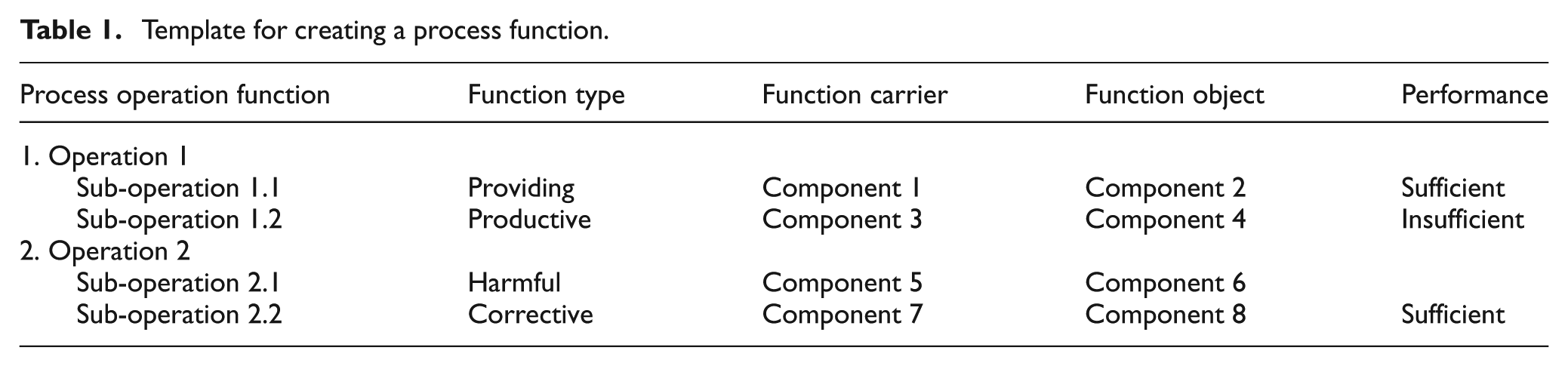
Template for creating process function model is presented in Table 1. Function carrier and function object in the table help to identify new process carrier after process trimming and reveal resource for problem-solving.
Template for creating a process function.
The general process of process function model is as follows:
Flow down overall process into sub-process operations based on problem situation. The sub-process operation may still contain several detailed processes.
Identify the detailed processes in the sub-process operation.
Determine action sequence and interrelationship of sub-processes.
Identify the function types of process operation, function carrier, and function object of the process operation and the process function performance for different detailed processes.
Create the process function model.
Methodology
The general framework is shown in Figure 1. The process consists of six steps. First, based on component function model, component trimming rules, CPIM, process function model, and RCA, process trimming candidates are identified. Then, three types of process trimming strategies are developed according to the corresponding type of candidates. Algorithm of process trimming is presented to identify key problems in technological process. Finally, key problem solving and solution evaluation are introduced to solve the key problems and evaluate the solutions.
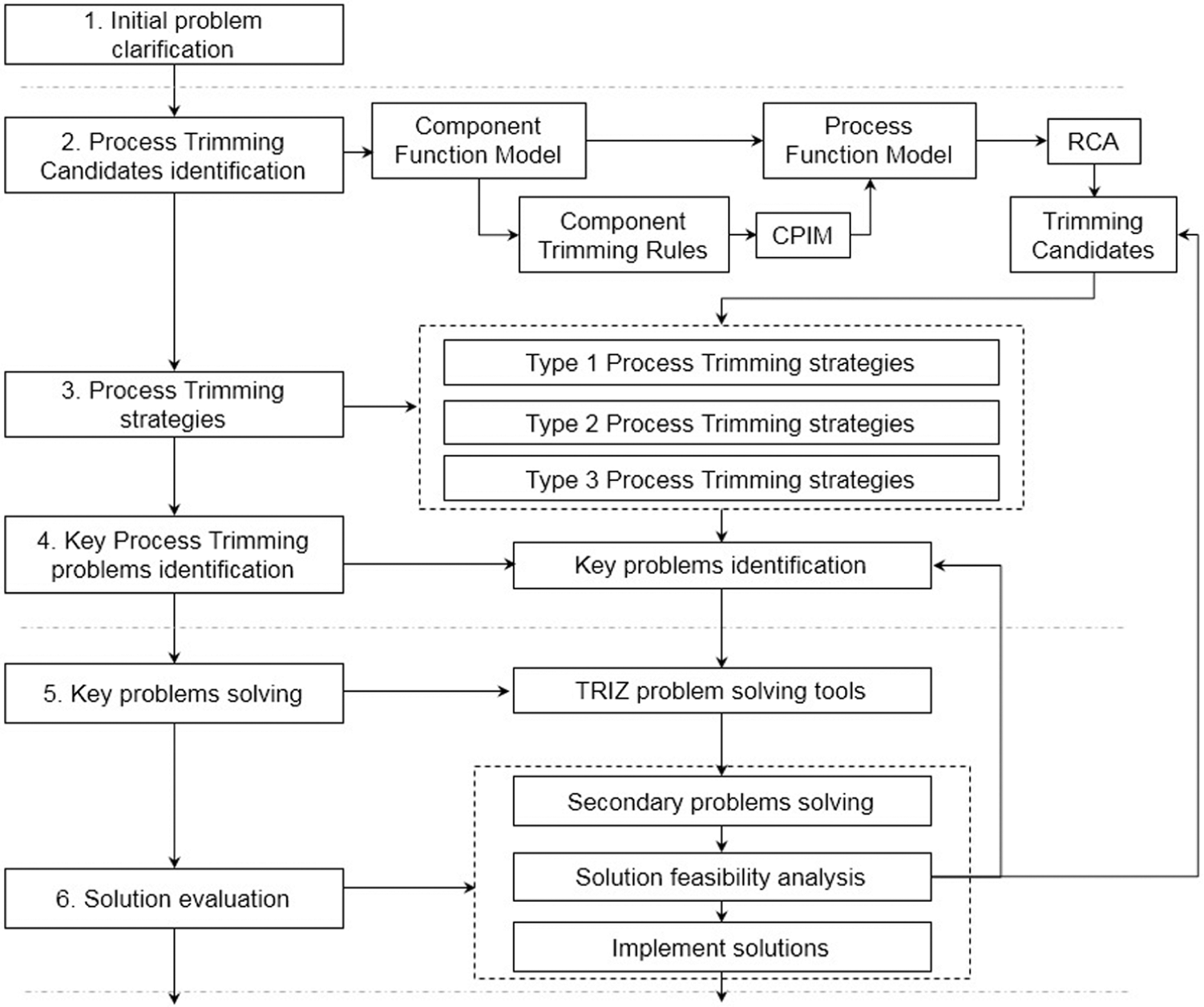
General framework for technological process and product innovation.
Process trimming candidates identification
This stage is to identify process trimming candidates for process trimming. Key tools including device function model (component function model), component trimming rules, process function model analysis, CPIM, and RCA are used to identify process trimming candidates. Process trimming candidates can be the operation process that has useful function, harmful function, and insufficient function.
Process trimming candidates come from the following process:
The process with useful function that has high cost or low functionality based on VA.
The operation process with useful function that its process object products or materials are trimmed in component function model.
The operation process with key disadvantage function (harmful function, insufficient function, etc.) in process function model.
The operation process that provides conditions for key disadvantage function in process function model.
The operation process that suffers or corrects the key disadvantage function in process function model.
The operation process that linked with key disadvantage function identified by RCA.
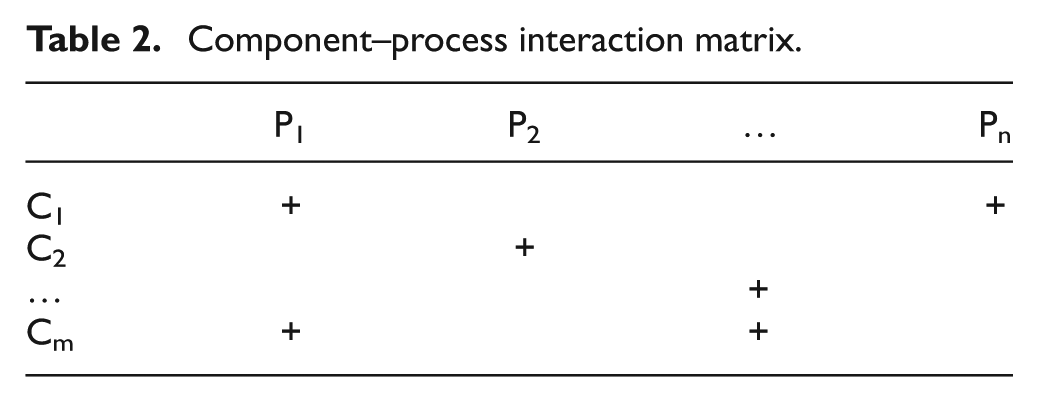
CPIM is presented in Table 2 to identify process trimming candidates. The matrix is one m × n matrix which has m components and n operation process. A “+” means the component relates to one operation process. The description of using CPIM for process trimming is given in section “Process trimming strategies.”
Component–process interaction matrix.
RCA 6 reveals the root causes of harmful function in technological process. It helps to identify the process linked with key disadvantages which could process trimming candidate.
Process trimming strategies
The process trimming candidates can be divided into three types:
Type 1, the operation process related to component(s) can be trimmed.
Type 2, the operation process related to component(s) cannot be trimmed, and all the operation processes have useful function.
Type 3, the operation process related to component(s) cannot be trimmed, and the operation process relates to operation process of harmful function (disadvantages).
Three process trimming strategies are developed according to the three types of candidates.
Process trimming strategies for Type 1
Based on component function model, if one component is trimmed related to key disadvantages (such as low functionality value and high cost, harmful function) applying trimming component rules, the operation process related to the component can be trimmed. This will lead to two situations in Table 1.
The first is that if the operation process only has interaction with the trimmed component, the operation process can be trimmed directly.
The second is that the operation process related to the trimmed component also has interaction with other component. It means the operation process should be trimmed after redistributing its useful process function among other operation processes. For example, if component C1 in the matrix is trimmed according to trimming component rules, operation process Pn can be trimmed directly because it only has interaction with C1. While operation process P1 cannot be directly trimmed because it performs useful process function to component Cm. The useful process function to component Cm should be redistributed to other operation processes.
Process trimming strategies for Type 2
There are several kinds of situation that one useful function operation process can be trimmed:
Trimming the adjacent sequence process. The later operation process can be trimmed or substituted if the prior operation is trimmed. The later operation process and the prior operation are in adjacent sequence. For example, if the prior process of productive function is trimmed, the adjacent later process of supporting function and measurement function is not necessarily needed.
Trimming the process that has cause and effect function relation. It should be pointed out that the cause and effect function relation does not have to be in adjacent sequence. There may be other processes between them. For example, it may contain a productive function, and measurement function process between productive function process (cause process) and transport function process (effect process).
The effect process can be trimmed if the cause operation process is trimmed. For example, if the cause process of productive function is trimmed, the effect process (such as productive function, supporting function, and measurement function) is not necessarily needed. The effect process can be trimmed if the cause operation process can perform the effect process function within itself. For example, the effect process of measurement function can be trimmed if the cause productive operation process can perform the measurement function within the process itself.
Integrating the same type of process or adjacent sequence process. For example, several productive function processes that have no adjacent sequence or cause and effect relation can be merged into one productive function process. Meanwhile, several adjacent sequence processes can also be merged into one process.
Using another new process can perform initial process function better.
Transferring the process to the preceding or subsequent process. Then, the operation process may receive more available or convenience resource (material, energy, information, etc.) to perform the required function.
Process trimming strategies for Type 3
Type 3 of process trimming candidate situation is more complex because the operations have defect and other useful function process link with it, which is depicted in Figure 2. This will lead to two situations.
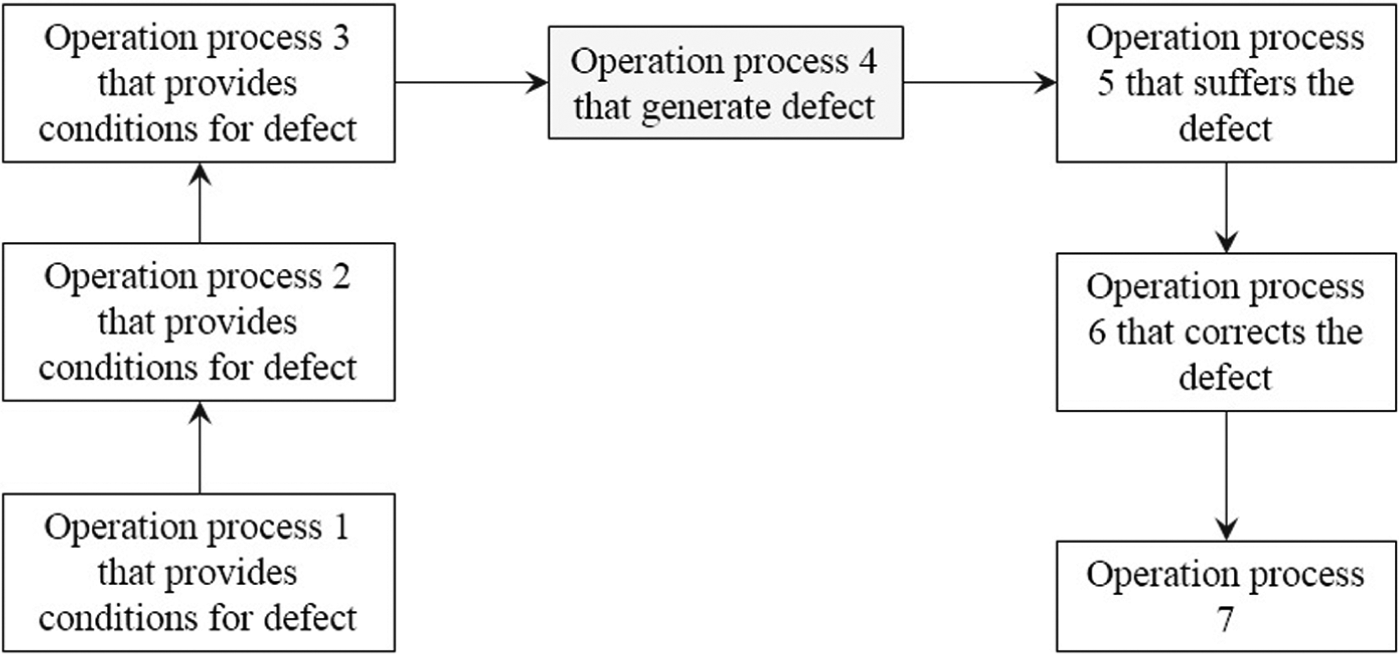
Technological process with defect.
The first is that the defect process can be trimmed.
Eliminating or changing the condition process. If one of the processes that provides the defect conditions is eliminated, or the process that generate defects is changed which making the defect is not generated, the process that corrects the defect can be trimmed. 11
Trimming the defect process and substituting one new process to achieve the same or better function.
Transferring the defect process to the preceding or subsequent process. Therefore, more available resources could be used to perform the function, which makes the defect disappear.
The operation process that generates the defect is eliminated; the process that corrects the defect can be trimmed. 11 The defect process is the cause process and the correct process is the effect process. The correct process is needed because there are defects in the cause process.
Trimming the defect process and redistributing its function into other remaining processes.
While the second situation is that the defect process cannot be trimmed. In order to deal with this type of problem, the following strategies are suggested to reduce the influence of harmful process:
The process that provides the defect conditions or generates the defect can be transferred to the preceding or subsequent process. Therefore, the defect is not sensitive to other processes.
The operations that are suffered by a defect are changed in such a way that they become insensitive to it. 11 Therefore, the need for performing a corrective function is eliminated.
If the process that generates the defect is corrected by itself, the initial corrective process can be trimmed. 11
If the process that generates the defect is corrected by another corrective process, the initial corrective process can be trimmed.
Key process trimming problem identification
Based on the last step of different process trimming strategies, this step identifies key process trimming problems for next stage of problem-solving. If one operation process is trimmed, the useful functions of the process should be redistributed to other new function carrier processes to perform the function.
Therefore, new process carrier should be identified at first. The new process carrier could be the following:
The adjacent sequence process.
The cause and effect function relation process.
The same type of process.
The preceding or subsequent process.
The process has necessary resource (such as substances, energy, and information resources) to perform the required process function.
Then, based on new process carrier identification, key process trimming problems could be generated. The process trimming problem statement is as follows:
How to eliminate the process?
How to make the new process carrier (for instance, adjacent sequence process, cause and effect function relation process, same type of process, the preceding or subsequent process) perform the initial process function?
These process trimming problems may lead to different types of TRIZ problem model (for instance, Su-field problems, engineering contradictions problems, and physical contradictions problems), which could be solved at problem-solving stage.
Once we need to solve a defect process of cutting electronic components’ thin film in manufacturing process. The thin film is placed on the component surface to protect the component during later process. Initial operation process used a machine with cut tool to cut the thin film after it sticks to the component surface. However, because the assembly gap between the part and other parts is very small, it leads to cut tool interference with other parts during the cutting process and generates production defects. Therefore, we trim the defect process of using a machine with cut tool and transfer its process function to the subsequent process. Then, the key process trimming problem is: how to make the subsequent process perform the cutting function? This process trimming problem and problem practical constrain lead to a physical contradiction problem: the hardness of a component X in the subsequent process should be solid to cut the thin film; however, the hardness of component X should be soft not to interfere with other parts. Physical contradiction indicates two opposite requirements on a single physical parameter of the system. 21 Convention innovative methods could hardly solve the contradictions problem, while this is the uniqueness and powerfulness of TRIZ. After careful resource analysis of the process, the factory has a lot of available amount of compressed air and the cost of air is not high. The compressed air is used as component X to perform the required function. It could cut the thin film very well; meanwhile, it will not interfere with other parts. This case indicates that process trimming problem helps to solve the problem without changing the process too much in an inventive way (solving the contradiction problem) and maximize using existing system resource (the subsequent process) and supersystem resource (compressed air).
Algorithm of process trimming
The step-by-step process of trimming for process is as follows:
Build component function model and process function model.
Identify process trimming candidates according to section “Process trimming candidate identification.”
Select one operation candidate in the process for trimming and identify the process functions of the candidates.
Use the corresponding process trimming strategy for a process function of the candidate based on different problem situations depicted in section “Process trimming strategies.”
Identify a new operation to perform the initial function.
Build the new process function model.
Formulate the process trimming problems.
Repeat steps 4–7 for all functions of the process operation selected in step 3.
Repeat steps 3–8 for all process operation candidates to be trimmed and generate process trimming problems.
Problem-solving
The process trimming can be transformed into different types of problems, which have been pointed out in section “Key process trimming problem identification.” These types of problems could be engineering contradiction problems, physical contradiction problems, Su-field problems, “How to” problem, and complex problems. Then, TRIZ problem-solving tools can be used to solve these types of problems. The general process of using TRIZ problem-solving tools to solve these problems has been disclosed in prior works.6,21 TRIZ problem-solving tools provide general abstract solution suggestions for the corresponding type of problem. Our case example in this article uses Su-field analysis to solve the problem. Therefore, Su-field analysis will be discussed.
Su-field (substances and fields) analysis is a model of a minimal technological system “object–tool–energy” to perform only one function. 8 Object is the function object and tool is the function tool that can also be called as function carrier in function analysis. Su-field helps to target function problems (harmful, insufficient, or excessive function) and provides standard solution suggestions. Transforming function model into Su-field model is illustrated in Figure 3.
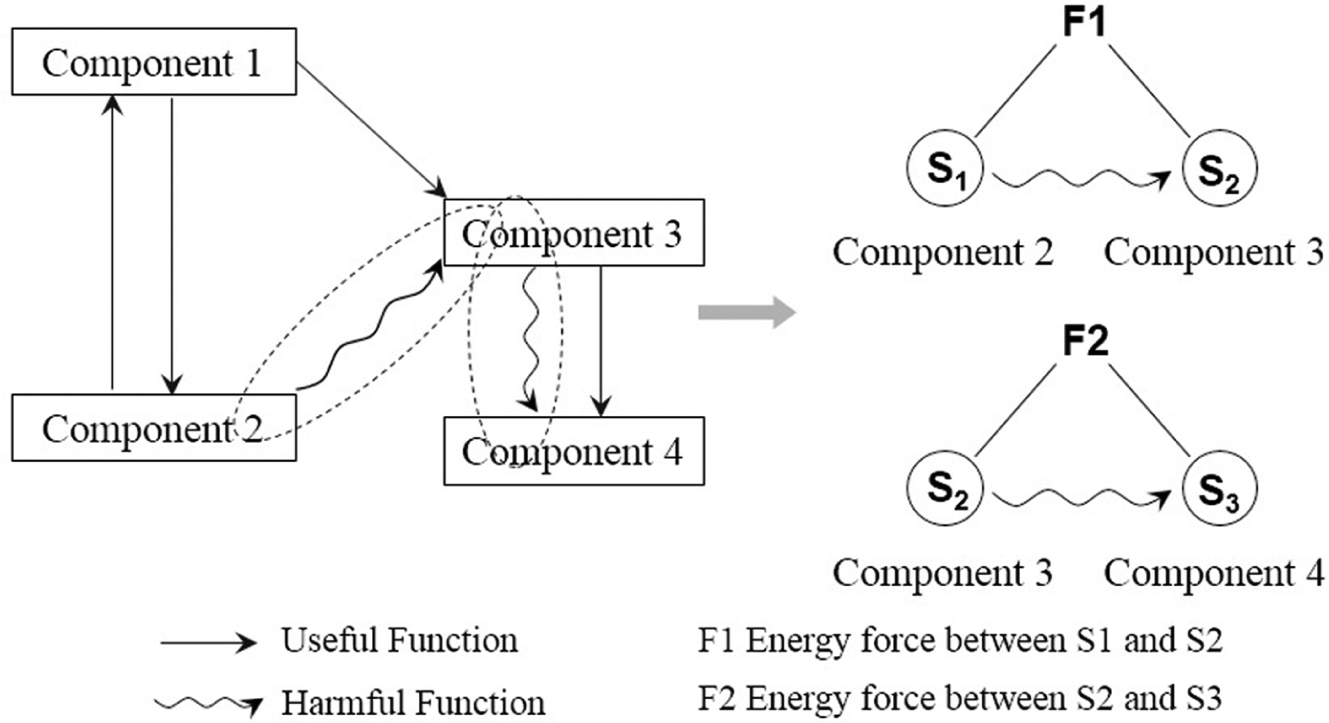
Transform function model into Su-field model.
There are five classes of standard inventive solutions including 76 standard solutions model to solve Su-field problems, which are as follows:8,21,31,57
Class 1: building and destruction of substance-field models.
Class 2: development of substance-field models.
Class 3: transition to supersystem and micro level.
Class 4: standards for detection and measuring.
Class 5: standards on application of standards.
Solution evaluation
This stage is generally to transfer general abstract solution to concrete design solution, solve secondary problems, evaluate solution feasibility, and further implement the solution. Secondary problems reflect the side effects or other drawbacks associated with the obtained solution.32,33 Trimming different processes will result in different trimming problems. Therefore, if the key problems do not generate proper solution or the solution is not feasible, we can go through back to adjust the problem and solve other key problems and repeat the innovation process.
Case example: door foam of three-and two-door refrigerator design
Case background
One-door foam of refrigerator in China market is shown in Figure 4. The door is made of toughened glass, and the control printed circuit board (PCB) display is pressure sensitive. An amplification view for Section B-B is presented in Figure 5. The manufacturing process is to produce door foam with components, component assemblies, labor, and machine.
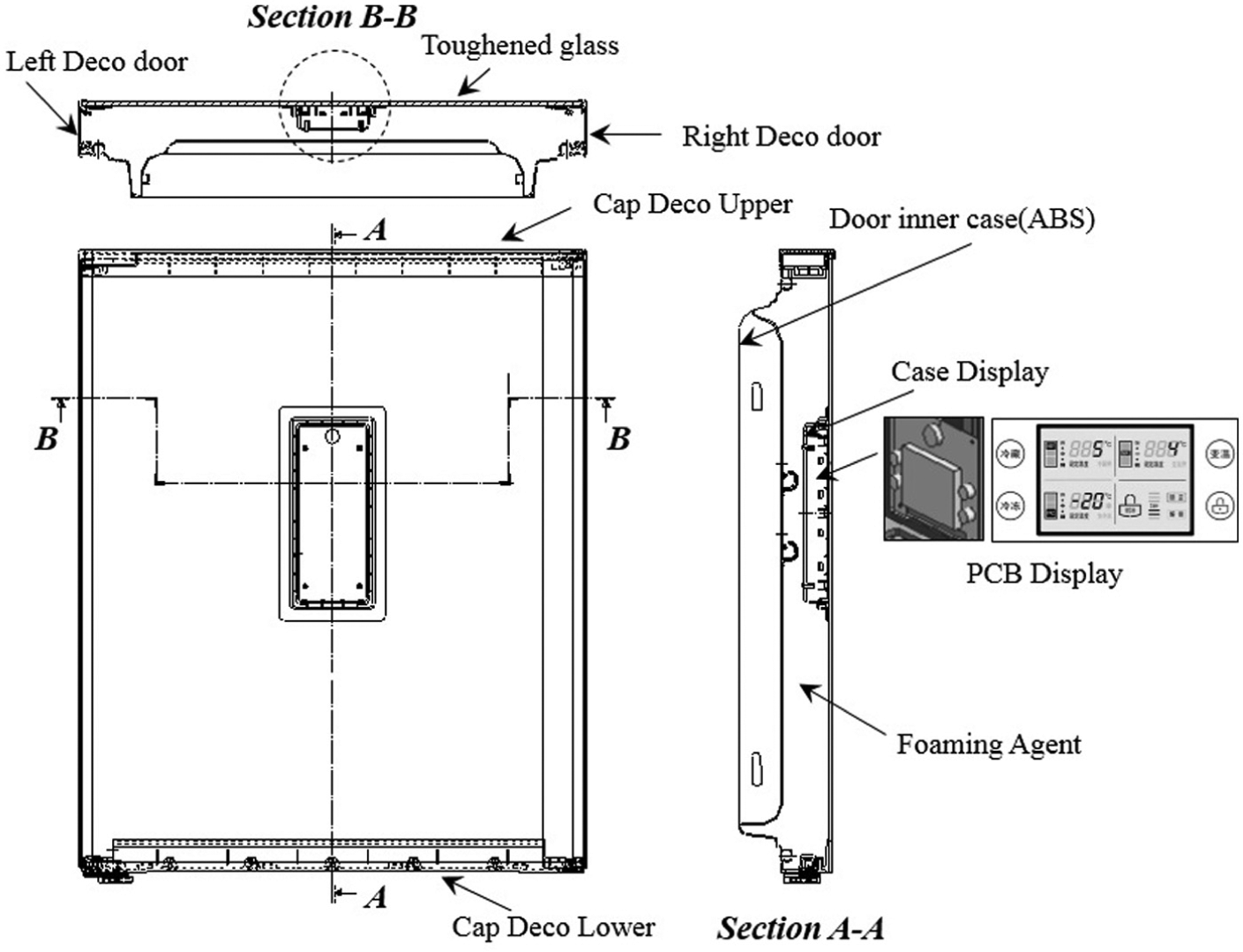
Door foam of refrigerator.
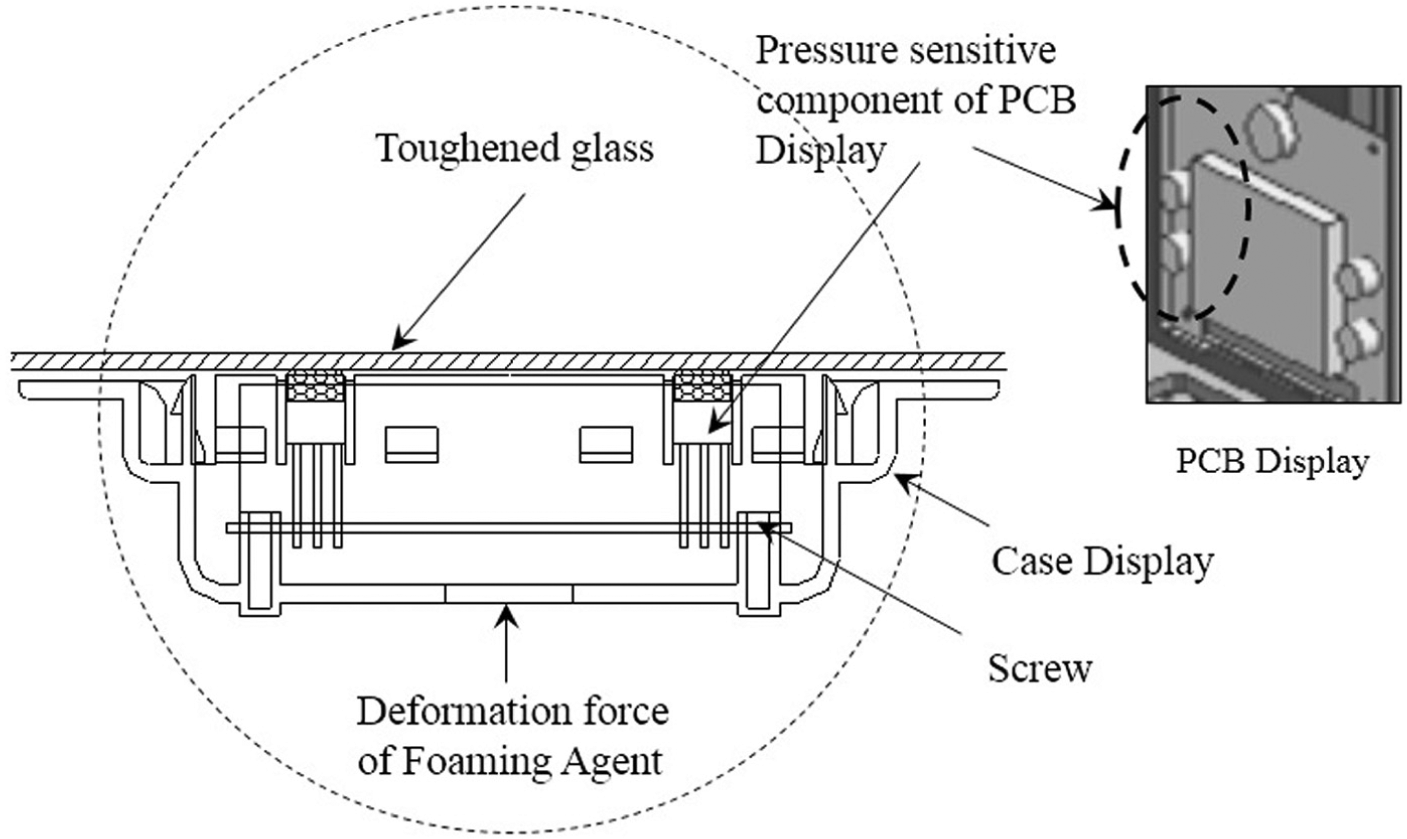
An amplification view for Section B-B.
The initial production manufacturing processes are as follows:
Assemble PCB display assembly with PCB display and case display.
Attach PCB display assembly into toughened glass with tape.
Assemble door frame with cap deco lower, cap deco upper, left deco door, and right deco door.
Assemble toughened glass assembly into door frame.
Put door frame into the mold half.
Put door inner case into the other half of mold.
Inject foaming agent into door frame and close the mold.
Molding door foam nearly 10–20 min in thermal insulation chamber of the production manufacturing line.
Then, open the mold and take out the door foam.
The problem is when molding door foam, foaming agent with high temperature deforms case display made with plastic part. The PCB display in case display also deforms. Therefore, PCB display will lead to pressure insensitivity in the design location. The product manufacturing defect rate is high. Meanwhile, when the defect door foam comes to market, the door has to be changed and service costs are increased. A research is carried out to solve the problem.
Process trimming
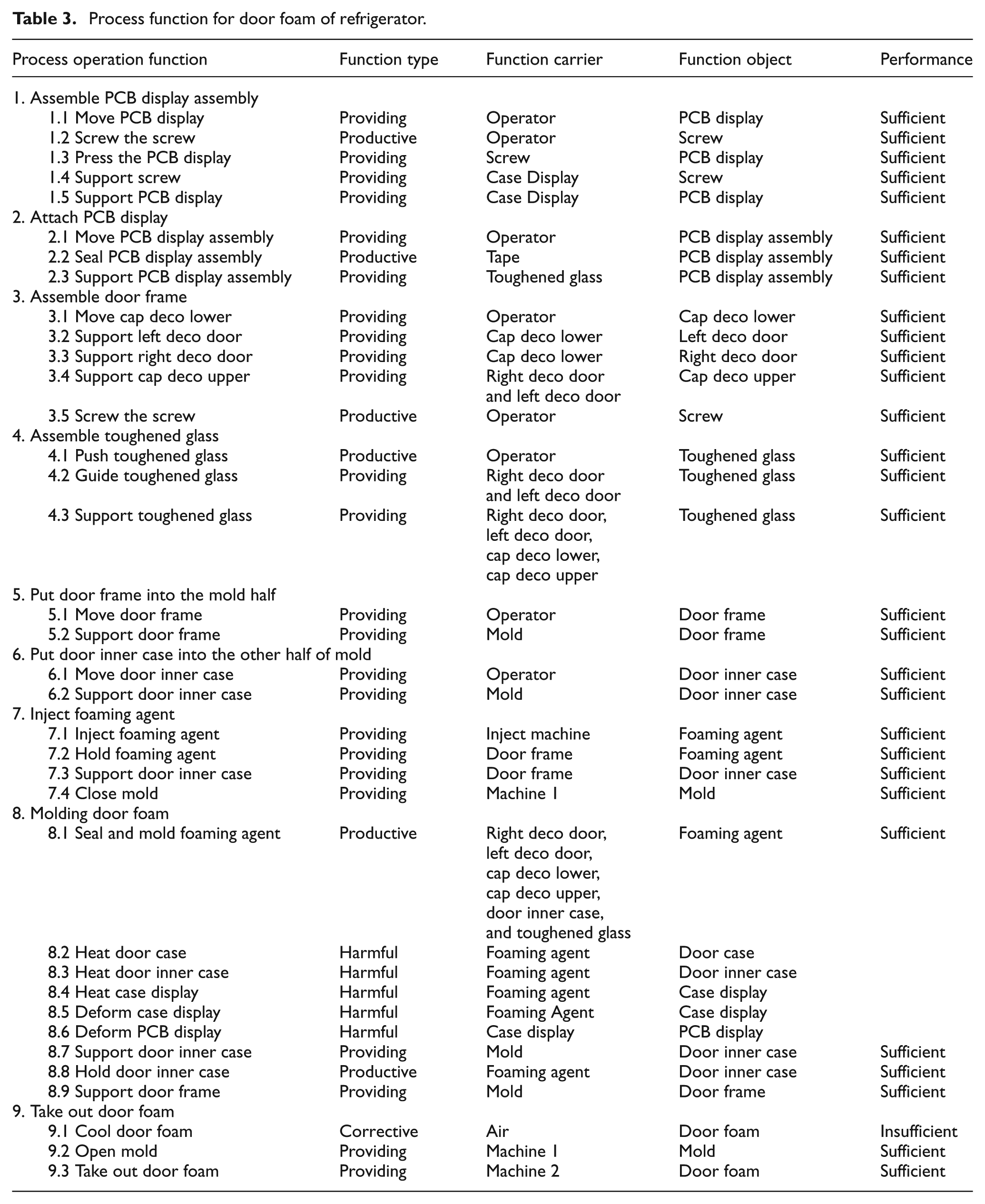
Function model analysis, process function, and process function model for door foam of refrigerator are presented in Figure 6, Table 3, and Figure 7, respectively. Function model identifies key function disadvantages, which could help to reveal process trimming candidates. The harmful functions are as follows: foaming agent deforms case display and case display deforms PCB display. Foaming agent, case display, and PCB display could not be trimmed because these components perform some useful functions. Therefore, process trimming strategies for Type 1 cannot be used.
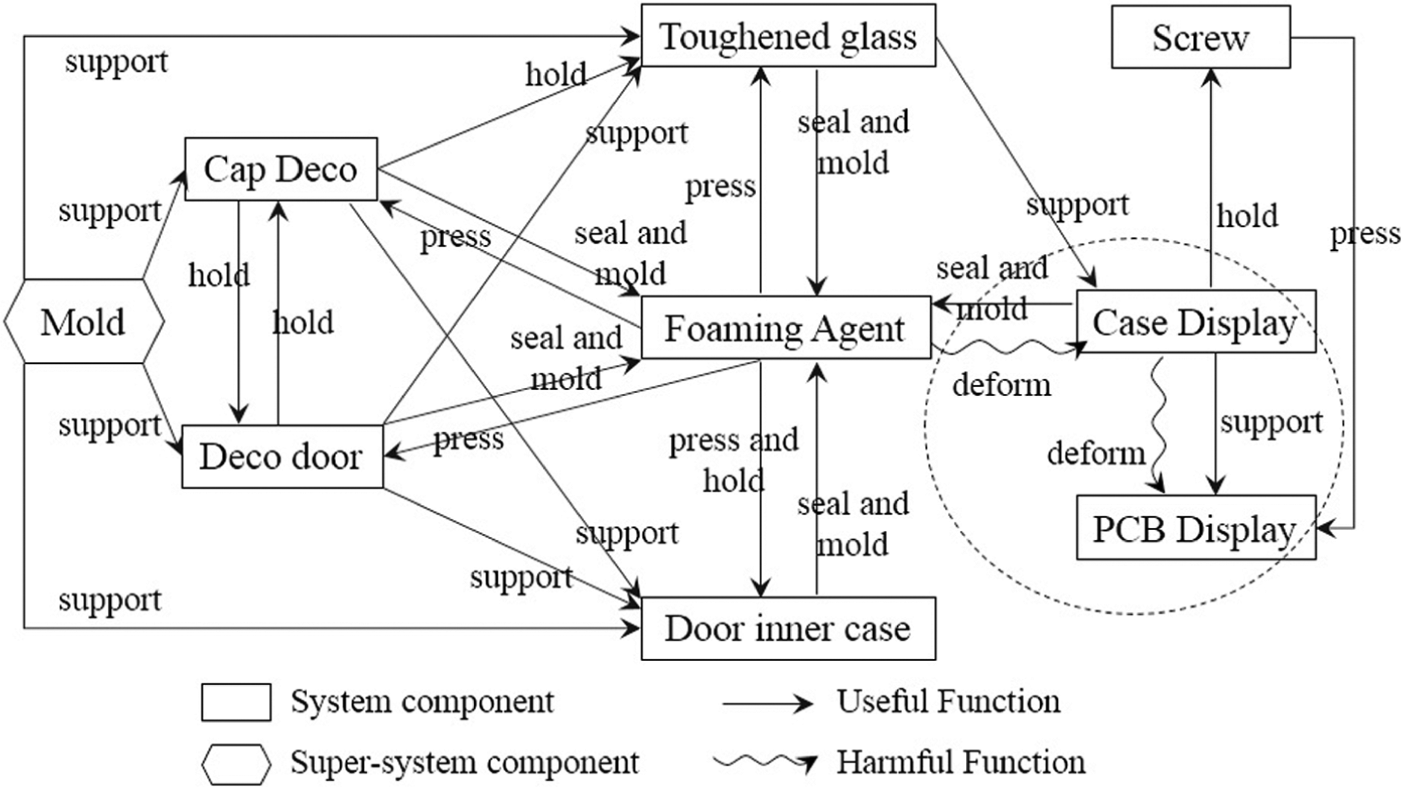
Function model analysis.
Process function for door foam of refrigerator.
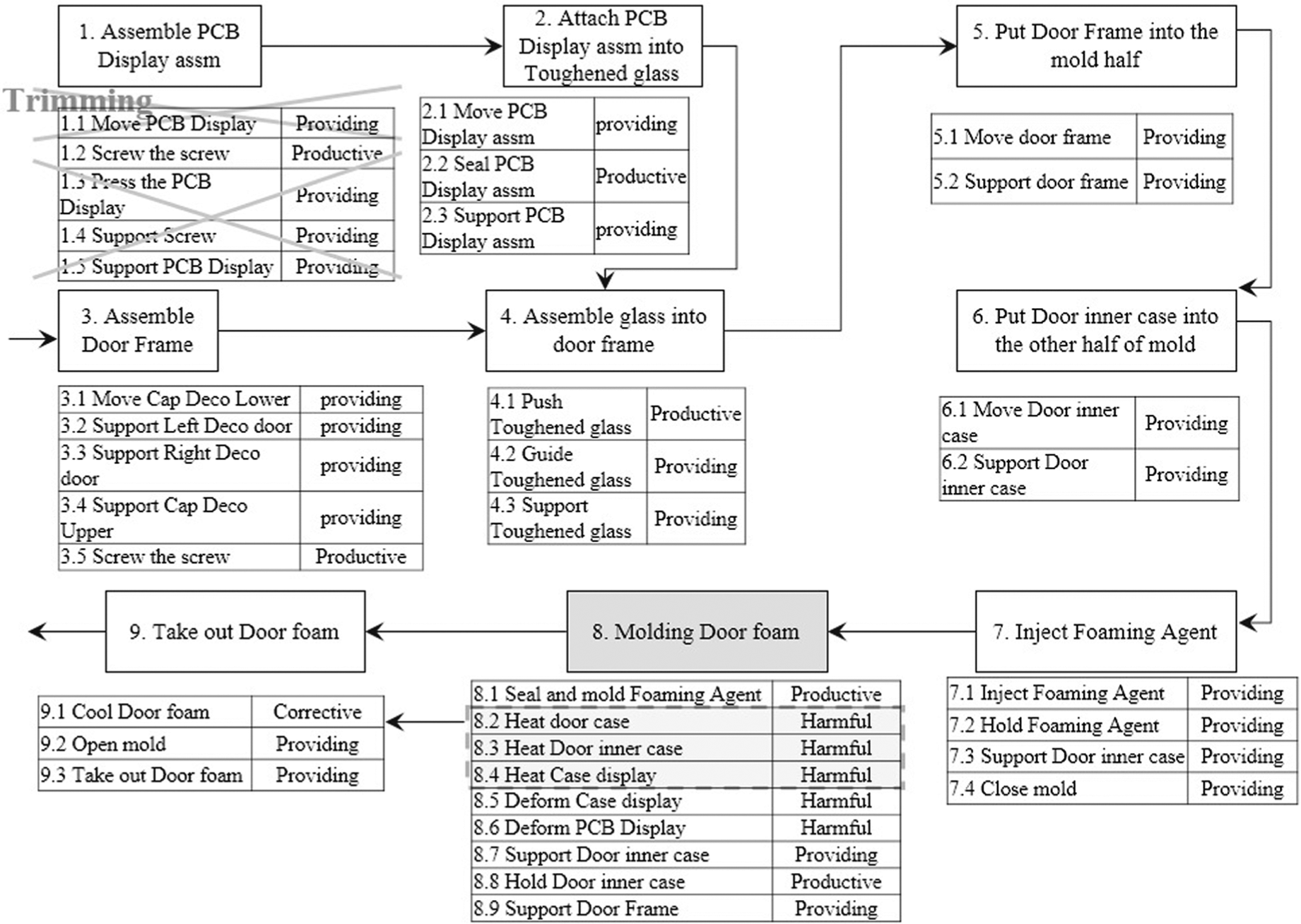
Process function model of door foam.
Five harmful process functions are identified, which are in processes 8.2–8.6 in Table 3. Processes 8.2 heat door case, 8.3 heat door inner case, and 8.4 heat case display generate harmful function, which are corrected by process 9.1. Processes 8.5 and 8.6 are key harmful disadvantages that we want to eliminate in the technological process. RCA is used to identify the process candidates that relate to processes 8.5 and 8.6.
RCA for processes 8.5 and 8.6 is created in Figure 8. Key harmful disadvantage in process 8.5 is root cause of process 8.6. Based on problem constrains, many factors that affect the case display deforming cannot be avoided, such as deformation force of foaming agent and stress concentration. Improvement design of case display is one direction for problem-solving. Meanwhile, if case display does not support PCB display in operation step 8 of molding door foam, key harmful disadvantage of PCB display deforming in process 8.6 can be avoided. The processes 1.2–1.5 are all linked with process 1.1 Move PCB display. Therefore, processes 1.1–1.5 are the candidates for process trimming.
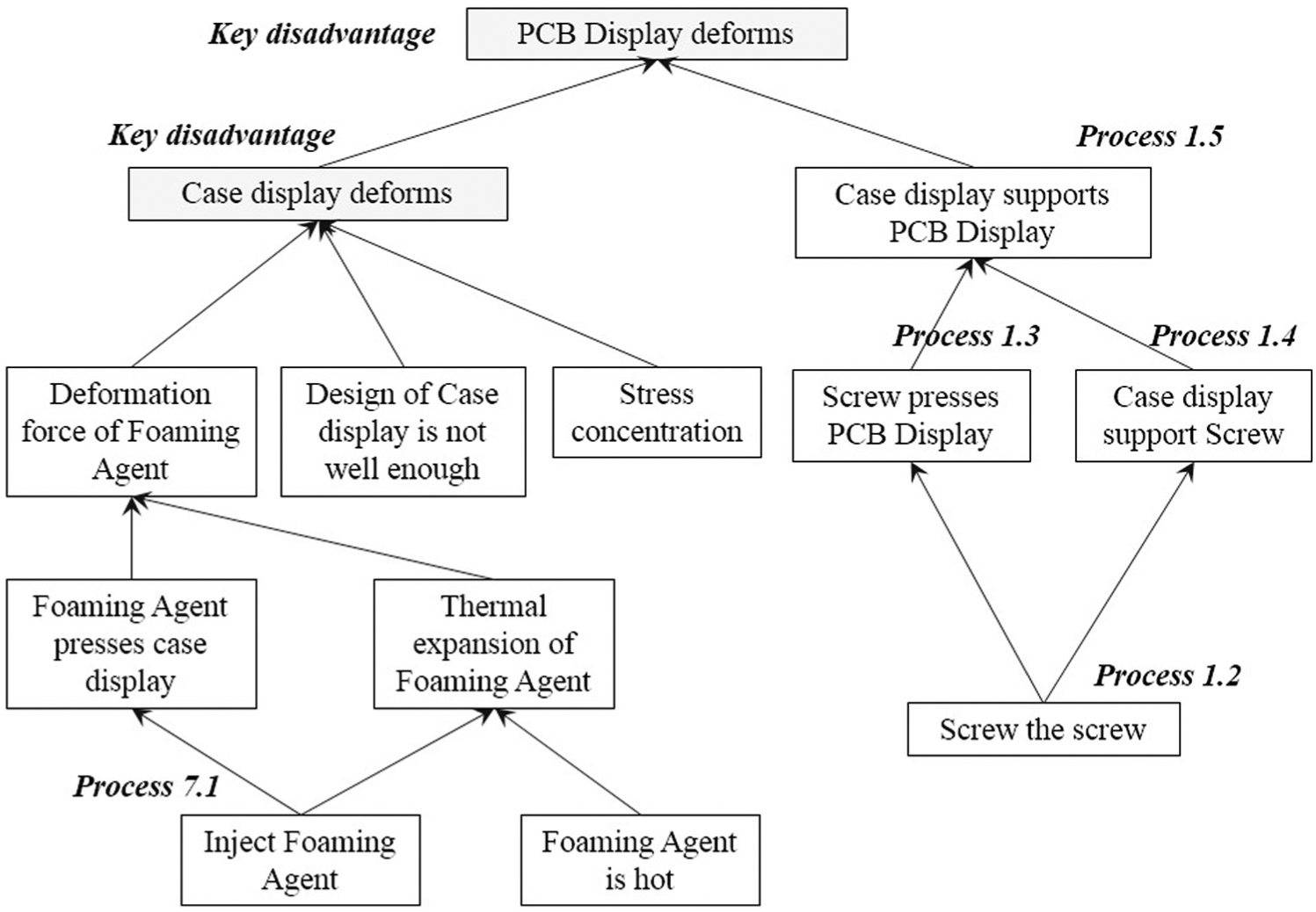
Root cause analysis.
Process trimming strategies for Type 3 problem are suitable to deal with the case example problem. Because the process harmful functions 8.2–8.6 cannot be trimmed, the second situation of process trimming strategies for Type 3 is applied for process trimming: trimming processes 1.1–1.5 of move PCB display and transferring to the subsequent molding door foam process that deformation is not sensitive to these processes. However, functions of processes 1.1–1.5 are needed to be performed.
The process trimming and function model analysis generates the following key problems that need to be solved:
How to transfer manufacturing processes 1.1–1.5 to the subsequent molding door foam process that deformation is not sensitive to those processes after molding door foam.
How to stop deformation effect of foaming agent to case display and case display to PCB display.
Problem-solving
After key problems are identified, problem-solving tools of TRIZ are used to generate abstract solution suggestions.
Su-field analysis is presented in Figure 9. To stop or decrease deformation effect of foaming agent to case display and case display to PCB display, general solution models are suggested based on standard solutions. Substances of S4 and S5 are introduced to stop the deform effect. They can be as follows:
Modified substance of S2 or S3;
Existing substance in the system;
New substance to the system.
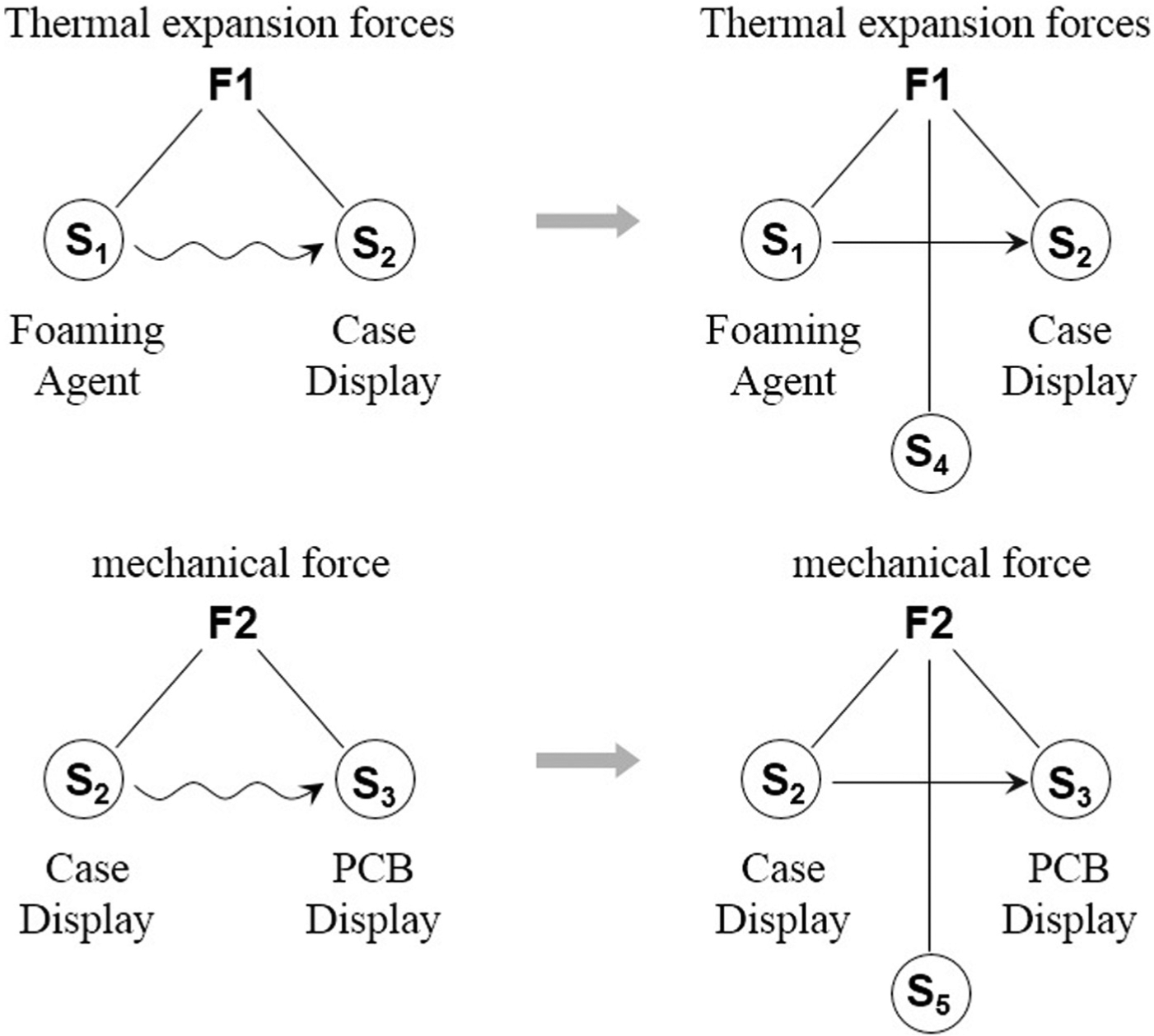
Su-field analysis.
Finally, the abstract solution is transferred to concrete solution, which is illustrated in Figure 10. In Figure 9, case display (S4, modification of S2) is a new design that sets aside space for PCB display installation after molding door foam. Therefore, the PCB display pressure sensitive becomes insensitive to deformation of case display. Cap deco upper (S5, existing substance in the system) is used to support case display when molding door foam.
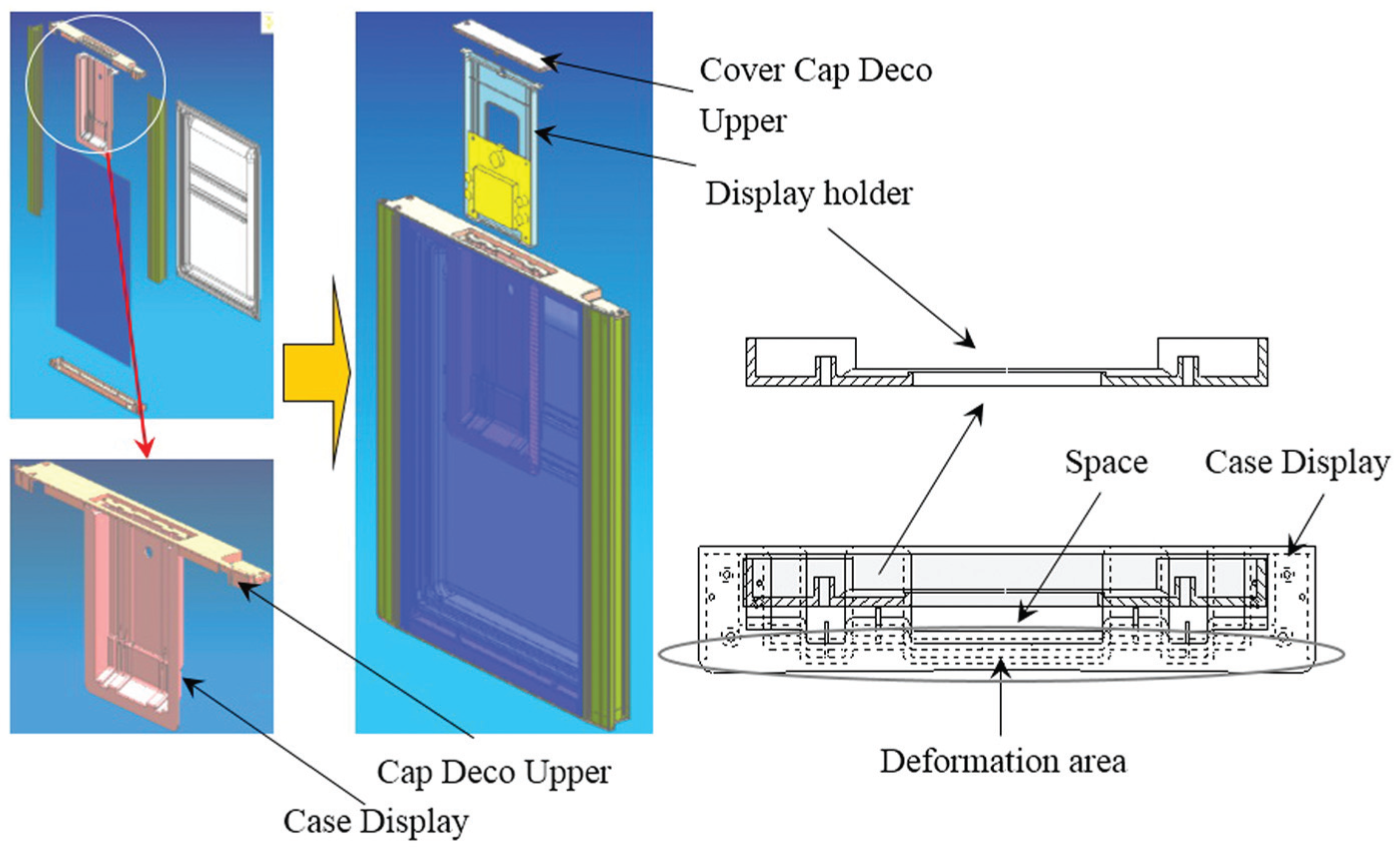
New design of door foam.
The solution generates a secondary problem: foaming agent still could deform new design of case display because it has hollow space. Su-field analysis is used to solve the secondary problem. A tooling made of wood or plastic is put into the case display to stop the deformation effect.
The new production manufacturing processes after trimming are as follows:
Assemble cap deco upper assembly with case display and cap deco upper.
Assemble door frame with cap deco upper assembly, cap deco lower, left deco door, and right deco door. Put the tooling into case display.
Assemble toughened glass into door frame.
Steps 4–7 of new production manufacturing process repeat the process of initial steps 5–8 production process.
8. Then, open up the mold and take out the door foam and then remove the tooling in case display.
9. Put PCB display and display holder into case display and cover with cover cap deco upper.
If the initial design generates defect in production or service, the door foam will have to be discarded. While new design and production process greatly decrease the defect of pressure insensitivity in the design location. The new design solves the problem without changing the process and product too much and maximizes using existing system resource (the subsequent process) and supersystem resource (using tool to support case display and removing it after taking out door foam). There may be still some deformation of case display after removing the tool. However, the space between case display and display holder in Figure 10 makes deformation not sensitive to the subsequent molding door foam process. The PCB display in new design could change very easily for maintenance and service. Therefore, the new solution greatly decreases defects and cost of service.
Conclusion
In order to identify key problem and solve the problem in an inventive way, this article proposes an integrated and structured process for technological process and product innovation with TRIZ. It is different from conventional design methods and innovative approach. Compared with other innovative design methods mentioned in section ““State of art,” our method provides a logically structured method from process trimming candidate identification, process trimming strategies according to the corresponding type of candidates, and key process trimming problem generating. Then, TRIZ problem-solving tools are used to solve key problems in an inventive way (solving conduction problems, Su-field problems, and transferring solution from other domains into our specific problem) and maximize use resource of system and supersystem.
Our previous works6,21 mainly focus on component function analysis and component trimming for product innovation. While this article mainly focuses on technological process innovation problem based on process function analysis and process trimming. In particular, process trimming candidates for process trimming are identified based on component function model, component trimming rules, process function model analysis, CPIM, and RCA. Then, three types of process trimming strategies are discussed according to the corresponding type of candidates. Trimming process operations and transferring the functions to other process help generate new types of problem that may have never been thought before. Algorithm of process trimming is presented to identify key problems in technological process.
Contributions of the article include the following:
Establishing a framework based on process trimming candidate identification, process trimming strategies, key process trimming problem identification, and TRIZ problem-solving tools for technological process and product innovation;
Developing a way to identify process trimming candidates based on component function model, component trimming rules, process function model analysis, CPIM, and RCA.
Identifying key problems to be solved according to process trimming strategies and algorithm of process trimming that have been developed.
Applying the method to solve door foam of refrigerator design and manufacturing process, the new solution significantly improves product quality and reduces cost.
TRIZ is only one of the effective methods for product and process innovation. It requires systematic way from problem identification to solution optimization and evaluation for innovation. Meanwhile, in order to support product development lifecycle, TRIZ still needs to be integrated with other innovation methods for different goals at different lifecycle stages. For example, TRIZ is integrated with QFD, DOE, robust engineering, and AHP to provide more practical solution focused on right goals from voice of customers. Research efforts will also be spent on further implementation of TRIZ into different applications, for example, DFSS, patent strategies, lean product development (LPD), and service design.
Footnotes
Acknowledgements
The authors appreciate anonymous reviewers, Dr Sergei Ikovenko and Dr Yongwei Sun, for their helpful comments and suggestions on earlier drafts of this article.
Declaration of conflicting interests
The author(s) declared no potential conflicts of interest with respect to the research, authorship, and/or publication of this article.
Funding
The author(s) disclosed receipt of the following financial support for the research, authorship, and/or publication of this article: The author would like to thank Shanghai Institute of Producer Service Development (SIPSD) and Shanghai Research Center for Industrial Informatics (SRCI2) for the funding support to this research.