




Abstract
Industrial emergence is a broad and complex domain, with relevant perspectives ranging in scale from the individual entrepreneur and firm with the business decisions and actions they make to the policies of nations and global patterns of industrialisation. The research described in this article has adopted a holistic approach, based on structured mapping methods, in an attempt to depict and understand the dynamics and patterns of industrial emergence across a broad spectrum from early scientific discovery to large-scale industrialisation. The breadth of scope and application has enabled a framework and set of four tools to be developed that have wide applicability. The utility of the approaches has been demonstrated through case studies and trials in a diverse range of industrial contexts. The adoption of such a broad scope also presents substantial challenges and limitations, with these providing an opportunity for further research.
Introduction
The emergence and establishment of new industrial activity is a matter of both fascination and concern for managers and policymakers alike. While the contribution of technological development in driving innovation and fostering economic activity is widely appreciated, the relationship with the growth of firms, leading on to wider scale development of new industries, is less well understood. The means by which scientific discovery and other stimuli to new forms of economic activity feed through into the developing structure of industry are not at all clear. During the growth of new firms, the adaption of existing players and the evolution of the industry structure within which they sit, there appear to be many pitfalls and barriers, which will need to be overcome before a new industry may be seen to be established.
However, within this challenging context, entrepreneurs, industrial managers, policymakers and scientific research funding bodies are all variously motivated to understand these issues better and facilitate a more effective transition of knowledge from the science base into established, sustainable, profitable, industrial activity. Porter’s
1
definition of emerging industries as newly formed or re-formed industries that have been created by technological innovations, shifts in relative cost relationships, emergence of new consumer needs, or other economic and sociological changes that elevate a new product of service to the level of a potentially viable business opportunity
gives some insight into the many factors that could influence the emergence phenomenon.
Given the variety of possible influences, it is perhaps unsurprising that contributions of potential value in better understanding this phenomenon arise from many different disciplines. In this article, several of the perspectives that help to shed light on this important issue are reviewed, including co-evolutionary complex adaptive systems and patterns of industrial dynamics. The aim is to identify the characteristics of the emergence phenomenon that have general applicability. Consideration is given to possible means of structured analysis of complex technological and industrial system dynamics and the potential suitability of roadmapping approaches in this context. This search for pattern has been extended to the review of previous examples of industrial emergence, by means of a mapping process, as a result of which some phases and transitions in the emergence phenomenon may be recognised. Based on this review of theory and practice, a framework for industrial emergence is proposed, which summarises the patterns observed.
This article goes on to briefly report the development of four management tools. The framework and associated methods are designed to improve understanding and anticipation of the associated pitfalls and barriers to emergence, enabling more effective management practice. In conclusion, potential future uses of these ideas are discussed and opportunities for further research explored.
Existing investigations into industrial emergence phenomena
This section provides a review of literature considering industrial emergence and methodology to investigate the relevant systems associated with this emergence. Particular features are found, which characterise technology-based industrial emergence, and then, frameworks and models that are currently used to explore industrial dynamics are examined.
Industrial emergence systems
Explanation of terminology
Many emerging industries are ‘based on a technological innovation meeting a new or existing customer need’, 2 and technology has been described as a ‘catalyst for economic growth’. 3 Therefore, the investigation of technology-based industrial emergence is likely to be of interest to personnel in both organisational management and policy-level decision-making bodies.
Technology itself is complex – consisting of highly integrated architecture and subsystems. 3 Technology does not exist in isolation but develops through ‘quasi-evolutionary dynamics of technical change’, 4 interacting with cognitive, economic and other social factors. Therefore, when investigating the emergence of technology-based industries, it is important to consider the system in which they are involved and the interactions and feedback loops within that system. 5
The process of emergence can be defined as ‘the arising of novel and coherent structures, patterns and properties driving the process of self-organisation in complex systems’. 6 This definition emphasises several key aspects: novelty, structure and patterns, self-organisation and complexity. It is also clear that emergence has a dynamic, temporal component, 7 and any examination of emergence phenomena needs to consider the system evolution over time. 8 It is well known that an industry is not a static entity but evolves over time in terms of context, 9 environment, structure, 10 organisation structure and strategic business propositions. 11 However, little is known about the early stages – the emergence of the industry. 12
Defining an ‘industry’ in itself is difficult, 13 and there are also similar difficulties in defining an ‘industrial system’, particularly in specifying the boundaries. 10 These socio-economic systems have a considerable number of interacting factors influencing the system’s development, including existing products, processes, materials and organisational forms. 14 This multifaceted nature is an important feature of emerging industries, as indicated by Porter’s 1 definition.
Within industrial emergence, there are multiple perspectives from a range of actors and stakeholders, 15 some with more influence than others. 16 Emerging industries are formed through both de novo and incumbent firms, 17 and an established industry sees similar issues to that in an emerging industry when there are fundamental changes in competitive rules accompanied by an order or magnitude in growth. 1 Policymakers, investors, supply chain actors, potential customers, companies, managers and entrepreneurs all have an interest in and effect on industrial emergence. 18
Dimensions of industrial emergence
In the very early stages of an industry, it will not even be recognised as an industry; 19 however, at this time, events and activities occur, on which the industry is built, 8 and it is these which are of particular interest to this research. How an industry evolves depends on many of the different factors relevant to the industrial system 18 and also on path dependency – what has happened in the past, 8 the initial conditions and the system’s interaction with its environment. 20 Different enablers and barriers within the industrial system will speed up or slow down progress.7,21
Therefore, emerging industrial systems would be expected to have an important turbulent, temporal dimension, multiple factors of influence with several actors and stakeholders involved. A structure becomes apparent over time, through interaction of the different system components and interaction with the environment the system is developing in. 4
Demand and supply dynamics influence the development and progression of the system.22,23 The organisational structures found within industrial systems – investment communities, firms, networks and so on – will influence how actors adapt their strategies in response to patterns seen in their complex environment,24,25 and it is this active choice of strategic development which differentiates the evolution of industrial systems from the blind variation characteristic seen in biological evolutionary systems. 4 This self-organisation 26 is characterised by agents and organisations manipulating their environments, attempting to turn situations to their own advantage, learning and adapting through these experiences.3,27 In this sense, the technology-based industry systems are seen to be complex, adaptive, co-evolutionary systems,27–29 involving many dimensions but self-organising and adapting within their environment.
Characteristics of industrial emergence
Within these complex adaptive systems, there are certain features we would expect to observe particularly as the system itself is emerging. In the early stages of industrial evolution, there is much uncertainty1,30 about many aspects of concern to different relevant actors. 31 This lack of knowledge and uncertainty lead to a requirement for ‘pioneers’ 32 in the industry to establish legitimacy. 33 It is expected that these uncertainties will reduce over time, as the system becomes established, 34 in the same way as uncertainties for company R&D projects reduce with time. 35 The uncertainties of multiple actors will relate to their existing technological frames, which can be manipulated through communication by firms, to improve adoption. 18
One of the mechanisms for establishing legitimacy within a new industry is to use artefacts, such as products, 9 and demonstrations, such as competitions, 36 to provide personal experience, which can then be used to communicate with other relevant actors. 33 These artefacts or ‘mediating devices’ will change in form and function over time, adapting through consumer learning and experience. 9 Firm-level actions such as niche market formation and early interaction with prototypes and concept demonstrators are an important articulation process during technology development. 37 Successful articulation leads to new technologies becoming part of, or overthrowing, incumbent regimes and highlights the important role of advocacy coalitions in creating legitimacy. 38 Government can also play a role in providing legitimacy for an emerging system 39 and supporting establishment of a new industry.21,40 This also illustrates the multilayered nature of industrial emergence. 28 It has impacts and interactions across a spectrum of industrial hierarchies: from national sectors through to individuals. 41 These different ‘layers’ within an industry hierarchy reinforce the concept of emerging industry systems as ‘complex systems composed of different interconnected levels and qualified by dynamic boundaries’. 42
While these industrial systems are dynamic, they are characterised by periods of punctuated equilibrium, 43 where the system settles into an essentially static state, before undergoing a rapid change or transition. 44 Often the change is precipitated by some technological event, discontinuity or ‘tipping point’.4,45 These technological events do not occur in isolation but often provoke an environmental (social, legal, political) response. 45 This feature of emerging industry systems relates to the concept of ‘self-organised criticality’ within complex systems: a dynamic feedback process in which periods of equilibrium alternate with unpredictable cascades of change.46,47 We therefore expect to see phases or stages of development within industrial emergence. 28 These are often illustrated using life cycle analogies relevant to industry development, as described in the next section. It has been suggested that the criteria for distinguishing the transitions that occur between phases within an industry be further refined because much of the prior literature deals with transitioning between s-curves, that is, between industries, rather than transitions through the life cycle of a single industry. 12 Popper and Buskirk 48 suggest that the transitions between stages within the technology life cycle – examined from a marketing perspective – are likely to be difficult. This is particularly challenging when moving from niche to mass markets, as seen in early industries.4,8,21 This echoes Utterback and Suárez 49 who propose that the failure rate of new firms will be particularly high following the transition from one life cycle phase to the next.
Models and frameworks used to study industrial emergence
Life cycles
To show the dynamic progression across time of a particular system or component, an analogy of an organism’s life cycle is often used. 50 The basic premise is that something starts (is conceived, then born), grows, has slowed growth as it reaches maturity and then declines (dies). There are many life cycle models associated with industrial systems, including life cycles for industry, 10 market, 51 demand, 52 organisation, 53 product, 54 product categories, product forms, branded products, brand names, 55 technology, 56 technology adoption and innovation 57 and technology maturity, 58 among many others.
While the life cycle model provides a simplification of the dynamic progression of industrial emergence, it has some recognised deficiencies. 59 It can be difficult to determine the boundaries of the phases 13 and indeed which phase an industry 51 or an organisation is in. 60 From the range of different life cycle models available, each seems to present a single perspective, with Ansoff 52 being one of the few authors to present a hierarchy of cycles, including demand, demand-technology and product, using the sales volume as the common unit of analysis. This linear representation of a single dimension is a significant simplification of the complex, co-evolutionary, non-linear dynamics expected in industrial emergence. 28 A more sophisticated view is a perspective that regards the technology life cycle as existing as a nested hierarchy of system, sub-system and component-level technology cycles. 61 This view is extended by Funk 62 who shows how the interactions between incremental improvements and market demand create technological discontinuities. It highlights the importance of analysing both firm and environmental factors when looking at the emergence of a dominant technology. 63
Considering industrial emergence systems as complex systems, we would expect them to be ‘nested hierarchies that contain other complex systems’. 42 This should include the interactions and co-evolution of the multiple dimensions discussed previously, such as economic, social and political environments. 41 Therefore, while life cycles provide a simplification of a single perspective, greater insight is sought into the co-evolution and possible coupled fitness landscapes, which arise through the interaction of the different dimensions within the complex system. 46 To search for patterns within industrial emergence, it was thought that a mapping tool could provide suitable simplification, retaining enough detail to represent the complexity and to identify the significant components in the early stages of industrial emergence.
Therefore, to analyse industrial emergence, there is a need for structured analysis, which encompasses a range of perspectives and can be applied at multiple layers. The ability to represent the interaction between different dynamics is important, as is the representation of patterns and learning over time. It is expected that the emerging industrial system will exhibit features of complex adaptive systems, namely, phases of development with transitions between them, articulation demonstrators to establish legitimacy, and self-organisation towards a particular goal, through co-evolution between the actors within the system itself and the environment. Any analysis method should be easily communicable, as there is a wide range of stakeholders involved and communication between these actors would assist with addressing perceived uncertainties experienced within industrial emergence.
Structured analyses of complex technological and industrial system dynamics
Mapping industrial system dynamics
Analysing the emergence of industrial systems in a structured and systematic way is made extremely challenging by their complex socio-technical nature and their highly non-linear dynamic systems-behaviour, as described above. In particular, it is difficult to specify clear system boundaries, appropriate timescales and phases of interest, as well as the evolving set of key system actors and perspectives.
There have been various attempts within a diverse set of research domains (e.g. innovation systems theory, evolutionary economics, technology studies) to explore the complex dynamics, phases and activities within emerging technological and industrial innovation systems.38,64–67
Hekkert et al., 38 for example, analysed technological change by systematically mapping events associated with particular categories of innovation system activities. Their approach uses a framework structured around critical innovation system processes, so-called functions of innovation systems, which are deemed necessary for new technology innovation systems (and associated emerging industries) to evolve and perform successfully. These functions include activities or patterns of behaviour, such as knowledge development, knowledge diffusion, market formation and the creation of legitimacy. 64
By contrast, Walsh et al.’s 65 exploration of technological change focuses on the evolution of core technological competencies. In particular, they examine the role of disruptive technologies in establishing ‘epochs’ in the development of the semiconductor silicon industry in the second half of the 20th century. These epochs – distinct phases in the development of the semiconductor industry – are characterised in terms of an evolving set of required competencies and capabilities (e.g. semiconductor device design, inorganic chemistry, batch processing, wafer bonding). The resulting ‘roadmap’ summarising the development of the semiconductor industry is based on the ‘revolutionary, evolutionary and cumulative nature of technology core competencies and their interactions with disruptive technologies from a market perspective’.
The importance of a ‘social system perspective’ in analysing how an industrial infrastructure emerges to support the development of technological innovation systems is emphasised by Van de Ven. 67 This approach involves capturing important events associated with different interdependent ‘tracks’ related to critical components of the innovation systems, which contribute to novel technology development and industry emergence. These components include activities and capabilities related to institutional arrangements (governance, standards, etc.), resources (scientific research, finance, skills base, etc.) and proprietary corporate activities (firm R&D, manufacturing, supply networks, etc.).
Building on insights from evolutionary economics and technology studies, Geels28,66 explores technological transitions from a multilevel perspective in order to help analyse system reconfigurations taking place within the nested hierarchy of different system levels. He identifies the importance of early technological ‘niches’, multi-actor ‘regimes’ (involving networks of researchers, producers, suppliers, users, policymakers, etc) and the broader ‘landscape’ of heterogeneous economic, social and political factors and trends. This approach was used to structure systematic case study analysis of historical technological transition related to industrial emergence. In particular, Geels identifies a set of key dimensions associated with these socio-technical systems, which are used to structure the analysis, including technology, user practices, application domains (markets), infrastructure, industry structure, policy and techno-scientific knowledge.
Roadmapping the evolution of complex technological and industrial systems
Although there is limited evidence in the literature of roadmapping approaches being used to explore the emergence process of entire industrial systems, roadmapping frameworks have several features and qualities, which suggest their potential appropriateness and utility for such analyses.
Technology roadmapping techniques – in particular those approaches that deploy structured visual diagrammatic frameworks – have been shown to be highly effective in analysing evolving complex adaptive systems. 68 Roadmapping approaches have also been tested and proved effective in examining systems displaying high levels of evolving uncertainty and path-dependent behaviour,69,70 characteristics that are intrinsic to complex, adaptive systems. Furthermore, roadmapping frameworks typically incorporate many of the innovation system ‘components’ and ‘dimensions’ used in approaches outlined above, suggesting the potential to facilitate the structured analysis of dynamic industrial systems over time. Importantly, previous research in the application of roadmapping has demonstrated the intrinsic flexibility of the approach.71–73 In the context of analysing emerging industrial systems, such flexibility is important, given the challenges of identifying precise system and phase boundaries, as well as the critical system functions and perspectives associated with emerging industrial systems.
Roadmapping frameworks have been shown to be flexible in terms of scalability to different system levels, timescales, multiplicity of stakeholder and system actor perspectives. 68 Roadmap frameworks generally comprise two key axes, which both require configuration for application to the mapping of industrial emergence: (a) time on the horizontal axis (traditionally running forward into the future for strategic roadmaps) and (b) time on the vertical axis, a set of ‘perspectives’ or themes, which characterise the system, are organised into a set of layers (and sub-layers). The key events, features, processes, barriers, enablers and so on, which govern the evolution of the system, are then plotted, often graphically, on the map. The flexible and scaleable nature of this roadmapping architecture is captured in the generalised framework proposed by Phaal and Muller, 68 which can be customised to address a broad range of strategic, industrial and innovation contexts.
Technology roadmapping approaches have been widely applied at a range of different system levels (e.g. production-related processes, components, products, product ranges, business units, firms, national sector, global industry) to support innovation, strategy and policy development and deployment.74–77 Phaal and Muller highlight the extremely broad dynamic range of systems that mapping techniques have used to analyse, for example, from exploring a number of broad industry sector trends, all the way to analysing the scientific foundations of underpinning industrial technologies. 68
One of the most important features of roadmapping is its effectiveness in integrating different perspectives, for example, technology, product and market strategy. 70 Indeed one of the most important functions of roadmapping is to identify the interplay, interdependencies and alignment opportunities associated with these dimensions. Könnölä highlights the need for roadmapping analyses of entire industrial and innovation systems to go further and explore the dynamic linkages between not only co-evolving technological and industrial changes (e.g. dominant designs, emerging technologies, standards, value chains) but also policy and social changes (e.g. regulations, economic instruments, governance, societal routines and values). Könnölä 78 incorporates these roadmapping dimensions within a proposed ‘Innovation Roadmap’. This thinking is reflected in many government-commissioned roadmaps for emerging technologies and industries, which often explicitly include policy and societal dimensions to explore themes such as the scope for public–private R&D partnerships, future standards and regulatory needs, and outreach to the general public.79,80
For analysis of any emergence phenomenon, time is, of course, a critical dimension. Time is represented explicitly on most roadmaps, thus providing a holistic framework within which integrated analysis can be represented. Roadmaps have been used to explore a broad range of timescales and phases. In addition to an axis based on real time (typically divided into months or years), the time axis is often further separated into short-, medium- and long-term time phases. Sometimes, the window of analysis is broken by critical decision points or ‘stage gates’. Occasionally, roadmaps associated with new technology-based industries have the time axis separated into phases associated with sector maturity (roughly corresponding to industrial life cycle phases discussed above), for example, an early phase associated with initial progress in developing technologies, policies and market preparation; a subsequent phase associated with transitioning new technology applications (T-As) to the marketplace and a final phase associated with market and infrastructure expansion.
Although roadmaps are most commonly used to explore the dynamics of relatively established industries (and/or focus on later stages of private sector technological demonstration and application development), roadmapping techniques have also been used to analyse the scientific and early technology development stages of the innovation process, including the activities of university researchers and start-up companies exploiting novel science-based technologies.77,81,82 These phases and activities play a potentially critical role in determining the dynamics and path dependencies of industrial emergence.
Roadmapping historical technological and industrial emergence
The concept of the emergence maps outlined in the rest of this article extends the mapping timeline into the past, in order to enable the historical evolution of complex industrial systems to be explored and analysed in a structured and systematic way. In particular, historical events, developments, barriers and enablers associated with industrial emergence are tracked in the context of the themes and perspectives conventionally used for future strategy analysis and captured in corresponding roadmapping layers.
Although traditional roadmapping frameworks have occasionally incorporated exploration of the very recent past, in order to help stakeholders better understand initial conditions and ongoing trends associated with the system being mapped, 68 the use of these techniques for longitudinal historical case study analysis is relatively novel. This concept of using mapping frameworks for the analysis of historical examples of technology emergence was tested as part of a previous research project, where the development of novel silicon gyroscope systems by an aerospace company was mapped. 82 The effectiveness of this exercise, which demonstrated roadmapping’s ability to capture both the system complexities and the dynamics of the time dimension, motivated the more complex endeavour to map industrial emergence presented in this article.
Industrial emergence framework
More than 20 historic industry maps have been produced, by several different researchers, using an exploratory mapping approach, derived from roadmapping, with some example maps shown in Figure 1. These maps have different scopes and foci and cover a diverse range of industries, such as automotive, battery, catalytic converter, cheese, computer, digital cameras, displays, e-readers, internet, low-temperature technology, medical imaging, mobile phone, orthopaedic trauma, photovoltaics, portable entertainment, regenerative medicine, semiconductors, silicon gyro, software, stem cell and wireless. Of particular interest in these maps is the contribution of scientific and technological development in stimulating industrial activity.
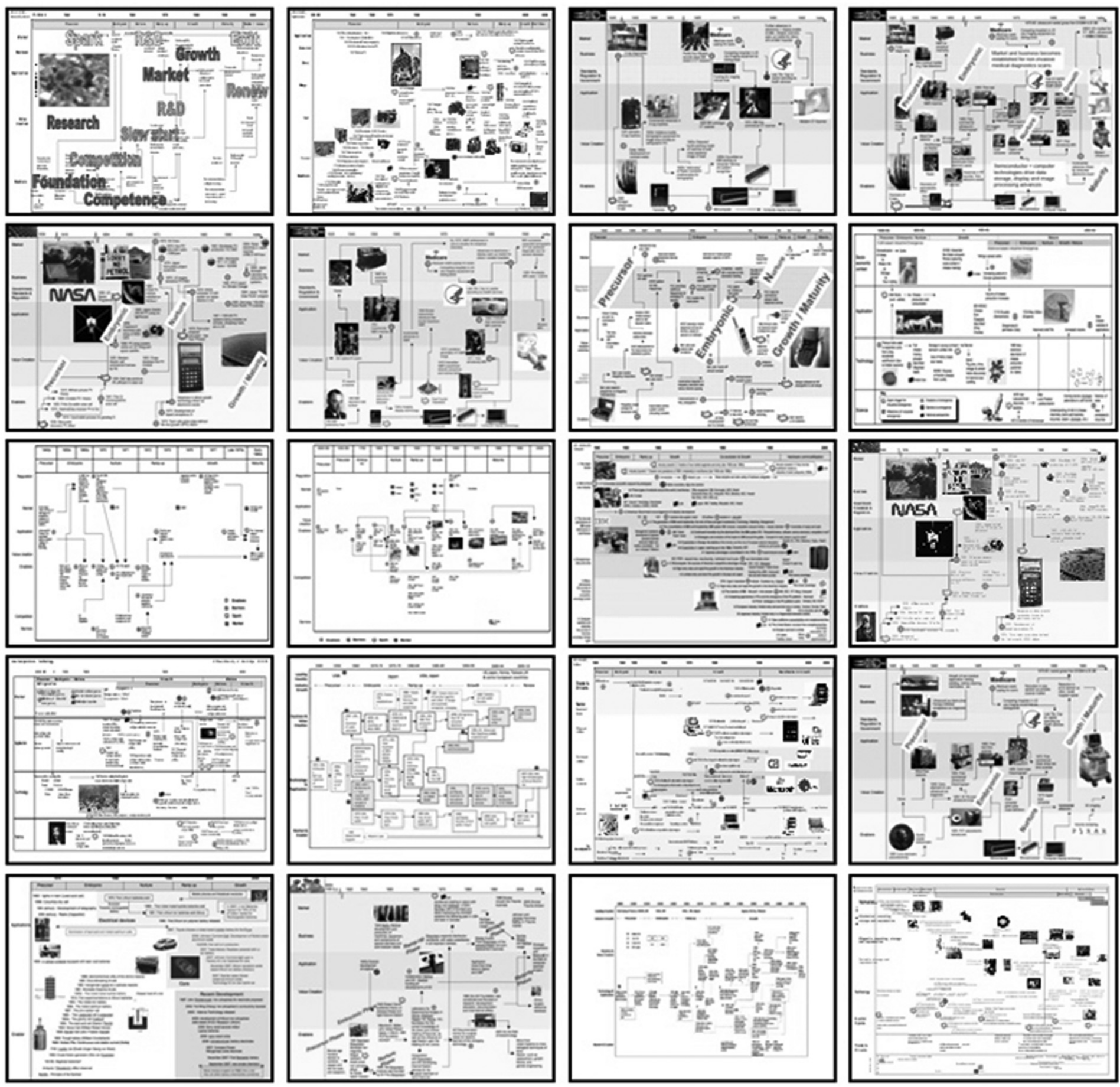
Example thumbnail maps across a range of industries.
The characteristics of emergence reported in literature are apparent in many of the maps, including the coupling between economic and social factors, the co-evolution and dependency between different parts of a system (e.g. developments with semiconductor, communications and memory technology in the digital camera case), and the presence of various life cycles nested within an overall emerging industry. Consideration of the common features of these maps led to the identification of the main phases and transitions that occur during industrial emergence (Figure 2).
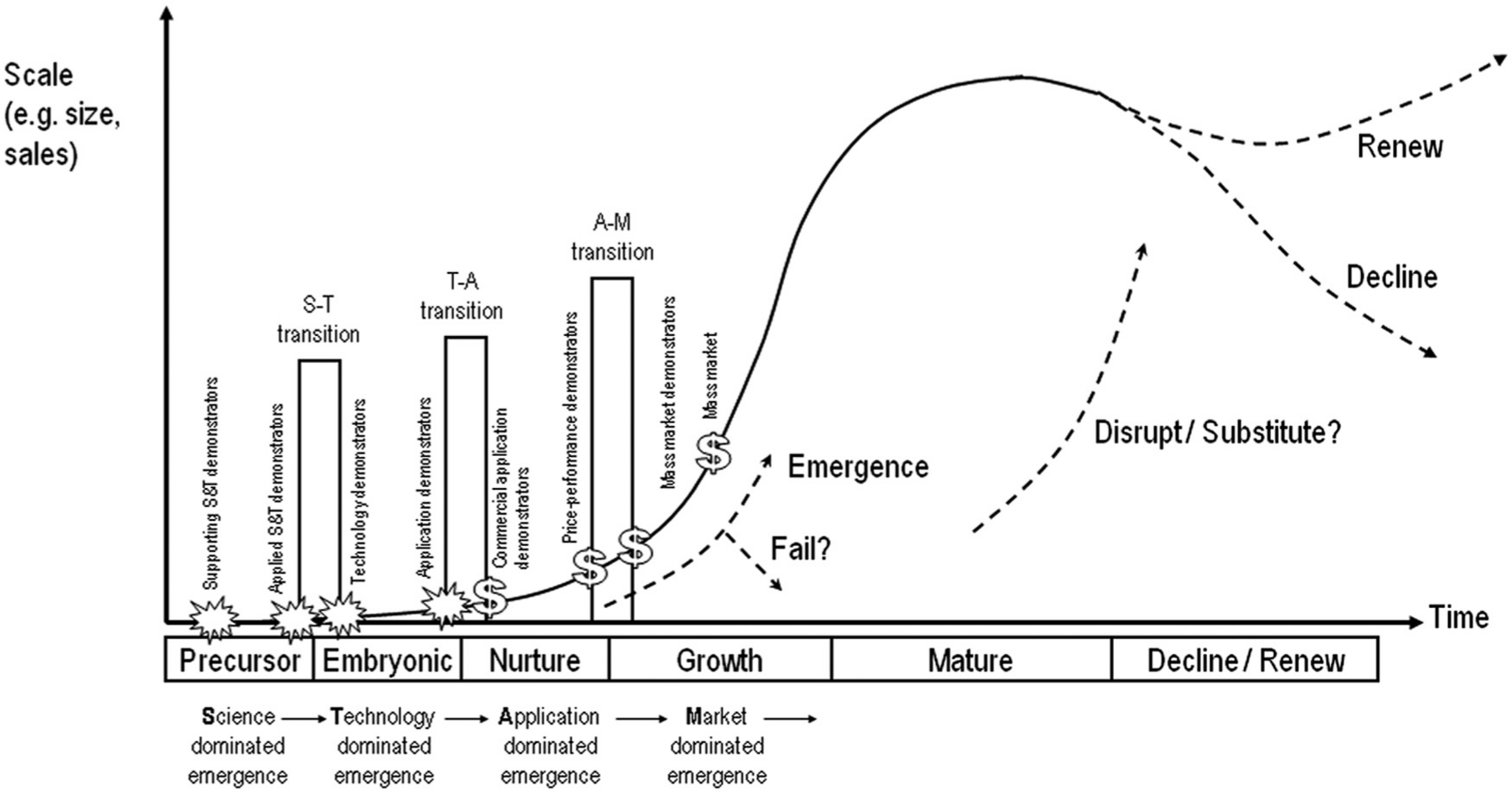
Phases, transitions, milestones and trajectories of technology-intensive industrial emergence. 83
The four main phases associated with science and technology (S&T)-based industrial emergence are those of science (S), technology (T), application (A) and market (M). There are significant challenges associated with progressing through these phases, with the demonstration of particular characteristics necessary for these transitions to be realised. In the case of the science–technology (S-T) transition, it is the demonstration of scientific feasibility that is essential, while for the T-A and application–market (A-M) transitions, it is commercial potential and mass market price–performance, respectively, that need to be demonstrated. Drawing on the organising principles of roadmaps allows these phases and transitions to be formulated into an industrial emergence framework (Figure 3).
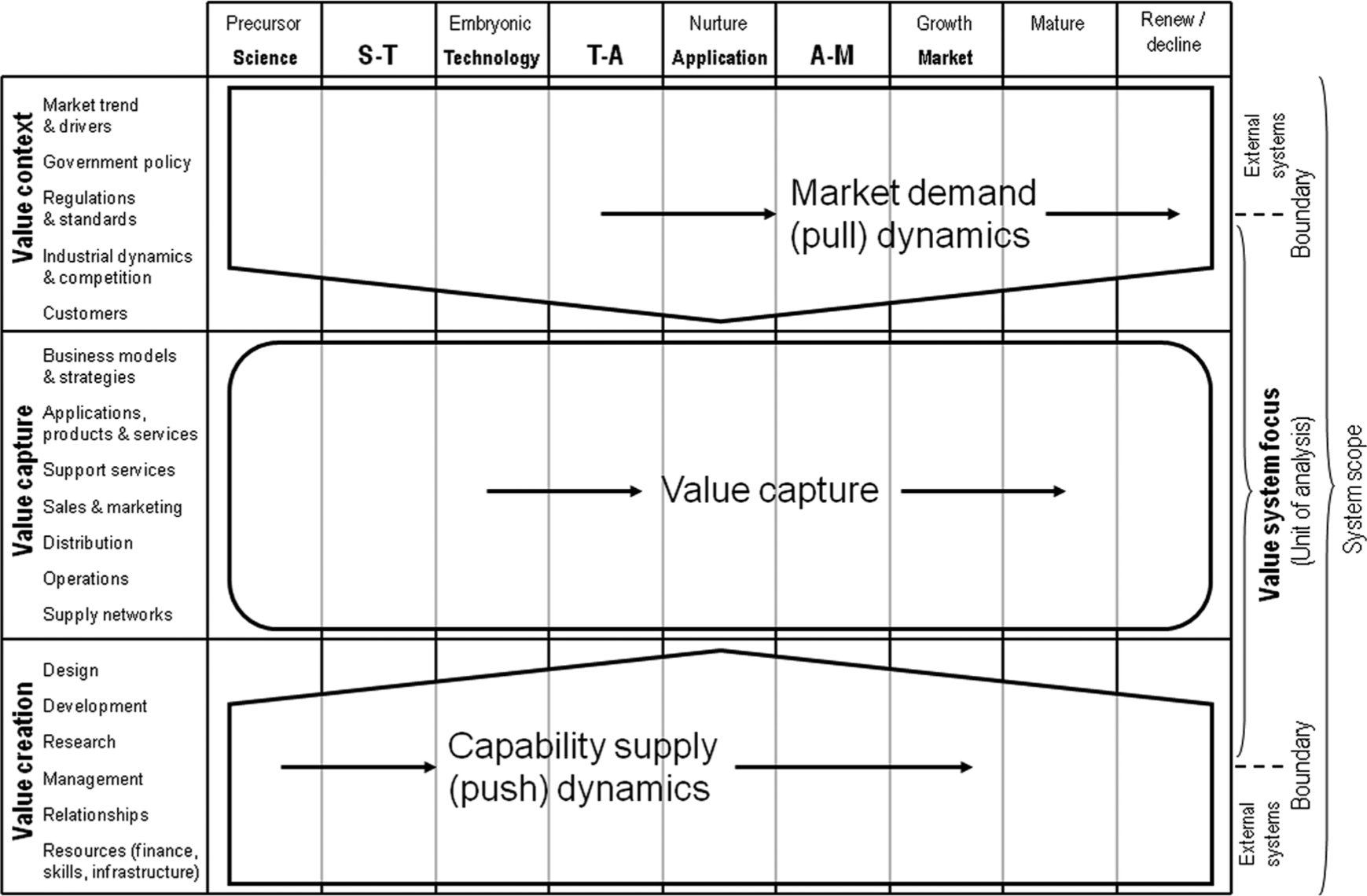
Themes, phases and transitions for emergence maps (past) and roadmaps (future), highlighting system focus and scope. 83
As a time-based dimension, the key phases and transitions are depicted on the horizontal axis of this framework. Meanwhile, the vertical axis comprises three categories of key industrial emergence themes. The first of these categories, Value context, considers the macro- and micro-environmental themes, which define how opportunities arise and industries are shaped. The second category, Value capture, includes those business processes and activities whereby organisations deliver products and services to customers and thereby generate revenues. The themes within the final category, Value creation, cover the business processes employed by organisations and the resources they draw on to generate novel scientific or technological knowledge.
Taken together, the phases, transitions and themes define the framework and provide a ‘canvas’ on which significant events and milestones during industrial emergence can be mapped. It provides a visualisation of how the industry in question has emerged. The importance of demonstration in making the transition from one phase to the next is seen again in the key achievements that are depicted, with a ‘demonstrator chain’ apparent in a number of industries studied. The range of different demonstrators and their importance at different points in the industrial emergence process is shown in Figure 2. Other significant factors that are important for characterising industrial emergence include the presence of early market activity, either in terms of specialist markets, lead users or early adopters, along with supply-side and demand-side stimuli, and enablers and barriers to progress.
Tools to assist with navigating industrial emergence
Based on the industrial emergence framework and roadmapping principles, a suite of four practical methods (tools) has been developed and tested within the research programme. These tools are specifically designed for technology-intensive industrial emergence but can also be applied in other situations with appropriate adaptation (where different patterns, phases, transitions, events and milestones may have relevance). A modular philosophy has been adopted, in the sense that the methods can be used in isolation or in various combinations, either with each other or with other strategic tools and processes.
Three of the methods support mapping of the historical emergence and development of industrial systems, to identify patterns, enablers and barriers – the learning from these approaches can be a useful input to strategic planning, which is the focus for the fourth method. The suite of tools and their relationship to each other are described briefly as follows.86
Industry Scan (IS). A method for mapping, understanding and communicating patterns, enablers and barriers associated with historical industrial emergence, supporting policy, strategy and innovation processes. The approach is based on experience from more than 25 maps, covering a diverse range of industrial contexts (see section ‘Industrial emergence framework’).
Expert Scan (ES). An interview-based method for capturing personal perspectives of historical industrial emergence, which can be combined to understand patterns, enablers and barriers, as an input to strategy, policy and innovation processes. Eighteen case studies have enabled the development and testing of the method, covering five sectors, including 14 applications within the Cambridge commercial inkjet cluster.87 These are listed in Table 1.
Organisation Scan (OS). A workshop-based method for mapping and sharing experience of historical emergence, to understand patterns, enablers and barriers, as an input to strategy, policy and innovation processes. A total of nine trials have been conducted in a range of organisational and industrial contexts, with details included in Table 2.
Emergence Roadmap (ER). A workshop-based roadmapping approach, configured to support organisations to navigate S&T-based industrial emergence, supporting decision-making and action. The method has been piloted in seven cases, within both industrial and academic (technology transfer) environments, as listed in Table 3.
Summary of ES cases.
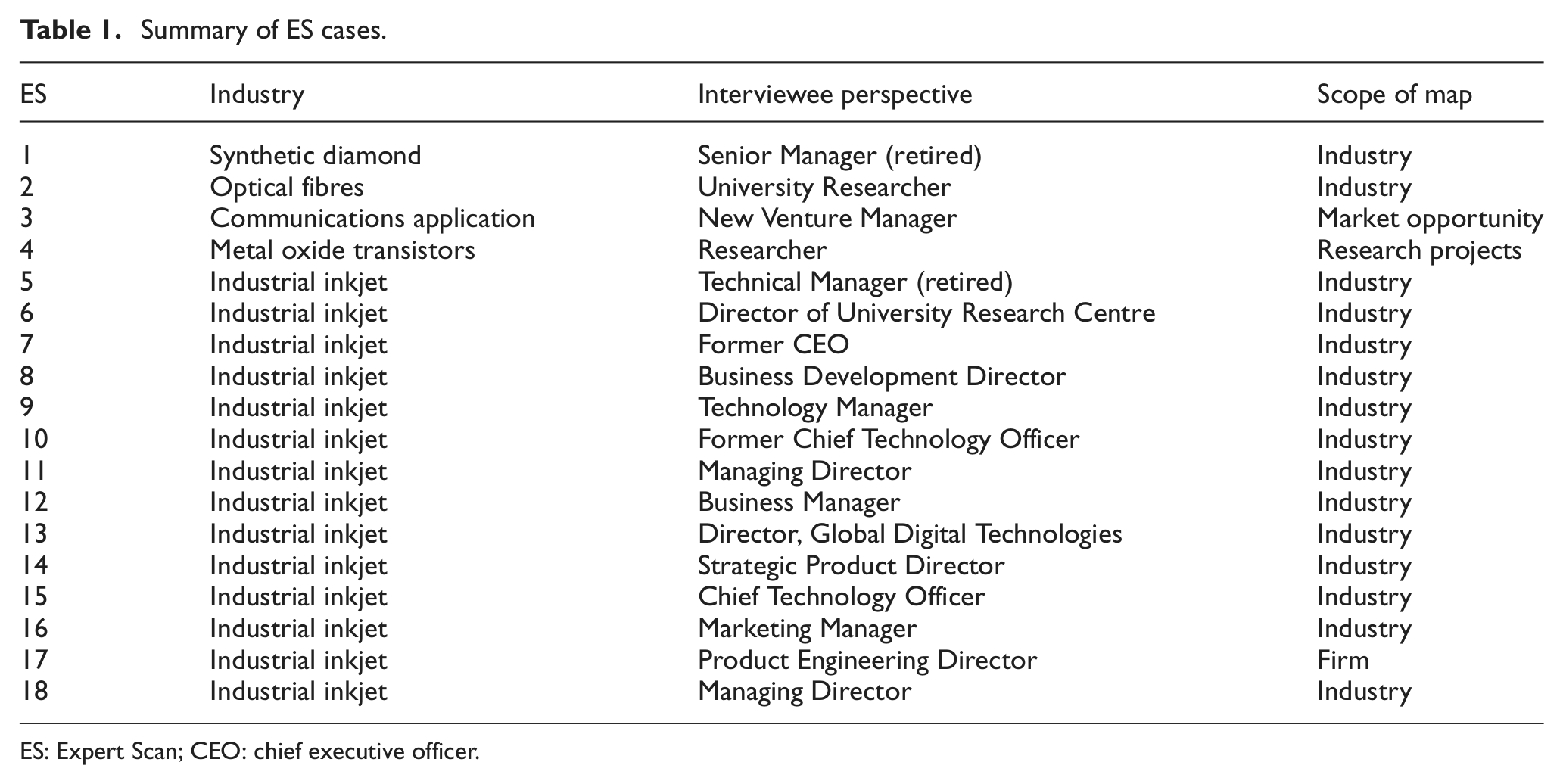
ES: Expert Scan; CEO: chief executive officer.
Summary of OS trials.
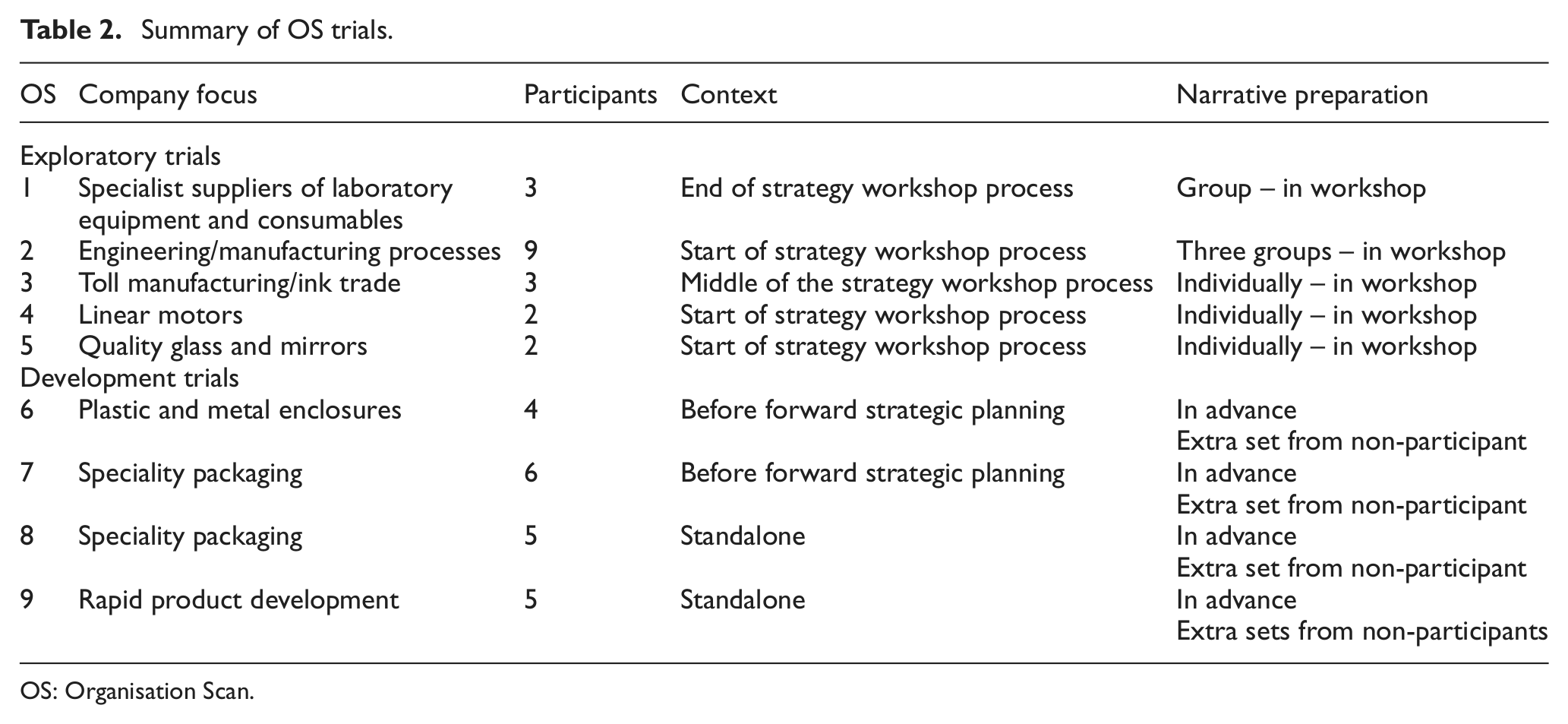
OS: Organisation Scan.
Summary of ER trials.
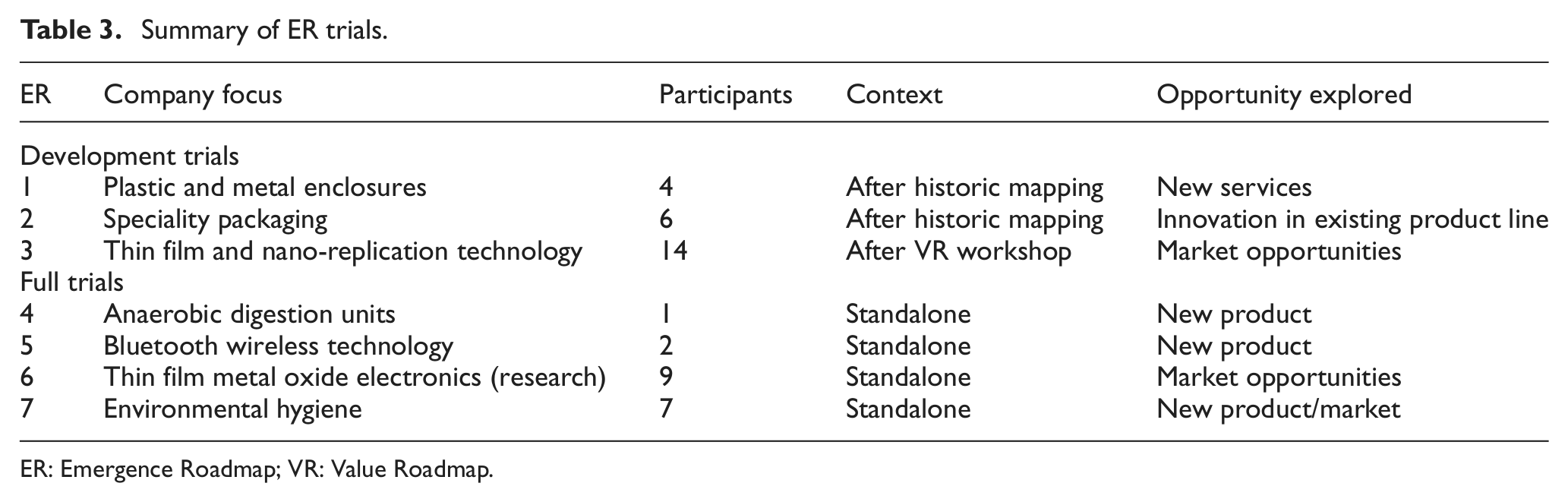
ER: Emergence Roadmap; VR: Value Roadmap.
The ER method requires a relatively clear focus, in terms of an identified future opportunity. It can be used in conjunction with the Value Roadmap (VR) workshop-based approach for exploring, identifying and prioritising future opportunities for early-stage technology. 82 Figure 4 shows the relationships between these tool modules. Each tool is based on roadmapping principles, 68 enhanced by the industrial emergence framework, where appropriate. The tools can be applied against the following two dimensions.
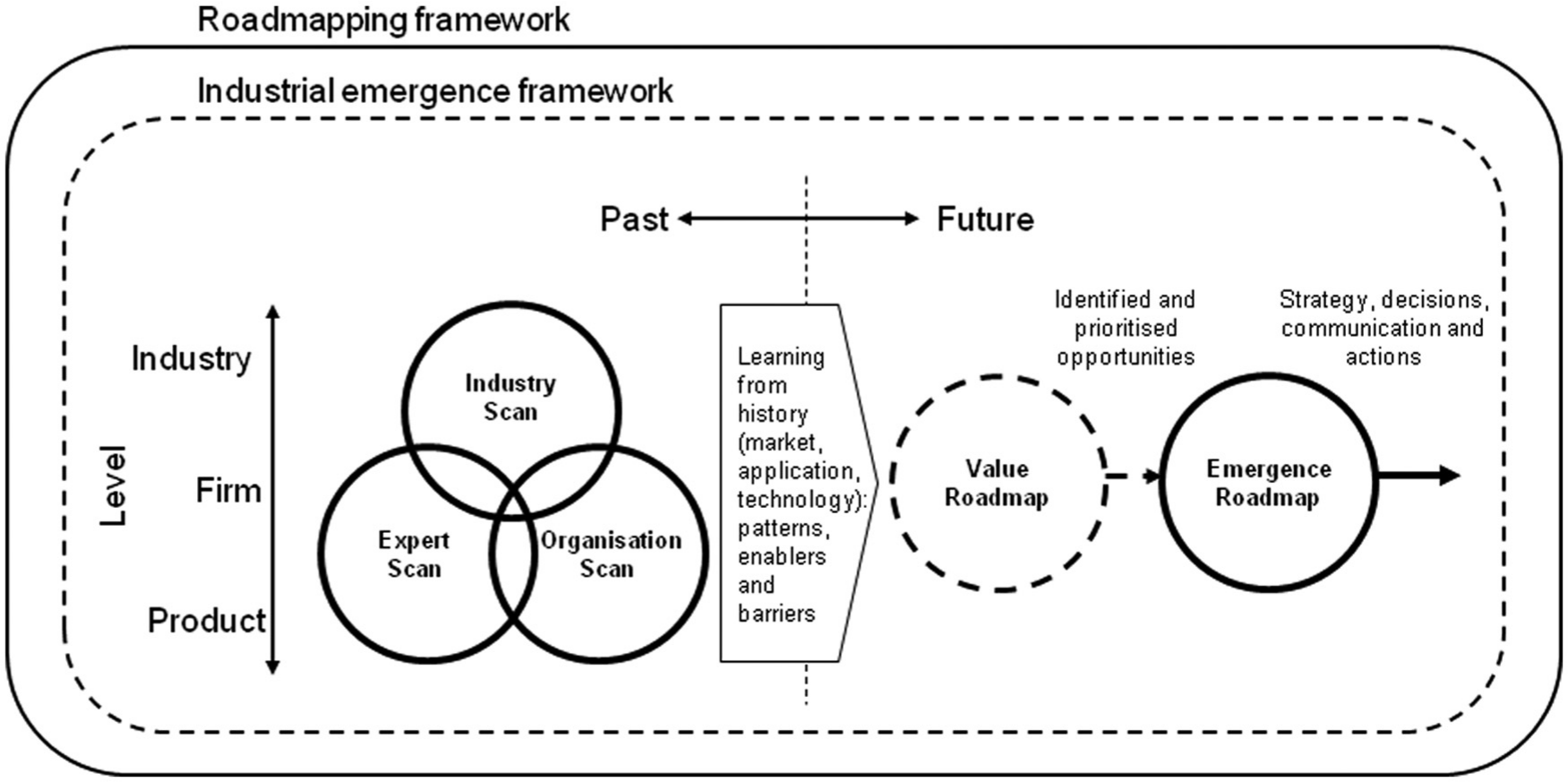
Map of tool modules and relationships, positioned against time (past and future); the Value Roadmap method (shown with dotted circle) can be used in conjunction with the Emergence Roadmap approach, if helpful, to provide focus.
Time: past (learning from previous experience) and future (strategy).
Level: focus for application, ranging from industry/sector to firm and product.
The IS and ES approaches are intended for use by managers, policymakers, academics, technologists, consultants and analysts with an interest in understanding the patterns, enablers and barriers associated with the evolution, development and change of complex industrial, business and technological systems, with particular reference to how value emerges from the science base.
The OS and ER workshop-based methods are intended for use by managers, technologists, consultants and analysts to understand the specific enablers and barriers associated with a particular technology-based commercial opportunity evolution, development and change. In the case of an OS, the focus is on learning from the past, and for the ER, the direction is forward looking, to identify appropriate demonstrators and actions.
Discussion and conclusion
The complex nature of the industrial emergence phenomenon has been discussed and investigated from many theoretical and practical perspectives. Nevertheless, it remains difficult to anticipate not only for purposes of policy initiatives but also concerning the decision-making required of the many actors directly engaged in the emergence process, who have business or societal interests at stake. Key requirements of any attempt to understand better, and hence more effectively navigate, this phenomenon would seem to be the need to deal with dynamic multilevel, multi-player system complexity, in the context of an evolving time dimension.
The emergence mapping studies described in this article, concentrating particularly on technology-intensive industrial emergence, provide some additional insight into the phenomenon and have been found to be useful to individuals and organisations directly involved in historic and ongoing emergence contexts. The usefulness relates to visibility of typical phases and transitions in the emergence process, learning from past experience (own or others’) and the potential ability to anticipate the decisions and actions necessary to survive in this dynamic situation. While by nature a highly complex set of phenomena, the identification of such phases and transitions, and the importance of the associated demonstrators, permits an abstraction of some clarity and utility from this context.
The tools described have been developed and tested with partner organisations during the research and have been documented so that they may be further disseminated and tested. It is anticipated that further learning about the use and benefit of such tools will continue during this process. The tools have already found application in teaching, research and technology transfer.
Industrial emergence has proved to be a very interesting area for research, and our work has identified many additional avenues for possible further enquiry including the following.
Development of a tool specifically designed to support research consortia formation.
Improved understanding of the role and nature of demonstration, classification of demonstrators against phases, leading to possible user guidance for the next demonstration.
How patterns of emergence differ between sectors.
Extending into systems of systems analysis and thereby making links to other cross-disciplinary research themes, such as industrial sustainability and the resilience of industrial systems.
Given the nature of the phenomenon being studied, this has been an adventurous (and some might say, overly ambitious) research project. The potential limitations of what has been achieved are also recognised, given the very large scope of the domain being studied. Nevertheless, an integrated suite of practical tools has been the outcome, embodying an improved understanding of industrial emergence.
Footnotes
Funding
This work was supported by the UK Engineering and Physical Sciences Research Council (grant number RG45382).