




Abstract
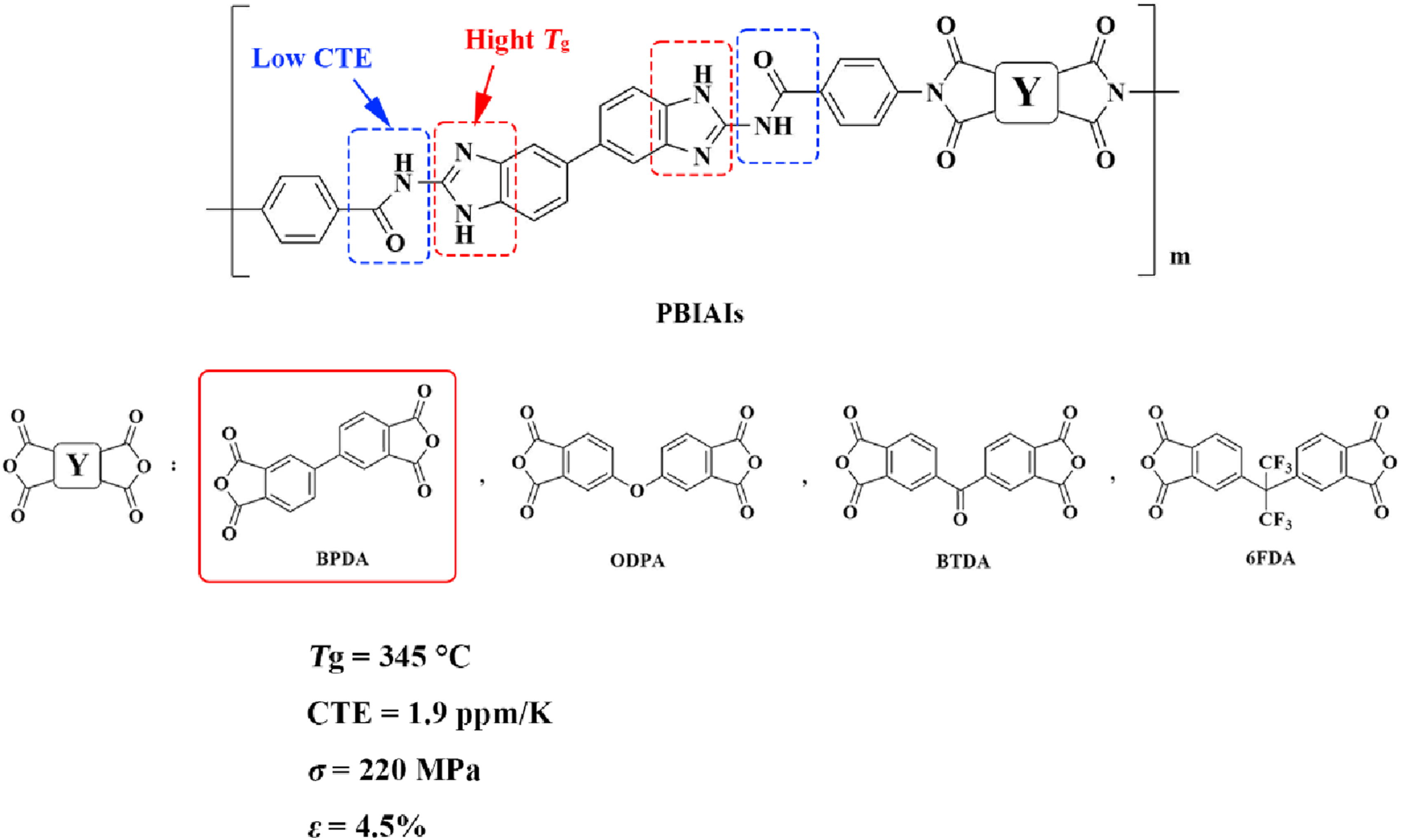
To provide polyimide (PI) with high heat resistance and ultra-low coefficient of thermal expansion (CTE) for use in flexible display substrates, a novel diamine with bisbenzimidazole and bisamide groups, namely N,N'-(1H,1'H-[5,5'-bibenzo[d]imidazole]-2,2'-diyl)bis(4-aminobenzamide) (BZBA), was designed and successfully synthesized. Several poly(benzimidazole-amide-imide) (PBIAI) films were prepared by thermal imidization with 3,3',4,4'-biphenyltetracarboxylic dianhydride (BPDA), 4,4'-oxydiphthalic anhydride (ODPA), 3,3',4,4'-benzophenonetetracarboxylic dianhydride (BTDA), and 4,4'-(hexafluoroisopropylindene)-diphthalic anhydride (6FDA), respectively. Among them, BZBA-BPDA has a high glass transition temperatures (Tg = 345 °C) while achieving an extremely low coefficients of thermal expansion (CTE = 1.9 ppm K−1), meeting the processing requirements of polymer flexible substrates in OLED devices. The effects of different dianhydrides on the performance of PBIAIs were compared, providing a meaningful reference for further adjusting the PI molecular structure to meet specific requirements for industrial polymer films.
Get full access to this article
View all access options for this article.
References
Supplementary Material
Please find the following supplemental material available below.
For Open Access articles published under a Creative Commons License, all supplemental material carries the same license as the article it is associated with.
For non-Open Access articles published, all supplemental material carries a non-exclusive license, and permission requests for re-use of supplemental material or any part of supplemental material shall be sent directly to the copyright owner as specified in the copyright notice associated with the article.
