



Abstract
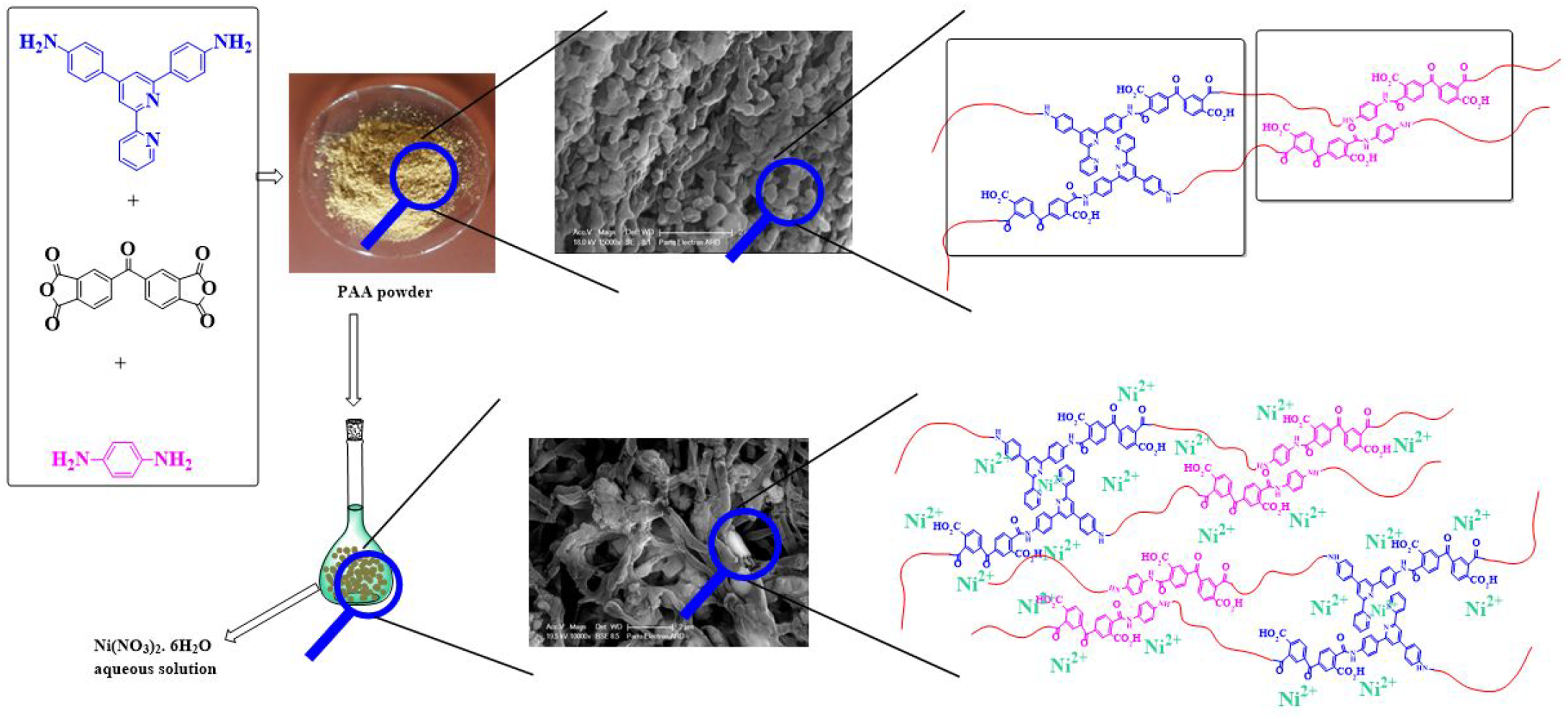
New poly(amic-acid)s sorbents, bearing bipyridine chelating groups, were synthesized by reaction of benzophenonetetracarboxylic dianhydride (BTDA) with different percentages of 4,6-bis(4-aminophenyl)-2,2′-bipyridine (BAPB), and 1,4-phenylene diamine (PPD) and were characterized by FTIR and 1HNMR spectroscopies. Because of the imidization of these poly(amic-acid)s after about 10% weight loss, their thermal stability was raised to about 500°C. The glass transition temperatures of these polymers were in the range of 154–166°C. The sorption of Ni(II) by these sorbents from the aqueous solutions was investigated by varying different parameters such as the contact time, pH, and sorbent dosage. Results indicated that the optimum efficiencies of these sorbents toward Ni(II) were at 25°C, at pH = 4 and after about 75 min. According to the Langmuir equation, the maximum uptake capacity (qm) of PAA30/70 as a best sorbent for nickel was 14.66 mg.g−1. The modeling results confirmed the pseudo-second-order sorption for the metal ion. The morphology of these sorbents before and after sorption of Ni(II) was investigated using Scanning Electron Microscopy and the results confirmed the porous structure of these sorbents.
Get full access to this article
View all access options for this article.
References
Supplementary Material
Please find the following supplemental material available below.
For Open Access articles published under a Creative Commons License, all supplemental material carries the same license as the article it is associated with.
For non-Open Access articles published, all supplemental material carries a non-exclusive license, and permission requests for re-use of supplemental material or any part of supplemental material shall be sent directly to the copyright owner as specified in the copyright notice associated with the article.
