




Abstract
One of the less explored questions in the Christian tradition of Just War is the question of who can use legitimate force. This article focuses on this question. The intention is to assess different legitimate, plausible, historical interpretations for the relevance of Just War in the post-Cold War world order by using evidence from game-theoretical modelling and post-Cold War textual and conflict data. The assumption is that those interpretations that are rational and lead to peace are more relevant for today's world than those that do not. This way the article makes two original contributions. First, the article links consequentialist ethical discussion with research findings on consequences of the use or non-use of force. Secondly, the paper offers an altered interpretation of who should use force and who should not. The article suggests that force is functional in preventing violence only when the target accepts the norms enforced by the user of force and recognises the user as a legitimate enforcer of the mutually accepted set of norms. Force is rational and practical for the prevention of violence only when it disincentivises selfish temptations in legitimate order.
Introduction
The New Testament's teachings on violence have been interpreted in various ways. While there are clear prescriptions to ‘turn the other cheek’ 2 and to obey ‘the authority [that] does not bear the sword in vain’, 3 the difficulty lies in determining who can carry a sword and use force, and who needs to turn the other cheek. This article focuses on this dilemma.
The intention is not to reveal a theologically correct interpretation of the text. Instead, the aim is to assess different legitimate, plausible, historical interpretations for their relevance in the post-Cold War world order by using evidence from game-theoretical modelling and post-Cold War textual and conflict data. The assumption in this exercise is that interpretations of the agency and conditions of force that lead to increased violence do not make much sense in today's world, whereas those that are rational and lead to peace seem more relevant. 4 Thus, the question in this article is whose use of force is rational and practical if we want to avoid fatalities from organised violence.
Thus, the aim of this article is limited to analysing which interpretations of the New Testament's prescriptions concerning who may use violence are effective in preventing violence. This narrow focus may be subject to ethical critique: surely, different forms of violence may produce different outcomes, and the effect on the level of violence is not the only criterion by which the relevance of an ethical interpretation should be judged. Such critique is warranted, as the focus here is indeed restricted to the question of how helpful various interpretations of Christian ethics concerning the agency of force are in reducing violence (even against ‘bad people’). The article addresses the issue of agency while acknowledging that different types of violence may possess varying degrees of moral justification, regardless of the agent employing such violence. Therefore, due to the article's limited scope, no overly broad conclusions should be drawn from this analysis. The argument presented here is intended as one contribution—one brick in the wall of arguments—toward a more comprehensive understanding of Christian ethics on the use of force and its relevance in today's world.
It is possible to challenge this limited concept of relevance and the exclusive focus on agency by suggesting that organized violence involves both aggressors and victims, and that, regardless of the agent, the use of force in defence of the latter against the former is justified—or at least more justified—than the reverse. Consequently, conflating the analysis of force used by both sides, whether for defence or offense, would seem unacceptable or, at the very least, reflect an unduly narrow perspective (focused solely on the effect of agency on the reduction of violence). While this appears to be a reasonable counterargument to the criterion of ‘relevance’ of agency adopted in this study, a legitimate response would be to argue that, although the motives and types of force have been extensively examined in Just War theory, the question of who the legitimate agent is in the use of force has clearly been understudied. Hence, there is a justified need for a focused examination of agency.
Moreover, although theories have often made assumptions about the effects on levels of violence—an important consequentialist criterion in Just War theory—there has been little empirical research on the validity of the assumptions underlying different theories. The prevailing assumption has been that unilateral violence by various state actors against terrorists who slaughter innocent children would reduce violence, whereas violence used for aggression against independent states would increase it. However, as will be shown below, unilateral violence—even when deployed in defence of victims of terror or dictators—tends to increase, rather than decrease, the level of violence. At the same time force by an authority, in similar contexts, tends to reduce violence. Thus, agency alone is a relevant factor in determining the effect on levels of violence, regardless of the other important factors, such as the type of violence. Even when unilateral force aims to protect people from terrorists or rogue states, it appears to escalate violence, whereas force employed by universally recognised ‘authorities’ tends to reduce it. Therefore, agency matters, and there is a need to test our assumptions about the relationship between force and levels of violence, as we often make such assumptions incorrectly. A sharp focus on agency and its effect on levels of violence is therefore justified.
By ‘force’, we mean deadly violence used for the political purpose of achieving terms of peaceful interaction that are considered just or beneficial by the user of force. By ‘organised violence’, we refer to conflicts, one-sided violence, and non-state violence as defined by major datasets such as the Uppsala Conflict Data Program (UCDP) conflict data and Correlates of War data. 5 Organised violence involves political incompatibilities (disputes over governance or territory) and results in fatalities. It can take the form of state-based conflict violence, in which at least one of the conflicting parties is the state and all conflicting parties are armed; one-sided violence, where the state or a non-state group targets civilians; or non-state violence, in which the state is not a party to the conflict.
To investigate different interpretations for their rationality and practicality, I model prescriptions game-theoretically and then use existing discursive and conflict data to see how different approaches to force affect levels of violence. For this, we utilise some of the basic bargaining theories. 6 In order to align rational models more closely with reality and to make claims about causal relationships between prescribed ethical approaches and the evolution of violence levels, this article draws on existing data and studies concerning the effects of organised violence fatalities in international operations conducted by unilateral powers, the global authority of the United Nations, and regional organisations as authorities within their own territories. Additionally, the article incorporates intrastate statistics on organised and criminal violence to analyse the relationship between various approaches to the use of force and the development of violence. Rather than explicitly testing existing theories, this study contributes to theory-building in the area of rational and functionally relevant Christian ethics of violence—ethics that are effective in promoting peace in today's world.
The two main contributions of this paper to the existing literature are as follows. The first novel contribution is that it links consequentialist ethical discussion with research findings on consequences. Instead of simply claiming that destructive force is acceptable in some contexts if it creates a lesser evil than the original violation it prevents, this paper investigates how different approaches actually affect levels of violence. In this way, this paper challenges arguments based on imagined but practically impossible options from our menu of moral choices. While specific methods of using violence ‘to prevent atrocities’ may seem appealing, without proof of how such methods actually affect atrocities, we cannot know if such methods are useful. Thus, a consequentialist analysis that links ethics to real consequences is needed. Alex Bellamy shows how some violent measures (for example, arming righteous rebels) that gain legitimacy from their assumed positive consequences actually increase the suffering of the people they intend to defend. 7 The intention of this paper is to continue this linking of consequentialist ethical discussion with studies of the actual consequences of violent and nonviolent action.
Again, despite the intent to provide consequentialist evidence for and against different interpretations of Christian ethics on violence, there remains an empirical limitation: the evidence considered is restricted to the post–Cold War period, from 1989 to 2023. Thus, in this article, the reference to ‘today's world’ necessarily refers to the period from where the evidence originates from. Arguably, ‘today's world’ is also changing with the emergency of a new kind of Cold War. It is therefore not possible, on the basis of this study, to claim that the specific ethical interpretations it supports were relevant during the Cold War era—or, indeed, in the emerging context of what appears to be a second Cold War. What still seems evident is that unilateral interventions have not become more effective in de-escalating organised violence. Furthermore, we still observe that wherever the United Nations has been involved, its positive impact remains consistent. The fact that UN peacekeeping operations—still shown to be the most effective in reducing violence—may not be employed as frequently in the future as they were in the early decades of the post–Cold War period does not imply that the UN should no longer be entrusted with the handling of international disputes, as opposed to relying on unilateral initiatives, which, even in recent years, have continued to escalate violence. The refusal of great powers to utilise global authority for the arbitration of international conflicts does not necessarily undermine the relevance of ethical frameworks that prescribe the use of force only by legitimate ‘authorities’, rather than through unilateral action. The failure to act according to ethical prescriptions does not, in itself, invalidate those prescriptions. However, it may alter the practical conditions under which decisions about the use of force are made. If the legitimate use of force becomes structurally impossible under the conditions of a new Cold War, we may find ourselves facing a paralysis in the capacity for forceful intervention. While it would seem to follow from the logic of this study that a new ‘authority’, i.e., new rules of engaging the UN, should be developed in dialogue between the structurally opposed Cold War groups of nations, this study does not offer direct support to such a proposal. This study is limited by the scope of its empirical evidence, and it acknowledges the possibility of developments to which it cannot provide adequate responses.
Secondly, based on the above-mentioned analysis of consequences, the paper offers a slightly altered interpretation of the context for the application of the pacifist norm of not resisting evil with evil. The core concept in this context is relational authority. This paper suggests (and shows that such an approach would make practical sense) that violence should be barred from contexts where the user and the target follow two different normative codes or where the user of force is not considered by the target a legitimate enforcer of the mutually accepted set of norms. At the same time, force is functional in preventing violence when the target accepts the norms enforced by the user of force and recognises the user as a legitimate enforcer of the mutually accepted set of norms. In these situations, deviant behaviour that needs to be deterred, prevented, or punished is not based on differing concepts of justice and morality but simply on selfish temptation to violate accepted norms. In such situations, the use and threat of force is rational, and it reduces violence, while in situations of coercive bargaining over norms and justice, the use of violence, even against another violent actor, tends to escalate violence.
Existing Literature on the Christian Prescriptions Related to the Agency and Circumstances of Legitimate Force
While the literature on Christian prescriptions related to force and violence is unanimous about the overall objective of peace and non-violence, there is considerable variation in interpretations of Christian ethics concerning tolerance towards unjust circumstances without trying to change them with force. The interpretations regarding the circumstances and agency of force in the pursuit of just peace are perhaps the least explored in the Christian tradition. This section reviews the literature on the conditions under which turning the other cheek can and cannot be applied, and on who can make decisions and implement the use of force, if such use is deemed acceptable. This discussion pertains to the context of force, ranging from relations between citizens and the state, inter-state relations, and finally, relations between states or groups and global authorities (UN, International Criminal Court, International Court of Justice, etc.). After that, the empirical sections will review the different interpretations by using game-theoretical modelling and evidence from existing peace efforts and approaches to conflict prevention and containment of violence.
At the time of the Sermon on the Mount, the world was not as global as it is now, and the context of relationships was limited to those between individuals and between the state and individuals. Relations between equal states and between states or groups and global authorities were practically non-existent, and thus, it is not possible to determine with certainty what the biblical prescription for these types of contexts would be. Yet the rationales for differentiating circumstances and agencies of force in the New Testament can be applied to today's world, and there are various interpretations on the matter.
The most radical pacifist interpretation claims that the command to turn the other cheek is universal and thus applies to all circumstances and agents. The command is given in the Sermon on the Mount after an introduction that blesses peacemakers. The Greek word εἰρηνοποιός (eirēnopoios), translated as ‘peacemaker’, can be used, unlike perhaps the English translation, both in the context of settling interpersonal and broader social disputes. Thus, for some authors, the separation of public and private morality regarding force is unacceptable. Thascius Caecilius Cyprianus (210–258), the bishop of Carthage, for example, emphasised that killing was immoral regardless of the context. 8 Leo Tolstoy, an influential Christian pacifist writer, although not an authority in theology, condemns the modern state as immoral, referring to the same argument. 9 According to the early Christian philosopher of war, Saint Aurelius Ambrosius, Bishop of Milan (c. 339–397), and Saint Aurelius Augustine of Hippo (354–430), the rule of turning the other cheek applies even to self-defence, which means that using force for one's own defence is not permissible.
Gregory Boyd and John Howard Yoder represent a modern variation of this pacifist interpretation in their rejection of Christian states. According to Boyd, political thinking that defends states by referencing some kind of Christian identity of the state threatens to tribalise the Church and confuse the defence of Christians with the defence of Christianity. It has enabled the former by means that compromise the latter. 10 According to Boyd, the rule of a worldly kingdom, no matter how apparently moral, is never worth defending by means of violence, as the power of the sword a worldly kingdom represents is never worth the power of the cross that non-violence represents. 11 While violent people can be defeated by violence, violence itself can only be defeated by love. 12 Furthermore, in the reality of nuclear weapons, the Pope has at times questioned the applicability of any conditions of just war. If there is a risk of global annihilation, no unjust order may be bad enough to justify a war that could destroy the world. According to Pope Francis, the realities of the risk of mutual destruction push our security thinking in a direction where mutual victory is the only way to security. 13 We need to develop the awareness that nowadays we are either all saved together, or no one is saved. 14
At the other extreme of the Christian tradition on war, there are scholars who view their own country, often the United States, as a Christian state and thus a legitimate authority to use force in global affairs. The most radical interpretation of the tradition of Christian nations is represented by what Boyd and Yoder call the Christian holy war tradition. 15 St. Athanasius of Alexandria (293–373) assumed that Christians have the right and responsibility to fight barbarians in defence of their religion: ‘Although one is not supposed to kill, the killing of the enemy in time of war is both a lawful and praiseworthy thing.’ 16 Nigel Biggar suggests almost a complete rejection of the pacifist norms of the Heavenly Kingdom in worldly affairs and calls on the responsibility of Christians to defend Christian nations. Genocides, like the one in Rwanda in 1994, cannot be prevented by acting morally. 17 This type of Christian thinking criticises pacifism and claims that ‘Christ would never advocate turning the other cheek to terrorists and America's enemies’. 18
For Biggar, legitimate authority for the defence of a humanitarian order rests with sovereign states that possess the recognised capacity to maintain and enforce justice and adhere to international norms and laws. This authority can extend to international coalitions or organisations when global humanitarian issues are at stake. 19
There are also positions between these two extreme interpretations. While early Christian tradition forbids violence in self-defence, under certain circumstances, the defence of others was considered permissible. 20 Later, this was also Martin Luther's interpretation: turning the other cheek ‘is what the individual Christian is called to, but it is not even what the individual Christian is called to with reference to others’. 21 The justification of force in the protection of others requires specific conditions, given Jesus’ explicit rejection of the apostle Peter's defence of Jesus against an illegitimate attack. 22
Christian theorists have justified the use of force in defence of others by viewing it as the defence of a legitimate order. For Augustine, a legitimate order can be defended, but the use of force must be authorised by a legitimate authority, implying that the state can use force to enforce order on citizens, but ordinary citizens cannot. 23 This is often argued 24 with references to the justification of state authority in the New Testament: ‘Let every person be subject to the governing authorities, for there is no authority except from God, and those authorities that exist have been instituted by God. Therefore, whoever resists authority resists what God has appointed, and those who resist will incur judgment.’ 25 Interpretations based on this source suggest that the idea of turning the other cheek does not apply to the relationship between the state and individual citizens. Instead, the state has the right to use force on its citizens. Following this line of argument, Palmer, for example, suggests that ‘individual Christians are to refrain from avenging wrongdoers or using violence; God has instituted civil authorities to undertake these functions’. 26
This is close to Martin Luther's interpretation as well. According to him, ‘one of the ways in which we love our neighbour and look for the protection of our neighbour is through the institution of the civil government. God has instituted civil government to protect the weak against the strong, to protect the good against the wicked.’ 27 Some interpretations of St. Augustine's interpretation of the proper authority in the use of force point to the same interpretation: According to Joseph Capizzi's interpretation of St. Augustine, nonviolence is required at the individual level and just-war is mandated at the societal level. 28 If, then, the state authority can manage societal order by force, that does not mean that a government would be an authority in the international system. Rather, in an international system a state is partisan quite as an individual is partisan towards another individual in a state system. An individual must bring violations of justice to the attention of the state (police), while a state must bring such violations to the UN Security Council, rather than starting to enforce one's partisan interpretation of justice unilaterally. This view is represented by Iain Atack, who summarises the logic of agency in the correct interpretation of the Just War theory as follows: Just war theory prescribes force in defence of a system of justice against its opportunistic violators. In the international system such a system is codified in the international law, which is based on sovereignty and noninterference in internal affairs of other countries. 29 ‘Under Article 42 of the UN Charter, however, the UN Security Council has become the sole legitimate authority for authorising the use of armed force “to maintain or restore international peace and security”. This rules out the unilateral use of armed force or war as an instrument of any state's foreign policy’. 30
The Catholic Just War tradition often discusses the legitimacy of order and suggests that a legitimate authority is required as the agent or, at least, to authorise the use of force. For St. Augustine, however, the legitimate order is not clearly specified but implicitly understood as the Roman state. 31 The globalisation of the world since St. Augustine's time has led to changes in the interpretation of legitimate authority. Following this interpretation, secular versions of the Just War tradition have often assumed that states are legitimate authorities regardless of the circumstances. Thus, if a state has the right intentions and justifications—i.e., if the use of force constitutes a lesser evil compared to the injustice it rectifies—and if all non-violent means have been exhausted, then states have the right to use force, for example, to end genocidal violence in another country. 32 According to James Pattison's consequentialist argument, humanitarian intervention in defence of people whose human rights are being violated by terrorists, criminals and dictators should be the responsibility of the interveners that will be the most effective in such defence. 33 For Pattison, this implies the military capacity to conduct protective operations.
While states may be legitimate towards their citizens, their legitimacy may not extend to other equal states. A leader of one state is not, in Augustine's sense, a legitimate authority to the people of another state. Yet, this is often how the Just War tradition is interpreted, especially when it comes to relationships between democracies and autocracies, where democracies justify warfare as an effort to avenge or end autocratic violence. 34 This, I believe, is against the original ideas of the Catholic Just War tradition, as the authority, in the ideas of Robert Austin Markus and St. Augustine, emphasises the commonness of the normative order that defines legitimate order and its authorities. If there is an order and a procedure by which it is governed, then the legitimate authorities of that order are allowed to use force in defence of the order, against members who have consented to the rules but are tempted to violate the order and its norms for self-interest. 35 For example, Milošević and Clinton were not operating under the same rulebook, making it difficult to claim that Clinton was an authority to the Serbs of Serbia (in the war on Kosovo) or to Bosnian Serbs (in the war on Bosnia). Thus, Clinton had to impose its authority, and this goes against the Catholic Just War tradition that suggests that ‘Public Authority [is] Instituted by Common Consent and Not Imposed by Force’. 36 The idea of the commonness of the normative order is often part of the justification for humanitarian interventions and the use of force by one state against another. Bellamy, for instance, has suggested 37 that the humanitarian use of force aligns with the rules of the Just War tradition since there is a legitimate humanitarian order in the world, given that practically all states have signed and committed themselves to the UN Charter and the Universal Declaration of Human Rights. 38 Bellamy, citing Sohail Hashmi, Steven Lee, and Brian Lepard, claims that the traditions of all major religions are more or less unanimous in their judgement of violence and war. 39
Yet one could argue that ‘authority’ does not only imply a common normative order between the user and the target of force, but also that the user of force has a commonly accepted role as an enforcer of the norm. This is, to some extent, what some proponents of the just war justification of humanitarian interventions suggest. Gerry Simpson and Bellamy propose that, due to the implicit acceptance of hegemony, great powers are within their rights to violate the sovereignty of ‘outlaw states’, since this is generally accepted by smaller states. 40 However, this reasoning leads to a selective defence of legitimate order, given that the UN Charter—signed by practically all states—is explicit about legitimate authority. States and regional organisations have the legitimate authority to defend themselves, but only the United Nations Security Council can authorise action to defend humanitarian order beyond a country's own borders: ‘no enforcement action shall be taken under regional arrangements or by regional agencies without the authorization of the Security Council’. 41 The division between these two views is exemplified on the one hand by supporters of humanitarian interventions by great powers when the exercise of veto rights in the UN Security Council prevents legitimate authority from acting, and, on the other hand, by proponents of the responsibility to protect, 42 who emphasise the authority of the UN Security Council, even when partisan interests may prevent forceful action.
This critique pushes the argument towards stricter limits on the use of force. According to this view, the condition of ‘authority’, under which we could assume force to be acceptable, requires (a) a common normative order between the user and target of force, and (b) a consensus on who can enforce the order and how. In such a situation of ‘authority’, violations of the common normative order, i.e., threats to just peace, still exist. However, instead of these threats stemming from disagreement on norms or mechanisms of enforcement, just peace is threatened by the temptation to violate the just order for selfish gains. Force is therefore not a bargaining tool but a counterforce against the temptation to do wrong. We will further develop this position in the following empirical chapter using the criterion of rationality and evidence on what reduces fatalities in the reality of deadly disputes.
Based on this review, we can distinguish four different interpretations of the Christian prescription towards agency in the legitimate use of force:
There is the early Christian interpretation, according to which ‘turning the other cheek’ is a universal prescription, to be applied by all in every situation. There is a theoretical interpretation, which this article will further develop in light of game theory and empirical evidence. According to this view, force is useful within a consequentialist ethic, for a legitimate authority resisting the selfish temptation to violate commonly accepted norms. There is an interpretation that the state is the authority that can declare wars, which is justified if all other means have been exhausted and if force constitutes a lesser evil than the injustice it rectifies. Force is acceptable by Christian nations in defence of a Christian order.
Rationality and Pragmatism in the Use of Force
Context of Bargaining
The investigation of the rationality of the use of force from the perspective of reducing violence can be divided into two parts. On the one hand, force can be used as bargaining leverage to promote just terms of interaction. On the other hand, once such terms or norms are established, the question shifts to their enforcement. These two stages have very different game-theoretical and causal logics: in the former process, there are several cooperative options (different terms of interaction) to choose from, whereas when a normative order already exists, there is only one cooperative option, and other options are temptations to deviate from the agreed terms of cooperation. Furthermore, in general, while there is more evidence of the negative consequences of force in the former context, there is some evidence of positive ones in the latter context.
If we first investigate the situation in which norms are being bargained, we can apply classical bargaining models to our analysis. In perfect information scenarios, all bargainers would know who needs to yield to the other's demands, as in rational calculation, only one of the two has a weaker hand in the coercive bargain. 43 Mutually destructive conflict is possible only when one or both parties are overconfident in their bargaining position. 44 We will use the term ‘bargaining failure’ to describe a situation where bargainers fail to assess their relative bargaining positions and demand more than they should, resulting in war. At this point, we can say that actual violence in conflicts results from a bargaining failure, not an inability to defend oneself, as defence merely protects the terms we require for our interaction with others. If we lack coercive power, we will have to concede more, but we are not, at least in theory, more likely to experience violence from others. This can be explained by the following game-theoretical logic of the so-called bargaining games. 45 In its simplest form, it can be presented by revealing two objectives: the objective to avoid the collapse of negotiations on the terms of cooperation and the objective to secure beneficial terms of interaction. Threats are used as bargaining chips, linking cooperation to specific, partisan interests related to the terms of cooperation. Such can be described in Figure 1.
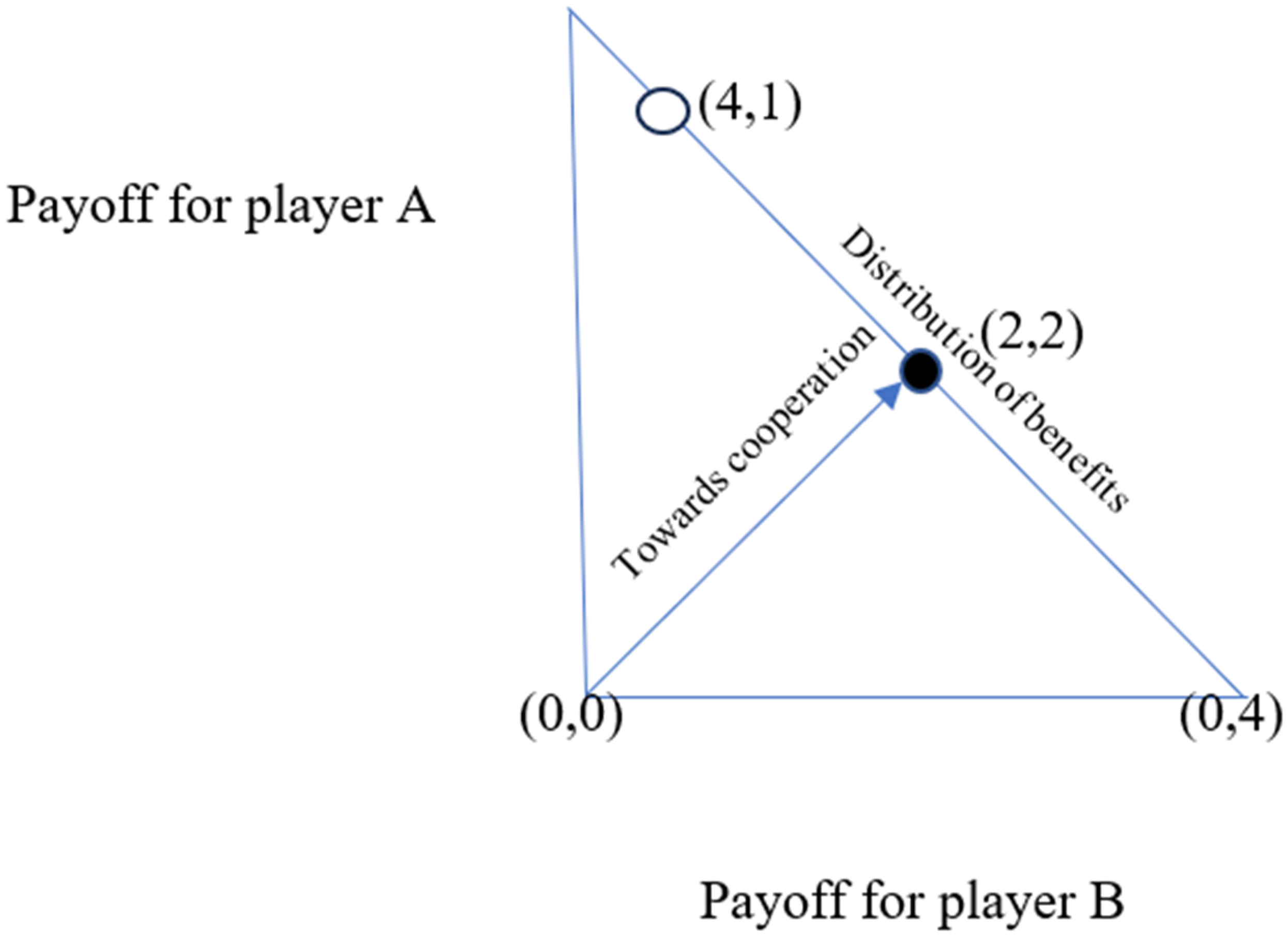
Simple bargaining game.
If player A insists on terms that give a payoff much better than player B gets (say 1 for B and 4 for A), the strategic risk of a bargaining failure, a situation in which agreement is not reached and players end up with no benefits (0,0) is much greater for A than for B. Consequently, player B can make credible threats about withdrawing from negotiations as its loss would only be one payoff unit, while the loss for A would be 4. Only once both have an equal strategic risk, neither can make credible threats about pulling out of negotiations (as they will be equally affected by it).
If, however, bargaining becomes coercive and parties inform that failure to reach an agreement triggers a military response, the bargaining game becomes extended. 46 Figure 2 describes such a situation. Let us assume that player A is much more powerful than player B and can cause four units of damage to B, whereas B can only cause one unit of damage with its military power against A. This would mean that the original demand by A about 4 units in payoff, against B's one unit is realistic, as A now can threaten B with a loss of five payoff units, the same amount it would itself lose in bargaining failure and thus the strategic risk would be the same for both players. If player B insisted on a fifty-fifty share of 2 units for both, it would have a risk of 6 units, while A would only risk 3 units. Thus, a rational solution for the players, according to the logic of rational bargaining, is a very uneven share of benefits, 4 for A and 1 for B.
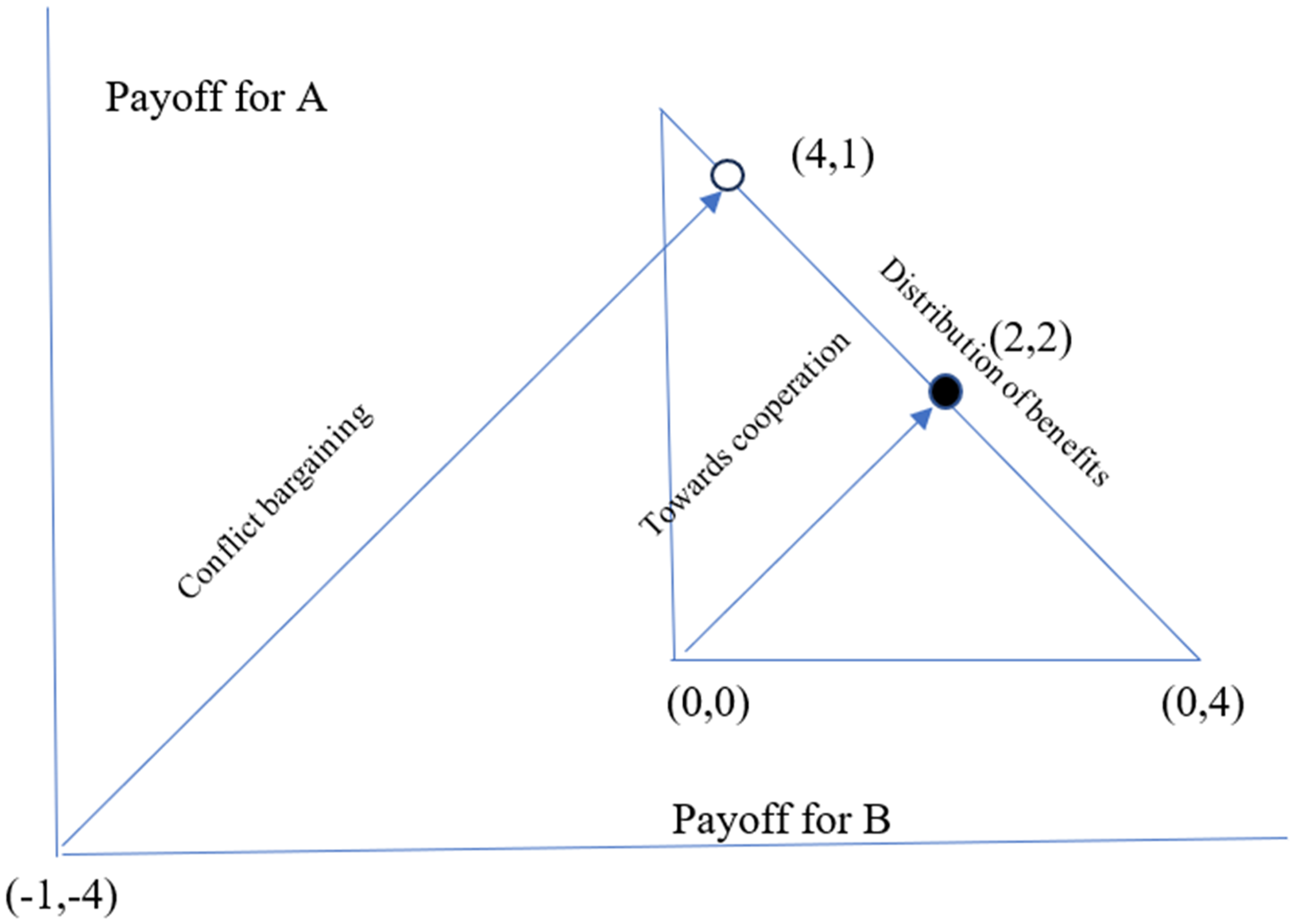
Coercive bargaining game.
When partisan agents use military power, it is rational for them to demand more than they would if they were not prepared to use force. Failing to do so would not be rational, and if, for example, one's demands were in line with its moral code, not demanding a more moral solution would be unethical. However, in this situation, the power and willingness to use force by a partisan agent will always lead to greater demands, and thus, an increased risk of bargaining failure if one of the agents has a mistaken understanding of its bargaining leverage. Furthermore, while the pure power of argument influences the terms of interaction when neither side uses force in support of their argument, the use of force skews the bargain away from the balance of argumentative persuasiveness of the position of each side.
Thus, theoretically, military power does not increase safety, but it improves the terms of interaction for the user of force since power can be used as bargaining leverage. However, this does not mean that power enhances the ethical value of the negotiated solution. Theoretically, assuming symmetry of the moral equality of the bargainers, the use of force moves the solution further away from the argumentative strength of the positions held by the two bargainers. The track record of great powers tends to support this assertion: powerful states colonised countries in the name of spreading Christianity, yet colonial rule often turned out to be exploitative, occasionally even genocidal, rather than just or in any way Christian. Thus, arguments for the use of partisan force do not seem to be supported by game-theoretical investigations of normative relevance in today's world. Rather, the use of force when negotiating norms tends to be irrational, compromising the negotiator’s own safety and undermining the overall ethical quality of the bargaining solution.
Thus, force does not reduce the likelihood of violence in the context of normative bargaining in theory, but do we have empirical evidence in support of this theoretical finding based on assumptions of rationality? Empirical evidence suggests, indeed, that the use or the threat of the use of force in the negotiation of terms of interaction often improves the terms of interaction for those using force. According to Kyle Beardsley and Victor Asal, the possession of nuclear weapons improves terms of interaction in international relations. 47 This is not something Christian pacifists would deny. On the contrary, they speak about self-sacrificial, radically inclusive love (even of one's enemies), and thus, in Christian pacifism, the partisan losses for not using or threatening to use violence are explicitly recognised. 48 However, while the terms of interaction may be better for the powerful actor when it uses or threatens the use of force in bargaining, the terms may not be more moral, as the example of powerful colonial or imperial powers suggests.
What, then, happens to the levels of violence: do we generally need to prepare for war in order to safeguard peace? While it is evident that our military power increases the insecurity of our own adversaries, empirical evidence suggests that such capacity in a bargaining context does not even protect our own people. If we compare countries using SIPRI data (from March 2023) on the average share of military expenditure per GDP during 2017–2021, we find that the correlation between military spending and the per capita number of fatalities from organised violence is positive, not negative. Thus, the more a country spends on defence as a percentage of its GDP, the less safe its population is from organised violence! 49 The positive correlation is statistically not fully significant (coefficient 0.1622, n = 146, p = 0.0505). However, the fact that the association is positive means that an emphasis on defence spending does not safeguard citizens from violence. There is no discernible difference in the effect of military spending on levels of violence between democracies and dictatorships, Christian and non-Christian nations, or developed and underdeveloped countries. Although democracies and developed countries are generally more peaceful, those with greater military capabilities do not protect their citizens from organised violence any more effectively than democracies and developed countries with minimal military spending. Power serves to protect the principles and values that are defended—not the people themselves.
Military spending enhances a country's coercive bargaining leverage and secures political values, even if it does not protect people from violence. 50 This once again reveals the limitations of our narrow focus on levels of violence: while it is conceivable that the leverage of moral agents, augmented by military power, could contribute to positive change in the world, our focus on violence does not capture this dimension. What it does reveal, however, is that regardless of the ethical character of the actors involved, all agents may become overconfident in their diplomatic bargaining positions and may therefore find themselves compelled to defend their values through organised violence. This occurs because bargaining failure is equally probable for both strong and weak powers, as well as for moral and immoral actors. Strong and moral powers, if acting rationally, tend to demand better—or more ethical—terms in coercive bargaining, and thus may, just as frequently as weaker or less moral powers, demand too much.
In the context of civil wars, or intrastate normative bargaining, the evidence is also against the use of violence. Several studies have shown, on the one hand, that common ownership of firearms by private individuals increases violence in society, and on the other hand, that firearm owners and their families are at greater risk of violence, particularly violence involving firearms. 51 Empirical studies have also suggested that military strength of subnational groups often constitutes a structure of intrastate security dilemma, which has been seen as a major dynamic causing intrastate conflict. 52 Thus, at least in these cases, the prescription to turn the other cheek or, at the very least, not to respond violently to perceived unfairness makes practical sense.
Context of Enforcement of Commonly Accepted Norms by Legitimate Authorities
Once there is authority, however, the situation changes. This is primarily because when an authority exists above two disputants, the authority's power does not lead it to demand more. After all, the bargain is no longer about its own demands but about norms that both disputants recognise. Since the enforcer is not partisan, it represents both sides, and thus, it would not know which way to adjust the balance in the terms of interaction when power and force enter the bargain. Therefore, while power increases the willingness to demand in a partisan setting, it does not have this effect in the context of authority.
Figure 3 illustrates what such an extended bargaining situation entails. Here, enforcement only increases the mutual benefit of reaching an agreement. If bargainers have misunderstood their leverage, and the external enforcer provides additional incentives to adhere to neutral terms of interaction, enforcement reduces the risk of bargaining failure. Let us assume that the commonly accepted norm gives a payoff of 2 for both players, but player A is tempted to demand 4 for itself, leaving player B with a payoff of 1. Now let us assume that the ‘authority’ has the power to deny one payoff point from each player. Instead of A risking 4 payoff points while B risks only 1, A now risks 5 points compared to B's 1. This reduces the likelihood of A thinking it still has a lower strategic risk. Even if the authority is weaker than the players and cannot significantly alter the payoff structure, its enforcement still makes such an outcome slightly less probable.
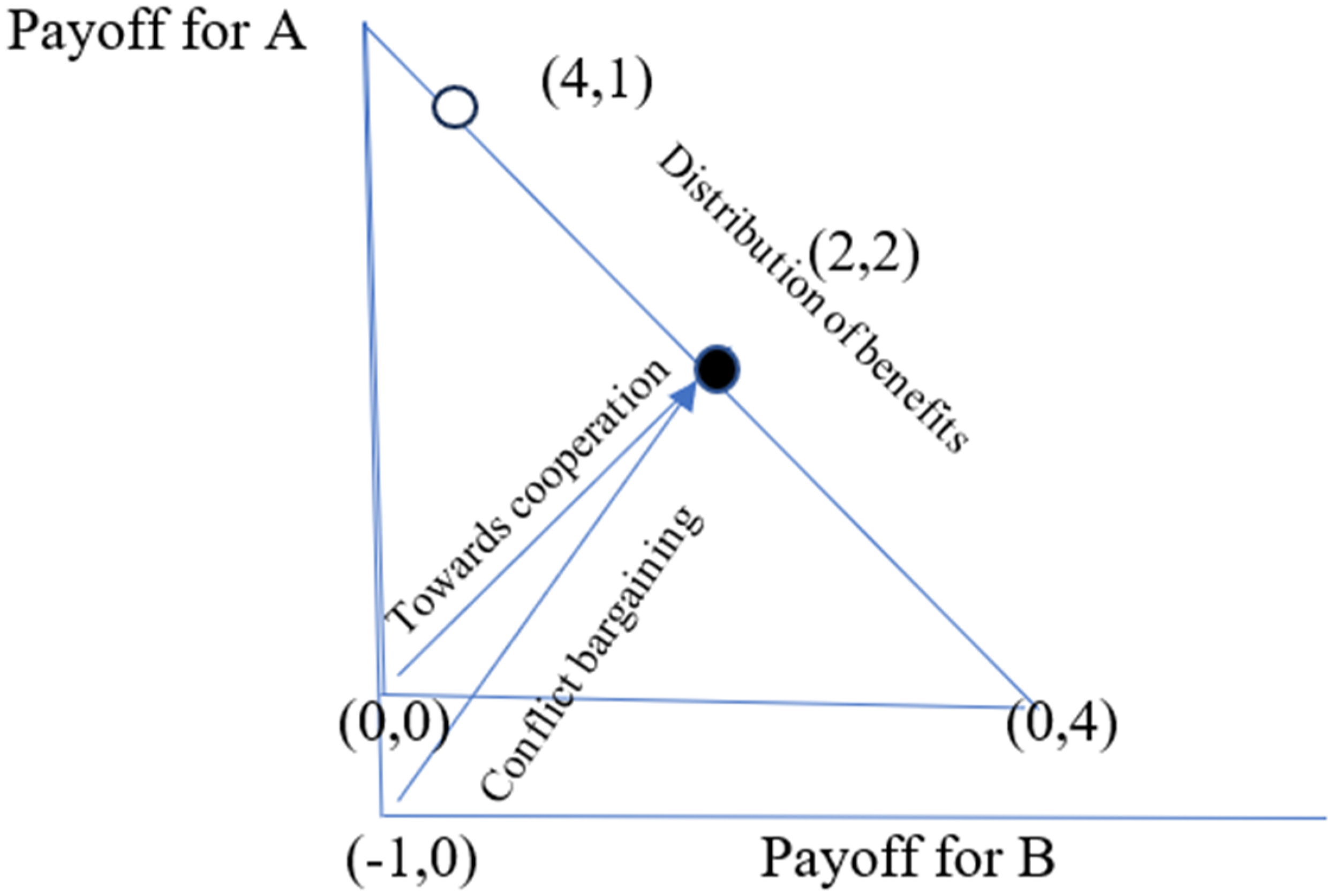
Enforcement by an authority.
If we then look at the ethical quality of the solution that can be achieved with the use of force by an authority, we can agree, at least theoretically, that something which enforces ethical consensus is better than a solution driven by the temptation to violate norms for self-interest. Thus, it seems clear that there is a rational reason for allowing the threat of the use of force by authorities.
The track record of the use of force by authorities also aligns with expectations derived from rational models. Strong states tend to be internally less violent than weak states. The capacity to use power to disincentivise the temptation to violate accepted norms and laws is strongly associated with lower levels of organised violence. 53 This is because a functioning state uses force against temptations to deviate from agreed-upon norms; however, the power of a functioning state does not change those norms.
Similarly, when UN peacekeeping operations are well-resourced, including their ability to use force, peacekeeping tends to save lives. 54 Thus, power does not tempt the UN to demand more from a conflict bargainer. The organisation represents both conflicting parties and is therefore inclined only to uphold commonly accepted norms. Consequently, even though the UN has vastly smaller resources for enforcing norms, it is significantly more effective than powerful great powers. In the 16 unilateral great power interventions with a declared motive of protecting people, data 55 reveals that in 10 cases, the number of fatalities increased both during and after the operation compared to the situation before it, while UN peacekeeping has a far better track record. Of the 36 post-Cold War peacekeeping operations of the UN (here treating back-to-back operations as one operation), only in three—Rwanda, Mali, and Syria—did the UN fail in the same manner as the unilateral great powers failed in more than half of their operations. Furthermore, in two of the three failed UN operations, the host of these operations was also the target of a unilateral operation. Thus, of the 36 operations, only in Rwanda can we claim that the UN failed in the same way that great powers failed in 10 of the 16 operations.
Thus, both the overall track record and rational models suggest that we should utilise the concept of authority—i.e., the commonality of norms between the user and target of force, and the mutual recognition of the legitimacy of the user of force as the enforcer of common norms—as the criterion under which the norm of turning the other cheek does not apply. Justifying the use of force based on an actor's objective identity as a Christian state or a moral democracy is impractical, just as trusting all moral states as authorities in their relations with other states does not contribute to building a just peace. Instead, force exercised by legitimate state authorities against the selfish temptations of citizens, or the use of force by the UN against its member states, tends to promote peace. This is the broader perspective that this article aims to establish. However, nothing is as clear-cut as theoretical articles may suggest. Thus, there is still a need for discussion on borderline cases and how to address the question of force and violence in such situations.
Discussion: Between Authority and Partisan Force
While, in general, powerful states are better at regulating intrastate competition and thus are more peaceful, and even if partisan forceful bargaining and enforcement do not typically reduce violence, the distinction between ‘authorities’ and ‘partisans’ is muddled. States are rarely entirely legitimate in the sense that all their citizens accept their norms and their role as enforcers of commonly accepted norms. In international relations, this is even more complicated: not all countries accept the role of the UN, even though most people in most countries do. 56 For example, Israel, Turkey, and Greece, with their controversial experiences of UN peacekeeping in the Middle East and Cyprus, do not have majority support for the UN in world affairs. Similarly, the regimes of states are not always viewed as legitimate by individual citizens and intrastate groups within those states. Thus, states in their intrastate affairs and the UN in its international regulation of member states sometimes need to be cautious about the use of force, as such force may clearly fall more within the context of coercive normative bargaining than the disincentivisation of selfish temptations.
While a state's strength to disincentivise selfish temptations is useful for peace, this does not mean that the harshest punishments for crimes will always work better for peace than more lenient punishments. Punishment for crimes is generally much harsher in the US compared to EU countries; yet the level of criminal violence has traditionally been much higher in the US than in any EU country. 57 At the same time, efforts at dialogue between perpetrators and victims of violent crime have proven more effective in preventing repeated violent crimes than mere enforcement of the law. 58 Thus, while authorities, in principle, can use force and this can contribute to peace, they should not take their authoritative position for granted. Legitimacy requires dialogue, responsiveness, and flexibility regarding norms and measures of enforcement. Soft but capable states tend to reduce violence better than hard and capable ones.
Similarly, the UN, as a global authority, is efficient in conflict prevention partly because of its dialogue-focused foundational principles. To start with, the UN negotiates the consent of its operations with host states. There is broad agreement in empirical research on the benefits of such consensus and the approach aimed at securing it. 59 Furthermore, maintaining host consent through dialogue, keeping open channels of communication, and preparing personnel for interaction with state officials are crucial for the success of operations. 60 Additionally, the UN's basic principle of neutrality between conflicting parties tends to facilitate the successful reduction of violence. 61 Instead of emphasising power in peacekeeping, the UN has a fundamental principle against the use of anything but minimal levels of force and violence. 62 Furthermore, the UN tends to perform better when focusing on mediation and dialogue, 63 while still possessing useful levels of force. 64
Thus, even authorities tend to perform better when recognising that some violence is not based on temptations but rather on genuine disagreements about what is fair and just. Therefore, while force by authorities, when used to enforce commonly accepted norms, tends to be beneficial for reducing violence, authorities are never perfectly legitimate and thus need to re-establish their authority through constant dialogue.
Footnotes
Declaration of Conflicting Interests
The author declared no potential conflicts of interest with respect to the research, authorship, and/or publication of this article.
Funding
The author disclosed receipt of the following financial support for the research, authorship, and/or publication of this article: This work was supported by the University of Bath.

Author Biography
In addition to purely academic work Professor Kivimäki has been a frequent consultant to the Finnish, Danish, Dutch, Russian, Malaysian, Indonesian and Swedish governments, as well as to several UN and EU organizations on conflict and terrorism. Professor Kivimäki has been advisor to Finland's former President, Nobel Peace Prize laureate Martti Ahtisaari in peace processes in Indonesia's Aceh and Papua, and in Myanmar. President Ahtisaari has publicly praised Professor Kivimäki's advice during the Aceh peace talks as being ‘vital for the success of the process’ and described his contributions to the peace processes in Indonesia and Myanmar as ‘worth gold’.