




Abstract
Doughnut Economics is an economic model designed to overcome the negative impact that the crude use of Gross Domestic Product (GDP) can have on both society and the environment. As the model becomes more widely adopted it is important to explore the model from a theological perspective. Early Christian economic thought provides a way of exploring and challenging many of the fundamental ideas and conceptualisations of the DE model. DE has much to learn from early Christian thinkers. Firstly, a non-absolutist understanding of property can fuel calls for a more radical distribution of wealth than called for in DE, with an even greater emphasis on the process and benefits of individual almsgiving. Secondly, it shows how the limitations of the social foundation of DE has much to learn from the positive value of the ascetic lifestyle promoted by some early Christian thinkers. Finally, at a time when there are understandable concerns about the limits of the ecological ceiling, early Christian thought offers both hope and a call to action.
Introduction
Doughnut Economics (DE) is a way of modelling our economies to try to make them fairer and more sustainable. It was developed by Kate Raworth in response to the negative impact that the crude use of a single economic metric, Gross Domestic Product (GDP), is perceived to have on the world.
GDP is a measure of the goods and services produced by a country, and it is often considered a measure of how well or badly a country is doing economically; typically, a government with a falling GDP will not be in government for long. However, GDP is not a substitute for social welfare, and it is not designed to measure non-market aspects of life. 1 The limitation of GDP can be seen in the market goods and services it includes. It is a measure that preferences the chopping down of trees and the use of prostitutes rather than living trees and happy marriages. As Goodhart's law puts it, ‘When a measure becomes a target, it ceases to be a good measure’, and when governments focus on GDP as a substitute for social welfare, social welfare inevitably suffers. 2
DE is not the first suggested alternative to the dominant GDP, but it is one that has gained a lot of attention, has been applied in a number of major cities (e.g., Amsterdam, Copenhagen), and has even been noted by Pope Francis. 3 If, Raworth argues, we want to change our economy, we need to redraw the pictures we use to represent it. 4 DE envisages the economy as a ring doughnut within which we must stay if we want to live sustainable and just lives (see Figure 1). 5 On the outside of the doughnut is the ecological ceiling, beyond which we damage the environment in a myriad of ways, including climate change, biodiversity loss, and depletion of the ozone layer. The inner boundary of the doughnut consists of the minimum foundations necessary for all, including food, clean water, sanitation, and education. Living within the doughnut means a sustainable and just life for all.
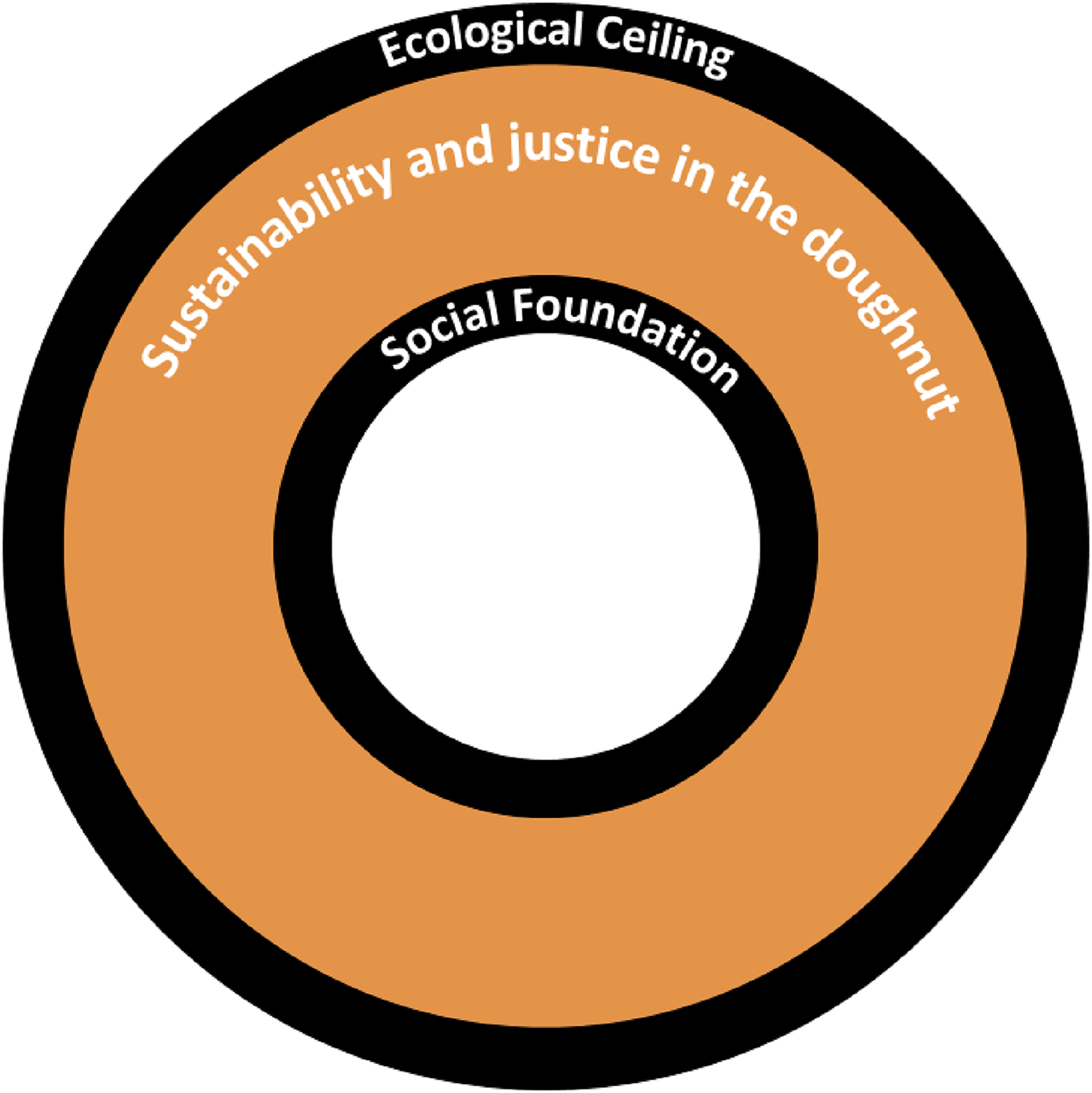
Living a sustainable and just life within the Doughnut
Alternatives to GDP are typically either a composite metric which like GDP bundles metrics together into a single figure (e.g., the Human Development Index, Gross National Happiness Index) or a dashboard of multiple indicators that takes into account the environment and individual well-being (e.g., DE, the Better Life Index). 6 A dashboard of metrics can be more accommodating of innovations and does not necessitate an arbitrary weighting of very different features, but it can be difficult to draw a simple narrative. Metrics need to measure what is important, but also convince potential users of their validity and usefulness, particularly those parties that may benefit from the continued use of existing metrics. This inevitably leads to inertia against radical adaptations to an existing metric.
The advantage of the DE model is that while it includes a dashboard of indicators, the simple visual image of a doughnut with an ecological ceiling that we should not go beyond and a social foundation people should not fall below is one that people can readily subscribe to from across the political spectrum. Disagreeing on the relative importance of individual indicators, whether ‘gender equality’ or ‘political voice’, does not have to prevent an organisation from adopting the broader model in an effort to become more sustainable.
The size of the challenge should not be underestimated. ‘No country has ever ended human deprivation without a growing economy. And no country has ever ended ecological degradation with one.’ 7 This means that new ideas are needed from outside the discipline of economics, but while Raworth lists many other disciplines that have contributed to the thinking of DE, theology is noticeably absent. 8
Here DE is compared to the economic ideas of early Christian thinkers. It does not start with a grand hypothesis for testing, but rather allows the main themes to emerge from the literature, with a purposive and snowball sampling, comparing both the areas of difference and similarity between DE and early Christian thinking. A very different economic period provides a lens through which to challenge the concepts, entities and relationships that contribute to our worldview. While DE is typically applied at a city and country level, Raworth also recommends that people map their own lives onto the doughnut. 9 Early Christian thought particularly helps with our personal economic decisions as it was primarily written for pastoral purposes.
As DE is a high-level model that has not yet been explored in the context of early Christian thought, a broad approach is necessary, considering a wide range of sources. While a number of early Christian thinkers are considered below, we should pay particular attention to the seemingly polar opposites of John Chrysostom (c. 347–407) and Clement of Alexandria (c. 150–c. 215), who are amongst the most regularly referenced patristic fathers on the topic of wealth. They also reflect pre- and post-Nicene periods and the changing economic influence of the Church at these times.
After introducing the DE model in more detail, and a literature review, the DE model is considered from the perspective of distribution, asceticism, and the goodness of creation. These themes can be seen to correspond broadly to the structure of the doughnut model: distribution is at the heart of ensuring that we stay within the doughnut; asceticism provides an alternative perspective on the social foundations of the doughnut; and the goodness of creation provides an optimistic perspective on the ecological ceiling. Other themes could have been selected or considered in more depth; however, these three were often mentioned by early Christian thinkers, and combine to relate to the model as a whole.
It will be shown that there are three ways in which DE might benefit from the insight of early Christian thought. Firstly, an alternative understanding of ‘ownership’ and ‘property’ as understood in early Christian thought can fuel calls for a more radical distribution of wealth than called for in DE, with an even greater emphasis on the process and benefits of individual almsgiving. Secondly, the social foundation of DE has much to learn from the positive value of the ascetic lifestyle promoted by some early Christian thinkers, showing that the call to a more restricted lifestyle is not a purely negative call. Finally, at a time when there are understandable concerns about the limits of the ecological ceiling, early Christian thought combines both hope and a call to action.
Review of the Literature
Theological Reflections on Doughnut Economics
There have been very few theological reflections on DE. One of the first papers to consider theological implications of DE was Jari Visto's consideration of the contribution that ecotheology could make to discussions on sustainable development, in which he charted the changes that have taken place in ecotheology since its inception in the 1960s. 10 Although Visto framed the discussion within the context of DE, DE was primarily shorthand for the need to consider economic, social, cultural, and environmental factors in relation to one another, rather than engaging directly with the model.
The first study, and so far only study, to look more closely at DE from a theological perspective was Stephanie Puen's consideration of how Catholic Social Thought (CST) could contribute to DE. 11 Three different ways were identified: creating a greater understanding of human nature; emphasising the importance of human culture; and articulating the role of businesses in such an ecosystem. 12 While there are many useful insights that CST can undoubtedly bring to DE, Puen focuses principally on the encyclicals, and it is important to recognise that these publications’ teachings have developed alongside the modern economic system that is causing such difficulties. It is important to take into consideration perspectives from outside today's economic system. While the encyclicals do reference patristic sources, they typically do so out of context and are not referencing socioethical texts of early Christian thought. 13
The Economic-Theological Nexus
The relationship between the economy and theology has been explored by many researchers in many disciplines, with the importance of the relationship gaining widespread interest with Max Weber's conception of the Protestant work ethic. 14 While Weber's work has been the subject of much debate and criticism over the intervening century, he undoubtedly opened economic discussion to the idea that significant economic influences can come from outside the market. 15 However, the impact of these influences may not always be readily discernible, and while Weber argues for the Protestant work ethic, Tanner argues that the opposite position, a Protestant anti-work ethic, could equally be developed that could undermine the spirit of capitalism. 16
Economic theology is not just religious teaching on economic issues but rather sees the two areas strongly interconnected or ‘intimately connected’, to use Stefan Schwarzkopf's phrase. 17 Neither religion nor economics existed in the ancient world as they do in the secular West today. It is only with modernity that there is ‘religion’ separate to secular pursuits of life. 18 Similarly, the ‘ancient economy was embedded’; a distinct economic activity was not perceived by the ancients, but rather it was embedded in everyday life. 19 This embeddedness inevitably leads to a certain amount of cross-pollination of ideas, with the early cohabitation of economic and theological terms and conceptualisations having consequences for both theology and economics that echo down to today.
The cross-pollination of economic and theological conceptualisations is seen in both the way the Christian doctrines of the incarnation and redemption can be perceived in economic terms, and the way markets can be spoken of in religious terms. The perception of the incarnation and redemption in economic terms is most explicit in the ransom theory of atonement as developed by Origen and Gregory of Nyssa, in which Christ is the payment by which humanity is bought from the devil. 20 In such a scenario Jesus is money, which itself is just a short step from the biblical metaphors of Christ and God's kingdom as treasure or pearl of great value. 21 As Luke Bretherton argues, money as metaphor for atonement is attractive because it is a ‘universal medium of exchange’. 22 On the other side, it is not only common for money and the markets to be spoken of in religious terms, but some would even go as far as to claim that faith in the markets is to all intents a functioning religion. 23 After all, today it is the market that is seen as omniscient, omnipotent, and, increasingly, omnipresent.
There are also more practical economic consequences for theology. Theological decisions may be biased in favour of the Church's economic interests. For example, it has been suggested that the rejection of Pelagianism may have been overly influenced by self-interest and a desire for the Church to grow among the Roman upper class. 24
Early Christian Economic Thought
There was no area known as economics in the ancient world, and the Roman intellectual tradition did not include economic studies. 25 Therefore, many studies look at concepts that are considered to fall under the area of economics, concepts that are appropriate to the economy at the time, 26 such as ownership and scarcity. 27 Other studies have focused on the influence of the social context and models of the time on economic ideas: the distribution of wealth across society and the early Christian audience; the agricultural setting for the discourse of Jesus; the idea of patronage or virtuoso religions. 28 Such studies may focus specifically on the economic issues raised in particular texts in context, either canonical works or lesser-known extracanonical works such as the Syriac ‘Book of Steps’. 29 Wendy Mayer considers poverty and generosity to the poor in the works and time of John Chrysostom, and shows the importance of voluntary asceticism for the relief of involuntary poverty. 30 Hennie Stander provides a brief overview of twelve different economic issues: engagement with the world, the economy at large, ownership, the Church as owner, the nature of wealth, important economic principles, trade, socioeconomic conditions, charity and almsgiving, slavery, interest, and monasticism. 31
One notable study that has taken early Christian thought and used it to provide insights into a modern economic problem is Timothy Patitsas's study of how Basil the Great's fourth-century philanthropic program might provide insights into how microlending could work where other international development projects have failed. 32 Patitsas suggests that Christian social activists should not rely on modern economic experts alone. 33
With the possible exception of usury, there was no consistent dogmatic teaching within the patristic writing on economic subjects. 34 There is also no coherent interpretation of the patristic opinions. 35 The theologian is an economic animal, and brings his or her own context to the economic investigation. The context for many theologians in the West today, however, is the continuing strong influence of the Roman idea of ownership, with its principle of ‘absolute and individual ownership’. 36 ‘Absolute’ means that, at least in theory, a person has the right to do what they like with what they own. 37 In reality there were necessarily some restrictions, even during the Roman period, where unrestricted use would impact other people and their property, but it was nonetheless ‘minimally restrictive’. 38
Early Christian Thought and the Environment
DE's recognition of an environmental ceiling reflects current concerns about climate change and ecological degradation. The need for a Christian response to the degradation of the environment was emphasised by Lynn White's 1967 article in Science, in which the Christian attitude to the ‘dominion’ of the Earth was blamed for the ecological crisis, long before the true extent of the crisis was known. 39 There are an increasing number of works providing a theological perspective on the environmental crisis, a few of which have focused specifically on early Christian thought on the issue.
Stander addressed White's criticisms by considering what the patristic fathers wrote about Gen. 1:28, finding that while it was true that the Church Fathers were more interested in what comes next, there was also great interest in stewardship of the earth. 40 Oleh Kindiy also found that the Church Fathers emphasised the goodness of creation and the call for stewardship, and concluded that Christians today had to learn from earlier examples of asceticism. 41
Jame Schaefer explored patristic and medieval theologians’ thought on nine different ecological concepts, from the goodness of creation to our kinship with other creatures. 42 Each ecological concept was explored with a five-stage methodology, from representative quotations associated with a particular concept, through the associated context, coherence and relevance for today, to the helpfulness of the concepts in addressing current ecological concerns. 43 As Schaefer emphasises, the early Church Fathers had a very different cosmology to people today, and a strong anthropocentric bias. 44 For Schaefer these differences can make the patristic fathers potentially harmful to theological discourse on the environment unless they are appropriately rehabilitated through a modern perspective. In this study, however, the patristic fathers are not viewed through the lens of current thinking, but as a challenge to current thinking.
A Radical Distribution of Wealth by Individuals
Distribution in Doughnut Economics
DE argues that there is a need for an economy where the default is for wealth to be distributed to the many rather than being accumulated by the few. Inequality is recognised as damaging to individuals, society and the environment as people indulge in conspicuous consumption and strive to have more goods than the next person. 45 As the gross inequalities of the world today clearly attest, this redistribution cannot be left to the market alone. Markets do not ‘favour the needy’. 46 Instead, markets marginalise nonmarket values, with significant political and social consequences. 47 Unsurprisingly, DE considers economic inequality to be a ‘design failure’. 48
Raworth believes there is not only a need for the redistribution of income, but also a redistribution of wealth, time and power if current inequalities are not to keep increasing. 49 Redistribution becomes increasingly important if society is to be weaned off its obsession with GDP growth, as the promise of GDP growth persuades people to ignore some of the worst inequalities. 50 Such a redistribution requires the contributions of the state, the market and the commons. 51
Distribution of Wealth in Early Christian Thought
There was no clear dogma on economic issues within early Christian thinking; however, while there were different interpretations of the New Testament call for a redistribution of wealth, its importance was recognised by even the less communalist thinkers.
One of the strongest calls in the Gospels for the distribution of wealth is the story of Jesus and the rich young man (Mt. 19.16-22; Mk 10.17-22; Lk. 18.18-25), in which Jesus says to the rich young man, ‘If you wish to be perfect, go, sell your possessions, and give the money to the poor’ (Mt. 19:21). 52 Whereas some early Christian thinkers opted for a figurative interpretation of the story, others recognised a more literal interpretation.
Clement of Alexandria is the most famous example of taking a figurative interpretation: It is not what some hastily take it to be, a command to fling away the substance that belongs to him and to part with his riches, but to banish from the soul its opinions about riches, its attachment to them, its excessive desire, its morbid excitement over them, its anxious cares, the thorns of our earthly existence which choke the seed of the true life.
53
For others, however, such a figurative approach was not enough. As John Chrysostom, a prolific writer on the rich and poor, wrote in a homily on the Gospel of Matthew: ‘It is not enough to despise wealth, but we must also maintain poor men, and above all things follow Christ.’ 54 For Chrysostom the consequences of taking up one's cross and even ‘to shed one's very blood’, put the call for the rich young man to give up his riches into perspective. 55 After all, it would be churlish to baulk at giving away the treasures of this world when we must be willing to give up our very lives. The distribution of wealth was about justice. As Chrysostom said when considering the parable of the rich man and Lazarus (Lk. 16.19-31), ‘… remember this without fail, that not to share our own wealth with the poor is theft from the poor and deprivation of their means of life; we do not possess our own wealth but theirs’. 56
The practical differences between Chrysostom and Clement should not be exaggerated, however. As Margaret Mitchell notes of Chrysostom's writings on the rich and poor, it is not always consistent and resists systematisation. 57 Similar may be said of Clement. Taking Clement's figurative interpretation of the story of the rich young man in isolation inevitably simplifies what would in reality be a more nuanced position, and a position that was likely to differ over time. In Paedagogus Clement not only reiterates Jesus' point that giving to the poor will store treasures in heaven (Mt. 6.1) but states that ‘riches that are not under complete control are the citadel of evil’. 58 Clement's position on almsgiving is in contrast to both the total divestment of wealth and the uncritical support of wealth. 59
Clement's understanding of property also differed from most people's understanding of property in the West today. Indeed, as Douglas Meeks notes, people's understanding of property has differed throughout history. 60 Clement did not subscribe to the absolute Roman right to do your will with your property, but rather saw it as a means to God's will. 61 To hold on to your property did not mean holding on to an exclusive right to use it as you will.
When it comes to the redistribution of wealth it can often seem as though the history of Christianity is looking for ways to not accept the radical call that Jesus gave, whether we consider Clement's suggestion in the second century that we interpret the story of the rich young man figuratively, or Brian Capper's recent suggestion that people are different, and have different callings when it comes to the distribution of wealth. 62 Clement also provides leeway on the topic of household goods, allowing that different household items may be ‘fitting’ to different people according to ‘person, age, occupation, and occasion’. 63 This willingness of Christians to come up with excuses rather than accept the more obvious interpretations of Scripture was recognised by Pelagius as he railed against alternative interpretations of a camel passing through the eye of a needle rather than accepting the obvious conclusion: ‘What an intolerable excess of ingenuity a man is forced to employ by his love of riches … How blessed this ingenuity would be if only he could exercise such mental effort for the love of God!’ 64
Despite some of the excuses, early Christian thought does call for a more radical distribution than many would wish for. As will be shown below, however, it is not enough that we distribute wealth, but that attention is paid to how it is shared, ‘sharing it generously, but not mechanically nor with affectation’. 65
The Benefits of Almsgiving in Early Christian Thought
Charity and almsgiving were seen in the early church as the only way of narrowing the gap between the rich and the poor. 66 Poverty was part of God's providence for both rich and poor, for the good of both, as Chrysostom states: ‘For poverty assuredly is more suitable to virtue than wealth; and those existing in sin come into great consolation from helping those who stand in need.’ 67
The heavenly return of investment from almsgiving to the giver was noted by many early Christian thinkers, particularly in the fourth and fifth centuries as the deterioration of the Roman Empire brought eschatological issues to the fore. 68 For Chrysostom, almsgiving was the ‘queen of the virtues’ and it was a way of receiving forgiveness for sins. 69 As Chrysostom says in one homily, ‘even if you have many sins, you should not be afraid if you possess almsgiving as your advocate’. 70 With such an advantage it is not surprising that Chrysostom was enthusiastic in the promotion of almsgiving. 71
As well as contributing to the forgiveness of sins, Chrysostom also promoted the importance of giving away wealth to become a better person: ‘… whilst rich, thou wilt never cease thirsting, and pining with the lust of more, but being freed from thy possessions, thou will be able to stay this disease’. 72 By comparison Clement thought that doing away with the lusts and passions for wealth was sufficient, and that ‘by becoming noble and good, he may be able to use these possessions also in a noble manner’. 73 Not that this would be easy; wealth is like a snake, Clement noted elsewhere, but ‘he may train the beast by the invocation of the Word and remain unharmed’. 74
As might be expected from Clement, while he promoted almsgiving, he was not necessarily consistent in his teaching on its distribution. As the fragment ascribed to Clement in Nicetas's catena on Matthew states, ‘Alms are to be given, but with judgment, and to the deserving, that we may obtain a recompense from the Most High’. 75 At other times he was more compromising: ‘Do not yourself decide who is worthy and who is unworthy, for you may happen to be quite mistaken in your opinion’. 76
The way that wealth was distributed was also important to early Christian thinkers. It should be done of a person's free will, and without averting one's gaze. As Chrysostom wrote, ‘For the reward is not proportionate to your necessity, but to your free will’. 77 He also saw the importance of seeing the poverty and the humanity of the poor, rather than allowing his congregation to avert their eyes while they rationalised poverty. 78 Nonetheless, Chrysostom recognised the difficulties in achieving a just social order through almsgiving. 79
Doughnut Economics and Distribution in Early Christian Thought
At first glance there are many similarities between the distribution of DE and the distribution promoted in early Christian thought, most noticeably with the recognition of the importance of a more radical distribution of both income and wealth than is seen in the world today. However, there are also some noticeable differences, including the reasons for the economic inequality, the level of inequality that is acceptable, and those who are responsible for addressing the inequalities.
DE considers economic inequality to be a ‘design failure’; inequality is not a necessary part of economic growth but reflects decisions about how an economy is designed. 80 This differs considerably from early Christian thought, where economic inequality could more properly be recognised as a design feature, providing the opportunity for those who are richer to give generously. Many today would find the early Christian position unacceptable, seeing it as an attempted justification of the unjustifiable. However, as it was based on a non-absolutist understanding of property, there was a greater impetus for the individual to rectify the inequalities, and to do so far more radically than in DE. It could be argued that it leaves the poor as mere pawns in a rich person's game, but we must equally be wary of the alternative: emphasising the importance of the systemic distribution of money or material wealth can contribute to the belief that material wealth is the most important measure of value.
That the focus of DE is primarily on systematic distribution is in many ways understandable; leaving distribution to people's individual proclivities has failed to address growing inequalities. This has less to do with the legacy of Christianity as espoused by early Christian thinkers, and more to do with people's preference for the Roman idea of absolute and individual right to do what they wish with their money. As Raworth notes, there is a need to reappraise the role of the state, the market and the commons, and reconceptualising money as something that has been given to share would be an important early Christian contribution to rectifying economic injustices. 81
Early Christian thought was much less welcoming of the idea of a fat doughnut, with great disparities of wealth without personal responsibility, than DE. In DE there is a social foundation below which people should not fall, and an environmental ceiling they should not breach, but between the extremes there is room for great disparities of wealth. This is both a strength and a weakness of DE. It makes the model acceptable to people across the political spectrum, but it stops short of being a radical overhauling of a dehumanising system. Despite some of the occasional excuses, early Christian thought calls for a more radical distribution than many have ever necessarily wished for or that DE requires.
DE also lacks a role for the individual in the distribution of wealth, which would probably be of concern to early Christian thinkers. Our understanding of the economy is very different today than it was 1,500 or 2,000 years ago, and we see a variety of alternatives to almsgiving for the redistribution of wealth, from new taxes to job creation schemes. However, an extremely efficient tax system that distributes wealth would not have the same benefits to the giver as an unequal distribution of that wealth by almsgiving, or develop the same kind of community. DE is not totally immune to the human benefits of giving freely. When considering the issue of a time bank, whereby people deposit their time to help people now so that they can retrieve help in the future when they need it, Raworth recognises that additional research is necessary to ensure that such systems ‘reinforce rather than replace the human instinct to care for others’. 82 For this to happen, however, there would need to be a greater emphasis on individual choice than currently exists in DE. This does not mean that there should be no systematic distribution, but that it must work in partnership with the individual distribution of wealth, not simply as a replacement to it.
Early Christian thinking on the distribution of wealth provides a challenge for people today, as it is far more open to a radical distribution of wealth, and also calls for the individual to play a part. There is a need for people to move on from the Roman idea of property as something that we can do with what we like, and see it as our responsibility to redistribute appropriately.
Asceticism and the Social Foundations
The Social Foundations of Doughnut Economics
The social foundations at the centre of DE are designed to provide ‘the basics of life on which no one should be left falling short’. 83 These twelve basics include food, water, health, education, income and work, peace and justice, political voice, social equity, gender equality, housing, networks, and energy. Many of these social foundations have been widely accepted since the middle of the twentieth century, at least in theory, and are encapsulated in agreements such as the UN's Universal Declaration of Human Rights (1948) and the Sustainable Development Goals (2015). People might disagree about what these DE basics mean, and how they are achieved, but there has been sufficient agreement on the values for the documents they are based upon to be adopted by all UN member states.
Asceticism
For early Christian thinkers the social foundation of a person's life was not to be provided by an expanding list of needs, but rather in the life, death and resurrection of Jesus Christ, and ascetic self-denial was one way of inculcating a more spiritual life. Even before the desert ascetics Clement of Alexandria was calling for people to live more frugally, noting that there were plenty of examples of frugality from the Scriptures, from the risen Christ being offered broiled fish, to Jacob wrestling with God while he was sleeping on the ground with a stone pillow. 84
Asceticism is designed to lead to spiritual self-mastery through self-denial. Although we may associate self-denial with the disposal of worldly goods, it is important to recognise that personal wealth and voluntary poverty were not incompatible. 85 It was no more necessary to give up personal wealth to live a life of voluntary poverty, than it was necessary for a man to become a eunuch to abstain from sexual activity. Nonetheless, as Mayer points out, although asceticism is not associated with a total disposal of wealth, asceticism does denote a change in focus, from generosity to the citizens of the polis to generosity to the church and the poor. 86 After all, as Clement put it, ‘For what sharing would be left among men, if nobody had anything?’ 87
In reaction to the problems of the later Empire asceticism took the form of monasticism. 88 It had the ‘pride of place’ in the thinking of John Chrysostom, with Mitchell describing it for Chrysostom as ‘the seedbed from which all else should come to restore the primordial order of divine cooperative ownership’. 89 While Jesus may not have required the disposal of their wealth by everyone who believed in him, Chrysostom wanted to ‘democratize monastic values’ to the laity, emphasising the need to limit our attachment to worldly goods. 90
In today's world asceticism can often have negative connotations, ‘not freedom but submission to irksome rules; not beauty but harsh rigor; not joy but gloomy austerity’. 91 A distinction should be made, however, between ‘natural’ and ‘unnatural’ asceticism; natural asceticism is about the restriction of physical needs without deliberately choosing to inflict physical harm, whereas unnatural asceticism deliberately chooses to inflict pain and torment on the body. 92 In a world where any distinction between true and false needs is, for the most part, ‘passé’, it is easy to see how the negative connotations of asceticism prevail. 93 Nonetheless, recognising the advantages of natural asceticism and the distinction between true and false goods is an important part of re-envisioning asceticism for the challenges of today.
The Advantages of Asceticism
Early Christian thinking recognised a number of advantages from asceticism, the most immediate of which is that it helps to keep our passions for worldly goods under control. The need for self-control where worldly goods were concerned was near universal within early Christian thinking.
Gratuitous spending is an issue that brings together both Clement of Alexandria and John Chrysostom. Clement denounces pointless expensiveness where the purpose should be ‘usefulness’, dismissing ivory-handled table knives and those who chase after expensive menus: ‘These men hug delicacies to themselves, yet after a while they must yield them to the privy.’ 94 The image of privies and chamber pots have a long tradition in moralising that both Clement and Chrysostom embraced in denouncing pointless expense, with Chrysostom contrasting how as ‘one voideth his excrement even into silver, another has not so much as bread!’ 95
Unsurprisingly, Chrysostom is particularly vehement when it comes to the dangers of wealth capturing a man's heart: ‘Whom shall I call a slave? … The one who is the slave of a man, or the one who is the captive of passion? The former has his slavery on the outside; the latter wears his captivity on the inside.’ 96 For Chrysostom the dangers of worldly enticements was an issue of great importance: ‘For those who are eager to go to the races and the other satanic spectacles, who have no care for self-control and give no thought for virtue …. these people walk by the wide gate and the easy road.’ 97 That, as Jesus said, is the path to destruction (Mt. 7.13).
There were also systemic advantages from a proportion of the population adopting a voluntarily ascetic lifestyle, with the ascetic becoming a way of money being channelled from the rich to the involuntarily poor. 98 In a society where the involuntarily poor were considered feckless and looked down upon, the moral value of the voluntarily poor was held in high esteem, making the voluntary poor a more attractive target for alms which could then be distributed to the involuntary poor. 99 As Mayer notes, ‘When we consider this model of care for the poor within a system in which reciprocity, patronage, status and honor are significant, everyone's needs are neatly taken care of’. 100
The Lessons of Asceticism for Doughnut Economics
DE, and the modern world more generally, has much to learn from asceticism as espoused by early Christian thinkers. Whereas Jesus’ concern for the poor has been widely lauded, there has been far less enthusiasm for his reputed renunciation of wealth and property. 101 In fact, where there are no limits to the world's offerings, ‘the avoidance of enjoyment through ascetic self-control appears irrational’. 102 Even a hundred years ago, when consumerism could be considered less rampant than it is today, it could be recognised that all but the very poor were spending too much on material goods. 103 Today the world has reached a point where, as DE acknowledges, unless we take steps to avoid some of that individual consumption that is increasingly equated with personal enjoyment, everyone will suffer.
The problem, however, is there is a general reluctance to embrace the sorts of changes that are really needed. Few of us will have gold or silver toilets, but many will have embraced a lifestyle that includes a variety of modern-day equivalents, where the focus is on expensiveness rather than usefulness. Sports cars crawl around congested city streets, must-have technology is used in the same way as the previous iteration and is thrown away tomorrow, and in the fashion industry cost and usefulness are seemingly inversely correlated. In comparison to the seeming glitz of the material goods, the ascetic life does not seem to be one with widespread appeal.
The extreme inequalities that necessitate the redistribution of wealth could also be used to cast doubt on the call to asceticism: what role does asceticism have on those with precarious lives? In the same way Jesus calls for the rich young man to sell his possessions (Mt. 19.16-22), it may be that it is the comparatively wealthy who first need to adopt a more ascetic lifestyle. The conspicuous consumption that is accepted in a growing economy will be deemed less acceptable in an economy that is stagnating or where the limits of growth are recognised, and a new conspicuous asceticism may be necessary by the comparatively wealthy, whether at a national or international level, to prevent social unrest.
As Raworth acknowledges, while conspicuous consumption has consequences to the environment, it may also be a reflection of a deeper need in people's lives: ‘when it comes to consumerism, perhaps the poverty we aim to conceal lies in our own neglected relationships with each other and with the living world’. 104 Undoubtedly early Christian thinkers would add God to the list of people's neglected relationships, and would see asceticism as a way of improving that.
The religious dimension is noticeably lacking from DE, reflecting the type of Western secular society from which DE has emerged. Although Raworth acknowledges that the economic values held by the typical WEIRD (Western, educated, industrial, rich and democratic) person are not necessarily shared by the rest of the world, she does not take note of one of the biggest differences, the role of religion. 105 By relegating the spiritual, which may be deemed a political necessity in a pluralistic society, it inevitably emphasises the material, and in purely material terms the ascetic life is unlikely to have widespread immediate appeal.
In the same way that monasticism was embraced when Christianity was faced with the decline of the Roman Empire, it is possible to imagine a new asceticism emerging in response to the challenges of today. In the same way fourth-century monastic movements played an important role in the redistribution of resources, it may be that a new asceticism can play an important role in the promotion and growth of a sustainable economy. Such asceticism will be a necessary part of bringing people back within the bounds of the ecological ceiling.
Early Christian Thought and the Ecological Ceiling of Doughnut Economics
The Ecological Ceiling in Doughnut Economics
The ecological ceiling of DE is based on the premise that we must take into consideration the wider environment if we are to ensure we continue to live in a healthy habitable planet. Earlier macroeconomic models were ‘closed and complete’, typically ignoring wider environmental concerns. 106 In terms of consumption Raworth likens us to an industrial caterpillar, ‘ingesting food at one end, chewing it through, and excreting the waste out at the other end’. 107 The problem with such an approach is that the resources that we are making use of are finite, and ignoring the environmental impact of waste can create devastating levels of pollution, loss of biodiversity, and an increase in climate change.
The environmental impact of our lives of conspicuous consumption is increasingly widely recognised, although most people and organisations are failing to do enough about it. According to Raworth there is typically a scale of responses from ‘do nothing’ to ‘do no harm’, but what is required of organisations is that they ‘be generous’, that they give back to the systems of which we are a part rather than just taking from them. 108 After all, in a model that gives little room to the spiritual, ‘Only one form of wealth persists through time and that is the regenerative power of life powered by the sun’. 109
A limitation with DE, however, is that the assumption that people should care about life on the planet is taken to be self-evidently true. It may be that people in general should care about life on the planet, but when the consequences of climate change and ecological degradation are perceived to be problems for future generations, it is not necessarily the case that an individual should care today. Rather, it is in a person's interest to choose to believe in technological progress, sufficient demographic change, or, for those choosing not to have children, to simply claim that it is not their problem.
Sufficiency in Early Christian Thinking
Early Christian thinkers would not have shared the modern understanding of an ecological ceiling, so it is necessary to consider early Christian concepts that resonate with our modern understanding. The most important of these concepts is sufficiency, the idea of there being enough. It was an important concept for early Christian thinkers that applied to both personal wealth and the natural world.
It was deemed acceptable for Christians to have wealth and ownership as long as it was sufficient rather than superfluous wealth. 110 John Chrysostom associated an abundance of worldly goods with the rich man who ended up in Hades, as well as parasites, and a robber-chief. 111 A person is not fortunate for having an abundance of goods, but rather should be pitied for their future sufferings. 112
The idea of sufficiency was also translated to the natural world. Clement of Alexandria provides a view of God's provision of what is, and is not, needed: ‘He supplies us, first of all, with the necessities such as water and the open air, but other things that are not necessary He has hidden in the earth and sea.’ 113 Where humankind is not involved in the distribution of natural goods they are also deemed to be possessed equally, ‘Observe whether the rich man enjoys the benefit of this air of ours more than the poor’, says Pelagius. 114
There were occasions in the early Christian period when there was not enough, and it was not always due to inequalities deliberately caused by individuals. In a world where it is generally accepted that there should be sufficient wealth for everyone, natural disasters can be attributed to anthropocentric causes. John Chrysostom, when reflecting on an earthquake which he attributed to God's anger, thought people should consider the sins that caused it: ‘Everyone else was afraid because of the earthquake, but I was afraid because of the cause of the earthquake.’ 115
Dominion, Stewardship and the Goodness of Creation
Christian theology has been criticised for decades for its perceived attitude to the environment encapsulated in the idea of being given ‘dominion’ over the earth. 116 However, early Christian thinking was more interested in the idea of stewardship. 117 Stewardship is the natural reaction to a world perceived to be good. The goodness of creation is a view that goes back to Genesis and God's judgement that everything that he had made was very good (Gen. 1.31). As one of John Chrysostom's homilies on Genesis warned his listeners, it is ‘arrogant folly’ to disagree with God's evaluation of creation. 118 The consequences of the Fall and the promise of Heaven always risk a negative perception of the material world, but while the earth may pale in comparison with the spiritual realm, its goodness is not in question.
The goodness of creation was emphasised by many early Christian thinkers in response to Gnosticism and its cosmology that saw the material world as a mistake. 119 In contrast to Gnostic teaching Clement taught that through contemplation of the universe people can recognise the rule of God. 120 Similarly, Basil the Great delighted in the natural world in his Hexameron: ‘I want creation to penetrate you with so much admiration that everywhere, wherever you may be, the least plant may bring you the clear remembrance of the Creator.’ 121 Although the whole of creation can lead people to God, Basil ascribed particular importance to the earth being formed before the sun in the six days of creation, so that ‘those who worship the sun, as the source of life, may renounce their error’. 122
The Goodness of Creation and Doughnut Economics
Like others before her, Raworth notes that Western cultural ideas about dominion over nature can be traced back at least as far as the first chapter of Genesis. 123 As has been shown, however, this is only half the story, and fails to recognise the goodness of creation and the responsibility to care for creation, a responsibility that was amply recognised by early Christian thinkers. In fact, that people should care about life on the planet probably owes more to the Christian cultural inheritance than anything self-evident, as was seen with the Gnostics arriving at a totally different conclusion. Without a firmer ethical foundation for the necessary stewardship of the earth, there are likely to be many who continue to ignore the problems caused by breaching the ecological ceiling.
The contrast between Raworth's sun as the persistent form of wealth and power of life, and Basil's emphasis on the importance of the world is a significant one. 124 Although from the perspective of thermodynamics Raworth is undoubtedly correct, if we are not careful the choice of focus undermines the purpose of the model. It is not simply the mechanistic universe that is good, but especially the richness of life on this planet.
The framing of the world as sufficient is important if ethical solutions are to be found to the environmental crisis. It is a framing that requires changes in behaviour and expectations, and a weaning off of our consumerist lifestyles, rather than a reduction of humankind. If people view the world as sufficient, they can adjust their expectations appropriately, whereas if they view resources as scarce, other people are competitors to be overcome. This negative view of humanity is also encouraged by an emphasis on the ‘dominion’ part of humankind's role. People are no longer framed as part of the solution, but the cause of the problem. The ideas of sufficiency and the goodness of creation combine to give both hope and a call to action. The extent to which such a call to action is needed can be seen in the extent to which natural goods are are shared unequally, including the essentials of clean air and water.
Not all of early Christian thinking on the natural world would be as welcome as ‘sufficiency’ and the ‘goodness of creation’. John Chrysostom's call for personal reflection in response to an earthquake would not only strike many people today as harsh, but disgustingly offensive in the face of a natural disaster. 125 Nevertheless, unlike some other natural disasters, there is an overwhelming case for the human responsibility for climate change and ecological degradation, and a need for personal reflection and taking of responsibility. Such personal responsibility is to a great extent lacking from DE.
With hindsight it might be said that it would have been better if more notice had been taken of Clement's observation that ‘things that are not necessary He has hidden in the earth and sea’. 126 Many today would wish that fossil fuels had been left in the ground, along with the jewels and precious metals that Clement had in mind. There is no turning back the clock, however, to some pre-industrial low-energy age; rather we must find ways of stewarding the earth that reflects the goodness of creation.
Conclusion
The need to distribute wealth, live within our means, and steward the environment all have precedents that early Christian thinkers would have recognised, but whereas early Christian thinkers had firm foundations for these beliefs, today they must either be considered self-evident truths or appeal to our personal interest.
Reconciling the need for a greater distribution of wealth without forcing the distribution on our already fractured communities is an uphill task. If Clement of Alexandria was looking for some leeway when confronted with the words of the incarnate God, people are unlikely to listen to modern politicians. Inequality is a problem that DE starts to address, but distribution must make room for individual action. It is only when people really see the poor, and take responsibility for those who have less than themselves, that they and their communities can benefit from the inter-relational nature of almsgiving. We need to be as generous in our relations with our communities as Raworth calls us to be with our environment. 127 For this to happen, however, we must return to our understanding of wealth and ownership. Raworth rightly acknowledges the reappraisal of the role of the commons, but there is a need to go even further than this, and encourage an alternative to the dominant Roman idea of ownership. 128
The asceticism of some early Christian thinkers offers an alternative to the social foundations of DE. In the same way as asceticism took the form of monasticism in response to the problems of the later Roman Empire, it may be that a new asceticism emerges to accompany the environmental crisis. 129 It is hard to see such an asceticism taking place, however, without greater room in public discourse for the religious part of people's lives. When religion is relegated to the private sphere we cannot expect the values it incorporates to have their full impact in the public realm. Instead we find conspicuous consumption and other worldly values are permitted to be promoted virtually unopposed. It is not simply that a secular model should be religious, but that a WEIRD model has failed to recognise the importance of religion for much of the world, and has thus discarded a powerful lever for changing economies.
In comparison to the world of scarcity that sits at the centre of modern economics, the sufficiency provided by God provides hope in volatile times. Although DE aims for security with its social foundations, the ease with which such temporal foundations can be rocked has been seen with the recent wars and pandemic. It might be thought that the belief in sufficiency will lead to the environmental abuse envisioned by those who only see the ‘dominion’ call of Genesis, but a belief in the fundamental goodness of creation ensures that stewardship has an important role to play.
The underlying premise of DE is that economic systems are complex and interconnected, and one part cannot be adjusted in isolation without there being a potentially cascading knock-on effect elsewhere in the system. This can also be seen in the aspects of early Christian thinking that were considered; almsgiving, asceticism and the goodness of creation are all strongly interrelated ideas. It should not be expected, therefore, that these highly complex systems will map neatly onto one another. Nevertheless, this article has shown that early Christian thinking can provide new insights into DE.
While Schaefer noted the potential harm of the patristic fathers to theological discourse due to their different cosmology and strong anthropocentric bias, early Christian thinkers can nonetheless be used to inform DE. 130 There are areas of concern, but also important truths. We baulk at the poor being reliant on the largesse of the rich, but it is equally important that the rich see the poor and do not rely on systemic distribution alone. Similarly Chrysostom's comparison of the allure of worldly goods to slavery should not be ignored simply because such comparisons are deemed unacceptable in the modern world.
Puen originally suggested that Catholic Social Thought could contribute to DE in three ways: creating a greater understanding of human nature; emphasising the importance of human culture; and articulating the role of businesses in such an ecosystem. 131 To these we can now add three ideas from the early Christian thinkers that can help economies get into the Doughnut: the non-absolutist understanding of property; the positive side of asceticism; and the goodness of the earth providing a call to both hope and action.
This article only brushes the surface of what early Christian thinkers have to teach us as Western civilisation arguably faces the biggest challenge since the fall of the Roman Empire. Early Christian thinkers do not provide simple solutions to the complex problems of today, but they do provide alternative perspectives and different values to those of today. Future in-depth studies should build upon this initial study to explore early Christian perspectives on other aspects of the DE model in more detail, as well as other contemporary economic models.
Footnotes
Acknowledgements
Thanks to Dr Elizabeth Phillips for her feedback and constructive criticisms of earlier drafts of this work.
Declaration of Conflicting Interests
The author declared no potential conflicts of interest with respect to the research, authorship, and/or publication of this article.
Funding
The author received no financial support for the research, authorship, and/or publication of this article.
