



Abstract
This article explores a programme of dream analysis carried out by Major Kenneth Hopkins during the Second World War, conducted in the unlikely circumstances of a POW camp. Hopkins, who was captured in 1940 and held in two camps within Germany, collected and analysed over 500 dreams from his fellow prisoners. The article seeks to place this project within historical context, connecting it to other dream analysis projects, including that of Mass-Observation (M-O), which was contemporary to Hopkins. Hopkins’s project has clear similarities to other observational cultures in the interwar period, including both M-O and popular ornithology. It also seeks to explore the motivation behind Hopkins’s attempts to collect dreams, his bibliography and sources, and his goals for the project. Ultimately, Hopkins’s analysis combined psychological and psychoanalytic theory with experimental and observational techniques to produce what he conceived to be a unique insight into the psychical impact of imprisonment. Hopkins’s death in 1942 prevented him from publishing the results of his analysis, but it exists as an early example of what would later be called ‘citizen science’ focused on the mind in captivity.
Kenneth Hopkins’s notebooks
In April 1945, a US Army unit moving through northern Germany made a curious discovery while searching through the wreckage of an abandoned camp. A series of journals were found, written in English and containing notes in a small, neat hand recording approximately 600 dreams. Nearly 100 contributors had submitted their dreams over a period of two years, and a single author had copied all of them down, and attempted to categorise and analyse them in a series of hand-drawn charts and annotations. Letters found alongside these dream diaries indicated that the mastermind behind this project was Major Kenneth Hopkins, a British Army officer captured outside Dunkirk in the spring of 1940 and held in prisoner-of-war (POW) camp Oflag VII-C Laufen and later in Oflag IX-A/H Burg Spangenberg. Hopkins could not be found, but his correspondence mentioned a Professor Valentine at the University of Birmingham, so the diaries were duly posted there in the hope that he could forward them to their owner when he returned from captivity. 1
A counterpoint to scientific studies of the POW psyche by psychiatric experts within the British military, Hopkins’s dream studies represent a major lay attempt to bring psychological theory to bear on the experience of captivity (E. Jones and Wessely, 2010; Lawson, 2025; Makepeace, 2017a). Hopkins effectively created his own vision of the psychology of imprisonment, grounded in his reading of various theorists, including Freud and Jung but also more eccentric sources such as J. W. Dunne, a popular experimenter who investigated precognition and dreams. In peacetime, Hopkins was a schoolteacher and part-time ‘territorial’ officer from Birmingham. While in captivity, Hopkins hatched the idea of collecting dreams from his fellow prisoners and analysing them, both quantitively and qualitatively. He appears to have been planning a doctoral thesis to be written up and published after the war, which he was ultimately unable to complete. He had previously undertaken a part-time MA in Education at Birmingham between 1935 and 1938, supervised by Birmingham's Professor of Educational Psychology, Charles Valentine. Unfortunately, before his project could be brought to completion, Hopkins died of emphysema on 16 September 1942, still in captivity. 2
Hopkins attempted to use an eclectic selection of techniques, gleaned from psychology, psychoanalysis, sociology, and elsewhere, to help map the psychical and emotional impact of internment. Hopkins’s project was dependent on the twin principles that prisoners’ dreams were worthy of study and that he (despite his POW status) was a suitable scientific observer. Hopkins provides the best example of a broader trend, in that his dream project represents an individual utilising new technologies and practices to create a collective record of a phenomenon, guided by but independent of professional assistance. Such a project was not unheard of in the context of interwar Britain – observers had applied themselves to a number of different topics, including birds (through the British Trust for Ornithology) and aircraft (through the Royal Observer Corps) (Macdonald, 2002). The wartime state likewise sought to draw on the collective expertise of everyday people, including housewives called upon to share their expertise on household management (Beaumont, 2025). The most well-known representative of this phenomenon is Mass-Observation (M-O), whose wartime programme of dream surveillance bears a striking familiarity to that carried out by Hopkins.
Boris Jardine's work on M-O explores its role and that of similar projects in bringing a new kind of ‘scientific citizen’ into being, through his or her participation in highly co-ordinated data-gathering exercises (Jardine, 2018). Where Hopkins was unusual was in attempting to expand this observation to dreams and the psyche, in a manner simultaneously more scientific and more esoteric than M-O. Hopkins was self-consciously attempting to conform to scientific norms within the strained circumstances of a POW camp, but went beyond collection to explore the images contained within the dreams and their meaning within the camp's context.
This article instead assesses the contours of Hopkins’s project and seeks to locate it within popular psychology and observational cultures present in early 20th-century Britain. Hopkins’s notebooks allow us to explore the meaning of the dreams to Hopkins and his contributors within the context of his observational project. The content of the dreams contained within the diaries is less relevant than the notes Hopkins made at the end of each submitted dream, and the ephemera surrounding the recorded dreams – Hopkins’s notes on themes he saw as emerging from the dreams, his statistical analysis, and his rough bibliography. Through these, we can develop an understanding of the significance of Hopkins’s project and its combination of psychological theory and close observation in a non-professional context.
Rebecca Lemov talks about how dreams in the post-war period became historicised and materialised ‘almost as if floodgates had opened’. Dreams suddenly became ‘circulated, networked, broadcast, and projected things’, as television allowed the projection of dreamlike images and sequences into viewers’ own homes (Lemov, 2015: 176; original emphasis). In some ways, Hopkins’s dreams reject historicisation because their context is so niche and the fact that they remained hidden within a set of notebooks for decades after the war's conclusion. This article does not intend to centre the content of the dreams, or treat them as unproblematic material for analysis, but instead seeks to assess the overall dream analysis project, including Hopkins’s motivations and techniques. It is not a biographical history of Hopkins or his dreamers, although relevant aspects of Hopkins’s pre-POW existence will be referred to, alongside slight biographical detail about two of Hopkins’s most prolific dreamers. It does not take a psychological or neuro-historical approach to analysing the content of the dreams in an attempt to gain insight into the impact of captivity on the psyche for these particular POWs or in general. As previous observers have noted, the historical use of dream diaries is difficult – many dreams possess a purely private significance which has been lost, and even if one were to attempt to judge a collective unconscious of sorts, the sample is often very small (Miller, 2001: 37).
Dreams, social theory, and observational cultures
The historical relationship between dreams and social theory in the 20th century has been explored in depth. Daniel Pick and Lyndal Roper, in the introduction to their edited volume on Dreams and History, explore how multiple projects in the 1930s sought to link Freudianism with new sociological techniques, including M-O's dream diaries (Pick and Roper, 2004: 9–12). Rebecca Lemov has written about the post-war efforts of American social scientist Bert Kaplan and colleagues to record dreams on an international scale, creating what she terms a ‘database of dreams’ (Lemov, 2015). In particular, M-O’s wartime programme of dream surveillance has received a good deal of attention. Notable contributions include Tyrus Miller's article on the historical uses of dreams, a chapter on M-O and ordinary life in Helen Groth and Natalya Lusty's Dreams and Modernity, and recent work by Charlotte Hallahan on dreams and wartime citizenship (Groth and Lusty, 2013; Hallahan, 2024; Miller, 2001). In terms of the psychological knowledge that led M-O, Hopkins, and others to link dreams to a deeper meaning, Graham Richards has covered the percolation of psychoanalysis into British popular culture, due in part to the ability of psychoanalytic theory to meet the needs of a substantial portion of the British public (Richards, 2000). Hopkins’s dream diaries have received little attention from historians, but a team from Harvard University did publish an analysis in 2014, comparing the dreams to those of other populations (Barrett et al., 2014).
The emergence of observational cultures within interwar Britain has been covered in some depth, with particular focus on the ‘new ornithology’, regional surveys, plane-spotting, and of course, M-O (Macdonald, 2002; Parker, 2023; Toogood, 2011). Nick Hubble positions M-O within ‘Everyday Life’ studies, as an interdisciplinary project which simultaneously sought to record the world and transform it (Hubble, 2006). Mark Toogood has covered the role of these observational cultures in the extension of scrutiny to the everyday ‘natural’ and ‘social’ (Toogood, 2011). More broadly, work has been done on the emergence of what would later be called ‘citizen science’ in the interwar period, driven in part by the emergence of new media and a growing focus on adult education (A. Jones, 2020). Hopkins’s project represents an extension of this to the psychical realm, with the dreams of himself and his fellow prisoners seen as suitable material for a project which would grant a deeper understanding of the impact of captivity on the self.
Applying psychological theory to the POW experience
The principle that lengthy captivity could result in psychological changes, potentially lasting beyond an individual's liberation, gained credence during the 1914–1918 war. Notably, Swiss surgeon and diplomat Adolf Vischer created the new diagnosis of ‘Barbed Wire Disease’ to explain the emergence of psychological symptoms in POWs held for long periods of time, a term that gained some influence even if it did not enter the popular lexicon (Makepeace, 2017b). The interwar growth in popularity of psychological thinking meant that many (but not all) POWs would have entered captivity after 1939 with some degree of understanding of psychological theory, and would have thought about the impact of captivity in psychological terms. A small number had undergone formal training in psychiatry and psychoanalysis before the war and were able to bring this to bear on what they experienced. 3 Some, like Kenneth Hopkins, had an active interest in psychological theory but no formal training. Other prisoners had little knowledge of psychology beyond what British popular culture had provided them with, but managed to develop their own theories about what captivity could do to the mind. 4 Being held behind barbed wire for lengthy periods was seen as a psychologically significant (although not necessarily traumatic) event. 5 POWs recognised that the artificial conditions of captivity led to their social and emotional lives being stunted, and tried to grapple with this in a number of different ways.
Several imprisoned Medical Officers commented on the vivid dreams experienced early in captivity, and it is possible that Hopkins’s own dreams inspired his topic of research (Challis, 1945; Cochrane, 1989). In his highly influential publication on ‘Barbed Wire Disease’, Adolf Vischer listed vivid dreams as a potential symptom (Makepeace, 2017b). Hopkins was not the only POW to investigate his own dreams, although his attempt was by far the most developed. Methodist Chaplain J. S. Naylor, captured at Tobruk in June 1942, recorded several food-focused dreams in his POW logbook, including one where he purchased a large fruitcake shaped like England and Wales.
6
Naylor was interested enough in these dreams that he secured a copy of the textbook A Biological Introduction to Psychology by R. J. S. McDowall and copied the following into his diary: An interesting series of dreams was described by a physiologist in a German POW camp in 1917. When at first food was scarce, conversation and dreams were commonly about food. Sex was conspicuously absent. When, however, parcels from England began to arrive and the security instincts were reasonable, sex stories and sex dreams became a feature of life.
7
It is important to stress that POW camps were not closed environments where prisoners had no connection to the outside world. In August 1941, Hopkins reported that ‘News of air battles etc are getting in in cypher under footer [sic] and cricket results’. This link to the outside world resulted in a great deal of worried conversation among prisoners which is recorded as ‘constant discussion of Blitzkrieg & invasion of England’. 8 More broadly, POWs had access to letters from home, which gave them some sense of what was happening in the outside world. As Clare Makepeace's work on the familial ties of British POWs has shown, prisoners attempted to keep relationships alive through the limited correspondence they were allowed to send and receive – between two and five short letters a month, depending on rank (Makepeace, 2013).
Hopkins’s background: The new psychology and teaching
It is worth emphasising that Hopkins had no medical training and had not undergone a training analysis, rather, he was a schoolteacher who had encountered psychological theory before the war and sought to apply it to the POW experience. Teachers in the interwar period were highly likely to encounter the work of William McDougall, Freud, and other psychological theorists in the curriculum for teacher training, but their understanding was often rather thin, and official surveys of teachers found little enthusiasm for theory (Thomson, 2006). However, a basic level of psychoanalytic theory was seen as a useful tool for teachers to help interpret their pupils’ behaviour and guide them toward fulfilling careers. Barbara Low, one of many psychoanalysts writing for a popular readership, claimed in her 1928 The Unconscious in Action (listed by Hopkins in his bibliography) that ‘Only by means of contact with his own unconscious and its mechanisms can the teacher hope to interpret his pupil's whole personality’ (Low, 1928: 23). Within this framing, Hopkins’s role as a teacher also saw him acting as an intermediary between new psychological science and the general public, acting to operationalise new theories in the classroom.
Hopkins appears to have developed an enthusiastic interest in psychological theory during his MA at Birmingham, and kept up a correspondence with his supervisor after he finished the course. In a letter from Charles Valentine to Hopkins dated 8 November 1940, Professor Valentine stated that Hopkins’s wife had informed him of his wish to study POW dreams, which Valentine thought to be ‘an excellent idea’. It is unclear why Hopkins chose dreams as his subject material. Valentine, while supportive of his former student, was ultimately sceptical as to the value of dreams in extracting useful information regarding an individual's psyche. 9 The only books Valentine was able to recommend on dreams were his own and Freud's, although he expressed doubt that Hopkins would be able to access the works of Freud, which were theoretically banned under the Nazi regime. Valentine recommended that Hopkins ‘look out for wish-fulfilment dreams, fear dreams based upon war experiences, regression to childish memories and symbolism in dreams’. 10 Valentine personally felt that ‘dreams have no deep significance, and are primarily caused by physiological processes’, but supported his student's attempt to glean meaning from the dreams presented to him.
Valentine had previously stated in his New Psychology of the Unconscious (of which he sent a copy to Hopkins in Laufen) that the application of psychoanalysis to cases of neurosis was purely the domain of trained medical practitioners; amateurs should stay clear. At the same time, Valentine admitted that he took part in analysing certain cases, but only where the individual was in ‘thoroughly good physical health: their symptoms were of the nature of occasional irrational anxiety or fears or other emotions roused by apparently quite inadequate causes’ (Valentine, 1928: xi). Hopkins appears to have originally conceived of his project not as treatment for any individual mental disorder reported by his fellow prisoners, but rather as an effort to understand and chart the collective mental changes which occurred due to captivity. In his New Psychology, Valentine plotted a via media between those who rejected Freud wholesale and those who embraced him too fervently, ‘for example, in reference to the influence of sex on mental life’ (ibid.: vii) Valentine attempts to show the general reader what in psychology is established and what is still ‘speculative theory or hasty generalisation’ (ibid.). He focuses primarily on what he calls British ‘neo-Freudians’ rather than on Freud and Jung. In Valentine's opinion, dream analysis was useful for ‘the recording and analysing of dreams as a clue to lost memories and to unconscious and disturbing influences’. The ‘manifest content’ at the surface of the dream is largely unimportant, what matters is the ‘latent content’ hiding beneath (ibid.: 48). The search for latent content was to prove emblematic of Hopkins’s approach, as was the attempt to chart ‘unconscious or disturbing influences’.
Self-analysis
While Valentine was an academic psychologist with a university post, Hopkins was a prisoner with an abundance of time and material but little professional training. Hopkins’s project must therefore be seen alongside other attempts at internal analysis by interested laymen. The most notable attempt at ‘self-analysis’ in the British context was that of Pickworth Farrow. Similarly to Hopkins, Farrow was not a professional analyst or a doctor – he ran his family's engineering business in Spalding, Lincolnshire. In search of material for his psychoanalytic work, Farrow subjected his fellow citizens of Spalding to ‘careful observation and enquiries’ while attempting to prove his theories about fears of castration in young boys (Forrester and Cameron, 2017: 134). In the case of both Hopkins and Farrow, self-analysts found material where they could and attempted to adapt analysis to local circumstances.
There is a difference in that Farrow's self-analysis was focused on free association, whereas Hopkins’s work was primarily concerned with dreams. Hopkins’s choice to utilise dreams as raw material makes sense when considered within early 20th-century psychological thought. Thanks to the increasing popularity of Freud's work, from the turn of the century onwards, dreams were increasingly seen in psychological terms. W. H. R. Rivers became fascinated by Freud's dream analysis from 1917 onwards and began to analyse his own dreams in an attempt to discern inner conflict and unfulfilled wishes (Forrester, 2012: 73–6). Rivers later modified Freud's theories based on his experiences treating shell-shocked soldiers, seeking to reduce the role of latent content and hidden meanings (Rivers, 1923). Arthur Tansley, one of the greatest British botanists of his generation, found himself drawn towards psychoanalysis after experiencing a strange dream during the First World War (Cameron and Forrester, 2003: 211). This enthusiasm for dream analysis was not confined to elite figures such as Rivers and Tansley. In the context of popular enthusiasm for psychoanalysis, Hopkins’s focus on dreams begins to make sense. In his study of popular interpretations of psychoanalytic theory in the 1920s, Graham Richards notes that Freud's work on dream interpretation was often stressed as ‘unique and the great discovery that enabled him to unravel the structure of the human mind’ (Richards, 2000: 194). Dreams and their meanings occupied a central location within popular psychoanalysis, allowing the reader to deploy a new vocabulary and a number of concepts to their own raw material (ibid.).
Observational cultures
As stated above, Hopkins’s project existed as part of a broader pattern of ‘observational cultures’ which emerged in the interwar period. Spanning several scientific disciplines, these cultures represented a form of citizen science grounded in observers making detailed notes on their own immediate environments. M-O was the most notable output from this broader phenomenon, but similar projects emerged in geography, ecology, and even ornithology (Parker, 2023). Hopkins’s project combined his personal understanding and interest in dream analysis and psychoanalytic theory with observation at scale.
While it might seem unlikely, medical officers with formal training managed to complete research in captivity which was later published after liberation, but unlike Hopkins, these officers possessed professional training and defined career paths that encouraged the completion and publication of research (Cochrane, 1984; Westmore and Weisz, 2009). Observational cultures among non-professionals were also capable of penetrating the barbed wire of the POW camp. Derek Niemann has written about POWs John Buxton, John Barrett, Peter Conder, and George Waterston, who collectively carried out ornithological research within their camps, including within Laufen camp in the same period that Hopkins was recording dreams (Niemann, 2012). Assisted by friends and family in Britain who sent relevant materials, these men recorded the migration and behaviour of various birds, with the view that they could publish their findings after the war's conclusion. Like Hopkins, this required the taking of copious notes; unlike Hopkins, they were unable to bring other prisoners in as observers, something which John Barrett lamented after the war – ‘two thousand men with nothing to do but kill time’ could have made a sizeable contribution to the study of German birds (ibid.: 95). While it is unclear how much inspiration he took, the birdwatching project was certainly known to Hopkins, as John Buxton appears as a character in a dream recorded in February 1942. Buxton, described in Hopkins’s notes as ‘a bird watcher at Laufen’, is seen within the dream as proprietor of a garage the subject visits for car repairs. 11
Hopkins’s interest in dreams means that the closest observational project to his own was that of M-O, which had an active interest in dreams and whose founders believed that ‘dominant images’ could be ascertained from studying the seemingly random array of dreams submitted by their subjects. The war dreams and nightmares sent in do seem to show something of the ‘dominant images’ from the period in question, including air raids, invasions, spies, and Hitler, but alongside these are a great number of dreams which fail to feature the war at all (Miller, 2001: 35–44). In Germany, journalist Charlotte Beradt recorded the dreams of hundreds of German individuals under Nazism. Beradt recorded dreams that showed individuals slowly submitting to the regulations and surveillance of the totalitarian state, dreams produced not through unconscious conflicts but through ‘a public realm in which half-truths, vague notions, and a combination of fact, rumour and conjecture had produced a general feeling of uncertainty and unrest’ (Beradt, 1985: 15). Observation could occur at a more intimate level, particularly when psychological theory was utilised to explore dreams in depth. While M-O was crowdsourcing dreams, lay psychoanalyst John Layard was recording the dreams of a family in rural England, and attempting to decode them in terms of Jungian archetypes (Layard, 1944). Layard took a more active role than M-O, actively interrogating the family about the meaning of symbols present in their dreams and recording their discussions regarding potential interpretations. Hopkins’s project stands somewhere between Layard's in-depth analysis of a particular family and M-O's more impersonal attempt at analysing society at scale. Unlike M-O, Hopkins had some degree of personal relationship with all of his observers, allowing him to add a personal element to the observation and interact with the observers in a manner that other, larger projects could not.
In order to explore this, the relationship between Hopkins and his dreamers bears further consideration. Charlotte Beradt described writing a diary as a ‘deliberate act’ where the writer seeks to obscure their reactions and feelings, whereas dreams produce material ‘independently of their authors’ conscious will’ (Beradt, 1985: 9). While it is possible that many dreamers acted to conceal aspects of their dreams from Hopkins, the recorded dreams include remarkably frank descriptions of sexual acts with partners inside and outside of the camp, and therefore, it appears that most participants were willing to commit to sharing intimate dreams with Hopkins. The process of creating the dream diaries must therefore be seen as a collaborative act between Hopkins and his dreamers. Hopkins certainly discussed the dreams in detail after their submission, as often his notes reveal aspects of dreams which were first omitted and ‘filled in later’. 12 Unlike other observational projects, the nature of the material collected and the close proximity of Hopkins to his subjects means that he personally appears frequently within the project's records. He noted that by April 1942, his presence seemed to provoke subjects to remember material, noting that ‘sight of me served as stimulus to recall dream … This has also been noticed in other cases’. 13
In other projects, dreamers often attached much meaning to the collection and processing of their dreams, sending in those of family and friends and hoping to produce some ‘nice dreams or nightmares’ for submission to M-O. Participants sent in seemingly illegible notes recorded upon waking and asked the M-O directors to ‘have a go’ at deciphering them. Some participants thought that only a qualified interpreter could make sense of what they had written; from 1940, ‘I tremble to think what terrible Freudian complex it may show’ (Miller, 2001: 39–40). M-O’s dreamers were vaguely aware of Freud's theories on the sexual nature of dreams, with one noting his ‘strictly dirty’ dreams were full of ‘Freudfulness’ (ibid.). Similarly, those presenting their dreams for analysis by Hopkins likely had some knowledge of the theory behind dream analysis, as Hopkins appears to have taught a class on psychology within the camp. His papers contain two sets of lecture notes dated a week apart in April 1942, with lectures on ‘The Unconscious’ and ‘Childhood & Adolescence’. 14 Hopkins appears to recognise this in dream M25, where he notes that some days previously he had been ‘discussing colour in dreams with Subj; he was not sure then whether he saw colour or not’. 15 The subject then vividly dreamed about eating in a restaurant, where he was drawn to the ‘clearly + vividly coloured’ tartan patches worn by the diners around him. 16 If Hopkins was concerned about the impact of teaching psychological theory to his dreamers, the diaries do not record it. He seems to have had no pretensions of scientific objectivity; put no distance between himself, his project, and the subjects; and indeed submitted his own dreams for analysis alongside those from other dreamers.
Hopkins’s techniques: Dream content, interpretation, and influences
Unlike the American investigators, Rebecca Lemov describes in her work on the post-war ‘database of dreams’, Hopkins made no use of psychological projective tests such as the Rorschach (Lemov, 2009). His technology was more primitive – he recorded the dreams the morning after they occurred and discussed their potential meaning with the dreamer. Hopkins’s notebooks include an index of the dreams recorded, tracking the numbered dreams against numbers representing individual servicemen. He charted them over time, recording the precise date the dream was experienced. He then included a grid which documents the characteristics of each dream, including a large number of categories and tropes. This included ‘self-preservation’, ‘sex’, ‘hunger’, ‘pugnacity’, and emotions including ‘anger’, ‘annoyance’, ‘anxiety’, etc. (Figure 1). Hopkins identified recurring symbols, which he tried to interpret – darkness in a dream corresponds to the restrictions of prison life, staircases are sexual, and rain is urination. He appears to have attempted to compile an index of symbols but did not have time to finish it. In line with Helen Macdonald's observation that strategies of regimented observation and recording helped constitute a new identity for amateur ornithologists as scientists, Hopkins’s strategy helped to constitute his identity as a psychologist (Macdonald, 2002). Both Hopkins’s objects (the dreams) and his subjects (the dreamers) are subject to a scientific gaze which is nonetheless grounded in the specific context of the camp. Both Hopkins’s correspondence with Professor Valentine and his rough notes make mention of an article which he intended to write, confirming that he ultimately planned to write his findings up for a professional audience.
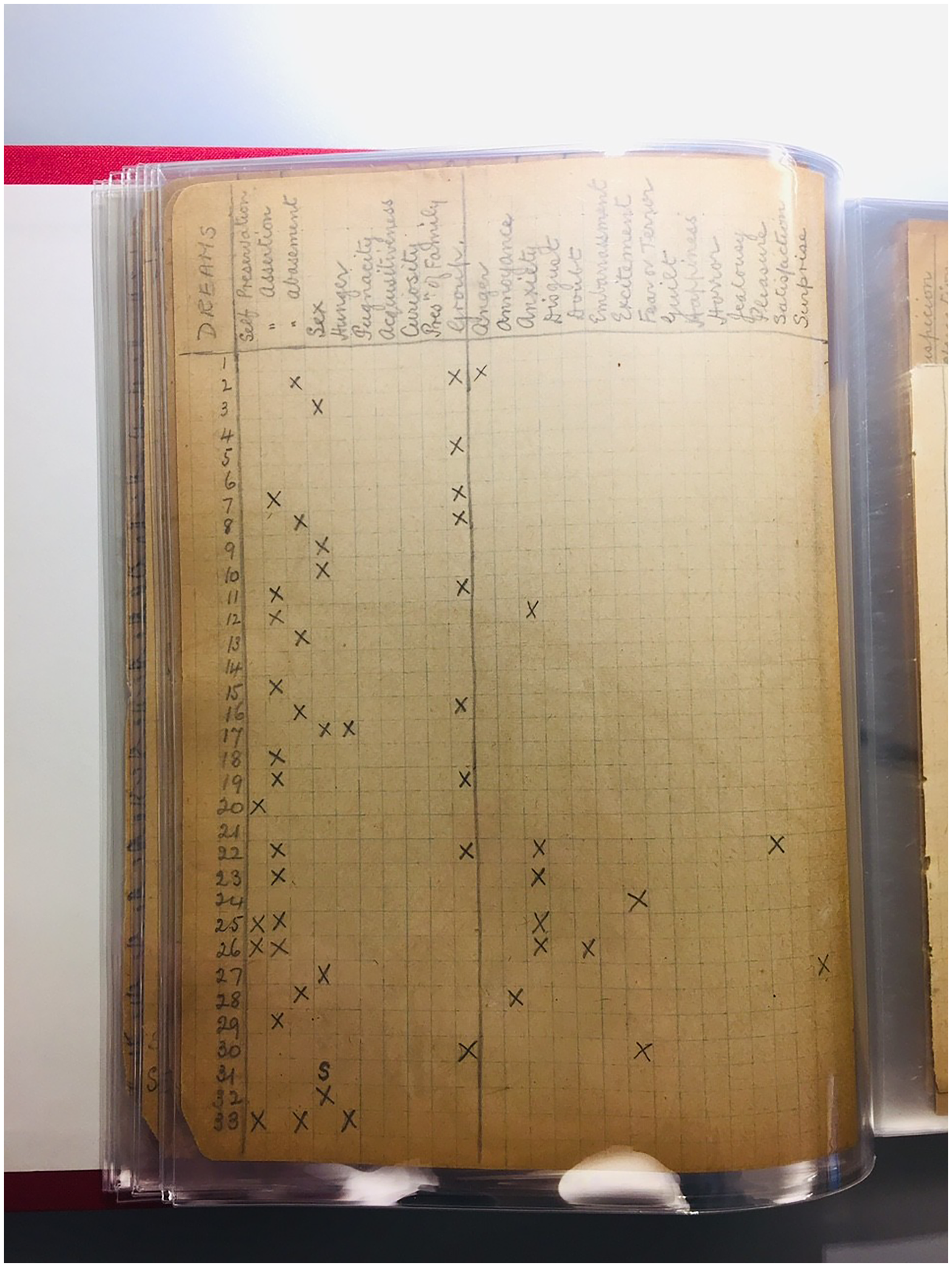
Grid from Hopkins’s Notes Which Charts the Characteristics of Dreams Submitted for Analysis.
The question arises why Hopkins’s fellow POWs were willing to participate in his project. As David Saunders has explored in his work on research subjects in the Second World War, a willingness to engage in ‘experimental labour’ can arise from a number of complex motivations, and can interact with the subject's self in complex ways (Saunders, 2021). The conscientious objectors studied by Saunders exposed themselves to scabies out of a sense of patriotism and in pursuit of ‘somatic citizenship’. The imprisoned dreamers submitting their records to Hopkins may well have been doing so out of a willingness to contribute towards scientific advancement and a desire to help a brother officer. In a note asking his fellow prisoners to submit more material, Hopkins stated that, There is some evidence of an extension of the primary function of dreams to influence waking life & the author would be infinitely obliged if officers who have a) dreams about returning home or b) any strongly emotional dreams, would note them & communicate them to him, so that perhaps the evidence may be increased to an extent that makes it certain that this extension occurs.
17
Latent and manifest content
On occasion, the dreams appear simply to represent reality as experienced by the prisoners during their waking hours. One subject was ‘running a hostel for shell shocked personnel’ where ‘the inmates were very ragged and in a poor way altogether’. The response to this was to instil some discipline: ‘I made them tidy themselves, clean boots and polish up their brasswork etc.’ Hopkins thought this was related to ‘our own poor appearance’, and added a note saying ‘projection?’ 18 Valentine had provided Hopkins with advice on similar dreams, and Hopkins’s source William McDougall mentions simplistic ‘reproduction dreams’ as described by soldiers from the Great War, where traumatic events reoccur night after night. These are due to ‘the expression of repressed fear’. When one's ‘reserves of energy’ run down, repression is less effective and repressed emotions can present themselves in dreams (McDougall, 1933: 137).
In other cases, deeper analysis was required to access the latent content hidden within a dream, which Hopkins attempted to provide. In the case of dream 277, notes show that the subject ‘was very insistent on knowing the “interpretation” of this dream’, and Hopkins duly tried to interpret it as best as he could. The subject described looking over a hedge at a house he had previously looked to buy with his wife but had decided against because it was too big. 19 Hopkins interpreted this as ‘desire to get home frustrated (by hedge) … When get there we shan’t be able to afford all we should like’. The subject then saw Winston Churchill giving a speech, but this was interrupted by the house bursting into flames, which Hopkins interpreted as, ‘Churchill's speeches show intention to continue war, which will lead to destruction of property (house on fire). His attitude opposed to subject's wishes’. The subject dreamed that he tried to save a chair from the inside of the house but instead ran out carrying a bag of cheap tableware, as used in the POW camp. Several men from the camp then appeared and began filling buckets with earth to fight the fire. Hopkins felt that this meant, ‘Subject is in favour of action which will save as much as possible from destruction but hasty action may be at the cost of something more valuable. Hasty peace may mean another war in which some who have suffered imprisonment may have to fight again’. 20 What at first appears to be a confusing mess of images was interpreted by Hopkins as internal tension over the progress of the war – tension between a desire for a quick peace and liberation versus a long slog to final victory that might mean years of imprisonment.
Hopkins’s analytic project therefore helps clarify the internal tension surrounding two contradictory desires – to be immediately freed from captivity and to achieve a lasting British victory – in the minds of both an individual dreamer and the camp as a whole. Hopkins often notes subjects’ attitudes towards victory or defeat as an aside to recording the dream; for example, in dream 373, where the subject has a ‘long, one-sided conversation’ with Hitler, which left the subject feeling that Hitler was ‘a good chap but inferior’. The subject afterwards ‘felt happy enough about victory’. 21 Bearing in mind that an allied victory was far from certain at that point in the war (1940–1942), Hopkins saw his fellow prisoners as working through their complex feelings surrounding the war's future conclusion. In another dream, the subject rejects a friend's assistance during a calligraphy lesson, which Hopkins interprets as ‘disguised protest here against Padre Heard's suggestion, in his economic geography lecture, that war would not be over until 1942’. 22 Heard's lecture appears to have left a lasting legacy in the camp's psyche, as another dream two weeks later featured a ‘large troupe of Bavarian children’ who arrived at the camp to announce peace had been declared. Hopkins’s notes indicate that following Heard's lecture arguing for ‘long confinement’, there had been much discussion of the possibility of ‘short confinement’ and a quick peace. 23
Hopkins appears to have been particularly interested in the emotional ramifications of a potential German victory for British servicemen trapped in captivity. In dream 290 from the end of July 1940, the subject is told by a German guard that Britain has been successfully invaded and the war is now over. Hopkins writes that this dreamer is generally ‘very optimistic about the result of the war … He is convinced England will win’. After recording that the subject woke from this ‘nightmare’ feeling ‘frightfully depressed’, Hopkins added the word ‘Conflict’, which he then crossed out and replaced with ‘Possible Catharsis’. 24 Based on Hopkins’s reading of Freud, he saw the dream as the subject working through the trauma of a potential German victory, which, from the vantage point of mid-1940 after the fall of France, appeared likely. Ville Kivimäki has covered the ‘nationalisation’ of dreams during the Second World War in Finland, positing the existence of ‘a specific dream culture shaped and created by war’ (Kivimäki, 2021: 299). Laufen POW camp appears as a similar ‘dream culture’ on a much smaller scale, and complicated somewhat by Hopkins’s project and his interactions with the dreamers.
Over time, some dreamers appear to have begun to interpret their own dreams with Hopkins’s assistance. In dream 447, the dreamer experienced being on board a ship heading through treacherous waters, and seeing the wreck of another ship called the ‘Potiphar’ which was slowly swaying and beginning to break up on the rocks. The subject duly offered his own interpretation, which is that the ship he was on represented England, the treacherous journey was the war, and the wrecked ship was France – which was called ‘Potiphar’ to signify the subject's imprisonment, as Potiphar was responsible for the imprisonment of Joseph. Hopkins, however, thought the subject provided this explanation ‘to prevent deeper enquiry which might have revealed a sexual content painful to subject’. 25 While Hopkins’s project was to some extent collaborative with his fellow prisoners, and some dreams were subject to discussion, his notebooks appear to have been private. At the end of dream 225, Hopkins noted that the subject ‘has appearance, walk + manner of a “nancy” … Sex dream disguised?’. 26 Tension is exposed here between Hopkins’s personal analysis and the public one which the subject created and shared with Hopkins – what appears to the subject to be a dream about international forces and the progress of the war is in fact a hidden signifier of potential homosexuality.
Tyrus Miller has claimed that the ‘psychic differentiation’ produced by modern liberal societies makes dominant images difficult to identify, especially when compared to the 17th-century clergymen's dreams described by Edmund Burke (Miller, 2001: 48–9). However, this fails to account for the intense psychopathological environment of the POW camp. It has been noted previously that POW camps were deeply collective environments, with little to no privacy and where almost all important decisions were made by the group (Lawson, 2025). In a tight-knit community, with limited connection to the outside world, it appeared to Hopkins that the collective mind of the camp was easier to grasp. After recording a number of anxious dreams in quick succession, Hopkins claimed that there was ‘an anxiety re. invasion of England throughout the camp … This is in some cases explicit and in others wholly or partially repressed’. 27 Dreams therefore granted Hopkins the ability to measure the collective morale of the camp, even when individuals’ feelings were ‘wholly or partially repressed’ and thus invisible to the casual observer.
The symbols present in individual dreams may vary slightly, but the underlying currents could be observed across different dreamers. In dream M17, the dreamer reported a half-finished escape dream, where he planned but did not execute an escape from Laufen. Hopkins described this as ‘a frustrated partial wish fulfilment together with compensation e.g., subject counts POWs instead of Germans doing so’. The compensation was due to a ‘wave of optimism’ currently hitting the camp due to the potential end of the war. 28 Sometimes, the psychic life of the camp was obvious, on occasion, it required Hopkins’s analytic skills to come to the surface. In interpreting dream M37, Hopkins noted that the subject's ‘intense, almost militant optimism suggests a repressed anxiety’ which was stimulated by a recent lack of war news. 29
External influences: Trotter and Jung
Occasionally, Hopkins’s notes and annotations directly reference a theorist or writer, allowing a clearer view of his analysis. In a case where a prisoner in the same room as the subject dreamed the same content (bulls) on the same night, Hopkins noted the name ‘Trotter’ down alongside a brief description of the dream. 30 A surgeon by training, Wilfred Trotter published the highly influential Instincts of the Herd in Peace and War in 1916, which raised several concerns surrounding human nature, politics, and war (Trotter, 1916). Disagreeing with Freud's account of repression, Trotter theorised the existence of an associational impulse, an inbuilt ‘sensitiveness’ to herd opinion. This herd instinct was essentially conflicted, as drives towards sex, self-preservation, and nutrition were at odds with the need to work towards the good of the herd (Swanson, 2014). For Trotter, collective behaviour was the norm, rather than an occasional, irrational event which required explanation. Hopkins seems to have viewed his imprisoned dreamers as a herd of sorts, subject to the same influences and therefore producing similar dream images.
One of Hopkins’s greatest influences appears to have been Carl Jung, interpreted through the various English texts Hopkins could access in Laufen. The ‘Practical Psychology’ works read by Hopkins did not contest the value of academic psychology and psychoanalysis, but attempted to translate both of these disciplines into insights which the layman could use in everyday life (Thomson, 2006: 40). Valentine's book claimed support from Jung in admitting ‘the significance of dreams for present and future life’, which, according to Jung, indicates ‘the struggling upwards in the self of partially neglected impulses of a higher order’ (Valentine, 1928: 112). Valentine claimed that the dream ‘may be simply the ideal completion, or fuller carrying out, of processes begun and still active in waking consciousness’ (ibid.). William McDougall's analysis of his own dreams (in a book accessed by Hopkins) with the help of Jung led him to claim that dreams could provide more than insight into the unconscious mind, they could also provide ‘guidance for our conduct in the future’ (McDougall, 1933: 199). This is because dreams are influenced by ‘the whole personality, rather than that aspect of it only familiarly known to ourselves and our friends’ (ibid.). Based on these readings, Hopkins began to see Jung's archetypal idea of rebirth in some of the dreams presented to him, and noted ‘Rebirth (Jung)’ as a topic of interest. A relatively brief dream where the subject reported going home with his wife to a ‘completely strange’ new house while experiencing ‘a very happy feeling’ became indicative of the psychic renewal offered by imprisonment and isolation. 31 Building on his second-hand reading of Jung, Hopkins thought that the psyches of individual prisoners were attempting to act out and assert themselves in the face of the deadening atmosphere of the camp.
This becomes apparent in Hopkins’s statistical analysis, which he carried out in his notes, tracking common tropes and producing percentages to assess how often they occurred over time (Figure 2). Hopkins claimed that ‘Instincts’ appeared in 68% of all analysed dreams, with instincts defined in the margins as ‘Self-preservation, self-assertion, sex, hunger’. However, ‘Group instinct’ only appeared in 22% of dreams, showing the tension between self-assertion and group cohesion. This tension appears to have increased as captivity drew on. In Hopkins’s analysis of his first hundred dreams, self-assertion, self-abasement, and anxiety appear as the most popular topics, at 27%, 13%, and 14%, respectively. 32 Over time, self-assertion grew in importance – in his statistical analysis of dreams 401–500, Hopkins found evidence of self-assertion in 41% of dreams.
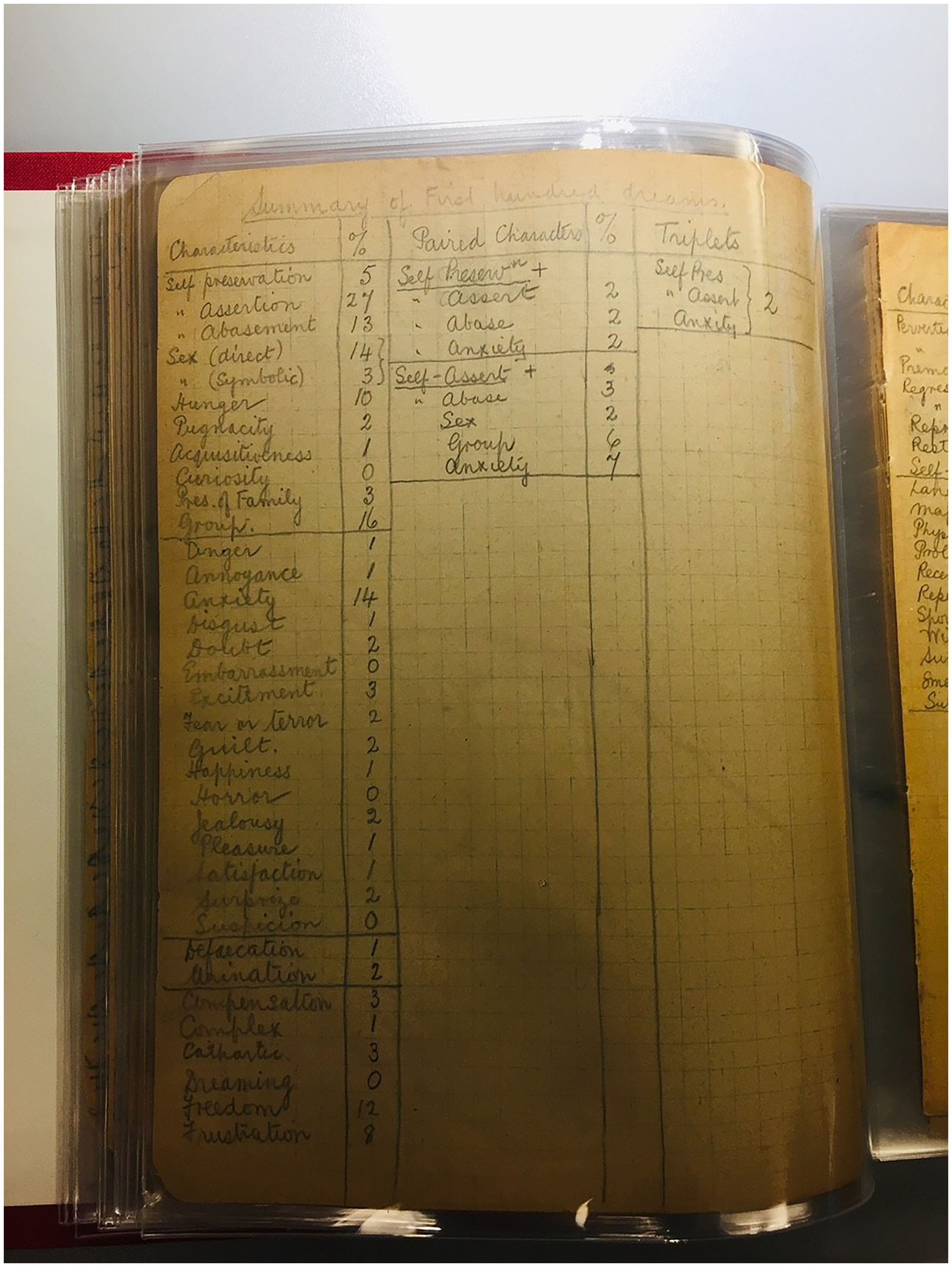
Statistical Analysis from Hopkins’s Notes, Tracking Common Tropes and How Often They Occurred.
Hopkins’s notes on individual dreams allow some closer insights into the meaning of these concepts within his analysis. He seems to have viewed his fellow prisoners as veering between extremes of self-abasement and self-assertion. In dream 396, Hopkins notes ‘fluctuation from self-assert … to self-abase … + back to self-assert’ as the subject moves between asserting himself in social situations and being ignored by his peers. 33 To some extent, he saw this as being grounded in POWs’ exclusion from the everyday lives they had left behind when they entered captivity. In dream 374, Hopkins notes ‘an assertive element’ where the subject remonstrates with his gardener. Hopkins felt that this was present ‘to counter self-abasement feeling owing to non-participation’ in a house purchase the subject's family had recently completed without him. 34 When read in light of Hopkins’s note above about the influence of dreams on waking life, his notes seem to indicate that he saw the prisoners’ dreams as pushing them towards self-assertion in the face of the self-abasement of captivity. Unfortunately, the notebooks containing Hopkins’s full case notes on individuals have been lost, leaving only a fraction of his insights into dreams and the psychological impact of captivity.
Aside from Jung, Hopkins’s bibliography also included less elite sources. As Peter Mandler has eruditely described, by this point in time, the language of social science had begun to seep into everyday life through the medium of the mass-market non-fiction paperback (Mandler, 2019). POW camp libraries held a number of these books, and Hopkins appears to have made use of them in an eclectic fashion. Leslie Weatherhead was a Methodist minister with an interest in psychology, who saw a valuable therapeutic role for clergymen alongside psychiatrists and professional psychologists. In his Psychology in the Service of the Soul (1929), utilised by Hopkins, he claims that a dream ‘may be the symbolic expression of anything seriously and deeply exercising the subconscious mind … It is because the dream may symbolically express anything with which the mind is deeply preoccupied that it often appears to be a warning and foreshadowing’ (Weatherhead, 1929: 42–3).
It seems likely that some of the texts in Hopkins’s bibliography were sourced from fellow prisoners or the shared camp library. With a limited number of psychological texts in circulation and an abundance of free time, Hopkins potentially picked up recommendations for potential reading material from other sources. The input of fellow prisoners helps to explain why Hopkins’s work seems to have possessed something of the generic POW concern with warding off ‘brain staleness’ stemming from long periods of boredom (Makepeace, 2017a). Included in his bibliography is R. H. Thouless’s The Control of the Mind (1927), which covers mental exercises and ‘mental efficiency’. Thouless felt that through the pursuit of mental efficiency and the demonstration of willpower, one may combat ‘worry, mind wandering, irritability, depression or needless fears’ (Thouless, 1927: 11). Also included was Thouless’s 1930 Straight and Crooked Thinking, regarding logical fallacies in everyday reasoning and argument (Thouless, 1930). Hopkins was therefore engaged with the ‘practical psychology’ mentioned earlier, although at no point does he record utilising the exercises recommended by Thouless and others.
Prophetic dreams
Some aspects of Hopkins’s thinking can be reconstructed by reading the academic and popular works he references alongside his dream diaries, where he occasionally made reference to particular authors. Included in Hopkins’s bibliography is An Experiment with Time by J. W. Dunne (1927), a popular book on dreaming which Hopkins would have likely encountered before the war. Inspired by a number of prophetic dreams experienced by himself and friends, Dunne subjected precognition to experimental verification, constructing a complex theory based around the infinite dimensionality of time and the supposed imperishability of the individual observer of temporal events (cited in Mauskopf and McVaugh, 1980: 225). Dunne had no history in psychological or scientific research – although he had been a talented aeronautical engineer, his only previous book had been on fly-fishing (Dunne, 1924). Despite this lack of experience, reviewers were cautiously positive about his experimental technique, with Nature describing Dunne as a ‘careful, sane experimenter’. As part of his claim to experimental accuracy, Dunne publicly distanced himself from occultism and psychic research. He also explicitly denied any connection between his book and Freudian psychoanalysis, which he seems to have viewed as pseudoscience (Inglis, 1984: 227–9).
Dunne began his experiment by logging his dreams every morning when he awoke, and attempting to compare the images contained in them with events that then occurred. Dunne urged his readers to try out the experiment for themselves, recording the images they found in dreams and seeing if they later reoccurred in waking life (Dunne, 1927: 66). Dunne claimed that dreams were ‘composed of images of past experience and images of future experience blended together’, and therefore that images contained in dreams could be observed later in time than they occurred (ibid.: 54). While ignored by scientific experts, Dunne's theories received a good deal of attention in the popular press, and many readers kept dream diaries in line with Dunne's instructions. Dunne's book was reprinted several times and even those who had not read it would have been exposed to literary and theatrical interpretations, notably, J. B. Priestley's 1937 play Time and the Conways (Price, 2014: 105).
Hopkins seems to have been sceptical of Dunne's theories but felt obliged to collect the dreams and record the dreamers’ attitudes towards them. In dream M3, a subject claimed that they had dreamed about entering Laufen prison camp ‘a long time ago before arrival at Laufen’, and that they recognised the camp when they arrived months later. Prior to this, the subject ‘had never heard of Laufen, nor thought of being taken prisoner’. Hopkins was clearly dismissive of this claim and wrote in his notes that the subject claimed to recognise the square gate tower, which is ‘quite an ordinary affair + subject may have dreamed some other one which he had actually seen’. 35 Dunne represents an influential example of popular engagement with experimental methods, and even if Hopkins was doubtful about Dunne's claims of precognition, he felt obliged to record his work within the bibliography and note down the supposedly prophetic dreams presented to him by other prisoners. These prisoners may or may not have been aware of Dunne, or may have simply been inspired by the long history of supposedly prophetic dreams stretching back to antiquity. What is perhaps more important is Dunne's status as an independent observer utilising dreams as raw material for a self-conceived scientific study. Even if Hopkins was personally sceptical about Dunne's claims, he provides an excellent example of another lay experimenter working with dreams, who was successful in publishing his theories and influencing the public's perception of dreaming.
Dreamer 11
In the case of one of his most prolific dreamers, Hopkins appears to have crossed the boundary from the collection of dreams into an actual analytic relationship. In November and December of 1940, Dreamer 11 submitted lengthy dreams almost every day, which Hopkins wrote up and followed with copious notes in order to fully comprehend the case. Hopkins’s case notes reveal that Dreamer 11 must have discussed not only his dreams, but also his difficult relationship with his family, his romantic entanglements, and his innermost thoughts and fears. Dreamer 11 demonstrates an impressive commitment to Hopkins’s project – by December 1940, he was submitting dreams almost every night.
After dozens of dreams, Hopkins felt certain that 11 was lacking in self-confidence and desired to assert himself more. In many of his dreams, he ‘felt need of greater energy than his own to get him out of difficulties’. The frequent ‘self-assertive’ impulse in the dreams was guidance from Dreamer 11's psyche to help him pull himself out of the difficulties in which he found himself. 36 However, this impulse appeared to be pulling the subject too far in one direction, overcompensating for his feelings of inferiority by building up his ego to dangerous levels. The tension between the individual and the collective occurs frequently in Hopkins’s notes on these dreams. In dream 425, Dreamer 11 was part of a group of naval officers, and Hopkins notes that he ‘did not see himself as a separate entity all through the dream’. 37 After a lengthy dream where 11 had the role of ‘stroke’ in a rowing boat facing the other three rowers, Hopkins claimed that 11's dreams revealed him to be ‘antagonistic to a smooth working community’. 38 Part of this may have been rooted in Dreamer 11's difficult childhood – based on a number of dreams, Hopkins suggested that Dreamer 11 possessed a ‘complex’ to do with his attitude to his father, who ‘made rather a mess of his life’. 39 Dreamer 11 must have discussed his family and his feelings towards them in depth with Hopkins, noting that he felt a good deal of ‘hero worship’ towards his elder brother. 40 The notes on these dreams go into more detail than for any other dreamer, and the level of factual detail about Dreamer 11's life suggests that this was informed by multiple in-depth conversations with Hopkins. Hopkins utilises psychoanalytic terminology that does not occur elsewhere, and mentions undertaking free association with the dreamer.
There is no evidence that Hopkins had undergone a formal training analysis, but his bibliography contains a number of works by Freud and his English disciple Ernest Jones, alongside popular works which touch on psychoanalysis. In crossing the boundary from disinterested observer to analyst and confidante, Hopkins seems to have created an ersatz psychoanalytic treatment for the complex feelings with which Dreamer 11 found himself dealing due to his captivity. This was against the explicit advice of most of his sources. Barbara Low, in her work for schoolteachers, stated that the teacher must not under any circumstances ‘attempt to carry out analysis of his or her pupils’ (Low, 1928: 11). David Yellowlees, in his book attempting to relate the ‘new psychology’ to Christianity (utilised by Hopkins), similarly recommended against unsupervised analysis by laymen (Yellowlees, 1930: 57). However, a parallel does exist in the form of the ‘commonsense’ dream analysis carried out by psychiatrist Thomas Ferguson Rodger in interwar Glasgow (Phelan, 2020). In Rodger's dream-focused psychotherapy, the analyst intervened only rarely to help decipher symbols within dreams which the patient had already identified as possessing meaning, and stressed the importance of social and environmental context to the content of dreams. Nonetheless, Rodger was a professional psychiatrist acting within his consulting room – Hopkins was a schoolteacher acting within a POW camp.
Hopkins listed the names of his contributors in the first volume of his notebooks, alongside the addresses of those who presumably wished to be updated on Hopkins’s publication after the war's conclusion. It is therefore possible to identify Dreamer 11 as Lieutenant Kit Silverwood-Cope of the 98th Field Regiment Royal Artillery. 41 The tension described by Hopkins between Silverwood-Cope's desire to assert himself and his anxiety about disrupting a ‘smooth working community’ becomes more complex given that Silverwood-Cope later escaped from German captivity and spent months with the Polish resistance before being captured again and sent to Colditz Castle (Macintyre, 2022: 155). With this knowledge, it is possible to see Silverwood-Cope's escape attempt as stemming from his need to assert himself and negate his feelings of inferiority – or rather, it is possible to see this as a potential interpretation proposed by Hopkins. Tensions between the individual and the community take on a different tone when it becomes apparent that Silverwood-Cope's plans to escape the camp could have resulted in collective punishment for the remaining POW community, including Hopkins himself. There are also potential class tensions, as the middle-class grammar school educated Hopkins subjected the experiences of the well-off Silverwood-Cope to his analysis. The latter's dreams often reference his time at public school or his periods of foreign travel, two experiences of which Hopkins would likely have little knowledge.
Escape exists within the diaries as a complex topic. The centrality of escape attempts to POW life has been deconstructed by several historians, but escape does occur frequently within Hopkins’s recorded dreams (Crossland, 2009; McKenzie, 2006; Shephard, 2010: 14). However, the subjects (and Hopkins) appear to have had mixed perspectives on the feasibility and desirability of escaping the camp. In dream 229, the dreamer recalls winning a horse race by a narrow margin but getting sopping wet and finishing to roaring laughter from the crowd. Hopkins added a note which reads ‘escape – possibility of war ending + their successful effort being only mirth provoking?’ 42 Hopkins’s portrayal of a successful camp escape as futile and laughable, rather than heroic, defies the assumed attitude that POWs were always striving to escape their German captors or assist others within the camp that sought to do so. In dream 217, from 17 July 1940, the same subject describes an escape attempt across the Yugoslav border as narrowly successful. 43 Hopkins notes briefly that the subject ‘made attempt + failed’. Hopkins’s index of names reveals that Dreamer 5 is Kenneth Lockwood, one of the ‘Laufen Six’ who attempted to escape from Laufen in September 1940 and were then sent to Colditz Castle (Anon., 2007). In a later dream, after Lockwood reported being sent into a futile battle which he knew was lost, Hopkins noted that it displayed ‘conflict between duty of escaping and the hardships that would go with it’. 44 Lockwood was actively planning his escape when he submitted this dream, but it is unclear to what extent Hopkins was aware of this and the extent to which it informed his analysis. What is clear is that escape was something which Lockwood felt driven to by ‘duty’ but felt conflicted about, particularly in terms of the danger it offered and the possibility that a dangerous escape would be followed by a peace treaty rendering it pointless.
Conclusion: Hopkins’s significance
Peter Burke claimed in Annales in 1973 that ‘dreams have a history’ and that it should be possible to write a social history of dreams. This rested on the assumptions that dreams provide the dominant images of an era (as M-O claimed) and that dreams could represent an indirect form of communication which can supplement the information left to us from official documentation and discourse (Burke, 1973: 329). Kenneth Hopkins’s project rested on the same assumptions, in that he attempted to analyse the dreams at scale and in depth. However, Hopkins’s project was fundamentally framed and guided by his knowledge of psychological theory developed from his MA degree and his bibliography. Pick and Roper, in their work on the interpretation of dreams, suggest that the historian's role ‘might be to develop the possibilities of a cultural history of dream contents and of repression’ (Pick and Roper, 2004: 18). This paper sets out the limits of doing so within the context of the mid-20th century. Post-Freud, Hopkins and his dreamers could not help but present the manifest content of their dreams in terms of repression and hidden meanings. ‘The New Psychology’ had so penetrated the cultural milieu of Hopkins and his camp mates that they could not help but use it to frame their dreams, even if this theory was often half-understood or adopted second- or third-hand from popular works and textbooks. Hopkins and his project lie within what Pick and Roper describe as a series of ‘weird, wild and sometimes wonderful expropriations of ideas that were made’ from Freudian and Jungian theory, although not in this context from ‘novelists, essayists and poets’ but instead from a POW camp in wartime Germany (ibid.: 27).
To summarise, Hopkins’s project was a multifaceted attempt to grapple with the psychical impact of captivity, inspired by both experimental and observational cultures and psychoanalytic theory. Both of these influences were moderated by the nature of life in a prison camp – Hopkins’s experimental technique and his bibliography were limited by the difficulties inherent in life behind barbed wire. However, he did claim to have identified clear symbolic and thematic continuities between different dreams, as well as having analysed a number of the dreams in considerable depth. Charlotte Hallahan describes M-O’s failure to gain clear images from their dream diaries, describing their attempts ‘to enforce a system on the unsystematic, to find clear signs in the enigmatic’ (Hallahan, 2024: 213–15). In contrast, Hopkins appears to have achieved with his project a successful result on his own terms, and identified what he saw as clear symbols and trends across his POW population. Despite his lack of resources, Hopkins created a clear system for the analysis of dreams at scale, avoiding the methodological laxity and miniscule sample sizes for which Tyrus Miller later criticised M-O (Miller, 2001: 37). Groth and Lusty describe M-O's dream archive as haunted by failure, given the failure of those running the organisation to find overarching narratives and dominant images (Groth and Lusty, 2013: 173). Hopkins’s notebooks could be said to be haunted by success – only his death prevented him from attempting to publish his findings, which he personally appears to have seen as innovative and insightful.
It is regrettable that Hopkins’s individual case studies (which appear to have contained in-depth psychoanalytically informed discussions with his subjects) did not survive the war. What matters more than the content of the dreams recorded in Laufen is the manner in which Hopkins planned the project and the ways in which he chose to interrogate the raw material of his fellow prisoners’ dreams. What emerges from his notebooks is a powerful lay attempt at understanding what it means to live as a prisoner, and how captivity wove itself into prisoners’ psyches. In particular, Hopkins’s notes explore the tension between individual and collective motivations.
Nick Hubble compared M-O to Freud's model of the analytical encounter at a societal scale, in that it took potentially traumatic material (i.e. the abdication crisis, the Munich Agreement) that was beyond the ability of ‘normal societal defence mechanisms’ to deal with, and attempted to process it in order to achieve societal transformation (Hubble, 2006: 11–14). In a sense, Hopkins was attempting to achieve something similar for Laufen's POWs – taking the raw material of captivity as recorded in dreams and attempting to process it, or at least to record and recognise how it was being processed while the prisoners slept. This explains Hopkins’s theory that prisoners’ dreams were exerting a stronger than normal influence on waking life, and his requests for dreams about returning home. Obviously, this was on a smaller scale than M-O, but this scale allowed Hopkins to engage with his dreamers in a way that others could not. Rebecca Lemov's work on Bert Kaplan investigated an archive of dreams defined by its massive scope and ambition (Lemov, 2015) – this present work investigates a micro-archive defined by its nicheness and limitations. This paper treats Major Kenneth Hopkins as worthy of study as Kaplan, although he had access to none of the technologies that a later generation of researchers (projective tests, microcards) would utilise, and his fieldwork was limited by a barbed wire fence. ‘Wild’ cultures of observation like that created by Hopkins are worthy of attention, even if they only occur at the micro-level.
Hopkins’s project simultaneously worked at the level of the collective (in the case of anxiety related to war news) and the individual (in the case of Dreamer 11). Moreover, it investigated the complex and ever-shifting relationship between the individual and the collective, in the case of Dreamer 11's rowing dream. Hopkins simultaneously went broader and deeper than M-O's attempts to gain dominant images from the British public's dreams, investigating the meaning of specific symbols within the shared context of the camp. Hopkins’s personal presence and interactions with the dreamers mark his project as a distinct observational culture which allowed him to gain deeper insights, echoing what would later be termed ‘co-production’ in research. While this breached scientific norms by rejecting objectivity and placing Hopkins himself within the experiment, he seems to have acknowledged this. His notes often record his own interactions with dreamers, including where past conversations or simply his own presence seems to have provoked a submission, and this becomes part of the analysis rather than necessitating the exclusion of these dreams.
Kenneth Hopkins’s untimely death in 1942 prevented his project from coming to fruition. From the available material, it seems likely that Hopkins planned to publish his research after the war's conclusion. It is impossible to state what conclusions Hopkins would have reached in these publications, and what the wider world would have made of them. However, what remains of his research stands as a powerful and unique example of what would later be termed ‘citizen science’, created and led by a layman in an unlikely context. Hopkins was simultaneously citizen scientist, psychoanalyst, British Army officer, and, perhaps most importantly, bored and isolated POW.
Footnotes
Acknowledgements
An earlier version of this paper was presented at the Social History Society annual conference, and the author is thankful for useful feedback received there. The author is also grateful to the editors and anonymous reviewers at History of the Human Sciences for their helpful comments. Special thanks go to the archival staff at the Wellcome Collection and the BPS History of Psychology Centre for their assistance.

Funding
The author disclosed receipt of the following financial support for the research, authorship, and/or publication of this article: This work was supported by the Economic and Social Research Council, Centre for Society and Mental Health at King's College London (UKRI861). The views expressed are those of the author and not necessarily those of the ESRC or King's College London. Part of the research behind this work was completed as part of a PhD, supported by a Principal's Scholarship at Queen Mary, University of London.
Declaration of conflicting interests
The author declared no potential conflicts of interest with respect to the research, authorship, and/or publication of this article.