




Abstract
Care has become an overdetermined word in the medical humanities and beyond, a focus not only of debate around the nature and purpose of the field, but also of the wider issue of the status of medicine in relation to society and the individual. As a symptom of this problematic, this article proposes care as an ‘untranslatable’, in the sense defined by Barbara Cassin. This is pursued via an engagement with the history of the ethics of care and with its translation into francophone contexts as une éthique du care, in tension with the philosophie du soin elaborated in the work of Frédéric Worms, and then with the several translations into French and English of Sorge and its derivations Besorgen and Fürsorge in Martin Heidegger's Sein und Zeit (Being and Time). A genealogy of care is thus established, and what emerges as the principal motif of its untranslatability is the relation between a primary form of relationality and the socio-technical dimension in which we may recognise healthcare.
Introduction
While it has become a powerful leitmotif in the field of medical humanities, and has a multifaceted history within this field and beyond it, care is (an) untranslatable. I propose in what follows to explain what I mean by this and to explore its implications, following the approach established by Barbara Cassin in the Dictionary of Untranslatables (Cassin, 2014), itself a translation of Le vocabulaire européen des philosophies: Dictionnaire des intraduisibles (Cassin, 2004). Writing in the preface to the volume, Cassin proposes that the titular term ‘untranslatable’ ‘in no way implies that the terms in question … are not and cannot be translated’ (Cassin, 2014: xvii). The untranslatable, rather, is ‘what one keeps on (not) translating’ (xvi). In other words, for my purposes, care is a term that does not permit of straightforward passage from one language to another; it is a ‘symptom of difference’, which allows for an interpretative exploration of the ‘networks to which the word belongs’, and of the ‘divisions, tensions, transfers, appropriations, contradictions’ that have determined its passage across languages, disciplines, and practices (xvi).
My discussion of the untranslatability of care and the network that radiates around it is not intended to legislate on its usage in the medical humanities or in any other field, but rather to elucidate and mobilise the heterogeneous and complex intersections of its instances; to use, in other words, the dissonances provoked by its translational histories in order to enrich our understanding of what we mean when we talk about care. There is more at stake here than semantic variation; care and its variants carry a particular existential, ethical, sociopolitical, and deontological charge in the present conjuncture, as if not to care about care, not to pay attention to it, were to default on an essential quality of being human, a proposition I will consider further on. But the tautological sense of ‘caring about care’, of paying attention to it (attending to something or someone being another translation of care) suggests that what we are dealing with has the character of what Roland Barthes called a myth, something that passes as going without saying or as self-evident, and thus as hiding, behind this self-evidence, the materiality of the sign and the constructed quality of its history and of its translations (cf. Barthes, 2012). My inquiry into the untranslatability of care is intended to cut into the self-evidence of care and to bring to light the architecture of its construction. What I propose then is something like a genealogy of care, via a consideration of its untranslatability.
Care is in fact a comparatively brief entry in the Dictionary of Untranslatables, authored by Catherine Audard, a Professor of Moral and Political Philosophy at the London School of Economics and the translator into French of John Rawls’ Theory of Justice, who locates the problem of its translation specifically in the dissonance between two distinct uses in philosophical discourse: the translation into English of Heidegger's Sorge and its ‘declensions’ Besorgen and Fürsorge, and the English of the (feminist) ‘ethics of care’ in work following Carol Gilligan's propositions in In a Different Voice (Gilligan, 1982). ‘In both cases’, Audard writes, ‘it is impossible to translate the term into French’ (Audard, 2014: 125). Before looking more closely at the rationale Audard proposes for this untranslatability and at the network that radiates around the term and across languages, it will be useful to note further occurrences, in the recent and contemporary discourse on care, of the untranslatability of the term, that is, those instances where writers or translators have felt obliged to qualify their use of the term or its variants, to mark out the problem of its translation. In keeping with the orientation of this volume, pursuing a comparative reflection on the anglophone and francophone medical humanities, we will be working across the three languages of English, German, and French, while it can also be said that this reflection has been prompted by the (non-)translation of le care in the French language.
Writing in the review Esprit in 2009, the French philosopher Frédéric Worms, interviewed in this issue, proposes the following: I don’t know if one should translate the word care by soin, but what is certain is that what the two notions have in common, in English and in French, is that they have several meanings. It is this very polysemy that places both words at the heart of contemporary ethical and political debates. In both cases, in fact, there is a kind of appeal, first of all, to a primordial feeling or need in the domain of life, but also to an activity or a technique in the social domain which has become more and more important and complex. The whole issue in these debates would thus be focused on the relation between these two aspects, or rather on the necessity of acknowledging the relation between these two aspects, in our societies and in our lives. So we must come back to the word, first of all on each of the two notions, with their respective polysemy (which do not completely overlap), so as to see them converge around demands which are without doubt crucial in our present time. (Worms, 2009: 191)
In pointing here to the convergences and differences in the multiple senses of le care and le soin and to the urgency of the question of care in the present, Worms makes two broad points. Firstly, both terms involve the dual aspect of a vital dimension, qualified as original or primordial, and a social dimension; the first relates to life as the vital dimension of the struggle against death, the second to practice and technique. Secondly, the relationship between these two aspects has become increasingly important and critical. We can infer that the ‘untranslatable’ difference between care and le soin arises from the different ways the terms construe the relation between the vital and the social aspects, or, to put it in more abstract terms, between the ‘first’ (original or primordial) dimension, and the dimension of social practice and technique. We might also infer that the reason why care is such a critical issue in contemporary ethical and political debates is due to the increasing distance, or the emerging acknowledgement of the distance, between the ‘first’, vital and primordial aspect, and the dimension of social practice and technique.
A brief sketch of the chronological background can shed light on Worms’ opening gambit, in this article from 2009. We will see that the temporality of translation and the displacement of contexts involved is a determining factor in the sense of the terms involved and thus that it shapes the debate in important ways. The ‘ethics of care’ that Audard signals as one of the discursive fields in which the untranslatability of care insists originates in the work of Carol Gilligan, whose work In a Different Voice, published in the US in 1982, took issue with the psychology and epistemology of her colleague Laurence Kohlberg in order to propose an ethics based on responsibility and care rather than on abstract and universal notions of rights, arguing also that this ethics of care found its ‘different voice’ in women, due in part to their closer relation to the vital needs of children. Gilligan's work fast became a keystone of arguments for a feminist ethics in the US in the years that followed, but it was subsequently critically re-assessed for its over-emphasis on an essentialist approach to sex and gender by other feminist writers, including Joan C. Tronto, who embraced the same argument for an ethics of care in her work Moral Boundaries (Tronto, 1993). Tronto focused for her part on the practice of caregiving and the political question of the unequal distribution of largely unremunerated care work. Further work on the ethics of care would follow (see below), but it was largely not translated into French (both in the sense of passage into other languages, but also in the sense of its entry into the discourse and its impact on debates) until the 2000s. A collective volume published by the École des hautes études en sciences sociales (EHESS) in 2006, edited by Sandra Laugier (herself a translator, particularly of the work of Stanley Cavell) and Patricia Paperman, Le souci des autres. Éthique et politique du care, collected and relaunched the momentum of diverse journal articles in which the ethics of care had been gaining ground in France, and included translations of work by Gilligan and Tronto, among others. A new translation of Gilligan's In a Different Voice, now with the subtitle ‘pour une éthique du care’, was published in 2008, followed the next year by a translation of Tronto's Moral Boundaries as Un monde vulnérable. Pour une politique du care (2009). 1 Some 20 years or so after its emergence in psychology and theories of justice in the US, then, the ethics of care saw a fairly rapid introduction into French academic discourse and consecrated the non-translation of the English word care, including alongside Laugier and Paperman further work by Fabienne Brugère (2008, 2011), Pascale Molinier (2013), and Valérie Nurock (2010), among others. This new discursive paradigm also reached into mediatised political discourse, in part through a celebrated interview with Martine Aubry, leader of the opposition Socialist Party, who appealed to the need to ‘take care of others’ (prendre soin des autres) and to the ethics of care, in a critical response to President Sarkozy's proposed pension reforms (see Laurent, 2010; Chaschiche, 2014). A further aspect of the chronological displacement at stake here is that the ethics of care in its French version tended to be pitched against the universalist theory of justice of John Rawls, whose Theory of Justice, despite being translated into French by Audard, in 1987, only began to gain ground in France in the same period.
My interest in this chronology is not only with the delays and displacements of the translation of the feminist ethics of care into French, and as part of the history of care in the discourses of the human sciences, but also with the way it foregrounds care as untranslatable, as something, to borrow Cassin's words, that one keeps on not translating. With ‘l’éthique du care’ the word care was incorporated into the French language as a synecdoche for a set of discourses the strangeness or foreignness of which Laugier, Paperman, and their colleagues sought to foreground. It functions something like a proper name, which as Jacques Derrida has observed, both resists and demands translation (Derrida, 1985). In the preface to Le souci des autres Paperman and Laugier set out the reasons for the maintenance of the term in English, and in doing so indicate some of the key elements of this argument. Issues of translation and translation decisions are thus keyed in to manifest or latent ethical, social and (geo)political perspectives; the untranslated word, functioning something like a proper name, is a symptom. Referring to the chronological and contextual gap between the emergence of the ethics of care in the US and its adoption in France, Paperman and Laugier write, The resistance with respect to analyses in terms of care, or at least what once can suppose that these resistances have in common, relate perhaps in part to an unassimilable element in the use and meaning of the English word care. The difficulty in translating the term, like any phenomenon of untranslatability (Cassin, 2004) is of course not only a question of lexical range or cultural specificity. It is an integral part of the difficulty we have in making different idiomatic networks overlap. Solicitude, care, concern [sollicitude, soin, souci]: these translations, which are all possible and which have been proposed in different contexts, certainly partly cover the semantic field of the word care, but no single term is sufficient to bear the complexity, and each of them on its own draws it toward caricature. Perhaps the English word care relates too explicitly to two themes, that of concern [souci] understood as worry or sorrow [chagrin] and that of solicitude and care [soin] (Resweber, 2003). This, somewhat awkward double thematic of suffering and assistance [assistance] that we find in the usual translations (concern/care/solicitude) [souci/soin/sollicitude], effaces the agency specific to caring, which we have sought to bring to light, and the ordinary meaning (both perceptive and practical) of to care: to pay attention to, to occupy oneself with. Even if care was the word chosen to translate Heidegger's Sorge into English, we are sticking here with its ordinary use, which is already difficult enough to determine. (Laugier and Paperman, 2011[2006]: 21)
Like Worms, Paperman and Laugier point to the inherent polysemy of the word care, and, also like Worms, but with a different inflection, to the duality of the term, on this occasion between concern (worry, sorrow) and solicitude (caring for), in which the distinction between the concerns of the self and the care given to others seems to be at stake. However the principal reason given by Laugier and Paperman for the maintenance of the English word care in French, as an ‘untranslatable’, is that the various translations available lose the agental, practical sense of caring, which in their view captures the ordinary meaning of the term, as a practice. Here then, we see a fairly clear emphasis on the activity of caring, which supports the critique of the abstraction of a universalist ethics and a political economy that does not acknowledge caring as value, practice, or labour.
Worms, for his part, in the article cited above, which responds implicitly to Laugier and Paperman's propositions, points to the normativity inherent in the arguments. Following his interpretation of the duality inherent to both care and soin in terms of vitality and technique, or praxis, he writes, One cannot understand the ‘ethics of care’ if one does not moreover underline how they seek to give this feeling, on the one hand, a normative bearing which is in fact decisive and central, and to this activity, on the other hand, a social bearing which is just as determinative and even constitutive. (Worms, 2009: 191)
Worms’ point is that the ethics of care depend on an ethical and political principle, or on a double normativity, to recognise and value the aspect of feeling and response to vulnerability and need – the vital aspect of the phenomenon (Gilligan) – and to recognise and value the practice and activity of caring (Tronto). Both of these normative critiques impinge upon the socio-political structure supported by a universalist theory of justice based on the rights of the individual. In broader terms, the critical dimension of care relates here to the distance between a vital dimension seen as primary or primordial, and a social and technical reality that obscures or ignores it.
However, further on in Worms’ account the duality inherent in both care and le soin between the vital or emotional dimension or aspect and the technical or socio-practical dimension or aspect is itself questioned or rather transformed into a kind of mutual interdependence. Worms’ reference here is to Georges Canguilhem, for whom the vital and the technical are constitutively interdependent: the technical is not a separate dimension of abstract knowledge but, in its origins at least, a necessary, prosthetic element of the relation of the organism to its milieu (see Canguilhem, 1991: 222). Care (le soin) then is both assistance or help (secours) given in response to a need or a vulnerability, but also and in the same instance a technical, ‘operative’ (opératoire) knowledge or skill (Worms, 2009: 193, 194). Care, then, as a form of relation of the vital organism to its milieu, is not a dimension supplementary or posterior to that of technique or social practice but can instead be considered as the origin of technique, and moreover as a norm that in Worms's account could and should regulate it. In this light Worms’ argument, which draws much from Canguilhem, is that the philosophy and epistemology of le care or of le soin, and the ethics and politics that arise from them, must not separate the intersubjective relation of care from the social activity of caring. Rather, both should be considered as part of a (necessarily critical and transformative) philosophy of the living in relation to its milieu. 2
We saw above how Laugier and Paperman justified their maintenance of the English word care in their translation, in the broad and specific sense, of the ethics of care into French through a consideration of the network of cognate terms that radiate around it: the nouns solicitude, care, concern, sorrow, and assistance and the verbal forms to pay attention to and to occupy oneself with – my awkward and necessarily provisional translations of the French terms sollicitude, soin, souci, chagrin, assistance, faire attention à, s’occuper de. We can also note their reference to the English translation, as care, of Heidegger's Sorge. The decision to maintain the word care is differentiated from the ‘choice’ of care as a translation of Sorge, and the decision to ‘stick’ with’ the ‘ordinary’ sense of the practices and activities of caring is differentiated from the use of Sorge by Heidegger and of care or le souci by his translators. We can also note that in her case for the untranslatability of care Audard highlights the problems, the translational loss, caused by the rendering of Sorge as care: ‘There is no possibility of making the connotations specific to the German Sorge flow into the English “care” and the current development of the meaning of “care” that is drawing this word in the direction of interpersonal relations and concern about others makes the translation of Heidegger given here in English rather enigmatic’ (Audard, 2014: 125). Audard also notes the difficulties caused between the three languages of German, English, and French in the translations of Heidegger's terms. While, as we will discuss and explain further on, the thrust of Heidegger's arguments in Sein und Zeit draws much from the ‘particle metaphysics’ (Dubost, 2014: 145) that characterises the German language and its philosophical use by Heidegger in particular (an ‘extreme example’), English and French, lacking this apparently more ‘motivated’ and less arbitrary determination, are obliged to ‘take quite a different path’ (ibid.: 146, 147). In brief, while the ‘architecture’ of care in Sein und Zeit is built, initially, around the prepositional variations of Sorge, Besorgen, and Fürsorge, the derivation from this linguistic and ‘everyday’ grounding (ibid.: 147) is cut adrift in English and French, resulting in variations and differences between translations of all three terms. What I want to pursue here is the idea that these differences are themselves productive of sense, and their exploration can itself be a path to a deeper understanding, if not of definitive translational solutions. The enigma signalled by Audard is in fact a resource. The fact that she also suggests that the feminist ‘“deconstruction” of universalist morality and the principle of identity [are] in accord with a trajectory that merges with the Heideggerian heritage of Sorge’ (Audard, 2014: 125; emphasis added) also supports the view that the sense of care at stake in these two discourses – the ethics of care and Heideggerian ontology – are not as far apart as they initially seem.
Heidegger: Sorge, Besorgen, Fürsorge
My contention then is that paying attention to the architecture of care in Heidegger is a crucial element in the understanding of the multiple uses of the term in the human sciences, and a no less vital element in the history and the future potential of the medical humanities. We should also note that we are moving here from an ethics and politics of care – in the work of Gilligan, Tronto, and the French proponents of the éthique du care – towards a philosophy or metaphysics of care, thus to the effort to provide an ontological grounding for care, resonant with the philosophie du soin proposed by Frédéric Worms. Much of what is at stake in the various discourses on care, I would suggest, is precisely this effort to base an ethics, a praxis, and a politics or care on an ontology of care. Whether it is the various proposals to derive a medical, psychiatric, environmental, or social ethics and praxis of care from Heidegger's Sein und Zeit, 3 or the recourse to a psychoanalytic account of the transitional object relations of the infant (Winnicott, 2005[1971]), to theories of attachment in early life (Bowlby, 1988), or the evolutionary relation of the human to their ‘exosomatic’ technological prostheses (Stiegler, 2017), discourses on care tend to appeal to some kind of original, ‘primordial’ or developmental ground or cause, as we saw with Worms’ reference to the idea of a ‘primordial feeling or need in the domain of life’ (Worms, 2009: 191). It is important nevertheless to underline that Worms’ philosophy, and the epistemological concerns of Canguilhem that inform it (in part), do not involve an appeal to emotion or to a pseudo-humanistic notion of fellow-feeling, but derive from a solid ontology of care, itself related to a fundamentally relational ontology. But we also saw how Worms problematised the implicit opposition between this ‘first’, vital dimension and the subsequent register of care and caring as an ‘activity or a technique in the social domain’ (ibid.) with reference to Canguilhem's definitive statement of the necessary interrelation of the vital and the technical. The common denominator across all of these approaches is the proposition, implicit or explicit, of a relational ontology, the constitutive embeddedness of life in its milieu, of being-in-the-world, the imbrication of the subject with others. Heidegger's philosophy offers a compelling, if not uncontested, account of this relational ontology.
At first, however, in order to understand the architecture of care in Heidegger's Sein und Zeit and in its translations, we have to first understand something about his use of language. I referred above to Dubost's felicitous expression ‘particle metaphysics’ and its ‘extreme’ deployment by Heidegger, which refers to the way extraordinary differences in sense hinge upon small differences in ‘preverbs’ (Dubost, 2014: 146). A well-known example occurs with Heidegger's distinction between Vordandenheit and Zuhandenheit, for which translators are obliged to adopt more roundabout solutions, with considerable variation between the different versions, such as –in English – readiness-to-hand / presence-to-hand (Macquarrie and Robinson in Heidegger, 1962), and handiness / objective presence (Stambaugh, in Heidegger, 2010), or – in French – l’être-à-portée-de-la-main / l’être-sous-la-main (Martineau, in Heidegger, 1985), disponibilité / l’être subsistant (Auxenfants, in Heidegger, 2019) and utilisabilité / l’être-là-devant (Vezin, in Heidegger, 1986). This is a significant (and productive) challenge for the translator. A further challenge relates to the way Heidegger, while drawing much from the ‘everyday’ use of language, also wishes to distinguish from it the special sense in which he intends the terms. What I have somewhat crudely described here in terms of a contrast between ‘everyday’ usage and Heidegger's special usage in fact relates to a fundamental proposition in his philosophy, the difference between the ontical and the ontological, which, in very broad terms, is the difference between the factual or ‘factical’ being of entities, on the one hand, and the primordial question of Being, on the other hand. Often, as we will see, Heidegger will seek to distinguish the ‘factical’ or ‘ontical’ aspect of words and expressions as we encounter them in our everyday dealings from the primordially ontological meaning that his philosophy wants to reveal.
Thus it is with care; Heidegger engages critically with ‘everyday’ usage in order to wrest out of it a more primary ontological sense. In Chapter 6 of the first section of Sein und Zeit Heidegger writes, ‘Dessen Sein enthüllt sich als die Sorge’ (Heidegger, 1967[1927]: 182), translated by Macquarrie and Robinson as ‘Dasein's being reveals itself as care’ (Heidegger, 1962: 227). This programmatic proposition of ‘Dasein's primordial totality of Being’ (ibid.) comes after the careful and step-by-step investigation of the different modalities or declensions of Sorge – Besorgen and Fürsorge – and after the proposition that for the most part we encounter entities in the world as equipment that is ready to hand. The ‘architecture of care’, as I have called it, the analytic of its constituent parts, precedes the proposition of Sorge as the name for the ‘structural whole of Dasein's everydayness in its totality’ (ibid.: 226). The pertinence of the philosophy of care in Heidegger to the history of the medical humanities, I would suggest, relates more to this architecture and its building blocks than to the overall design, even though, since the ‘structural whole’ is ontologically primordial, its constituent parts derive from it. It is nevertheless at the level of these elements that the most productive translational variations are encountered; while the English and French for Sorge – care and souci, respectively – remain constant across the two translations into English (Macquarrie and Robinson, Stambaugh) and the three translations into French (Martineau, Auxenfants, and Vezin) the propositions for Besorgen and Fürsorge differ significantly. To understand the significance of these differences, however, we need to grasp the difference between the meaning of the German words, and the precise sense Heidegger wants to give them. The difference between Besorgen and Fürsorge, then, relates to the difference between Dasein's encounters and ‘dealings’ with entities in the world, or ‘things’, in the first case – Besorgen, and the fact, in the second case – Fürsorge, that it encounters these entities with others, and is existentially and constitutively with in its way of Being. Whence Heidegger's fundamental proposition that the Being of Dasein is Being-with (Mitsein). In cruder terms we could say that the Sorge of Besorgen relates to care for things, while Fürsorge relates to the care we share mutually with others, even though we might hesitate on the idea of a reciprocal, one-to-one relationship implicit in ‘mutually’, since the ‘one’ is always already ‘with’ the other in its constitutive Being. An important additional element in this architecture is that, within his twin accounts of both modes of Sorge, Heidegger introduces the further distinguishing factor of ‘deficient’ modes of being in both respects. Neglect, for example, is defined not as the opposite of care but as a deficient mode of care. Thus, over the course of several chapters of Sein und Zeit, Heidegger establishes a tablature or architecture of care, which we can now attempt to set out with reference to the instances of translational variation that occur therein.
For the sake of clarity the differences between the translations are set out here in the form of a table. I will manage the methodological problem of giving a second-hand account of this architecture of translations in one of the languages (English) that is already at stake by referring to Macquarrie and Robinson's version as a baseline (since it happens to be ready to hand) before focusing in on the differences (for an extremely useful commentary on a synthetic ‘tableau’ of care in Sein und Zeit, see also Zarader, 2012: 190).
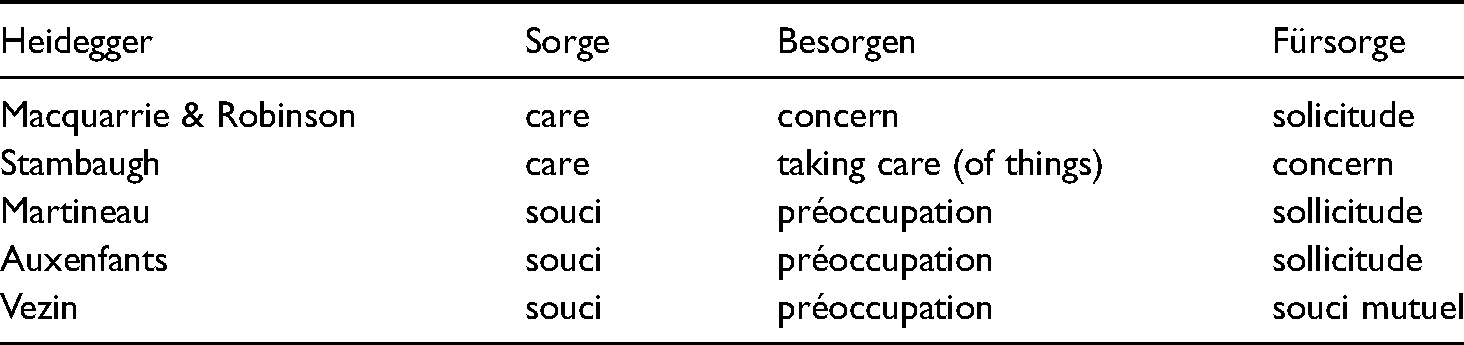
Here, in the second chapter of the first division of Sein und Zeit, Heidegger introduces Besorgen: Dasein's facticity is such that its Being-in-the-world has always dispersed [zerstreut] itself or even: split itself up into definite ways of Being-in. The multiplicity of these is indicated by the following examples: having to do with something, producing something, attending to something and looking after it, making use of something, giving something up and letting it go, undertaking, accomplishing; evincing, interrogating, considering, discussing, determining.… All these ways of Being-in have concern as their kind of Being – a kind of Being which we have yet to characterise in detail. Leaving undone, neglecting, renouncing, taking a rest – these too are ways of concern; but these are all deficient modes; in which the possibilities of concern are kept to a ‘bare minimum’. The term ‘concern’ has, in the first instance, its colloquial [vorwissenschaftliche] signification, and can mean to carry out something, to get it done [erledigen], to ‘straighten it out’. It can also mean to ‘provide oneself with something'. We use the expression with still another characteristic tum of phrase when we say ‘I am concerned for the success of the undertaking.’ Here ‘concern’ means something like apprehensiveness. In contrast to these colloquial, ontical simplifications, the expression ‘concern’ will be used in this investigation as an ontological term for an existentiale, and will designate the Being of a possible way of Being-in-the-world. This term has been chosen not because Dasein happens to be proximally and to a large extent ‘practical’ and economic, but because the Being of Dasein itself is to be made visible as care. This expression too is to be taken as an ontological structural concept. (See Chapter 6 of this Division.) It has nothing to do with ‘tribulation’, ‘melancholy’, or the ‘cares of life’, though ontically one can come across these in every Dasein. These-like their opposites, ‘gaiety and ‘freedom from care’ – are ontically possible only because Dasein, when understood ontologically, is care. Because Being-in-the-world belongs essentially to Dasein, its Being towards the world [Sein zur Welt] is essentially concern. (Heidegger, 1962: 83)
Besorgen thus stands as the ontological basis for a multiplicity of ways in which Dasein has to do with things in the world, including the ‘deficient’ modes of these ways of being. It has its root, as it were, in care (Sorge), as the ‘ontological structural concept’ to be distinguished from the ‘colloquial, ontical simplifications’ of everyday usage. Macquarrie and Robinson, translating, note that ‘concern’ is ‘by no means an exact equivalent’ for Besorgen and propose that ‘“Besorgen” stands rather for the kind of “concern” in which we “concern ourselves” with activities which we perform or things which we procure’ (ibid.). While, as the translators also note, the etymological connection between Sorge and Besorgen is lost in their version, ‘concern’ nevertheless succeeds in capturing the polysemic range of the word as something akin to ‘business’ (as in ‘a (business) concern’, or ‘taking care of business’) and ‘concern’ in the sense of worry, associating it with anxiety, and the sense of Being as something that ‘is an issue’ for Dasein.
A different approach is taken by Stambaugh, who proposes, for Besorgen, ‘taking care (of things)’ (Heidegger, 2010: 53). In contrast to Macquarrie and Robinson's ‘concern’, Stambaugh's solution appears to divest Besorgen of its more subjective and affective connotations and emphasise the pragmatic character of what is at stake, perhaps in order, as we will see, to support her proposition for Fürsorge (see further on). No such difference pertains to the three French translations, all three of which offer préoccupation for Besorgen, which leans more to the side of the subject thus preoccupied rather than the businesses or the things that require attention.
Before considering Fürsorge it may pay to pause on the varied translations of one of the ‘ways of Being-in (-the-world)’ that Besorgen (concern, taking care, préoccupation) encompasses in the quotation above: ‘bestellen und pflegen von etwas’ (Heidegger, 1967: 56). Macquarrie and Robinson propose, as we saw, ‘attending to something and looking after it’ (Heidegger, 1962: 83); Stambaugh: ‘order and take care of something’ (Heidegger, 2010: 53); Martineau: ‘prendre soin de quelque chose’ (Heidegger, 1985: § 12); Auxenfants: ‘cultiver quelque chose et en prendre soin’ (Heidegger, 2019: 76); and Vezin: ‘faire la culture et l'’élevage de quelque chose’ (Heidegger, 1986: 90). These variations suggest the extent to which pragmatic or ‘technical’ attention to something, in the sense of maintaining it, overlaps with the sense of attention given to persons, in both French and English. I would risk here the potentially obvious proposition that the meanings of the various expressions relating in different languages to care, concern, and preoccupation are inflected differently depending on whether their object is inanimate or animate, personal or impersonal, but that the contrasting dimensions overlap and interfere with each other. As translations of pflegen – looking after, taking care of, prendre soin de – have the same polysemy as that pointed out by Worms in the passage cited at the beginning of this article (and in the interview included in this volume), between the vital and the technical.
Heidegger, however, wants to distinguish more radically and ‘primordially’ between taking care of something and taking care of someone, at least in the ontological sense. This is not to say that care for persons does not encroach into the practice and technique of taking care of things, or that we may not be led, say as collectors, curators, or fetishists, to care for things as we might for persons, or, as carers of other humans, that we may not be led to treat them as things. These would presumably be ontical diversions from or deficiencies (or ‘violations’, in Worms’ sense) of the primordial ontological basis on which Heidegger founds Fürsorge: care for persons is distinct from care for things, but also from care for animals or the environment, because as Dasein we are ‘with’ these things in a different way from the way we are with other Dasein.
Heidegger puts it like this: If Dasein-with remains existentially constitutive for Being-in-the-world, then, like our circumspective dealings with the ready-to-hand within-the-world (which, by way of anticipation, we have called ‘concern’), it must be interpreted in terms of the phenomenon of care; for as ‘care’ the Being of Dasein in general is to be defined (Compare Chapter 6 of this Division). Concern is a character-of-Being which Being-with cannot have as its own, even though Being-with, like concern, is a Being towards entities encountered within-the-world. But those entities towards which Dasein as Being-with comports itself do not have the kind of Being which belongs to equipment ready-to-hand; they are themselves Dasein. These entities are not objects of concern, but rather of solicitude. (Heidegger, 1962: 157)
While (in Macquarrie and Robinson's version), the attitude we have with respect to the other Dasein with whom we are ‘with’, and the attitude we have towards things than concern us, or with which we are concerned, have the same ‘existentially constitutive’ grounding in care (Sorge), the ‘entities’ concerned have a different ‘kind of Being’, and we need a different name for the former kind: solicitude. However symptoms of untranslatability, so to speak, arise with Stambaugh's solution: If Being-with remains existentially constitutive for being-in-the world, it must be interpreted, as must also circumspect dealings with the innerworldly things at hand which we characterized by way of anticipation as taking care [Besorgen], in terms of the phenomenon of care [Sorge] which we used to designate the being of Dasein in general. (Cf. Chapter Six of this Division.) Taking care of things is a character of being which being-with cannot have as its own, although this kind of being is a being toward [Sein zu] beings encountered in the world, as is taking care of things. The being [Seiende] to which Dasein is related as being-with does not, however, have the kind of being of useful things at hand; it is itself Dasein. This being is not taken care of, but is a matter of concern [Fürsorge]. (Heidegger, 2010: 114)
We see that Stambaugh's proposition of ‘taking care of things’ for Besorgen enables her to keep concern for Fürsorge, to swap the terms around, as it were, either side of the zone of interference between the vital or relational and the socio-technical aspects of care. The untranslatability of care is particularly acute in this instance. Stambaugh's choice is not arbitrary, however, since it is motivated (linguistically rather than psychologically) by the ‘everyday’ associations of Fürsorge, which Macquarrie and Robinson comment in a note: There is no good English equivalent for ‘Fürsorge’, which we shall usually translate by ‘solicitude’. The more literal ‘caring-for’ has the connotation of ‘being fond of’, which we do not want here; ‘personal care’ suggests personal hygiene; ‘personal concern’ suggests one's personal business or affairs. ‘Fürsorge’ is rather the kind of care which we find in ‘prenatal care’ or ‘taking care of the children’, or even the kind of care which is administered by welfare agencies. Indeed the word ‘Fürsorge’ is regularly used in contexts where we would speak of ‘welfare work’ or ‘social welfare’; this is the usage which Heidegger has in mind in his discussion of ‘Fürsorge’ as ‘a factical social arrangement’. (Heidegger, 1962: 157)
Macquarrie and Robinson refer here to Heidegger's comment on the ‘factical urgency’ of the social arrangements of care as ‘welfare’, rendered in French as ‘assistance’ (Martineau, in Heidegger, 1985: § 26, and Auxenfants in Heidegger, 2019: 155) and as ‘mutualité’ (Vezin, in Heidegger, 1986: 163): Even ‘concern’ with food and clothing, and the nursing of the sick body, are forms of solicitude. But we understand the expression ‘solicitude’ in a way which corresponds to our use of ‘concern’ as a term for an existentiale. For example, ‘welfare work’ [‘Fürsorge’], as a factical social arrangement, is grounded in Dasein's state of Being as Being-with. Its factical urgency gets its motivation in that Dasein maintains itself proximally and for the most part in the deficient modes of solicitude. Being for, against, or without one another, passing one another by, not ‘mattering’ to one another – these are possible ways of solicitude. And it is precisely these last-named deficient and Indifferent modes that characterize everyday, average Being-with-one-another. These modes of Being show again the characteristics of inconspicuousness and obviousness which belong just as much to the everyday Dasein-with of Others within-the-world as to the readiness-to-hand of the equipment with which one is daily concerned. These Indifferent modes of Being-with-one-another may easily mislead ontological Interpretation into interpreting this kind of Being, in the first instance, as the mere Being-present-at-hand of several subjects. It seems as if only negligible variations of the same kind of Being lie before us; yet ontologically there is an essential distinction between the ‘indifferent’ way in which Things at random occur together and the way in which entities who are with one another do not ‘matter’ to one another. (Heidegger, 1962: 158; emphasis added)
Heidegger's insight that neglect is but a ‘deficient mode’ of care explains, to some extent, the overlap and interference referred to above. It is the deficient or ‘indifferent’ modes of solicitude that, given that they dominate our everyday and ‘average’ being with each other, can ‘mislead’ us into thinking that the same kind of indifference, or ‘carelessness’, is at stake with things as it is with other human beings, or: we are deficient in our care for others when we treat them as ‘mere’ things. This might suggest that the untranslatability of care derives from our ‘average’ conflation of care for things and care for persons, a conflation embedded in ‘everyday’ language, from which Heidegger seeks to turn away, the better to reveal the ontological distinctiveness of being with others and the mode of care that pertains to them. It is not only, however, a matter of carelessness, or rather, the ‘average’ deficiency of solicitude or concern for others is not simply due to our not caring for or about them. Heidegger offers a parallel between the ‘inconspicuousness’ that characterises things in the world when we take hold of them to use them, and the fact that we are relationally always and already with others in our mode of being. The presence of things and our ‘withness’ with others retreat behind the ‘obviousness’ of our ‘average’ engagements with them, and it is the task of philosophy to reveal this withdrawn ‘with-being’ to us.
While the two translations into English differ as we have seen in their rendering of Fürsorge, the solutions proposed in French also include an important variation, between ‘sollicitude’ (Martineau, in Heidegger, 1985: § 26, and Auxenfants, in Heidegger, 2019: 155) and ‘souci mutuel’ (Vezin, in Heidegger, 1986: 163). An earlier translation of a part of Sein und Zeit by Rudolf Boehm and Alphonse de Waelhens, as noted by Martineau, had also proposed ‘assistance’ as a translation of Fürsorge (Heidegger, 1985: § 26). Both Martineau and Auxenfants depart from this usage, which they find ‘narrowly transitive’ (Heidegger, 1985: § 26; Heidegger, 2019: 155) and propose ‘sollicitude’ because of its etymological connection to souci. Vezin, however, whose translation is announced as based on that of Boehm and de Waelhens, changes assistance to ‘souci mutuel’ (Heidegger, 1986: 163). He argues that ‘the literal translation of Fürsorge by souci pour would be misleading because, in French, se faire du souci pour implies a benevolent thoughtfulness, a worried and affectionate solicitude (the mother who prays for her child's recovery). The expression soziale Fürsorge undoubtedly means social assistance, but for Heidegger the word is to be taken, not in a humanitarian sense, but in a strictly existential sense (which is morally neutral)’ (Heidegger, 1986: 554). Vezin adds the important observation that Heidegger's phrasing implies a shared being ‘in care’, so to speak: ‘The first [nuance that must not be overlooked] is the locution in which “mutual concern” appears. It says that Dasein “stands in mutual concern” (steht in der Fürsorge). It's not just the mother who's keeping an eye on bottle-feeding time, it's the baby who's asking for care’ (ibid.). Vezin's introduction of ‘mutuality’, with souci mutuel, is intended to offset the one-to-one relationship of individual beings, of one to another, and point towards the shared reciprocity of care. Jean Greisch, on the other hand, in his extended and attentive commentary of Sein und Zeit, makes the following observation: Fürsorge, as Heidegger indicates, is the official term in German administrative language to designate the institution of Public Welfare [Assistance publique]. It is probably for this reason that Boehm-Waelhens translate Fürsorge by ‘assistance’. The translation adopted by Martineau – sollicitude – is certainly preferable. It introduces a new preposition in the subtle play of prepositions which determine this analysis; for is added to there and with. Solicitude, literally translated, is care for the other. (Greisch, 1994: 162)
To conclude, prematurely – as always with Heidegger – it will be fruitful to consider yet another division within care introduced by Heidegger, specifically with relation to Fürsorge, since it pertains to the interference of care as a socio-technical structure and care as a primordial ontological relationality. In contrast to the ‘negative’ modes of Fürsorge he evokes in the last quotation above, Heidegger writes, With regard to its positive modes, solicitude has two extreme possibilities. It can, as it were, take away ‘care’ from the Other and put itself in his position in concern: it can leap in for him. This kind of solicitude takes over for the Other that with which he is to concern himself. The Other is thus thrown out of his own position; he steps back so that afterwards, when the matter has been attended to, he can either take it over as something finished and at his disposal, or disburden himself of it completely. In such solicitude the Other can become one who is dominated and dependent, even if this domination is a tacit one and remains hidden from him. This kind of solicitude, which leaps in and takes away ‘care’, is to a large extent determinative for Being with one another, and pertains for the most part to our concern with the ready-to-hand. In contrast to this, there is also the possibility of a kind of solicitude which does not so much leap in for the Other as leap ahead of him [ihm vorausspringt] in his existentiell potentiality-for-Being, not in order to take away his ‘care’ but rather to give it back to him authentically as such for the first time. This kind of solicitude pertains essentially to authentic care – that is, to the existence of the Other, not to a ‘what’ with which he is concerned; it helps the Other to become transparent to himself in his care and to become free for it. (Heidegger, 1962: 158–9)
Heidegger's point here is that there is a kind of solicitude that intervenes at the level of concern (in Macquarrie and Robinson's version), or ‘taking care of things’ (Stambaugh), or ‘préoccupation’, that is at the level of our day-to-day engagements with tasks or tools that are ready to hand, with a what. This mode of care tends to step in for the other, to take (their) care away from them, risking dependency or domination. This contrasts with the ‘authentic care’ that intervenes at the level of the Being or existence of the other, which ‘leaps’ ahead of the other so as to ‘return’ their care to them. Zarader comments, ‘It is clear that the first modality of solicitude is also the more frequent, for the fundamental reason that I encounter the other within the framework of common preoccupations; we work together, we do the same things, we are together in the same action. The other solidarity, which is a solidarity of existence in a “project” in the strong sense, is far more rare’ (Zarader, 2012: 193). Greisch observes that the first mode is generally found in social ‘assistance’, while the second in psychoanalysis or spiritual mentorship.
We might suspect however that the ‘authentic’ and ‘positive’ mode of care is being progressively positioned at the extreme edge of our factical social existence, as a rarified form of ‘authentic’ existential commitment, distinct from the ‘ordinary’ care of shared tasks or stepping in to do for the other what they cannot do themselves. We can note in passing that this is quite different from the conception of care as a vital pre-condition of subjective life as such, described by Frédéric Worms in this volume. In this regard Heidegger's thinking appears quite distant from the vital philosophies of Bergson and Canguilhem. While Heidegger orients the ‘authentic’ sense of care towards the common project or commitment to shared existence as such, which he will go on to elaborate in Sein und Zeit with specific reference to temporality, the ‘everyday’ sense of care as solicitude, where we find it in its ‘factical social arrangements’, appears to be progressively compromised by the ‘framework of our common preoccupations’, on which Heidegger will focus in his later work on the technological ‘enframing’ (Gestell) of the world. While we generally encounter care in its ‘deficient’ modes of neglect or indifference, even the most frequent ‘positive’ mode of solicitude tends towards dependency and domination. Babette Babich, in a comprehensive engagement with Heidegger's Fürsorge, proposes, Heidegger begins his general discussion of solicitude by noting that it includes basic ‘preoccupations’ such as ‘with food and clothing and the nursing of the sick body’, and by emphasizing that most of these concerns are dispensed with in the most intimate ways and, most of the time, negatively, deficiently.… The predominance of such negative modes of solicitude foregrounds in turn the social requirement of alleviating (and also routinely dis-attending to) human needs. Thus, for Heidegger, ‘welfare world or ‘social assistance’, which also happens to be named Fürsorge as he mentions (and there is a parallel with the technical force of Heidegger's use of the term Fursorge and the everyday, mechanical or automatic sense in which we speak of such ‘caring’ or ‘solicitude’), has to be set up precisely as an institution. This is so because, in parallel with Heidegger's emphasis on the predominant modality of inauthenticity, ‘Dasein maintains itself proximally and for the most part in the deficient modes of solicitude’. (Babich, 2018: 17)
Babich foregrounds here the connection between the ‘deficient’ modes of care and the subsequent need for ‘social assistance’, both of which are implicit within Heidegger's term Fürsorge. Both possibilities need to be heard in care, and this is a factor in its untranslatability. It is as if the deficient mode of solicitude, in which we tend to pass by the other, indifferently, as well as the immediate and urgent pressure to assist those who cannot complete everyday tasks themselves lead us to attend to the others we are with as if we were attending to the ready to hand: Fürsorge is bent towards Besorgen. Solicitude, which stems from a primordial relational ontology, the fact that we are always already with the other, merges, in its deficiency, with the myriad of urgent everyday tasks to accomplish and the socio-technical mechanisms we have established to this end.
Two zones of untranslatability thus come to light. With Fürsorge, between assistance, sollicitude, souci pour, and souci mutuel, and between concern and solicitude we oscillate within a zone of interference and perhaps of indistinction between care as a socio-technical structure or provision, and care as a mutual benevolence, a shared interpersonal relationality. Our ontologically primordial care or concern for others and with others always risks falling back into the attitude we have to daily tasks, with our cares as things to do. These tensions and interferences are symptoms of the untranslatability of care, since each translation or variation construes this duality differently and leans either side of the scale. Whence the need to keep on (not) translating care.
Footnotes
Declaration of conflicting interests
The author declared no potential conflicts of interest with respect to the research, authorship, and/or publication of this article.
Funding
The author received no financial support for the research, authorship, and/or publication of this article.
