




Abstract
British historians drew on anthropological exemplars to remake social history between 1959 and 1977. Eric Hobsbawm's ‘primitive rebels’, Peter Laslett's World We Have Lost, Keith Thomas’s studies of witchcraft, and E. P. Thompson's ‘moral economy’ were all inspired by contemporary social anthropology, and they transformed historians’ understanding of the past. Reconstructing this moment of cross-disciplinary research contributes to our understanding of broader changes in the mid-century human sciences. This was a moment of grand theorizing about ‘modernization’, capitalism, and industrialization. Social historians responded to these concerns by drawing analogies between the past and the ethnographic present. The result was a number of hugely influential studies of social change that posed new questions to those seeking to create abstract models of modernization out of the English past.
James Obelkevich (2000: 134) was surely right when he argued that the origins of social history proceed from the ‘the basic notion of studying things in their social context’. Yet by declaring that this idea was simply ‘in the air’ during the 1960s, and that ‘it wasn’t necessary to get it from books’, he overlooked the fact that it was from a particular set of books (anthropologists’ books) that many social historians discovered a new way to understand ‘social context’.
One canonical social historian, E. P. Thompson, made this point emphatically: ‘Just as economic history presupposes the discipline of economics, so social history must presuppose the discipline of social anthropology’ (1977: 260). For Thompson, as for many other social historians of his generation, social anthropology was foundational because it offered examples of pre-industrial and non-capitalist societies that could contextualize surviving evidence of life in pre-capitalist Europe. 1
Of course, other ideas also influenced the development of social history in Britain. According to Miles Taylor (1997: 158), it is Lewis Namier's ‘painstaking reconstruction of patronage and kinship’, combined with the influence of the French historians writing in the journal Annales, that best explains the emergence of British social history. Guy Ortolano (2004) urges caution when searching for origins, however. ‘Social history’, he explains, was never ‘monolithic’. Rather, the early 1960s were ‘a time of diverse possibilities for a field whose disparate origins and methodological catholicity rendered it attractive to a range of practitioners’ (ibid.: 487). If we want to understand the wider cultural significance of social history in this period, Laura Carter (2021) asks us to look beyond universities and male academics to secondary schools, media, and the demise of what she calls the ‘history of everyday life’.
So rather than attempt to validate E. P. Thompson's sweeping statement about the transformation of the whole of social history, I argue here that anthropology had a clearly discernible impact on the work of four canonical social historians: Eric Hobsbawm (1917–2012), Peter Laslett (1915–2001), Keith Thomas (1933–), and E. P. Thompson (1924–93). Looking in detail at their engagements with anthropology leads to the article's second main argument: each of these historians used anthropology to make an intervention in a wider conversation then taking place across the human sciences about modernity, economic development, and modernization. This case is made in four parts. The article's first three sections argue that Hobsbawm, Laslett, and Thomas all used anthropology to explain the distance between the pre-modern past and the modern present. The final section then argues that E. P. Thompson used anthropology to stake a claim about the potential simultaneity of the modern and the non-modern.
This raises a question about how these historians defined modernity. The texts surveyed here are neither programmatic nor theoretical. Yet clearly, all these historians did cleave to the idea that some important process of modernization had taken place in Europe between the beginning of the 16th century and the mid 19th century. Hobsbawm's interest in working-class politics, Laslett's reconstruction of household and family structures, Thomas’s investigations of beliefs about the natural world, and Thompson's study of values all contributed to the emergence of the concept of the ‘early modern’ to describe this period of transition (Machielsen and Pfeffer, 2023: 270, 291).
Social anthropology offered a set of analogies, comparisons, and research topics for exploring the ‘early modern’ and theorizing ‘the social’. Historians in France (Burke, 2015) and in the USA (Klein, 2011) made a similar turn at the same time. This turn to interpret the past via the ethnographic present can be profitably interpreted as a species of what Raewyn Connell (2007) calls ‘northern theory’. Like the theorists Connell studies, social historians used anthropological case studies to help them understand Europe better, not to reflect on the ideas and values of the ethnographic subjects they read about. Social historians implicitly and explicitly cast their contemporaries in other parts of the world as stand-ins for Europeans in the early modern period. Modernity was then measured by the distance between, on the one hand, contemporary Europe and, on the other, a combination of the ethnographic present and the long ago past. I will return to these issues in more detail at the end of the third section of this article and in the conclusion.
For now, it only needs to be said that this use of anthropology to make implicit, and sometimes explicit, arguments about modernization renders the works of social history discussed here distinct from the type of cultural history written in the 1980s and 1990s, often under the influence of Clifford Geertz (1973). After the ‘cultural turn’, many scholars became deeply suspicious of narratives that presented history as a one-way process of causal development from the pre-modern past to the modern present (Vernon, 2014: ch. 1). The article's conclusion explores these contrasts before ending with a brief excursus into some contemporary relationships between anthropology and historiography.
Eric Hobsbawm and the anthropology of primitive rebellion
In an interview conducted 20 years after the publication of his book Primitive Rebels (1959), Eric Hobsbawm explained that anthropology was one of the three main factors that contributed to the book's contents (the other two were his travels in Southern Europe and his reading of Antonio Gramsci). Anthropology provided the most proximate cause for publication because he had been asked by the social anthropologists Max Gluckman and Meyer Fortes to tell them of any ‘European precedents’ for the anti-colonial rebellions then taking place in Britain's African colonies (Thane, Lunbeck, and Hobsbawm, 1979: 115). Fortes and Gluckman asked Hobsbawm to present a paper on that topic, and then Gluckman invited him to give further lectures at Manchester. Primitive Rebels was written up out of that material.
The book was therefore influenced by anthropology in at least two ways. First, it was prompted by the request of anthropologists. Second, its account of ‘social banditry’ closely aligned with the ideas of his hosts in the Manchester anthropology department. At that time, Gluckman and his colleagues were writing important ethnographic works on politics and law, mostly in Africa. These works of ‘Manchester School’ anthropology showed how conflict erupts when competition over political office-holding breaks out into the open (Ambler, 2023). Gluckman laid out a version of this argument in the flagship social history journal Past & Present, of which Hobsbawm was on the editorial board. In ‘The Peace in the Feud’ (1955: 1) Gluckman wrote that ‘while custom appears to exacerbate … conflicts custom also restrains the conflicts from destroying the wider social order’. Conflict may often be provoked by customary feuding, but it was often followed by a rearticulation of shared values that mended preceding schisms (ibid.; Turner, 1968[1957]: 90–3).
We can hear echoes of this ‘Manchester School’ theory in Hobsbawm's Primitive Rebels. ‘Social banditry’ was a ‘cry for vengeance’, Hobsbawm argued, and often played on a hope to right ‘individual wrongs’. Like Gluckman's feuding tribal politicians, bandits and peasant leaders often sought to reassert customary rights, meaning they had, in Hobsbawm's view, only ‘modest’ ambitions. Ultimately, this meant the maintenance of a ‘traditional world in which men are justly dealt with, not a new and perfect world’. Social banditry thus had ‘next to no organization or ideology’ and was ‘inadaptable to modern social movements’ (Hobsbawm, 1959: 5). ‘The future’, Hobsbawm wrote, ‘lay with political organization’ rather than in the defence of customary rights (ibid.: 28).
While Hobsbawm thought that bandits offered little hope of being turned into successfully ‘modern social movements’, millenarians and other utopian religious believers offered more promising material for what Hobsbawm termed becoming ‘modernized’ (Hobsbawm, 1959: 6). ‘Of all the primitive social movements … millenarianism is the one least handicapped by its primitiveness’, he wrote (ibid.: 57). This was because utopian religious cults were ‘revolutionary and not reformist’. When ‘fitted into a framework of organization, theory and programme which come to the peasants from outside’, millenarian groups could be made modern (ibid.: 6). The millenarians’ total rejection of the present world and their longing for a new one meant that they could ‘readily exchange the primitive costume in which they dress their aspirations for the modern costume of Socialist and Communist politics’ (ibid.: 64). Millenarian movements were thus ‘an extremely useful phenomenon’ to the wily political operator wanting to foment a socialist revolution (ibid.: 107). Being modern, to Hobsbawm, clearly meant being on the left, and this meant being organized in a global struggle against capitalism.
This whole argument speaks to Hobsbawm's politics. He had become a communist as a schoolboy in Germany and joined the Community Party of Great Britain as a student at the University of Cambridge (Kaye, 1984: ch. 5). During and after the Second World War, he was a prominent member of the Communist Party Historian's Group and, like his comrades, he maintained an interest in uniting economic analysis of social change with a close study of popular politics and protest (Schwarz, 1982). Almost 20 years after the publication of Primitive Rebels, Hobsbawm noted the relevance of this political context: ‘You can read [the book] as an attempt to see whether we were right in believing in a strongly organized party. The answer is yes’ (Thane, Lunbeck, and Hobsbawm, 1979: 116). The lesson for political actors in the present would be to lay aside any hope that local protest would overturn the established order. Only communist discipline, and a Leninist party, could bring about a social and political revolution.
In later works written for a non-academic audience, Hobsbawm left behind an interest in anthropology. In The Age of Revolution (1962), The Age of Capital (1975), and The Age of Empire (1987) he combined economic history and social history in grand narratives of classes, cultures, and economic change. This was a far cry from the world of Primitive Rebels, but, as in that earlier book, Hobsbawm drew on a wide reading of social science and he lauded the fact that historians and social scientists were finding common ground over their explanations of social change (Hobsbawm, 1971).
Even though Hobsbawm's oeuvre was mostly marked by looking at the very biggest structures of modernization and economic growth, in Primitive Rebels we find him in 1959 taking a turn that a number of his colleagues would make over the following decades. Social historians would increasingly draw on anthropology for theoretical inspiration when looking at the small-scale and the pre-capitalist. So, too, did Hobsbawm's interdisciplinarity allow him to reflect on the relationship between the past and the present in a global context. Primitive Rebels drew on the history of anarchists and peasants in Southern Europe to think through the questions posed to him by Max Gluckman and Meyer Fortes about anti-colonial uprisings in the contemporary British Empire.
As we will see, Hobsbawm's communist politics put him at odds with the historians discussed in the following sections of this article. Despite these differences, however, all of these scholars were united by their interest in anthropology and by their sense that European history and the contemporary politics of modernization spoke intimately to each other.
Peter Laslett and the anthropology of conflict and the family
Peter Laslett, like Eric Hobsbawm, also reimagined social history via an engagement with social anthropology. Like Hobsbawm, he was also influenced by anthropological theories of conflict. But the historical and political lessons he drew from that reading were very different. The first sign of Laslett's burgeoning interest in anthropology can be found in a funding application he made to the Rockefeller Foundation to travel to the USA in 1953. He proposed to research a book provisionally titled The Social Structure of England in the 17th Century. This marked a change from Laslett's previous interest in the history of 17th-century political thought (Skodo, 2014). His new project aimed, he wrote, to apply ‘contemporary sociology and social anthropology to the economic, social, political and intellectual institutions of that country at that period’. 2 The World We Have Lost (1965; henceforth WWHL) was the result of this work and appeared in print 12 years later.
In WWHL Laslett sought to overturn a whole swathe of research on 17th-century England, in particular the accounts that centred on class conflict in that period. Laslett's book focused mainly on the 17th and early 18th centuries and argued that historians should focus on the family and demography rather than class to understand subsequent historical change. Laslett linked his understanding of history with the contemporary global politics of development, arguing that ‘the contrast between English and European societies before and after industrialization’ can be equated with ‘an interest recently acquired by politicians and economists, though their eyes are turned on “underdeveloped countries” in the present world for the most part’ (Laslett, 1965: 240).
Laslett also tied this interest in economic development to Cold War debates about revolution. For communists, the 17th century in England fired the starting gun for revolutionary modernity that shot through the French and then the Russian Revolutions. ‘The macro-structure of Stuart society … has become a subject of world-wide discussion’, he explained, because ‘a good part of the contemporary world has to believe in a particular version of what is called The English Revolution for political reasons’. Thus ‘class conflict in the age of Charles I and Cromwell is not simply a matter of social antiquarianism’ (Laslett, 1965: 23).
Social anthropologists’ ideas about kinship and family were vital to Laslett's interventions in this charged debate. He acknowledged that the anthropologists who most informed his thinking included Max Gluckman, Meyer Fortes, Jack Goody, Audrey Richards, and Edmund Leach (Laslett, 1965: xiii). 3 Anthropology was a helpful spur for rethinking the nature of social stability and locality, and it offered a way for Laslett to reimagine the nature of the political and social elite as a whole.
One of Laslett's key arguments in WWHL was that the gentry and nobility constituted what he called a ‘web of kinship, to use a phrase of the anthropologists, which enfolded families in the ruling segment’. The key insight was that this web of kinship ‘was not simply a community of interest, a political or economic grouping, it was a lineage, a clan. Entry into it was by marriage’ (Laslett, 1965: 48). What he controversially called Stuart England's ‘one class society’ was characterized by squabbles and conflicts within the elite, rather than between classes. As with the societies studied by anthropologists, he characterized early modern England by ‘its division into a network of small county communities which were also conflict arenas’. ‘Once the imagination is set free’, he wrote, making analogies between these ‘conflict arenas’ and the societies studied by anthropologists became irresistible. ‘Professor Gluckman's examination of African communities shows how a fight over the dynastic succession is a permanent feature of political life.’ In similar fashion to Gluckman's ‘Manchester School’ discussed in the previous section of this article, Laslett argued that ‘far from destroying the whole, conflict actually confirms its solidarity. This fits some of the features of political life in England aptly enough, from Tudor, to Stuart, to Hanoverian and even to Victorian times’ (ibid.: 162).
This was all too much for 17th-century specialist and former Communist Party member Christopher Hill, who wrote a lengthy review of Laslett's book in 1967. Hill (1967) took particular aim at the idea that conflict before the Industrial Revolution had not challenged the wider social structure. On this count, he queried Laslett's application of Max Gluckman's anthropological theories to this period of English history. Hill was unable to ‘see the relevance of’ Gluckman's ideas to the era of the Civil Wars and ‘to a society which was not primitive, to a war which was not dynastic, and to a problem which, so far from being permanent, was unique’ (ibid.: 125), while putting an aside in a footnote, ‘I intend no disrespect to Professor Gluckman's exciting work by questioning Laslett's analogy’ (ibid.: 125, n. 2).
Laslett had used Gluckman's theory of the socially stabilizing force of conflict to downplay the revolutionary implications of the period in English history from 1500 to 1800. According to Laslett, true social upheaval had come only with industrialization, and it was only between 1940 and 1947, he thought, that English society had begun to exhibit signs of how fundamental this process had been. During these years, the social structure had begun looking more like a ‘pear, tending to become an apple’, with more people massed in the middle and fewer at the top and bottom. Thus ‘Englishmen, perhaps even more Englishwomen, have ceased to look upwards as much as they had always done; outward-looking has begun to compete with upward-looking’ (Laslett, 1965: 220). The recent ‘emancipation of women’ had begun to have a profound effect on the structure but not yet ‘the direct political effects … such language as this might lead us to expect’ (ibid.: 224).
By contrast to Hobsbawm's vision of history, therefore, Laslett's was a liberal or social democratic history, not a communist one. Laslett conceived of progress and social change as slow and gradual and considered the welfare state as its culmination. In this sense, Laslett's work conforms to a characterization of much of the social history published in Britain during the 1960s and 1970s as ‘in essence, a welfare-state version of the past’ (Cannadine, 1987: 173).
While Laslett's politics was broadly social democratic, at least some of his theoretical inspiration was, as we have seen, anthropological. For instance, Laslett's ideas about the stabilizing and non-revolutionary role of conflict owed something to contemporary social anthropologists like Gluckman. This much can be gleaned from closely reading his book and was obvious to contemporaries like Christopher Hill. In their overview of his life and career, John Dunn and Tony Wrigley (2005: 126) argue that Laslett also took from anthropology a broader appreciation that exhaustive, focused research on a locality ‘need not be microscopic but could be microcosmic’. Like contemporary anthropologists, Laslett thought that attention to the small scale, to the everyday, and to non-elites could illuminate foundational concerns pertinent to the wider field of social science.
Laslett's contribution in this regard was to focus on family and household structure. On the question of who married whom, and how big their household was, parish records spread across England might provide the answer. This information could then be used to challenge ideas presented by Marxists like Christopher Hill about revolutions, and also to undermine a mainstay of 19th-century social science, including that of Marx and Engels: that some time in the past large, extended families had shrunk into small nuclear ones (Kuper, 2005: 79–80).
Gathering the data to argue this point would be too great a task for one scholar, however. So Laslett set up the Cambridge Group for the History of Population and Social Structure in 1964 with his younger colleague Tony Wrigley to carry out a collective endeavour of social research (Dunn and Wrigley, 2005: 122–3). The Cambridge Group asked volunteers in parishes across the country to send in records of births, marriages, and deaths from their local archives. The Cambridge researchers would subsequently sift the material and reconstruct the demographic structure of the country.
This research had global implications, prompting Laslett to perceive England's social structure ‘as one amongst others’ (Laslett, 1965: 231). His aim in WWHL was to present an initial overview of the Cambridge Group's findings about England before a collective effort might allow him to write ‘something like a definitive study of the social structure of pre-industrial England, and perhaps of Europe generally’ (ibid.: vii).
This endeavour won him the admiration of the novelist, scientist, and politician C. P. Snow, who had recently engaged in a series of vociferous exchanges with the literary critic F. R. Leavis about the merits of modernization (Ortolano, 2009). ‘I think [your demographic researches] are an essential foundation for any society that you and I and people like us now want’, Snow wrote to Laslett (quoted in Ortolano, 2004: 495). Snow thought that Laslett's evocation of pre-modern life could stymie anti-big-state conservatives because it showed the merits of a system of welfare for achieving greater equality. It could also quash the arguments of Marxists and members of the incipient New Left who blamed capitalism for all society's ills (ibid.: 482–4). Snow wanted to spread the fruits of modern industrial society across the world (Ortolano, 2009: 195). Laslett thought that his research might help.
Laslett's history of England revealed how a long demographic transition had created a more equally stratified society where citizens – both men and women – might interact on more equal terms. Yet despite the claims Laslett made for the importance of his research and its relevance to policymaking, he had performed something of a sleight of hand in WWHL. As he admitted in the introduction to the 1972 edited collection Household and Family in Past Time, the kind of data that could be extracted from parish records was limited. It did not, in fact, allow the historian to reconstruct the ‘kin relations outside coresident domestic groups’ (Laslett, 1972b: 1). Births, marriages, and deaths gave a sense of who had lived within the confines of one dwelling, but they did not give a sense of how much the dwelling's residents had relied on mutual aid from other households in the wider community, whether these people had been related, or whether these relationships had changed over time.
‘The fact is’, Laslett explained, that historical evidence ‘is poorly adapted for the recovery of the process of development and change in domestic groups’ (Laslett, 1972b: 33). He therefore included a warning to his readers that what he called ‘the resident familial group alone is the question’ at hand, ‘not the kinship network, nor any “familial” relationships between distinct households’ (Laslett, 1972a: ix, n.). So his descriptions of the ‘the family’ in the past were much more limited than the rich anthropological case studies he compared English kinship against.
The social anthropologist Jack Goody, who had pioneered research on developmental cycles in domestic groups (Goody, 1958), did not seem too worried by Laslett's warnings. In fact, he confirmed that Laslett's data fitted well with anthropologists’ findings. The family, Goody wrote, ‘did not break up with the industrial revolution’. Its functions had merely changed. Basic functions of ‘reproduction, production and consumption’ were always segmented into small groups in non-industrial societies in any case (Goody, 1972: 119). Even in societies where polygamy meant that there were large households of multiple wives, the total group split into a series of smaller units for many of its social functions. The story of ‘the emergence of an “elementary family” out of “extended kin groups”’ – an idea ‘beloved by nineteenth-century theorists, Marxist and non-Marxist alike’ (ibid.: 124) – therefore seemed untrue. According to Laslett's historical research and Goody's survey of the anthropological literature, family size did not vary greatly between societies. The effect of their research, Goody wrote, meant that social scientists had finally thrown out the idea that pre-modern peoples lived in large communes of related family members, which over time broke down into nuclear households, as orthodox Marxists supposed.
Research by Laslett and his colleagues in the 1960s had apparently secured the theoretical supersession of the 19th-century human sciences. Social anthropology married with demographic research had allowed Laslett to give a non-Marxist account of social change over time. An appreciation of anthropological theory and the merits of an ethnographic approach to the ‘microcosm’ helped Laslett mark a break with the pre-modern past of a different sort to the Marxists: he dismissed the idea of a 17th-century social revolution and he sought to overturn Marxist understandings of the history of the family. His lauding of the social structure of the mid 1940s saw him offer general support to social democracy and the welfare state, and C. P. Snow picked up on Laslett's wider argument that material and moral betterment had put England on a path towards a recognizably modern society. This was an optimistic social history fit for a social democratic age (Cannadine, 1987: 173).
Keith Thomas and the anthropology of magic and belief
Keith Thomas's influential reimagining of English history also drew from his significant engagement with social anthropology. 4 Then a young history fellow at St. John's College, Oxford, in 1961 Thomas wrote in the Oxford Magazine that social anthropology ‘could provide valuable reinforcement for historians confronted by a paucity of evidence of the mental life of the lower reaches of the distant society they are studying’ (Thomas, 1961: 387). Anthropology, Thomas explained, offered historians novel methods to read partial sources. It also provided the means to uncover the mentality of ordinary people, and it could help measure the distance travelled from a pre-modern past to the present. Thomas urged that this anthropological frame of mind might attract more students as well as greater public interest by moving beyond the ‘endless analysis of the gymnastics of minor politicians’ traditionally studied in the academy and then prominent in the undergraduate exams at Oxford (ibid.: 388; Machielsen and Pfeffer, 2023: 267–8).
Thomas also wrote his article in response to recent remarks made by the Oxford professor of social anthropology Edward Evans-Pritchard (1950, 1961), who argued that anthropologists and historians had a lot to learn from each other. Thomas's review in the Oxford Magazine was sympathetic to Evans-Pritchard's point of view. The essay piqued the interest of Thomas's colleague Lawrence Stone, who invited him to present a version of the paper at a seminar. 5 After some revision, Thomas submitted the manuscript to the journal Past & Present, where it was published in 1963 under the title ‘History and Anthropology’.
In this much more extensive essay, Thomas wrote that social anthropology might help unite religious, ecclesiastical, and economic history – fields that historians had too often treated separately, ‘like patients in a hospital’. British historians wanting to break the metaphorical patients out of the ward tended to rely on what he called ‘vulgar Marxism’. These historians’ use of Marxism was often more methodological than political. In the impoverished historiographical culture of post-war Britain, Thomas argued, a kind of economic determinism seemed to be the only way that historians could relate social phenomena to each other. He sought to persuade his colleagues who had become Marxists-by-methodological-default that the insights of social anthropology might help them because anthropologists ‘explain things in terms of each other’ without reducing social facts down to an economic bottom line. After all, Thomas pointed out, anthropologists had discovered that economic actions ‘are themselves culturally determined’ (Thomas, 1963: 7).
Thomas connected the advantages of anthropology for the synchronic and contextual study of the past with a claim about what it offered for diachronic analysis of social change, making direct comparisons between the European past and the contemporary non-European world in a way that is now familiar from the work of Hobsbawm and Laslett. ‘The problems of persuading Africans to adopt the rhythms of an industrial life’, he wrote, ‘are almost exactly those which confronted Josiah Wedgwood when he endeavoured to convert the feckless, easy-going populace of Staffordshire into “such machines … as cannot err”’ (Thomas, 1963: 11). Economic development, on this reading, was a universal phenomenon, and current modernizing tendencies in Africa should be seen as homologous with the Industrial Revolution in late 18th-century Britain. Anthropological literature describing the effects of industrialization and colonialism in the present, he suggested, constituted a vital body of work to understand the Industrial Revolution in the past.
During the later 1960s, Thomas was working alongside his doctoral student Alan Macfarlane on witchcraft beliefs in England, and he connected this historical study with contemporary issues in the social sciences (Macfarlane, 1970; Machielsen and Pfeffer, 2023: 266–70). Thomas’s first major intervention on this topic took place at the 1968 Association of Social Anthropologists (ASA) conference, held at King's College, Cambridge. One way that a historian might help a room of anthropologists, Thomas suggested, was to show the emergence and decline of witchcraft accusations over time (Thomas, 1970: 53). Historical records could be used to explain not only how accusations flared up in a society but, crucially, when, and possibly why, they began to subside. In this sense, English history provided something like a laboratory for testing, and perhaps ultimately refining, anthropologists’ theories about witchcraft accusations.
Thomas's data from England seemed to support the argument commonly made by anthropologists that social stress caused witchcraft accusations to spike. This accorded with recent work by Max Gluckman that proposed that witchcraft accusations in the societies he studied resulted from the heightened social tension that arose from colonial rule. In his 1956 book Custom and Conflict in Africa (1956: 101), Gluckman argued that the competition between ‘old and new social principles’ was leading to dislocation in the social structure of many African peoples. More anxiety meant greater numbers of accusations of witchcraft.
In his 1968 ASA paper, Thomas made a similar argument about social change and witchcraft. He proposed that the years in which witchcraft accusations had been at their height in England had been a time when ‘the conflict between the communal norms of mutual aid and the individualistic ethic of self-help was probably at its most acute’ (Thomas, 1970: 72). The result had been a tension between the opposing values of ‘neighbourliness’ and ‘individualism’ (ibid.: 63). Thomas's crucial insight concerned the fact that accusations of witchcraft had often followed the denial of a demand for food or services from a beggar or poor villager (ibid.). A poor woman turned away at a villager's door had become a source of guilt, and then, when misfortune had arisen, the object of suspicion. The breakdown of traditional modes of mutual aid and the rise of confessional tensions and civil war in 17th-century England had led members of small communities to feel ashamed at their lack of charity and to cast blame for their misfortune on the poor and the downtrodden. The re-stabilization of the social order towards the end of that century had led to a decline in accusations. Changes in the intellectual culture had also played a role. A rationalist elite had begun to doubt the play of magical forces. By the beginning of the 18th century, much of the old world and its assumptions about the cosmos had been broken up and reconstituted. Greater social stability had also led to less angst, fewer accusations, and an elite made up of magistrates, judges, and courtiers unwilling to believe any more in magic and witchcraft.
This seemed like a strikingly similar argument to the one made by Gluckman about increased witchcraft accusations resulting from social change and colonial rule in Africa. Gluckman had also drawn an analogy between contemporary Africa and witchcraft in Europe. The establishment of the ‘industrial system’ in Africa, Gluckman wrote, was increasing ‘conflicts in personal relationships’, leading to ‘an increase in fears and charges of witchcraft, as happened at the beginning of our own industrial revolution’ (Gluckman, 1956: 102). With time, Gluckman hoped, those who believed in witchcraft would cease to be distracted ‘from the real causes of natural misfortune’ and the ‘real nature of conflicts between social allegiances’ (ibid.: 108). A ‘highly productive economy’ and its values of ‘individual achievement’ would be ‘incompatible’ with the kinship-based social organization that led to accusations of witchcraft (ibid.: 101). Europe's history led Gluckman to hope for a future for Africa without witchcraft accusations.
Thomas’s presentation in 1968 implied some problems with Gluckman's theory. Whereas Gluckman had associated the witch craze in Europe with the birth of the Industrial Revolution of the late 18th and early 19th centuries, witches were not, on the whole, hunted in England at that time but a century or more earlier. Thomas and Gluckman's chronologies implied different strategies for fighting contemporary witchcraft beliefs. The idea, Thomas wrote, that the ‘rise of industry, sanitation and education’ would sweep away witchcraft accusations seemed ill-founded (Thomas, 1970: 70–1). Accusations in England had not ended with the spreading of material wealth from the fruits of industry, as Gluckman had suggested, but from the stabilization of England's polity in the wake of the Restoration and with the birth of an elite wedded to ideas of rational improvement in the secular realm. More central still, Thomas wrote, the ‘essential circumstance underlying the decline of witchcraft accusations in England was the changing situation of the dependent members of the community’ (ibid.: 72). Witchcraft accusations had begun to subside only after the waning of the social aftershocks associated with the introduction of the Poor Law at the start of the 17th century and as the countryside had begun to settle into a new, increasingly capitalist, if not yet industrial, mode of production. Social welfare provision, not economic growth alone, had stabilized society in England and led to a decline in witchcraft accusations.
Like Laslett and Hobsbawm before him, Thomas's theories connected European history with a much broader trend in the mid-century human sciences. At this time, a large number of researchers tried to explain and describe how the transition from pre-modernity to modernity had come about and how this transition might be related to the emergence of capitalism and industry. In a world of growing global interdependence, in which many governments were committed to development projects abroad under the heightened politics of the Cold War, social history might explain how Britain had arrived at its own version of modernity and whether this history might apply to other societies (Ortolano, 2015).
These intellectual interests combined with new streams of funding for research on modernization and development, especially in the USA, where the Rockefeller and the Ford Foundations pumped money into the social sciences during the 1950s and 1960s (Gilman, 2003). Thomas was keen to incorporate these new approaches to the past into the history syllabi at the University of Oxford. For instance, the economic historian Walt Rostow had recently transformed the study of British economic history by explaining the conditions for economic ‘take off’ in the past (Cannadine, 2008: 99–101; Ortolano, 2015). Yet at Oxford in the 1960s and 1970s, most teaching was wedded to the study of high politics, not recent advances in economic and social history, and ‘remained largely impervious’ to the efforts of those like Thomas and ‘of students – and some staff – to encourage reform’ (Machielsen and Pfeffer, 2023: 267).
Thomas's engagement in debates about the transition to modernity saw him intervene in an intellectual context that also took him far from ongoing arguments about undergraduate history syllabi at Oxford. His interdisciplinary interests and his anti-Marxism made him a candidate for a group of social scientists called the American Committee on Comparative Politics (CCP) when they began casting about for a historian to apply their new brand of modernization theory to Britain. While they were not explicitly linked to the American security state, the group's members were clearly trying to connect their knowledge to pressing questions in American foreign policy. The CCP's mission was to integrate what were known at the time as the ‘underdeveloped’ nations into the orbit of the academic study of comparative politics (Gilman, 2003: 129). They did this by dividing the world between ‘agricultural’ and ‘modern’ societies, with ‘transitional’ states shifting between the two (ibid.: 133). The ‘study of postcolonial politics’ in the USA during the 1960s was ‘essentially made up of’ the CCP's works, writes one historian (ibid.: 153).
The CCP's initial overture to Thomas resulted in some confusion: he was not sure who they were. But, after receiving some literature listing the members of the committee, Thomas accepted their invitation. 6 The CCP had originally thought to invite the American political scientist Michael Walzer, or Thomas’s former Oxford colleague who had since relocated to Princeton University in New Jersey, Lawrence Stone. Walzer never received the invitation. 7 Surviving documents are not clear about what happened to Stone's invitation. Perhaps he passed on Thomas's name after declining? Either way, it was Thomas who received a memo from the doyen of modernization theory Lucian Pye and a draft copy of the book Crises and Sequences of Political Development with a note to apply its insights to British history.
Crises and Sequences was a classic of the new modernization theory. It proposed that nations experienced six common political crises during their development (crises of Penetration, Integration, Participation, Identity, Legitimacy, and Distribution). New nations faced the possibility of experiencing these crises in such quick succession that they might collapse. The implication was that knowing more about the crises might avoid such a catastrophe and the opportunity communists might take to foment revolution amid the social wreckage. The idea that all nations faced a common set of crises had been lifted by political scientists from their understanding of how Western capitalist states had developed over the past few centuries (Tilly, 2006: 418). The CCP were intrigued to see if historians would confirm their theories and how they might reinterpret the past in light of them.
Despite the high hopes of theorists like Lucian Pye, the results were not very positive. The papers from the 1968 conference that Thomas attended, and a follow-up event that took place in 1970, took almost 10 years to be published and questioned the coherence of the CCP's whole enterprise. The collection, edited by the historian Raymond Grew, contained a foreword by Lucian Pye that expressed little surprise at the ‘vivid difference between the historian's respect for the particular and the theorist's awe of abstract ideas’ (Pye, 1978: v). Pye was, however, disappointed that none of the historians seemed willing to wholeheartedly accept that public health systems and the establishment of universities could be unequivocally classed as ‘development’ and ‘modernization’ (ibid.: vi). Grew's introduction posed a different problem. Far from declining to think about modernity and modernization, most historians had a worrying tendency to think of their own particular period as ‘almost always … “the transitional one”, usually from “traditional” to “modern” society’! (Grew, 1978: 9).
Thomas's contribution echoed these sentiments and remarked that a ‘lack of precision … handicaps any attempt’ at applying the political scientists’ concepts of modernization because of each historian's prejudices. In English historiography, modernity's arrival had been heralded by different historians with the Tudor revolution in government, the Civil War in the mid 17th century, industrialization in the 19th century, or even, in the High Tory history of Maurice Cowling, between 1920 and the first Labour government in 1924 (Thomas, 1978: 43). Thomas concluded that ‘it is doubtful whether any two historians, presented with the same problem in its current state of formulation, would come up with the same solution’ (ibid.: 90). The three main ingredients of modernization – equality, capacity, and differentiation – were simply too vague to define historically. Despite his hopes that American-style social science might improve his colleagues’ understanding of the English past at Oxford, Thomas's experience of the real thing (at least in the garb of modernization theory and the CCP) left rather a lot to be desired. Social anthropology, rather than modernization theory, remained his theoretical lodestar.
A year after Thomas's attendance at a second CCP workshop in 1970, his first major publication, Religion and the Decline of Magic (1971), appeared. Thomas recalled in an interview later in life that his ‘guiding assumption’ in this book was taken not from modernization theory but from social anthropology, namely, the idea that ‘we should begin by thinking that we know nothing about people in the past’. The job of the historian, like that of the anthropologist, was to avoid falsely attributing to the subjects of their research ‘emotions, beliefs and emotions which are ours, just because they seem natural human and normal’ (Pallares-Burke, 2002: 91). It also bears other hallmarks of its time. In a familiar trope from the preceding discussion of Hobsbawm and Laslett, the book opened with an analogy between early modern England and ‘the “under-developed areas” of today’ (Thomas, 1971: 3). Like Max Gluckman, Thomas explained that the social function of magic, religion, and belief in the other-worldly amounted to a distraction from the real causes of misery and misfortune in England: disease, dearth, and early death. The implication was that once they realized that this was the case, social reformers could set about improving the lot of the poor and England could slowly be made modern.
While modernization theory clearly influenced his thinking and he was excited by the potential of Walt Rostow's ideas to invigorate his undergraduate teaching, it was social anthropology that offered the tools to enter into the ‘mental life of the lower reaches’ (Thomas, 1961: 387) of the 17th century. Thomas used anthropology to mark a break with a world that had been left behind some time in the early 18th century. Subsequent material and moral betterment had slowly bent England into a more recognizably modern shape. This progress was to be admired, but he worried that social scientists researching ‘modernization’ in the abstract might have a hard time creating universal models from particular historical experiences like England's.
In this sense, Thomas’s work can be profitably compared with Laslett's. Both men used anthropological models of conflict and consensus to undercut the prevailing trend of Marxist social history that Thomas had decried as ‘vulgar Marxism’. This put both historians politically at odds with the communist Eric Hobsbawm. However, all three men used anthropological research in much the same way (to draw analogies and as a spur to understanding non-elites) and Thomas and Hobsbawm both sat on the editorial board of the pioneering historical journal Past & Present. All three historians used anthropological examples to limn the distance between a ‘primitive’ pre-modern past and a ‘modern’ present. They also made an implicit argument about modernity, capitalism, and industrialization. Modernity had arisen in ‘the west’, and ‘the rest’ of the world was being met by much the same forces as had shaken English society in the 18th and 19th centuries.
In this sense, their history can be understood in Raewyn Connell's (2007) terms as examples of ‘northern theory’. This is because the anthropological examples they used were not treated as specific instances of knowledge formed through and under colonialism and read sensitively in that context. Like the classical sociologists Connell analyses, these social historians ‘render[ed] the social thought of colonised cultures irrelevant to the main theoretical conversation’ (ibid.: 46). Laslett's WWHL, Thomas’s world of magic and Hobsbawm's Primitive Rebels were all written with anthropological analogies to explain, as Connell writes of sociologists like Max Weber, ‘a world that has been surpassed’ (ibid.: 46). To flesh out that past, all these historians relied on contemporary anthropology. Rather than engage with the people discussed in those ethnographies as having co-present value in their contemporary world, those living in places far away from Oxford and Cambridge and London were consigned, by analogy, to Europe's long ago past.
E. P. Thompson and the anthropology of morality
E. P. Thompson used social anthropology very differently from the other social historians discussed in this article. He refused to see in ethnographic data a world that had been left behind in the past. For Thompson, anthropology offered a way to theorize what he called a ‘moral economy’ that held open the imaginative space for anti-capitalist resistance in the present. The moral economy might bridge the past and the present and unite the ethnographic far away with the English near at hand.
In direct contrast to Hobsbawm in Primitive Rebels, Thompson lauded popular protest as a potentially revolutionary activity. These differences in intellectual outlook can be explained, at least in part, by the politics of the two men. After the Soviet invasion of Hungary in 1956, Thompson left the Communist Party of Great Britain, while, as explained above, Hobsbawm remained committed to the Leninist view that a vanguard party was a necessity for achieving communism. Thompson remained a kind of Marxist but sought over the following years to create a ‘humanist’ socialism, hoping to escape what he saw as the economic determinism of both the communist left and the contemporary Labour Party (Rogan, 2017: ch. 4).
Like the other historians discussed in this article, Thompson turned to the past and to anthropological research to explain the social changes wrought by capitalism in order to better understand how the present had emerged. 8 This interest in anthropology can be first discerned after the publication of The Making of the English Working Class (1963). Although The Making contains references and analogies to industrialization in Africa and in Asia, as far as I am aware the book was not directly influenced by social anthropology. Two years later, though, as he first theorized his idea of the ‘moral economy’ in a long essay titled ‘The Peculiarities of the English’, there are explicit signs that anthropology was influencing his thinking.
In ‘The Peculiarities of the English’, Thompson explained how non-quantitative sources could allow historians to recover a world that existed before capitalism, one in which economy and society had not been separated. Thompson explained (in much the same spirit as Keith Thomas in his 1963 Past & Present article) that sociologists and anthropologists ‘have sufficiently demonstrated the inextricable interlacing of economic and non-economic relations in most societies, and the intersection of economic and cultural satisfactions’. This insight helped to explain, for instance, the fact that ‘until the late eighteenth century … the common people of France and England adhered to a deeply felt “moral economy” in which the very notion of “economic price” for corn … was an outrage to their culture; and something of the same moral economy endures in parts of Asia and Africa today’ (Thompson, 1965: 354). Anthropological research about economic life in non-European countries might therefore help the historian understand the transition away from a moral economy in England's past.
Six years later, Thompson's article ‘The Moral Economy of the English Crowd in the Eighteenth Century’ made good on this insight. He wrote that ‘the confrontations of the market in a “pre-industrial” society are of course more universal than any national experience’. Furthermore, he went on, ‘the elementary moral precepts of the “reasonable price” are equally universal’ (Thompson, 1971: 135). This had implications for the contemporary politics of economic development. Those economists and economic historians who were at this time emphasizing the importance of ‘growth’ were, Thompson wrote, ‘guilty of a crass economic reductionism, obliterating the complexities of motive, behaviour, and function’ (ibid.: 78). Contemporary anthropologists, on the other hand, maintained the importance of these complexities of motive, behaviour, and function in their analysis, and this is what drew Thompson to their work.
Anthropologists often emphasized functions, motives, and beliefs to critique simplistic notions of the self-interested abstraction of ‘economic man’ who was rational and pursued economic ends in a utilitarian fashion (Foks, 2023: chs. 2, 7). This critique appealed to Thompson, who had long been a critic of utilitarianism in English political and intellectual culture (Winch, 2000). Anthropology also allowed him to make a point about the universality of the moral economy by providing an ethnographic and comparative framework that placed England alongside other places where protests about prices had arisen. He made both the qualitative argument about economic man and the comparative argument about the geographical spread of the moral economy by mentioning in his article the founding figure of social anthropology in Britain, Bronisław Malinowski, who had carried out research in the Trobriand Islands off the south-eastern coast of New Guinea during the First World War (Foks, 2023: ch. 1; Young, 2004).
Thompson invoked Malinowski's and its uptake among historians when he wrote that ‘we all know the delicate tissue of social norms and reciprocities which regulates the life of Trobriand Islanders’. But economic historians had nevertheless reduced the ‘infinitely-complex social creature’ Malinowski had written about – ‘Melanesian man’ – into ‘the eighteenth-century collier who claps his hands spasmodically upon his stomach and responds to elementary economic stimuli’ (Thompson, 1971: 78). By writing this, Thompson wanted to urge his readers that participants in markets did not always behave under some abstract market rationality and that they should not be described as having done so in retrospect by historians. Rather, they should be treated with the same kind of descriptive acuity that Malinowski had demonstrated in his ethnographic work. Trobriand Islanders exchanged in the Kula shell necklaces and armbands in a way that cemented social ties rather than merely utilitarian values.
Thompson argued that historians should learn from anthropologists that non-capitalist economic exchange was regulated by custom and not by abstract, utilitarian reasoning (this latter point was the overarching argument across the whole of Malinowski's economic anthropology; see Foks, 2024). In describing the social forces driving market behaviour, and capturing the norms underwriting a moral economy of complaint against price rises under scarce conditions, Thompson thought that he had explicated ‘not an involuntary spasm, but a pattern of behaviour of which a Trobriand islander need not have been ashamed’ (Thompson, 1971: 131). Bronisław Malinowski clearly influenced Thompson's understanding of the moral economy as a social as well as an economic phenomenon, even though his works do not appear in that article's citations.
The anthropologist whom Thompson did cite was Sidney Mintz, whose work provided more comparative evidence of market behaviour. In ‘Moral Economy’, Thompson cited an essay by Mintz that studied middlemen and middlewomen in markets in Haiti, Jamaica, Guatemala, and Mexico where traders acted as bridges between peasant producers and elites in wider circuits of exchange. There remained a degree, Mintz wrote, of ‘economic personalism’ in all these places, wherein ‘a network of person-to-person dealings … persist over time and outlast any single transaction’ in markets (Mintz, 1959: 24). These social relationships could not simply be reduced to economic rationality understood as individual utilitarian reasoning. Thompson found in Mintz on markets and Malinowski's anti-utilitarian economic anthropology the means to rethink pre-capitalist exchange and thus England's history. Thompson drew on both anthropologists to make the point that in ‘eighteenth-century Britain or France (and in parts of Southern Italy or Haiti or rural India or Africa today) the market remained a social as well as an economic nexus’ (Thompson, 1971: 135).
A year after his moral economy article was published, though, Thompson began to worry that uniting anthropology and history posed certain risks. In a review of Thomas's Religion and the Decline of Magic and Alan Macfarlane's The Family Life of Ralph Josselin, he criticized the ‘increasing tendency to abstract some anthropological and sociological finding from its context and to flourish it around as if it was possessed of some intrinsic value as a typological fact about all human societies’ (we can hear an echo of Christopher Hill's review of Laslett, written five years earlier). Such insensitivity to the particularity of each human society and the humans in it was ‘actively injurious to history’, Thompson wrote (Thompson, 1972: 43). He worried that flattening the differences between 18th-century Birmingham, 16th-century Persia, and a village in 20th-century Ecuador all under the term ‘Pre-Industrial Society’ put history under ‘extreme strain’. Such woolly comparativism, he wrote, threatened to ‘puncture’ the discipline and let in ‘a gush of abstract typological air’ (ibid.: 46). Despite these warnings, he reassured his readers that Keith Thomas's work and his use of anthropology was conceptually airtight. Thomas's focus was only on England, so it was not a work of abstract comparison. Nor did Thompson think that Thomas’s interdisciplinarity shaded into the simplistic application of unmodified anthropological theories to English history.
History, Thompson argued, was ‘above all, the discipline of context’, and Thomas had maintained the sovereignty of history, and of context, above the instrumental application of social theory to the past. Whether his own account of the moral economy of a year earlier would pass the same test is less clear. Thompson's concept of the moral economy contained a productive ambiguity between representing a stage in history that had been left behind in England and an immanent possibility found in all social relationships, ready to be activated with enough ethical insight.
During an interview in 1976, he reaffirmed the importance of anthropology in just these terms. He told of his interest in how ‘a vocabulary of agency and moral choice got completely lost’ in Western capitalist ideology because of ‘a notion of the maximization of productive growth as being the inner motor of a machine that people trail along behind’. ‘This’, he explained, ‘is why I am now particularly interested in anthropological concepts that may be brought to the examination of norms of a noneconomic kind’ (Abelove et al., 1984: 21). A year later in the Indian Historical Review, Thompson reaffirmed that his reading of anthropology meant that he had found a robust way to reject ‘positivistic or utilitarian categories of explanation’ (Thompson, 1977: 248). By then, Thompson was critiquing this tendency not just in Europe and in the past but also in India in the present, which he had visited during the Emergency of 1975–7 and about which he was deeply disturbed (Satia, 2020: 262). Anthropology thus allowed Thompson to reject what he saw as a worldwide acceptance of developmental thinking about economics and also to insert English history into a wider conversation about the global politics of modernization.
Where Thompson departed from the other historians discussed previously in this article was his commitment to a form of populist politics and in his criticisms of modernity. As Thompson had explained in 1976, he had a horror of any history that saw the veneration of growth into a ‘machine that people trail along behind’ (Abelove et al., 1984: 21). His implicit argument with Hobsbawm about the merits of modernity and the value of popular protest reflected an ongoing dispute on the left about the route out of the present and towards a socialist future. Thompson's work implicitly disagreed with Hobsbawm's attachment to Leninism and his vaunting of economic growth and modernization. Thompson's experience of the Hungarian Uprising and the Communist Party's response to it in 1956 had left him suspicious of communism and led to his break with Leninism. By the 1970s, he was committed to a form of popular protest that sought to break the impasse on both sides of the Cold War through popular mobilization via the groups Campaign for Nuclear Disarmament and European Nuclear Disarmament (Eastwood, 2000).
It was at just this time that he was reading anthropology in order to reject ‘positivistic or utilitarian categories of explanation’ in historiography (Thompson, 1977: 248). Thompson's anti-utilitarian historical vision seems to have dovetailed with his contemporary politics (Winch, 2000). In a late essay, ‘The Moral Economy Reviewed’, he wrote appreciatively of writers who had taken up his concept less as a ‘traditional, “backward-looking”’ notion and instead seen it as something that is ‘continuously regenerating itself as anti-capitalist critique, as a resistance movement’. But his appreciation pulled up short of general praise, for ‘in inexpert hands’ such analyses of the moral economy ‘may bleed off the edge into uncontextual moralistic rhetoric’ (Thompson, 1991: 341). Historiography was not the same as political thought or moral philosophy, Thompson suggested, but it was certainly an arena for contesting political ideas about the past with an eye on the present (Bess, 1993).
Conclusion: From social history to the cultural turn and towards a new synthesis?
This article has argued that a number of the most significant works of British social history from the late 1950s to the 1970s can be productively understood and compared in light of their engagement with social anthropology: Eric Hobsbawm's theorizing of social banditry, Peter Laslett's WWHL, Keith Thomas's writings on witchcraft, and E. P. Thompson's idea of the moral economy. These writers’ interest in social context did not appear out of ‘thin air’, as James Obelkevich wrote. Their sensitivity to social context came, in large part, from their different readings of social anthropology.
All of these social historians drew analogies between the social changes they described in the past and the forces anthropologists saw transforming the ethnographic present. Analysing these comparisons has led to the article's second argument: that historians’ reading of anthropology put them in dialogue with the contemporary politics of economic development and modernization. This, in turn, was part of a much broader mid-century moment across the human sciences concerned with the emergence of modernity, capitalism, and industrialism in the so-called developing world (Ortolano, 2015), most often carried on in a Eurocentric frame of reference about how ‘the west’ related to ‘the rest’.
To this extent, Hobsbawm, Laslett, and Thomas can be understood as doing what Raewyn Connell calls ‘northern theory’ by reading the social milieus of the imperial peripheries through the interests and optics of the metropole. They represented the peoples discussed by anthropologists as exemplars and comparators rather than creators of value and knowledge in their own right (Connell, 2007). E. P. Thompson, however, seems to have proposed something like a truly relativizing agenda. The moral economy united peoples’ experiences across space and also across time before and after the deluge of capitalism's triumph. Thompson seems to have hoped that an ethical renewal of socialism would reconnect the utilitarian and acquisitive moderns with their forebears in the past and with their contemporaries facing the depredations of modernization in the present. Perhaps it is because he rejected so many orthodoxies of his time that Thompson's idea of the moral economy has proved to be so influential (Booth, 1994; Rogan, 2017; Thompson, 1991: 259–351), jumping across disciplinary divides into anthropology, influencing political scientists, sociologists, historians, and many others down to the present. Thompson's refusal to bow to a one-way trajectory of modernity led to his work's continuing relevance during the 1980s and 1990s. His lament about the destructive ‘machine’ of economic growth seems destined to inspire and provoke long into the future.
While Thompson's ideas were read, cited, and debated across disciplines through the 1980s and 1990s the kind of anthropology being drawn on by historians diversified, taking in then-new symbolic and structuralist anthropology. Clifford Geertz's The Interpretation of Cultures (1973) had a huge influence, as did Claude Lévi-Strauss and Mary Douglas. Some sense of this shift can be gleaned from the citations in the flagship social history journal Past & Present (see Figure 1 below). The impact of the later cultural anthropology is certainly striking (mainly represented by Clifford Geertz), but so, too, is the continuing importance of works of social anthropology from the 1920s to 1960s that influenced the historians written about here. Surely E. P. Thompson was right, at least in part, when he wrote in 1977 that ‘just as economic history presupposes the discipline of economics, so social history … must presuppose the discipline of social anthropology’ (Thompson, 1977: 260).
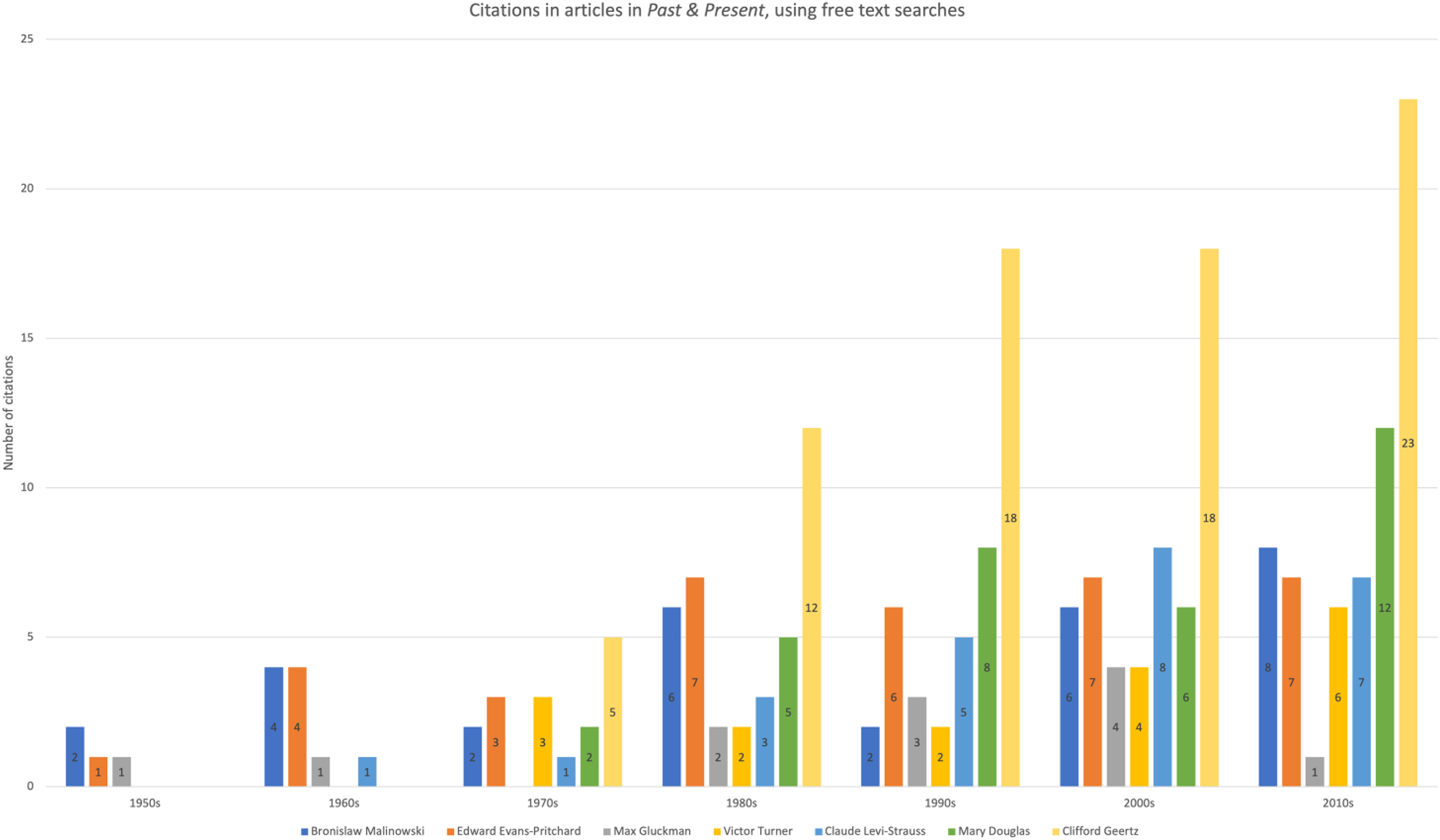
Number of articles by decade citing significant social anthropologists in the journal Past and Present.
The cumulative effect of all this anthropological theory on history led, in time, to Keith Thomas's longed-for historiographical dethronement of high politics from many university syllabi. Yet, as time has gone on, many scholars have come to query the assumptions made by social historians like Eric Hobsbawm, Peter Laslett, and Keith Thomas that the past should be read as a tale of development and that the present emerged in some causal fashion out of it. By the 1980s, postmodern and post-structural suspicion of master narratives abounded, postcolonial critics were skewering Eurocentrism, and feminist scholars were reassessing what social historians had taken to be ‘the social’ (Iggers, 2005; Klein, 2011; Maza 2017; Vernon, 2014: ch. 1). This led to new dividing lines between cultural and social historians; between, on the one hand, a social history that continued to assert that ‘causes matter because causes link the past to the present directing us to the future’ and, on the other, a cultural history interested in ‘exploring and accepting the strangeness of the past on its own terms as a lesson in tolerant relativism and an invitation to critique the present’ (Maza, 2017: 196).
In the wake of these debates about culture and society, historians continue to cite anthropologists, especially, as the citation data above shows, Clifford Geertz. More recent anthropological theory, however, seems to have had less of an impact. For instance, there seems to have been comparatively little engagement among historians, with recent anthropological theorists of ‘ontology’ and ‘alterity’ (Heywood, 2018) – Philippe Descola, Martin Holbraad, Anna Lowenhaupt Tsing, and Eduardo Viveiros de Castro – being collectively cited in only 16 articles published in Past & Present since 2000.
One explanation is that history has not turned away from anthropology, but that both disciplines have been affected deeply by a common transformation across the human sciences. Since the 1980s, Michel Foucault has become a touchstone for scholars across all fields. His work's impact has inaugurated a wider turn that the anthropologist Sherry Ortner (2016) calls ‘dark theory’. A huge body of work in both anthropology and historiography has focused on power, neo-liberalism, prisons, and the state. The line of transmission here is less from anthropology to history than from the writing of Foucault onto both disciplines simultaneously.
Signs of other syntheses are emerging across the human sciences, too, especially in studies of inequality. Here, big narratives of macro-social change are being united with detailed analyses of empires, property rights, and labour relations (Davies, 2022; Jackson, 2023). Most researchers of inequality have now left behind the idea that modernity is singular, monolithic, and European. Instead, more and more human scientists agree, there are multiple modernities and they are global. With rising inequality and the combined effects of anthropogenic climate change, many scholars seem less sure about the stability of these modernities under such massive strain. Now, in the wake of the decades-long dialogue between historiography and anthropology, we might ask again: What is ‘modernity’? Can we draw inferences from social processes in the ethnographic present to study the vanished past? Is it possible to talk of ‘modernization’? By reading classic works of 1960s and 1970s social history, it is possible to see these questions emerging, and perhaps we can draw from them some inspiration for asking them anew.
Footnotes
Declaration of conflicting interests
The author declared no potential conflicts of interest with respect to the research, authorship, and/or publication of this article.
Funding
The author disclosed receipt of the following financial support for the research, authorship, and/or publication of this article: This work was supported by the Arts and Humanities Research Council (grant no. 1506671).
