




Abstract
This article explores how post-war documentary film-makers negotiated complex social, formal, and autobiographical issues associated with representing mental illness and its treatments, and the extent to which their respective approaches helped to challenge conventional attitudes to alternative psychotherapies – especially within the context of advances in new documentary film-making technologies, alongside a wider culture of social activism. Focussing on A Look at Madness (Regard sur la folie; Mario Ruspoli, 1962, France) and Now Do You Get It Why I Am Crying? (Begrijpt u nu waarom ik huil?; Louis van Gasteren, 1969, Netherlands), the article discusses how the collaborative, democratic aims of cinéma direct coincided with the ethos of institutional psychotherapy, and compares this with the relations between the documentary form and the subject of LSD-assisted psychotherapeutic techniques in Van Gasteren's film.
Keywords
Introduction
The epistemic turbulence of the 1960s inevitably upset traditional attitudes to mental illness, with a host of new studies on psychiatric institutions, schizophrenia, sexuality, and social psychology attracting a general as well as a specialized readership. While it might be an exaggeration to claim that figures such as R. D. Laing, Michel Foucault, Erving Goffman, or Thomas Szasz became household names at this time, the impact of their contributions is undeniable, alongside a growing acceptance that, as Susan Sontag memorably put it, ‘in every society, the definitions of sanity and madness are arbitrary – are, in the largest sense, political’ (1988: lv). Elsewhere in the 1960s, the field of documentary film-making was undergoing its own democratic ‘revolution’ as the development of relatively quiet, lightweight cameras and synchronous sound recording devices inaugurated what is loosely termed the era of cinéma-vérité. The Second World War had played an important role in shaping the histories of both mental health care and the documentary: if film-makers availed of advances in photographic and recording technologies originally intended for military reconnaissance and surveillance purposes, the war had also highlighted the limitations of psychiatry and the need for more humane approaches to the treatment of combatants and civilians traumatized by their wartime experiences. Some of the leading figures associated with post-war radical psychiatry had themselves worked as army psychiatrists, or had been involved with wartime resistance groups, while others had been imprisoned for holding anti-fascist views: experiences that would inform their subsequent work and associate them with social libertarianism and the politics of pacifism.
The corpus of documentaries dealing with important figures, theories, and practices related to radical psychiatry and alternative psychotherapies is varied and predominantly European or North American, especially within the context of the long 1960s (Joice, 2022: 224–7). Not surprisingly, recent scholarship in this area has tended to stress the role of documentary in supporting specific mental health care reforms and promoting the development of progressive psychotherapeutic communities within a given cultural context. In the case of Italy, for example, the influence of the Basaglias and Psichiatria Democratica in the production of films such as La porta aperta (The Open Door; Gandin, 1968), I giardini di Abele (The Gardens of Abel; Zavoli, 1969), Nessuno o tutti – Matti da slegare (Mad People to Untie; Agosti et al., 1975), Follia come poesia (The Poetry of Madness; Mangiacapre, 1979), and even San Clemente (Depardon and Ristelhueber, 1982) has been discussed quite extensively (e.g. Emerson, 2021; Foot, 2015: 218–23; Forgacs, 2014: 243–50). 1 Similarly, there is a growing body of scholarship available examining the relations between documentary film and French alternative psychotherapies, especially regarding the remarkable career (and film-making) of Fernand Deligny (Marlon, 2022; Witt, 2022). Other studies have focussed on documentaries about the institutional psychotherapy movement in post-war France, looking at how the politics and philosophy of radical psychiatry intersects with the aesthetics of the documentary image (Bandosz, 2021; O’Rawe, 2019); these studies have also highlighted the particular significance of film-making about – and within – the Clinique de La Borde. 2 Meanwhile, within a British context the persona and practices of Laing (and the Philadelphia Association) have been the subject of various observational (e.g. Asylum; Robinson, 1972), expository (e.g. Swedish film-maker Lars Wallin's Schizofreni: En sjukdom eller bara en etikett [Schizophrenia: A Disease or Just a Label?; Wallin, 1970]), and experimental documentaries (most notably, Luke Fowler's [2011] collage of archival images and soundscapes, All Divided Selves), as well as realistic docu-dramatizations influenced by Laingian thinking (e.g. Family Life; Loach, 1971). While this is not surprising, given Laing's subsequent celebrity status and the range of his own writings and media appearances, the incorporation of his arguments and those of the other so-called ‘anti-psychiatrists’ into the mainstream discourse on psychiatry was a lot more complicated than hindsight or contemporary popular culture might suggest (Snelson, 2021).
In contributing to this expanding field of research, the following article discusses two documentaries produced during the 1960s: Mario Ruspoli's A Look at Madness (Regard sur la folie; Ruspoli, 1962) and Now Do You Get It Why I Am Crying? (Begrijpt u nu waarom ik huil?; Van Gasteren, 1969). Both films are instructive in terms of how film-makers negotiate the complex issues involved in representing mental illness and alternative psychotherapies, and in how these ‘negotiations’ are invariably influenced by wider historical, structural, and autobiographical factors. A Look at Madness, for example, is a broadly participant-observational documentary exploring everyday life at the psychiatric hospital of Saint-Alban, in Lozère. Under the influence of François Tosquelles, Saint-Alban had become synonymous with institutional psychotherapy and its democratic, collaborative, and creative approaches to psychiatry, and part of the film's appeal is evident in the fortuitous compatibility between the culture of institutional psychotherapy and Ruspoli's documentary methods. If the remote world of Saint-Alban might seem removed from the aftermath of the war and the travails of the Fifth Republic, Now Do You Get It Why I Am Crying? directly confronts the experiences of traumatized war survivors and their families in the Netherlands. Sharing some similarities with medical education documentaries of the period, Van Gasteren's initial aim was to use his film to publicize and explain the controversial LSD-assisted psychotherapeutic techniques of Jan Bastiaans. However, it is the trauma and treatment of one of his patients – Jan [Joop] Telling – that emerges as the principal subject of the film, connecting its ostensibly educational and humanitarian theme with Van Gasteren's own traumatic wartime experiences.
Implicit in this comparative approach, of course, is also the suggestion that such films continue to pose questions relevant to contemporary documentary film-making, especially when that activity adopts observational, diaristic, socially engaged, and/or advocatory methods to represent mental illness in a sympathetic, responsible, and seemingly enlightened way. Regardless of their motivation, however, the problem remains today – as it did for Ruspoli and Van Gasteren in the 1960s – that the psychiatric subject can all too readily become an object, and the language and structures of any given documentary film always run the risk of further institutionalizing madness by ‘re-alienating’ particular people from the rest of the world, reinforcing the assumption that there are some out there who are mad (‘them’), and others observing them who are not (‘us’). Or, put another way, can film-makers and their audiences ever escape resembling the residents of 19th-century Montevideo, who, according to one of Eduardo Galeano’s (2018: 58) vignettes, ‘spent their Sundays on a favourite outing: an excursion to the jail and the insane asylum.… Contemplating prisoners and lunatics, the visitors felt certifiably free and sane’?
Cinéma de la folie
Born in Rome, Mario Ruspoli spent his childhood in Italy before moving to Paris, where he lived for most of his adult life. His parents belonged to aristocratic families: one of his grandmothers was a direct descendant of Talleyrand, while the other was the granddaughter of Charles Haas (who, among other distinctions, was reputedly Proust's principal model for the character of Charles Swann in À la recherche du temps perdu). In addition to being a notable documentary film-maker and journalist, Ruspoli was also a successful writer and photographer, anthropologist, gastronomist, entomologist, prehistorian, antiquarian, musician and jazz fan, motorcycle enthusiast, and long-standing member of the Collège de 'Pataphysique. No mere dilletante, during the 1950s he organized ethnographic expeditions to the Azores to study whaling communities (the basis of his first film, which he made with Chris Marker); he discovered numerous new insect species while conducting research on the Anatolian peninsula (research he subsequently published with the distinguished Austrian entomologist, Stefan von Breuning); he played piano on several recordings with the French jazz clarinettist Claude Luter; and, through his association with Luter and Boris Vian, he even accompanied the Chicago jazz guitar legend Big Bill Broonzy (Dauman, 2011).
A certain fault line or contradiction might seem to run through this array of interests and accomplishments: on the one hand, there appears to be an attachment to an anti-rationalist, post-Cartesian concept of perception and reality, or what is being promoted as reality, a tendency towards absurd, associative and eccentric sources and forms of knowledge ('pataphysics, prehistory, jazz), and yet, on the other, a commitment to social and natural scientific discourse (anthropology, entomology, documentary, motorcycles). However, Ruspoli's contradictory sensibility was also a product of the culturally eclectic character of his education and training in post-war Paris, and the close relations between anthropology and surrealism, primitivism and psychoanalysis: for Ruspoli, as for his contemporary, Jean Rouch, ‘surrealism and anthropology, art and science, were never separate worlds’ (Bickerton, 2004: 50). Also, like Rouch, he was an active member of the Committee of Ethnographic Film at the Musée de l’Homme, as well as being a regular patron of the Cinémathèque Française (both of which were based at the Palais de Chaillot), drawing him into the company of not only Henri Langlois and Mary Meerson but also Marker, and Anatole Dauman (who produced Rouch and Edgar Morin's seminal Chronicle of a Summer [Chronique d’un été; Rouch and Morin, 1961]). This was also the heyday of André Malraux's eventful stewardship of French museum culture (which was increasingly being criticized for its role in the history of colonialism).
Ruspoli's career as a documentary film-maker began with his involvement in journalism, and especially through his contributions to Constellation, a popular digest magazine of the late 1950s and early 1960s. As was often the case during this period, the step from print to broadcast journalism could be surprisingly short, and Ruspoli soon found himself producing – and even presenting – current affairs programmes (especially for Télé-Luxembourg). In terms of developing his own distinctive documentary style, however, he – like Rouch and Marker – was uncomfortable with the popularization and increasing vagueness of the label cinéma-vérité. Instead, he preferred the term cinéma direct, which is more closely related to the French and Canadian formulation of ‘direct cinema’ than the North American version championed by figures such as Robert Drew and Richard Leacock. Although the subject of much debate at the time, the boundaries between these approaches might seem indiscernible from a distance, and in a sense they are all products of the same important transformations in mass culture and film-making technologies: television, and new lightweight, ‘noiseless’ cameras alongside improvements in processing film stock that reduced the need for heavy lighting equipment (Graff, 2014: 275–324; Van Cauwenberge, 2013: 189–90). The ability to combine a camera (namely, the new KMT Coutant 3 ) with a portable Nagra tape recorder and a lavalier (‘clip-on’) microphone enabled film-makers to walk and talk with the camera, adding mobility to portability. By the time Ruspoli travelled to the Lozère to make an ethnographic documentary about this impoverished, agriculturally underdeveloped region in the south-east of France, his modest crew included the Canadian cinematographer Michel Brault and Roger Morillière, who had both been involved in the production of Chronicle of a Summer, as had Ruspoli's editor on this occasion, Jean Ravel. Working with these individuals, and this new equipment, offered Ruspoli a film-making experience less about documenting a social reality than getting inside that reality to reveal it in a new phenomenological complexity, developing a method that ‘expands and clarifies Rouch and Morin's view of the ambivalence of the camera as a self-effacing “observational tool” and as something which provokes a reaction’ (Van Cauwenberge, 2013: 194).
Ruspoli would elaborate on his concept of cinéma direct in 1962, with both the production of his Method 1 (a 28-minute ‘manifesto film’ made for Radiodiffusion-Télévision Française; Ruspoli, 1963a), and a report he authored for UNESCO, Pour un nouveau cinéma dans les pays en voie de développement: Le groupe synchrone cinématographique léger (For a New Cinema in the Developing Countries: The Lightweight Synchronized Cinematographic Unit; Ruspoli, 1963b). Seeking to embrace the possibilities created by the recent advances in film-making technology, he advocated a method that would liberate the documentary image from both the ideology of the picturesque and its typically didactic or journalistic formats: ‘[Instead] this cinema … demands thought, a perpetual exchange with the screen, and self-criticism even on the part of the audience’ (Marcorelles, 1973: 148). In keeping with the emerging tenets of cinéma direct, Ruspoli wanted to explore the margins of contemporary society by integrating the film crew into communities, allowing stories and conversations to emerge through informal participation rather than strategic provocation, adopting a perspective on social reality characterized by a measured neutrality rather than conscientious objectivity, by a spirit of openness and curiosity, which also included an ongoing exploration of the forms and possibilities of the medium itself. Ideally, there would be no post-synching or post-production editing of images to a prepared script: the structure and shape of the film would be determined by the voices, gestures, actions, and reactions of its participants: as much as possible, it would be their film; which is not to suggest that cinéma direct was shot in continuity or was devoid of découpage: in The Earth's Forgotten (Les inconnus de la terre; Ruspoli, 1961), for example, seven hours of footage was finally edited into a 35-minute film (Bovier, 2011: 15).
On completing that film, Ruspoli and this crew began work on A Look at Madness (the psychiatric hospital of Saint-Alban-sur-Limagnole was also situated in the Lozère region). The final cut of the film ran to 47 minutes, and Dauman (largely to maximize its short-format distribution potential) decided to divide it into two films, the second of which centred on the annual fête or party at which patients, former patients, families, doctors, nurses, and locals gather in the grounds of the hospital to parade in fancy dress, dance, and play games. Titled La fête prisonnière (The Patients’ Party, 17 minutes), this second film does possess a certain narrative autonomy but is best regarded as the concluding segment or epilogue to A Look at Madness rather than as a free-standing and separate short documentary, and when first broadcast on French television in 1962, both parts of A Look at Madness were recombined as a single film (Berton, 2011: 54–5; Graff, 2011: 9). Not only do the same figures appear prominently in both films, but sequences in the ‘first’ include patients hand-printing a poster for the fête, while an important scene involving a patient making confetti in the workshop is more meaningful when we see that very same confetti being thrown around during the fête, or the final sequence from La fête prisonnière, when Brault turns his camera on us (static, and in close-up), in dramatic contrast to the long, panoramic shots of Saint-Alban at the opening of A Look at Madness (as if deliberately concluding the film with a valedictory shot to playfully ‘de-establish’ the cinéma direct self-effacement of camera and crew).
If the emphasis in the ‘first’ film is placed on the clinical environment and the organization, activities, and meetings taking place in the hospital, the ‘second’ completes that picture by showing how the fête represents the incorporation of a carnivalesque dimension to the therapeutic culture at Saint-Alban, as Ruspoli's inter-title card puts it: ‘More than a party … a place for encounter, for treatment, a way amongst others to reconnect, renew, and restore broken communications’. While visiting a Swiss asylum in the mid 1950s (as part of his research on Ludwig Binswanger), Foucault was struck by the highly theatrical, performative, and communal nature of such activities, concluding that they revealed a paradox at the heart of psychology itself (i.e. that while its theories may be to all intents and purposes scientific and modern, its therapeutic practices still rely on pre-modern rituals and traditions to make sense of madness): ‘And by a strange paradox, by a strange return, we organise for [the patients], around them, with them, a whole parade, with dance and mask, a whole carnival, which is in the strict sense of the term a new feast of fools’ (quoted in Robcis, 2021: 114–15; see also Venable, 2021: 60–1). This is an attractive argument but not entirely applicable to everyday life at Saint-Alban, which embodied a willingness to acknowledge and explore such paradoxes: unlike other psychiatric hospitals or asylums, the creative activities and theatrical performances organized by the patients’ co-operative or the Club Paul Balvet, for example, were not simply extramural or supplementary social events – occasioning the return of a repressed history of madness – but rather they were understood as intrinsic to the therapeutic environment, organized around collective, democratic procedures.
The hospital at Saint-Alban had become a remarkable place at the forefront of institutional psychotherapy – an approach to mental health care that sought to transform psychiatry in France. Originating in 1930s, this essentially communitarian form of psychiatry came to prominence after the Second World War (especially given that 45,000 mentally ill people had died largely due to a policy of negligence – or ‘soft extermination’ – in France's psychiatric hospitals between 1940 and 1945), and with the arrival of Tosquelles at the end of the Spanish Civil War (Von Bueltzingsloewen, 2009). The alternative therapeutic model practised at the hospital was holistic, collective, and ‘multi-disciplinary’ (or ‘pluri-disciplinary’), incorporating into conventional psychiatry ideas and treatments derived from psychoanalysis, psychology, anarcho-syndicalism, Marxist theory, existential phenomenology, but also visual arts, performance, and creative therapies. Institutional psychotherapy was versatile, improvisational, democratic, and predicated on the assumption that mental illness was simultaneously personal and structural, and while hospitals would continue to exist (an institutional frame), they should be non-concentrationary, and integral to – not separated from – wider community and civil society. Although institutional psychotherapy sought to ‘dis-alienate’ patients by rejecting conventional psychiatric treatments and power relations, it refused to be defined simply in terms of what it opposed, and – arguably, unlike the so-called ‘anti-psychiatrists’ – its practitioners regarded the hospital environment as an active therapeutic and transferential space: ‘The hospital – its architecture, its activities, its staff, represented [what Tosquelles referred to as] a collectif soignant, a “healing collective”’ (Robcis, 2021: 40).
Ruspoli's sensibility, political sympathies, and documentary methods were clearly sympathetic to the ethos of institutional psychotherapy, especially in relation to Saint-Alban, where ‘the medical staff worked to develop a “politics of madness” anchored in psychoanalysis, anarchism, and surrealism’ (Robcis, 2021: 47). In emphasizing the importance of surrealism to both institutional psychotherapy and cinéma direct, Mireille Berton lists other aims and approaches common to both: the shared desire to democratize and rejuvenate their respective practices, or ‘disciplines’ (psychiatry and documentary); a commitment to creating an environment in which hierarchies would be subordinate to collective, collaborative endeavour; becoming advocates for attentive listening and giving voice to those individuals and communities undergoing treatment, or being represented; placing especial importance on ‘speech’ and the act of speaking openly, associatively, randomly; and, of course, encouraging and harnessing creative and artistic activity and expression (Berton, 2011: 62). Interestingly, Berton also describes A Look at Madness as ‘un film surréaliste’, and just as surrealism left its mark on many of those associated with institutional psychotherapy (most notably, Lacan, Tosquelles, Lucien Bonnafé, and Jean Oury), so too Ruspoli's documentary aesthetic is as much a mosaic of glimpses and interruptions as an exercise in capturing people and events as they present themselves to the camera.
The opening sequence from A Look at Madness, for example, features text by Antonin Artaud, taken from his correspondence with Jacques Rivière from the early 1920s, in which Artaud famously defends his poems as authentic literary formulations expressed from the depths of severe mental illness. While Artaud had fraught relations with the Surrealist movement, he is commonly associated with it, and especially in relation to his 1938 book of essays, Le théâtre et son double (The Theatre and Its Double). A psychologically vulnerable individual who suffered throughout his life from severe psychotic episodes and catatonic breakdowns (not to mention harrowing psychiatric treatments), Artaud's preoccupation with his ‘madness’ led him to question not only the authority of rationality, and distinctions between being and performance, experience and representation, but especially ‘the scandal of a thought separated from life, even when he is given over to the most direct and savage experience that ever made the essence of thought understood as separation, of that impossibility that it asserts against itself as the limit of its infinite power’ (Blanchot, 2003: 40). At the beginning of the film, the quotations from Artaud's defiant letters to Rivière (as chosen by Tosquelles and his fellow psychiatrists, Roger Gentis and Yves Racine) emphasize the necessity of rejecting normative categories and definitions of reason, madness, art, and truth (Berton, 2011: 52). Another pre-credit sequence further reframes our assumptions about how cinéma direct will approach ‘madness’ and the role of the asylum: a title card outlines the scenario and petitions the audience to consider this subject with an open mind (‘Let us hear, even in anguish, this message from the world of madness’), followed by a series of close shots of a male patient (Riquet), who briefly but movingly recounts his life experience, his hardships and loneliness (he also features in the ‘La fête prisonnière’ segment); the film's opening credit sequence then follows before cutting to a series of panoramic shots of the village and environs of Saint-Alban, with the hospital (a former fortress turned sanatorium) clearly visible in the frame. Artaud's words (spoken by Michel Bouquet) accompany Brault's camera as it probes and manoeuvres its way along the corridors and through the wards and beds: ‘a central collapse of the soul … a veritable paralysis … a staggering central fatigue, a kind of grasping fatigue.… A fatigue as old as the world, the sense of having to carry one's body around, a feeling of incredible fragility which becomes a shattering pain’ (Artaud, 1988: 64–5). 4
Although Tosquelles is the figure most readily associated with Saint-Alban in the post-war period, A Look at Madness is careful not to become a hagiographic portrait of any individual psychotherapist. In fact, the first extended sequence involving a psychiatrist talking to a patient features Gentis and a woman, ‘Mme Blanche’. In another sequence, a young man discusses his condition with another psychiatrist. Shot in a close-up and with most of his face obscured by darkness, he talks about his ongoing struggles with anxiety, and feelings of melancholy. The film then cuts to a shot of a reel-to-reel tape recorder playing back his words at a later meeting to three (and then four) psychiatrists (including Horace Torrubia and Tosquelles). The segment also includes a close shot of two pet finches in a cage in this office, and towards the end Brault's camera again seems to drift aimlessly towards a window and a patient standing alone, outside. There are various conceptual dimensions and expressive layers to this sequence. While fragmentary, it offers a sympathetic representation of someone articulating their feelings, and other people listening carefully to those words (Figure 1). There is also the presence of visual metaphor and an awareness of how documentary film is in fact always an inadequate, elusive form that – somewhat like institutional psychotherapy – succeeds only by constantly interrogating its own communicative potential and limitations, or, as Seàn Cubitt has put it, ‘Documentary operates by Zeno's paradox, constantly approximating but never seizing a real which flees before it’ (Chanan, 2007: 56).
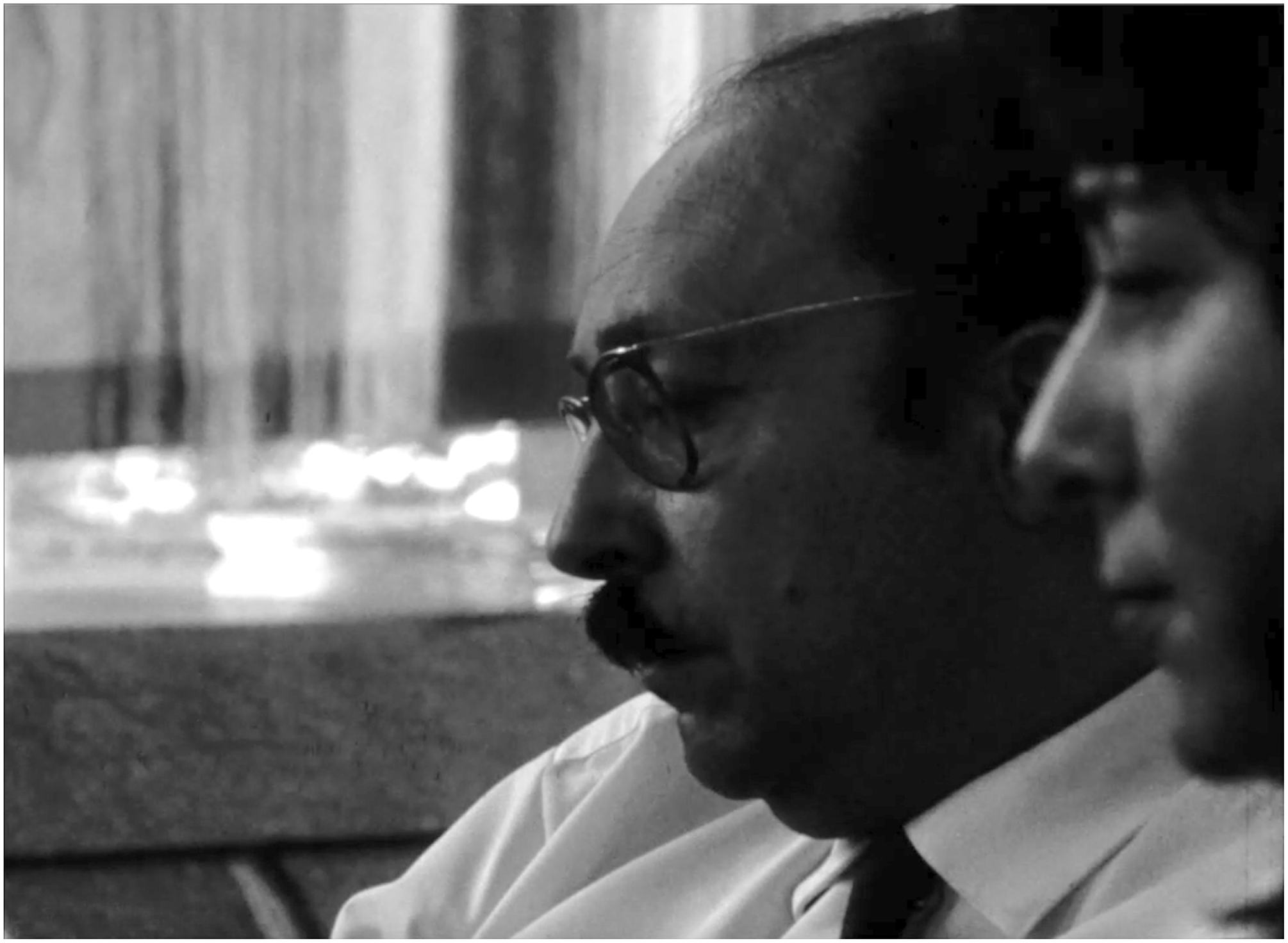
Screenshot from A Look at Madness (Ruspoli, 1962) featuring François Tosquelles with the film’s assistant director, Dolorès Grassian.
Given that A Look at Madness was produced in collaboration with the staff (rather than just in dutiful consultation with them) and that the anti-hierarchical aspirations of institutional psychotherapy involve extensive collective responsibility and decision-making between staff and patients, the film's most direct moments tend to occur during meetings and group discussions, during times when the observational film-making process is afforded a certain ‘invisibility’ as people forget the camera and recorder are also present. In one such sequence the issue of how the film itself may only be serving to simplify and misrepresent the reality of life at Saint-Alban and institutional psychotherapy becomes a topic of conversation between the psychiatric staff at their weekly Sunday morning meeting. Being filmed also raises the question of their self-consciousness and how this can distort an approach to a therapeutic philosophy predicated on the freedom to improvise. Comments made by patients are analysed (for example, that the nurses resemble museum guards) in relation to whether the patients may feel they are being ‘exhibited’ by this particular film production, and how viewers of the film might misinterpret what is happening in any given moment. A Look at Madness may differ in many respects from Chronicle of a Summer, but its cinematography is similarly attentive to the significance of the spoken and unspoken word, and these discussions are reminiscent of the reflexive qualities associated with Rouch and Morin's film.
Framing trauma
Like Ruspoli, Van Gasteren's career encompassed an array of artistic and cultural spheres, such as: photography, journalism, installation and techno art, sound engineering, public sculpture, Eastern mysticism, Beat poetry, and classical jazz. His documentary film-making also engaged with national and global issues ranging from water management and housing development in the post-war Netherlands to the political economy of European integration, and problems in the developing world. Unlike Ruspoli, however, his work in the 1960s did not respond to the new era of lightweight cameras and television by pursuing a discernibly direct style or manifesto. Van Gasteren embraced an independent – iconoclastic, even – approach to film-making, one that not only eschewed the formal elegance and gentile nationalism associated with the latter years of the ‘Dutch Documentary School’, but also embraced and integrated forms, ideas, and audiovisual experiments drawn from other contemporary arts. The subject matter of his film-making and other artwork (which often plays fast and loose with the distinction between factual and fictional styles) can be quirky and surreal as well as serious, frequently moving across observational, participatory, and essayistic documentary modes.
The defining trauma of Van Gasteren's life occurred in May 1943, during the German occupation of the Netherlands. As a member of the Resistance, he agreed to hide a Jewish fugitive, Walter Oettinger, in his Amsterdam apartment. This was an extraordinarily dangerous time: the Nazi authorities and their Dutch collaborators were nothing if not assiduous, and there was clearly no shortage of local informants: In the Netherlands … the Dutch police were important to the deportation of the Jews, 75% of whom (from a total of 140,000) were murdered [which] may have been because of a ‘conformist authoritarian social stance’ among the police rather than any real ideological support for Nazism, but the outcome was the same. (Stone, 2010: 42)
No doubt due to profound trauma stemming from his own circumstances at this time, Oettinger's behaviour became highly unpredictable and reckless, endangering not only Van Gasteren but other members of his resistance cell, and whoever they too may have been helping (there were also thousands of Jewish civilians and refugees still in hiding at this time). Accounts of what happened next vary, but it seems Van Gasteren was ordered by his superiors to kill Oettinger, which he did. The corpse was soon discovered by the Amsterdam municipal police (who treated it as a civil crime), with Van Gasteren sentenced to four years’ imprisonment for manslaughter: ‘Eight months after the war [he] was reprieved, released from prison and rehabilitated as a member of the resistance’ (Pisters, 2016: 76; Renders and Veltman, 2021: 120). 5
Dealing with the psychological legacy of this experience – with what would nowadays be termed post-traumatic stress disorder – involved Van Gasteren in various therapies and treatments throughout the 1950s and 1960s, which was – in Amsterdam as elsewhere – also a time characterized by growing generational conflict and social activism, anarchic ‘happenings’, and psychedelic experimentation (Lindner and Hussey, 2014). Van Gasteren was an enthusiastic ‘participant observer in [the Dutch] artistic counter-culture scene in the 1960s’, and as well as making films and artworks that engaged directly with this milieu, he ‘tried everything to explore the borders of his consciousness and the frontiers of self, ranging from parachute jumping, to sensory deprivation tanks, to hashish, mescaline, and LSD’ (Pisters, 2016: 101). Representing this era constitutes an important strand in his documentary oeuvre, with several of his films dealing directly with the countercultural search for personal freedom and expanded consciousness: Out of My Skull (with Robert Gardner; Van Gasteren, 1965), Hans: Het keven voor de dood (Hans: Life Before Death; Van Gasteren, 1983b), De ingreep (The Operation; Van Gasteren, 1979), and the Dutch television mini-series Allemaal rebellen (All Rebels; Van Gasteren, 1983a). Suicide is also a recurrent theme in his work, particularly throughout the 1960s: his mother took her own life several months after the death of his father in 1962, and the following year he was deeply affected by the suicide of his friend, the composer and artist Hans van Sweeden (the subject of Hans: Het keven voor de dood). It was within this cultural and personal context that he became interested in the medicinal use of hallucinogens, and in Jan Bastiaans’ alternative psychotherapeutic (or psycholytic) treatment programme, which combined psychoanalysis with the administration of drugs such as pentobarbital or sodium pentothal and LSD.
A conventionally trained psychiatrist who had initially embraced Freudian psychoanalysis in the late 1940s, Bastiaans completed his doctoral thesis on ‘psychosomatic after-effects of oppression and resistance’ (Bastiaans, 1957). Based at Leiden University's Jelgersma Clinic, his drug-assisted therapies were unorthodox but in the post-war era these methods enjoyed some political support, and he emerged as an influential advocate for the rights of Nazi concentration camp survivors, as well as former resistance fighters and PoWs, and returning internees from Japan's wartime occupation of the Dutch East Indies (Indonesia): In the setting of psychiatric treatment, and more specifically in sessions with LSD or psilocybin, [Bastiaans] took the position of the father-figure who gave his patients the warmth and understanding they required.… This gave him the emotional involvement needed for a successful therapeutic use of LSD, but also made him suspect among colleagues who worked from the set of professional detachment. (Snelders and Kaplan, 2002: 229)
This treatment also involved the use of psycho-dramatic and role-play techniques, including using actual Nazi books and posters, photographs, newsreel, military music, and recordings of Hitler's speeches to ‘unblock’ the patient's traumatic memories and enable more effective therapy. Despite his influential supporters, including many war victims, Bastiaans’ methods remained controversial and by the early 1980s his therapy was being increasingly criticized: while ‘there were dramatic improvements … the recovery in people with serious difficulties was often temporary’ (Vermetten and Olff, 2013).
Initially, Van Gasteren had wanted to film Bastiaans treating Joop Telling as part of the psychedelic segment in his autobiographical film There’s No Plane for Zagreb (Nema aviona za Zagreb, 2012), which includes an ‘interview’ with Timothy Leary. 6 Profoundly traumatized by his experiences as a concentration camp prisoner, Telling was 22 years old when he was arrested in 1941 (a shipyard worker and trade unionist, he had been distributing pamphlets in support of the February Strike), imprisoned and then deported to various camps in Germany – including Sachsenhausen and Bergen Belsen – until he was ‘liberated’ by the Soviet army in 1945. When viewing the rushes, Van Gasteren decided that this encounter, and the wider story of how Bastiaans was treating sufferers of ‘KZ [Concentration Camp] Syndrome’, would be more appropriate as the subject of a documentary in its own right, albeit one to be produced for educational purposes: Now Do You Get It Why I Am Crying? was initially screened only within clinical psychiatric and medical research circles before a re-edited version was made for Dutch public television, which was later distributed in the USA and Germany (Figure 2). The film is notable for two reasons: firstly, the public screening of the re-edited version in 1972 is believed to have influenced public opinion and the Dutch government's decision not to release the ‘Breda Three’, the last remaining German war criminals still imprisoned in the Netherlands (Pisters, 2016: 72–3); secondly, not long after Telling's death in 2000, Van Gasteren began work on a sequel, The Price of Survival (De prijs van overleven, 2003), which explored the effects of intergenerational trauma, and how Telling's emotional suffering and obsessive behaviour affected his family, especially his relationship with his two children. 7 In its approach, this later film also points to Van Gasteren's eventual disillusionment with Bastiaans’ approach.
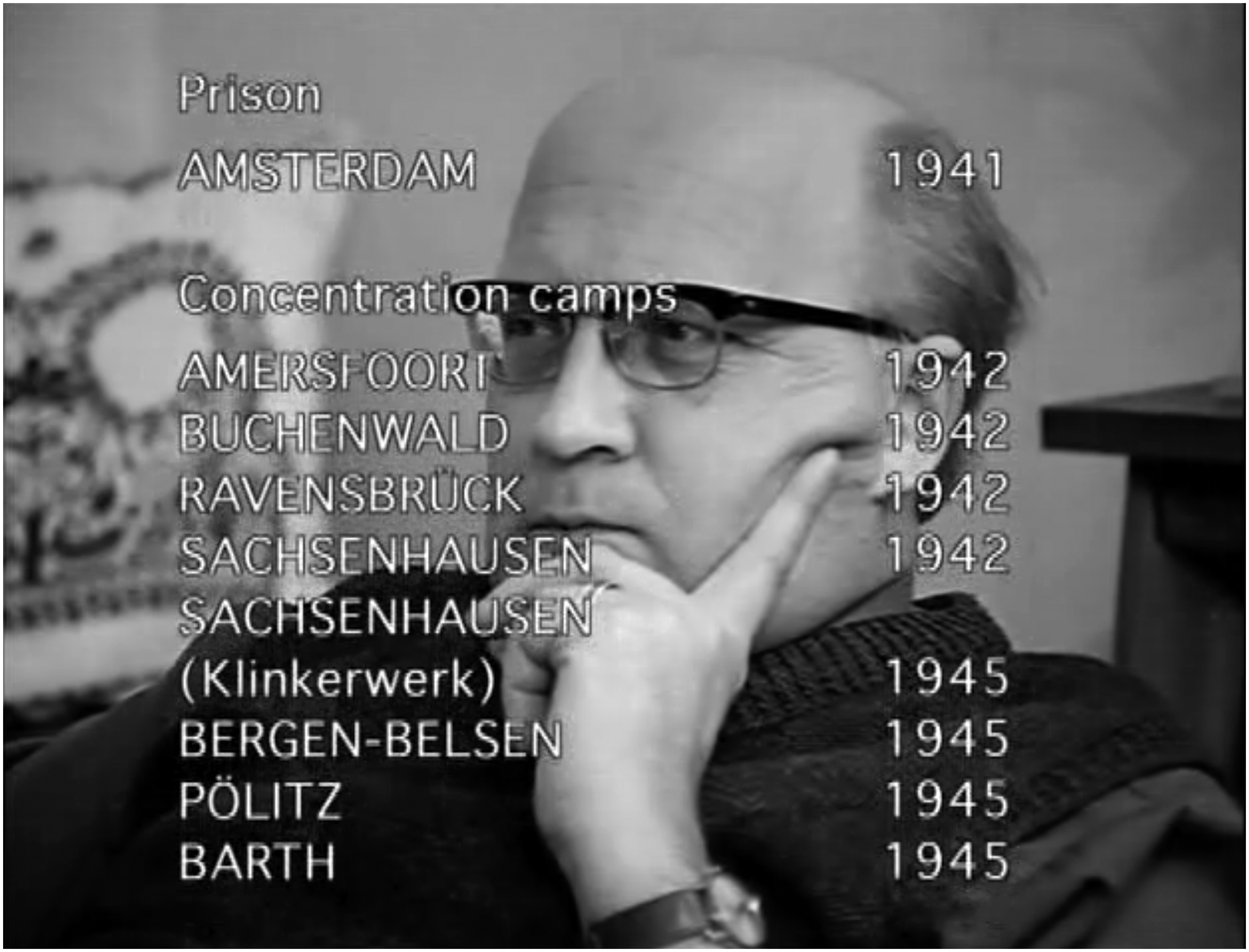
Screenshot from Now Do You Get It Why I Am Crying? (Van Gasteren, 1969) featuring Joop Telling, a Dutch concentration camp survivor and patient, at Dr. Jan Bastiaans’ clinic in Leiden.
Despite rendering its cautiously optimistic narrative in austere 16 mm black and white, and largely eschewing voice-over and music, Now Do You Get It Why I Am Crying? does draw on various expressive techniques to aestheticize its subject matter (namely, this experimental – and seemingly effective – new treatment for traumatized survivors of the Second World War and the German occupation). It also employs disruptive framing and parallel montage strategies in depicting Telling's severe emotional suffering and its impact on his relationship with his wife and children. While successful in relaying a clear – if essentially, didactic – sense of Bastiaans’ therapeutic methods, the film struggles to prevent its observational ambitions from lapsing into voyeurism, especially in its representations of the LSD-assisted therapy session itself. This formal unevenness is partly a consequence of the film's provenance (as an episode from There’s No Plane for Zagreb), and its different audiences (psychiatrists and mental health care workers, as well as a wider television-viewing public in the Netherlands, and then elsewhere). Bastiaans, for example, is allowed to assume an essentially expository role when being filmed lecturing to his students on ‘KZ-Syndrome’, the low-angle shots of him behind and in front of his lectern, intercut with wide shots of an enrapt student audience, might imply it is his film about his work, not someone else's film about the experiences of one of Bastiaans' patients. These opening sequences also situate him as an eminently rational, authority figure whose clinical practices owe something of their alternative or radical reputation to a modish faith in the healing powers of psychedelia rather than principles of democratic psychiatry, or anything akin to institutional psychotherapy à la Saint-Alban.
In terms of its visual style, the film's inclusion of personal and historical photographs, as well as archive footage from the liberation of the camps, may well have been influenced by Alain Resnais’ Night and Fog (Nuit et brouillard, 1956), which itself had an interesting reception history in the Netherlands and was to prove ‘instrumental in helping to create a certain image of the war and as an adjunct to its historiography remit [in that country]’ (Van der Knaap, 2006: 147). The presence of old family photographs (especially those of Telling as a child, and his ‘unhappily married’ parents) – like the archive footage from the liberated camps – immediately raises questions about how the past is documented and framed, and if personal and public histories can ever be separated, especially traumatic histories. For Telling, like many concentration camp survivors, the experience of the camps defies not only basic morality and reason but imagination itself, and his testimony leaves the audience in little doubt that a source of his present psychological turmoil is the knowledge that what happened remains fundamentally incomprehensible to anyone who was not there with him. Early in the film, for example, Van Gasteren cuts from Bastiaans’ lecture (as he begins to discuss a typical case of ‘KZ-Syndrome’) to a photograph of Telling as a young man, followed by photographs of him with his future wife, and then one from their wedding day. This montage of pre-concentration camp images is then ‘interrupted’ by graphic military archive footage from the camps at the time of their liberation. The sequence then cuts to a contemporary scene: a long shot of Telling looking out through his large front-room window at the busy world below before a reverse shot reveals him to be watching a passing train on the other side of the street. In one sense, virtually every element in this sequence is staged – the lecture (quite literally), the photographs, the inclusion of archive footage, and the symbolism of the train – and testifies to a documentary practice that will readily subordinate observational continuity and directness to rhetorical finesse and associative montage.
Nevertheless, the subject matter and educational aims of Now Do You Get It Why I Am Crying? necessarily curtailed Van Gasteren's tendency to disregard distinctions between the film-maker as observer or participant, ethnographer, or autobiographer. This is not to say that his own personal history and preoccupations are ever entirely absent, and any analysis of the film should also consider that less than a year before he began work on Now Do You Get It Why I Am Crying? Van Gasteren had accepted a commission from the Netherlands Television Service to make a documentary about the ongoing war and famine in Biafra, Bericht uit Biafra (Report From Biafra, 1968), with Johan van der Keuken and Roeland Kerbosch: ‘All three filmmakers returned shaken and devastated by the amount of misery they had seen’ (Pisters, 2016: 123). 8
Conclusion
A Look at Madness and Now Do You Get It Why I Am Crying? are committed to using the language of documentary film to promote psychotherapeutic practices that challenged prevailing assumptions about the nature and treatment of mental illness. Never aesthetically doctrinaire or without an appreciation of irony, the guiding collaborative, democratic aims of cinéma direct coincided with many aspects of institutional psychiatry. Similarly, the legacy of a modernist scepticism towards official versions of reality – especially medical versions – is evident in the expressive techniques by which Van Gasteren represents Bastiaans’ LSD-assisted therapy, and how it might help to release Telling (and other trauma victims) from an abyss of mental torment and socially destructive patterns of obsessive behaviour: if Artaud, surrealism, and perhaps ’pataphysics, accompany Ruspoli in his exploration of the alternative psychiatric community at Saint-Alban, so too Van Gasteren's documentary method in Now Do You Get It Why I Am Crying? is similarly influenced by the countercultural zeitgeist, even if both films seem at times susceptible to the charisma of a given therapist.
As products of their time, both institutional psychotherapy and psychedelic-assisted psychiatry sought a cure for mental illness, an elusive treatment programme and therapeutic environment capable of unlocking or solving the mystery of madness once and for all. In this sense, A Look at Madness and Now Do You Get It Why I Am Crying? convey the utopian, idealistic spirit of those times. In our contemporary world, of course, the discourse of mental illness is more complex and postmodern, permeating so many aspects of civil society and the mass media, circulating in a world in which stress, anxiety, depression, grief, and trauma are regarded as normal human conditions requiring ‘emotional management’ and ‘resilience skills’ rather than psychopharmacological intervention. Yet perhaps we should also be wary of such normative assumptions, and bear in mind that A Look at Madness and Now Do You Get It Why I Am Crying? still demonstrate how documentary film-making about mental illness and its treatments benefits from being available to a variety of artistic influences, experimental possibilities, and personal experiences, and that the relationship between form and content is integral rather than incidental to the success of any encounter between film-makers and the realities of mental illness. The alternative to this approach – and the one worryingly commonplace in today's Western broadcast media – espouses a highly formulaic, conservative documentary practice that asserts the objective reality and humanitarian integrity of its representations. Such film-making can too readily become an inadvertent mechanism for re-marginalizing and silencing those individuals and communities that comprise its ostensible subject matter.
Footnotes
Declaration of conflicting interests
The author declared no potential conflicts of interest with respect to the research, authorship, and/or publication of this article.
Funding
The author received no financial support for the research, authorship, and/or publication of this article.
