



Abstract
This article explores histories of the science of stress and its measurement from the mid 19th century, and brings these into dialogue with critical sociological analysis of emerging responses to work stress in policy and practice. In particular, it shows how the contemporary development of biomedical and consumer devices for stress self-monitoring is based on selectively rediscovering the biological determinants and biomarkers of stress, human functioning in terms of evolutionary ecology, and the physical health impacts of stress. It considers how the placement of the individual body and its environment within particular spatio-temporal configurations renders it subject to experimental investigation through standardized apparatus, electricity, and statistical normalization. Examining key themes and processes such as homeostasis, metricization, datafication, and emotional governance, we conclude that the figure of the ‘body electric’ plays a central limiting role in current technology-supported approaches to managing work stress, and that an historical account can usefully open these to collective scrutiny.
Introduction
Stress is increasingly a global problem that affects both mental and physical health outcomes. Globally, work stress is thought to be a key contributor to the rise in mental health problems such as anxiety and depression. The World Health Organization recognizes stress as a growing problem in developing countries, and the next International Classification of Diseases (ICD-11), to be published in January 2022, defines the phenomenon of chronic workplace stress as ‘burnout’ (World Health Organization, 2019). Nationally, governments are increasingly concerned about the links between work stress, absenteeism, and presenteeism, including the impact on economic productivity. In the United States alone, stress costs enterprises $300 billion, or 2.6% of GDP in 2006 (Brun, 2007). Strategic responses across government and the private sector variously involve risk assessment and organizational procedures (Health and Safety Executive, 2019), and guidance on the overuse of digital technologies. Many workplace well-being initiatives offer advice on work–life balance, and a conviction to reconnect people (with their bodies, minds, nature, or each other) through such individual activities as mindfulness, yoga sessions, and opportunities for exercise. As we will argue, such initiatives portray a set of assumptions in the public sphere around selectively rediscovering the biological determinants and biomarkers of stress; human functioning in terms of evolutionary ecology; and the physical health impacts of stress. Rather than offer historical accounts and reports of stress or the phenomenon of burnout as such (see Hoffarth, 2017; Jackson, 2013), then, our emphasis is on how individualized, physiological, and evolutionary accounts of stress have recently become mediated through technological formations that represent embodied stress as an aggregation of externalized data points. We will explore how these manoeuvres can serve to hollow out collective claims to being well in the contemporary workplace.
A key feature of emerging responses to work stress is the development of biomedical and consumer devices for self-monitoring. These involve combinations of novel software and wearable sensor hardware to measure electrodermal activity, heart rate variability, or to assess electrochemical or volatile organic biomarkers for emotional stress found in sweat (e.g. Zamkah et al., 2020). An article in Nature heralds the development of ‘epidermal electronics’ as the inevitable next step: ‘wireless sensors mounted directly on the skin, where they can pick up a host of vital signs, including temperature, pulse and breathing rate’ (Gibney, 2015: 27). Therapies including eMental health apps and transcranial magnetic stimulation have variously been posited as the future of medical treatments to address national ‘epidemics’ of stress (Kim et al., 2016; Phillips, Gordeev, and Schreyögg, 2019). Less well known is the development of ‘electroceuticals’, treatments based on electromagnetic fields (Famm et al., 2013). The American Institute of Stress (n.d.) believes that electroceuticals signify the future of medicine. As we discuss below, this apparently futuristic approach is entirely in keeping with the historical fascination with the medical applications of electricity (e.g. Morus, 1999; Parisi, 2018; Peña, 2005) and the use of electricity to induce and also to gauge stress within physiological experimentation.
This article considers the development of an historical consensus on the science of stress and its measurement from the mid 19th century onwards. It is a consensus that placed the individual body and its environment within a particular spatio-temporal configuration, making it subject to experimental investigation through standardized apparatus, electricity, and statistical normalization. We argue that these historically emergent spatio-temporalities of stress within and across bodies have shaped contemporary approaches to stress. By using Foucault’s (2003) descriptions of the social apparatus of anatomo-politics and biopolitics, we show how the history of stress research is also one of emotional management, normative ideals, and subjectivity formation. We demonstrate how an imaginary of the ‘body electric’ persists as a central figure in the knowledge, epistemologies, and methodologies of stress research and workplace well-being initiatives. The historical trajectory encompasses techniques and technologies that emerged from early experiments with electrical stimulation of nerves in the late 18th century, and the psychophysics of emotions and sensation in the late 19th century. This is followed by the identification of physiological mechanisms of homeostasis and adaptation to external stimuli in the mid 20th century, right up to the contemporary use of wearable digital biosensors. These diverse strands converge by means of distinct yet related processes of metricization and then datafication. Hence a key tension in the stress management practices of the contemporary workplace is a result of novel spatio-temporalities of data standardization, ownership, and analysis. The aggregation of biophysical data is no longer contained solely within the physical hardware of the wearer's device, but shared globally through proprietary cloud-based software platforms, with potentially negative implications for the possibility of collective organization at work. We explore how such wearable technologies have suddenly become adopted into the therapeutic regimens of workplace stress. By doing so, we foreground the conceptual development of what has become a subfield of biology, the physiology and neurophysiology of stress. We explore how this subfield can be complemented by more interdisciplinary insights to suggest how researchers, organizations, and governments might deal with this contemporary occupational health crisis.
Since working conditions (relations of power, labour, and capital) are central to understanding work stress, it is somewhat surprising that some research developments in the treatment of work stress are often concerned with individual biological aetiology (Polacchini et al., 2018; Ryff, Singer, and Dienberg Love, 2004; Sumner et al., 2020). The core aim of this article is to explore how this rift between individual aetiology and work conditions has come to pass, and to consider how the emphasis on self-management might be impacting workers’ collective capacity to monitor and address their workplace stress. We outline the historical specificity of the way in which wearable digital technologies – which sense, measure, compute, and visualize physiological phenomena – transform the body into data that is then algorithmically correlated with particular psychological states. This mechanism encourages users to ‘capture’ and categorize certain psychological traits or habits of thought and ‘improve’ their responses to specific triggers or environments through biofeedback, that is, biological data presented to them. This is often via obscure techniques of analysis and proprietary software channels – in order to elicit emotional self-management. We argue these technologies reconfigure mind–body–environment relations leading to the emergence of a specific spatio-temporality of stress. Temporally, stress is conceived as an immediate psychophysiological ‘flight or fight’ response. Spatially, this response relates to proximate stimuli within an individual's perceptual environment. We find that understanding of contemporary articulations of ‘techno-ecologies’ of stress can be illuminated through the historical excavation of the ‘body electric’, and can be understood through a framework that combines historical and sociological analysis. It is by no means inevitable that the workplace technologies outlined here should prioritize emotional self-management at the apparent expense of workers’ capacities for collective organizing. Yet, as we argue, the ways that data from such technologies is processed, visualized, shared, and stored provides grounds for cautioning against the particular form of emotional governance enabled by these processes.
The article consists of three substantial sections, each of which maps onto models or frameworks for defining and interpreting stress, namely the organismic, the psychological, and the ecological. We begin with ‘Defining stress’, a review of the origins of scientific definitions of stress within early 20th-century physiology and psychology, which takes the organism and its interior and exterior milieu as the main unit of analysis, prior to the employment of stress in relation to the workplace and technology. The following section, ‘Metricization and bodily sensation’, then outlines the processes of metricization achieved through scientific instrumentation to constitute the figure of the body electric, the productive worker's body as monitored and measured. This places the measurement and modelling of stress and its effects more firmly into the realm of psychology, and especially the emerging field of industrial psychology. In the third section, ‘Datafication and the biopolitics of machinic emotions’, we consider the legacy of this process by showing how specific workplace ecologies of digital wearable technologies render the ‘body electric’ visible and sharable through data, framing it as the biopolitical target-object of emotional governance. Emotional governance can refer to social practices of regulation, management, government and policymaking, service design, or state-citizen relationships, which see emotions as central to their conception and operation (Jupp, Pykett, and Smith, 2017). We argue that platforms for obtaining and sharing data captured by wearable biosensors constitute an ecology of data and devices, and a corresponding ecological approach to stress and stressors. We thereby show how deepening the understanding of the convergent role of scientific instrumentation and digital technologies in the historical and contemporary conceptualization of work stress advances this agenda by considering the processes by which the body electric shapes the discourses and regulatory practices of emotional governance. Finally, in the conclusion we draw out the significance of this account for evaluating digital workplace well-being interventions.
Defining stress: The organismic perspective
As a workplace health initiative to combat stress effects, a newspaper article was handed to one co-author that reported on stress research at Carnegie Mellon and Penn State Universities. The then-recent groundbreaking study found that it was not stress per se but a participant's emotional reactivity to daily stressors that carried an increased risk they would report a chronic physical health condition a decade later (Piazza et al., 2012). The article and its infographic (see Figure 1) also explain the gross physiology of stress, including how the release of the stress hormone cortisol from the adrenal glands helps suppress inflammation. Its continued release builds up bodily resistance to the cortisol, leading to chronic inflammatory response, complicating pre-existing disease or even causing new ones (Templeton, 2012). This is the now standard biomedical model of stress, which, as this section will show, derives from original research in the early 20th century. In their review of a century's worth of articles on stress, management psychologists identify one of the first pieces of research in the 1930s to connect an organizational stress (noise) to a physiological strain (stomach complaints and muscular stiffness; Laird, cited in Bliese, Edwards, and Sonnetag, 2017: 390). While the mechanical metaphor of strain deployed by Laird may have its roots in physics and engineering accounts of machines, this early physiological understanding of stress was also accordant with the organismic account of stress and behavioural responses to stress (‘fight or flight’ / ‘general adaptation syndrome’) offered by the early pioneers of stress research such as Walter Cannon and Hans Selye, explored below. Their theories remain influential in contemporary approaches to stress management (e.g. Cartwright and Cooper, 1997: 8), for instance, in the breaking down of individual job-related stressors into specific physiological symptoms (Nixon et al., 2011), or the emphasis on individual cognition, personality and coping styles (de Tormes Eby and Allen, 2012; Meurs and Perrewé, 2011).
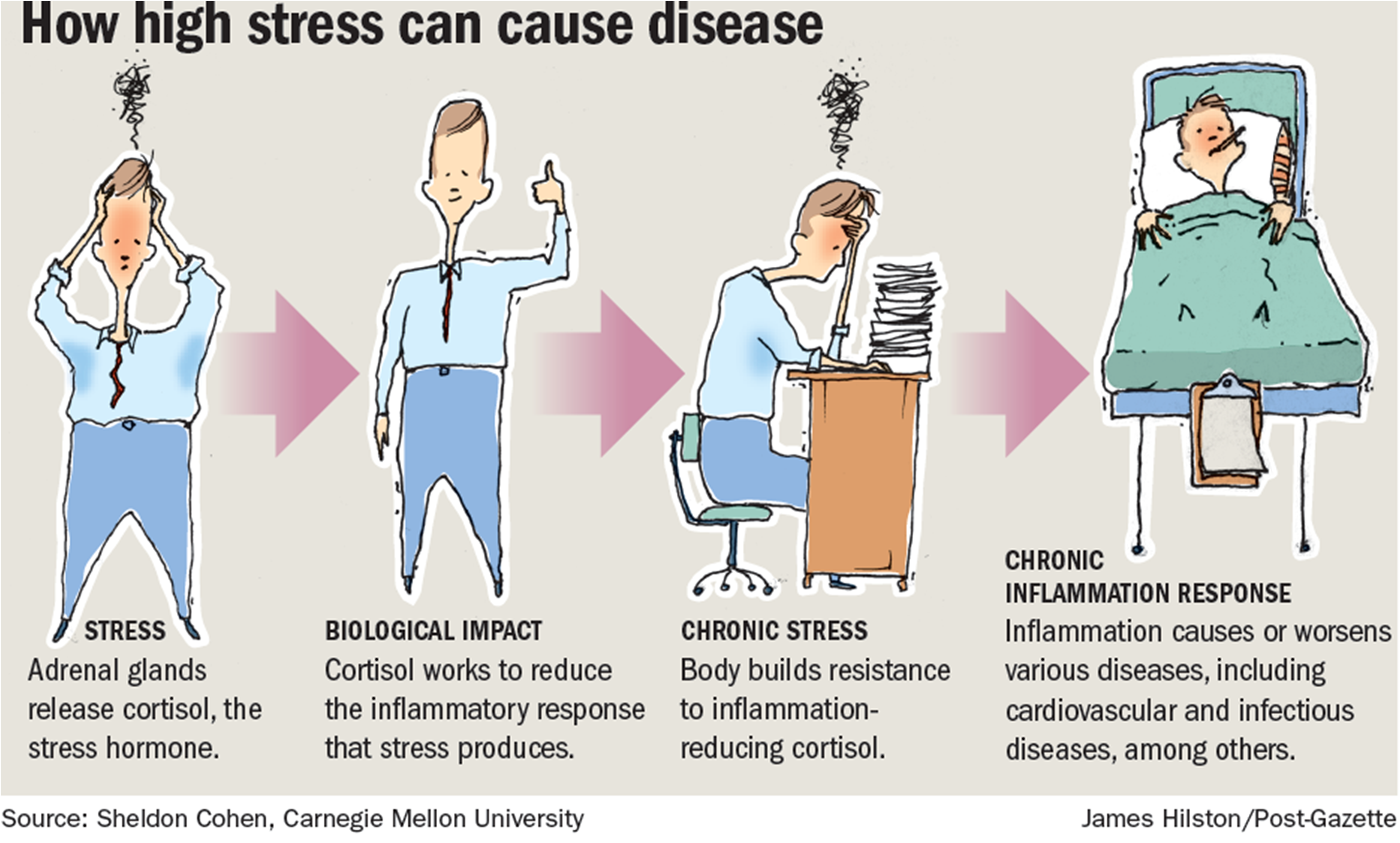
Infographic on the links between stress and chronic diseases. Source: Illustration by James Hilton in Templeton (2012). © Pittsburgh Post-Gazette 2021, all rights reserved. Reprinted with permission.
Homeostasis and the search for balance
Prevailing theories in stress research during the 1980s elaborated on how individuals strive for homeostasis within a specific ecosystem or environmental context. Self-adjustment, resource management, and coping were part of a search for stability, and stress was a disturbance to this feeling of comfort (Cartwright and Cooper, 1997: 5; Hobfoll, 1988; Lazarus and Folkman, 1984). It is to the historical relationship between homeostasis and stress that we now turn.
Walter Cannon's early experimental physiological work at Harvard Medical School is considered among the first to establish correlations between heightened emotions and disturbances of bodily processes such as digestion due to ‘adrenin’ (adrenaline), as explained in his Bodily Changes in Pain, Hunger, Fear and Rage (Cannon, 1915). Cannon's thesis was that the body worked as a whole, with the nervous system ‘building up reserves and fortifying the body against times of need or stress’ (ibid.: 32). Such a need occurs in the notorious ‘fighting or flight’ (ibid.: 211) response, where circulatory and respiratory changes occur suddenly, and certain physiological functions such as digestion even shut down temporarily. A more fully developed and integrated articulation from an organismic perspective occurs in his later The Wisdom of the Body (Cannon, 1963[1932]), where he characterizes the physiology of the internal environment as the ‘fluid matrix’ of the body, a concept he acknowledges is directly indebted to French physiologist Claude Bernard's highly influential milieu intérieur (internal environment; see Bernard, 1984[1865]). Bernard used this concept from 1854 onwards after observing the way that the temperature and sugar level of the blood was kept remarkably constant, managed by vasomotor and glycogenic mechanisms, respectively. In evolutionary terms, this may have resulted from our ancestor organisms carrying the sea onto land within them: The fixity of the milieu supposes a perfection of the organism such that the external variations are at each instant compensated for and equilibrated.… All of the vital mechanisms, however varied they may be, have always one goal, to maintain the uniformity of the conditions of life in the internal environment.… The stability of the internal environment is the condition of a free and independent existence. (Bernard, in Gross, 1998: 383)
It is in The Wisdom of the Body that Cannon first defines his related concept of homeostasis: ‘The coordinated physiological reactions which maintain most of the steady states of the organism are so complex and so peculiar to living beings.… That I have suggested a special designation for these states, homeostasis’ (Cannon, 1963[1932]: 24). Maintaining ‘steady states’ within the organism (which is itself an inherently unstable ‘open system’; ibid.: 299) necessitates the completely automatic regulation of both materials (e.g. calcium, fat deposits) and processes (e.g. blood oxygen levels) by means of what Cannon termed the ‘sympathico-adrenal system’ (ibid.: 263ff.). Changes in the world outside the organism involve changes in the interior of the organism, and thus there are divergent but corresponding branches of the nervous system, one dealing with the organism's interior and the other its exterior. Despite not citing the British physiologist Charles Sherrington, who had distinguished between an organism's ‘interoceptive’ and ‘exteroceptive’ surfaces for the perception of stimuli in The Integrative Action of the Nervous System (Sherrington, 1906), Cannon conceives of a similar distinction between interoceptive and exteroceptive ‘sensory fibers’, so that physiological change effected in the organism is aligned with what he called the ‘interofective’ or the ‘exterofective’ domains (Cannon, 1963[1932]: 249). The former make alterations within the interior of the organism to adjust to external conditions, and the latter alter external conditions in order to keep interior conditions stable. A chain of (interofective) reactions within the organism are triggered by environmental stressors, all as preparatory steps for the organism to fight or take flight: The secreted adrenin cooperates with sympathetic nerve impulses in calling forth stored glycogen from the liver, thus flooding the blood with sugar for the use of laboring muscles; it helps in distributing the blood in abundance to the heart, the brain, and the limbs (ie, to the parts essential for intense physical effort) while taking it away from the inhibited organs in the abdomen; it quickly abolishes the effects of muscular fatigue so that the organism which can muster adrenin in the blood can restore to its tired muscles the same readiness to act which they had when fresh; and it renders the blood more rapidly coagulable.… In short, all these changes are directly serviceable in rendering the organism more effective in the violent display of energy which fear or rage may involve. (ibid.: 228)
The emphasis on homeostasis was also central to Hans Selye's neo-Darwinian theory of the General Adaptation Syndrome (GAS), which similarly acknowledged Bernard's milieu intérieur and extended Cannon's endocrinological ‘fight or flight’ response to involve three stages, namely Alarm/Arousal, Resistance, and Exhaustion (Selye, 1950). The ‘general’ aspect of the syndrome lies in the principle that ‘all living organisms can respond to stress as such, and that in this respect the basic reaction pattern is always the same, irrespective of the agent used to produce stress’. Maladaptation of the organism to repeated exposure to stress leads to ‘diseases of adaptation’, he argued (ibid.: 1383). Through this repeated exposure to stressors, sustained levels of arousal would prevent the organism's capacity to return to homeostasis through the para-sympathetic nervous system, leading to elevated levels of cortisol secreted by the pituitary gland and resulting in pathological effects of stress on the body's immunity, digestion, and circulation (Wainwright and Calnan, 2002: 70). This pathway from environmental stressor to medical pathology is now frequently referred to in the field of biological psychology as ‘allostatic load’ (McEwen and Stellar, 1993), and is indicative of a shift towards tracing and mapping sources of stress, risk factors, and biological outcomes in epidemiological terms. This shift needs to be understood in light of the social and historical context through which scientific advances in stress research through industrial psychology offered a biopolitical means to govern the emotional states of workers.
The historical timeline for the development of these physiological concepts and processes, from Bernard to Cannon to Selye, offers one influential organismic approach to stress prior to being almost entirely absorbed into industrial psychology and the psychological domain. For, in a detailed analysis of the changing definitions and science of stress in modern psychology, historian Mark Jackson (2013) tracks Selye's and Cannon's construction of biological and adaptive theories of homeostasis to a societal focus on understanding the effects of prolonged emotional stimulation or threat. Such conditions were characteristic of the interwar and post-war context in which they were working and the applications to which psychological research was being put, including addressing military shell-shock, trauma, and industrial fatigue. For instance, Jackson describes Cannon's support of the anti-Franco Spanish resistance movement, and his framing of bodily control and balance in light of contemporaneous discussions of European autocracy and American democracy. Jackson argues that these were indicative of an expression of psychobiology that was deeply geopolitical (ibid.: 73). Similarly, the noted contributions of Selye to understanding the effects and potential management of chronic stress reflected how specific diseases (heart disease, cancer, rheumatism, and diabetes) began deeply affecting American society around the 1930s. For Jackson the development of Selye's GAS theory and the endocrinological definition of stress cannot be separated from unemployment initiatives, industrial fatigue studies, and ‘anxieties about the [economic] burden of disease and disability’ (ibid.: 88), which emerged during and after the Great Depression, along with a fear of social disorder and economic instability. The organismic theories of bodily homeostasis still found in stress research today can thus be explained as a desire for social stability. What characterizes some contemporary stress research and interventions, namely the search for electrochemical biomarkers and the use of wearable electrodermal sensors, arguably revives elements of the organismic approach. By exploring these historical continuities we can address the ways in which stress research itself has become individuated, depoliticized, and divorced from specific societal and political-economic contexts, particularly those that are alienating and exploitative of workers (e.g. Dollard, Dormann, and Idris, 2019: 7).
Metricization and bodily sensation: Psychology and the scientific instruments of stress
Embodied cartographies of sensation
Before focusing on the development of the galvanometer as an electrophysiological instrument for the measure of stress, some of the historical conditions through which the impulse towards the metricization of other, equally subjective bodily phenomena are examined. This section therefore examines the role of metricization (the scientific compulsion to measure in this case physiological data, and to compare across populations) in actualizing a more subjective, individualized, and emotional account of stress appraisal (Lazarus and Folkman, 1984). However, there is no suggestion of a clear distinction between organismic and psychological theories. Rather, we demonstrate that the contemporary account of stress as an emotion that can be managed and regulated is highly dependent on particular technologies and activities of measurement.
As we saw, Claude Bernard's novel concept of the milieu intérieur from 1854 onwards had highlighted a distinction between bodily interior and exterior and a means of translation within the organism between them. Meanwhile, as laboratory-based physiology in the wake of Hermann Helmholtz and Johannes Peter Müller became more established in Germany, the first half of the 19th century brought an awareness of sensations of the bodily interior under rigorous scientific observation, legitimating the study of previously invisible, deeply subjective bodily phenomena such as pain, touch, and fatigue into objective series of measurements through tools and apparatus that first delimit, demarcate, and measure, and then crucially establish norms, thresholds, and values that become normative among (and across) populations. Early psychological experiments on sensation by Ernest Heinrich Weber's laboratory from 1833 measured touch across a range of human subjects, for example, and directly influenced and encouraged the so-called father of psychophysics Gustav Fechner's work in the measurability of sensation in 1860 (see e.g. Arens, 1989: 22). A psychonormative model of the thresholds of pain, fatigue, and muscular movement therefore emerged at this time. Fechner, building upon Weber's experiments, stated the aim of his Elements of Psychophysics was nothing less than to establish ‘the exact science of functional relations or relations of dependence between the body and the mind’ (Fechner, 1966[1860]: 7). Their psychophysical work in the laboratory assumed that the metrical objectivity of sensations was both possible and desirable.
Accordingly, both Weber and Fechner assumed that measurement was not only key to understanding the thresholds of perception, but was also a means of disentangling various indistinct bodily sensations and their associated nerve pathways including touch, pain, and what was variously conceived as ‘common sensibility’ or general sensations (see e.g. Parisi, 2011; Paterson, 2021b). In Elemente der Psychophysik (1860), for example, Fechner distinguishes something along the lines of the measurability (or otherwise) of interoceptive and exteroceptive sensations: ‘Objective sensations, such as sensations of light and sound, are those that can be referred to the presence of a source external to the sensory organ’, he explains, whereas ‘changes of the common sensations, such as pain, pleasure, hunger, and thirst, can, however, be felt only as conditions of our own bodies’ (Fechner, 1966[1860]: 15; emphasis added). To these ‘common sensations’ indisputably felt through the body but difficult to measure, we of course add what Cannon (1915, 1928, 1963[1932]) had termed the effects of ‘emotional disturbance’ on the viscera of the body, and what Selye will categorize as stress in its modern understanding in a paper of 1936.
Despite Fechner's professed aims to understand the relations between the body and the mind through scientific means, at this stage there was little acknowledgement of the complexities of psychosomatic processes. Instead, Weber, followed by Fechner, Goldscheider, Von Frey, and others, was embarking upon an experimental cartography of touch, pain, and the nervous system by mapping out the sensitivity of the exterior of the body, of intensities, and areas of cutaneous difference by means of precisely adjustable measuring instruments (see Parisi, 2018; Paterson, 2019, 2021b). A few brief examples will suffice here (although see Paterson, 2021b for more extensive treatment). The pressure algometer was designed by Émil du Bois-Reymond and extensively employed by the anthropologist Cesare Lombroso, measuring sensitivity to pressure and pain. As described in De Tactu of 1834, Ernst Weber designed and used a similar device he called a Stangenzirkel (‘beam compasses’; Weber, 1996: 30), a hand-held metal frame with a precise imprinted scale with two points, one of which could slide closer to or further from the other to measure tactile discrimination. Later devices would be larger movable frames affixed to tabletops with an immobile and restrained subject. Von Frey's experiments between 1894 and 1896 used an ‘aesthesiometer’, a stimulus made from a strand of hair within an adjustable hand-held instrument that could be varied precisely in terms of length or weight. Algometers and aesthesiometers alike were designed to ‘standardise and quantify the intensity of a pain-producing stimulus’, and ‘to map sensitivity on body surfaces, to study biosocial difference and to measure analgesic effect’, says Noémi Tousignant (2014: 112–13). Any conception of the interiority of those measured bodies could only ever be an indirect inference from a cumulative data set comprised of a supposedly representative set of bodily surfaces. Each individual subject's capacity to discriminate thresholds of touch and pain perception was consequently assimilated into a normative curve. The means to measure processes inside the body proper, what Goldstein (2006), for example, terms the ‘inner world’ of adrenaline and organ secretions, of vascular processes and pulses, would require a parallel yet separate genealogy of devices and apparatus such as the kymograph to really create representations of the physiological interior that could be circulated (see Schmidgen, 2014). Carl Ludwig's kymograph of 1847 was used to correlate arterial pressure and thoracic air pressure, Hermann von Helmholtz's myograph of 1849 for measuring muscle contractions, and Karl von Vierordt's sphygmograph of 1854 for writing the pulse. Yet another set of instruments stemmed from early experiments in electrophysiology and so-called ‘medical electricity’ (Morus, 1999: 252) in the 19th century. The ‘body electric’ would proceed further into the interior.
The spatio-temporalities of electro- and psychophysiological instrumentation
Instruments developed in the second half of the 19th century to measure bodily responses to stress largely share this parallel route, culminating in galvanic skin response (GSR) measurement. However, instruments for measuring stress specifically emerged from an even earlier branch of inquiry than the psychophysics of touch and pain, from 18th-century experiments in electrophysiology, but their specific application to gauging emotional disturbance ran parallel to the project of psychophysics. As explored further in this section, like the compasses and aesthesiometers, early 19th-century experimenters applied a galvanometer to various parts of the body, and towards the end of that century the device was found to be an indicator of emotional disturbance. Measurement of electrical resistance on the skin surface is of course the basis of GSR, known more recently in the scientific literature as electrodermal response (EDR). In essence, electrical resistance reduces when an experimental subject perspires, and this serves as an index for emotional perturbation since the subject is in a heightened state of physiological arousal, such as when afraid, startled, excited. Conversely, when the subject is calm or relaxed the measured resistance increases (see e.g. Reevy, 2010). Galvanic response is indexical, and perspiration is only one of a number of automatic physiological reactions of an organism to its environment. Perspiration, along with increased heart rate, increased blood pressure and decreased digestive activity is an autonomic function of the sympathetic nervous system. Remembering the words of Fechner, that common sensations are measurable only in relation to the conditions of one's own body, there is wide variability of individual responses to GSR measurements, since a small stressor for one individual might prompt a large galvanic response yet register little for another (also Piazza et al., 2012 in the previous section).
The beginnings and the broader implications of this new science of galvanism, ‘the most capital experiment of electrophysiology’, as Émil du Bois-Reymond put it (in Piccolino, 1997: 444), had far-reaching effects. For, along with the capacity to locate and measure sensation on the bodily exterior, these early experiments with electrical stimulation of nerves began to open up the inner biological architecture of an organism and map its neurophysiological functions. As we argue below, these parallel cartographies will become conjoined through the production of a ‘body electric’ by which we come to know and measure stress in the first decades of the 20th century.
This electrophysiological pathway stemmed originally from Swammerdam's remarkable observation of 1678 of the contraction of frogs’ legs when electricity was applied. No systematic attempt to understand the mechanisms behind this occurred until almost exactly a century later by Galvani in the 1780s. The subsequent trend of applying electricity to disembodied frog fragments was taken up by Volta, with Helmholtz's measurement of the speed of nerve conduction in the frog leg in 1850 and the graphical tracing of the legs’ movements using a myograph, right up until Nobili's use of a galvanometer, Schweiger and Ampère's invention of around 1820, to measure conductivity in frog nerve fibres in 1927 (Boller, Keefe, and Zoccolotti, 1989: 869). Based on six years of experimentation and notes taken from 1780, Galvani hypothesized that the muscular contractions resulted not from any extrinsic electrical cause, but rather from a force generated within the animal itself, a specifically ‘animal electricity’ generated through the muscles. Volta read Galvani's major work Commentarius (1791), but in his own experiments on frogs’ legs found that electrical transmission through the nerves alone, bypassing the muscle, remained effective. One of the first English language descriptions of the galvanometer's function was by a Dr Bischoff in 1802, in a paper titled ‘On Galvanism and Its Medical Applications’, which described how a gold leaf and a wire were hung in a glass tube and an electrical current applied. The relative strength of the current was shown graphically by the degree of movement towards each other, and a brass scale attached to the device offered a numerical indication of the basic mechanism (see Malin, 2014: 180). Despite the basic nature of the apparatus there was nonetheless an immediate graphic means for indicating current strength, along with an indicative scale for an observer to notate the results periodically and consistently. The metricization of electrophysiological pathways could begin.
This period saw the extensive application of galvanometers to medicine and psychological science. Charles Féré was co-author with Alfred Binet of Le magnétisme animale (Féré and Binet, 1887, and the author of treatises on the ‘psycho-mechanics’ of Sensation et movement (1887), and specifically the study of emotions in La pathologie des emotions (1892). In a paper for the transactions of the Societé de Biologie in 1888, he reported his discovery of different levels of electrical conductivity around the human body using the galvanometer when visual, auditory, or emotion-provoking stimuli were introduced. He determined an association between skin conductivity and emotional fluctuation, making emotional perturbations an outwardly measurable phenomenon. In an article published in 1890 in Pflügers Archiv für Physiologie, Russian physiologist Ivan Tarkhanov similarly observed changes in skin activity with a galvanometer, and discussed the influence of ‘psychic processes’ on the galvanometer (Peterson, in Reevy, 2010: 282). In Tarkhanov's case the galvanometer employed no external electrical source and instead read the naturally occurring differences in electrical potential between different skin areas. As Andreassi (2013: 191) explains, Féré and Tarkhanov had essentially initiated the two main methods of measuring electrodermal activity (EDA), Féré recording skin conductance and Tarkhanov skin potential.
With an approach beginning to reach into the realms of emotional management and psychological subjectivity, early in the following century Carl Jung (in 1906) and Frederick Peterson (in 1908) both conducted experiments ‘demonstrating that anticipation, embarrassment, and other emotions were associated with greater galvanometer responses’, explains Reevy (2010: 282). The scientific terminology would solidify around GSR, as coined by Gildemeister in 1922, and later EDR, as coined by the scientist and editor of the journal Psychophysiology Don Fowles in 1981 (see Boller, Keefe, and Zoccolotti, 1989). The long-running scientific instrumentalization of emotions then heralded a novel emotional culture and new forms of emotional self-governance, gradually but radically shifting the prior 18th-century meaning of emotions from one relating to religious comportment, public and political perturbations, or social mobilizations, to a concern with the interior and singular mind (Hewitt, 2017: 6). As historian of science Otniel Dror has noted: Collectively, these characteristics of the technologies for recording emotions allowed the investigators (so they argued) to gain access to the emotions of their human and animal subjects objectively, directly – at the level of the animal life, preconsciously and independently of the examinee's will or knowledge. (Dror, 1999: 365)
Dror (1999) helpfully sets out how these graphic instruments were later developed in the context of cultural shifts from the Victorian spiritual account of emotions to the resolutely embodied accounts of the modern era. In the early 20th century, to recognize – and to manage – one's embodied emotions was to be modern
Bypassing the subject: electrodermal engineering
The late 19th century had seen new applications of the galvanometer to the human body for putative health benefits, treating ailments such as ‘sciatica, headaches, rheumatisms, herpes, lacrimation, and nervous disorders’ (Pera, 1992: 19), suggesting a popular enthusiasm for understanding emotions through machines. Histories of industrial fatigue offer insights on the integration of biological and psychological knowledge identified above, and how this has shifted over time. The history of work stress as a concept is commonly linked with Taylorist principles of industrial and workplace efficiencies of speed, combined with long working hours, at least prior to periodic governmental regulation in the 19th and 20th centuries. Extensive workplace studies during World War I were published as a series of reports by the Industrial Fatigue Research Board Chaired by physiologist Charles S. Sherrington from 1918. These proffered an expansive definition of industrial fatigue that could include physiological, psychological, and social components, such as muscle and mental tiredness, chemical changes, and even worker unrest (Gillespie, 1987: 238). Yet the idea of industrial fatigue was quickly superseded by the end of the 1920s by psychological accounts, whose remedies were more palatable to employers, argues Gillespie, since ‘industrial fatigue placed too much emphasis on altering the working environment to prove attractive to managers, who preferred psychologists’ promise of selecting workers for the existing environment’ (ibid.).
In this sense the discipline of industrial physiology has been seen as quite radical in relation to identifying the corporeal impacts of labour. But on the other hand, it has also been associated with the biomedicalization of a socio-economic problem; that of labour-capital relations and the quest for maximized productivity through the body, as explained by Blayney (2019: 314): Anxieties about the exhaustion of the working population were mobilised to legitimate an extension of physiological knowledge from the laboratory into society, and to justify interventions into the organisation of the workplace by a new breed of industrial experts, placing scientific knowledge at the centre of debates about management and the organisation of work.
Yet it is not inevitable that the biomedical rendering of the worker's body through technologies should lead to depoliticization and individuation. As Hayward's (2017) account of the 1930s London bus driver strike attests, bus drivers were able to collectively organize around a novel concept of stress as a cause for their gastrological complaints. They achieved this with reference to psychophysiological and endocrinological knowledge, drawing on laboratory studies of fatigue and animal studies of psychosomatics of stress. This was by no means an exclusively medicalized account of stress, as the drivers referred to the ecological stressors of London's congested streets, combining a critique of the epochal time of modernity, and class analysis of health inequalities with an evolutionary understanding of Cannon's fight or flight mechanisms (ibid.: 6).
By further examining the wider ecology of stressors and sensors across the social sphere in the following section, we set out the detailed processes by which technologies of stress measurement are implicated in the practices of emotional governance and impact opportunities for worker collectivity in the contemporary workplace.
Datafication and biopolitics of machinic emotions: Ecologies of stress
Regulating the collective sensorium in the psychophysics laboratory
The previous sections were concerned with incremental empirical processes of instrumentation, metricization, the graphic visualization and inscription of emotions and stress, and the incarnation of the body electric predominantly in physiological laboratory settings. Yet this should not be read as supposing that stress emerged as a concern primarily through laboratory practice. Rather, as the observations about the concurrence of psychology, psychotherapy, and war attest, the laboratory practices and conceptualizations of stress were driven as much by social formations, such as concerns about ‘industrial fatigue’ and modes of governance, as they were by technological processes. In this section, we contrast these processes with those of datafication, essentially the way that measurement data is processed, shared, and stored. The classificatory mechanism at work through the scientific apparatus of the late 18th and 19th centuries outlined above can itself be contextualized within a larger overarching social apparatus of what Foucault terms ‘anatomo-politics’ and a shift to biopolitics (Foucault, 2003: an idea developed in the section ‘Approaching emotional governance’, below). In the latter, population emerges as a political subject in its own right, argues Foucault, as a parcel of measurable vital statistics that chart aggregate bio-histories. A state bureaucracy can ask how these can be correlated with and enhance national wealth, social stability, and even fighting power. In the second half of the 20th century, what Ehrenreich (1970) refers to as the ‘medical-industrial complex’ shifts the responsibility for the acquisition of such data to private health providers and health insurers. In terms of the apparatus for the measurement of vital statistics, we saw how abstract sensations and affects within the bodily interior are captured and processed, in the laboratory, in therapies, and in the wild (and in the case of stress, also on the battlefield). The kinds of forces and affects related to stress that are identified, classified, and become ‘measurable’ therefore emerge from specific apparatus that are conceived and initiated as a response to a perceived urgent need by the state, are intensified during wartime, and later become part of the business model for the medical-industrial complex, where biometric data feeds directly into the profits of health insurance companies.
This larger social apparatus within which the scientific means of measurement takes place consists therefore of ‘a certain manipulation of relations of forces, either developing them in a particular direction, blocking them, stabilising them, utilizing them, etc’, explains Foucault (1980: 196). An ‘anatomo-politics’ is focused on the individual body, deployed in institutions, and administered by professional groups on the basis of their claims to scientific knowledge. It is concerned with how actions can be integrated into systems of efficient control, and on techniques that work on what is deemed the ‘natural’ body – in terms of what it does and what it can do – ‘the natural body, the bearer of forces and the seat of duration’, as Foucault (1977: 166) explains. The state needs healthy bodies, able to identify and cope with stress, and the proliferation of the psy-disciplines from the end of the 19th century is the culmination of this process: individuals become self-managing, with the body as the locus of control, in the service of the spatial imaginary of national territory.
This self-management becomes problematic, as will be shown, in terms of the features of contemporary forms of measuring and governing stress within ‘cognitive capitalism’. This is manifested in intangible rather than material capital (knowledge, affective labour), radical transformations in information and communications technologies, unresolved social and political conflicts at the heart of the crisis of Fordism, and novel political economies of attention (Vercellone and Giuliani, 2019: 13). Within this context, the spread of datafication, a tension between the gathering and analysis of personal data through consumer technologies, and the subsequent transfer of ownership and management of embodied data on stress to private corporations, are notable trends in the hybridization of the body and technology, not least within workplaces. In the shift from anatomo-politics to biopolitics, then, the focus becomes managing populations against (statistical) norms and isolating outlying bodily ‘deviations’ requiring correction. With the rise of the graphic method in the 19th century, cemented by Étienne-Jules, Marey (1878; see also Paterson, 2021a, 2021b), and the laboratory-based psychophysics of pain and sensation that produced normative populations, there is what Philo (2012: 505) describes as a ‘gradual materialization of biopower concerned more with populations than with individuals’. The charting of affective responses through the galvanometer similarly involves standardized instruments, applied first to specific bodies, but which become a form of production, and then regulation, of norms within biotic processes at the level of the population: Unlike discipline, which is addressed to bodies, the new nondisciplinary power is applied not to man-as-body but to the living man, to man-as-living-being; ultimately, if you like, to man-as-species. To be more specific, I would say that discipline tries to rule a multiplicity of men to the extent that their multiplicity can and must be dissolved into individual bodies that can be kept under surveillance, trained, used, and, if need be, punished. (Foucault, 2003: 242)
The disciplinary arc that Foucault identifies here somewhat mirrors the historical narrative we identified in previous sections, from the psychophysical subject to the wider ecologies of signs and markers at the population level. That is, from Weber and Fechner's production of the psychophysical subject, those detached norms of touch and pain as measured through individual bodies in early physiological laboratories, to the production of psychosocial norms across cultural groups, and finally to the ecology of wearable electronic devices that offer data accessibly to consumers, but which have become increasingly co-opted as aids for detailed biodata surveillance by a corporate management class (part of what David Beer [2019] calls, after Foucault, the ‘data gaze’). Hence we see a shift in emphasis of the apparatus of galvanic response, from being a laboratory-based instrument to gauge the subject's emotional state, to having a far wider deployment driven by the commodification of biosensing technologies and their use in relation to workplace well-being and the reduction of work stress. Such emotional instruments are now available as consumer technologies, yet plugged into global proprietary networks of data.
Wearable biosensing technologies: Regulating the collective sensorium ‘in the wild’
To understand and speculate on the biopolitical significance of recent biosensing technologies aimed at the identification and management of stress, which are the natural successors of 19th-century instruments including the myograph and the galvanometer, an explanation of datafication and what happens to collated and circulated data is necessary. This means, first, the ‘soft’ or bureaucratic technologies (the apparatus) through which such data becomes organized and circulates, and second, the recent explosion of cloud-based corporate infrastructure, which populations – and governments – are increasingly reliant upon.
While the historical account provided so far emphasized the significance of graphic representations of bodily processes for reimagining the spatio-temporalities of stress, what is perhaps novel in the 21st century is the emphasis on aggregate data solicited through personal and wearable digital technologies. This helps to explain more broadly the relationship between metricization and normalization. This has its foundations in the standardized or largely predictable psychophysiological reactions to phenomena such as stress, pain, and touch, which was achieved through the boundary setting of a normative sensorium that applies across bodies derived from individualized data during the 18th and 19th centuries. We can now witness the translation of the products of this measurement into continuous stacks of digital data that can be added to at any time, where the scientific imperative towards metricization feeds into datafication. As Lupton (2016: 55) argues: ‘The process of “datafication” – that is, of rendering complex human behaviours, feelings, relationships and motivations into forms of digital data … often involves metricisation.’ The question of who is in control of this data highlights one significant difference between the scientists of the 19th century and the governments and private corporations of the 21st.
In the process of datafication, as raw or unprocessed sensation from the bodily interior becomes measured, processed into a datastream, uploaded to proprietary servers, and then shared with other users, something like a new collective sensorium, a shared imaginary of the electric body, emerges. This has the potential to enhance collective action on workplace stress, but as we will argue, processes of data aggregation and the means by which such data flows and is visualized, programmed, and standardized currently support novel individualized forms of emotional self-governance and normalization. This is made possible as a result of the historical antecedents that we have examined as producing the body electric as an informational body. A range of miniaturized and mobile GSR devices measuring EDA as a proxy indicator for stress, or portable photoplethysmogram (PPG) devices that use optic sensors for heart rate monitoring have been offered for sale, such as Affectiva's Q Sensor launched in 2010 (discontinued in 2013), Microsoft's Band in 2014 (discontinued in 2016), Empatica's E4 wristband in 2016, and Bitbrain's Ring in 2019. In late 2018, the Apple Watch was able to provide regular consumers with their own electrocardiogram (EKG) data and included PPG sensors. By actively being involved in one's own aggregation and management of biodata in this way, the datafication process feeds into a collective imaginary of normative bodily activities and physiological functions. This imaginary can be produced only through the uploading and distribution of individually collected data, which allows comparisons with others through app-level social connectivity, a process accelerated by sharing on social media platforms. In being able to view, download, and map pathways and activities, each user effectively has a working model or schema not only of their own body's physiological function, but also some conception of the thresholds and distribution of biodata among a population (see Paterson, 2018). As more consumer devices will incorporate EDR functionality, in a similar way the self-monitoring of stress levels along with heatmaps of stress distribution across a population can be rendered graphically visible. Hence the conviction in psychological research on stress that biosensing technologies offer a productive future for understanding the stress process (Bliese, Edwards, and Sonnetag, 2017: 398).
These commercial applications are in some cases outstripping the research progress in detecting and monitoring workplace stress, with trials of a meditation app already underway in one UK government department, for instance (British Psychological Society, 2020). Another, the ‘Mindstretch’ app from Belgian company BioRICS has been promoted as ‘the best self-monitoring app for stress management, burn-out risk reduction and more personal resilience’ (BioRICS, n.d.-b). It uses real-time heart rate tracked with a FitBit, mental state measured by an in-app survey, and an algorithm to monitor what they term ‘mental energy use’, recalling Hobfoll's (1988) ecological account of stress as the conservation of resources, and the organismic accounts of homeostasis. The purpose of this is to help users identify times and situations when there is a ‘shortage of metabolic energy production’ (BioRICS, n.d.-a). Similarly, a finger held device called ‘Pip’ measures EDA, and ‘allows you to see your stress levels. It connects your emotions with engaging Apps which teach you, through biofeedback, to better manage everyday stress, leading to a richer, fuller life’ (Pip, 2020). The capacity to visualize complex physiological data, the automation of psychological inferences, and the therapeutic promise of affective self-regulation and optimization through biofeedback are all central features of these applications, and part of broader rationales of workplace well-being industry to shape workplace identities (Pykett and Enright, 2016; Zoller, 2003).
Approaching emotional governance
Contemporary efforts to manage workplace stress through such hybridized ‘machinic emotions’ are enabled by the long history of metricization, and reimagined through datafication, then. This section demonstrates how these efforts are shaped by new forms of emotional governance, through the figure of the body electric. Otniel Dror has described the digital environments of affective technologies such as stress sensors as ‘phantasmagoric realizations of a fusion between human affect and machine, coupled with numeric and, at times, digitized modalities for representing, storing, and transmitting the passions’ (Dror, 2001: 358). To extend this analysis of how the relationship between this body electric and its technological milieu relates to more abstract conceptions of power, labour, and the economic landscape of cognitive capitalism, at least two further points of enquiry are necessary: the cultural dynamics of post-human embodied subjectivity, and new techno-ecologies of attention.
First, materialist feminist perspectives and Foucauldian-inspired analyses of biopower and subjectivation have emerged as means by which to fuse the organismic perspective on emotions evident across the 19th century with the idea of emotional datafication. One of the aims of this body of work has been to outline how the commodification of life itself under advanced capitalism relies on the capacity of information and biotechnologies to replace what we have termed the collective sensorium with ‘the proliferation of quantitative differences – multiples of One – on a planetary scale’ (Braidotti, 2012: 170). Hansen (2004: 13), for instance, outlines the ‘doubling’ of the human subject and the sensorium through technology: ‘When the body acts to enframe digital information … what it frames in effect is itself: its own affectively experienced sensation of coming into contact with the digital.’ The production of an ‘informational body’, then, which is fed in part through an embodied reflexivity and popular model of the way an organism and its milieu responds to, is a doubling. It does not perform the critical function of dissembling the organizational means through which stress is produced, but it does allow an uncritical creativity in performing adjustments of the embodied subject to psychonormative levels or thresholds (by such means as workplace well-being initiatives, biofeedback, and self-management of stress).
Material feminisms problematize the imagined boundaries of technology and embodiment by evoking the figure of the post-human as central to embodied subjectivity, and call into question the normative values by which emotional thresholds are set. For example, drawing on feminist and post-Marxist perspectives, Phoebe Moore shows how wearable physiological tracking devices and biofeedback software in a Quantified Workplace project in the Netherlands made hitherto intangible forms of emotional labour visible, describing them in relation to the explicitly ‘agile’ management practices through which they are incepted: Agile management inverts the relationship between the machine and the body, where, because technology changes, workers are told to expect constant workplace transformation and thus to constantly self-manage the effects of incessant change and to become subjectively ‘agile’. (Moore, 2018: 40)
In this way, the flexibilized service economy can be seen as a socio-economic milieu characterized by technologies that support its ‘affective regime’ (Moore and Robinson, 2016: 2776). This two-way mediation of the body through technology and scientific practices actively obscures the processes of norm-setting and reduces the intersubjective nature of collective or public emotions as matters of singular subjective concern. Outlining the specific historical trajectories through which the stressed body electric comes to be known through the affordances of scientific instrumentation and technology thus helps us to elaborate on the role of data practices in individuation
In a similar vein, Foucauldian analyses of the production of the ‘somatic’ individual in relation to their milieu have also offered insightful sociological perspectives through which to critically examine both the scientific and economic contours of datafication. Nikolas Rose's (2007) interrogation of contemporary biopolitics has set out the role of biomedical knowledge, such as we find in the physiological conception of the body electric. He articulates how the molecular (and more specifically neuromolecular, genetic) imagination and the ‘circuits of vitality’ have become integral to shaping how we come to see ourselves through the body, directing our self-identity in the pursuit of health and wealth (ibid.: 3). In this vein, Ruckenstein and Dow Schüll (2017: 264) identify the ways in which wearable data-tracking tools are used in the surveillance of workers’ health, to offer health insurance discounts or reward forms of healthy citizenship, and further concealing deeply engrained health inequalities and labour insecurities characteristic of the medical-industrial complex. Such technologies make new forms of emotional governance mediated through datafication possible because they carry with them an assumption not only that subjective experience can no longer be trusted in the articulation of emotions, but also that ‘human senses alone cannot handle the vagaries and intensities of daily lives and must be digitally supported’ (ibid.: 269).
The contention here is that the mediation of human embodiment has been reshaped to the extent that we can no longer trust ourselves to emotionally self-govern. Instead we must defer to the real-time, geo-located space-times of digital technology as the preferred instruments of affective insight, eschewing the possibility of collective emotional expression. In this sense, the demands of the increasingly technology-saturated capitalist workplace exceed the cognitive and physiological capacities of prior generations of human workers to function properly, leading to novel forms of psychological harm and alienation. Variations of this argument have been used to explain precursors to stress within modernity, such as neurasthenia, ‘railway spine’, and shell-shock of course (e.g. Schivelbusch, 1986). In his study of the phenomenon of burnout in America between 1970 and 1982 and its emergence in the countercultural self-help institutions of New York City and the San Francisco area, Hoffarth (2017) likewise shows how the popular imagination blamed the ‘unnatural’ effects of industrial civilization, and revealed a tension between the communal desire for deep social and institutional change and the rise of self-awareness and self-management in the modern service economy that Hochschild (2003[1983]) had identified. As Hoffarth explains, ‘Discussions of burnout often paired resignation over the interpersonal demands of work with suggestions for how to manage or mitigate negative emotions’, with the result that ‘burnout interventions focused mainly on the self, while organizations, institutions and society were often shielded from calls for change’ (Hoffarth, 2017: 42). The shift from medicalized interventions with expert knowledges, which promised to render successive layers from the skin surface to the bodily interior through graphic inscription, to the dispersal of self-managed biometric devices within the workplace or, increasingly, available directly to consumers, is increasingly pitched as the overarching solution to the problem of work stress and burnout, without addressing or challenging the prevalence of surveillant management cultures within institutional or corporate workplaces, or well-meaning public health initiatives.
Peter Lindner has extended this analysis by setting out the novelty of wearables and sensors within the ‘new everyday socio-technical entanglements and their more-than-human rationalities of (self-)governance’ (Lindner, 2020: 71). He proposes that such technologies symbolize a new modality of behavioural governance that is focused on habits and practices of governing the more-than-rational determinants of human action: ‘body-behaviour’ and ‘“life as it is lived”’, rather than a biopolitics of ‘life itself’ (ibid.: 73). The new techno-ecologies of work stress can thus be seen in terms of how the effort of disciplining body-behaviour is shifted from individuals to their gadgets with their ability to deliver the right kind of information and feedback at the right time and set the right incentives in the right way. (ibid.: 86)
The second area of enquiry that can elaborate on the significance of the new techno-ecologies of work stress for contemporary dynamics of ‘immaterial’ labour, power, and capital are post-Marxist accounts of the economization of attention and cognitive capitalism (e.g. Lazzarato, 2004; Terranova, 2012). The evolution of the internet since the late 1990s, and the development of post-industrial, service, and knowledge economies since the 1980s, have radically reshaped the novel data practices of affective technologies. In this context, the co-presence of producer and consumer demand new forms of emotional and ‘immaterial’ labour that are often gendered, invisible, and unpaid (Hochschild, 2003[1983]). Meanwhile, the source of economic value shifts from the scarcity of goods/production capacity to a ‘scarcity of the capacity for the reception of cultural goods’ (Citton, 2017: 2; original emphasis). In a world of abundance of information, content, data, and cultural products, it is our attention that gives value to things. Critical scholarship in this field has focused on how the selective direction of attention is manipulated, our desires and embodied subjectivities captured in pursuit of a dominant capitalist profit motive, obscuring the ways in which this attentional economy is itself individualizing and homogenizing (ibid.: 7; Hannah, 2013).
Yet as our historical account demonstrates, the ‘novelty’ of some of the key mechanisms of attentional economies is much overstated. A long history of behavioural governance in the workplace, task performance, the capacity to overcome stress and emotionally self-regulate in order to pay attention to enhance productive labour precedes the invention of the internet and consumer-grade wearable devices. Nonetheless, an analysis of the spatio-temporalities of attentional economies can be instructive, detailing both its socio-economic dynamics and its material infrastructures. To these ends, McKenzie Wark (2012: 164) proposes the notion of ‘vectoralist power’ to describe a new class hierarchy between the ‘hacker class’ and the ‘vectoralist class’. The former refers to people engaged in creative production or consumption (through attention), while the vectoralist class have the means to draw down profits from what people pay attention to.
As Citton (2017: 65–6) notes, this is not, as is often supposed, ‘immaterial’ but is concretized spatially, and owned by those who control the ‘industrial production of iPads, cables, microprocessors’, as well as the often monopolized communications networks, holders of intellectual property rights, or global finance firms. This vectoralist power provides us with a way to understand the figure of the body electric in the context of work stress, though the ways in which attention is mechanically reshaped. First, as Citton (ibid.: 67–9) outlines, a process of grammatization reduces our collective sensorium to ‘discrete units susceptible to logical manipulation’ (i.e. the digital binary values of 0 and 1). Second, vectoralist power is exercised through programming – what is selected for our attention is already prefigured, shaping in turn what we perceive, how we behave, and again in turn, what is materially produced. Algorithms and information architecture exemplify this mechanism. Third, because vectors are a necessity for realizing the value of the scarce resource of attention, their owners have the power to determine the format and nature of the data that flows within. As a result, attentional economies are characterized by standardized data forms, with the effect of homogenizing creative and knowledge production, universalizing certain conventions, and prefiguring our collective attention. Alongside this vectoral avenue of power, it is important to consider how the expanding industry of data analytics acts as a key location of both the cultural and economic value of data. Beer (2018: 465) argues that data power ‘is firmly in the hands of those who are able to interpret or tell stories with the data’, playing a crucial role in the interpretation and sense-making, technical data processing, what (data science) methodologies and interfaces are given preference, and what data we pay attention to.
These processes of grammatization, programmatization, and standardization supplement and mirror the aforementioned processes of metricization and quantification associated with developments in the 19th- and 20th-century psychophysiology of sensation and emotions. Whether we seek to analyse data flows, new class formations, or conduits or locations of data analysis power, the economization of attention offers some important tools to interrogate how stress and emotions more broadly become embedded in socio-material environments that are always already imbued with power relations. By combining historical and social science modes of enquiry, we can therefore begin to decipher the coming together of scientific instrumentation, consumer technologies, data practices, and configurations of data power that are shaping embodied relations to work, stress, and ourselves.
Conclusion
Electrification is the process of reconfiguring our collective attention, at a global level, according to self-reinforcing dynamics that profoundly restructure the way in which we receive and evaluate our lived experiences. (Citton, 2017: 69)
Today's workplaces are unrecognizable from those of the late 20th century, let alone the mid 19th, and there is also much hype about the future nature of automation, work, workplaces, and worker identities. The rapidly developing ubiquity of digital technologies has radically altered the shape of the economy, our everyday working experiences, and social relations. The rise of globalized service industries, the flexibilized and insecure ‘gig economy’, and the advent of new kinds of ‘platform work’ are reliant on digital connectivity for the realization of economic value. At the same time, they proliferate unjust working practices and new forms of alienation, discrimination, and exploitation (Graham et al., 2020). Class relations between workers and capitalists are being reimagined through the characters of the ‘digerati’, in which hierarchical power is blurred; the digital worker and the digital entrepreneur are seen to embody the ethos of a technocapitalism that relies on personal (and yet highly gendered) technological acuity (Fisher, 2008). As a result, the entire mode of economic organization has been reframed in the various guises we have explored above, such as the economy of attention, platform capitalism, cognitive capitalism, or affective capitalism. These sometimes hyperbolic images of socio-economic transformation should not be accepted uncritically. Questions remain about their claims of novelty, points of distinction, and continuity.
However, one significant way in which such modes of economic organization have been realized in the corporate world since the 1990s is through ‘workplace wellbeing’ interventions, human resource management, stress prevention, and stress management (Richardson, 2017). New academic journals such as the International Journal of Stress Prevention and Wellbeing since 2017 reflect renewed interest in approaches to work-based therapeutic coaching (Palmer and O’Riordan, 2017: 2). Considering the detailed history of the intersection of techno-ecologies of work stress, alongside critical perspectives on emotional governance in the context of cognitive capitalism, partly explains how workplace well-being has become a business opportunity for commercial companies and consultants applying psychological evidence and deploying wearable digital stress monitors.
There are many fascinating histories of the science of emotions and of stress in particular to draw from, as we have done in this paper. These have carefully and precisely documented the conditions in which emotions have come to be seen, discussed, practised, and responded to in a particular way. A thriving field of scholarship reflects on the scientific assumptions, laboratory practices, conventions of knowledge production, affordances of instrumentation and technologies, and societal applications and driving forces in shaping the history of emotions. Such accounts have helped to explain why the body has become the de rigeur explanation and location of emotional experience, and why it is that so many other academic disciplines now look to psychophysics and neuroscience to understand embodiment (Plamper, 2012: 298). In this paper, we have considered how the spatio-temporal dimensions of emotions have categorically and conceptually shifted over time. Over the course of the 19th century, understandings of stress evolved from the notion of sensation located at the bodily exterior or skin and understood through metrics pertaining to lab-based research participants’ immediate responses, towards instrumentation that located stress in the biological interior – the space of the muscles, conducted through electricity, and experienced through preconscious reflexes. During the 20th century, psychological instrumentation, graphical representations, novel psychiatric therapies, and the popular use of galvanometers converged to generate a sense of emotions (rather than sensations) that were situated in the language and representations of emotional self-management, experienced and expressed ‘after the event’. This was later intensified during the two world wars, as stress was conceptualized at both the scale of individual trauma and national resilience. Stress was by now seen ‘in the wild’, as endemic in society and requiring post hoc recovery and intervention. Finally, in the 21st century, we have charted how these same principles of metricization and quantification have been extended through economic circuits of emotional data for the management of worker and population health, in which individuals must take responsibility for developing health-promoting behaviours and pre-emptive strategies for stress reduction using biofeedback.
By bringing together this historical account with contemporary sociological perspectives we can begin to draw out some conclusions about how we can – and should – evaluate the use of wearable technologies in the contemporary workplace. The ways in which the location of stress has shifted (from skin to muscle, to mind, to language, and back to the body), and its temporality (from response, to reflex, representation, recuperation, prevention) are brought into view. We also see how these spatio-temporal shifts have been accompanied by important continuities, how technologies relating to, knowledges about, and capacities of electricity and electric devices have lived through the body electric. While this has made stress ‘visible’, and enabled stress data to become networked, quantified, and aggregated, it has also sedimented vectoral formulation of data power. In effect, this obscures the ways in which our lived experience of stress can and perhaps should be evaluated from the perspective of collective attention as opposed to individuated bodies.
Footnotes
Declaration of conflicting interests
The authors declared no potential conflicts of interest with respect to the research, authorship, and/or publication of this article.
Funding
The authors disclosed receipt of the following financial support for the research, authorship, and/or publication of this article: The authors gratefully acknowledge funding from the University of Birmingham Institute of Advanced Studies Visiting Scholarship scheme 2018.
