




Abstract
This article offers a case study in how historians of science can use musical theater productions to understand the cultural reception of scientific ideas. In 1970, Stephen Sondheim and George Furth's musical Company opened on Broadway. The show engaged with and reflected contemporary theories and ideas from the human sciences; Company's portrayal of its 35-year-old bachelor protagonist, his married friends, and his girlfriends reflected present-day theories from psychoanalysis, sexology, and sociology. In 2018, when director Marianne Elliott revived the show with a female protagonist, Company once again amplified contemporary dilemmas around human sciences expertise—this time, the biological fertility clock. Through Company, Sondheim and Furth—and later Elliott—constructed arguments about modern society that paralleled those put forth by contemporary human scientists, including psychoanalytic models of the mind, the lonely crowd phenomenon, and shifting conceptions of masculinity and femininity. Because of their wide popularity and potential for readaptation, musicals such as Company offer a promising source base for analyzing the relationship between contemporary society and scientific expertise in specific historical contexts.
New York City, NOW (Olson, 1997: 49)
This is the setting for the 1970 Broadway musical Company by book writer George Furth and composer-lyricist Stephen Sondheim. Sondheim describes Company's narrative as: ‘[Robert], a man with no emotional commitments, reassesses his life on his thirty-fifth birthday by reviewing his relationships with his married acquaintances and girlfriends’ (Sondheim, 2010: 165). Company has no linear plot. Rather, the show consists of disparate scenes of Robert with his married friends and girlfriends, all of which revolve around themes of marriage and relationships. Company was a mirror: it was a show about contemporary upper-middle-class New Yorkers, presented to contemporary upper-middle-class New Yorkers (Bristow and Butler, 1987). Per theater scholar John Olson (1997: 47), ‘Company is one of the few Broadway musicals [of the latter half of the 20th century] to reflect the environment and lives of its original audiences.’ As critic Walter Kerr (1970) wrote in his review of Company, the musical stares modern ‘society straight in the eye before spitting in it.’
This article sets forth two central arguments: first, that Sondheim and Furth constructed arguments about modern society in Company that paralleled those put forth by contemporary human scientists; and, second, that the genre of musical theater can offer valuable insights into the cultural history of the human sciences. Because of the critical acclaim Company's 1970 production received (a record-setting 14 Tony Award nominations), and because of Company's importance in the theatrical canon as the first commercially successful concept musical, the show provides a case study in analyzing a musical as a history of science text (Gordon, 1990). 1
This article builds on prior scholarship in both the human sciences and theater studies. In theater studies, it extends previous analyses of Company's sociocultural commentary, including how the show presented femininity and how audiences interpreted Robert's sexuality (Cohen and Cohen, 2016; Pribyl, 2019; Wolf, 2014; Wollman, 2012). In history of science scholarship, the article follows the methodology of studies that have traced science's representation in popular culture, including Daniel Pick's Svengali's Web and Jane K. Goodall's Performance and Evolution in the Age of Darwin (Goodall, 2002; Pick, 2000). Like those studies, this article charts how a seemingly non-scientific work implicitly and explicitly engaged with contemporary scientific thinking.
Company was written in the late 1960s, during the ‘Age of Anxiety.’ 2 Following World War II, approaches from military psychiatry entered civilian society, bringing new attention to Americans’ nervous symptomatology and, in turn, framing emotional distress as illness (Herzberg, 2010: 32). In the 1950s and 1960s, mental health researchers identified a stress epidemic affecting American society (ibid.: 51). The 1952 clinical guide to psychological disorders—the DSM I—defined anxiety as synonymous with ‘psychoneurotic disorders,’ blurring the line between normal and pathological anxiety (Crocq, 2015; Horwitz, 2014: 129). By the mid 1960s, conventional wisdom held that up to half of all patients seen in general practice were free of physical illness and suffered entirely from psychological issues (Horwitz, 2014: 33). Anxiety was seen as a consequence of modern life—including the corporatization of society and changing family structures—rather than as a specific psychiatric illness (Horwitz, 2010).
This ‘Age of Anxiety’ set the tone for Company. For instance, the show's opening number starts with the ensemble bombarding Robert with nicknames (‘Bobby’/‘Bobby-baby’/‘Bobby-bubi’) and Robert describing his life: ‘Late nights, quick bites, party games / Deep talks, long walks, telephone calls’ (Sondheim and Furth, 1996: 8–13). These lists—of nicknames, of events—establish a frantic rhythm that mimics the hustle of urban life; they connect the anxiety in Robert's life to mid-20th-century social and urban stressors (Gordon, 1990: 44). In this way, Company embraced the contemporary perspective of anxiety as a symptom of modern life; thus, the show was a product of a mid-20th-century culture defined by the human sciences.
From the 1930s to the 1960s, the human sciences enjoyed a ‘golden age,’ with experts serving as respected authorities in American society (Joyce, 2011). At this time, the human sciences were trying to make sense of a changing American society: psychoanalysis analyzed the dichotomy between consciousness and unconsciousness, sociological texts criticized the effects of conformism and urbanism, and a growing body of scholarship on gender brought attention to men's and women's roles in American society (Mandler, 2019b).
Paralleling these human sciences analyses of modern society, the 1970 production of Company offered its own critique of life in mid-century New York City: first, by using song to mirror psychoanalysis’ interest in the unconscious; second, by encapsulating mid-century studies of other-directedness and loneliness in its representation of urban life; and third, by portraying relationships that reflected contemporary scholarship on sexual activity and gender. Since this original production, Company has been revived three times on Broadway—in 1995, 2006, and 2021—and countless other times in local theaters (Pribyl, 2019). The 2021 Broadway revival, which originated in 2018 on London's West End, changed male protagonist Robert to a female Bobbie. In doing so, this revival again brought the show into conversation with contemporary human sciences—specifically, the pervasive 21st-century idea of the female fertility clock.
Through both the 1970 and the 2018 production, Company illustrates how the genre of musical theater can mirror—and sometimes amplify—human sciences arguments about contemporary society. 3 In musical theater, songs exaggerate and intensify a dramatic moment by heightening the moment's expression; this, in turn, can lead to deeper emotional truths about the characters and their lives (Knapp, 2006: 12). Through this exaggerated theatricality, Company amplified critiques of contemporary society that echoed and augmented human sciences analyses, in both the mid 20th and the early 21st century.
The American musical can provide important insights into the reception and co-option of scientific ideas in a non-scientific sphere because of the genre's relevance to American popular culture. The genre rose to prominence in the 20th century and by the 1950s was established as culturally significant (Purdom, 2018). Musical theater's influence extends beyond Broadway; a musical's songs and narratives can often traverse the world and embed themselves in popular culture. For example, songs from Rodgers and Hammerstein's Oklahoma! (1943) comforted troops on World War II battlefields, and lyrics from Lin-Manuel Miranda's Hamilton (2015) have been coopted as Black Lives Matter protest slogans (Maslon, 2018). Further, because musicals are often revived years or decades after their original production, the genre offers scholars an opportunity to analyze changing relationships with science through time using the same text.
Company is not the only musical that engages with the human sciences; other American musicals also offer explicit and implicit engagement with the discipline. 4 For instance, in Oklahoma!, Rodgers and Hammerstein's construction of the character Jud Fry likely reflects contemporary understandings of mental illness, sex obsession, and isolation. The phonetics and elocution lessons in Lerner and Loewe's My Fair Lady (1956) could provide insight into how the study of speech was approached as both self-help and scientific discipline. The presentation of Sweeney's insanity in Sondheim and Wheeler's Sweeney Todd (1979) offers an opportunity to compare late 20th-century and Victorian understandings of insanity. Mitchell's Hadestown (2019), which portrays a world reeling from environmental change, opens a window into how people cope with 21st-century understandings of climate change.
By analyzing the relationship between Company and the human sciences, this article demonstrates how historians of science can use the American musical to study the cultural reception and interpretation of scientific ideas through theater. In histories of the human sciences, scholars often provide only a cursory discussion of a discipline's cultural reception (e.g. de Laurentis, 2008; D’Emilio and Freedman, 1998; Hale, 1995; Hell, 1997; Holland, 1993). Also, most prior scholarship on science and theater has focused on ‘science plays,’ 19th-century performance, and theater's engagement with the natural sciences (e.g. Goodall, 2002; Shepherd-Barr, 2006, 2015; Trippett and Walton, 2019). 5 Through the example of Company, this article offers new ways to approach both the human sciences in American culture and science on stage.
Through Company, Sondheim and Furth constructed a show that paralleled the arguments set forth by contemporary human scientists about mid-20th-century American life, including the tension between the conscious and unconscious minds, the lonely crowd syndrome in urban life, and patriarchal understandings of mental illness, gender, and sex. In 2018, the female-led revival reinvigorated these human sciences parallels by co-opting the late-20th-century idea of the biological fertility clock. Both productions of Company thus engaged with contemporary human sciences and provide useful examples of how academics can profitably study the history of science through American musical theater.
‘I could understand a person if …’: Psychoanalysis in Company
Psychoanalysis provided Stephen Sondheim and George Furth with a self-scrutinizing language for Company's introspective view of the self (Holden, 2010). In particular, psychoanalytic conceptions of the relationship between the conscious and the unconscious were central to Company's use of song, with Sondheim's construction of the show's score echoing contemporary psychoanalytic understandings of the mind.
In the 1950s, because of the publication of popular texts on Freud, psychoanalysis had a growing presence among the New York City intellectual community (Ross, 2012; Zaretsky, 2005: 212, 303). In the post-war period, the use of psychoanalytic terminology in newspapers increased (Mandler, 2019b). This growing non-medical interest in psychoanalysis centered on resurrecting the personal aspects of life, such as sexuality and creativity (Zaretsky, 2005: 301). Stephen Sondheim, as both a New York intellectual and a psychoanalytic patient, became acquainted with the discipline's thinking. In 1958, in his mid 20s, Sondheim began psychoanalysis. ‘I was just, sort of, unhappy,’ Sondheim explained. ‘I didn't go for any reason’ (Secrest, 1998: 180). He continued in therapy for more than two decades, through the writing of Company (Hunter-Tilney, 2010; Secrest, 1998: 179).
When talking about his characters, Sondheim said, ‘I like neurotic people. I like troubled people.… I like to hear rumblings beneath the surface’ (Gordon, 1990: 11). Company's premise centers on these subsurface rumblings: according to Sondheim, the show takes place ‘in an instant in Robert's mind, perhaps on a psychiatrist's couch, perhaps at the moment when he comes into his apartment on his thirty-fifth birthday’ (Sondheim, 2010: 166). Further, as critic Walter Kerr (1970) wrote, ‘[Company's] mood is misanthropic, the view from the peephole jaundiced.’ Or, put a different way by critic Clive Barnes (1970), ‘These people are just the kind of people you expend hours each day trying to escape.’ These comments highlight the show's focus on ‘troubled people’ and their subconscious, which aligns with both Sondheim's interest in neuroticism and leading 1960s psychoanalyst Karl Menninger's view that ‘most people have some degree of mental illness’ (Hale, 1995: 255; Menninger, Mayan, and Pruyser, 1964). Company showcases these unflattering and often-avoided angles of people and their relationships. ‘The people are frantic, and [the lyrics] mirror the desperation,’ Sondheim explained (Kane, 1972). Menninger's sentiment of universal struggle is paralleled in Company, where every character is troubled by something, from anxiety to divorce to midlife crises.
Psychoanalyst Erich Fromm, in the opening session of the American Orthopsychiatric Association's 1966 Annual Meeting, said, ‘We are … not concerned enough with the pathology of normalcy—the drive to conform—that prevents a man from knowing his own fears, his angers, his hopelessness’ (Jaffe, 1966). According to Fromm, modern society created a tension between what an individual consciously knew and what they unconsciously experienced (ibid.). This tension between the conscious ‘outer world’ and subconscious ‘inner world’ plays out in Company. For instance, friend Jenny tells Robert, ‘I don't feel you’re really ready [for marriage]. Do you think, just maybe I mean subconsciously—you might be resisting it?’ Robert responds, ‘I have no block, no resistance, I am ready to be married,’ explaining he is not married because he has ‘always had things to accomplish’ and that he knows ‘that can sound like rationalization, but it's not’ (Sondheim and Furth, 1996: 40; emphasis added). In the 1960s, there was a growing psychoanalytic interest in the causes and effects of resistance (Forsell and Åström, 2012). Furth's book—as seen in Robert and Jenny's conversation—engages with this interest in resistance: both characters employ psychoanalytic language to explore Robert's resistance to change. In Erich Fromm's words, this dialogue highlights how a discrepancy between the conscious and the unconscious prevents ‘a man from knowing’ his inner feelings.
This discrepancy also arises in Sondheim and Furth's construction of protagonist Robert as both a psychoanalytic patient and an analyst. In the show's metanarrative, Robert recounts anecdotes—the show's scenes—on a psychiatrist's couch. But within the show, Robert serves as a psychoanalyst-like figure. He is the third, observational presence in the couple's relationships. The couples sing, ‘You never need an analyst with Bobby around’ (Sondheim and Furth, 1996: 82). For instance, in the show's second scene, Robert asks friends Sarah and Harry a series of questions until Sarah says, ‘Goodness, Robert, all the questions,’ and, ‘See how you [Robert] talk in questions’ (ibid.: 21, 23). By calling out Robert's questioning, Sarah implicitly compares Robert's behavior to that of a psychoanalyst observing and then questioning his patient. In turn, Robert's role in the show parallels that of a psychoanalyst: observing and analyzing people. Harold Prince, director of the original 1970 production, noted that Robert ‘had to be the observer’ (Rogers, 2020: 428; Zadan, 1994: 128). To Prince, Robert needed to be an outside critic of these relationships, just like a psychoanalyst—even though Robert, per the show's metanarrative, is also a psychoanalytic patient.
In particular, the show's use of song furthers this idea of detached, analytical observation. While most musicals prior to Company used song to further plot or character development, songs in Company serve as commentary on the action, exposing—in Sondheim's words—‘the subtext of the scenes’ (Gussow, 1970; Purdom, 2018; Secrest, 1998: 192). 6 Sondheim described the songs in Company as ‘comment and counterpoint,’ being ‘sung mostly by people outside the scene’ (Zadan, 1994: 117). In the mid 20th century, literary scholar and Freud promoter Lionel Trilling often discussed Freud's exploration of ‘the dark side’ of life (Ross, 2012; Zaretsky, 2005: 303). Similarly, song explores ‘the dark side’ of Company. According to theater scholar Joanne Gordon (1990: 48), one of the score's successes is contrasting ‘the lies and superficiality Robert wants to believe with the genuine emotion that lurks beneath the surface.’
For example, following the conversation with Jenny, Robert says, ‘I mean it when I say my life is totally prepared for a gigantic change right now. I am ready to be married’ (Gordon, 1990: 40–1). Then, in the song ‘You Could Drive a Person Crazy,’ Robert's girlfriends sing about why he is single. The song is a jazz-like sister number with a bouncy tune and an upbeat dance to match (ibid.: 54). While the music and dance suggest innocence, the song's lyrics are cynical. The girlfriends dissect Robert's flaws, singing about how he is ‘a troubled person’ who drives them ‘crazy’ and ‘mad’ (Sondheim and Furth, 1996: 41–2). Theater scholar Mark Steyn (2000: 138) notes how, in the Jazz Age, ‘crazy’ would mean ‘moderately excited,’ but here, ‘crazy’ is ‘deranged.’ The girlfriends sing about how they ‘could understand a person if …’, explaining their attempts to diagnose Robert's resistance to marriage (Sondheim and Furth, 1996: 42). They try to understand him as psychoanalysts try to understand patients. Through the song, Sondheim constructs a relationship between Robert's conscious and unconscious that parallels how Trilling and Fromm described the tension between these two parts of the human mind.
The song offers a response to Robert's line ‘I am ready to be married.’ According to his girlfriends, he is not ready. Joanne Gordon argues the ‘women are in fact phantoms of Robert's psyche’ (Gordon, 1990: 56). And Robert knows this—because Company takes place in an instant in his mind (Sondheim, 2010: 166). According to music scholar Mark Horowitz, Robert uses the scenes in the show to construct a logic about his current state in life, with every scene answering a question the audience has not heard him ask (Wolf, 2014). In this scene, the question is ‘Why am I single?’, with the answer being ‘You Could Drive a Person Crazy.’ The show uses song to explore Robert's repressed unconscious because, as a musical, Company's songs can offer a commentary distinct from dialogue. Sociologist Philip Rieff, a contemporary of Trilling and a vocal promoter of Freud, wrote in 1959 that through psychoanalysis, an individual could relate ‘himself more affirmatively to his depths’ (Rieff, 1959; Ross, 2012). In ‘You Could Drive a Person Crazy,’ Robert is doing just that: exploring the unconscious reasons for why he is still single. The psychoanalytic language of Company exhumes the unconscious, and the internal is expressed through song, embracing the conscious/unconscious dichotomy set forth by Trilling, Rieff, and other contemporary psychoanalysts.
‘Alone is alone, not alive’: The lonely crowd in Company
In the mid 20th century, the human sciences often attributed an individual's psychological state to larger societal forces; for example, psychoanalysis studied social and environmental forces, social psychiatry often focused on urban studies, and sociology developed an interest in other-directed personalities (Ramsden and Smith, 2018). In Company, Sondheim and Furth paralleled this attribution of problems to societal causes by using New York City as a central force in the show's narrative.
A 1966 New York Times article reported that psychoanalysts believed individual problems ‘can only be considered in the context of the tensions of contemporary societies’; in the article, psychiatrist Eugene Brody explained it was logical to assume a ‘relationship between psychological well-being’ and ‘social well-being’ (Szulc, 1966). According to Sondheim, Company makes ‘a comparison between a contemporary marriage and the island of Manhattan’ (Gordon, 1990: 39). Critic Leonard Harris wrote, ‘[Company] is an ode to New York … the high tension, hyperthyroid world of midtown. And it catches all the nervousness’ (ibid.: 39).
The ‘high tension’ world of Manhattan defines both Company and the character of Robert. In the opening number, the repetition of names and the sounds of the cityscape bookend Robert's explanation of his days. Robert's routine is connected to the city; his rhythm echoes the city's rhythm. Therefore, Sondheim and Furth construct an implicit connection between Robert and New York City that parallels the connection contemporary human scientists were drawing between the individual and their environment.
Mid-century social psychiatrists thought society—particularly city life—needed to ‘re-balance’ to prevent mental illness from overwhelming the country (Smith, 2016). In 1939, sociologists H. Warren Dunham and Robert Faris found those admitted to Chicago asylums most often lived near the city's central business district (ibid.). In 1962, sociologist Leo Srole published the study Mental Health in the Metropolis, which found that 80% of the 175,000 East Side New Yorkers surveyed suffered from mental illness (Dollard, 1962; Harrison, 1962). Srole said these findings were likely representative of ‘similarly located … areas in other large American cities’ (Srole, 1962). This idea of the city as a cause of mental illness was picked up by the mainstream press; for instance, a 1964 New York Times article reported that the ‘environment modifies [someone's] basic personality,’ with ‘Americans who grow up outside of great cities [retaining] more flexibility’ (Taylor, 1964).
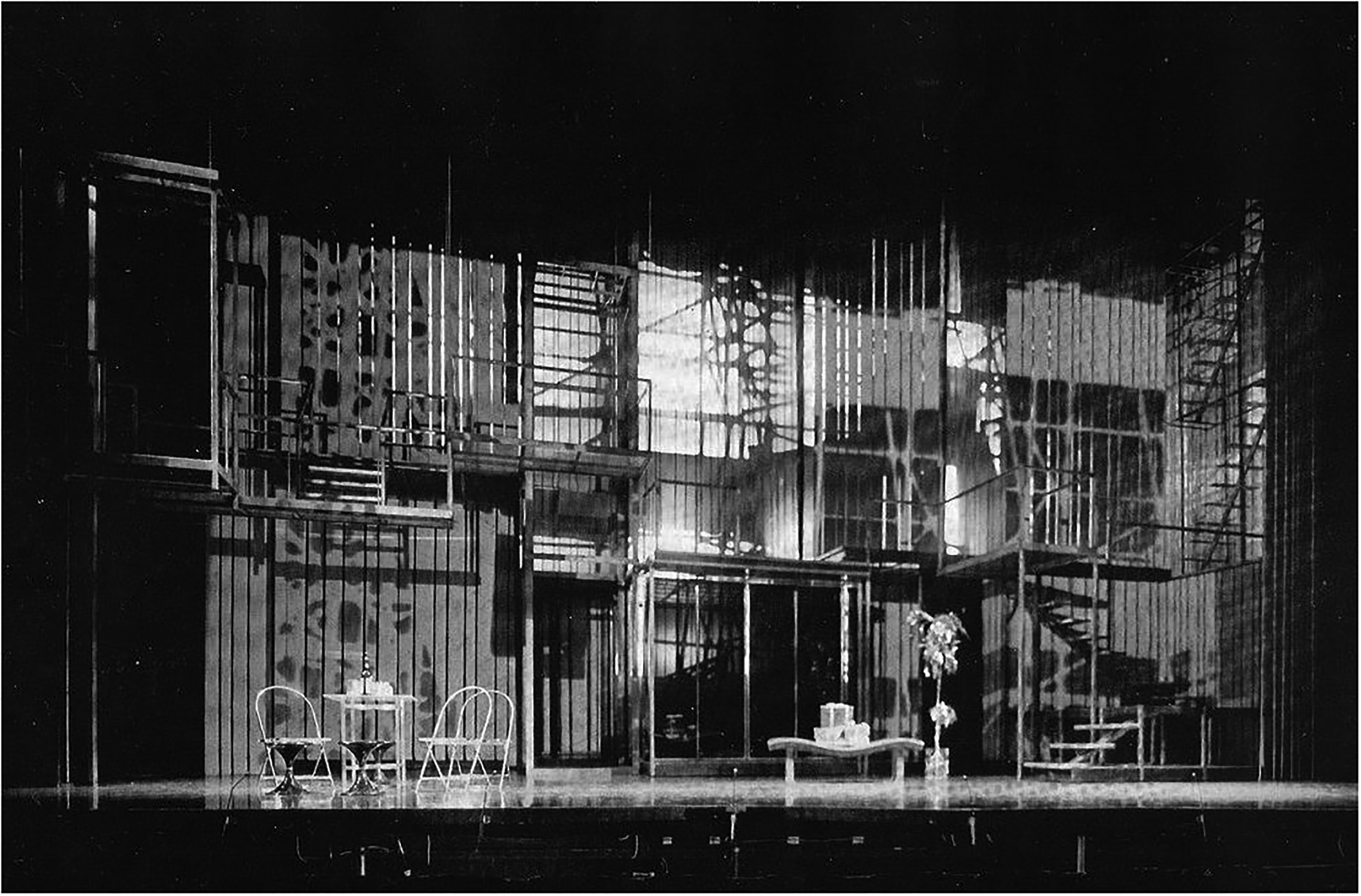
In other words, the city was seen as detrimental to well-being, a sentiment that the creative team brought to Company. In the show, Boris Aronson's set of skeletonized Plexiglas and steel brought the oppressive urban environment into the theater (Figure 1). Describing his inspiration for the set, Aronson said, ‘In New York, people sit stacked on top of each other in transparent cages. We live in a Plexiglass [sic] world now’ (Rich and Aronson, 1987: 220). Critic Stanley Kauffmann wrote, ‘Aronson's set dramatizes the cellular, scarily clean feeling of a modern Manhattan apartment’ (Gordon, 1990: 41). The set is dehumanizing; critic Walter Kerr said it ‘looks like [a] prison’ (Kerr, 1970). To further this aesthetic, over 600 photographs of contemporary New York were projected onto the stage during the production. These photographs were not of famous landmarks; rather, they captured the concrete reality and isolating hustle of everyday New York (Vandevender, 2014: 121). Sondheim explained the set was designed to create ‘an urban society in which individuality and individual feeling become more and more difficult to maintain’ (Zadan, 1994: 131). The set exemplified entrapment and tension, creating a place that exacerbated, rather than remedied, psychological issues, specifically loneliness and isolation.
Boris Aronson’s set for Company.
Sondheim used Company's songs to convey the idea that urbanism could cause psychological distress. Telephone busy signals, city buzzing sounds, and the repetition of Robert's nicknames envelop the characters in the commotion of the urban world and illustrate ‘the plight of bewildered rats caught in a libidinal treadmill,’ according to theater scholar David Savran (2012). 7 The repetition of nicknames creates an ‘oppressive effect’ on Robert, in the words of scholar Raymond Knapp (2016: 358). The show's cacophony of nicknames and city sounds drives Robert to his final song, ‘Being Alive,’ where he expresses his desire to finally find love. Leading up to ‘Being Alive,’ the couples incessantly repeat Robert's nicknames, but while every other time Robert has let the repetition continue, this time he yells, ‘Stop! What do you get?’ (Sondheim and Furth, 1996: 114). By breaking out of the grating urban noise that has defined his mental state for so long, Robert can finally define himself; he can settle down. 8 In turn, through this line, Furth exhibits how Robert's environment—what he aims to stop—has been defining his psychology up until this moment.
By connecting Robert's loneliness to his urban environment, Sondheim and Furth construct a narrative that parallels David Riesman's arguments in his 1950 book The Lonely Crowd. The book, according to Riesman, was about ‘“social character,” the patterned uniformities of learned response that distinguish men of different … groups’ (Riesman, 1950: v). The book argued that, despite post-war prosperity, the traditional American ethos of self-reliant independence was weakening, and as a result, America was becoming a nation of anxious, over-socialized individuals (McClay, 1998). Riesman identified a lack of individualism as the core problem (Palmer, 1990). He described how the ‘inner-directed’ American character type was being supplanted by an ‘other-directed’ type (Wrong, 1992). In the book, Riesman employed a navigational metaphor to explain these types: the inner-directed man was guided by a ‘gyroscope’—an internal sense of what to do—while the other-directed man was guided by a ‘radar dish,’ driven by a constant anxiety to please and follow those around him (Herzberg, 2010: 54; McClay, 1998). Historian Wilson McClay notes, ‘The oxymoron [in the book's title] captured many of the more troubling features of the corporatized, bureaucratized, suburbanized, and homogenized white-collar America that had emerged … after World War II’ (McClay, 1998).
The Lonely Crowd quickly became a bestseller. By 1970, it had sold over a million copies (Mandler, 2019a). According to historian Peter Mandler, the book's popularity was due to the new market for paperback books and a strong cultural appetite for sociology texts, which helped the American public situate themselves in society and cope with post-war cultural changes (ibid.). Sondheim and Furth were likely familiar with the text while writing Company. For example, Sondheim said Company was about ‘the increasing difficulty of making emotional connections in an increasingly dehumanized society.… It's the lonely crowd syndrome’ (Zadan, 1994: 131; emphasis added).
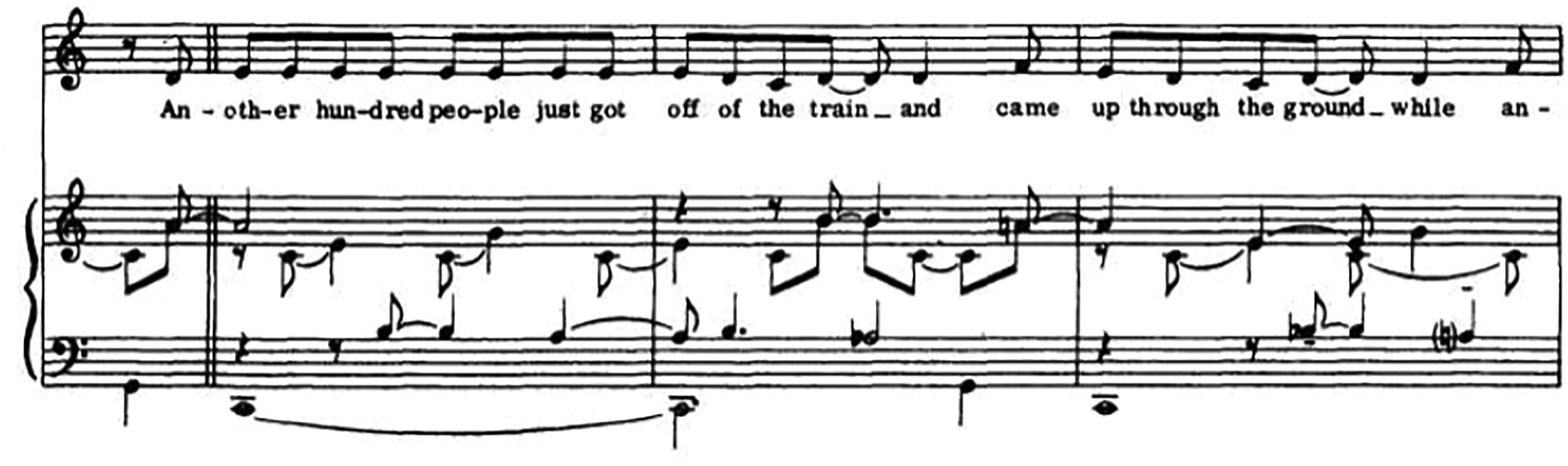
Sondheim and Furth echo Riesman's argument about urban loneliness in the show's fifth scene, when Robert talks with each of his girlfriends on a park bench while one of them, Marta, sings ‘Another Hundred People.’ The song begins: ‘Another hundred people just got off of the train / and came up through the ground / While another hundred people just got off of the bus.’ A few lines later: ‘It's a city of strangers—/ Some come to work, some to play—/ A city of strangers—/ Some come to stare, some to stay’ (Sondheim and Furth, 1996: 50). The song is about ‘the drifting of rushed life, the endless progression of events’ in New York City, according to orchestrator Jonathan Tunick (Zadan, 1994: 176). It musicalizes ‘the lonely crowd syndrome’; in the song, hundreds of strangers exhibit simultaneous conformity and separation. Joanne Gordon says the song displays ‘the parallels between Robert's dogged isolation and the loneliness of the city,’ attributing Robert's solitude to his New York environment (Gordon, 1990: 58). In The Lonely Crowd, Riesman explained how the other-directed character was emerging ‘in the upper middle class of our larger cities: More prominent in New York than Boston’ (Riesman, 1950: 19). In ‘Another Hundred People,’ Marta sings, ‘Will you pick me up or do I meet you there or shall we let it go? / Did you get my message, ’cause I looked in vain?’ (Sondheim and Furth, 1996: 51). These questions, always asked and never answered, convey a sense of other-directedness; the speaker is looking to others for guidance.
The song's music furthers the lyrical message by imitating the actions of urbanites passing each other without engaging (Figure 2). In the song, there are two ostinatos of different lengths that run against each other (Savran, 2012). Whenever the song begins to repeat, a rising countermelody enters and then slowly fades away, like a missed connection in ‘a city of strangers’ (ibid.). Riesman wrote of the loss of autonomy, individualism, and true connection that came with modern life (Gilbert, 2005: 53). Sondheim captures this sentiment in ‘Another Hundred People,’ bringing a theatricality to Riesman's argument and demonstrating the tension between city and individual in both lyric and music.
‘Another Hundred People’ sheet music excerpt.
At the end of this scene, Marta and Robert are talking. ‘You know what the pulse of this city is?’ Marta asks Robert. ‘A busy signal,’ he responds (Sondheim and Furth, 1996: 55). The telephone busy signal is the sound of Company; it opens the titular song on the 1970 cast recording. It is Robert's New York City. And it encapsulates his problem with the city: a place of waiting, a gnawing sound of perpetual suspension. Marta then tells Robert, ‘If you’re really part of this city, relaxed, cool and in the whole flow of it, your ass is like this,’ making a large circle with her forefingers and thumb. She continues, ‘If you’re just living here, runnin’ around uptight, not really part of this city, your ass is like this,’ tightening the circle to a fist (ibid.: 56–7). Robert, she says, is the latter. In The Lonely Crowd, Riesman explained how American citizens—particularly middle-class men—were characterized by ‘passivity and joylessness,’ created by living in a ‘time of disenchantment’ (Jackson, 2013). According to Marta, Robert epitomizes this ‘passivity and joylessness.’ He is ‘just living’ and ‘not really part of this city.’ Sondheim describes Robert as ‘empty,’ ‘cold,’ and a ‘cipher,’ all descriptors that echo Riesman's classification of American citizens (Sondheim, 2010: 166). Later, in the show's penultimate scene, Robert tells Joanne he is ‘very uptight’ (Sondheim and Furth, 1996: 110). Robert identifies the truth in Marta's comment and, by extension, Riesman's diagnosis: the city's uptightness is a part of him. Sondheim and Furth construct a character in Robert that parallels the other-directed men Riesman analyzed in his book.
Per mid-20th-century human scientists, the rise of other-directedness led to a rise in loneliness. Loneliness emerged as an emotional state because, due to urbanization, a growing number of people were living alone in cities, like Robert (Alberti, 2019: 31). In 1955, sociologist Claude Bowman hypothesized that ‘men are lonely [because] we now have more individuality … but this advantage has been purchased at a large psychological price’ (Smith, 2016). Psychiatrist Frieda Fromm-Reichmann, one of the first psychoanalysts to study loneliness as a disorder, wrote in a 1959 essay, ‘Loneliness seems to be such a painful, frightening experience that people do practically everything to avoid it’ (Laing, 2016: 23). Robert encapsulates this view in Company's finale, singing, ‘Alone is alone, not alive’ (Sondheim and Furth, 1996: 116). Furth also echoes Fromm-Reichmann's comment in Company when, to close the show's first act, Robert asks Amy to marry him. Amy tells Robert, ‘You’re afraid not to [get married].… It's just that you have to want to marry somebody, not just somebody’ (Sondheim and Furth, 1996: 68; original emphasis). Amy notes how Robert's loneliness creates fear: he is so desperate to avoid loneliness that he cares more about being married than who he marries.
Mid-century sociologist Robert Weiss postulated that when people were lonely, they tended to view the world in increasingly negative terms and to expect and remember instances of rudeness and rejection, creating a vicious cycle of loneliness and negativity (Laing, 2016: 26). In Company's opening scene, Robert presses ‘play’ on his answering machine. He stands alone as voice-overs fill the space with messages from friends. Then his friends arrive at his apartment for a surprise party. Staring out at the audience—not acknowledging them—Robert blankly says, ‘Say it and get it over with. It's embarrassing. Quick. I can't stand it’ (Sondheim and Furth, 1996: 5). They all say happy birthday. Robert responds, to nobody in particular, ‘I stood it’ (ibid.). Negativity pervades Robert's perception of his friends. Rather than appreciating them, he ‘stands them.’ Robert is separated from his friends, first through voice-overs and second through avoidance, highlighting both his isolation and his negativity. Robert's loneliness resurfaces when, in the second act song ‘Side by Side by Side,’ the couples have dance breaks answered by their partners, but Robert's dance break is answered by silence (ibid.: 84). When the couples then sing ‘What Would We Do Without You,’ Robert responds, ‘Just what you usually do!’ (ibid.: 83). The couples’ presence makes Robert's loneliness clear; he is defined by his connection with his friends because he is other-directed. Through the character of Robert, Sondheim and Furth engage with the contemporary perception of environmentally caused loneliness and isolation, and the use of song in Company draws attention to the tension between individual (Robert) and environment (New York City), particularly in ‘Another Hundred People.’
‘To cherish and to keep you’: Gender and sex in Company
Most human sciences research in the mid 20th century—Riesman's The Lonely Crowd, Trilling's psychoanalytic work—centered on the middle-aged, white-collar man. In turn, these studies demonstrated a patriarchal bias by treating the American male as ‘the normal standard’ for social sciences studies. By centering Company's narrative on a 35-year-old white male, Sondheim and Further wrote a show that focused on the same demographic human scientists treated as ‘the norm’ and, in turn, implicitly echoed the human sciences’ patriarchal bias.
In the mid 20th century, new academic disciplines were bringing increased scrutiny to gender and sex in contemporary American culture. In response to the era's masculine normativity, the 1960s women's liberation movement spurred the use of the social sciences as a tool for female empowerment (Friedan, 1963; Levant and Wong, 2017). Dovetailing with this growing interest in gender, mid-20th-century researchers applied quantitative data collection to the study of sexual activity. Company reflected this way of thinking; per theater historian Bryan Vandevender (2014: 156), ‘Company's most significant connection to its zeitgeist was its depiction of … sex and marriage.’ Through the show's characters—particularly Robert and bride-to-be Amy—Sondheim and Furth construct analyses of gender and sex that parallel those set forth in the human sciences.
In mid-20th-century America, following World War II, the rise of the nuclear family, the prevalence of white-collar work, and the entrance of women into the workforce undercut traditional ideas of masculinity, which often defined men through the exclusion of others (Gilbert, 2005: 16; Kimmel, 1996: 155). In the 1950s, a growing concern about men's role in American society sparked a new body of critical academic literature that studied and often deplored the effects of corporate work and family life on men (Gilbert, 2005: 32). For example, in The Lonely Crowd, Riesman argued that as men and women became equals in society, men lost their ability to express themselves as individuals and leaders; they lost their ‘inner directedness,’ driven now by anxiety rather than pride (Chinn, 2006). Riesman and his human scientist peers clung to the idea of the ‘self-made man’ not only as the ideal form of masculinity but also as the ideal human form; these researchers saw the American man as the prototypical citizen (Joyce, 2011). Contemporary human sciences studies, infused with a patriarchal bias, saw changing ideas of work and femininity as challenges to the traditional conception of an American male.
For instance, take sociologist C. Wright Mills’ 1951 book White Collar. Mills argued that ‘the nineteenth-century farmer and businessman were generally thought to be stalwart individuals,’ but the modern corporation had spawned a ‘new Little Man,’ a ‘small creature who is acted upon but does not act’ (Mills, 1951: xii). In other words, per Mills, the 20th-century ‘Little Man’ was incapable of an independent (or, in Riesman's words, ‘inner-directed’) masculinity. In Company, Sondheim and Furth construct their own ‘Little Man’ in Robert. Robert demonstrates a lack of autonomy—like Mills’ ‘Little Man’—in his voicemail message from the show's opening scene: ‘Hi, this is Bob.… And whatever you’re calling about my answer is yes’ (Sondheim and Furth, 1996: 4). Here, Robert agrees to whatever someone else might ask of him; he is ‘acted upon’ and ‘does not act.’ Later, Robert describes his relationship with the couples by singing, ‘Ports in a storm, / Comfy and cozy, / Side by side … / by side’ (ibid.: 77). Robert places himself as subordinate to the couples: he is the third ‘side’ in the lyrical list, set off from the prior two by a pause. He self-identifies as a ‘Little Man’ who follows his friends just as the white-collar man follows his corporation.
Mills argues the Little Man is ‘more often pitiful than tragic’ and is ‘pushed by forces beyond his control’ (Mills, 1951: xii). Mills attributes this to how the Little Man has ‘no firm roots, no sure loyalties to sustain his life and give it a center’ (ibid.: xvi). In one of Company's final scenes, Joanne asks Robert if he wants a cigarette. ‘I never smoked,’ he tells her. She asks why. ‘I don't know. I meant to. Does that count?’ he says. Joanne responds, ‘Meant to! Meant to! Story of your life.… You’re weak.… I hate people who are weak!’ (Sondheim and Furth, 1996: 108). By calling Robert ‘weak,’ Joanne presents him as ‘pushed by forces beyond his control.’ These ‘forces’ exist both within and outside the show. Outside the show, according to theater scholar Ashley Pribyl (2019: 214), Robert's ‘weak characterization’ led some theatergoers to rely on extra-textual ‘forces’ (such as Sondheim's sexuality) and interpret Robert as a homosexual, even though textual clues (such as Robert's three girlfriends) present him as heterosexual. Within the show, these ‘forces’ that push Robert are his friends. As theater scholar John Olson (1997) writes, ‘We never see [Robert] initiate contact with his friends.… He appears to merely react to the actions of others.’ Echoing Mills, Robert's friends attribute this weakness to his lack of roots. Jenny tells Robert that ‘a person's not complete until he's married,’ implying his problem lies in his singledom (Sondheim and Furth, 1996: 39). Robert's troubles parallel Mills’ assessment of white-collar men in mid-20th-century America; Sondheim and Furth, like Mills, link pitifulness and a lack of firm roots to Robert's singledom and dependence on others.
Company also echoes a growing body of human sciences scholarship on women in mid-20th-century America, such as when Robert's friend Amy has an anxiety attack on her wedding day, singing ‘Getting Married Today.’ ‘Married Today’ is considered a patter song, where the song's rhythms and textures parallel those of free speech rather than typical sung lyrics (Chung, 2019). As a patter song, ‘Married Today’ is more spoken than sung—a high-speed delivery of dense prose that includes one of the fastest verses in musical theater: 68 words in 11 seconds (Wolf, 2014). 9 In her opening lyrics, Amy quickly sings, ‘Pardon me, is everybody there? / Because if everybody's there, / I want to thank you all for coming to the wedding’ (Sondheim and Furth, 1996: 58). Sondheim intentionally avoided rhymes when writing ‘Married Today,’ creating a feeling of stress and anxiety in the song. He explained, ‘If I had rhymed the lines in the patter, it would have implied an organized control of Amy's thought processes, when in fact disorder is the essence of hysteria’ (Sondheim, 2010: 184). Sondheim's use of a patter song for Amy—mimicking speech and avoiding rhymes—constructs a sense of anxiety that establishes the song's commentary on mid-20th-century understandings of gender.
Further, by using the term ‘hysteria’ to describe Amy's condition, Sondheim connected the character to a specific mental illness. Dating back to ancient Greece, hysteria had been seen as a female-specific disease; the name, coined by Hippocrates, stemmed from the Greek work hystera, meaning ‘uterus’ (Tasca et al., 2012: 111). Hysteria arose from male medical professionals viewing women as troubled and crazy; thus, the portrayal of Amy as hysteric perpetuates this perception of women, a perception constructed by male doctors and conveyed by men like Sondheim and Furth. Symptoms of hysteria often included shortness of breath, anxiety, nervousness, and irritability, and Amy's patter song encapsulates these symptoms through its rapid-fire pace and lyrics that discuss anxiety (‘Do you want to see a crazy lady fall apart in front of you?’) and irritability (‘Go! Can't you go? / Why is nobody listening?’; ibid.; Sondheim and Furth, 1996: 58). While early theories of hysteria blamed the disease on physical ailments (e.g. menstrual blood), by the 20th century, hysteria was seen as a psychological illness caused by sexuality problems (McVean, 2017). Sondheim's use of marital commitment and monogamy as triggers for Amy's hysteric fit aligns with this psychological perspective of the disease, even though, by the time Company premiered, hysteria was increasingly called into question as a valid medical diagnosis (Tasca et al., 2012: 110). 10
While the disorder of ‘hysteria’ had fallen out of favor, anxiety was still commonly diagnosed among mid-20th-century American women. By 1960, three-quarters of American doctors were prescribing tranquilizer drugs to treat everyday anxiety, with women using these drugs at rates twice those of men (Herzberg, 2010: 73; Horwitz, 2010; Tone, 2008: 90, 97). A 1960 Wall Street Journal article noted that ‘women, as a rule, are unhappier than men,’ underscoring the patriarchal bias of the era (‘Study Finds Many Persons With Anxiety,’ 1960). In the mid 20th century, inspired by Freudian psychoanalysis, second-wave feminist Betty Friedan (1963: 115) connected the ‘age of anxiety’ to the plight of the mid-century woman. In her 1963 book The Feminine Mystique, Friedan noted the growing prevalence of a ‘housewife's syndrome,’ which included symptoms of malaise, nervousness, and fatigue (ibid.: 293). According to Friedan, this problem stemmed from the Freudian belief that happiness came only from familial relationships, leaving housewives feeling neurotic if they hungered for any independence (Herman, 1995: 291).
Right before Amy's panic attack, her fiancé Paul sings, ‘I give you the rest of my life, / To cherish and to keep you, … / Today is for Amy, / My happily soon-to-be wife’ (Sondheim and Furth, 1996: 58). Then Amy launches into her song. By prefacing the song with Paul's lyrics about possessiveness in the familial relationship (‘cherish’ and ‘keep’), Company echoes Friedan's thinking that a woman's neuroses stem from a loss of independence. Amy sings, ‘We’ll both be losing our identities—/ I telephoned my analyst about it / And he said to see him Monday, / But by Monday I’ll be floating / In the Hudson with the other garbage’ (ibid.: 60). Amy's anxiety attack fits Friedan's ‘housewife's syndrome’: she exhibits nervousness about her forthcoming marriage, specifically noting a loss of identity.
Toward the end of the scene, Amy says, ‘I will go running right out of this apartment and move into the “hopeless cases” section at Bellevue where they’ll understand me’ (Sondheim and Furth, 1996: 63). Amy sees her anxiety as permanent (‘hopeless’), an innate flaw arising from her psyche rather than from society's expectations for women. By hyperbolizing her diagnosis, Amy puts it on a par with that of those who have a chronic and debilitating level of anxiety, when, in reality, her issue is momentary. The scene ends with her chasing after Paul. Through ‘Getting Married Today’ and the character of Amy, Sondheim and Furth construct a commentary on the modern American housewife that parallels Friedan's assessment of women's social position and reflects the patriarchal bias in medicine of seeing women as anxious messes in need of treatment.
Conversely, Paul's reaction to marriage—about ‘giv[ing Amy] the rest of my life’—echoes mid-century perceptions of masculinity (Sondheim and Furth, 1996: 61). The 1950s celebrated the sanctity of family life, with Life magazine declaring 1954 the year of ‘the domestication of the American man,’ following a decade of dedicated fatherhood and husbandry after World War II (Kimmel, 1996: 165). This idea of ‘male domestication’ continued into the late 1960s, when sociologist Patricia Sexton wrote of how the rise of women had led to the emasculation of men in her 1969 book The Feminized Male (Garland, 1971). Sexton critiqued both white-collar society and wives for demanding ‘unmanly amounts of submission’ (Sexton, 1969: 17). Paul willingly accepts this submission when he tells Amy he will ‘cherish and … keep’ her, ‘honor[ing her] forever’ (Sondheim and Furth, 1996: 61). He places himself as subservient to Amy, celebrating the forthcoming dependency. In turn, Amy and Paul portray what mid-century human scientists saw as the effects of marriage on both men and women. Further, through the character of Amy, the show captures the misogyny of the mid-20th-century human sciences. Even though the men in the show face their own dilemmas—such as Robert and his singledom in ‘Being Alive’—it is Amy who breaks down into an uncontrollable panic attack, a move that reflects patriarchal, misogynist biases toward anxiety in the late 1960s.
In a related commentary on gender, Company presents a sex scene that parallels the mid-20th-century sexology scholarship by William Masters and Virginia Johnson. In 1966, Masters and Johnson published Human Sexual Response, which used anatomical measurements of blood pressure, orgasmic experiences, and so on to describe the ‘sexual response cycle’ (Buckley, 1969). Human Sexual Response gained popularity, selling more than 250,000 copies in two years (Brecher and Brecher, 1966: 20). However, the Wall Street Journal described the book as ‘so clinical as to be dull,’ and the New York Times wrote, ‘This is a scientific treatise, which will not titillate’ (Bishop, 1966; Guttmacher, 1966). According to Masters, the primary goal of the book was ‘acceptance,’ and Masters and Johnson saw clinical, non-romantic language as a way to legitimize their work as a scientific pursuit (Buckley, 1969). To avoid romanticizing sex, Masters and Johnson often borrowed terminology from the corporate world; for example, they wrote about how breaks from sex could ensure ‘maximum return’ (Masters and Johnson, 1966: 121). This materialism disentangled emotion from the physicality of sex (Robinson, 1989: 178). Masters and Johnson's work was often covered in the press, so Sondheim and Furth were likely aware of their research when writing Company (Hale, 1995: 298).
In one scene, while Robert and girlfriend Amy are having sex, Kathy does a solo dance to convey the physical dynamics of sex. In the stage directions, Furth notes, ‘Kathy's dance expresses the difference between having sex and making love’ (Gordon, 1990: 66). Just as Masters and Johnson took a technical approach to studying sex, Kathy's ‘Tick Tock’ dance disentangles the emotions of sex from the physical act. During the dance, Robert and Amy dryly vocalize their thoughts. ‘Oh, this is sensational,’ Robert says. ‘I think he really likes it,’ from April. ‘Oh, I like that,’ Robert adds (Sondheim, 1970). In the 1970 cast recording, these comments are muffled, diminishing emotional expression and establishing a distance between speaker and body. The remarks provide a clinical commentary on an experience, similar to Masters and Johnson's descriptions of sex in Human Sexual Response.
Through Company's portrayal of its characters and their relationships, Sondheim and Furth construct parallels between the show and mid-century understandings of gender and sex, from Mills’ ‘Little Man’ to Friedan's Feminine Mystique to Masters and Johnson's sexology. Through these gendered parallels, the show captures the patriarchal biases in mid-century human sciences research by portraying Robert as protagonist, Amy as anxious, and Kathy as performative. The man becomes the celebrated center of both Company and contemporary social science scholarship, framing women as mentally unstable and subservient.
‘Tick tock’: The biological clock in the 2018 revival of Company
In 2018, a revival of Company premiered in London's West End before opening on Broadway in December 2021. 11 This revival, directed by Marianne Elliott, gender-swapped many of the show's characters: for instance, male Robert became female Bobbie, and female Amy became male Jamie. 12 Elliott said that when she first considered directing Company, she dismissed any revival as anachronistic (Bamigboye, 2016). ‘[The show] was so on the money about 1969–1970,’ Elliott said (Turner, 2020). But, through gender-swapping, Elliott modernized Company's mid-century aesthetic: she both undermined the patriarchal bias of the mid-century human sciences and—through the now-female protagonist—brought forth 2010s concerns over the ‘biological clock’ (the gendered idea that the fertility of a person with ovaries rapidly declines in their 30s).
In the 2018 revival, the anxiety-ridden Amy and her husband Paul were replaced with the anxious Jamie and his husband Paul. By replacing the heterosexual woman with a homosexual man, Elliott challenged the gendered conceptions of anxiety set forth in the show's original libretto. In an April 2020 interview with Elliott, reporter Kyle Turner commented, ‘[Amy's anxiety attack] seems very gendered … the way she's described as having a sort of quote-unquote “hysteria.”’ Elliott responded, ‘It just felt, again, of its time, and I just suddenly had the thought … “What if it was a man!?” … Because, of course the group of people [in the 2010s] who are questioning whether they should be married or not are gay people, you know? It felt really, again, relevant’ (Turner, 2020). While the lyrics in ‘Getting Married Today’ remained largely unchanged, Jamie's gender erased the mid-20th-century context of hysteria, tranquilizers, and the ‘housewife syndrome’ in favor of a 2010s commentary on homosexuality and marriage. The anxiety was no longer hysteric. Through this change, the 2018 production addressed the patriarchal biases of the mid-century by erasing the historical, biased (and, in 2018, outdated) link between anxiety and married women.
Elliott's production primarily confronted mid-century patriarchal biases by gender-swapping the show's protagonist, changing out male Robert for female Bobbie. In doing so, Elliott replaced the concerns of the ‘Little Man,’ ‘inner- and other-directedness,’ and masculinity with 2010s concerns over the female ‘biological clock.’ 13 She explained, ‘It feels so relevant and contemporary to make it about a woman because a woman is still struggling with [mid-30s singledom] … in a way that only men were in 1969’ (Turner, 2020). By invoking the ‘biological clock’ as a social and scientific concept, Elliott made Company ‘much more now,’ in her words; the fertility clock established a 21st-century relevance for a 20th-century show (Bamigboye, 2016).
The term biological clock, in the context of female fertility, is often traced to a 1978 Washington Post op-ed by Richard Cohen titled ‘The Clock Is Ticking for the Career Woman.’ Cohen wrote that women have been able to ‘do all the things that men traditionally have done, [but] now they face this biological clock’ (Cohen, 1978). Cohen argued that the women's liberation movement came into conflict with the ticking clock of female fertility, writing, ‘This is where liberation ends. This is where a woman is a woman—biologically, physiologically, uncontrovertibly different’ (ibid.). The term biological clock conflated biology and culture, ensuring that, even as the liberation movement was fighting for gender equality, there would always be a ‘physiological difference’ between men and women. Through the term, Cohen cast reproductive issues as exclusively female—even though men, too, have a fertility clock (Twenge, 2013). According to historian Moira Weigel (2016), the concept made it seem natural and inevitable that reproductive burdens would fall solely on women.
The term capitalized on a growing cultural concern in the 1980s United States around fertility. The development of effective birth control and the legalization of abortion had led to an increasing number of women delaying motherhood to pursue education and work (Weigel, 2016). The birthrate had dropped from 3.5 children per woman in 1957 to 1.5 in 1976, with the Centers for Disease Control announcing a ‘fertility epidemic’ in the 1980s (ibid.). The use and popularity of the ‘biological clock’ concept increased in the coming decades. In 2014, the American Society for Reproductive Medicine issued a report on Female Age-Related Fertility Decline (notably ignoring men) that discussed how the fertility of someone who ovulated began to decline significantly when they turned 32 (Macintosh, 2015). However, a growing body of 21st-century scholarship challenged these findings, arguing that female fertility was relatively stable into the late 30s and male fertility often declined only a few years later than female fertility (Twenge, 2013). Despite this increasing doubt surrounding the term's scientific validity, the ‘biological clock’ concept remained prevalent into the 2010s, when Marianne Elliott revived Company.
Gender-swapping Company's protagonist introduced the ‘biological clock’ as a central, though implicit, concept in the show. Even if the ‘biological clock’ concept was not scientifically grounded, it was culturally supported, and Elliott embraced this cultural acceptance in her revival. Elliott explained, ‘Doing [Company with] a female in 2020 who's 35 and is very conscious of her body clock … feels relevant’ (Peikert, 2020). In another interview, she said, ‘Men don't have to worry about these things, do they? There is a structural unfairness. My 30s were major, workwise, and all my life I’d said: I’m not going to get married, and I’m definitely not having children either because I want a career. I thought the two were mutually exclusive’ (Cooke, 2018). Elliott imbued Company's now-female protagonist Bobbie with the same struggle she had faced in her 30s. This struggle—stemming from a gendered ‘structural unfairness’—harkened back to Cohen's comments on the tension between women's liberation and women's biology, which had had little to do with actual biology and everything to do with perceived biology. The late 20th century had nurtured a perception that women had to make a distinctly female choice between career and family. This tension created the revival's psychological thrust; the singledom that had been an issue of loneliness and masculinity for Robert was now an issue of the biological clock for Bobbie.
Beyond Elliott's own explanation of her revival, theater critics invoked the idea of the biological clock when explaining Bobbie's conflict in the show. Critic Matt Wolf (2018) wrote, ‘Because [Bobbie is] a woman, her body clock is surely ticking. And if she wants to have children, she’ll need to settle on a man to do it with.’ Rather bluntly, Wolf validated the gendered assumptions surrounding the clock, presenting it as a solely female problem, just as Cohen did in the 1970s. Critic James Feinberg (2019) invoked a similarly gendered assumption when he wrote, ‘It's true that today it's easier to swallow a thirty-something woman anxious about being single than a thirty-something man (the biological clock has something to do with it)’. Wolf and Feinberg assumed that the female ‘biological clock’ concept was scientifically valid, in turn applying this assumption about female anatomy to their analyses of Elliott's Company. They used the ‘biological clock’ to construct an urgency around Bobbie's singledom and her need to find a husband.
The change in Company's psychological thrust from masculinity to fertility was furthered through a new choreography for the ‘Tick Tock’ dance. In the 1970 production, this dance had provided the backdrop to Robert and April's sex scene. But, in Elliott's revival, the clock-like rhythm of the song was used to invoke the beat of the biological clock. Matt Wolf described the scene: ‘The feeling of anatomical countdown lends an unexpected meaning to “Tick Tock,” a dance number that is here accompanied by a nightmare sequence where Bobbie imagines a domestic life—morning sickness and all—that is far from bliss’ (Wolf, 2018). The ‘Tick Tock’ scene displays Bobbie's nightmarish vision of her future, a vision defined by her apparent need to settle down and have a child. The scene underscores the tension Bobbie perceives between her career and motherhood—a tension arising from Bobbie's (and Elliot's) belief in the validity of the biological clock. The re-choreographed ‘Tick Tock’ dance highlights how the 2018 revival shifted the show's relationship with the human sciences from 1970s sexology to 2010s fertility. Thus, the same show—produced in both 1970 and 2018—captures how the preoccupations of expert discourses in the human sciences have changed across generational contexts.
‘What do you get?’: Conclusion
‘I want the audience to laugh uproariously for two hours and then go home and not be able to sleep,’ Stephen Sondheim said of Company (Gussow, 1970). Sondheim and Furth wanted Company to force audiences to confront the uncomfortable realities of their world: the mid 20th century was a time of social change, with the rhythm of city life, the structure of relationships, and perceptions of self-identity all in flux (Herzberg, 2010; Richards and Elliott, 1991; Zaretsky, 2005). Spheres of cultural production, from the human sciences to musical theater, were interrogating these changes, considering what it meant to live in modern society. In the human sciences, psychoanalysis provided a way to navigate the modern world, sociology provided a framework for society's problems, sexology provided a quantitative approach to understanding sex, and gender studies provided a means to explain social differences.
Company constructed a similar critical gaze toward society. In a New York Times letter to the editor, Mrs. Alan Richstone wrote of Company, ‘But what was it all about? A commentary on our present-day society? Why use musical comedy as the vehicle?’ (Richstone, 1970). Richstone's question gets to the heart of Company's aim: to use the seemingly innocuous genre of musical theater as a vehicle for social analysis. The show, by challenging escapist assumptions for musical theater, offered an examination of the lives of and problems facing contemporary upper-middle-class New Yorkers. Company conveyed the psychoanalytic tension between the conscious and the unconscious (in ‘You Could Drive a Person Crazy’), the housewife syndrome and female anxiety (in ‘Getting Married Today’), and the loneliness and other-directedness of urban life (in ‘Another Hundred People’). Using the emotional thrusts of song, dance, and narrative, the show implicitly disseminated contemporary human sciences analyses, reaching audiences beyond the scope of more traditional academic publications.
When Marianne Elliott revived the show in the late 2010s, she again brought Company into conversation with contemporary human sciences, because the gender-swapping of the protagonist invoked the female fertility ‘biological clock.’ In both the 1970 and the 2018 productions, the often-implicit integration of the human sciences into the narrative brought forth a contemporaneity, an engagement with the present moment that exposed and explored the issues of modern society.
However, historians of the human sciences have often overlooked the 20th-century stage as a place of scientific inquiry and communication. Company's exploration of modern society underscores the value of considering the genre of musical theater when studying cultural reception in the history of science. This analysis also illustrates the value in looking specifically at the intersections between the human sciences and 20th-century theater. The American musical—through both its exaggerated theatricality and its popularity—can amplify and broadly disseminate scientific ideas. Therefore, this article on Company offers a case study in how history of science scholars can use musical theater to understand the co-option of scientific ideas in a non-scientific sphere.
Company both implicitly and explicitly amplified the human sciences through a multisensory theatrical experience that engaged emotionally, aurally, and visually with contemporary societal changes. Just as Menninger, Mills, Riesman, and Cohen used the human sciences to expose the problems with modern society, Sondheim and Furth (and, later, Elliott) did the same through theater. Together, these thinkers and writers used their respective disciplines to comment on the contemporary human condition. Both the 1970 and the 2018 production, like concurrent human sciences scholarship, looked at the problems of society—the pervasive anxiety, the loneliness of urban life, the gender divisions—and said, in Robert's words, ‘Stop! What do you get?’ (Sondheim and Furth, 1996: 114).
Footnotes
Declaration of conflicting interests
The author declared no potential conflicts of interest with respect to the research, authorship, and/or publication of this article.
Funding
The author received no financial support for the research, authorship, and/or publication of this article.
