




Abstract
Many states make use of personal identity numbers (PINs) to govern people living in their territory and jurisdiction, but only a few rely on an all-purpose PIN used throughout the public and private sectors. This article examines the all-purpose PIN in Finland as a political technology that brings people to the sphere of public welfare services and subjects them to governance by public authorities and expert institutions. Drawing on documentary materials and interviews, it unpacks the history and uses of the PIN as an elementary building block of the Nordic welfare state, and its emerging uses in the post-welfare data economy. The article suggests that, although the PIN is capable of individualizing, identifying, and addressing individuals, its most important and widely embraced feature is the extent to which it enables interoperability among public authorities, private businesses, and their data repositories. Interoperability, together with advances in computing and information technology, has made the PIN a facilitator of public administration, state knowledge production, and everyday life. More recently, in the post-welfare data economy, interoperability has rendered the PIN a national asset in all the Nordic countries, providing a great advantage to biomedical research, innovation business, and healthcare.
Introduction
The topic of our article is the personal identity number (PIN) in Finland. Every permanent resident and most temporary residents in the country have a PIN, and this single code facilitates and enables a great variety of mundane economic, administrative, juridical, and public service-related transactions in which personal identification is required. In Finland and other Nordic countries, the PIN is a ubiquitous, self-evident, and routine operator of connections and communication between different walks of life and different institutional domains of society. As a code for identification and access (see Dodge and Kitchin, 2005), the PIN has become somewhat invisible in the Nordic countries, and many people have started to take it for granted (Bauer, 2014).
The Nordic PINs have not yet been studied in great detail. In addition to a small number of historical studies (Frestad, 2017; Krogness, 2011; Watson, 2010), epidemiologists and statisticians have introduced the uniqueness of national PINs to their professional communities (e.g. Ludvigsson et al., 2009; UN Economic Commission for Europe, 2007), and civil servants involved in the process of implementing the PIN have written memoirs (Varho, 1993, 2011). On top of this, the Nordic PINs have received little attention in the social sciences literature (with the exception of Bauer, 2014; Kinnunen, 1998). Such a lack of interest is a little surprising, because the Nordic PINs are socially and politically unique. In most countries, such extensive coding of the relations among individuals, society, and public authorities would be infeasible, and many countries have resisted the use of codes for all-purpose personal identification, because codes are seen as having great potential to render individuals vulnerable to abuse by public authorities and commercial enterprises, and to violate juridical and moral principles of privacy (e.g. Vandezande, 2011).
Our interest in the PIN arose while we were conducting research on population statistics, biobanks, and other public databases. 1 While studying institutions of data and knowledge production, we became curious about the PIN, a ubiquitous identifier that enabled operative connections among different data sources, public institutions, private businesses, and individual citizens. In this article, we pose three questions. First, how did the Finnish PIN emerge as an all-purpose code (see Dodge and Kitchin, 2005)? Second, how has its scope of use expanded and transformed? Finally, what kinds of administrative, political, technical, and sociocultural settings have enabled and modified it?
Theoretically, we build on an analytics of government approach derived from Michel Foucault’s (2000a, 2000b) insight on the specific mode of Western political reason that focuses on rationales and arts of governing that attempt to make the lives and conduct of populations and individuals governable. The governmentality approach is particularly productive for an analysis of the vicissitudes of the Western welfare state (Helén, 2016), because it shows the welfare state as a dynamic and dispersed mosaic of ‘government of life’ (ibid.; Lemke, 2011). Furthermore, it calls attention to political technologies (Foucault, 2000c), that is, technical and epistemic means of embracing, controlling, and intervening in people’s conduct in a variety of domains of living, ranging from public health to urban planning. In accordance with this line of thinking, we approach the PIN as a political technology aimed at governing people and society (Dean, 2002; Foucault, 2000a, 2000c). More precisely, the PIN is a core element of practices and technical infrastructures for the collection and management of data relating to populations and citizens (see Bauer, 2014; Ruppert, 2011, 2012, 2013; Sætnan, Lomell, and Hammer, 2011). As we focus on the PIN, our study highlights an elementary dimension of technologies of governing, indispensable especially for knowledge production serving the state and other public authorities in making people, populations, society, and individuals governable (Dean, 2002; Foucault, 2000a, 2000b).
We examine the powers of the PIN from a historical perspective. Unlike straightforward histories of the PIN presented by state authorities (Digital and Population Data Services Agency, n.d.-a; Statistics Finland, n.d.), we offer a nuanced account of its early stages. Our empirical materials consist of committee memoranda, legislation, newspaper articles from the main national newspaper Helsingin Sanomat, interviews, policy documents, and ethnographic field notes generated during our studies on Finnish population registration and statistics production, and on biobanks and data management in healthcare and related services, in which we came across the emergence and various uses of the PIN. 2 We analyse this material to determine how the Finnish PIN functions and makes sense in the contexts of its usage. Our analysis is inspired by the material-semiotic approach (Law, 2009, 2016), which allows us to pay specific attention to the reciprocal enactment between practices of governing people and society, and the technical features and capabilities of the PIN in the framework of the Finnish welfare state. We focus on the requirements and tasks that specific practices of governing have assigned to the technical mode and capacities of the PIN, and how the PIN’s technical ability to trespass and channel information among various domains of society has facilitated and shaped governing practices. Our analysis demonstrates how the PIN materializes, or puts into action, relationships, transactions, and practices that are indispensable for governing of and within the state – the welfare state – and, in fact, for the functioning of society at large.
We show that interoperability among different sectors of public administration and their data repositories has been and still is the constitutive feature of the PIN in Finland and other Nordic countries. Interoperability means that the PIN is adaptable and flexible, able to be deployed in different contexts, and it has the capacity to provide a connection between databases, which features have made it prone to the acquisition of additional uses and new functions in new domains of public administration and society – a phenomenon referred to in STS literature by the term function creep, which addresses the expansion or shift of a system or technology beyond its original function, ‘slowly, gradually and/or imperceptibly’ (Koops, 2021: 37; see also Dahl and Sætnan, 2009). In the following, we present an overview of expansion of the Finnish PIN into undesigned, unintended, or even unimaginable uses, and of how the scope of the PIN’s applications has transformed over the past few decades.
One aspect of this expansion, or ‘creeping’, of the Nordic PIN’s operational scope relates to its original task of establishing a link between public databases. This capability has been praised by, for instance, demographers, epidemiologists, and social scientists (e.g. Gissler and Haukka, 2004; Jowell et al., 2007; Ludvigsson et al., 2009), for whom the PIN presents opportunities to pool research data from different sources. In relation to this theme, we also discuss whether new functions for the Nordic PIN are creeping in, given the increasing interest in utilizing public registers and databases as ‘Big Data’ for more extensive governmental and commercial purposes.
Our article proceeds as follows. In the next section, we describe briefly the nature of the PIN in Finland, and we then present the emergence and consolidation of the PIN as embedded in the development of social security and welfare services. The following section is an analysis of interoperability mediated by the PIN in public administration, state-related knowledge production, and academic research. In this section, we discuss the PIN’s role as a facilitator of everyday living in society. We then go on to focus on the emerging uses of the PIN as an operator of more intense data sourcing and data mining in the contexts of post-welfare state administration, management, and knowledge production, and in the global health data economy. Finally, we conclude our article by summarizing our findings and discussing how the PIN’s ability to enable interoperability among administrative and policy domains and public data depositories has facilitated the expansion of its use and empowered it to shape practices of governing people in the welfare state. As the PIN has evolved into an all-encompassing ‘code of life’ (Dodge and Kitchin, 2005) in Finland and other Nordic countries, it has come to materialize the ethos of the welfare state.
What is the PIN?
Technically, the Finnish PIN (in Finnish henkilötunnus, abbreviated hetu) consists of 11 characters. 3 The first six digits express the day, month, and year of a person’s birth, and in this regard, all Nordic PINs are similar. The seventh digit, following the date of birth, may be one of three symbols: a plus sign, for persons born in the 19th century; a hyphen, for those born in the 20th century; or an A, for those born in the 21st century. The seven characters are followed by a three-digit individual number that distinguishes persons with the same name and date of birth from each other; females are given even and males odd three-digit individual numbers. The last character – either a number or a letter – is a so-called ‘control character’, intended to reveal automatically any typographic and/or other errors in the number (Digital and population data services agency n.d.-a). Thus, the PIN is not a random sequence of numbers (Otjacques, Hitzelberger, and Feltz, 2007) but a series of numbers containing personal information: date of birth and sex.
The determination, issuing, and uses of the PIN are regulated by a strict legal framework ( Laki väestötietojärjestelmästä ja Digi- ja väestötietoviraston varmennepalveluista 661/2009 ; Tietosuojalaki 1050/2018 ; Valtioneuvoston asetus väestötietojärjestelmästä 128/2010 ). A state agency called the Digital and Population Data Services Agency (the Population Register Centre until the end of 2019) maintains the PIN and the centralized population register (officially called the Population Information System). All Finnish citizens and most foreign-born persons residing in the country, permanently or temporarily, have a PIN, and they are therefore pinned to the Finnish state symbolically and spatially, because the population register also contains address information. Since the 1990s, every newborn child has been issued a PIN within a few days of birth if their parents are Finnish citizens or foreign nationals registered in the population register as permanent residents. The sphere of PINned residents in Finland does not include asylum seekers, although their residence in the country often exceeds the time limit for issuing the PIN (Ustek-Spilda and Alastalo, 2020). Currently, the PIN is used in practically all government databases, and for decades, it has been widely used in the databases of private businesses.
The birth of the PIN as a technology of social insurance
How was such an all-encompassing code developed in Finland? The PIN was built alongside the institutionalization of the welfare state in the early 1960s and is firmly rooted in the rationale of social planning and the mobilization of evolving information technology (or automatic data processing [ADP], as it was known at the time). Already by the late 1950s, the population bookkeeping committee suggested that all citizens be individualized by an identity number consisting of their date of birth and an individual code (KM 1958: 56), but the proposal did not lead to action. Reporting on the idea of issuing citizen cards in Sweden, the main Finnish daily, Helsingin Sanomat, noted that the idea of issuing a number to everyone ‘is not a new invention in itself, as every Swede is given such by birth…but only very few people know their number and the number has so far had little use’. 4
The idea of assigning numerical identifiers gained momentum a few years later with the passage of the Employee Pension Act in 1961. As the pension was decreed to accumulate according to individual lifetime income ( Työntekijäin eläkelaki 395/1961 ), it was necessary to develop a system enabling the reliable identification of individuals. Name, date of birth, and address were not sufficient for that purpose, and the evolving ADP also favoured a numerical identifier. Teivo Pentikäinen – a Finnish insurance mathematician who played a key role in the planning of the employee pension system – reminisced in the late 1990s that ‘the law was – quite boldly – made so demanding to enforce that it could not be enforced without computers. At that time, automatic data processing was still in its infancy, and the difficulties were very great’ (Kinnunen, 1998: 119).
It was decided that the identification of employees would be implemented by assigning an identity number to everyone entitled to a pension, but such a number had to be invented. Mathematician and wartime cipher solver Erkki Pale is usually credited with inventing the Finnish PIN (Kinnunen, 1998; Varho, 1993). Working for Tietokonepalvelu (the Computer Service), a company founded by private pension insurance companies, Pale designed the required identification code. Due to his work experience in a Swedish insurance company from 1948 to 1951, he was acquainted with the Swedish regional birth number system. As in Sweden, date of birth formed the basis for the code (although the date of birth was expressed in a different order) and a three-digit individual number expressed sex. The inclusion of date of birth was supposed to make the code easier to remember. The procedure was set forth in the Employee Pension Decree of 1962, which stated that a person eligible for an employee pension ‘shall be provided with a numbered employee pension card containing the information necessary to verify his or her identity.…The number of the employment pension card shall be entered in the notifications and pension applications…as specified by the Finnish Centre for Pensions’ (Työntekijän eläkeasetus 183/ 1962 ). As a result, the first ID number was initially referred to as the employee pension card number.
Employees were instructed to present the pension card to their employers on commencing new employment. Helsingin Sanomat primed its readers: ‘This is an employee pension card which every citizen should keep from “cradle to grave”’. 5 To endure over long periods, the card was laminated and designed to fit the average wallet. The same article described the card, the number, and their purpose as follows: ‘The number is the most important part on the card.…The card with the number is the most important emblem which directs pension contributions earned in different employment to the right person and in due course ensures the right pension’. 6 This quotation reveals the key function of the number: it guaranteed the fair payment of pensions by enabling public authorities to identify individuals reliably (see Dodge and Kitchin, 2005).
The employee pension system did not cover the whole population. The Finnish Centre for Pensions issued 1.5 million employee pension cards with this numeric identifier from 1962 to 1964. Most of the population of 4.4 million – including entrepreneurs, farmers, minors, and pensioners – were left outside the system because the employment set limits for the new holders of the identifier.
The development of social insurance continued with the enactment of the Health Insurance Act in 1963 ( Sairausvakuutuslaki 364/1963 ). Implementation of the act presumed, again, a reliable identification system, because some health insurance benefits were income-related. The moment for parallel institution-specific identification codes to emerge was near at hand. At this point, the Ministry of the Interior stepped in and established a committee to develop a plan for the assignment of identity numbers to everyone entered into public person registers. The committee included representatives from the Ministry of the Interior, the Ministry of Finance, the Lutheran Church, and the Defence Command, as well as from the Finnish Centre for Pensions and the Social Insurance Institution (Kansaneläkelaitos, KELA). The committee endorsed the universal PIN not only because of the need for reliable individualization and identification, but foremost because of the expected growth of information exchange among person registers. The possibility of parallel numerical identifiers was a matter of concern, because if interoperability among administrative registers had been complicated, the transfer and exchange of information – for instance, between KELA and the tax authorities – would have become slow and costly (KM 1964). The committee also consulted the main statistical office, which advocated a universal PIN, because they had already embraced the idea of using individual-level (or ‘micro-level’) administrative data in statistics production.
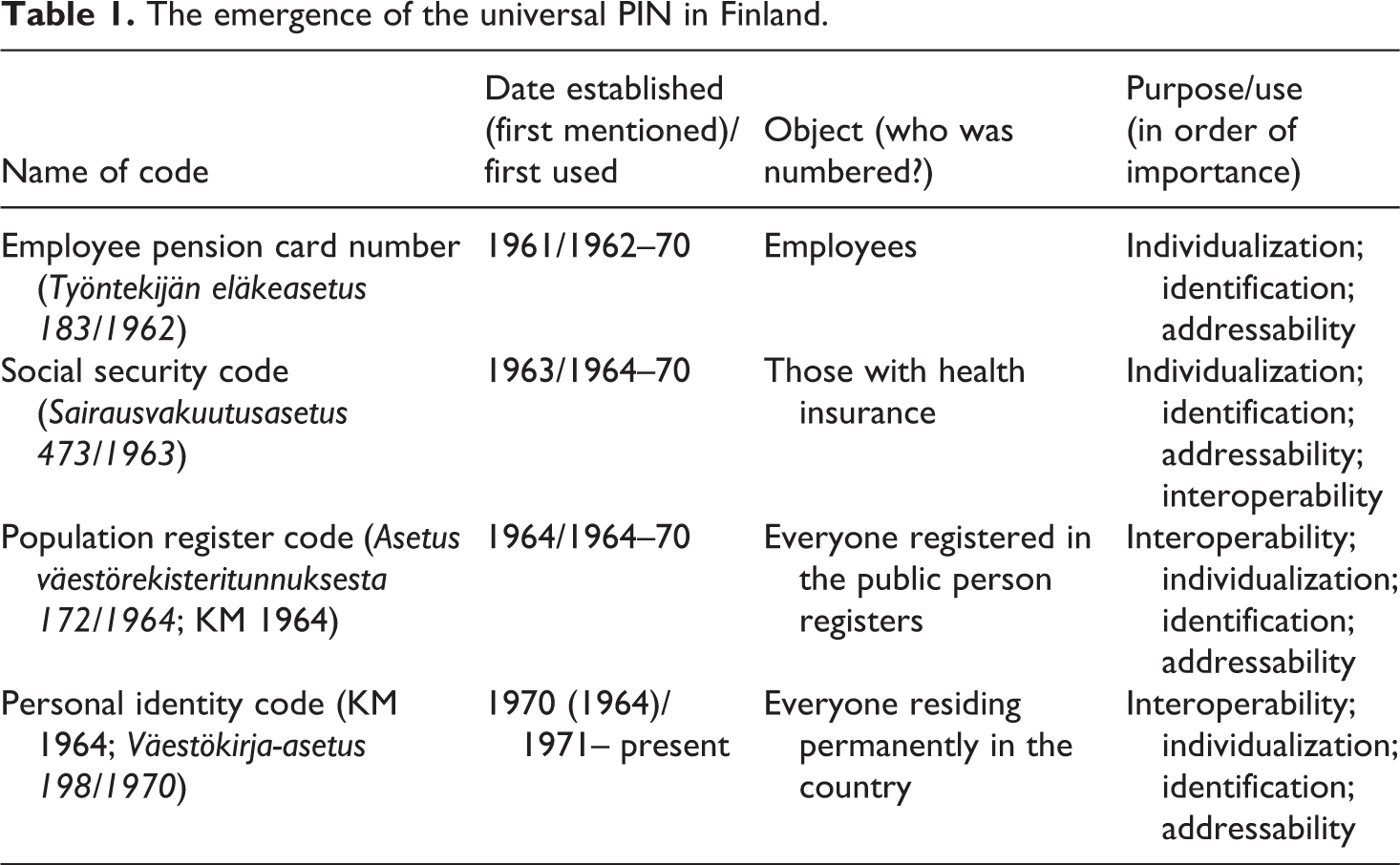
The PIN committee concluded that the employee pension card number – by then renamed the population register number – was the best possible identifier and suggested that it be used as an identifier in health insurance, employee pension, population, and other registers (KM 1964: 4–5). The committee also proposed the establishment of a new centralized population register (ibid.: 7). Perhaps the most important step towards the universal PIN was taken when the Decree on Population Register Code was enacted in 1964 as per the committee’s proposal (Asetus väestörekisteritunnuksesta 172/1964). As a result, two state agencies now issued PINs, but under different names: the Finnish Centre for Pensions continued to issue employee pension card numbers, and KELA started to issue social security codes (see Table 1 below on the emergence and transformations of the PIN).
As health insurance applied to every person living in Finland (Sairausvakuutuslaki 364/ 1963 : 1§), the whole population was to be numbered, but not at once. At the start of this process, the Finnish Centre for Pensions provided the employee pension numbers already issued on magnetic tapes to KELA to ensure uniformity in the numbers and avoid mistakes (such as issuing the same PIN to two or more persons). To ensure that everyone was assigned a number only once, the local population register keepers provided the newly founded local KELA offices with the personal details of those registered in their area, for use as a basis for the register. Reciprocally, KELA delivered the social security codes to the population register keepers to be marked as population register codes in the local population registers ( Asetus väestörekisteritunnuksesta 172/ 1964 : 6§). The issuing of PINs under two different names continued until the end of 1970, when the Population Register Centre, founded in 1969 to establish the centralized population register, started to issue PINs. Since this development, having a PIN has been detached from entitlement to welfare services and benefits, yet it is still commonly called a ‘social security code’ in everyday use.
The emergence of the universal PIN in Finland.
As indicated above, information technology was integral to the construction of the PIN and the register systems (also Kinnunen, 1998; see Bauer, 2014, on Denmark; and Puckett, 2009, on the development of the social security number in the US). The whole effort was also framed in explicitly technical terms in the media. Helsingin Sanomat, for instance, reported several times about the IBM computer that was acquired for and used in the employee pension regime and was the biggest and most effective in the country. 7 As computerization progressed, private businesses, such as banks and industrial corporations, also started to demand the unified identification code. 8
Merja Kinnunen (1998) summarizes that the PIN arose from the alliance of the welfare state, mathematics, and information technology. The code-based registers tied everyone to the population (ibid.: 131), and, aligned with information technology, they afforded specific state/citizen configurations (Bauer, 2014: 203). As the welfare state matured, it started to presume that people were registered and classified as individuals (Kinnunen, 1998). The Finnish PIN served – and continues to serve, even today – this pursuit of the individualization of citizens and residents by producing state-driven individuality, composed of date of birth and binarily categorised sex (and not, for instance, of region, as in Sweden until the early 1980s; kin; or marital status). 9 With a PIN, everyone can prove themselves to be ‘one’ and ‘me’, because the code identifies everyone as an individual. Thus, the code renders the PINned people dependent on the state and independent of other people for proving who they are. Simultaneously, the PIN makes it difficult to change identity, disappear, or come back with a different name and code. Altogether, the PIN enables the governing of society and the control of citizens and residents by means of the identification, registration, and documentation of individuals.
An operator of interoperability
Table 1 above summarizes how the Finnish PIN evolved from the early 1960s onwards, and how it functioned in the context of welfare state data management. Identifying people as separate individuals and making them identifiable for the provision of pensions, health insurance, and other benefits and services were highly important tasks of the PIN, but the sector-specific codes would have been sufficient to carry out these tasks. What was desired by launching the ‘universal’ code was interoperability, as Helsingin Sanomat made clear: ‘Gradually, as far as possible the aim is to get all public registers to use the same identification number, as the registers need to share a great deal of information with each other’. 10 This feature became the most important facility of the PIN. As a code allowing wide interoperability, it allowed and expanded to uses that shaped the welfare state and its citizens in ways that were not conceivable in the beginning. The code was originally planned to enable low-cost and rapid bureaucratic information transfer among public authorities, and to facilitate the production of official statistics. With advances in computing and information technology, the use of the PIN expanded and crept into new domains. It was deployed to facilitate massive data transfers among public authorities, and to serve as a tool for the real-time identification of clients in public services. In addition, the all-purpose code transformed state knowledge production by enabling the compilation of register-based statistics and, furthermore, opening up new possibilities for academic and administrative research. Finally, the PIN produced fluidity in people’s everyday lives beyond the welfare state, as private businesses quickly adopted the PIN for use in their databases and transactions. Such multiple uses were unimaginable in the early 1960s, when the Finnish PIN was introduced, and such an expansion was by no means intended.
Administrative fluency and bureaucratic effectiveness
The administrative registers and their data collection are intertwined with the building-up and maintenance of public welfare institutions and services like healthcare, social benefits, pensions, and education. Data processing, like public register keeping, is integral to bureaucratic power and the state’s capability, in terms of resource allocation and efficiency (Weber, 1922: 824–5). In relation to this, Susanne Bauer (2014: 193) notes that ‘the idea of mechanization has long shaped the approaches to organisation and management’, and points out that information technologies and electronic data processing have promised progress, efficiency, and the optimization of bureaucracies and the state. From this viewpoint, the ‘universal’ PIN has enhanced the bureaucracy of the welfare state tremendously in Finland and other Nordic countries by enabling interoperability. From the beginning of its use, the PIN made the administrative registers of public agencies linkable, which increased the efficiency and fluency of welfare provision and state administration, and reduced errors. Thanks to the all-purpose PIN, interoperability has been relatively uncomplicated, and it became an established practice in state administrations in Nordic countries well before ‘e-government’ emerged on the political or research agenda. In this respect, the Nordic countries are decades ahead of other EU states, where a variety of numerical identifiers are used for different administrative purposes and the desire for enhanced interoperability in e-government information systems is growing (Otjacques, Hitzelberger, and Feltz, 2007; Vandezande, 2011).
Regarding administrative interoperability, the most important usage of the PIN is the identification of persons in the registers and data management systems of different authorities, and in the data transferred among them. With the help of the PIN, the personal details of an individual can be accessed anywhere in public administration, and in health and social services, via a query from the Population Information System (PIS); private businesses can also make a PIS query for a charge (Digital and Population Data Services Agency, n.d.-b). The PIN has become the main device enabling government at the individual level, not only for the identification of an individual, but also for addressing that individual precisely, which ensures that pensions, benefits, salaries, and commissions go to the correct people. One of the most important uses of the PIN is to trace patients and their medical records. The PIN offers physicians, nurses, occupational therapists, physiotherapists, and other health care staff a tool for the efficient handling of referrals, and provides a means of identifying patients (Ludvigsson et al., 2009: 661). The code enabling interoperability is also utilized when, for instance, KELA receives the income information of recipients of unemployment or other social benefits, as well as student allowance, directly from the tax administration. These functions belong mostly to more recent layers of PIN usage in Finland, and these were added gradually, along with increases in the sophistication of information and communication technology (ICT) since the 1990s.
Register-based knowledge production
The PIN has a pivotal function in welfare state data sourcing and knowledge production. As noted above, Finland and other Nordic countries are famous for their comprehensive, well-ordered, and – since the 1960s – electronic public registers storing data on citizens, residents, and clients of public services. The PIN provides a crucial tool for the utilization of this data in knowledge production associated with the welfare state, because it allows data from different repositories to be aggregated, compared, and circulated among the users (Alastalo, 2009; Bauer, 2014). The PIN facilitates such operations, both as a code affording access to personal-level data in the registers and as a code that makes data in different public registers detectable and identifiable person by person. This dual function enables the deployment of the PIN as a device of interoperability among databases, indispensable for the emergence of the register-based knowledge production regime within the welfare state in Finland.
From an early stage, the PIN and PINned administrative registers have interlaced with information technology. This combination has transformed old and brought about new modes of statistical and academic knowledge production. It has engendered a new mode of population statistics production. In addition, new opportunities to link register data have boosted academic research and research for planning, policymaking, and administrative purposes conducted by state-related research organizations. In these contexts, the PIN is used, first, to link data from different registers reliably and, second, to link registers and other modes of data (such as surveys) together.
Statistics
By the early 1960s, the National Statistical Institute was already actively advocating the adoption of a universal PIN and the establishment of a centralized population register. It adopted – as did the national statistical institutes in other Nordic countries (Luther, 1993: 261) – the idea of an ‘archive statistical system’ (arkivstatistiska systemet), introduced by Norwegian statistician Svein Nordbotten. He proposed separating data collection from data processing in statistics production by storing all data in repositories for later use via an identification code given to each information unit (Nordbotten, 1961, 1967). In the Nordic countries, the PIN and PINned population registers became the backbone of statistics production, and today, they all have relatively similar register-based statistical systems. In 1970, data from the newly founded Population Register Centre was used for the first time to supplement the census (Luther, 1993: 261). In 1990, Finland became the second country in the world – after Denmark – to fully produce a register-based population census. As one statistical officer noted in an interview, ‘This personal identification system, which the Nordic countries and Finland have, enables reliable statistics on persons’ (an interview conducted by Alastalo in 2013).
Today, hundreds of annual statistics and several indicator databases on different aspects of healthcare and social services build on public register data, and Statistics Finland has announced that 95% of the data they use to produce statistics comes from administrative registers. Register-based statistics production was, for a long time, an exception internationally, and complicated statistical collaboration in the EU, for instance, because of the dominance of census and survey-based methods. However, over the past decade, the high costs of and falling response rates to the ‘traditional’ methods, together with the emergence of national population registries, have made register-based statistics more attractive and expedited their broader use (Bakker, Van Rooijen, and Van Toor, 2014; Coleman, 2012; Skinner, 2018).
Knowledge production in academia and research institutes
The opportunities offered by the PINned register infrastructure did not go unnoticed in academia or in state-related research institutes. In Finland, academic researchers first recognized the opportunities of the PIN for research in the mid 1970s. Finnish professor of sociology Tapani Val-konen (2007) recounts his discovery of the possibilities opened up by the PIN and new computer technology for the study of differences in socio-economic mortality: his study promised to involve lower costs and greater reliability than similar studies in which the register linkages were made manually. Finnish epidemiologists (e.g. Gissler and Haukka, 2004: 117) presented a long list of disciplines using register data: ‘epidemiology, clinical medicine, demography, health care research, jurisprudence, occupational health, pharmacology, social policy, sociology, and statistics’. Many researchers have praised register-based research for its reliability and coverage, as well as the good quality of the data (Gissler and Haukka, 2004; Jowell et al., 2007; Thygesen and Ersbøll, 2014).
Beyond academic research, the almost unlimited possibilities emerging from linking data from the PINned administrative databases have become indispensable resources for policy-relevant knowledge production. Particularly in health policy, public data repositories have become ‘infrastructural’ (Bauer, 2014: 203) for policy reasoning, and they have helped to promote the continuing epidemiological follow-up of populations and individuals. Susanne Bauer (ibid.: 203–4) concludes: This mode of knowledge production became a taken-for-granted rationality adopted throughout biomedical research, clinical trials, health services, evidence-based medicine, and public health. The epistemic spaces and regimes of population thinking emerged as a ‘Scandinavian’ mode of efficient organization of society. With the reorientation away from the welfare state during the 1980s and with the emerging genomic economies, the actual usages of these data infrastructures shifted.
An operator of everyday life
As a consequence of this, the PIN is an indispensable device for knowledge production and for the planning and administration of healthcare provision, as well as social and other public services and benefits in the welfare state. For citizens and clients of these services, it is a necessary tool that facilitates their practical relation to the welfare state and everyday transactions. Almost without exception, a person living in Finland needs a PIN if they want to interact with public services – for example, apply for maternity benefit or a pension, schedule a healthcare appointment, get a driver’s license or passport, or change their taxation percentage. The PIN facilitates such transactions as an identification code, and as an access code for clients (see Dodge and Kitchin, 2005). As the PIN is applicable to all welfare and other public services in the Nordic countries, it makes identification of the person automatic across welfare state administration. The PIN allows service providers to transfer documents and personal data easily and more reliably. For instance, when a person moves to a new address in Finland, it is enough for them to make an online notification, and the new address is automatically updated in all public administration databases (as well as customer registers of banks, insurance companies, and mobile operators; see below) by way of the PIN in the population register. Thus, people residing in Finland do not need to carry community tax bills and identification certificates from one office to another when they change residence or marry or divorce. In sum, the ‘one-fits-all’ PIN makes transactions with public authorities quite fluent for the client, and tends to reduce bureaucratic difficulties.
Given its emergence as a ‘smooth operator’ of transactions between citizens or clients and public services, the PIN has become more influential with the proliferation of electronic public databases (since the 1970s) and online interfaces for public services (since the 2000s). Every person with a PIN can apply, for example, for student, unemployment, or sickness benefits through the KELA website. For reasons of cyber security, the PIN is not used to sign into the online service; instead, a person can use an official personal access code or a personal banking code. Most people use a banking code associated with their PIN in the bank’s database, which allows connection to the same PIN in KELA’s databases. After successful access, the system automatically provides the client with an electronic application form with their name and address already filled in, as well as their children’s names and their PINs. If they have applied for benefits previously, their bank account number, information about their other social benefits, and, often, information on their income or economic situation are already filled in, because KELA’s data management system automatically retrieves this data from other registers. In Finland and other Nordic countries, applying for a variety of benefits and services related to social insurance and healthcare are everyday chores of the welfare state, conducted millions of times annually. Thanks to the PIN’s work in the background, the process – from identification of the client to the compilation of necessary data, and further to decision-making – is routinized and, in most cases, fluent.
The PIN has been adopted widely outside public services as well. As early as the 1970s, private companies started to use it in their databases. A similar development occurred in the US, where social security numbers, initially confined to a very specific purpose, spread into a wide variety of new uses (Puckett, 2009). The use of the PIN in Finland expanded widely when transactions in all domains of society started to become increasingly computerized in the late 1980s and 1990s. Today, it is a routine that applies, for example, when a person opens a bank account, applies for a loan, applies for insurance, opens a phone line, or buys or sells an apartment; in any of these situations, that person’s identity is certified by the PIN, which is checked in a database, and by their ID card or passport when affirming the contract. Over the past few decades, the PIN has been used in a large number of private customer or membership databases as a personal identifier, but such use is decreasing, due to data protection legislation and regulation that restricts ‘unnecessary’ listing of persons by their PIN outside public administration. 11 Thus, the PIN facilitates transactions widely in society and everyday life by making them more fluent, and by binding the partners of transactions closely to the code authorized by the state. As such an operator, the PIN functions primarily as the code of identification (see Dodge and Kitchin, 2005), but it also works as a token of the person’s trustworthiness, materialized by official ID cards and passports with the personal PIN printed on them. As the Nordic PINs are ‘universal’ – that is, one code applies to almost any transaction, and everybody has a PIN – they make trustworthiness self-evident and ‘automatic’ in everyday transactions. This, in turn, facilitates the maintenance of the generalized social and public trust characteristic of the Nordic societies (on the latter, see Rothstein and Stolle, 2008).
Indeed, the Nordic PIN is a ‘code of life’ (Dodge and Kitchin, 2005) that essentially modifies people’s relation to the state and other public authorities and to each other. It also greatly shapes the way people lead their everyday lives and manage a variety of official, economic, contractual, and social transactions in the Nordic countries. The PIN materializes social citizenship – citizenship based on social rights that entitle the person to social protection, care, and support that the state authorities are obliged to provide (Marshall, 1950; see also Johansson and Hvinden, 2013) – and brings it to the ‘street level’. It enables identification and recognition of an individual with a single code across a variety of public services, and it is therefore a necessary device to make eligibility and access to public healthcare, social benefits, and education a reality for each and every citizen. Furthermore, as the use of the PIN has been routinized widely in society, a mode of living in which most essential aspects of life are coded by a state-authorized identifier and symbol has become habitual in Finland and other Nordic countries.
New milieu: Data economies
As we have shown above, the Nordic PIN as a single identification and access code enables fluent interoperability of data management for administrative and research purposes, as well as for numerous everyday transactions. Recently, a new milieu for the use of the PIN and this specific capacity has emerged throughout the Nordic countries. Over the past decade and a half, policymakers, top government officials, leading regional public administrators, and academic experts in biomedicine, healthcare, and innovation policy have become enthusiastic about the possibilities associated with data mining of public population, healthcare, and social service registers (Bauer, 2014; Hoeyer, 2019; Tarkkala, Helén, and Snell, 2019; Tupasela, Snell, and Tarkkala, 2020). Pursuant to expectations, visions, and the ethos of global advocates of ‘precision medicine’ and a data-driven society (e.g. Mayer-Schönberger and Cukier, 2013; Pentland, 2013; Topol, 2012), many enthusiasts in Finland and other Nordic countries have suggested that, taken together, the national population, healthcare, and social service databases form a repository of Big Data. In their view of a data-driven future, data mining of the ‘goldmine’ of public registers and other databases will bring all imaginable blessings to society in the Nordic countries. It will keep Nordic life sciences and biomedicine competitive in global domains, resolve expenditure crises in healthcare and social services, boost innovation in business and the economy, improve administration and policymaking, and make medical treatment and interventions more precise and cost-effective. In this context, the Nordic PIN is praised as an invaluable device for flexible utilization of data. As the PIN functions as a single code that allows pooling of data from various public registers, it is seen as giving a great advantage to medical research, innovation business, and healthcare in each Nordic country.
Public policy aimed at extending the secondary use of health and social data in the public databases in Finland exemplifies this trend well. Finnish policy rationale also shows two emerging contexts for the use of the PIN. The term secondary use refers to all kinds of utilization of health and social data other than usage serving clinical or preventive healthcare, or client work in social services. In the early 2010s, many medical and ICT scientists, top government officials, politicians, and lobbyists from the semi-public think tank Sitra expressed concern that data in public databases was being utilized ineffectively, as far as the needs of research, policy, and the economy were concerned, and in light of the possibilities provided by advanced information technology. They began fervently advocating for policy, legislation, and regulation that would enable two things: first, wider secondary use of data for administrative, management, educational, and innovation and commercial R&D purposes; and, second, easier access to public data for a greater variety of potential users, private companies and research institutions included. For the advocates, the main problem was that the data was ‘stuck’ in administrative ‘silos’ behind legal and regulatory firewalls. New ‘enabling’ policy for the secondary use of public data aimed at removing or bypassing these ‘hurdles’ and encouraging smoother and less regulated interoperability that would allow more intense data sourcing from public repositories.
Biomedical research, especially medical genomics and biobanks, was the initial driver of the new policy in Finland, but economic viewpoints and justifications have become dominant in the policy rationale (Tarkkala, Helén, and Snell, 2019; Tupasela, Snell, and Tarkkala, 2020; on a similar tendency in Denmark, see Hoeyer, 2019). Policy documents, plans, reports, and ‘roadmaps’ (e.g. Ministry of Employment and the Economy, 2014; Ministry of Social Affairs and Health, 2017; Parikka, 2019; Sitra, 2016) present the potential of more intense and widespread utilization of the public health and social data as an economic matter in two contexts; they also highlight and reconfigure the importance of the PIN as the facilitator of interoperability. New policy has promoted more intense data sourcing of public databases in service of data-driven management of healthcare and social services. Deployment of data mining technology for the ‘strategic’ management and day-to-day administration of public service organizations was initially expected to greatly improve the efficiency of healthcare and social services, and considerably reduce the costs: Utilization of AI technology in different branches of healthcare and social services is one of the most important means to achieve reductions in healthcare expenditure.…With the help of ICT and its new methods, it would be possible to restrain the costs of healthcare and social services cumulatively by 2.5 to 5.5. billion euros in 2019-2028. (Neittaanmäki et al., 2019: 95)
Innovation policy is the predominant context in which the political and administrative urge to expand the utilization of population and person register data has emerged in Finland (Tarkkala, Helén, and Snell, 2019). In this frame, the PIN has assumed new uses and come to be seen as useful in a new way. In the 2010s, biomedical and healthcare R&D was highlighted as a key domain of innovation in Finland by public authorities, as well as by academic and business lobbyists. As framed by innovation policy rationale and practices, the Finnish population, public healthcare system, and – especially – public healthcare and population databases, along with systematic data sourcing, were seen as a national asset, a ‘treasure’ that would afford Finland an advantage in international competition. In the vision of policymakers and advocates, the uniqueness of the Finnish population and environment for health data sourcing makes Finland the world’s best ‘testbed’ for medical R&D that will attract international pharmaceutical and other medical enterprises and investors. This development, in turn, will increase business opportunities and alliances for Finnish researchers, companies, and start-up entrepreneurs, boosting growth in Finland’s innovative health sector.
In this innovation policy framing, the public collection and management of health data is primarily a matter of economic expectations, and, consequently, health-related data in public reservoirs becomes important as a resource for commercial innovation and R&D. From this perspective, the PIN is seen as a valuable asset of the Finnish health sector ecosystem in global competition, due to its uniqueness as a facilitator of interoperability in data sourcing.
Given the advocacy of more intense utilization of public data by a greater variety of users, the functioning of the PIN has started to acquire a new significance. Until the late 1990s, the PIN served data sourcing in the national context for administrative, policymaking, and research purposes. Although no specific data protection legislation existed before 1987, the use of public data was regulated by other laws (e.g. legislation on statistics production) and public authorities. In contrast, data policy for the new millennium has redefined the context for the use of the PIN by emphasizing the commercial prospects of health data sourcing in transnational domains and promoting ‘enabling’ public regulation. As expectations and operations within national innovation policy seek to accelerate the utilization of public health-related data, they connect public data repositories and the PIN with the emerging global health data economy. In the latter, the large amount of health-related digital data in both public and private repositories, as well as data generated by personal mobile devices and applications, is seen primarily as raw material, a commodity, or a business asset with commercial value (Prainsack, 2019; Sharon, 2016; Zuboff, 2019). The health data economy is embedded in a wider global economy of digital connectivity, dominated by giant transnational corporations that provide platforms and devices for digital communication and commerce (e.g. Google, Facebook, Amazon, Alibaba, Apple, Microsoft, and IBM). The GAFA corporations (see Prainsack, 2019) are capturing the dominant position in sourcing data on people and their lives en masse (Zuboff, 2019), which power the state and other public authorities have held for over two centuries. As a part of this trend, Google, IBM, and Apple, for example, have shown a growing interest in collaborating with academic, private, and public holders of big health data repositories (Powles and Hodson, 2017; Sharon, 2016). In the milieu of this digital universe, the role of the Nordic PIN is bound to change. It is quite likely that the PIN will increasingly function as a part of the encryption/decryption chain of codes by which data circulates across the borders of states, public and private organizations, and platforms and databases under multifarious technical, legal, organizational, and practical domains in which the power of ICT corporations is dominant. In this context, the Nordic PIN will probably be just another code among other technical coding solutions.
Conclusions
In this article, we have studied the history and characteristics of the Finnish PIN. According to Dodge and Kitchin (2005), the functioning of modern society requires a wide variety of codes for the identification of persons, things, transactions, and institutions. In this regard, Nordic countries are exceptional: the PIN is valid almost everywhere. The single PIN functions as an identifier, allows access to services and data across public services, and facilitates transactions and automates identification widely in society and everyday life. In this article, we have studied this unique ‘code of life’ (ibid.) by taking Finland as an example. We have traced the history of the Finnish PIN and examined its characteristics, with the aim of answering the following questions: First, how did the Finnish PIN emerge? Second, how have its uses been expanded and transformed? Finally, what kinds of administrative, political, technical, and sociocultural settings have enabled and modified it?
The example of Finland analysed in this article shows that the PIN was born of the specific needs of the welfare state – such as the provision of pensions and health insurance in Finland, and taxation in Denmark – at the moment that ADP had matured enough for large-scale use in public administration. However, the PIN was designed to be ‘universal’, flexible, and computable from the beginning, so that it would have the potential to exceed its original use for pension provision and serve the information transfer between the domains of public administration. As we have shown, these features facilitated the expansion and transformation of the Finnish PIN into a variety of uses, mostly unintended or even unimaginable in the early 1960s, when the PIN was launched. This gradual, almost imperceptible expansion, or ‘function creep’ (Dahl and Sætnan, 2009; Koops, 2021), over the last decades of the 20th century was interlaced with advances in information technology. This alliance made the PIN a crucial material and technical prerequisite of the political technology (Foucault, 2000c) that makes people and their lives governable in the Nordic welfare state.
In Finland and other Nordic countries, the PIN epitomizes an intersection of political practices of governing people and advanced data management technology (on the latter, see e.g. Ruppert, 2011, 2013). The PIN brings people and individual persons within the sphere of the welfare state and its provision of social security and care in many forms. First, it enables the collection, management, and transfer of data about populations and citizens for administrative and research purposes (see Bauer, 2014; Ruppert, 2011, 2012, 2013; Sætnan, Lomell, and Hammer, 2011). Second, it subjects people to control, actualized as data sourcing and interventions by public authorities and expert institutions. Simultaneously, it functions as an identifier that facilitates individuals’ access to public services and benefits, and it allows them a crucial means of managing their personal affairs in all essential domains of society.
This all-encompassing nature of the PIN is embedded in the specific character of the Nordic welfare state, and its ‘universality’ and flexibility make comprehensible the operations of that welfare state. The Nordic model – or ethos – of welfare has been seen as special, characterised by universal and equal eligibility for social security and services provided by the state (e.g. Hernes, 1988; Sørensen and Stråth, 1997), as well as widespread generalized trust in society (Rothstein and Stolle, 2008). If an ethos can be defined as ‘the principles of action and conduct that are disseminated throughout the texture of governing and give character and posture to the texture’ (Hänninen, 2001: 21), the PIN is the material and technical counterpart of the ethos of Nordic welfare.
We claim that the ability to enable interoperability among administrative domains, public authorities, and data repositories is the most important feature of the PIN in Finland and other Nordic countries. Due to this feature, the PIN can accomplish multiple tasks as an identifier, operator, and access code across the welfare state and society. As we have noted, administrative and data management interoperability with a single code has afforded – and affords today – many practices and arrangements that have shaped the welfare state and its citizens. The PIN allows uncomplicated and rapid transfer of information between public authorities and thus fairly facilitates bureaucracy and decision-making relating to welfare services and benefits. Moreover, PINned interoperability has shaped public knowledge production. First, it has enabled the replacement of the census by register-based population statistics production (Alastalo, 2009). The Nordic countries have been forerunners in this development, which has taken off globally in recent years, with the digitalization of public databases, creation of population registers, and introduction of the PIN for administrative purposes (Bakker, Van Rooijen, and Van Toor, 2014; Coleman, 2012; Skinner, 2018). In addition, the PIN has opened up new possibilities for academic research in Finland, most of all in demography, epidemiology, and the social sciences. Finally, the PIN as an intermediary device, working in the background of public and private bureaucracy, reduces complications and increases the fluency of everyday life for citizens, clients, and customers.
In recent years, a new milieu for the utilization of the PIN’s capacity for interoperability has emerged in Finland and other Nordic countries. Many innovation policymakers, government officials, and academic experts in biomedicine, healthcare, and ICT have become enthusiastic about the possibilities of public population, healthcare, and social services registers as Big Data and a resource for advanced data mining technology. In this context, the Nordic PIN has been highlighted as a national asset: the single code that allows data sourcing from multiple public registers and facilitates fluent interoperability between databases has been seen to provide a great advantage to biomedical research, innovation business, and healthcare in each Nordic country.
In particular, national innovation policy raises high hopes for the commercial potential of more intense utilization of healthcare and social service data (Tarkkala, Helén, and Snell, 2019), which attaches the public data repositories and the PIN to the emerging global health data economy. The latter is embedded in a wider global economy of digital communication, dominated by giant transnational ICT corporations. This tendency reflects the expansion and metamorphosis of the sourcing and utilization of public register data and the PIN in the Nordic countries. Initially, welfare state data management and its device of interoperability – the PIN – served public administration and social planning, from which the technology and practices enabling fluent interoperability expanded to serve knowledge production in a national context, through statistics compilation and academic research (Alastalo, 2009; Bauer, 2014). The recent turn has seen a modification of the interoperability of the Nordic welfare state data into a commercial asset, and the transformation of the PIN into an operator for the economy emerging around the datafication of healthcare (see Hoeyer, 2019; Tarkkala, Helén, and Snell, 2019; Tupasela, Snell, and Tarkkala, 2020).
In the corporate-ruled digital universe, the Nordic PIN may play a less significant role. It is quite probable that the PIN will increasingly function as a part of the encryption/decryption chain of codes by which data circulates across the boundaries of states, public and private organizations, and platforms and databases. In this context, the Nordic PINs are likely to be just one code among many.
Footnotes
Declaration of conflicting interests
The authors declared no potential conflicts of interest with respect to the research, authorship, and/or publication of this article.
Funding
The authors disclosed receipt of the following financial support for the research, authorship, and/or publication of this article: The research of Marja Alastalo was supported by a Kone Foundation grant for the project ‘Mobile People: Challenging the Population Statistics and Projections’ (2012–16) and an Academy of Finland research grant (no. 317303). The research of Ilpo Helén was supported by two Academy of Finland research grants (nos 292408 and 317303).

Notes
We dedicate our article to the memory of Professor Merja Kinnunen (1955-2021).