




Abstract
Emerging experience on the illiberal transformation of central government bureaucracy suggests that it is not a one-way street leading to a new equilibrium. The paper examines this dynamic and links it to existing scholarship on organizational change and administration. Firstly, we develop an improved descriptive-analytical frameworks grasping that transformation. Secondly, we examine a case of illiberal transformation, Hungary, to explore the patterns of underlying dynamics and compare them with expectations derived from theories of organizational change in bureaucracies. Based on depth interviews with key informants the paper identifies temporal patterns such as consecutive waves, reversals and delayed responses.
Introduction
In recent years, there has been a proliferation of studies on “democratic backsliding,” “democratic regression,” “hybridization,” and “illiberal transformation” (Blühdorn, 2020; Levitsky and Ziblatt, 2018). Although a growing number of studies have been conducted on various aspects and implications of this process, there is little systematic scholarship on how the core institutions and processes of exercising state power are changing. We refer to this latter phenomenon as the illiberal transformation of public administration. While there are some notable contributions that have examined this phenomenon, including works by Bauer, 2023, 2024; Dobbins and Labanino, 2025; Drápalova, 2024; Meyer-Sahling and Toth, 2020; Yeboah-Assiamah et al., 2025; Yesilkagit et al., 2024, there is a need for further research in this area.
The extant research in this field has historically centered on a limited number of specific aspects of illiberal transformation. In particular, the following dimensions of illiberal change appear to be of particular importance: the strengthening of patronage (Lotta et al., 2024; Story et al., 2023; Yeboah-Assiamah et al., 2025), the minimization of the role of bureaucratic expertise (Lotta et al., 2024), the implementation of downsizing and deregulation (Milhorance, 2022), and the exclusion of external stakeholders and the elimination of consultative arrangements (Dobbins and Labanino, 2025; Milhorance, 2022). In addition, the impact of illiberal populism on other administrative subsystems, such as local governments, has been examined by researchers (Drápalova, 2024). It is imperative to acknowledge the necessity for additional empirical and comparative research, given the acute nature of the phenomenon under study.
However, it is essential to recognize the need for more systematic theoretical efforts and, in particular, the development of an appropriate and relatively broad analytical framework to provide a solid foundation for such research. The first framework to conceptualize the consequences of democratic backsliding for public administration was proposed by B. Guy Peters and Jon Pierre (Peters and Pierre, 2019). Subsequently, an edited volume was published that expounded upon their model and applied it to several other subjects.
The theoretical ambition of this paper is to propose, on the basis of the aforementioned results, an improved analytical framework for studying the illiberal transformation of public administration. The present study is founded upon the framework developed by Bauer et al. (2021b), which, to the best of our knowledge, stands as the sole publication to date that has crafted a systematic analytical framework for the purposes outlined and has subsequently implemented this framework in a large-scale, internationally comparative empirical study. However, our approach introduces modifications to the Bauer et al. (2021b) framework in light of both empirical data and further theoretical ambitions. Most importantly, we introduce a qualitatively new element into the framework: time. There is a rich literature on how and why institutions in general, and public administration organizations in particular, change. However, the literature on illiberal transformation of public administrations has so far focused mainly on the historical, pivotal moments in time—in historical institutionalist parlance, critical junctures (Capoccia and Kelemen, 2007)—of regime change and their immediate institutional consequences, and has neglected the smaller or longer-term changes that occur after these major changes have taken place (Győrffy and Martin, 2022).
We suggest that illiberal reforms do not always simply go “from A to B,” as is often, if implicitly, assumed. Rather, like government organizations in other contexts, they change at different rates and in different ways. We derive expectations about these changes from theory and our empirical ambition is to test whether these expectations are supported by our data on Hungarian bureaucratic transformation.
In the next section we introduce our analytical framework based on extant work in general, and the empirical case studies in Bauer et al.’s (2021a) in particular. In the remainder of the paper, we aim to provide empirical evidence for the dynamic nature of illiberal administrative reforms using Hungarian data from 22 interviews with senior civil servants. Specifically, section three presents the questions, data, and methodology of the empirical research on illiberal dynamics. The fourth section outlines the key findings. Finally, we conclude the paper with a discussion and conclusions.
Conceptual and analytical framework
The administrative dimension of illiberal transformations
The analytical framework elaborated by Bauer et al. (2021b) provides a detailed and structured attempt to systematize the possible dimensions and variables of the illiberal transformation of government bureaucracies. 1 Moreover, the case studies in the same volume (Bauer et al., 2021a) empirically test the range of possibilities proposed by the framework and point to some of its limitations. Due to the limitations of the available space, we are unable to provide a comprehensive analysis and evaluation of the framework. Instead, we present our approach, which draws inspiration from the aforementioned framework. We will briefly highlight the deviations from the original framework in the following remarks.
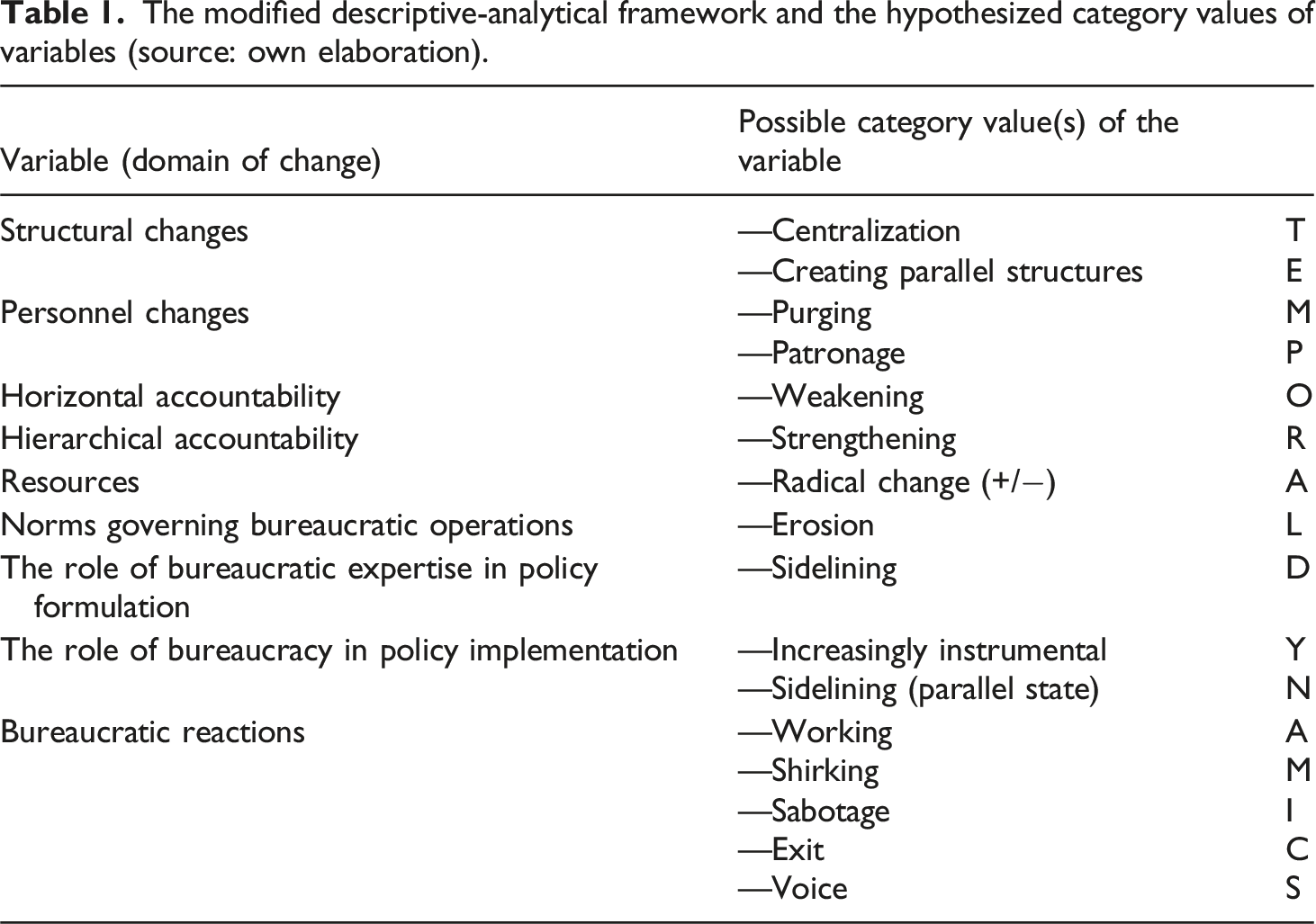
Our framework differs from the Bauer et al. (2021b) approach in that we do not define “general approaches” to bureaucracy by illiberal politics. The case studies of Bauer et al. (2021a) suggest that this concept and the categories involved therein (labelled as “sidelining”, “using” and “ignoring” bureaucracy) have limited descriptive power, as they are empirically applied and interpreted in different ways (see Di Mascio et al., 2021; Muno and Briceño, 2021; Strobel and Veit, 2021). We accept, however, the list of the main areas of possible policy interventions (termed “administrative reform strategies” referring to “structure”, “personnel”, “accountability”, “resources” and “norms”), although introduce some modifications. Specifically, we are incorporating new items into the list of these strategies, and we are defining clear category values as possible directions of illiberal changes to each of them.
First, we agree with Bauer et al. (2021b) that “structural changes” made to the central administration represent an important, perhaps paramount, domain of illiberal reforms. The case studies conducted by Bauer et al. (2021a) indicate that, more specifically, excessive centralization is a widespread pattern (see also: Drápalova, 2024). This includes the weakening or elimination of subnational and local autonomy and the expansion of the central government’s supervisory and control powers. But running somewhat counter to this trend, illiberal reformers sometimes consciously create parallel, competing organizations to keep administrative actors in check and thus to increase their own ability to control them (see the chapters on Nazi Germany and Poland). Therefore, with regard to the “structural changes” variable, we suggest “centralization” (Milhorance, 2022) and “creating parallel structures” (cf. Yeboah-Assiamah et al., 2025) as potential category values.
Secondly, illiberal administrative reforms often include measures targeting “personnel.” These measures include mass firings and a significant increase in political-ideological or personal-loyalty criteria in hiring, firing, and promotion decisions. These criteria are often used in place of or in addition to more traditional criteria, such as expertise and merit (Meyer-Sahling and Toth, 2020). Based on the empirical case studies we suggest that the two potential category values of illiberal personnel policies should be “purging” and “political patronage.”
The third variable in the Bauer et al. (2021b) framework is “accountability”, and the category value suggested by the framework is weakened horizontal accountability. The empirical cases of the volume support this claim. They suggest that lessening or eliminating different sorts of horizontal accountability is a fairly universal feature of illiberal transformations, ranging from limiting legislative oversight or freedom of information and transparency to legislating formerly illegal political or administrative practices or providing ex ante immunity or ex post pardons for wrongdoings (see also: Dobbins and Labanino, 2025).
Whereas the framework appears to focus on the horizontal accountability of public administration, other forms of accountability also appear in the case studies. We suggest that the accountability of bureaucracy toward its political masters should be scrutinized separately. Following Bovens et al. (2014), we propose to call this type of accountability “hierarchical.” We expect this type of accountability to increase during illiberal reforms, since such reforms aim to reduce bureaucratic autonomy and the discretionary power of public servants.
Fourth, as for “resources”, one pattern seems to be decreasing funding of agents whom the emerging illiberal center of government sees as hostile or autonomous, including subnational and local governments and central government agencies with the capacity to block or delay illiberal moves (see Drápalova, 2024, and the Hungarian and Polish cases in Bauer et al., 2021a). Thus, following Baumgartner et al. (2017), we propose that illiberal transformations are characterized by higher punctuations and more radical changes.
Fifth, the “norms” variable seems to attract the broadest scope of interpretation in the case studies. Indeed, conceptualizing and operationalizing the diverse types of norm erosion and change expected in illiberal transformations is a major challenge. We suggest that the deliberate erosion of liberal-democratic values as well as Weberian bureaucratic norms is likely to be a general feature of illiberal administrative reforms (e.g., Horwitz, 2021; Story et al., 2023).
Sixth, we propose two new variables as possible directions of illiberal reforms (inspired by the idea of “using bureaucracy” as a general approach in the original framework): using bureaucracy in policy formulation and using bureaucracy in policy implementation. As to the direction of expected change, the typical illiberal strategy is “not using” bureaucratic expertise in policy formulation, as illustrated by almost all the case studies. In terms of using bureaucracy in policy implementation, two possible illiberal strategies seem to exist: either using bureaucracy in a purely instrumental, military-like manner to implement policies while minimizing administrative discretion (as illustrated by the Hungarian, Polish, Italian, and Nazi Germany cases) or to sideline bureaucracy even in policy implementation through the creation of a parallel state or using the military for governance functions (as in the Venezuelan case).
Finally, a third set of variables in Bauer et al.’s (2021a) framework concerns bureaucratic reactions to illiberal change. The framework suggests three such reactions: “working”, “shirking” and “sabotage”. At the same time, it does not cover the Hirschmanian categories (Hirschman, 1970) of “exit” and “voice” (see also Bauer, 2023; Schuster et al., 2022). We assume that “working” essentially corresponds to “loyalty”. However, “exit” and “voice” appear to be relevant category values as well. The Hungarian case provides an illustration of the former, and the Brazilian of the latter (Hajnal and Boda, 2021).
Before we summarize our proposed analytical framework, we are going to introduce a new dimension to it: temporal change, or dynamics.
The dynamics of the illiberal transformation of government bureaucracy
We agree with Pollitt (2008: xi) that time is “a vital, pervasive, but frequently neglected dimension of contemporary public policy making and management,” and its importance is even greater in times of radical change.
Time appears in empirical studies of illiberal transformation—including the case studies in Bauer et al. (2021b) —to varying degrees. At one end of the spectrum are regimes with minimal tenure. In such circumstances (e.g., Italy in the 2000s), illiberal reformers pursue very short-term ambitions. At the other end of this spectrum are those cases—such as Nazi Germany and post-2010 Hungary in the same volume—in which both the foreseen and the actual time horizon of illiberal transformation extend to a decade or more. It is only in these latter cases that it is justified to move away from one implicit but important assumption of most studies of illiberal transformation. According to this assumption, the transformation proceeds from some initial point, A, to some fixed end-point, B. Instead, one may examine whether some of these presumed endpoints of illiberal transformation actually change over time.
Pollitt’s (2008) work is uniquely suited to serve as a theoretical anchor for formulating expectations about the temporal patterns and underlying mechanisms of the illiberal transformation of government bureaucracy. The volume—on which much of this sub-section’s treatment is based—meticulously reviews various streams of social science scholarship that have something to say about how organizational change in government plays out over time. It is, in particular, historical and path dependency frameworks (ibid., pp. 32–60) that offer clues regarding possible temporal patterns.
In such accounts of institutional change, the baseline scenario begins at a critical juncture, whereby “the structural (that is, economic, cultural, ideological, organizational) influences on political action are significantly relaxed for a relatively short period, with two main consequences: the range of plausible choices open to powerful political actors expands substantially and the consequences of their decisions for the outcome of interest are potentially much more momentous” (Capoccia and Kelemen, 2007: 343). The starting point of illiberal transformations can typically be thought of as such critical junctures that lead to a “punctuation” and are followed by a new period of “equilibrium” (Baumgartner and Jones, 1993). The resulting dynamics is similar to what we described above as the baseline, “from A to B” type of change. It is depicted as Pattern 1 in the below Figure 1. Expected patterns of illiberal changes (source: own elaboration).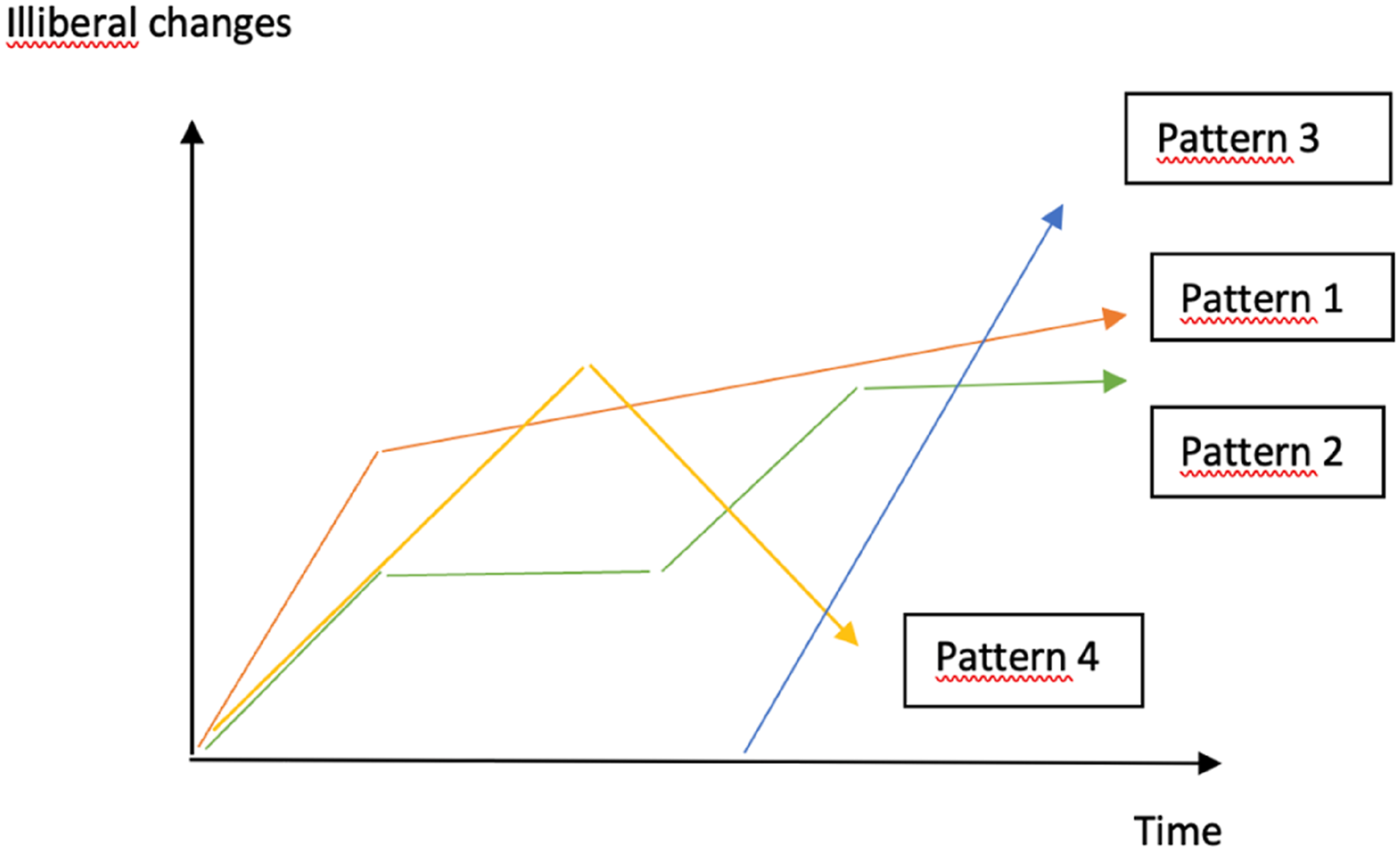
Streeck and Thelen (2005) argue that a limited degree of freedom exists for innovation even in times of extreme upheaval, but a longer series of relatively small, incremental changes can eventually lead to significant institutional change. In this sense it is misleading to interpret incremental change as a phenomenon of stability as contrasted to the idea of punctuations as large-scale transformation. They propose the concept of gradual transformation (Streeck and Thelen, 2005: 9). This type of change is depicted as Pattern 2 below.
Yet another type of change results from the simple—but often neglected—fact that certain changes “simply take a long time” (Pollitt, 2008: 16) and their further effects, too, are realized over time. Also, major changes, like policy dismantling (see Bauer et al., 2012) may require specific enabling conditions, for instance, strong legitimacy (Győrffy and Martin, 2022) that do not necessarily present themselves at the very beginning of the illiberal rule. Another explanation for the resulting dynamics, depicted as Pattern 3 below, might be that illiberal choices are also a function of learning by the decision makers.
Finally, Pollitt (2008: 51–59) identifies several dynamics that result from the cyclical nature of certain changes. These can typically be triggered by elements of the macro-level context (such as economic or political cycles). Depending on how the length of the cycles compares to the length of the observation there may be one or more “ups” and “downs”. Given our relatively short time horizon (described in the next section) our resulting expectation is formulated as Patter 4 below, consisting of one U-turn instead of cyclical changes.
The modified descriptive-analytical framework and the hypothesized category values of variables (source: own elaboration).
Research question, methods, and data
Our research question is the following: to what extent and in what ways is the illiberal transformation of Hungarian central government bureaucracy a uni-directional movement from its initial (2010) state to some fixed end-state? Based on our above review of extant theory we expect that the transformation features characteristic changes in the dynamics on the way, such as accelerations, halts, or even U-turns.
Our case study focuses on Hungary in the 2010–2019 period. The accelerated pace and extent, in addition to the temporal breadth, of Hungary’s autocratization during the observed interval serve to render it an extreme case of democratic decline not only in the European Union but among a broader set of comparable countries, such as OECD members. During the period under observation, the power holders in Hungary were in possession of a qualified legislative majority, thereby enabling them to establish a new constitution and to modify it at will, in addition to other fundamental laws that governed state institutions (see: Bozóki, 2015; Hajnal, 2021; Madlovics and Magyar, 2023).
Given the abundance of critical resources, including political and legislative support and time, it is reasonable to expect that the illiberal transformation of Hungary’s central government bureaucracy presents the broadest possible range of features, both qualitatively and quantitatively. This consideration renders Hungary a particularly noteworthy case of illiberal bureaucratic transformations.
Crucially, the case of Hungary seems to be particularly useful with regard to the temporal dimension too, because it covers almost a decade of consecutive rule by Viktor Orbán and his party and thus allows the study of changes that require a longer period of time. (Note that the time span of our inquiry stops in 2019 only because the collection of data happened in 2020-2021.) As an extreme case it is particularly useful for in-depth analysis of patterns and casual pathways (Seawright, 2016: 511). In summary, the relatively unconstrained character of the Hungarian case in terms of resources and time available, as compared to other contexts characterized by illiberal transformation, enables a comprehensive understanding of the full range of dimensions, domains, and temporal patterns of illiberal bureaucratic transformation. This configuration, as posited by LeCompte et al. (1993), can be regarded, in the Weberian sense, as an ideal-typical instance of the phenomenon under scrutiny, as it embodies the fundamental characteristics of the phenomenon in its purest form. It is reasonable to hypothesize that other cases of illiberal transformation, which are more limited and constrained and thus less pure, will feature different subsets of the patterns identified in our ideal-typical and all-encompassing case.
Our main empirical basis is a set of semi-structured interviews with key informants prepared as part of a broader research effort. We conducted the interviews prior to the development of the analytical framework used in this research, thus the interviews focused on analytical dimensions partly different from the ones we put forward here (see Hajnal and Boda, 2021). We argue that the most important variables in light of both the Bauer et al. and our own framework are, fortunately, included in the interviews, but the “resources”, the “hierarchical accountability” and most of the “bureaucratic reactions” variables are not, whereas some other dimensions such as different forms of “horizontal accountability” or “norm erosion”, were only indirectly covered by the interviews. In the latter case the data collected still offer indirect but relevant insights that are worth including in the empirical analysis.
The individuals who participated in the interview had previously held (or were, at the time of the interview, holding) prominent positions within the central government. An important inclusion criterion was that their (senior) management role spanned the periods before and after the onset of the illiberal transformation (i.e., 2010). This was necessary since a key feature of the interviews was that we asked respondents to contrast their illiberal-era experience with the situation characteristic at the onset of the illiberal transformation (Spring, 2010). Thus, the time scope of our empirical investigation is the 2010–2019 period. We identified interviewees using the authors’ personal networks, supplemented by snowball sampling. The participants represented a variety of ministries and had varying kinds of experience with the research subject. These differences seem to be mainly due to the different characteristics of the respective ministers, a topic that will be discussed in more detail below. The implementation of illiberal administrative reforms showed variations across the government. We conducted 22 interviews in Hungarian, with each interview lasting between one and 2 hours. When quoting verbatim, given the specific characteristics of the context such as the lack of legal protections against arbitrary dismissals and an atmosphere of distrust and fear, we anonymized certain details to avoid exposing respondents’ identities. For the same reasons we do not provide details such as organizational affiliations of our respondents. The quotes in this paper have been lightly edited for clarity in English. To improve interpretation, we supplemented the interview evidence with published research on Hungary’s bureaucratic transformation in the 2010s.
The analysis involved finding each reference to the illiberal transformation of bureaucracy (hereinafter: ITB) and coding it according to the dimension in which the change happened, the time of the change, and the direction of the change. The category values for the “time” variable are shown in Table A in the Appendix.
Next, we coded each change according to whether it pointed in the expected, illiberal direction or in a different, possibly opposite, direction (such as more vs less centralization). In addition, we incorporated a “no change” option to account for instances where respondents indicated that a particular variable’s value remained constant during a specified time period. We performed cross-tabulations of coding references to reveal patterns of change in reform dynamics. The analysis was performed using NVivo 12.
When interpreting the results of these cross-tabulations, it is important to keep in mind the following features of our data.
First, our respondents had unique, senior-level insights into their respective policy and administrative domains. In several cases, they played significant roles in the very governance reforms they described and assessed in the interviews. Consequently, they were more knowledgeable than almost anybody else about the substance of our inquiry. Given their long (and frequently diverse) public administration experience, they could understand, interpret, and assess the ITB features surveyed in the specific empirical contexts they oversaw (or once oversaw). However, their personal involvement introduces another layer of bias. The potential breach of anonymity may have limited their willingness to speak out and be critical. Indeed, in a limited number of cases, interviewees apparently perceived a high risk in being critical or even just participating in the research. Furthermore, given that many of our respondents have previously held government positions, or held positions at the time of the interviews, it is reasonable to assume that they generally share the same worldviews, beliefs, and values as the illiberal transformation agenda. Consequently, we expect them to perceive and report their experiences in a more, rather than less, favorable way that understates the illiberal nature of the reforms.
Second, we typically report our findings by counting the number of interviewees who conveyed given change pattern in a given time period. Interpreting these figures as different “measurements” or “observations” related to a given, fixed phenomenon would be misguided. Instead, interviewees’ perceptions are related to (partly) different referents. Occasionally, even the same respondent reported seemingly contradicting experience, such as a certain change in one context and the opposite in another. Consequently, differing perceptions do not constitute a contradiction or, especially, a limitation of our data. Moreover, the resulting numerical figures are not variables, so performing even simple arithmetic operations on these numbers would be misguided, too. The counts we provide are mere indications of the extent to which our interviewees shared an opinion. Given the nature of qualitative interviews the intensity of the opinions cannot be measured either.
Findings
To ensure easier reading of the data below, we have only included responses that claimed a change in the “illiberal” direction. We justify this approach by the fact that changes in the opposite (“liberal”) direction were reported quite infrequently (their proportion was less than 10%). (See the summary of our findings in quantitative terms in Table B of the Appendix).
The data suggest that there are three distinct temporal patterns of change, which we present in the subsections below. To increase the descriptive power of our concepts, we include short interview excerpts to illustrate how the different changes work out in the empirical context we are studying.
Pattern #1: “All at once!”
This pattern consists of an illiberal move at the beginning of the period and stagnation or near-stagnation after. It corresponds to the “critical juncture” approach, generally shared by the literature on illiberal reforms. We found that three of our ITB variables displayed this pattern.
Purging personnel
We noted a clear consensus among our respondents that 2010 signaled a marked strengthening of already-existing practices and policies with the aim of removing civil servants deemed untrustworthy or politically unreliable. A notable feature of these changes was the explicit institutionalization of these practices, in contrast to the informal approach of previous eras, illustrative of which was the very first law adopted by the newly formed legislature. Law XLIII/2010, among others, abolished all labor protection for civil servants, thus enabling employers to dismiss civil servants on the grounds of their lack of political trustworthiness (see also Hajnal and Csengődi, 2014.) Whereas the placement of personally or politically loyal people within civil service positions occurred in several waves throughout the coming years, the outright purging of the ranks of civil service happened mostly at the beginning of the examined period.
T he instrumentalization of bureaucracy
Seven respondents saw a marked initial (2010) increase in instrumentalization, some even seeing this as the defining characteristic of post-2010 bureaucracy. In response to the question, “Is there possibly a key difference between the pre- and post-2010 bureaucracy I haven’t asked you about thus far?” one respondent replied, “I think it’s become a lot more flexible…. It used to be that everyone left the office at 4:30 p.m. Now it’s rare; if you have to stay until 10 p.m. or on weekends, you do it…. The main difference is that it's much more politicized, and the bureaucracy has much less say; rather, it’s become a system that serves the politicians without any scruples or questions” [Source_02].
Four respondents saw a significant additional increase of instrumentalization during the post-2010 years, three of them locating this increase in 2016: “[In addition to central government bureaucracy] everything, including local governments, became the uncritical instruments of execution” [Source_15].
As these interview quotes indicate, the respondents did not necessarily see instrumentalization as evil. Whereas some regretted its negative impact on staff morale and on the overall quality of the workforce, others acknowledged its potential in increasing effectiveness and efficiency of bureaucratic operations.
The deterioration of bureaucratic norms
Five of our interviewees saw a clear deterioration in the norms governing the daily functioning of the bureaucracy immediately in 2010. The interviews focused on certain limited aspects of culture change only, namely on the strengthening (as we predicted) presence of what we term the “consiglieri”: that is, those who are greatly influential on bureaucratic operations but hold no formal position within the bureaucratic apparatus. The existence of such people is a clear breach of the received norms of proper bureaucratic operation.
“This [situation] operates at the level of the section chief, the deputy secretary of state, or even the secretary of state. My secretary of state was also somewhat shocked. Two weeks after the nomination, two well-dressed men in suits came to see him. They told him how things were in the industry, how things should be. At the end they asked, 'All is clear, are we done? Then he asked the minister if it was really serious. The minister didn't know immediately and had to look into it. Finally, the minister said, 'Don't argue with them; if there's any trouble, come and talk to me” [Source_05].
In connection with the 2010–2014 period, several interviewees highlighted the presence of the country’s then-strongest oligarch (Mr Simicska) in the entire central administration through a broad network of proxies. “From 2010, Simicska’s people completely penetrated the central administration. No decision could be made without his approval. All ministers and secretaries of state regularly went to him for approval” [Source_17]. 2
Apart from the—highly significant—phenomenon of “consiglieri” noted above, we found little evidence of the breaking of formal rules governing bureaucratic functioning. One such instance was the 2014 introduction, openly and admittedly in breach of the applicable law, of the ten-hour working day in the prime minister’s office: “Lázár’s [the then minister leading the Prime Minister’s Office] famous saying was when he introduced the law-breaking ten-hour working day that ‘these are not people, these are servants’” [Source_10].
Pattern #2: “Up and forward!”
Our analysis revealed no clear examples of gradual transformation. However, we did identify a recurring pattern that combines elements of Pattern #2 and Pattern #1: a substantial initial change, followed by successive, smaller-scale waves of change in a similar direction. Overall, this dynamic is more of a gradual change, even if the initial transformation, followed by subsequent waves, may be relatively large. Henceforth, we will refer to this modified pattern as “Pattern #2.” Four ITB dimensions exhibit this pattern.
Structural changes: Centralization
We argue that two almost diametrically opposing kinds of structural measures may characterize illiberal transformations: centralization and the creation of multiple, overlapping/competing structural entities. For the former, a vast majority of interviewees (15 of 22) agreed that 2010 signaled a wave of structural centralization, whereas not a single respondent disagreed with this claim. The organizational details of this centralization in central government bureaucracy are well documented elsewhere (Hajnal and Csengődi, 2014).
Despite unlimited centralization was already possible in 2010, of all the ITB features, this one showed the greatest additional dynamics throughout the entire post-2010 epoch. A total of 11 interviewees indicated significant additional centralization waves in the 2012–2019 period, most notably during the 2014–2018 period. Indicative of the extremity of the 2014–2018 centralization was one government initiative, the original version of which involved merging practically all of the 73 agencies—most of which had existed for decades or more—that operated under ministries into the supervising ministry. 3 In the end, the measure was somewhat softened but still amounted to a wholesale elimination of organizational autonomy at the sub-ministry level. After 2018, decision processes became further centralized: whereas before key decisions were overseen by the state secretary who led the prime minister’s office, from 2018 on, this role was largely taken over by the prime minister himself [Source_01].
Horizontal accountability
We asked interviewees about changes in social actors’ access to information about, and participation in, the workings of the central government bureaucracy (especially in policymaking). Whereas being informed and involved is not identical with keeping bureaucracy accountable, it is definitely a key prerequisite of such accountability.
The dynamics here is one of continuous increase in terms of its illiberal character, with a steep initial phase in 2010 and a somewhat less intense but essentially continuous further deterioration of public accountability subsequently. Three features of this trend deserve emphasis. First, “They [the government] involve only those actors [in consultations] who agree with the government” [Source 11]. Second, this selectivity is frequently replaced by an even more powerful mechanism: “They create pseudo-NGOs as window dressing …; they’re called civil society organizations, but they’re not in fact” [Source 09]. Omission and disregard of the government are often supplemented by active threat (with the withdrawal of funding) and intimidation: “X [minister] yells at the heads of local government associations for tapping their smartphones during consultation sessions with him, telling them, ‘This is not Parliament.’ And they’re scared to death and keep silent. Or even if they don’t, it doesn’t really matter” [Source 06].
Whereas the above mechanisms intend to formally—though definitely not substance-wise—maintain some extent of public involvement in the policy process, others aim to eliminate them as such. One of them is the use of individual MPs to propose bills, because in this case the public consultation process is simplified by law: “Individual members’ bills [in fact however put forward by the cabinet] constantly grow in number…” [Source 02].
A limited number of interviewees nevertheless had seen minimal or no changes in public involvement in bureaucratic operations over the last decade. Notably, all of these interviewees were fundamentally skeptical about that involvement and saw it as an overwhelmingly formalistic exercise with minimal impact on policy outcomes anyway.
Patronage
As was the case with the above ITB features, a majority of sources (11) were already reporting a significant strengthening of patronage in 2010. Importantly, several respondents reported a continued increase of patronage throughout the entire post-2010 years. Starting in 2014, however, the picture somewhat changed. Some respondents noted the highly dramatic and visible political/personal chasm between Prime Minister Orbán and his long-time closest friend and ally, the country’s then-strongest oligarch, Lajos Simicska, in 2015. In their view, prior to 2014, real control over ministries was exercised by Mr Simicska both personally and through various political and administrative proxies. As the schism between the two unquestioned leaders of the governing force grew, “his [Mr Simicska’s] people” were increasingly replaced by the prime minister’s trustees. As one interviewee put it, “Between 2010 and 2014, ministries didn’t even have the chance to control the agenda of cabinet meetings; everything was decided by Simicska’s people. The entire NFÜ [the agency in charge of overseeing EU funds] reported to [Simicska]. Orbán openly threatened [a senior official at NFÜ at the time] as a result… [Question: So the abolition of NFÜ in 2014 was abolishing Simicska’s control and ensuring that of Orbán?] Yes. And few people could preserve themselves. This means that political control became stronger from 2014 on” [Source_06].
Second, the long incumbency of the governing forces created additional room for politicization: “Over the last 9 years [three government cycles], the patronage system has reached down to the level of schoolteachers…. The situation is worsening because previously, clientelist networks were swept out every four years, but now they can reach down deeper” [Source_1].
Not using bureaucratic expertise in policy-making
The erosion of the reliance on bureaucrats’ expertise in policy formulation seems to be a long-standing feature of Hungarian central government, several interviewees having taken notice of this in the pre-2010 period. Many respondents (12), however, saw a marked trend break in 2010. The elimination of the already-weak role of bureaucracy in policy-making happened in most of the fields overseen by our respondents. Only two saw a positive shift in this time period. Notably, however, even these two respondents perceived only a temporary improvement; subsequently, both noted a definite decline along this dimension.
Several interviewees saw additional declines throughout the coming years, too. Similarly to the structure- and personnel-related ITB features discussed above, some respondents attributed this dynamic to the ever-increasing quest for politically controlling every aspect and segment of governance. “Between 2010 and 2014, there was still some optimism: finally, there’s a [parliamentary] supermajority; it’s possible to launch big reforms without making bad compromises. That lasted until 2013. From that point on, a very different, power-centered governance took place. In my policy area, elements of professionalism and technical expertise disappeared. Lázár [of the Prime Minister’s Office] totally killed this. Top-down execution …” [Source_01].
Another element—possibly in seeming contradiction with the previous one—was the increasing prominence of particularistic personal or business interests. “Starting in 2016 … decisions were clearly made according to individual interests…. Before, the case was that the school needed a new bathroom, and the contract was awarded to a crony business. But later, the crony business came and dictated the decision to be made. This was the case, for example, with introducing the [widely used software platform] in universities” [Source_02].
Pattern #3: “Better late than never”
Pattern 3 refers to those illiberal changes that do not occur at the beginning of the illiberal period but emerge at a later stage. We found only one change dimension that exhibited this particular pattern: the creation of competing, parallel administrative structures.
According to one interviewee, this ITB pattern was characteristic for the entire post-2010 era: “The administrative web is created so that nobody can feel safe and nobody has a sense of controlling their domain. There must always be two or three counterweights. Divide et impera. The prime mover of this whole system is the prime minister” [Source_11]. Three other sources, however, located this trend in the post-2014 years only. “This [period] is where I feel possibly conscious tactics against oligarchs [occurred]. Part of Orbán’s control is that he makes people compete with one another, such as Lázár [minister of the prime minister’s office between 2014 and 2018] and Rogán [minister of the cabinet office of the prime minister during the same period] … did. Later, others learned this practice from the prime minister, and ministers do the same within their own apparatuses” [Source_17]. 4
In terms of the number of respondents who reported the emergence of parallel structures, this ITB feature seems definitely occasional, although the qualitative strength of their claims is convincing.
Discussion and conclusions
Above, we presented an analytical framework of how illiberal political changes may affect the functioning of central state administration. The model is the main theoretical contribution of our paper that was designed to guide future research on illiberal administrative reforms. It builds on and departs from the one proposed by Bauer et al. (2021b). Using both theoretical and empirical considerations, we modified or omitted some elements of the original framework and included others, and a key development is that we defined specific category values for each “variable,” or change dimension, of the model.
Moreover, our framework includes a qualitatively new analytical ambition, that of identifying temporal changes (dynamics) other than the simple “from A to B” type change we termed Pattern #1. We hypothesized three different patterns, in addition to the baseline Pattern #1. Although other patterns may be possible, these were the ones directly relating to key mechanisms found in the literature of institutional change. Notably, whereas our empirical approach would have allowed the identification of other dynamics we found none.
The empirical component of our research utilized the variables proposed in our analytical framework and examined the temporal dynamics of their development throughout the initial decade of post-2010 illiberal Hungary. It is important to note that the data utilized in this study were derived from qualitative interviews conducted on illiberal administrative reforms prior to the formulation of the present framework. This phenomenon elucidates the scarcity of data on certain variables, including hierarchical accountability, additional forms of horizontal accountability (e.g., to the EU, the judiciary, independent agencies), and bureaucratic norms. Despite the fact that the data did not permit the utilization of the entire framework, they were instrumental in achieving the primary objective of the study, which was to examine the temporal dynamics of illiberal changes. This constitutes the empirical contribution of the paper.
The empirical findings confirmed that most dimensions of administrative change appear to have required a critical juncture to occur. Furthermore, we identified two instances of change patterns (“Up and forward” and “Better late than never”) that occurred well after the 2010 critical juncture. The explanation for this phenomenon is likely that illiberal reforms, by definition, represent paradigmatic changes (Hall, 1993). Consequently, their introduction necessitates the dismantling of institutional impediments and the potential sources of organizational resistance.
However, our data does not provide any clear examples of the “U-turn” Pattern #4. (Although note that other research points to the existence of such reversals even in the Hungarian context, see e.g. Boda, 2021: 374, on the partial re-decentralization of the educational system.) Consequently, the implicit assumption characterizing existing work on the illiberal transformation of bureaucracy—that such transformations should be seen as a finite move from some pre-reform Point A to an illiberal end-state Point B—is indeed somewhat simplistic.
The most frequent dynamics was the modified “Up and forward” Pattern #2. This pattern combines the historical institutionalist mechanisms of critical juncture and the “gradual transformation” mechanism put forward by Streeck and Thelen (2005). The critical juncture, in our case, was created by the landslide election victory of FIDESZ and the wholesale collapse of the party system characterizing the 1990–2010 period.
Pattern #3 (“Better late than never”) appeared in one instance only. Whereas we do not have direct evidence supporting our claim we interpret the empirical instance of this pattern (the creation of parallel and competing administrative structures) as the result of learning. Throughout the first half of the 2010s “strongmen” appointed by Orbán as key players of the central government machinery repeatedly run into open conflicts with the prime minister. Such an enabling of potential competitors of Mr Orbán became, according to some of our sources, an important element of administrative policy.
As previously mentioned, these considerations underscore the significance of critical junctures as preconditions of large-scale, radical changes.
At the same time, our results raise further questions that only further research can address. One of these concerns the lack of empirical instances of Pattern #4 in our empirics. The institutional change literature emphasizes the importance of cyclical movements, U-turns and reversals (see Pollitt, 2008: 51–59). It is important to note that these temporal patterns may signal the occurrence of policy learning. The absence of such patterns in our research may be attributed to the limitations of our study, the unique characteristics of the Orbán regime, or the inherent nature of illiberal transformations.
A final intriguing question we are addressing here concerns the relationship between temporal dynamics (and the causal mechanisms underlying them) on the one hand, and the dimensions of illiberal administrative reforms affected by those mechanisms (and thus featuring the corresponding change pattern), on the other. In other words, what are the reasons why certain dimensions of administrative change—such as centralization or patronage—feature the temporal dynamics that they do?
While the present study was not designed with the objective of identifying the (presumably multifaceted and varied) factors that shape illiberal reforms, the data collected allows for the formulation of some hypotheses. Győrffy and Martin’s (2022) assertion that legitimacy considerations may influence the temporal dynamics of illiberal reforms, including administrative reforms, is likely to be accurate. For instance, the erosion of horizontal accountability mechanisms was facilitated by subsequent increases in input legitimacy, which were precipitated by the electoral victories that occurred in the post-2010 era.
An alternative explanation for the observed differences in temporal dynamics is the time required for the changes to occur. Pollitt (2008: 16) asserts that certain types of changes require a significant amount of time. This dynamic is further compounded by the illiberal regime’s strategic deployment of loyal individuals within independent authorities and institutions of accountability, such as the Constitutional Court and the central bank. This phenomenon may also be indicative of the time required for the government to establish alternative sources of policy knowledge, such as think tanks with close ties to the government. In areas where there is a discernible connection to external actors, the illiberal transformation persists in subsequent years, even if it begins with a radical transformation at a critical juncture. In such areas, challenges related to legitimacy and complexity may have contributed to a prolonged implementation period for the transformation.
Nevertheless, in domains associated with the internal mechanisms of bureaucracy, the illiberal transformation could be executed in its totality. This was the case with regard to purging, instrumentalizing bureaucracy, and violating bureaucratic norms.
In addition to the above ones, our interviewees offered other possible explanations of the different dynamics. Several interviewees noted the leadership approach of various ministers, observing that illiberal reforms are not always implemented in a fully coordinated manner and that leadership discretion may be a contributing factor. This brings a certain contingency into the model. Others highlighted the politicized nature of specific policy domains, noting that illiberal reforms were introduced earlier and with greater intensity in those policy areas that were, for some reason, prioritized by those in power.
These remarks raise further questions about the temporal dynamics of illiberal administrative reforms. In our empirical inquiry, we did not differentiate between policy fields, ministries, or administrative areas, as our objective was to identify general characteristics of illiberal administrative reforms. A more in-depth analysis could and probably should make those distinctions. Our approach to the dynamics of illiberal reforms has been limited to the dimension of time, without considering the intensity or speed of these changes. In future analyses, we recommend incorporating these variables to more comprehensively assess the dynamics of illiberalism.
Footnotes
Declaration of conflicting interests
The author(s) declared no potential conflicts of interest with respect to the research, authorship, and/or publication of this article.
Funding
The author(s) received no financial support for the research, authorship, and/or publication of this article.

Notes
Appendix
Time periods used in coding the interview data.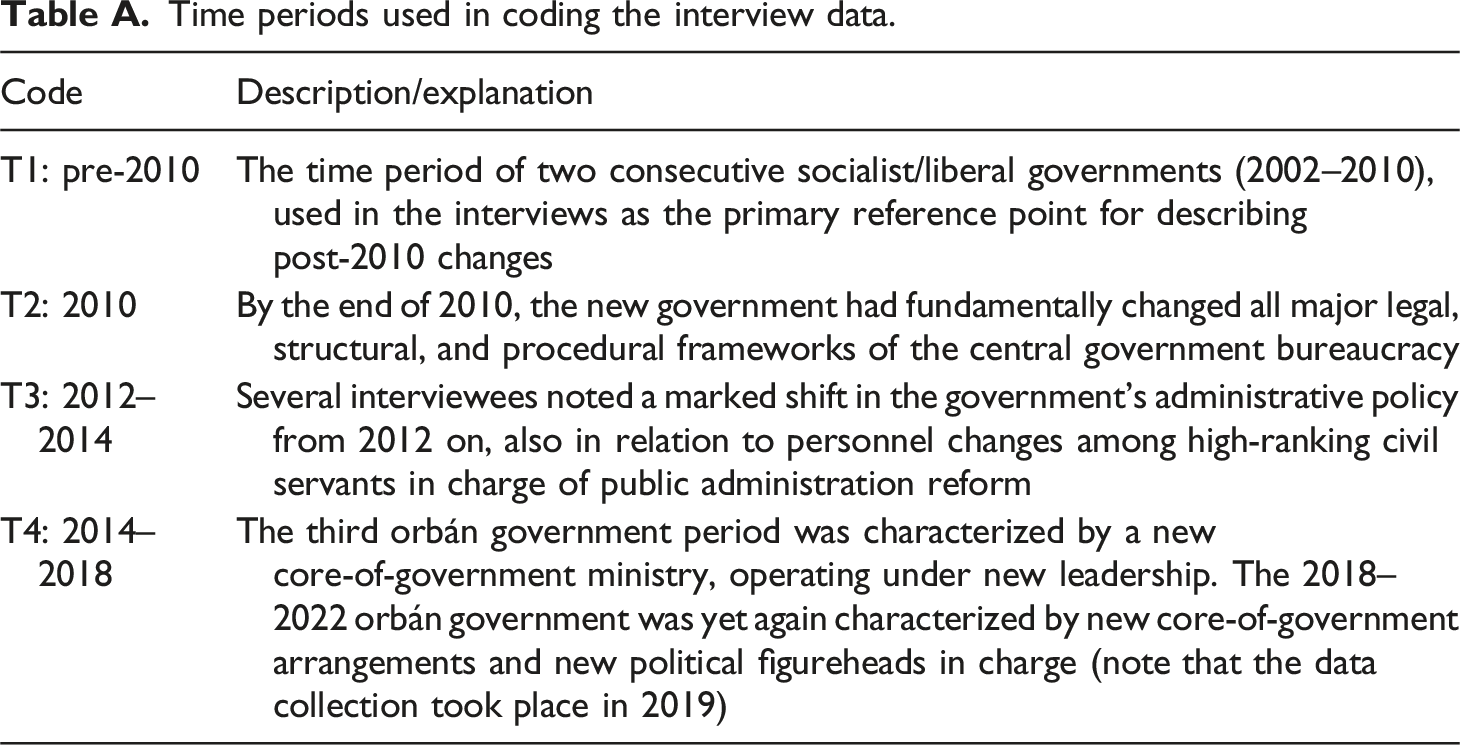
Code
Description/explanation
T1: pre-2010
The time period of two consecutive socialist/liberal governments (2002–2010), used in the interviews as the primary reference point for describing post-2010 changes
T2: 2010
By the end of 2010, the new government had fundamentally changed all major legal, structural, and procedural frameworks of the central government bureaucracy
T3: 2012–2014
Several interviewees noted a marked shift in the government’s administrative policy from 2012 on, also in relation to personnel changes among high-ranking civil servants in charge of public administration reform
T4: 2014–2018
The third orbán government period was characterized by a new core-of-government ministry, operating under new leadership. The 2018–2022 orbán government was yet again characterized by new core-of-government arrangements and new political figureheads in charge (note that the data collection took place in 2019)
Summary of interview findings (n. of interviewees who reported a move in the “illiberal direction” in different time periods).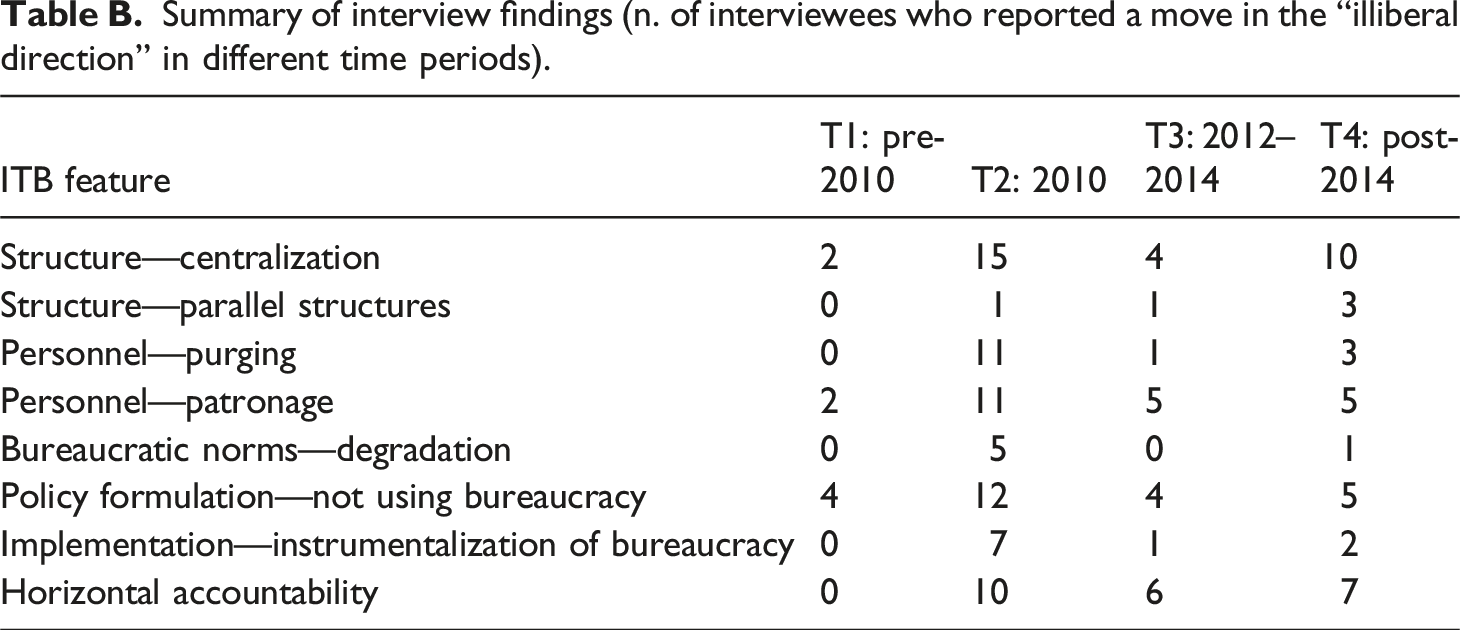
ITB feature
T1: pre-2010
T2: 2010
T3: 2012–2014
T4: post-2014
Structure—centralization
2
15
4
10
Structure—parallel structures
0
1
1
3
Personnel—purging
0
11
1
3
Personnel—patronage
2
11
5
5
Bureaucratic norms—degradation
0
5
0
1
Policy formulation—not using bureaucracy
4
12
4
5
Implementation—instrumentalization of bureaucracy
0
7
1
2
Horizontal accountability
0
10
6
7