



Abstract
Artificial Intelligence (AI) has become one of the most prominent topics in public policy and administration studies over the last years. Despite the attention to AI in this field isn’t entirely new, the universality of these group of technologies has radically increased the attention of scholars around the globe. This expansion of AI in the public sector entails the exploration of renovated foundations of analysis, not only to understand the novelty of these technologies, but also to connect these processes of adoption and implementation with other debates in public policy and administration. To do so, in this article we debate the need of an analytical framework of AI in the public sector based on the three levels of public administration: macro, meso, and micro. Also, we review the state-of-the-art in the field using the articles presented in the special issue on Artificial Intelligence and Public Administration: Actors, Governance, and Policy. Form here, we propose studying AI using a combination of macro, meso, and micro levels of public administration. We assume this will help to broadly apprehend how and why people, policies, and institutions interrelate with AI in public sector settings, and which effects can be expected from these processes in public administration.
Introduction
During the last few years, public administrations from around the world have accelerated the adoption and implementation of technologies based on Artificial Intelligence (AI), increasing the interest about this topic from scholars and practitioners alike. In contrast with other technologies, AI represents systems that can learn from the data and improve their performance. Although much has been written about AI in recent years, there is still a gap in terms of identifying and characterizing the main actors, governance structures, and related policies. This introductory article is intended to present the special issue on Artificial Intelligence and Public Administration: Actors, Governance, and Policy and is organized in four sections, including the foregoing introduction. Second, we display an analytical framework as the theoretical foundation, suggesting the need to study AI in the public sector looking at three levels of public administration: macro, meso, and micro. Then, we briefly describe each of the papers within this special issue, stressing their key findings for the study of AI in the public sector and their contributions to the abovementioned levels of public administration. Finally, we end this introductory article by addressing potential opportunities and challenges of studying AI in public policy and administration bridging the macro, meso, and micro levels.
Artificial intelligence in public administration: three levels of analysis from macro to micro
Different approaches have emerged to explore the implications of AI in public policy and administration. Literature reviews have presented diverse dimensions of AI in government, using different analytical frameworks and disciplinary perspectives (De Sousa and de Melo, 2019; Madan and Ashok, 2023; Valle-Cruz et al., 2020; Zuiderwijk et al., 2021). Medaglia et al. (2023) gauged them suggesting a group of categories of topics found in existing literature reviews about AI in government: (1) AI definitions and attributes; (2) AI techniques and methodologies; (3) AI uses and applications; (4) AI results, impacts, and benefits; (5) AI challenges and determinants; (6) AI strategies, best practices, and guidelines; and (7) ethical considerations about AI. Similar to other previous studies, these categories underline a range of features about implications of AI in public settings, but they put more emphasis in AI technologies rather than in the characteristics of public administration and policy.
Although we are aware of these different perspectives, based on the work of Criado (2021), Ewert et al. (2021), Moynihan (2018) and Roberts (2020), we propose our own approach to the recent study of AI in the public sector, by looking at three levels of analysis in public policy and administration: Macro, meso, and micro. Each of these categories unveil insights regarding AI in the public sector at different levels: (1) institutional/governance (governance regimes, political institutions, national strategies, regulation, etc.); (2) organizational/sector (areas of public services, public policy, networks, etc.); and (3) individual (behavior of public managers, street-level bureaucrats, policy actors, citizens, etc.). In general, within each of these public administration levels, AI technologies may produce consequences that scholars are studying separately. The next few paragraphs briefly explain each of these layers and their key aspects regarding AI in public administration. Figure 1 Levels in public policy and administration. Source: Authors’ own elaboration based on Criado (2021), Ewert et al. (2021), Moynihan (2018) and Roberts (2020).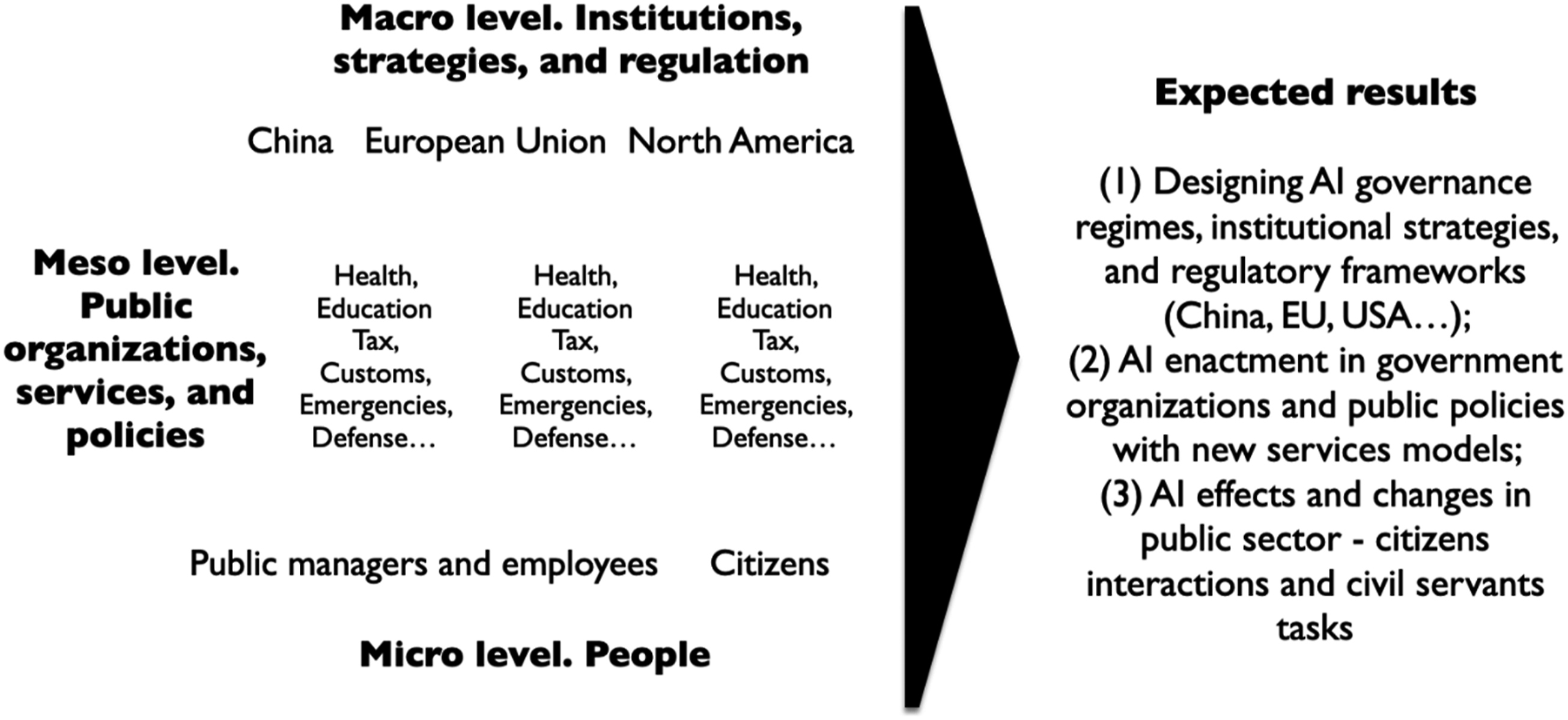
Macro-level of AI in public policy and administration: Designing AI governance regimes, institutional strategies, and regulatory frameworks
The first level of this analytical framework to AI in public administration relates to its governance at regional (i.e. China, European Union, North America, etc.) and national levels. AI technologies are representations of power, just like other previous technologies (Criado and Gil-García, 2019). Then, it is possible to speak about the “politics of AI”. The power of any technology is determined by the institutional and governance design carried out by the key actors of the political system and the capacity to solve big questions in our societies. Thus, assuming different configurations of power relations between actors and governance processes, resulting in distinctive political and governance outcomes, it is clear the importance of this layer of AI and public administration. To put it in another way, national governments are expected to shape governance mediated by AI, following their own distinctive patterns and priorities, based on different configurations of power relations between stakeholders, regulation requirements, or unique governance regimes. At the same time, AI technologies have their own affordances that will also shape these configurations in different political contexts. So, there will be a bi-directional effect between AI and the political context in which it is embedded.
Meso-level of AI in public policy and administration: AI enactment in government organizations and public policies
The second level of this framework of AI in public administration denotes that new public service models and public policy areas can be affected. This may include the existence of diverse approaches related to different public policy sectors and areas of service (health, education, security, defense, social policies, transportation, etc.) at different administrative levels (federal/national, regional/state, and local/municipal). AI technologies have important impacts on different organizational dimensions and public policy and services areas. AI and algorithms are powerful instruments to transform the relationships with third parties (individual citizens, private companies, and civil society) in the creation and provision of a new generation of public policies and services, more collaborative, co-produced, open, and oriented to citizens (Aceto et al., 2018). Following previous waves of technological innovation, AI may support some of the potential outcomes stated in the goals and objectives of a government initiative, public service, or policy, such as efficiency, cost savings, effectiveness, higher quality of service, innovation, etc. In addition, AI systems may promote new capabilities to transform different dimensions of public services delivery, including automation, complexity, holism, predictive capabilities, or innovating the models of service delivery itself.
Micro-level of AI in public policy and administration: AI effects on public employees and citizens
The third level of the proposed framework of AI in public administration refers to people and their individual behaviors: Public employees who work in, and citizens who interact with, public administrations. AI mediated governance can be understood as a performative process characterized by human interaction. During these processes, AI may shape the work of public employees and the interactions with citizens in public sector organizations. Therefore, it is necessary to understand this processes to identify their implications on government decision-makers, and third-party users, including dimensions such as discretion, trust, transparency, equity, legitimacy, citizen participation in decision-making, and collaboration in co-production, etc., or potential data biases in the process of algorithm training and implementation. Therefore, we must understand AI-human interactions and the performativity of algorithms in these processes, addressing changes in how humans work and make decisions in public organizations, and the perception and sense-making about AI tools by affected citizens. At the same time, the behavior of public employees and citizens shape the results of algorithms and AI in a two-way interaction process with multiple tools, capacities, and behaviors at stake.
Learning from Current research: A summary of the articles included in this special issue
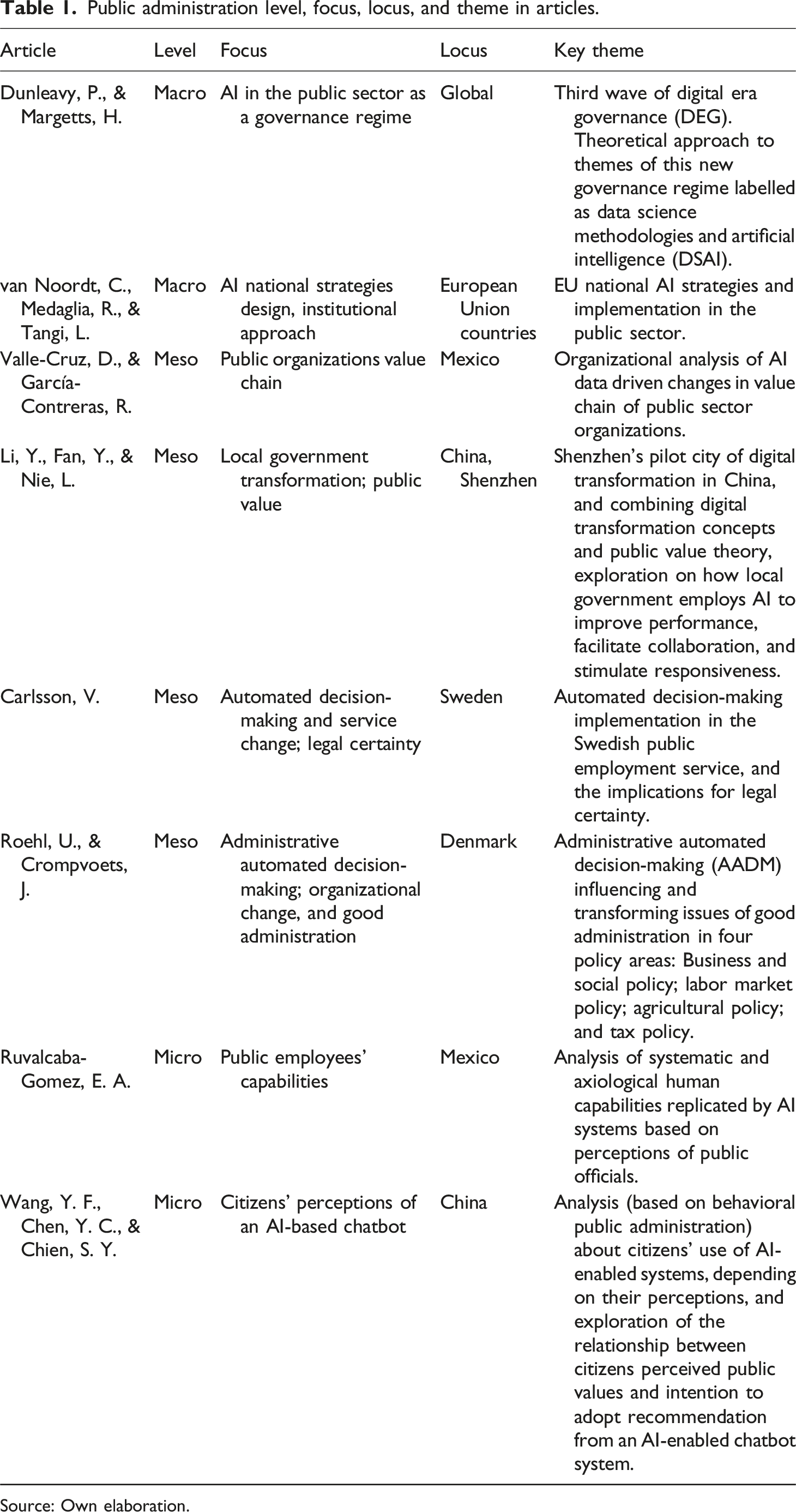
Public administration level, focus, locus, and theme in articles.
Source: Own elaboration.
The article by Dunleavy & Margetts, “Data science, artificial intelligence and the third wave of digital era governance”, is undoubtedly inscribed in the macro-level of AI, particularly, the theoretical debate about the consequences of AI in public sector governance. These authors describe the third paradigm shift in the digital era governance (DEG 3) model (named Data Science methodologies and Artificial Intelligence). The DEG 3 framework outlines a “quasi-paradigm that is not technologically determinist, yet centres on the management of technological, information regimes, and functional allocation changes as well as the already well-covered concerns of conventional public administration theories”. This approach is based on four themes of data science methods and AI in public administration: (1) data-intensive information regimes (previously, digitalization); (2) robotic state changes; (3) vertical integration & intelligent centre/devolved delivery restructuring (previously reintegration); and (4) horizontal administrative holism (previously needs-based holism). These themes comprise the governance arrangements, administrative rationale, and potential transformations of AI in public administration considering several components. Authors perceive them as pillars of a long-term research agenda for public administration and management. In addition, this emerging administrative model (DEG 3) will bring other important administrative alternatives related to outsourcing arrangements, information regimes, state organization, functional allocation, or administrative holism governance. In summary, this article supports the theoretical dimension of this special issue, and contributes to some of the prospective issues in connecting levels (micro, meso, and macro) of public administration with AI.
In the article by van Noordt, Medaglia, and Tangi, “Policy initiatives, for Artificial Intelligence enabled government: An analysis of national strategies in Europe”, one may find a study of the macro-foundations of AI in public administration looking at their strategic priorities. Since 2018 or so, national strategies have assembled different interest areas of national governments regarding AI and its development in different sectors. Based on a content analysis of 26 AI national strategy documents in Europe, the authors compare their focus and identify the most salient categories in these government documents, including the improvement of data access and data management as well as fostering collaboration with the private sector. Less attention is given to increase the internal government capacity or funding AI schemes, and they neither detail the implementation routes or accountability metrics, nor the focus on promoting AI from (to external stakeholders) or in (to internal actors in public settings) government. Therefore, this article contributes to a better understanding of the macro level of public administration and how an AI governance regime is adopting common features in the European region, whereas national governments maintain certain singularities and unique features based on their own political, economic, social, cultural, or administrative priorities.
In the article of Valle-Cruz & García-Contreras, “Towards AI-driven transformation and smart data management: emerging technological change in the public sector value chain” the meso-level is the focus by studying how public services value chain may change based on AI. Using a mixed methods approach (PRISMA literature review and a survey to active public officials with PLS-SEM multivariate data analysis) this article explores the challenges of AI-driven transformation and smart data management in public service organizations. Particularly, it is expected that public value chain outcomes will be transformed through the technological shift that AI represents. All things considered, these changes will take place with different rhythms at different regions or countries, whereas they suggest that this meso level of public administration it is also critically affected by AI technologies.
Following with the article of Li, Fan, and Nie, “Making governance agile: exploring the role of artificial intelligence in China’s local governance”, the meso-level of public administration is studied on a pilot city of digital transformation in China (Shenzhen). Combining digital transformation concepts and public value theory, the authors explore how a city government employs AI to improve performance, facilitate collaboration, and stimulate responsiveness. Based on mixed methods (combining topic modeling and qualitative analysis with Latent Dirichlet Allocation to content analysis of 103 policy documents), the study addresses the case studies of Pingsham district government, and Open Data Policy Lab in Futian district government, both in Shenzhen. Results of this article underline that governments tend to put more emphasis on the operational public service side related to internal benefits, than to the strategic dimension of value delivery outside the public sector, although service-oriented government transformation is rhetorically common. Also, the authors identify four dimensions of AI deployment in the public sector (data integration, policy innovation, smart application, and collaboration) and two roles of AI technology in local government (AI cage and AI colleague). All these categories have an impact on the meso-level of public administration and could be potentially expanded to other administrative layers.
In Carlsson’s “Legal certainty in automated decision-making in welfare services” article, we find an approach to the meso-level analysis with attention to the implementation of automated decision-making in the Swedish Public Employment Service, and the implications for legal certainty. This article analyzes how this principle of legal certainty is interpreted and defined during the practical application of automated decision making (ADM) in welfare services. The analysis draws upon a wide range of empirical material (15 personal interviews with public staff, policy documents, published reports, and working materials). Results show that, in practice, ADM processes are perceived as non-transparent and generate a relatively large proportion of incorrect decisions, while the implementation of ADM by welfare institutions has been encouraged due to the assumption that it strengthens public and democratic principles. Here, the meso level of public administration is tested with the analysis of a single case (policy/service sector and organization), addressing the implications of AI regarding the connection of ADM with welfare services, legal and management principles. Hence, this article contributes to explore the legal side of automated decisions in public organizations, and some of the emerging problems that public administrations must identify and prevent during these processes.
The article of Roehl and Crompvoets, “Inside algorithmic bureaucracy: Disentangling automated decision-making and good administration” is another example of meso analysis oriented to unveil how administrative automated decision-making (AADM) influences and transforms issues of good administration in four policy areas in Denmark (business and social policy; labour market policy; agricultural policy; and tax policy). This multiple case study in diverse Danish public administrative bodies (at distinctive layers of government, from municipalities to central government agencies) is based on empirical data (61 personal interviews, documents analysis and observations), giving strong salience to the AI techniques used in each organizational setting. Here, the authors identify six empirical relations between AADM and good administration, addressing the situation of public agencies with different types of decisions, political and professional complexity, volume of citizens served, or level of automation. Among other aspects, making transparent and comprehensible decisions or combining material and algorithmic expertise are key to design healthy AADM and promote good administration in public sector settings. Therefore, this meso-level article provides insights regarding automated-decisions and what factors public managers need to consider in their organizational settings.
The article by Ruvalcaba-Gomez, “Systematic and axiological capacities in artificial intelligence applied in the public sector”, explores the micro-level of public administrations with a comprehensive attention to competencies of public employees using AI technologies. This study presents a survey conducted to public managers in Mexico and, using Exploratory Factor Analysis, identifies systematic (related to the analysis and behavior of data) and axiological (related to impacts of values, ethics, and decisions) capacities from the perspective of public officials. The existence of these two groups of skills is of paramount importance as they might nurture and guide, for example, human resources policies and measures, including recruitment processes, internal training programs, or humans-robots collaboration in the public sector. Since this paper is focused on the micro level of public administration, it raises reflections, connections, and theoretical conclusions about human action, contributing to a novel categorization of the human capabilities that IA is imitating to develop public activities and services.
In the article by Wang, Chen, & Chien, “Citizens’ intention to follow recommendations from a government-supported AI-enabled system”, the authors investigate the micro-level of public administration from the perspective of citizens. Using the approach of behavioral public administration (BPA), this article studies how citizens use AI-enabled systems depending on their perceptions of this technology and explores the relationship between citizens perceived public values and their intention to adopt the recommendation from a governmental AI-enabled chatbot system. The article compares two AI communication strategies, featured-based and example-based, to test the conceptual framework (with an online-based experimental survey and data analysis using PLS-SEM). The results of the study pinpoint the salience of algorithmic transparency and privacy in AI systems’ citizens trust, also making familiarity with technology as another explanatory factor for this study. Hence, this analysis of the micro-level of public administration contributes to understanding the mediation process of humans demanding public services with AI systems provided by public authorities and suggests mechanisms to legitimate human-machine relations in public settings.
A forward-looking research agenda: bridging multiple levels of AI in public administration
Looking ahead, we can anticipate important challenges and opportunities for AI technologies in public policy and administration. They include topics such as theory development, research strategies, or multi-disciplinary analysis of AI in the public sector; research techniques and evaluation of AI in different settings; AI and public sector practice orientation, policy-cycle management, and service delivery outputs; or public employees and employment, citizens’ collaboration, and engagement; etc. It is beyond the extension of this introductory article exploring all of them in depth. Nonetheless, we argue that they could benefit from the analytical framework that we are proposing in this article. In our opinion, bridging the macro, meso, and micro levels should be seen as a precondition to moving forward the research field of AI in public policy and administration. Connecting these three levels will provide more thoughtful understanding to move forward, looking at a more dedicated and holistic approach to AI in the public sector. Hence, we suggest developing scholarly research in this area with studies analyzing more than one level of public administration at the same time, promoting understanding their (inter)connection from different perspectives.
In the Macro level of AI in Public Policy and Administration, future studies will need to understand the implications of big critical questions for states and governments. At a macro level, we have learnt that new theories in Public Administration and Management are emerging and how different countries are strategically promoting AI in different ways. We also need to improve our understanding of AI governance across countries and regions and how this may affect national administrative regimes and how these strategies could influence the overall architecture of the state. In addition, the differences among priorities in strategies fostering AI from and in public administrations are crucial to understand institutional frames and opportunities in different national contexts. Besides, the analysis of laws and regulations of different dimensions of AI (i.e. privacy, levels of risks and harms of algorithms, AI audits, etc.) and specific technologies (i.e. facial recognition, generative AI, etc.) should be addressed in future studies. At this level scholars will also have to reflect on the connections of public administration and AI, with democratic values and how political and administrative systems could be transformed in the future by this technological shift in the public sector. In practice, we must enhance our understanding of how private companies like OpenAI, Meta, Google, and Arthorpic interact with the government to promote the industry while adhering to legal and ethical obligations. Similarly, researching the ethical implications of AI-driven surveillance and social control is crucial to address issues such as mass surveillance and ethics concerns. It is also essential to examine how AI can contribute to existing social and economic inequalities within and between countries, potentially leading to new digital divides.
At a Meso level of AI in Public Policy and Administration future studies should examine the unique evolution of public organizations, services, and policies in different sectors of government activity. At this meso level we have advanced our understanding about the implementation of AI systems in different public policies and government organizations in different countries and governmental levels. It seems that new patterns, or modes of services are emerging, based on automated decision-making or value chain transformation, whereas it is not yet clear whether AI systems are fundamentally innovating the way public services are delivered or how they are interconnected with each other to provide holistic solutions to public problems, that are increasingly more complex and cross the boundaries of multiple sectors. Here, scholars also must study how data governance can be a key driver of fair and efficient AI outputs, mitigating data biases, or constructing data regimes adapted to different government agencies or areas of public intervention. In addition, this layer will be nurtured by the understanding of how to combine integration/centralization with distributed/decentralized systems of management, as combining these apparently contradicting approaches is one of the key opportunities for government innovation with AI in the future. Still, AI technologies must demonstrate their capacity to improve decision-making processes, augment organizational predictive capacities, transform their strategic planning, foster new governance structures, or even innovate in service delivery models. Scholars can also research the evolution of public-private partnerships in AI development to enhance accountability and transparency. They can explore how AI automates regulatory processes, monitors compliance, and enforces regulations. In addition, future studies should focus on how AI personalizes public services to meet individual needs and preferences. In all these respects, AI in public administration scholars will find avenues for future research.
Finally, the Micro level of AI in Public Policy and Administration should focus on the micro foundations of public administration and AI technologies, mostly the behavior of individuals both internally and beyond the organizational boundaries of government agencies. At this individual level, we have learnt about the new capacities that public servants need to develop to align with the requirements of a new civil service 4.0, working with robots who perform human activities, and interacting with citizens mediated by algorithms and AI technologies. Besides, there are increasing concerns with critical concepts in public administration, including citizens’ trust, confidence, or legitimacy of public institutions, and how they will evolve in different democratic (and non-democratic) contexts. At this stage, making these technologies more comprehensible and transparent for citizens may help, although future AI developments will probably transform the mediation processes and even the nature of these interactions. Therefore, scholars evaluating AI applications in the public sector must study the human side of design and implementation, collaborating with non-IT public managers/street level bureaucrats and citizens in these processes, and making clear that AI assessments must comprehend the full life cycle of algorithms in the public sector, from problem-definition to evaluation. In addition, at the micro level, we need to analyze the rise of new forms of digital citizenship. We also need to study how AI affects public servants psychologically, including their job satisfaction, motivation, and well-being. Additionally, we should explore how AI undermines human judgment in public decision-making, impacting critical thinking and questioning the ethics behind decisions.
Footnotes
Acknowledgements
We wish to thank all authors of this special issues for their important contributions, their hard work, and novel approaches to this emerging field of research. In addition, we are in debt with the expertise and ideas provided by reviewers during the process to improve the earliest versions of all manuscripts. Besides, we thank the team of Public Policy and Administration for their technical support during the production process. Last, but not least, we want to express our gratitude to Prof. Edoardo Ongaro, co-editor in chief of the journal, for his continuous support, patience, and insights over the whole editorial journey. His invaluable feedback made this special issue a reality.
Declaration of conflicting interests
The author(s) declared no potential conflicts of interest with respect to the research, authorship, and/or publication of this article.
Funding
This introductory article has been partially supported by the Agencia Estatal de Investigación, Research Grant PID2022-136283OB-I00, Spanish Ministry of Science, AEI/10.13039/50110001103 and ESF+.
