Abstract
Municipalities often collaborate with other stakeholders in smart city projects to develop and implement technological innovations to address complex urban issues. We propose the shared portfolio approach as an alternative way of collaborating, because we have identified possible limitations when the commonly used single-project approach is adopted in complex contexts, such as the smart city context. The portfolio approach enhances flexibility, an embedded focus and cross-project learning, because partners work on multiple projects – either in parallel or in succession – to develop multiple solutions to a specific problem. An in-depth case study is used to illustrate how the shared portfolio approach works. In practice, these insights can be used by public bodies who aim to collaborate in smart city development or by partners who work on smart city projects and wish to continue their collaboration in a portfolio setting. Conceptually, our paper develops a connection between cross-sector partnership literature and smart city literature by revealing how the shared portfolio approach could be an effective way to deal with the complexities of innovation in the smart city context.
Keywords
Introduction
A growing number of municipalities worldwide are experimenting with smart city projects, harnessing digital technologies to address urban challenges (Neirotti et al., 2014). As a result of this trend, a variety of smart city innovations have entered the urban environment, showcasing how digital technology can enhance the quality of public service provision in many policy areas, such as mobility, safety, healthcare, and education (Mora and Deakin, 2019).
Facing the complexity of urban challenges requires many municipalities to embrace collaborative approaches in which technological innovations are co-developed with multiple stakeholders, such as technology companies, research institutions, and residents. This cross-sector approach to smart city project development increases the legitimacy of project activities, contributes to reducing lock-in effects and the dependence on large technology vendors, and increases the chances of moving from experimentation to scaling. Moreover, involving a diverse range of societal actors brings together a wider variety of knowledge bases and perspectives on urban challenges, leading to approaches that can better respond to local development needs (Mora et al., 2019; Nesti and Graziano, 2020; Neumann et al., 2019).
The cross-sector partnerships (CSPs) sustaining smart city projects generate well-documented advantages, however, they also pose significant organisational challenges that have not received enough attention in smart city literature. These challenges mainly relate to the inherent complexity of managing multi-stakeholder innovation projects. There is evidence of an added complexity that stems from the ambiguous nature of urban challenges and possible solutions, varying views on how to address such challenges, unexpected backlashed caused by the exposure to the media and general public as well as concerns about privacy in the public realm (Hollands, 2015; Iveson and Maalsen, 2019; Meijer and Thaens, 2018).
How to best strategise smart city project development represents an overlooked subject matter of investigation, and the lack of a convincing argument has left a critical gap at the intersection between cross-sector partnership theory and smart city studies. Cross-sector partnership literature offers valuable insights into the dynamics of collaboration between project partners (Bryson et al., 2015; Page et al., 2015). However, most studied cross-sector partnerships have adopted a single project approach, in which partners work on one project to develop a single solution to a specific problem. This approach might not be suitable to exploit the full potential of smart city projects, because this context brings in a high-level of complexity (Appio et al., 2018). Our study contributes to overcoming this gap, by arguing that a shared portfolio approach to smart city project development may represent an optimal solution for coping with this strategic challenge. In a shared portfolio approach partners work on multiple projects – either in parallel or in succession – to develop multiple solutions for a single problem. This approach can enhance flexibility while ensuring an embedded focus and cross-project learning. These considerations build on the findings of our smart safety and security case: a smart city project initiated by the city of Amsterdam, the capital city of the Netherlands.
The rest of the paper is split into four main sections. Section 2 presents the theoretical framing of our study, where smart city project development is observed through the lens of cross-sector partnership theory. Section 3 discusses the methodology used to conduct the case study analysis. We provide background information that is relevant to understand the empirical setting and then highlight what data collection and processing methods have been used during the analytical process. Section 4 introduces the findings of the case study analysis. Finally, the paper concludes with Section 5 where we reflect on the practical and theoretical implications of our study, and we discuss its limitations and future research directions.
Theoretical framing
To address societal challenges, municipalities collaborate with other stakeholders in smart city projects in which the partners introduce technological innovations in urban settings (e.g. Baccarne et al., 2016; Kornberger et al., 2017). When this happens, smart city projects become an example of cross-sector partnerships (CSPs). Therefore, we decided to draw from the CSP theory to understand the dynamics and challenges of such collaborations (e.g. Bryson et al., 2015; Page et al., 2015).
Managing CSPs
CSPs have the advantage of bringing together different expertise (Emerson et al., 2012; Howard et al., 2016), tangible and intangible resources (Lee et al., 2017), and multiple perspectives on the problem that the project team intends to address (Seidl and Werle, 2018). Moreover, through embracing collaborative innovation principles, all project partners become responsible for the possible solution, increasing its relevance and effectiveness for multiple stakeholders (Stilgoe et al., 2013). Why and how the partners approach the project, however, tend to differ (le Ber and Branzei, 2010; Page et al., 2015; Van der Heijden, 2022). The partners come from different types of organisations and have different backgrounds, therefore, they hold multiple cognitive frames (McGivern et al., 2018; Vad Baunsgaard and Clegg, 2013; Van Marrewijk et al., 2016). As a consequence of these differences, the rationale behind the decision of project partners to join and participate vary in motivation and goals (Gray and Stites, 2013). This divergence is perceptible when comparing public organisations, which are most likely to pursue primarily social values, with for-profit organisations. For the latter group, gaining legitimacy, generating economic value, and increasing competitive advantage are the most common drivers (le Ber and Branzei, 2010; Murphy et al., 2015).
Perspectives on the project goals are likely to differ greatly across the project partners, because of their varying individual goals (Bryson et al., 2006; Dobusch et al., 2019; Majchrzak et al., 2018). Cognitive frames are used to interpret the problem and possible solutions and are constantly (re)negotiated during the collaboration (le Ber and Branzei, 2010). In the project formation stage, the initial partners make a first general agreement on the problem in order to select partners who could play a role in addressing the problem (Bryson et al., 2015). The identified problem is the common driver for which the partners collaborate (Selsky and Parker, 2005). The literature stresses that to move towards a shared understanding of the problem and possible solutions, it is crucial to collectively make sense of the project goals (Maitlis and Christianson, 2014; Seidl and Werle, 2018). To develop a shared understanding, different individuals shape each other’s meaning in their interaction (Maitlis and Christianson, 2014). This collective sensemaking process shapes the course of identifying and committing to collective goals and actions (Bryson et al., 2015) and makes it essential for producing outputs and impact (Gephart et al., 2010; Scott and Boyd, 2020).
When different interpretations of the project goals and ambitions or different ideas about how to address the social issue remain undetected and uncorrected, the risk is that decisions are made in alignment with some individual goals, while violating others. This could lead to conflicts in the project team and, in the worst cases, the failure of the collaboration (Zuzul, 2019). Consequently, the alignment between the individual goals of project partners with the overall goals of the project is of the utmost importance to ensure the commitment of the stakeholders to contribute to the smart city project. Research suggests that the partners in the project learn how to overcome different views on value creation by a dynamic process in which they move from contrasted views on the problem towards a shared understanding of the possible solution that should be developed in the project (le Ber and Branzei, 2010).
CSPs in the smart city context
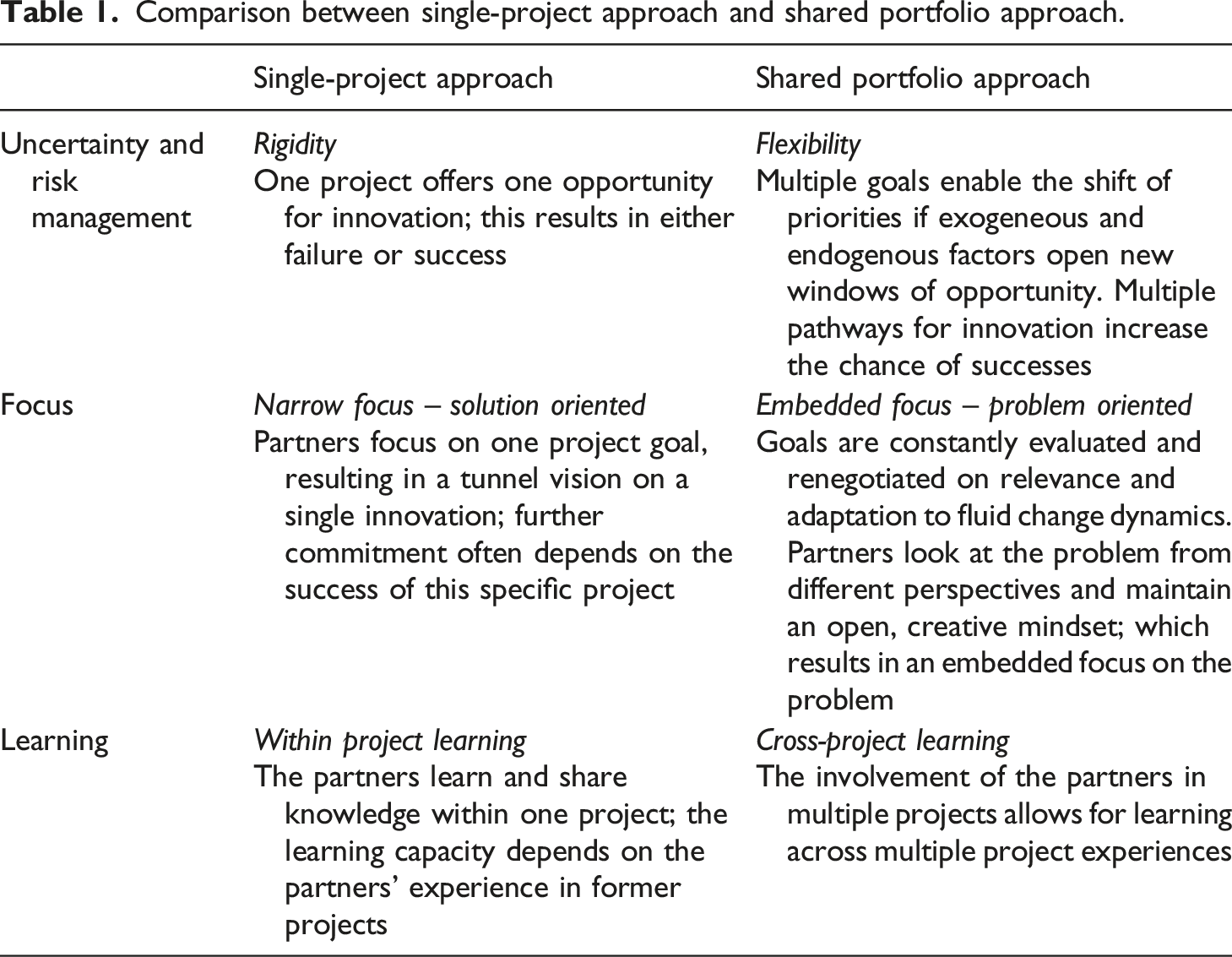
Most of the projects examined in CSP literature adopted a single project approach, in which partners work on a single project to develop a single solution to a specific problem. The single project approach might work in contexts where the problem to be addressed is relatively straightforward and unambiguous, and where partners can easily agree on a trajectory to work towards a solution together. However, in the case of smart city projects, these conditions are often not met (Appio et al., 2018). Urban problems bring a high-level of complexity and tend to be very contested, resulting in many perspectives on the problem and solution, often because of differences in values and organisational goals. In addition, there is not only ambiguity about what the problem is but also what solutions might be proposed; there may be various ways that lead to Rome. Also, the use of digital technologies in the public realm gives rise to many civic concerns around privacy, data management, and data protection. There might be strong public controversies for example around the use and storage of personal data (Stikker, 2019). Considering these characteristics, a single-project approach might not be suitable to exploit the full potential of smart city projects for the following main reasons, which are respectively associated with (1) Uncertainty and risk management, (2) Focus, and (3) Learning. These three dimensions will then be used to guide our empirical analysis.
First, partners adopting a single project approach work on a single innovation to address a specific problem. Consequently, the chance of success depends on one pathway toward a specific solution. That pathway could either lead to success or to failure, creating an all-or-nothing situation. The digital technologies typically used in smart city projects, however, are of an experimental nature. In addition, they come with complexities, uncertainties, and ambiguities, because of the high speed of technological developments and ethical considerations, such as privacy (Perera et al., 2014). Thus, a single project approach is likely to prevent the partners from including new technological developments and new insights emerging during the project and hence limits flexibility, increases uncertainty, and makes risk management difficult.
Second, partners using a single project approach work on one specific innovation. This could create a tunnel vision on the scope of the project. Consequently, this might lock out other possibilities to solve the problem and limit creativity and an open mindset to approach the problem. In addition, a single project approach makes it more difficult to include and adjust to feedback – that goes beyond the narrow scope of the project – provided by external stakeholders. This is important, because the partners work on innovations for which the input and involvement of external stakeholders are extremely important (Stilgoe et al., 2013). Thus, a single-project approach implies a narrow focus on one goal that might prevent project partners from looking at the problem from different angles.
Third, project partners using a single project approach work on a single innovation and often collaborate for short-term periods. The knowledge and expertise of the project team depends heavily on the experience of the project partners in previous innovation projects. Making sense of the complex smart city context and the perspectives of the different partners, does however, take time and demands experience. Therefore, the partners need to gain insights that form input for the sensemaking process which sharpens the problem and needed solution during the project (le Ber and Branzei, 2010). The learning process of the partners might be limited to the lessons learned from a single innovation project.
A shared portfolio approach to smart city development
Building on research developments in strategic alliances and innovation studies (e.g. Piening et al., 2016; Sun and Lee, 2013; Wassmer, 2010), we suggest countering the drawbacks of the single project approach by considering a shared portfolio approach to smart city development, in which partners work on multiple projects – either in parallel or in succession – to develop multiple solutions to a specific problem. A traditional portfolio is managed by one organisation and allows organisations to engage in multiple innovation projects simultaneously with different partners (Wassmer, Li, & Madhok, 2017; Wassmer, 2010). The approach spreads risk and possibly overcomes uncertainty. This is needed because it is hard to predict the success of an innovation project beforehand (Klingebiel and Rammer, 2014).
Innovation performance is positively affected by a greater breadth of innovation activities, especially in contexts with high levels of uncertainty (Klingebiel and Rammer, 2014). This resonates with the smart city context, where urban challenges come with uncertainty because they are often complex and ill-defined. In a portfolio setting, organisations gain more information about the different projects enabling them to decide upon the likelihood of success. With this information, organisations can select projects for further investment. In addition, a portfolio approach enables collaboration with a different set of partners in each project. Collaboration with different partners is an effective strategy to gain access to new resources (e.g. Wassmer et al., 2017; Wassmer, 2010) and to learn from others (e.g. Jiang et al., 2016; Muthusamy and White, 2005).
Therefore, a shared portfolio approach, in which multiple partners work on one portfolio, might offer important benefits for smart city ambitions. Multiple goals across innovation projects offer flexibility. This enables the shift of priorities if new opportunities occur. Furthermore, multiple projects create multiple opportunities for innovation. This makes it an effective way to manage uncertainty and risk, as the partners can still continue working on successful projects if other projects fail.
In addition, a portfolio of projects allows the partners to be involved in multiple (follow-up) projects, promoting an embedded focus on the problem that the partners aim to address. The goals per innovation activity can be constantly evaluated and renegotiated on their relevance related to the overall ambition of the partners. This stimulates an open and creative mindset, which enables the partners to look at the problem from different angles.
Last, the partners are involved in multiple projects with additional partners, enabling the transfer and combination of knowledge and resources. Experience accumulates across the projects (Castro and Roldán, 2015), enabling learning across projects.
Comparison between single-project approach and shared portfolio approach.
Methodology
We present an in-depth case study to theorise on how a shared portfolio approach could support innovation. An in-depth case study (Robson, 2011) provides an ideal design to gain a deeper understanding of how this approach works. Therefore, a case was selected that involves stakeholders from different sectors who applied a shared portfolio approach in developing technological innovations. Furthermore, we were interested in the development of the portfolio over time. Thus, another criterion was that the portfolio is in the development phase with the potential to have a post-portfolio impact on smart city development (Van Doren et al., 2018; Van Winden and van Den Buuse, 2017).
Research context
Amsterdam, the capital city of The Netherlands, has a longstanding reputation as a city that experiments with digital technology with multiple stakeholders. In the late 1990s, the city had a significant community of idealistic underground internet pioneers shaping new digital technologies to serve citizens and create a better city (Stikker, 2019), and local government was largely supportive. Later, the local government was one of the early movers in Europe in adopting active strategies to deploy digital technology to improve public services (e-government), mobility, security etc. Throughout the years, Amsterdam has promoted a multi-stakeholder and civic approach to urban technology. Rather than mainly relying on large technology companies or vendors as “providers” of technology solutions, the city government has always favoured a co-creative approach, engaging with local activists, knowledge institutes, citizens collectives and smaller local companies. In 2009, Amsterdam launched its first smart city strategy, an integrated approach developed in a cross-sector partnership, that aimed to run technology-oriented projects to address societal problems and challenges in the entire metropolitan area of Amsterdam (nearly 2.5 million inhabitants). Over the years, Amsterdam Smart City (ASC) morphed from a project-oriented organisation with a small number of partners and a limited number of projects into a community of urban innovators, public, civic and private, with approximately 6000 innovators striving to develop and apply digital technologies to develop innovative solutions for the urban area (About Metropolitan Region Amsterdam, n.d.; Amsterdam Smart City, n.d.). ASC serves as a platform for discussion, knowledge sharing and capacity building. Meanwhile, in 2015 the city opened a Chief Technology Office (CTO), a 30-staff dedicated innovation unit within the municipality that is tasked with supporting municipal departments with digitalisation in collaboration with users, tech companies, and other stakeholders. CTO works on projects in the field of e-health, circular economy, smart mobility, sharing economy, safety and security, and innovative procurement.
Research setting
In this paper, we examine the smart safety and security case: a smart city initiative where a variety of digital applications are developed and tested to improve safety and security. The projects are situated in the area around the Amsterdam ArenA, a multifunctional stadium (the home base of Ajax football club) that was built in the 1990s as the landmark of a new leisure and entertainment district, with cinemas, concert halls, and retail outlets. The area is located in the south eastern fringe of the city and is well accessible by public transport. Over the years, it has developed into a large entertainment district area of national significance. Given its function, traffic management, crowd management, safety, and security have always been key concerns in this area.
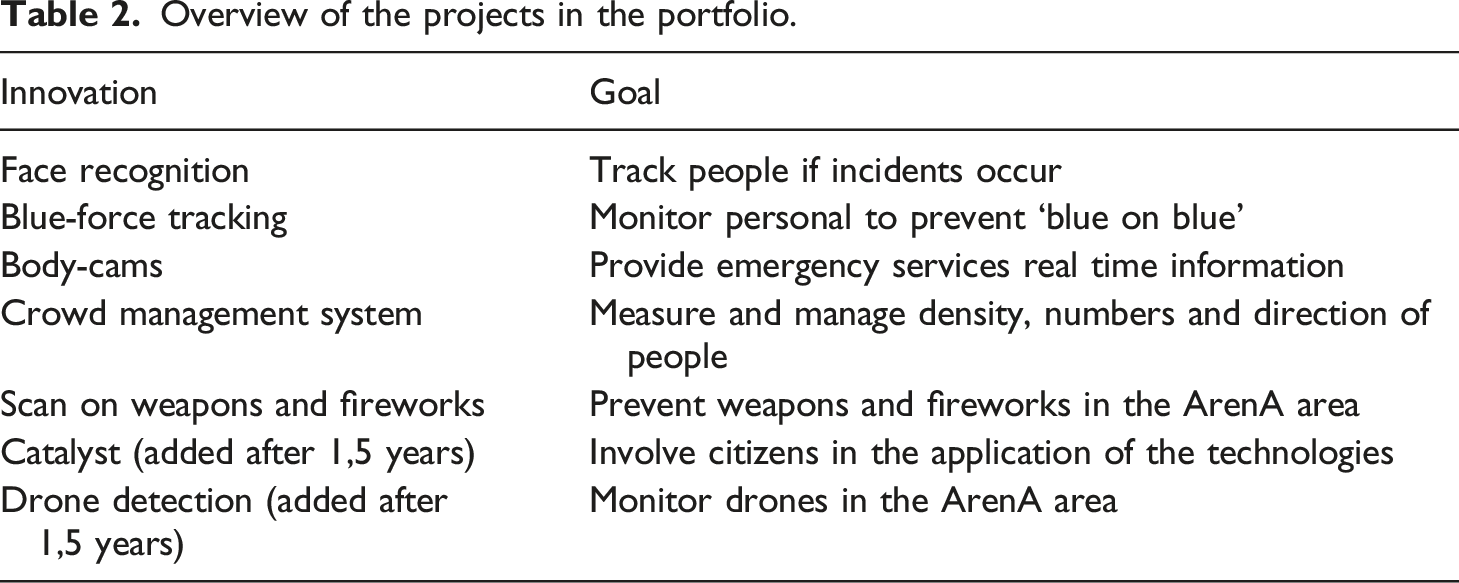
Overview of the projects in the portfolio.
Data collection
Overview data collection.
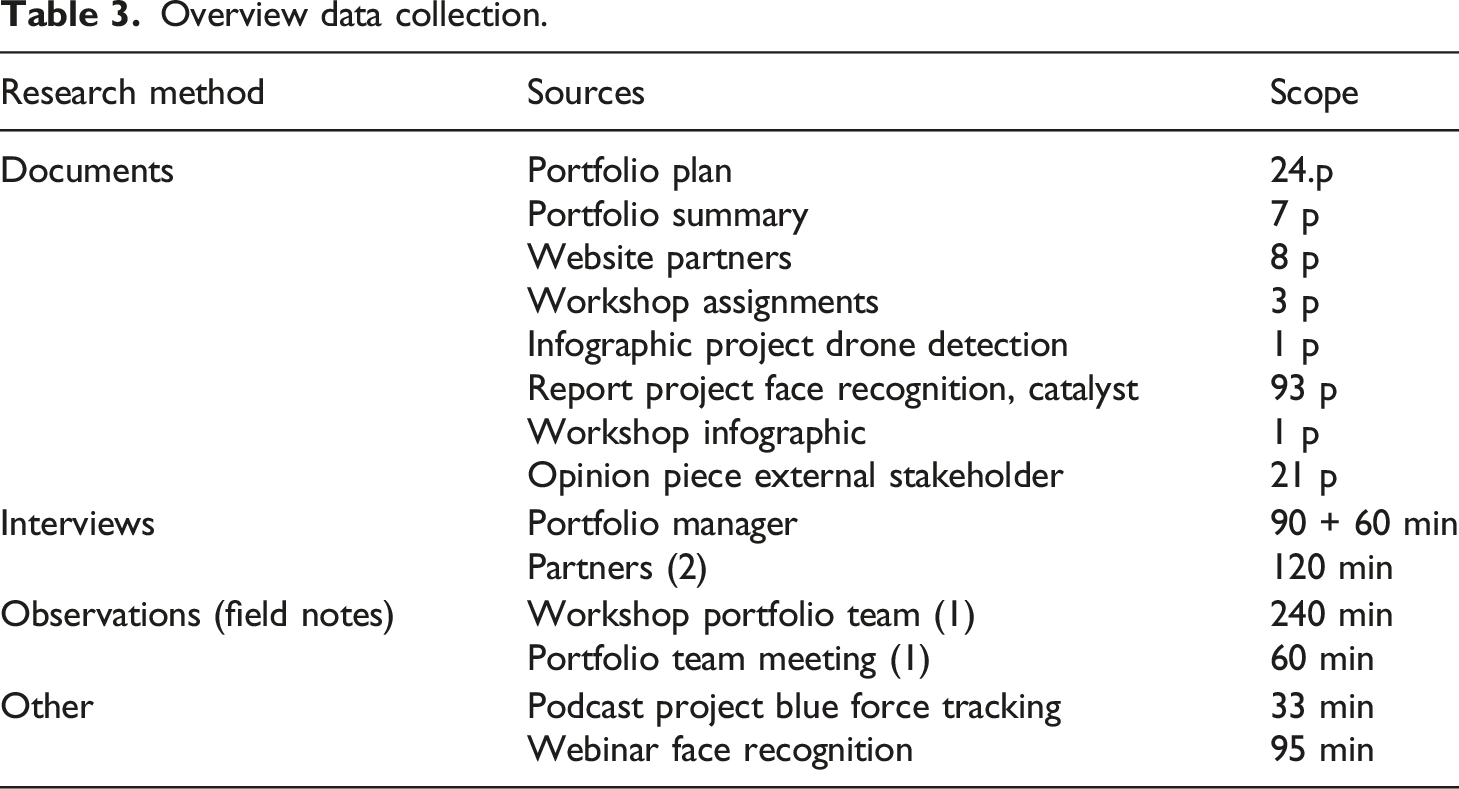
Documents include descriptions of the portfolio as a whole as well as the projects. Also, content from the website of the individual partners were collected (November 2019), an opinion piece about the project ‘face recognition’ written by an external stakeholder (May 2021) and an infographic that summarised the outcomes of a workshop followed by the project team focused on ethics (September 2021).
Semi-structured interviews were conducted with the portfolio manager (June 2019 November 2019, February 2021) and two of the partners (February, March 2021). Questions were asked about the partners’ views on the project goals and ambitions, the portfolio team and decision-making, and ideas about the long-term commitment of the partners to the project. The interview topics and example questions are shown in Table A1 in Appendix 1. A semi-structured interview is chosen because this ensures a structure for gaining information, but also allows flexibility in case novel and interesting insights present themselves during the conversation (Robson, 2011). One partner was not able to make time for the interview but participated in the workshop so we do have insights into his perspectives on the project.
Two of the researchers organised a workshop (in collaboration with a research colleague) for the portfolio team in December 2019. Rich observational data – translated into field notes – on the partners’ perspectives on the portfolio goals and ambitions were collected. The workshop is recorded and the partners provided documented data themselves in assignments. In addition, one of the researchers attended a portfolio meeting in which the dynamics within the team were observed.
Other data included a podcast episode, in which partner City and partner Police discuss the project Blue force tracking. Also, data includes a webinar, organised by partner Police, in which the project Face recognition is discussed. These two sources provided insights into how the projects were communicated and discussed with external stakeholders such as citizens.
Data analysis
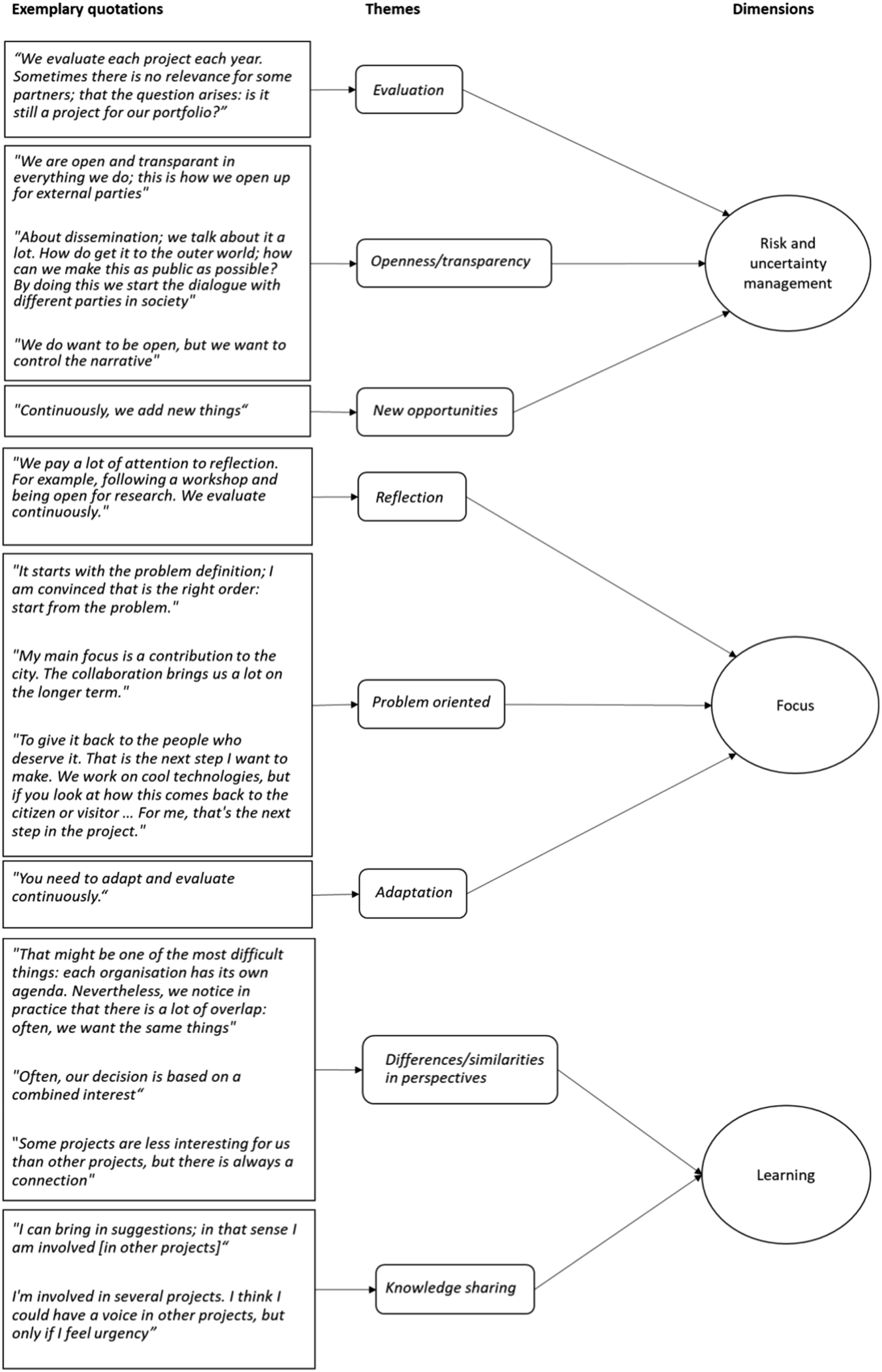
During and after the data collection, the data was analysed. The first analysis took place in November 2019 to prepare the workshop held in December 2019. The first author started the analysis by identifying general characteristics of the portfolio, such as the involved partners and practices. In addition, she analysed the portfolio plan and summary and the two semi-structured interviews with the portfolio manager, using open coding (Gioia et al., 2013). The analysis, which was discussed with the entire research team, provided the basis for the case description. Going back and forth between the data and literature, we developed our analytical framework. Next, the theoretical dimensions were used to analyse the field notes on the workshop. The second author was involved in organising the workshop and, thus, was able to remember and interpret original observations. The third author was not involved in the workshop and, thus, kept a distance from the original data enabling him to ask critical questions about the analysis. Thereafter, using our analytical framework, the first author analysed the field notes on the meeting, the interviews with the partners, the other documents and podcast and webinar. The analyses were again discussed with the research team. See Figure A1 in Appendix 2 for an example of our analysis.
Findings
As outlined in the research setting, the smart safety and security case sets out to test and implement multiple technologies to improve safety and security in the ArenA area. To assemble the portfolio, the partners produced a longlist of technological innovations, that might be promising for increasing safety, security and service in the pilot area. Based on their shared interests, time and budget, they selected five technological innovations to develop and/or test in the portfolio. Five projects were developed – each led by one of the partners, based on its expertise – structured around the five technological innovations. During the project, the partners added two projects to the portfolio. Although all the partners have their own agenda, in practice, there is a lot of overlap. Equally, the partners think it is valuable to be involved in all projects, even if the projects are not primarily relevant for their own organisation.
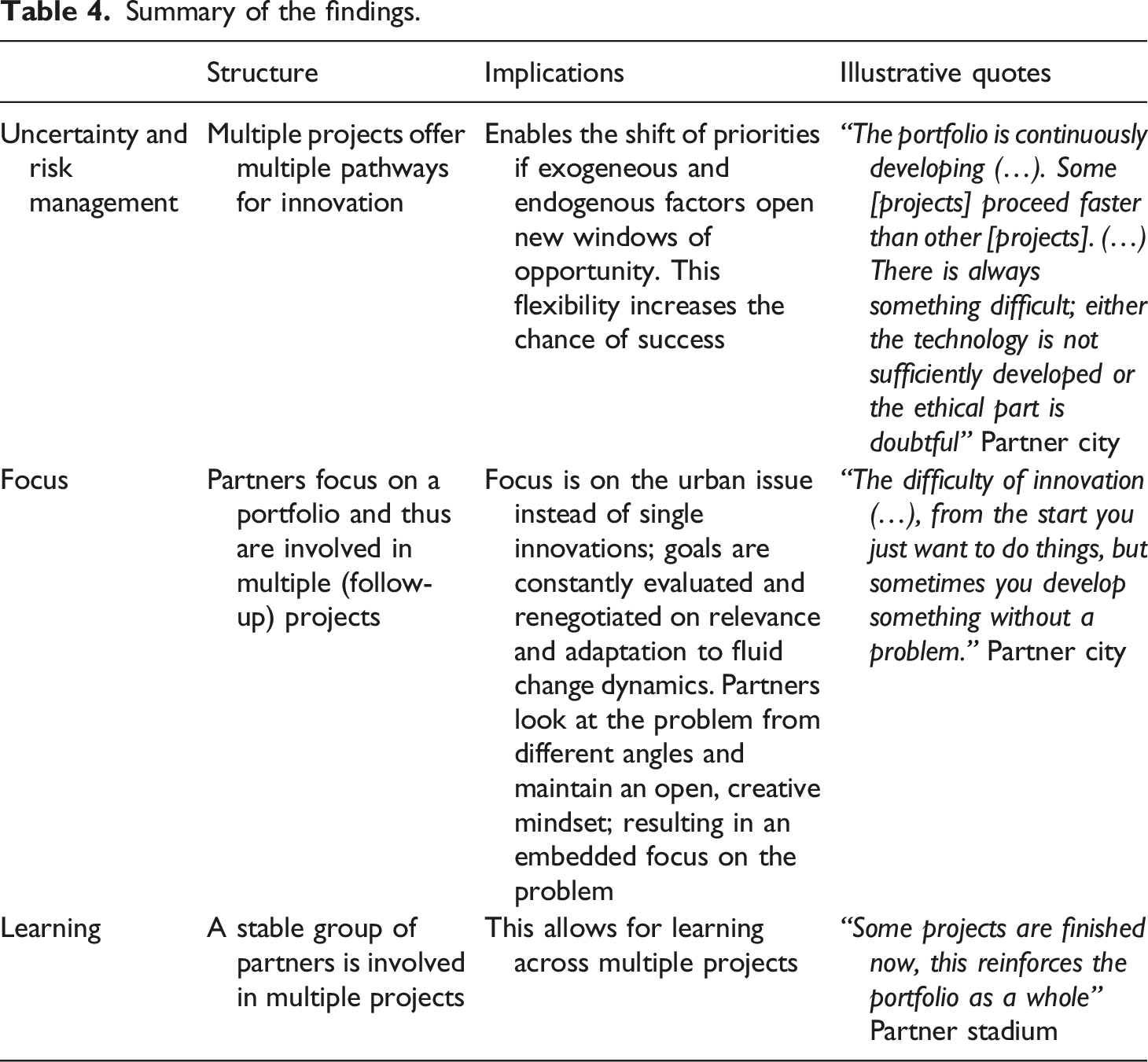
Summary of the findings.
Uncertainty and risk management
The portfolio approach enables a shift of priorities if exogeneous and endogenous factors open new windows of opportunity or pose a risk. Multiple pathways for innovation increase the chance of successes. In our case, the partners work on multiple projects that could contribute to the ambition of the portfolio: improving safety and security. This makes it possible to manage uncertainty and risks. Working on multiple projects enables the partners to shift priorities when unforeseen challenges in the projects occur and provides the flexibility to anticipate input from external stakeholders.
Unforeseen challenges are part of the innovation process, as innovation comes with a lot of uncertainty: “There is always something that fails”, partner City confirms. In some cases, the technology was not developed well enough to apply in the ArenA area. For example, the goal of the body-cam project was live streaming during an event but this was not possible with the current technology. In other projects, the technological aspects were developed, but the application of the technology in practice is delayed. For example, the technology for the blue-force tracking had been tested, however, as yet, there has been no suitable event to field-test it in real-life situations. These examples show that sometimes projects are delayed or paused, because of unforeseen challenges. The portfolio approach enables the partners to proceed with other projects, which increases the chance of a successful contribution to the overall portfolio goal.
In addition, external stakeholders proved crucial in the development of an effective security-enhancing solution for in the Amsterdam ArenA area. Initially, the partners focused on projects in which the effectiveness of technologies was explored. In a later stage, the partners realised, based on the feedback from external stakeholders, that it is important to actively involve citizens and visitors. Based on this, the partners decided to focus more on the practical application of technologies and added an additional project to the portfolio. This project is focused on the participation of citizens and visitors in the development of the technologies. Thus, the partners need flexibility within the portfolio to integrate the input from external stakeholders in their next steps.
The involvement of citizens and visitors is important as the use of data could bring in new problems related to ethics, such as privacy and data security issues. For example, media have written critically about privacy issues around face recognition. Dealing with this is important, yet difficult, as one of the partners explains: “we strive to be open, but we do want to control the narrative”. Therefore, the partners try to guarantee openness and transparency to citizens and visitors in the development phase of the innovations. For instance, the partners organise workshops for citizens in which they collect feedback on the innovation with webinars being held for external parties to discuss and inform about the innovation.
Focus
In the portfolio approach, goals are constantly evaluated and renegotiated on relevance and adapted to fluid change dynamics. The partners are involved in multiple projects, enabling them to focus on the urban issue from different angles. The portfolio has the ambition to facilitate safety, security and service by using technological innovations. The portfolio plan describes a general goal, to which all partners subscribe: “using digital techniques, realise at least the same safety situation [compared to physical security efforts], with increased efficiency and effectiveness of available resources; decreasing nuisance and increasing comfort for all stakeholders”.
All projects contribute to the overall ambition of the partnership and start from a concrete problem. “I am convinced that that is the way to go; start with a practical problem or a need in the operation”, emphasises partner City. “The difficulty of innovation (…), from the start you just want to do things, but sometimes you develop something without a problem.” Partner City is convinced that having a problem owner from the beginning helps to develop a relevant innovation. Here, the crowd management system – which is used to monitor and control the density and spreading of people within the area – is mentioned as a success story. The tested technology is handed over to and adopted by the problem owner, which can be seen as the end goal of the subproject. The technology is not only proven, but also applied and embedded in the relevant organisation. Also, by working on different projects that contribute to the same ambition the partnership could make a bigger impact.
Over time, it is important – yet challenging – to maintain a sharp link between the project and the initial problem or portfolio goal. Therefore, each year, the partners evaluate the projects on relevance related to the portfolio goal. “We pay a lot of attention to reflection and evaluation,” partner City says. The partners discuss the connection of the projects to the overall goal and to the partners. Questions are asked here, such as: does the project still contribute to the overall goal of the portfolio? Is the project still relevant for all the partners? Have other needs from citizens and visitors arise that need to be considered? In addition to the yearly evaluation, the partners follow workshops in which they reflect on ethical issues related to the innovations. Here, the partners reflect if the innovation contributes to solving the problem and if technology is necessary to this contribution.
During the evaluations, the partners also explore other possible projects. The project ‘drone detection’ is an example of a project that was added to the portfolio in a later stage, because one of the partners observed a problem with drones in the ArenA area. Unauthorised drones cause nuisance, causing security and public order issues, for example privacy violation and crashes. This safety challenge connects well to the portfolio goal, and thus the partners decided that this has potential for a new project.
Learning
A stable group of partners is involved in the portfolio which allows for learning effects. The partners learn about their different interests and perspectives, enabling effective collaboration. Also, the partners are involved in different projects, enhancing knowledge sharing across projects.
Three partners are involved from the start. Only one of the four partners are replaced after 2.5 years. The stability of the partners is considered an advantage. In particular, because it took some time to find out each organisation’s interests, motivations and expectations regarding the partnership. Partner Stadium: “In the beginning [the collaboration] was challenging, but just by doing we managed. Just by attending all the meetings”. This also becomes visible during the workshop about the future of the portfolio. Initially, the partners seems to hold similar perspectives about the ambitions of the portfolio – “create more impact”, “grow, replicate, extend the solutions”. However, continuing the conversation, different meanings are given to these ambitions. Partner City focuses on the contribution of the innovation to the liveability of citizens, whereas partner Police is mainly concerned with the eventual implementation of the innovations in the organisation and the possible impact on internal processes. Both partner Police and partner City emphasise the importance of laws and regulation as the boundaries of the concept; thus, the project only succeeds if the technological innovations fit into these boundaries. Partner Research stresses the need of longer-term commitment: “we need to establish a long-term program for a public-private partnership”. The variety of partner interests, perceptions and ambitions translates to differing perspectives on the project goals. Partner City emphasizes the importance of making the different interests of the partners explicit and mentioned his efforts to realise this: “At the start of the project, we articulated our expectations and we captured these in our portfolio plan.”
The partners thus invested in their relationship, by getting to know each other and their different backgrounds. Partner Stadium tells that some of the partners differ significantly: “partner Research does completely different things than us; sometimes, this is quite difficult”. By meeting on a regular basis and working together, the partners have learned what to expect from each other. This improved the collaboration from which the partners benefit during the partnership. An example is the lack of hard negotiation when selecting new projects but rather constructive consultation. Although the core group of the portfolio is stable, additional partners are involved in each project. This allows the core partners to select partners that are most suitable for the specific project and gain new knowledge in a wide network of partners.
The stability in the partnership allows for effective knowledge sharing and for learning across multiple projects. For example, based on the experience gained at the beginning of the portfolio, the partners noticed the need to apply the technologies in a more tangible way. In this way, a new project is born. In addition, partners are willing to commit themselves to projects, even though the projects are not in their primary interest. For example, partner City explains that face recognition technology is not something the municipality will ever use in the public area. Nevertheless, he thinks it is valuable to be up to date about the latest technologies that can be used in areas, such as the stadium.
Discussion and conclusion
Addressing complex urban challenges requires the collaboration of municipalities with different stakeholders. Collaboration between partners is a powerful approach to creating synergies and thus, innovating for complex challenges. In most smart city projects, the partners work on a single solution. However, the smart city context brings in additional complexity, for example because of the ambiguous nature of urban challenges and the use of technology. We unpack how a single-project approach might limit the effectiveness of smart city collaborations and propose an alternative: a shared portfolio approach.
In our analytical framework, we distinguish three aspects on which the shared portfolio approach could offer benefits compared to a single-project approach: 1) uncertainty and risk management; 2) focus; and 3) learning. We illustrate the shared portfolio approach through an in-depth case study on a smart city initiative in Amsterdam. In this initiative, the municipality of Amsterdam (responsible for public safety and security) collaborates with other partners – including the police, a knowledge institute, and the stadium – adopting a shared portfolio approach to develop and test a variety of digital applications to improve safety and security in an urban area around a large stadium. Starting with five projects based on shared interests, the partners extended the portfolio with two additional projects.
Practical and theoretical implications
The practical relevance of our study lies in setting out how a shared portfolio approach could be an effective approach to innovate in the complex smart city context. First, a shared portfolio approach helps partners to manage uncertainty and risk. Working on multiple projects enables partners to shift priorities when unforeseen challenges in the projects occur and provides the flexibility to anticipate input from external stakeholders. Second, partners are involved in multiple projects, enabling them to focus on the urban issue from different angles. Goals are constantly evaluated on relevance related to the problem and new possibilities for projects are explored, stimulating a creative, open mindset. Third, a stable group of partners working on multiple projects allows for learning effects. The partners learn about their different interests and perspectives, enabling effective collaboration. The partners are involved in different projects, enhancing knowledge sharing across project.
Our insights about how a shared portfolio could benefit effective collaborative innovation might be instructive for other cities or public bodies who aim to collaborate for smart city innovations. Instead of focusing on a single innovation, we recommend working on multiple innovations in a shared portfolio setting. In addition, the shared portfolio approach might inspire current smart city project partners to continue their collaboration and create a portfolio of innovations.
Theoretically, our work contributes to creating a stronger connection between cross-sector partnership literature and smart city literature by revealing how the portfolio approach can be an effective way to deal with the complexities of cross-sector collaboration in the smart city context. We apply insights from CSP literature to enrich the smart city literature. Although smart city literature emphasises the need for collaboration of the public sector with other stakeholders (Baccarne et al., 2016; Kornberger et al., 2017), it does not expand on how these collaborations work effectively. We recognise the need for unpacking the dynamics of cross-sector partnerships in the smart city context. CSP literature offers insights into the dynamics and challenges that come to play when public partners collaborate with other stakeholders (e.g. Bryson et al., 2015; Page et al., 2015). A key strategy to deal with multiple individual goals across all stakeholders is to formulate and commit to a common goal (Bryson et al., 2015; le Ber and Branzei, 2010; Scott and Boyd, 2020). However, striving towards one goal might limit the effectiveness of innovating in a complex context, such as smart city contexts. Here, we contribute to both CSP literature and smart city literature, by introducing a new collaboration structure – the shared portfolio approach – and unpack how this approach can enhance effective cross-sector collaboration in smart city contexts.
Research agenda
Our study is a first step in exploring a new approach for collaborative innovation in complex contexts and gives direction for future research.
First, our findings are based on an in-depth case study, situated in the context of Amsterdam. Future research could extend the generalisability and validity of our study by examining additional cases in other smart cities or other complex contexts than the smart city. This could lead to firmer statements on the implications of a shared portfolio approach for other cities and contexts.
Second, we touch upon sensemaking literature by theoretically explaining the importance of a shared understanding of the project goals and ambitions among the partners for the success of the project. Our empirics indicate that a portfolio approach might offer more space for sensemaking among partners because the approach enables the partners to anticipate new insights and external input and to keep an open mindset. It would be interesting if future research builds upon our work and explore sensemaking mechanisms in portfolio approaches and the implications for collaborative innovation further.
Third, future research could extend our findings by examining longer term consequences. Our case covers a 2-year period during which the portfolio is still running. It would be interesting to examine what the impact of a shared portfolio approach is on the problem the partners aim to address or on the longer-term commitment of the partners to the portfolio’s ambition. Practitioners might wonder if a vast group of partners is crucial for the portfolio’s problem-solving capacity and how a portfolio approach develops on the longer term.
Last, we developed an analytical framework in which we identified three benefits of a shared portfolio approach. Future research could strengthen and extend our framework by examining other aspects, for example, related to the collaboration itself.
Footnotes
Authors’ note
Full paper submitted for consideration at Public Policy and Administration
Acknowledgements
We would like to thank dr. Daniel van den Buuse for his help in organizing the workshop.
Declaration of conflicting interests
The author(s) declared no potential conflicts of interest with respect to the research, authorship, and/or publication of this article.
Funding
The author(s) received no financial support for the research, authorship, and/or publication of this article.

Appendix 1
Interview topics and example questions.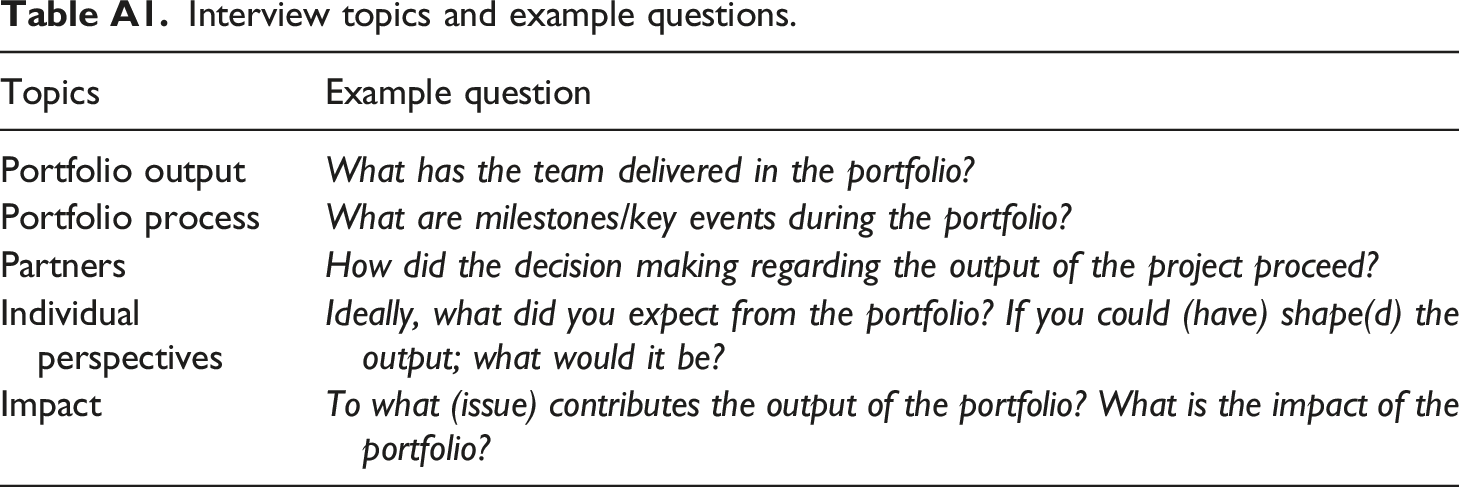
Topics
Example question
Portfolio output
What has the team delivered in the portfolio?
Portfolio process
What are milestones/key events during the portfolio?
Partners
How did the decision making regarding the output of the project proceed?
Individual perspectives
Ideally, what did you expect from the portfolio? If you could (have) shape(d) the output; what would it be?
Impact
To what (issue) contributes the output of the portfolio? What is the impact of the portfolio?
Appendix 2
Data structure.