




Abstract
The UK’s Work Programme (2012-18) was a major employment services programme, inspired by new public management principles. A relatively small number of directly commissioned ‘prime providers’ were paid by the central Government largely according to the number of job-outcomes their service users achieved but were given a ‘black box’ to design their own services and subcontracting arrangements. Drawing on an empirical study of subcontracted service providers, and focusing on those from the third sector, the paper shows that within this prime-led commissioning model, subcontractors came under sustained pressure to adjust their operational practices. We draw on institutional isomorphism to show that isomorphic pressures were experienced because of both the design and implementation of the Work Programme. Although there were strong pressures pushing towards convergence, however, the different starting positions of subcontractors meant that these changes were not entirely deterministic and some attempts at resistance were observed amongst third sector providers. Their diverse institutional contexts, including positioning and wider interest in the field, shaped how they navigated and responded to isomorphic pressures, ultimately mitigating homogenisation. The paper contributes a more sophisticated understanding of the ways in which provider organisations experience, interpret and respond to structural pressures within an evolving quasi-market. The findings have implications for public service reform programmes featuring quasi-markets that are intended to encourage innovation and a diversity of provision, particularly when promoting mission-led, third sector organisations (TSOs).
Introduction
The UK has been an enthusiastic adopter of the ‘activation turn’ in labour market policies, through which greater responsibility is placed on working-age welfare recipients to seek work in return for social security (Bonoli, 2010). Following international trends, employment services in the UK have been underpinned by new public management principles promoting outsourcing and the establishment of quasi-markets, designed to promote innovation and provider diversity, including bringing in the purported specialist skills of third sector organisations (TSOs) (Bennett, 2017; Damm, 2014; Struyven and Steurs, 2005; van Berkel and van der Aa, 2005; Wiggan, 2015). Contractualism and outcomes-based performance management have replaced more traditional accountability models based on citizens’ rights to services (Ramia and Carney, 2001; Jantz et al., 2018). However, scholars have observed that contrary to these policy aims, providers have typically converged on the provision of standardised frontline services (Considine et al., 2018; Considine et al., 2020a; Rees et al., 2014; Shutes and Taylor, 2014). For TSOs this isomorphic convergence is particularly problematic because it may threaten their specialist expertise and organisational mission, and thereby reduce service quality. Drawing on an empirical study of providers through an in-depth case study of the UK’s Work Programme, and informed by organizational theory, this paper explores these dynamics in unprecedented depth, providing a more nuanced understanding of the phenomenon with a particular focus on the experiences of TSOs.
The introduction of the Work Programme in 2012 represented a ‘big bang’ restructuring of UK employment services, creating a significantly extended quasi-market based on very large contracts, secured in the main by private sector ‘prime’ providers who, for the first time were granted a ‘black box’ over programme implementation (Foster et al., 2014). Although explicitly based on models employed elsewhere, particularly Australia, the Work Programme was extreme in the extent to which many of its design elements were implemented altogether. Primes were given considerable autonomy by the commissioner, the Department of Work and Pensions (DWP), to construct their supply chains of subcontracted providers and associated service interventions, with only minimal service prescriptions agreed at the contracting stage (Carter and Whitworth, 2015). Instead, the accountability model instituted by the DWP was based on ‘payment by results’ (PbR) with payments to providers conditional on securing sustained job outcomes for clients, with the weighting towards outcome payments increasing over the lifetime of the programme (Foster et al., 2014; Jantz et al., 2018). Finally, the DWP encouraged a process of competitive ‘price discounting’ at the commissioning stage, further reducing the resources available within supply chains, particularly at the early stages of the Programme.
As in other international contexts, the policy intention was to encourage a diverse market of providers and to stimulate service innovation and in the UK context this was accompanied by rhetoric emphasizing the role of TSOs as subcontracted providers (Damm, 2014). DWP claimed that a diverse range of organisations from different sectors would justify the black box approach, owing to their ability to ‘identify the best ways of getting people back to work’ (DWP, 2011: p6). However, at the outset concerns were raised that TSOs were in a weak position in relation to their prime contractors, and might be pushed out of the ‘marketplace’ (WPSC, 2011). Similarly, commentators have argued that the Work Programme’s delivery model was part of a wider trend which saw TSOs engaging in public service delivery becoming less distinct from commercial enterprises and effectively succumbing to ‘isomorphism’ as an outcome (Milbourne and Cushman, 2015; Egdell and Dutton, 2017). However, typically missing are nuanced and empirically based qualitative accounts of the ways in which subcontractors experienced and responded to isomorphic pressures. Thus, a scenario involving standardization of frontline services could be regarded as a ‘threat’ both to the employment services system and to providers within the quasi-market.
With this in mind, the paper draws on the concept of institutional isomorphism to closely unpack the pressures on subcontracted providers, through an in-depth case study of the Work Programme. We define institutional isomorphism as a process by which organisations are pressured to adapt homogeneous practices, by implementing common norms of behaviour, which are considered ‘appropriate’ within their field and compliance confers legitimacy to organisations as recipients of field resources (DiMaggio and Powell, 1983). There are strong grounds for expecting institutional isomorphism to operate in quasi-marketised employment services, representing as it does a field in which resources are distributed by a central statutory authority. Taken as a totality, the Work Programme’s novel design features and the circumstances of its commissioning were likely to have heightened these isomorphic pressures (DiMaggio, 1983). Second, TSOs are likely to be particularly prone to isomorphic pressures, given that they tend to operate in fields where externally derived legitimacy is the primary determinant of organizational success and survival (Frumkin and Galaskiewicz, 2004; Leiter, 2005; Fligstein and McAdam 2012). Importantly, the sample was made up of providers who had been awarded a subcontract and were receiving at least some referrals of clients upon programme commencement. For these reasons the focus of our analysis is on data drawn from a qualitative study of the experiences of subcontracted providers of all three sectors (public, private and third), and the inclusion of all three sectors enabled a specific comparative focus on the differences between providers experiences and strategies.
We contribute to the literature on employment services and third sector public service delivery by demonstrating how institutional isomorphism and associated adaptive organisational theories provide a powerful theoretical framework to help explain the pressures towards convergence seen in this and other studies (Considine et al., 2018, 2020). We focus particularly on unpacking the mechanisms through which the pressures impact on subcontracted providers within the Work Programme model and prime management structure. By providing a comparative exploration of the mechanisms our contribution is to show how convergence is not the necessary end point of isomorphic pressure: providers accommodate and resist in different ways and organisational mission can provide a key strategy for some TSOs. Though the UK has retreated somewhat from the extremes of outcome based contracting witnessed in the Work Programme, the findings, and theoretical tools of institutional isomorphism remain relevant in a context in which states continue to implement quasi-markets in public service delivery, for example in continuing reforms to Probation services in the UK (Macmillan and Livingstone, 2015).
The paper first outlines the relevant literature, setting the Work Programme in an international context, outlines key adaptive organisational theories and sets out how institutional isomorphism provides the theoretical framework with which to explore provider experiences. The findings show that subcontractors from all sectors experienced strong isomorphic pressures, predominantly coercive, but that providers varied in the degree to which they resisted and accommodated those pressures. Finally, we outline the implications for international debates on employment services of a more theoretically sophisticated and empirically grounded understanding of prime-led activation programmes.
The work programme in an international context
The Work Programme is part of a recent trend within state funded employment services in the OECD countries, towards ‘activating’ welfare-to-work programmes, which seek to increase the supply of job-ready individuals into the market. These ‘work first’ interventions tend to focus on low-cost job-search support and advice to unemployed individuals, aimed at rapid placements into readily available vacancies (Considine and O'Sullivan 2014; Wright et al., 2011). As such, they contrast with human capital approaches, which focus on education and training, or ‘demand side’ approaches, which emphasise labor market conditions rather than individual behavioural change (Considine and O’Sullivan, 2014). Greater conditionality for the receipt of benefits is also used to oblige ‘active’ participation in these job-search programmes (Ramia and Carney, 2001). Numerous authors have described the development of contracting arrangements with non-public providers as intrinsically linked to this activation agenda: including the deployment of outsourcing, marketisation and outcomes-based performance management (van Berkel and van der Aa, 2005; van Berkel, 2009). It follows a wider trend of quasi-privatisation, whereby services previously delivered either within the public sector, or in combination with the third sector, have been opened to a broader range of private providers, theoretically enabling greater diversity and individualisation of services whilst using competition to drive down costs (van Berkel, 2009).
The international literature on employment services commonly traces developments within different OECD countries and compares overall performance and efficiency, as well as highlighting challenges of quasi-marketised employment programmes (Struyven and Steurs, 2005; Van Berkel, 2009). Bredgaard and Larsen (2008) compared employment services in Holland, Australia and Denmark and suggested that despite a diversity of designs, programmes struggled in practice to provide efficiency gains or cost savings through competition. A recurring concern has been equality of provision, particularly the argument that they provide less support to more disadvantaged service users (Rees et al., 2014; Carter and Whitworth, 2015). A potential trade-off is identified between increased flexibility, personalisation and diversity for providers, and equality and minimum standards for all service users, particularly when financial pressures encourage risk averse behaviour (Considine et al., 2018).
The Work Programme was introduced by the UK Coalition Government in 2011 to replace a raft of separate ‘specialist’ programmes for those on mainstream and health-related benefits, young people, and a range of other claimant groups. In contrast, the Work Programme incorporated a much more diverse group of users and was expected, in theory, to cater flexibly to their individual employment barriers, while reducing transactions costs (Foster et al., 2014; Considine et al., 2020b). Several authors have identified the Work Programme as an important case for exploring some of the issues raised by these international trends, due to the high degree to which it implemented new public management principles as part of a large prime contractor model (Carter and Whitworth, 2015; Damm, 2014). The model is characterised by an extremely financially challenging ‘payment-by-results’ framework, the use of very large, regional prime contractors who can manage a supply chain of subcontractors, and a ‘black box’ commissioning framework that granted these ‘primes’ considerable contractual autonomy in the design of delivery and supply chain management.
Although ‘payment-by-results’ was not new to the UK employment services field, the Work Programme placed an unprecedentedly high proportion of funding on conditional payments for job outcomes and long-term job sustainment: with close to 80% of funding conditional on achieving outcomes for clients. The share of funding linked to outcomes increased over time so that by 2014 the Work Programme was entirely based on payment by results (Considine et al., 2020b). Taken together, the long delay between investment and payment, the small proportion of unconditional ‘process’ payments, and the ‘price discounting’ offered by primes in their bids, the programme’s payment model was extremely demanding, heightening the financial pressures likely to be cascaded down supply chains to subcontracted providers (Carter, 2018). Additionally, and again in contrast to predecessors, it was delivered through a small number of DWP-commissioned prime contracts, covering whole geographical regions for the length of the programme (Jantz et al., 2018). All but three of the 40 prime contracts, across 18 Contract Package Areas (CPAs), were won by large private sector organisations, largely due to their size and ability to handle the risk required (Damm, 2014).
Most subcontractor involvement took the form of ‘end-to-end’ provision (also known as Tier one subcontractors). Eligible service users in receipt of unemployment and some health benefits were, in the first instance, referred to one of the prime providers following a period attached to the public sector Job Centre Plus. Primes could choose to deliver services ‘in-house’ or refer the service user to ‘end-to-end’ (Tier 1) subcontractors. Most often this was determined by the location of the service user, though in some cases referrals were made by random allocation. The prime or end-to-end subcontractor would generally work with the jobseeker throughout their time on the programme, providing a range of interventions such as assisted job search or CV writing (Foster et al., 2014). Crucially, because of the resource-constrained environment, very little funding was available to purchase specialist interventions from specialist providers (also known as Tier two subcontractors) (WPSC, 2013).Many but by no means all specialist providers came from the third sector, but they could also be small private sector companies.
Taken together, these design features resulted in a context in which end-to-end subcontractors were generally smaller than their primes, often from a different sector or industrial background, and in which primes had a high degree of autonomy in terms of how they managed their supply chains. The wider environment was shaped by the payment-by-results regime heavily focused on job outcomes, constrained resources (exacerbated by primes’ price discounting), and a heightened commercial mindset. Unsurprisingly, therefore, subcontractors were likely to be in a relatively weak position, and subject to ‘top down’ isomorphic pressures (WPSC, 2011). Responding to these concerns, DWP expected primes to adhere to the ‘Merlin Standard’ to ensure fair treatment of subcontractors, and provide a mechanism to raise complaints but this was widely regarded as flawed as subcontractors could simply be sidelined if they did so (WPSC, 2013). This paper focuses on the experiences of these end-to-end subcontractors, who played a key role in delivering the Work Programme, through the lens of institutional isomorphism in order to unpack the pressures exerted by the programme, via the prime contractors, especially in light of the policy emphasis on creating a diverse marketplace which particularly stressed the inclusion of TSOs (DWP, 2011).
Understanding provider experience through the lens of adaptive theories and institutional isomorphism
The literature on employment services sits predominantly within a public management or social policy perspective. Although there is a wide body of international literature on the design and delivery of activation programmes (van Berkel, 2009; Struyven and Steurs, 2005; Wright et al., 2011), there are fewer contributions that explore empirical research data through the prism of organisational theory more broadly. Some commentators, typically critical of activation programmes and the role of TSOs in public service delivery, refer in passing to a range of adaptive organisational theories, especially the New Institutionalist concept of isomorphism, but rarely apply it consistently (Milbourne and Cushman, 2015; Egdell and Dutton, 2017). We argue that this body of literature has more to offer as a theoretical framework through which to understand provider experiences and outcomes within activation programmes. We apply theory systematically by outlining our understanding of isomorphism, comparing it to our empirical data, and examining in detail the extent to which isomorphic pressures were experienced by subcontractors.
Adaptive theories, and particularly New Institutionalism, share the idea that the environment can influence an organisation’s behaviour and characteristics over time. The different strands of New Institutionalism varyingly define institutions as explicit regulations, norms which guide behaviour, or as cognitive frames which shape agents' social reality (Scott, 1995). Collectively they constitute the ‘rules of the game’ which structure actors’ environment and subsequently guide their behaviour (Lowndes, 2010). Here we particularly draw on DiMaggio and Powell’s (1983) theory of institutional isomorphism, which focuses on the social transfer of institutional norms between organisations, leading to homogenisation around a bureaucratic model.
Three main types of isomorphic pressure – coercive, mimetic and normative – were posited by DiMaggio and Powell (1983). The most explicit is the idea of coercive isomorphism. This suggests that actors are forced to behave according to specified norms of behaviour via direct sanctions such as law enforcement, or indirect ones, such as restricting access to resources (DiMaggio and Powell, 1983). With its emphasis on power and control, coercive isomorphism echoes Resource Dependency Theory, first elaborated by Pfeffer and Salancik (1978). They argued that due to the need for organisations to acquire scarce external resources, those with control over resources have the power to make demands of their recipients. The second and third forms of isomorphic pressure relate to the transference of social norms surrounding appropriate and legitimate behaviour between organisations. Mimetic isomorphism suggests that organisations copy others they perceive as successful or legitimate (DiMaggio and Powell, 1983). Normative isomorphism describes how individuals spread these ideas when they move between different organisations, and within professional arenas, taking an established orthodoxy with them.
Overall, institutional isomorphism, and particularly the concept of isomorphic pressures – normative, coercive and mimetic – provides a powerful framework with which to explore subcontracted providers experiences in activation programmes such as the Work Programme. Importantly, DiMaggio argued that isomorphic pressures were particularly likely in fields where organisations, often not-for-profit, were competing for highly centralised resources provided by state agencies (DiMaggio, 1983). In quasi-market contexts the state often acts as a monopolistic purchaser of services and regulates market entry and exit, so rather than seeking to sell to a wide pool of buyers, providers seek to obtain legitimacy by incorporating the dominant norms and rules of the field, largely set by the state (Meyer and Rowan, 1977; Åberg, 2013).
In practice there are difficulties in applying these ideas to empirical observations and in distinguishing the pressures on organisations from tangible convergence as an outcome. Zucker (1987) distinguishes between approaches which view institutionalisation as an end state (homogeneity) and those that view it as a process with a focus on institutional creation, transmission and maintenance. In practice, the two distinct ideas are often conflated (Oliver, 1988; Leiter, 2005). DiMaggio and Powell (1983) are clear that as organisations submit to pressure to adapt to their environment, the result is homogeneity of institutional function and form. The implication in this context is that if isomorphic pressures act on a previously diverse set of subcontracted providers, possessing forms of specialist expertise, over time they will produce convergence and uniformity of structure and practice.
This notion of inevitable institutional convergence brought about by isomorphic pressures has been seen as overly deterministic, stripping actors of their agency and decision-making (Zucker, 1987; Fligstein and McAdam 2012). In fact, early adaptive organisational theories are not as deterministic as sometimes portrayed. Pfeffer and Salancik (1978) describe the myriad ways in which organisations might strategically resist external demands from their resource providers. Organisations might avoid dependency in the first place by diversifying their funding, avoid demands through secrecy or deception, playing demands off against one another, obstructing external scrutiny, or absorbing the dependency through mergers, joint ventures or ties between leaders and staff (Pfeffer and Salancik, 1978; Mitchell, 2014). If these strategies fail, an organisation may leverage its own resources to persuade or negotiate with those making demands.
Given then the potential differences in interpretation and response towards the same external pressures by different individuals and organisations, including resistance, we prefer the conceptualisation of isomorphism as a process rather than a deterministic outcome (Zucker, 1987). Rather than a uniform conformity amongst providers, we might expect instead a clear direction of travel and pressure to align with dominant norms and rules within the employment services field. Adaptive organisational theories provide a broad framework for understanding organisations as conscious and reflexive actors, capable of identifying the pressures on them to adapt to environment norms, and strategically resisting those seeking to judge their compliance. More specifically, the framework we adopt and build on here draws on institutional isomorphism, particularly the three forms of isomorphic pressure, and we apply that systematically and comparatively to explore provider experiences.
Method
Sampling framework
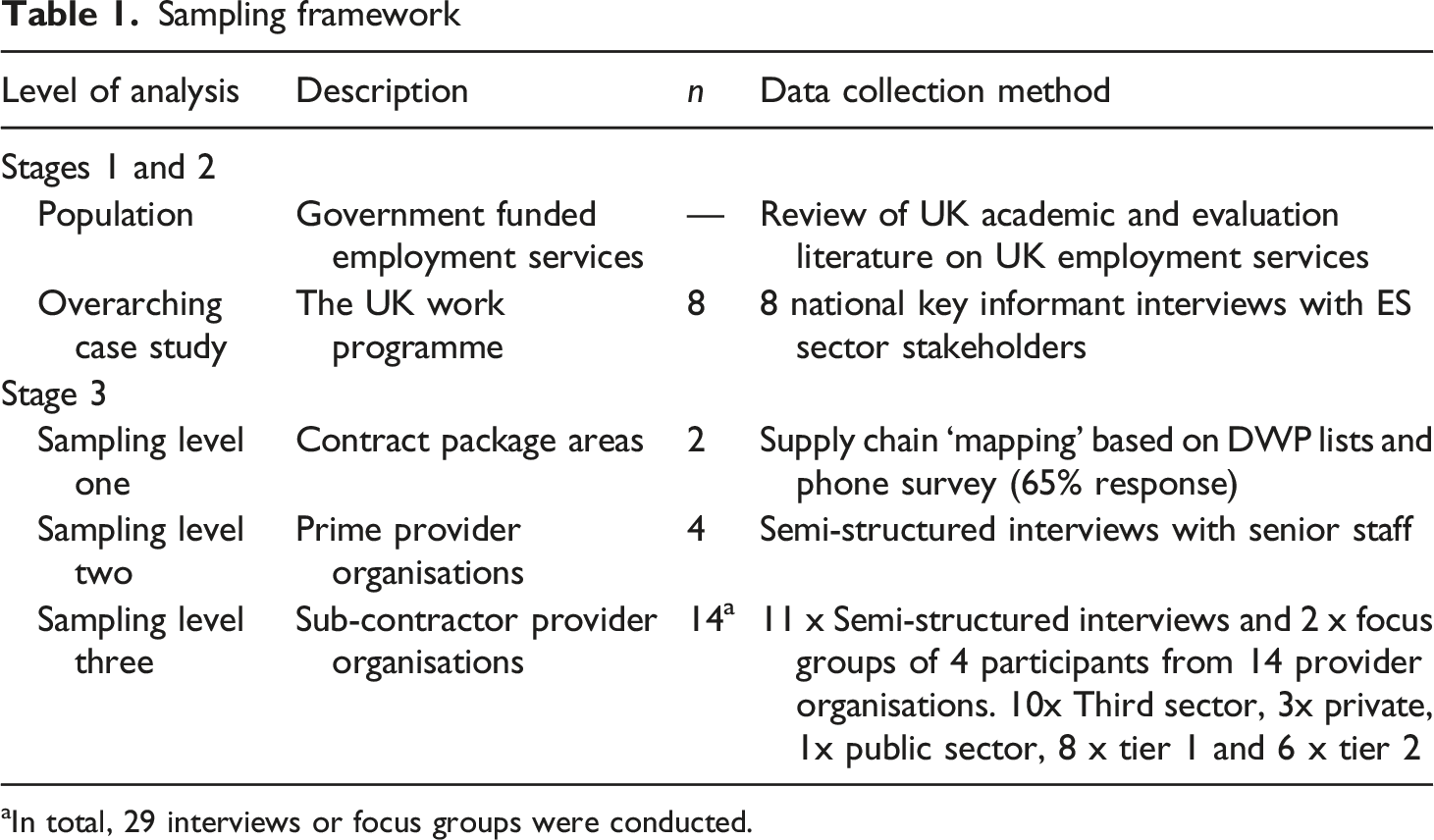
aIn total, 29 interviews or focus groups were conducted.
In stage 3, two geographical Contract Package Areas (CPAs) were selected to capture a range of prime-led supply chains that were typical of the program, that is, comprising two or three private sector prime contractors managing a mix of subcontractors from across sectors. The two CPAs chosen also captured some diversity in geographical and labour market characteristics (i.e. urban and semi-rural; northern and southern England). First, a ‘mapping’ exercise drew on publicly-available but rudimentary DWP data augmented by individually phoning subcontractors to verify their sector and supply-chain position. This proved challenging given the lack of detailed information on supply chain composition but was important in ascertaining the nature of subcontracted provision and their client group focus. Numbers of subcontracted providers listed in each supply chain varied considerably from just four or five to as many as 20 or 30, although the mapping exercise revealed that not all of these were engaged in delivery. Providers of different sectors were evenly distributed across the four supply chains with roughly equal numbers of third and private sector providing end-to-end (Tier 1) and ‘specialist’ (Tier 2) services in both CPAs and a lower proportion of public sector providers overall.
The mapping provided the necessary detail to select and recruit providers to interview. In-depth interviews were conducted with four of the five (private sector) primes operating in the two areas (the fifth declined to take part, impacting on the involvement of their subcontractors). Interviews and focus groups were then conducted with subcontracted providers of those four primes, selected to include a mix of sectors and tiers in the programme (see Table 1 for detail). These followed a semi-structured format, exploring their experiences of the commissioning and implementation of the programme, the nature of the services they delivered and the impact on their organisation ( Rees et al., 2013). Interviews lasted approximately 1 hour and were recorded, professionally transcribed and anonymised.
There were some limitations in the sampling. Generally, providers were apprehensive about participating in the study given the strictures in their contract about disclosing performance data (even though this was not the aim of our research) and the broader climate of concern about ‘gagging clauses’ (Egdell and Dutton, 2017). One prime declined to participate while another withdrew support for the research once underway following a change in senior staff. This meant some of their subcontractors (of all sectors) no longer had permission to participate and also withdrew from the research. Private sector subcontractors tended to be less willing to participate in the research than their third sector counterparts. The low numbers of public sector providers in the whole programme meant this group were the hardest to capture in the sample.
Analysis for this paper focused on the stage three interview data with prime and subcontracted providers. Specialist (Tier 2) providers were included in the focus groups: their insights were important but the qualitative exploration highlighted a clear distinction between the commissioning and implementation stages, and thus the data from Tier 2s were drawn on primarily in relation to the commissioning stage coding where they had to navigate contracting with primes but their limited involvement in delivering services meant they were less relevant when exploring implementation. Interview data were analysed in Nvivo, broadly following the approach to coding recommended by Braun and Clarke (2006), starting with initial deductive coding aiming to surface broad themes including provider expertise and experience, the commissioning process, contract management, delivery models and organisational values, specifically those operating ‘end-to-end’ contracts, as these providers were the most fully engaged in the programme, receiving clients and thus experiencing programme pressures. The next stage of coding was more inductive, informed by the framework of institutional isomorphism, specifically the forms of pressure (coercive, normative and mimetic) operating in the commissioning and initial implementation stages of the programme. In this phase, two further themes emerged: namely the strategies of accommodation or resistance that providers developed in response.
Findings
Our analysis reveals how two forms of isomorphic pressure, coercive and normative, were a central feature of subcontractor’s experiences of delivering the Work Programme in its first year, against a backdrop of an ‘unsettlement’ in the employment services field. For end-to-end providers, these isomorphic pressures had various sources and were dynamic, shifting in form over the stages of programme’s roll-out. At the commissioning stage the contractual requirements and regulatory framework set by DWP and negotiated with primes imposed a set of pressures on providers to operate according to fixed programmatic criteria, despite the black box. At the implementation stage pressures on subcontractors were exerted instead through the supply chain management practices of primes, the payment by results financing requirements, and general resource constraints. In the first section we outline how providers experienced these pressures and the ways in which alignment and standardisation of operating practices occurred. However, responses to these pressures did not entail a deterministic conformity among subcontractors. In the second section we demonstrate how providers ‘resisted’ isomorphic pressures. Their diverse institutional contexts, including positioning and wider interest in the field, their ethos and culture, shaped how they navigated and responded to isomorphic pressures, ultimately mitigating homogenisation within the field.
Isomorphic pressures from commissioning to implementation
In the initial commissioning stage, subcontracted providers primarily experienced coercive isomorphic pressures and some began to realign their service offer even while in negotiations with primes, shifting the focus of their services to standardised ‘generic’ delivery models. These gave them access to end-to-end (Tier 1) contracts which were viewed as less risky than specialist (Tier 2) services, since in practice they resulted in higher client referrals and thus outcome payments from the prime (Rees et al., 2013). This pressure was felt differently by providers from different sectors seeking a place in the supply chain. Whilst private and public sector providers were already offering generic services, TSOs had in previous employment programmes tended to offer specialist support to groups with particular needs (Authors, 2013). TSOs thus sought to adapt their services at the commissioning stage to secure a sustainable foothold in the emerging supply chains: instead of being a specialist provider working with the hardest to help, we realised that, if we wanted to stay in the market, we had to offer an end-to-end service (TSO, 5).
Coercive pressure at the commissioning stage was also experienced through the introduction of greater conditionality than was typical in previous programmmes. End-to-end contracts required the sanctioning of clients who failed to comply with compulsory behavioural obligations. This feature was much more problematic for TSO providers, for whom sanctioning was (usually) anathema to their organisational values. Some faced internal struggles over the ethical implications of sanctioning, but nevertheless adopted it during contracting: in one trustees’ meeting somebody said to me, “Are you used to dancing with the devil” (TSO, 26). In contrast private sector providers felt no contradiction between new programme requirements and their organisational ethos and navigated the commissioning process with little revision to service design.
Moving into the implementation phase of the programme, as subcontractors began to deliver services managed by their prime, a broader combination of pressures was channeled through the supply chain. Coercive pressures were now exerted by individual primes as they dictated a ‘commercial’ performance management approach towards their subcontracted providers. In the black box environment primes were free to manage the supply chain as they saw fit and subcontractors described punitive management techniques that enforced expected behaviours and practices. Indeed, primes saw it as part of their responsibility to bring their supply chain providers into line, particularly those (quite often TSOs) who they deemed to be less commercially ‘savvy’: I think what a lot of third sector providers lack… is the ability to performance manage in quite a tough minded, almost commercial mindset. But we can teach them that (Private prime, 11).
Coercive performance management systems such as league tables and a ‘perform or be sacked’ approach to their subcontractors were common practice. For several third and public sector providers this represented a substantial shift in their experience of delivering services: I have never known anything like this. I’ve always known that if I do not perform against my contractual agreements I will be hauled up. Fair play. But it will be done in a closed room with the contract provider, just me and them… This is done in public… Every supply chain meeting is a public flogging (TSO, 5). In particular, primes made substantial demands of subcontractors regarding outcomes reporting with an approach one provider described as: we want that information and we want it now (Public, 16). Several third and public sector subcontractors with little experience of this management culture struggled to accommodate their demands: we could expect somewhere in the region of 25 emails a week, “We want this by one o’clock,” and it would be twelve o’clock. So, very demanding (Public, 19).
Coercive pressures were heightened by the resource constraints introduced by the under-costing of bids by primes at the commissioning stage. This placed even more pressure on primes to maintain performance management strategies to guarantee financial viability: [The prime] has got £2,000 riding on this [client outcome], so [they] don’t trust you… (TSO, 18). The coercive pressures directed by primes to subcontractors extended beyond merely meeting targets, to defining how they were delivered. One subcontractor was forced to scale back their preferred client-centred in-work support model – provided successfully in earlier programes – by the prime who viewed the provider role more narrowly as a surveillance and reporting tool. Their role was re-cast as simply checking that ‘clients’ were still in work to trigger the outcome payments: my team was seen as a call centre to ring people up, find out if they’re in work, press the evidence button (TSO, 18). The provider described this as driving standardisation to a service model defined by the prime: we [prime] don’t really want you to ring the customer when you want to, you’ve got to ring the customer when their day 28 hits (TSO, 18).
Threats of withdrawal of resources were also a mechanism by which primes exerted coercive pressure on their end-to-end subcontractors. Poor performance against outcome expectations could lead to a termination of contract. They’ll tell you if you haven’t done well in month. And if you continue to not do well in month, then you’ll be replaced and it will cost you a fortune to be replaced (Private, 25). Indeed, one provider who was struggling with the performance management culture had already lost one of their contracts. As a result, some providers described operating at high alert: If they [prime] say to us, they want something today, we give it to them today. That’s what my managers have to do. I’ve said to them, you don’t make them wait; you don’t make them get frustrated (TSO, 24). Though both private and TSO subcontractors recognized the operation of these linked pressures, they differed mainly in the tenor of their judgement of them: TSOs were critical the impact on their staff and clients, while private organisations readily accepted them as a ‘natural’ feature of the new field environment.
Whilst coercive pressures were exerted in a visible way through prime management strategies, normative isomorphic pressure were evidenced by the way individuals moved between different organisations, thereby distributing field-based practices and knowledge. Some subcontracted providers with experience of earlier prime-led programs, now worked closely and enthusiastically with primes. TSO staff with prior experience in the private sector were able to assimilate the primes’ demands, demonstrating how industry practices and norms were being transmitted across organisational and sectoral boundaries: I’ve been here 7 years. Worked on the other side, if you like, worked for private and public and been in that business [the welfare to work field] before (TSO, 26). This movement of staff led to a ‘cross-fertilisation’ of normative practices across the various providers in the supply chain.
Normative pressures were also visible in the active recruitment strategies of providers in the early days of implementation that served to standardise their provision. Private sector providers in particular were very focused on recruiting ‘the right people’ which primarily meant staff from the commercial recruitment industry, particularly organisations with experience operating public employment services contracts. They argued that it was not easy to find people who can do it and have got a proven track record […]people who’ve got sort of ‘recruitmenty’ backgrounds, who’ve done Welfare to Work, and those people are like hen’s teeth (Private, 28). Public sector providers operating with less flexible staffing practices had less opportunity and less appetite to facilitate normative isomorphism. One provider noted in relation to the idea of sacking underperforming staff and recruiting new ones: We don’t treat our staff like this, you know (Public, 19), and a similar reticence was found in TSOs.
Normative isomorphism not only happened through recruiting new staff but through the loss of staff who were wedded to previous models of delivery and organisational values. At the implementation stage TSOs found they were losing staff uncomfortable with involvement in processes like sanctioning and performance management. Prior to the work programme ‘sanctioning’ – the imposition on clients of punitive benefit sanctions for non-compliance with appointments and other activation interventions – had not previously directly involved independent providers (Dwyer, 2018). One TSO provider noted that whilst they had accepted sanctioning in their contract with the prime they had lost staff as a result: It’s been very hard for some of our staff to actually sanction, some of our staff have walked out, they’ve actually left their jobs, they just couldn’t do it (TSO, 18). Private sector subcontractors were more willing to remove staff who were not delivering outcomes; if they’re not hitting month on month, minimum performance levels, it can lead to disciplinary action, and then the door, frankly (Private, 25). In the case of the (relatively) compliant TSOs, the convergence around new practices driven by the prime was occurring through the re-composition of their staff teams.
Whilst coercive isomorphic pressure dominated via the programme’s regulatory framework and prime supply chain management, and normative isomorphism also played a role, we found less evidence of mimetic isomorphism. At this early stage, the ‘unsettlement’ caused by the Programme’s introduction, the combination of design features and acute resource pressures meant that coercive and normative pressure appeared to crowd out this more subtle form of pressure, where organisations copy the practices of others they perceive as successful or legitimate. Organisations were preoccupied with negotiating the new rules and practices and were looking inward at their own performance rather than outwards to scrutinise the delivery approaches of other providers – moreover they had simply not had long enough to observe, absorb, and thus mimic successful approaches and organisational practices. It is important to note therefore that the pressures don’t apply all at once and instead operate sequentially at different stages of the programme’s lifecycle.
Resistance, and modification
Despite the dominance of coercive and normative pressures, convergence of organisational practice was not an inevitable or uniform result. Differences between subcontracted providers – whether cultural or related to their size or position in the wider field – influenced how they interpreted and responded to these pressures. They accommodated, but also resisted or subverted the pressures in various ways.
At the commissioning stage TSOs described their attempts to ‘push back’ on primes’ requirements during contract negotiations, for instance, resisting sanctioning non-compliant jobseekers. For some this meant turning down supply chain contracts: we said no [to one prime] mainly because we’re almost touching on sanctioning them and we as a charity wouldn’t do that. We’d do the work bit, we’re certainly not going to get into sanctioning (TSO, 8). Ultimately, this large, national TSO was able to ‘take or leave’ involvement in the programme because of its scale and financial independence – even though it was highly motivated to take part through a desire to support its client group (those with a disability). Another was unhappy about the requirement to report on ‘job outcomes’ which they saw as a breach of client confidentiality: We had discussions [with primes] and we really got to a point about what we could deliver, but they just wanted it linked to job outcomes. And we just said no, so we agreed not to pursue (TSO, 20). In this case the provider was able to agree contract terms with another prime who allowed them greater discretion over program implementation.
Isomorphic pressures to conform to particular programmatic features were not consistently applied by all primes, and subcontractors exhibited some agency and varying levels of power and interest in the field that shaped how they responded. In the above case the TSO who rejected the outcomes reporting element of the program had a high profile ‘brand’ which gave them power to negotiate and meant that the prime was willing to make concessions to secure their involvement. Similarly, the large TSO who rejected sanctioning ultimately chose to engage in the programme on a less financially profitable specialist provider (non-end-to-end) contract as employment services were not their core service. Private sector subcontractors on the other hand had little interest in negotiating or pushing back on the various features of the programme in contract discussion with primes. They were comfortable with sanctioning and outcome reporting and the isomorphic pressures were effectively absorbed and harnessed to strengthen their position in the field.
As the programme was implemented subcontractors also found ways to resist the coercive pressures being applied by primes. Again, this was mainly apparent in TSOs. One provider, frustrated by the prime pressuring them to deliver standardised provision, appealed to the core policy principle of the ‘black box’: I can fight my corner pretty hard – “I’m not doing it your way. I’m doing it my way, because that was what we signed up for. That was the contract. You said we could do that.” So we fought all the way in to run the black box. We believe in the black box (TSO, 24). Another actively resisted the prime’s determination to use in-work support as a form of monitoring: we have had battles galore about what our role is, and as a small, third sector, it’s like standing up to Goliath… we’ll make our stand but we will give the ‘in work’ support to the people, and that’s what we’re passionate about (TSO, 18). Here resistance took the form of the subcontractor continuing to provide a more holistic, user-centred, and intensive level of service that was not rewarded by their prime, while still providing the prime with outcome reporting. This enabled them to provide the type of service they felt their clients needed whilst also meeting the prime’s need for outcomes data. However, this activity was inadequately funded and therefore probably counter to the longer-term financial sustainability of the TSO, raising the possibility that resistance strategies might not be sustainable in the longer term. TSOs also described pushing back against primes’ stereotyped views of their characteristics and expected role in the programme: That is something I talk about to my staff all the time. It’s about maintaining your ethos within any programme that you run… It’s about, how do you stop yourself becoming… as I say, wearing purple suits. We call them the “purple suits”, the primes (TSO, 24).
Discussion and conclusion
The research outlined in this paper is based on an in-depth case study of the Work Programme at the early stages of its commissioning and implementation, as sub-contracted providers were navigating an unfolding environment that had been ‘unsettled’ by a these significant reforms to the field of employment services in the UK (Fligstein and McAdam, 2012; Taylor et al., 2016). The research is significant in several respects: first it focuses on the qualitative experience of subcontracted providers which remains rare in the literature; second it sampled providers from different sectors and the research was designed to consider differences between organisations from different sectors (Damm, 2014; cf Foster et al., 2014). The research was conducted in a challenging environment in which transparent information about subcontracted providers was scarce, trust was low, and consequently recruiting research participants was difficult (Jantz et al., 2018). A sustained consideration of the role of TSOs is also unusual, while third sector scholars have rarely interrogated such programmes in detail, inadvertently framing TSOs as passive victims of market-based reforms (Milbourne and Cushman, 2015). These points mean that the paper makes a contribution to a diverse set of debates in public administration, public employment services, and third sector studies literature.
Our findings show that two forms of isomorphic pressures – coercive and to a lesser extent normative – dominated in the environment created by the Work Programme’s prime-led supply chain model. Isomorphic pressures stemmed directly from the combination of design elements introduced in the programme – particularly the ‘black box’ model and payment by results – and further intensified by the cost pressures introduced at the commissioning stage, not least by the decision to encourage ‘price discounting’ by primes. We have also highlighted an important temporal element to the operation of the pressures, with coercive pressures particularly dominating at the early commissioning and contracting phases. Normative pressures were more apparent once implementation and service delivery were underway. The third, mimetic, form of isomorphism was much less visible in providers’ accounts, and more likely to occur later, as the programme’s ‘rules of the game’ became more stable and providers were able to copy and adapt others’ successful practices.
Focusing first on the coercive pressures at the earliest phase, we draw attention to the role of policy design in promoting a shift to standardised ‘generic’ delivery models, as well as the introduction of much more stringent conditionality (including sanctioning), which proved to be particularly problematic and disruptive for TSOs (Shutes and Taylor, 2014). As implementation commenced the pressures emanated more from the prime contractors, in the context of the black box model, and focused on performance management, the specific mechanisms used for client monitoring, and particularly benefit sanctioning. While normative pressures were more ‘subtle’, they were nevertheless apparent in the dissipation of private sector norms, values and techniques, including the active recruitment of ‘welfare to work industry’ staff with private sector backgrounds. Mimetic pressures were not observed (or yet to emerge) probably because we were observing the early phases of the programme, with knowledge about effective practices not yet clearly established. An implication of this for future studies is the need to be aware that isomorphic pressures shift over the lifetime of the programme.
Conceptually this paper makes a contribution to a growing strand of literature that applies organizational theory and particularly isomorphism to quasi-marketised employment services, particularly in the light of the standardization of services (Considine et al., 2020b; Shutes and Taylor, 2014). We build on previous studies by unpacking the detailed mechanisms through which isomorphic pressures impact on provider organisations, and how that leads towards standardization and organizational convergence. However, through our focus on the experience of providers from different sectors we have been able to show how pressures impact differently on organisations’ internal dynamics, and in particular how they are absorbed and accommodated in ways that are mediated by their organisational values and characteristics. Moreover there was resistance, or at least active opposition to the isomorphic pressures that they were experiencing, particularly in the case of TSOs, who are values based and mission-driven. This strongly suggests that full convergence is unlikely – additionally providers also have the option to exit the quasi-market (though this research didn’t track this). We therefore provide a nuanced account that articulates how convergence is neither an inevitable end state (‘isomorphism as outcome’) nor a singular and deterministic process (‘isomorphism as process’). Instead, there is active contestation and resistance, even if that is likely to be somewhat constrained. Differences between providers – in terms of their resources, logics, and values – should be taken into account in understanding how pressures are received, experienced and ultimately the effect these have on provider practices. This is a particular strength of ‘field theory’ accounts (Fligstein and McAdam 2012; Taylor et al., 2016)
Finally, the paper also makes a specific contribution to the literature on third sector-state relationships, particularly in the context of the involvement of TSOs quasi-markets and outsourced employment programmes; as well as to related policy debates. Isomorphism is particularly pertinent to TSOs because the centralised resource distribution and core design features of such programmes, as well as the stark power imbalance between them and prime contractors makes convergence more likely. The relative extremity of the Work Programme model – notably the ‘black box’ and full payment by results – further intensified these pressures, and the paper details the intersecting impact of design, financing, and prime management practices. This matters to TSOs because of the negative impact convergence is perceived to have on TSOs who traditionally value their independence, distinctiveness and ability to advocate for users (Macmillan, 2013; Egdell and Dutton, 2017). This poses a key challenge for policymakers and future programme designers. The Work Programme was presaged on the desire to encourage provider diversity, innovation, and rhetorically at least to incorporate the specialist skills and knowledge of TSOs. If TSO inclusion is to be taken seriously programme designers need to find ways, through effective commissioning, contract-management and governance mechanisms, to ‘protect’ TSOs in highly isomorphic field environments. Ultimately this depends on the willingness of Governments to make political commitments in support of genuine market diversity, innovation and personalization, and to recognize the distinctive contributions that TSOs can make to achieve social outcomes.
Footnotes
Acknowledgments
The support of the office for Civil Society (OCS) and the Barrow Cadbury UK Trust is gratefully acknowledged. This work was part of the programme of the joint ESRC, OCS and Barrow Cadbury Third Sector Research Centre. The authors would like to thank the participants in the study who so generously gave their time and insights.
Declaration of conflicting interests
The author(s) declared no potential conflicts of interest with respect to the research, authorship, and/or publication of this article.
Funding
The author(s) disclosed receipt of the following financial support for the research, authorship, and/or publication of this article: This work was supported by the Economic and Social Research Council (ESRC).
