




Abstract
A common criticism of strategic planning is that it is of little use when the environment is turbulent and the future is unpredictable. The last decade has witnessed great environmental turbulence and uncertainty in many conditions that are important for public policy and administration. This study analyses survey data from 144 public sector organisations in Norway in 2020 on how strategic planning has been designed and used over the past 4 years and how managers perceived the usefulness of the strategic planning. Most of the central as well as local government organizations prepared strategic plans in addition to mandatory plans and the managers perceived the net benefit of the strategic planning as positive, even under the turbulent environments of the recent years. A multivariate regression analysis showed that a prospector adaptation, stakeholder participation, use of management tools and ease of use of the strategic planning process had the greatest positive correlation with the perceived usefulness of strategic planning.
Keywords
Introduction
Strategic planning and management are used for adapting an entity, often an organisation, to an anticipated future development (Miles and Snow, 1978). Strategic planning differs from other planning in that it addresses the most important issues and aims to ensure that the entity as a whole is adapted to these important issues so that the entity can serve its purposes in the best possible way also in an uncertain future (Rumelt, 2011). This means that goals, organisational structure, and management systems and processes must be adapted to the strategy. In addition, public sector organisations must adapt their strategies to what is politically possible and desirable (Moore, 1995). Strategic planning and management are therefore based on various analyses and stakeholder participation and often use different processes and management tools (Ferlie and Ongaro, 2015).
International conflicts, financial crises, climate change, technological shifts, political changes and pandemics – all of which have recently incurred at once – are examples of conditions involving much turbulence and uncertainty. Such factors may have different implications for different parts of society, for different parts of the public sector, for the strategy work of individual organisations and even differently for different parts of an organisation. For many organisations, in the public as well as the private sector, more turbulent environments mean even greater unpredictability and uncertainty about the future and even more difficult planning than before. For many organisations – and especially in the public sector – more turbulent environments also entail greater uncertainty, but also greater opportunities and, not least, greater responsibility for influencing the environment and shaping the future than before. Strategic planning in public policy and administration may therefore be especially important for society in turbulent times. An important question for research and practice is therefore whether strategic planning and management is viable and in particular in turbulent times.
Criticism of traditional, rational governance such as planning and strategy is well known in the literature. One theme that has characterised the planning criticism is that when there is great uncertainty, authorities and senior managers do not have enough knowledge to make good, long range plans. Society and organizations should therefore be managed decentralized (Hayek, 1945). In fact, in many countries long-term, central planning in the public sector collapsed in the mid-1970s due to a very volatile environment. Another theme of the planning criticism is that even if governments and senior managers are able to make good, long range plans, conditions will often change during the implementation of the plans. The implementation should therefore take place through several small steps rather than in the form of a few major and abrupt changes (Lindblom, 1959). As a result of new public management reforms in the 1980s and 1990s, many countries resumed with strategic planning in the public sector but this time more decentralised than before (Eadie, 1983) and often termed strategic management rather that strategic planning (Berry, 1994). A third theme of the planning criticism is that our rational analysis and planning tools are too simple for capturing the many aspects of reality. In order to reduce uncertainty, public bodies steer rather by seemingly rational rules, but fall short in strategic planning, which inhibits renewal and free social development (Van Gunsteren, 1976). A common criticism is therefore that planning and strategy are difficult and to some extent is wasted when the knowledge of the present is inadequate and the future is uncertain and unpredictable. The same type of criticism that has been raised of traditional long range planning in the public sector (Van Gunsteren, 1976) and of budgeting in corporate governance (Wallander, 1999), we also find of planning in the field of strategy (Mintzberg, 1994). Hence, if ‘normal’ planning is difficult in ‘normal’ times, we could expect strategic planning in turbulent times to be an even more dubious endeavour.
Some common perceptions about governance and management are ‘myths’ in the sense that these perceptions are widespread but lack a good knowledge base. ‘Strategic planning and governance are important and good for organizations’, may be such a myth (Pfeffer and Sutton, 2006). At the same time, it may be the case that the criticism of this myth (cf. Mintzberg, 1994) is also without a solid knowledge base and thus is also a myth. The prevailing turbulent times can be a good opportunity to study this issue more closely.
Public sector organisations have a lot of planning, and they are often required to plan no matter how their environments are. There are many studies of long range planning and strategic management in government and municipalities (for example, Andrews et al., 2011; Boston and Pallot, 1997; Frølich et al., 2019; Hodgkinson, 2013; Johanson et al., 2019; Johnsen, 2018; Pasha and Poister, 2017; Poister and Streib, 2005). Based on a meta-analysis, George et al. (2019) found that strategic planning had a positive relationship with organizational performance across different contexts. There are some studies that systematically analyse how public sector organisations’ use strategic planning and management in different tiers of government (Pollanen et al., 2017), but few studies – if any – analyse the usefulness of strategic planning across tiers of government in times of great uncertainty and unpredictability, as is the case now.
This paper analyses data from an online survey on strategic planning and management in central government administrative bodies and directorates (agencies), government-owned higher education institutions (universities and university colleges), counties and municipalities in Norway in the autumn of 2020. The survey replicates common measures for strategic planning and management and probed the organisations' use of mandatory or voluntary strategic planning, their typical strategy processes, the use of management tools, ease of use and guidelines in the strategic planning and perceived usefulness of the strategic planning. Some of the data are therefore comparable to earlier collected data.
In this paper we ask: Do different public sector organisations experience the net benefits of strategic planning differently in these uncertain and turbulent times? How do different tiers of government apply mandatory and voluntary strategic planning? For example, are central government agencies, which often are closer to policy development than local government organisations, more active strategic planners than the municipalities? How are different management tools used in times of crisis compared to normal times? How do guidelines in strategic planning, which can reduce uncertainty for the organisations and increase the ease of use of strategic planning, impact the perceived usefulness of the strategic planning? In short: How do public sector organisations adapt in turbulent times, and how do strategic planning processes and typical strategic adaptations relate to perceived usefulness of the strategic planning?
The reminder of the paper is outlined as follows. The Strategic Planning, Turbulent Environments and Use of Management Tools section briefly explains important aspects of the environment that have changed in recent years and some common strategic management processes and tools. The Research Design Data section documents the research design and data. The Analysis section analyses the results. The Discussion and Conclusions section is a discussion of the results and concludes.
Strategic planning, turbulent environments and use of management tools
As mentioned, the subject of strategy has taken up rationality and planning criticism from the political and professional discourses that took place from the 1930s to the 1980s. Henry Mintzberg has promoted the probably best-known criticism of strategic planning (Ansoff, 1991; Mintzberg, 1990, 1991). He challenged the belief in rational analysis and systematic planning in strategy, especially as it appears in the so-called design and planning schools in the field of strategy (Mintzberg et al., 2009). The design school is particularly known for its prescription of strategy design as led by senior management using external and internal analysis (SWOT) (K. R. Andrews, 1971). The planning school is particularly known for its prescription of implementing strategy through a comprehensive, engineer-like planning system (Ansoff, 1965). These two prescriptions have given rise to many people’s assertion that strategic planning is best suited in large organisations in stable environments. These two schools, however, are the ones that still seem to characterise public sector strategy work the most (Johnsen, 2015), at least until the beginning of the 2010s. An interesting question is therefore whether public sector organisations continue to engage in extensive formal strategic planning with associated management tools (Bryson, 2004; Williams and Lewis, 2008) and whether public sector organisations find strategic planning useful, when conditions are characterised by even more uncertainty and unpredictability than they were 10–15 years ago (Hodgkinson, 2013).
Both the design school and the planning school in the field of strategy were developed in the 1960s. This was the end of a long period of economic growth and relatively stable conditions in the environment. From the beginning of the 1970s, the uncertainty and instability in the environment increased for many organisations, which increased costs and reduced the benefits of traditional long-term planning. Long-term planning became less popular in public policy at the societal level, but large organisations in the business sector and most public sector organisations continued with long-term planning in various forms, filled in with newer tools such as scenario planning.
Since the 1970s, uncertainty and turbulence have characterised strategy and planning. Awareness of an increasing environmental and climate crisis has increased. The fall of the Iron Curtain changed international power relations for some time. Globalisation and digitalisation have accelerated. Nevertheless, events in the period since the financial crisis in 2007–2008 have probably contributed to even more uncertainty and change for the public sector than before. International tension and uncertainty have increased, particularly as a result of Russia’s annexation of Crimea in 2014 and warfare in Ukraine, Brexit, the political uncertainty in the US and the conflicts between China and the West. Oil prices are always uncertain, and the major fall in oil prices in 2014 together with the environmental shift and the upcoming demographic change cause considerable subsequent uncertainty for public finances, for example in Norway (Meld. St 29 (2016–2017). This is part of the reasons for the de-bureaucratisation and efficiency reform (ABE-reform) in the government and for the municipal and regional reforms in Norway, which have reduced the number of municipalities from 428 to 356 and the number of counties from 18 to 10 from 2016 to 2020. These reforms have partly been devised as responses to increased uncertainty and expected less public sector financial resources in the future, and at the same time created increased uncertainty and less resources for individual public sector organisations in the present. On top of this came the corona pandemic in 2020. The changes in the environment and the ensuing increased uncertainty have different impacts on different types of organisations at different levels of public administration.
Organisational structural contingency theory tends to portray features of the environment according to whether they are complex or simple, stable or unstable, rich or poor and hostile or friendly (Donaldson, 2001; Thompson, 1967). Also in studies of strategy in the public sector, variables are used that capture such traits (Hendrick, 2003), for example, in the education sector and the municipal sector (Andrews et al., 2011; Meier et al., 2010). Such variables are often adapted to the specific environment of the studied types of organizations and are less suitable for describing traits that are common to different types of public sector organizations across tiers of government. (See Song (2008) for measures of agency employees’ perceptions of uncertainty.) This paper, therefore, did not include measures of environmental features or changes in the environment.
Instead of measuring traits of the organisational environments one could categorise different types of organisations and how they adapt to the environments. Several such taxonomies exist within organisation theory, leadership and public administration (for example, Mintzberg 1980; Hannah et al., 2009; and Wilson, 2000). The field of strategy has several such taxonomies and even prescribed positions (Porter, 1985; Vining, 2011). In this paper we rely on the Miles and Snow (1978) framework of the typical strategies of prospecting, defending and reacting (Boyne and Walker, 2004). Nevertheless, it seems fair to say that the uncertainty and unpredictability of the environment with an impact on strategic planning and governance has increased for most public sector organisations in recent years.
At the same time as international developments have led to increased uncertainty and unpredictability, the Government in Norway has continued to further develop the planning system in the public sector. The Government replaced its previous four-year programmes of action that had a long-term planning regime, with long range perspectives (scenario analyses) from the turn of the millennium (Thorsvik, 2014). The Planning and Building Act was revised in 2008, and the Municipal Act was revised in 2018. These laws and associated regulations included guidelines for the planning and management of municipalities and county authorities. The government annual reporting was standardised in 2014, and guidelines were developed for strategic planning in the government in 2019. The design of the laws and their accompanying planning guidelines are interesting because they affect the requirements and expectations and thus the ease of use of strategic planning and management, and the guidelines affect and at best reduce the uncertainty in the use of management tools in strategic planning.
What kind of processes and management tools do public sector organisations use in strategic planning now that faith in long range planning and long-term budgets is weak? As mentioned, strategic and economic planning remains strong. In addition, since the 1970s, the public sector has attached great importance to transparency and participation. From a previous survey of the use of strategic planning and management tools in municipalities in Norway in 2012, we know that strategic planning was widespread and the formulation of goals, the development of action plans and the development and revision of purposes, visions and values were the most commonly used tools (Johnsen, 2016). Among municipalities with formal strategic planning internal and external analysis (Andrews, 1971; Hill and Westbrook, 1997), stakeholder analysis and assessment of the feasibility of the action plans, were also common. We also know, from a similar survey in 2016, that municipalities predominantly were defenders but that strategic positions often were not aligned with internal structures (Jacobsen and Johnsen, 2020). Regarding central government, as recently as 2017, two-thirds of the government agencies had strategic plans with an average planning horizon of 5.3 years, which were in addition to the annual allocation letters in the agency governance (Johanson et al., 2019).
Summing up, an interesting question is how the considerable uncertainty and unpredictability of the environment in recent years has influenced strategic planning and management in the public sector.
Research design and data
The majority of data in this study comes from an online survey sent to public sector organisations in Norway in autumn 2020. In addition, data were collected by web searches for the presence of publicly available strategic plans in the 111 central government administrative bodes and agencies, in the 21 government-owned universities and university colleges, and in the 10 counties. Finally, data for inhabitants in all the counties and municipalities, and organisational size measured as man-years 31.12.2020 in all the 498 organisations in the total population, was collected from official records (Statistics Norway).
The survey was a replication of surveys in the municipalities and counties in 2012 and the municipalities in 2016. In 2020, the survey was expanded to include 72 of 111 government central administrative bodies and agencies and all the 21 government-owned universities and university colleges. As in earlier similar studies, all counties and municipalities were included, 10 and 356, respectively, in 2020. Most of the questions in the surveys were replication of validated questions from previous international surveys. The questions that used a Likert scale had values from 1 (strongly disagree) to 7 (strongly agree).
The dependent variable, perceived usefulness of strategic planning, was measured with four questions (George et al., 2018): whether the use of the strategic planning process for plan development (1) would improve the performance of the organization’s services, (2) would improve efficiency (doing things right) in the organization, (3) would improve effectiveness (doing the right things) in the organization and (4) whether the strategic planning process was useful for plan development in the organization.
The independent variables comprised the use of strategic planning documents, an eight-item scale for stakeholder participation in the strategic planning process (Poister and Streib, 2005), a ten-item scale for use of management tools in the strategic planning process (Poister and Streib, 2005), a five-item scale for formal strategic planning and a four-item scale for logical incrementalism (Poister et al., 2013), the strategic stances of prospector, defender and reactor (Andrews et al., 2011), but in the final analysis, prospector and reactor had two items each and defender was a single item measure, a three-item scale of ease of use of the strategic planning process (George et al., 2018) and a single item variable for user-friendly strategic planning guidelines. Prior to developing scales factor analysis (principal component analysis) was used to check for unidimensionality of the variables with satisfactory results. Organisational size measured as man-years, and local or central government, were used as control variables. The variable man-years was skewed and were therefore log transformed.
The surveys were planned to be sent out in the spring of 2020. Due to the corona pandemic, the surveys were first sent out at the end of September and following up of non-response was completed in March 2021.
Population and sample.
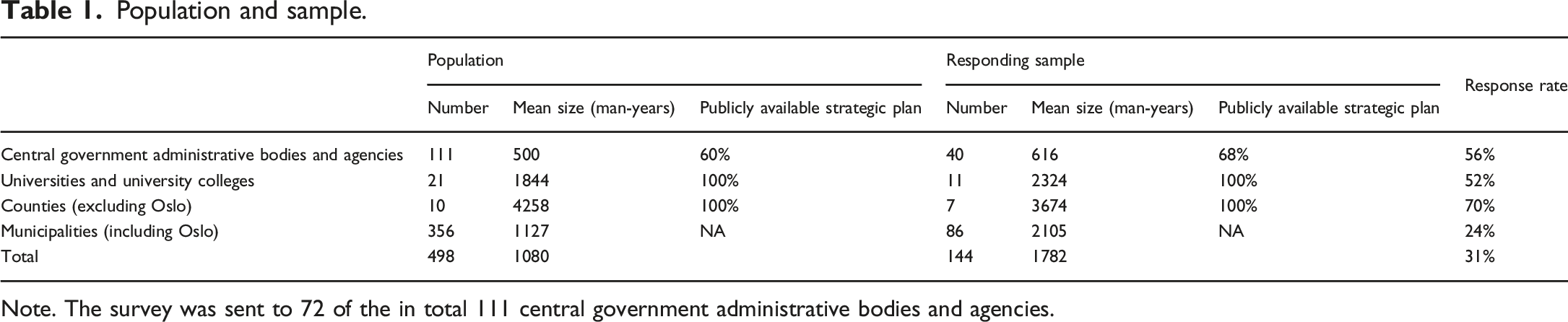
Note. The survey was sent to 72 of the in total 111 central government administrative bodies and agencies.
The overall response rate was 31%. The response rate was relatively high (52–70%) in the central government organisations, higher education institutions and counties, but the 24% response rate in the municipalities was relatively low. The response rate in a similar survey of public sector organisations in Canada in 2012 was 12.5% (Pollanen et al., 2017) but the response rate in similar surveys in the municipalities in Norway in 2012 and 2016 was more than 40% (Johnsen, 2016; Jacobsen and Johnsen, 2020). The recent municipal structural reform and the corona pandemic have probably posed greater challenges and required more management resources than usual for many municipalities in 2020. Moreover, many municipalities have probably received an unusual high number of surveys in 2020 because many students and researchers have not been able to conduct interviews as much as normally and therefore resorted to surveys. These factors may explanation the fact that the response rate was relatively low in the municipalities in 2020.
Regarding representativeness, there were responses from a variety of the agencies and from all four categories of old universities, new universities, specialized university colleges and general university colleges. Of the 111 central government, administrative bodies and agencies, 67 (60%) of these had a strategy plan in addition to mandatory plans (business plan), which were publicly available on their websites. Of the 40 central government, administrative bodies and agencies that responded to the survey, 27 (68%) had such publicly available strategic plans. All the government-owned higher education institutions and all the counties had such publicly avaliable strategic plans. The corresponding numbers for the municipalities are unknown. There were responses from municipalities in all of the country’s 10 regions, but there was a rising response rate with municipal size. This was partly a result of the following up procedure of non-response, which sought to acquire a high response rate from large municipalities due to the relatively low number of large municipalities in the population. No single item in the survey had more than five (3.5%) missing data.
Most of the respondents were senior management or chief financial officer, budget manager, accountant or controller (59%). 15% were managers or middle managers, 15% were advisers or senior advisers and 10% were politicians, directors or had other roles.
When all data comes from the same source, in this case a survey, there may be a risk that the data is characterized by this one method of data collection (Jakobsen and Jensen, 2015; George and Pandey, 2017). To investigate this possible source of error, we conducted a Harman one-factor test of all questions that used Likert scales. This is an unrotated factor analysis (principal component analysis) with only one factor. The analysis showed that this one factor explained 32% of the variation, well below the 50% typically used as a limit to detect the common method problem. Thus, this test suggests that the data is little characterized by the common method problem and can be used in further analysis.
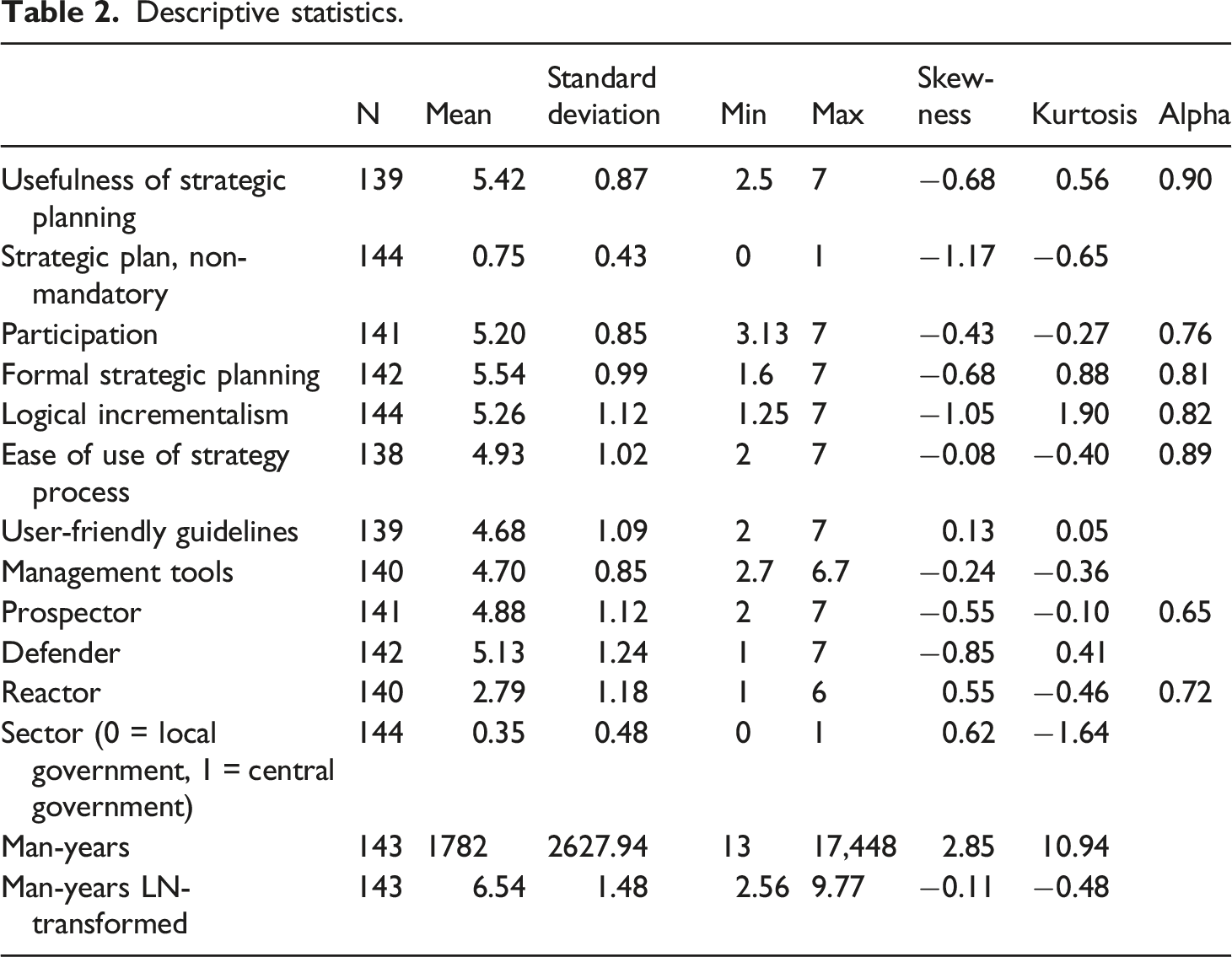
Descriptive statistics.
Analysis
Table 2 shows descriptive statistics of variables from the survey in 2020 as well as a dichotomous variable for sector and a variable for organisational size with data from administrative sources.
Table 2 shows the perceived usefulness of strategic planning measured as a scale averaging four questions, each measured on a Likert scale from 1 to 7 (alpha=0.90). The perceived usefulness was measured as 5.42, that is, considered relatively positive and well above the mean of the scale.
Assessment of perceived usefulness of strategic planning exceeding costs and efforts by type of government organisation.
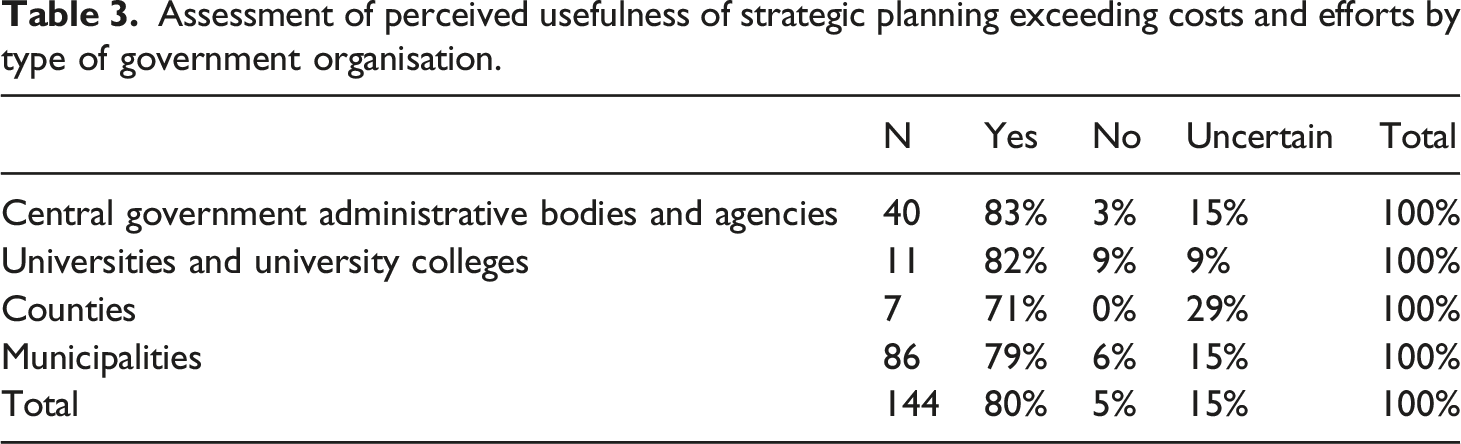
This question was also asked to the municipalities in 2016. At that time, in 2016, the municipal respondents answered 78% positive, 17% uncertain and 5% negative in their assessment of net benefit. In 2020, the experience in the municipalities was approximately unchanged with 79% positive, 15% undecided and 6% negative responses. (See Table 3.) It is interesting that the assessments were predominantly positive to strategic planning and management, also at the end of the year 2020 which had been a year of a lot of uncertainty and unpredictability.
What makes so many people in public sector organisations feel that the benefits of strategic planning are worth the time and effort, when the environment is so turbulent? The survey had no direct questions about the environment, but we asked a number of other questions, including the plans and processes, participation and use of the management tools in the strategic planning. The answers to these questions can reveal some factors that may explain why many organisations find strategic planning useful. We first look at some bivariate relationships before rounding off the analysis with a multivariate regression analysis of the perceived usefulness of strategic planning.
The positive assessment of strategy planning may be related to how the organizations have designed their planning systems. Public sector organisations such as agencies and municipalities are required to conduct planning and partly to formulate strategies, but how this is done is to a lesser extent regulated. Although government organisations and municipalities are required to develop goals and strategies, they are not required to draw up their own strategy plans. They can choose not to make their own strategic plans but instead use other, mandatory planning documents also as their strategy plans. Mandatory plans suitable for usage as strategic plans are the business plan in the government and the four-year financial plan, and in particular the societal section in the municipalities’ and counties’ area plan. The results showed that most organisations used mandatory plans as their (most important) strategic plans, but that most organisations also voluntarily made their own strategic plans or sub-plans. Here it is conceivable that government organisations, which are often closer to policy developments at the national level than most municipalities, are more active strategic planners than the municipalities.
Formal strategic planning and logical incrementalism by type of government organisation.
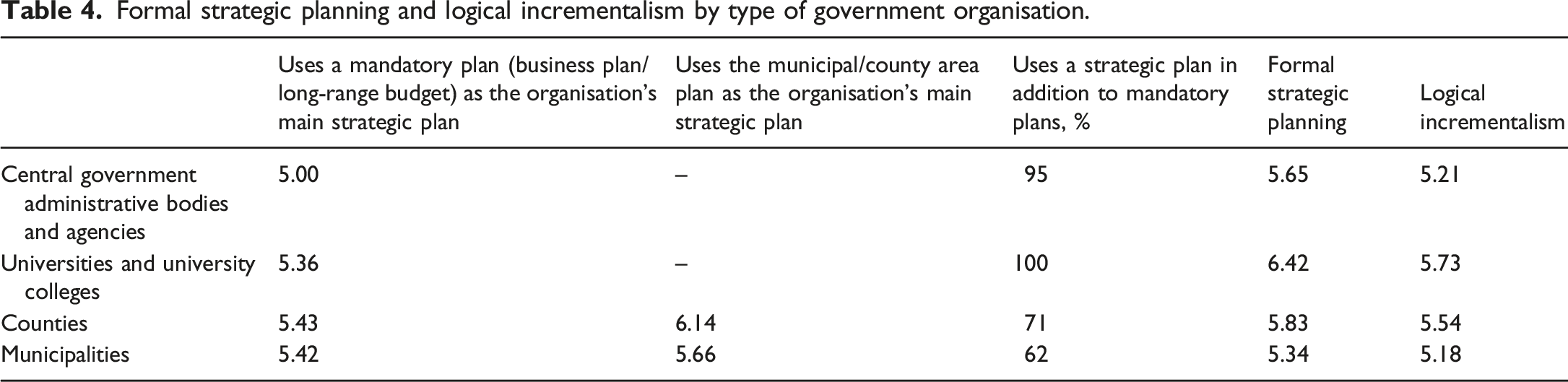
Table 4 also reports scales for ‘formal strategic planning’ and ‘logical incrementalism’ (Poister et al., 2013). As a result of the planning criticism of the 1960s and 1970s, Quinn (1982) developed a theory of strategic decision-making as incremental yet rational processes, which unite different subsystems and processes in organizations in a unified direction. This description of how actual strategy differs from ‘rational planning’, Mintzberg attributes as the beginning of the learning school in strategy (Mintzberg et al., 2009), that is, a perception that strategy is more developed in processes with many participants than as a formal plan that is decided only by senior management. The discourse in the field of strategy can give the impression that strategy work is a matter of either formal planning or informal processes. Our data indicate that most public sector organisations have both formal strategic planning and gradual processes for strategy development, perhaps much within the framework of mandatory planning, as Table 4 showed. Municipalities seem to have least and government-owned universities and university colleges most formal strategic planning as well as logical incrementalism.
Participation in planning is important for utilising the knowledge of various stakeholders and for anchoring the planning processes and creating commitment. Table 2 shows the extent to which different stakeholders have been perceived to have been central in the development of the strategic plan (Poister and Streib, 2005) on a scale from 1 (‘strongly disagree’) to 7 (‘strongly agree’), where the average for all was 5.2. Analyses of the data show that participation has been perceived as high in all types of organisations, but lowest in the central government administrative bodies and agencies and highest in universities and university colleges. The central government administrative bodies and agencies seem to have less involvement from the top political level and their owners (ministries) than others. Government agencies also have less involvement from external stakeholders (residents/citizens) than others. Many government agencies operate more in policymaking and governance than delivering direct services to end users. Furthermore, the government still attaches great importance to the one-year principle of its financial management, and the ministries are therefore not formally bound to the agencies' strategies. In the municipal sector, there is probably a closer link between political governance and the strategies of municipalities and county authorities. In the universities and university colleges, boards were also central and in the county municipalities ‘other external stakeholders’ who may have been other public authorities and organisations, were also central. On this basis, strategic planning seems to be adapted to the institutional differences between the government and the municipal sector. This may be part of the reason why the benefits of strategic planning are considered high in both the central government and municipal sectors. Nevertheless, the strategic planning appears to be a relatively top-level driven process as it was senior management and other managers who were considered to have been the most central to the planning development.
Table 2 also shows the extent to which the organisations have incorporated various management tools (‘elements’) into strategic planning (Poister and Streib, 2005). Public sector organisations use many of the well-known management tools in their strategic planning and management, but some tools are used more by some than others. Development of goals, visions and action plans is used the most, and competition analyses, market surveys and value chain analyses are used the least. The proportionate use of the tools in the municipalities appears to be similar to the way it was in 2012. Universities and university colleges appear to have been the most active users of many of the management tools. Government-owned universities and university colleges are in a competitive environment for students, employees and research projects with other government and private institutions. These higher education institutions may therefore use competition analyses and market surveys more than other central government agencies and municipalities. Internal and external analysis (SWOT) is one of the oldest and partly much criticized management tools (Hill and Westbrook, 1997) and is often used in strategy design and strategy planning. Internal and external analysis is common but was not among the most commonly used tools. There was less than medium use of mapping of internal resources and competencies. Whether strategic planning based on analyses of ‘core competence’ and ‘strategic capabilities’ in line with resource-based theory (Hansen and Ferlie, 2016; Prahalad and Hamel, 1990; Wernerfelt, 1982) is already widespread or has not become commonplace in public sector organizations, is unknown. This is an interesting topic for further research.
A bivariate correlation analysis of the use of 10 management tools used in the strategic planning and the perceived usefulness scale showed that all the relationships were positive in the range of r = 0.18–0.43 and significant (p≤0.05). The five management tools with the highest correlations (r≥0.35) were formulating goals, making action plans, conducting user surveys, producing feasibility plans and formulation visions.
The prospector and even more so the defender stance were the most common ways for adapting to the environment (Andrews et al., 2006, 2011). (See Table 2.) Analyses of the data reveals that the counties seem to adapt the prospector stance the most and universities and university colleges adapt the defender stance the most.
Multiple regression analysis (OLS) of perceived usefulness of strategic planning (N = 125).
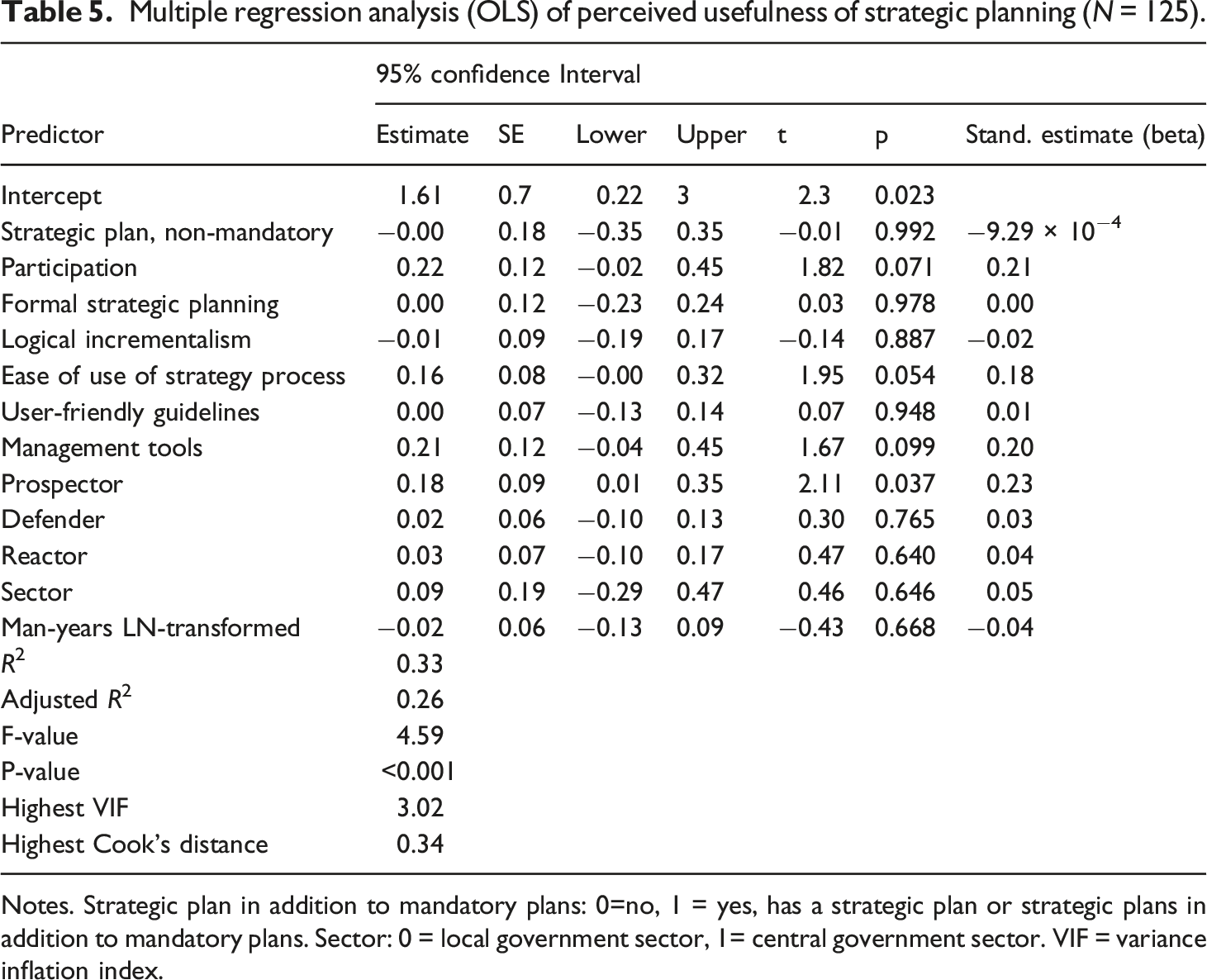
Notes. Strategic plan in addition to mandatory plans: 0=no, 1 = yes, has a strategic plan or strategic plans in addition to mandatory plans. Sector: 0 = local government sector, 1= central government sector. VIF = variance inflation index.
From the model results in Table 5, we see that the strategic type of prospector, participation, use of management tools and ease of use of the strategic planning process, had the greatest positive and significant correlations with the perceived usefulness of strategic planning (beta coefficients ranging from 0.18 to 0.23, p<0.10). There is therefore reason to believe that for organisations to benefit as much as possible from their strategic planning and management, they should manage their strategic planning conscientiously. The organisations should use appropriate management tools for the strategic issues to be identified and included in the action plans. Moreover, the organisations should work to ensure that the strategy processes are both easy to learn and easy to participate in. It may also be the case that prospecting is useful, or at least perceived to be useful, in turbulent environments. Whether the strategic planning utilises mandatory plans or separate strategy plans in addition to the mandatory plans, or formal strategic planning or gradual processes characterized by logical incrementalism, do not seem to have any significant correlation with the perceived usefulness of strategic planning.
Discussion and conclusions
The main conclusion of this study is that for many organisations in the public sector, strategic planning seems to be perceived as useful also in turbulent times. The widespread perception that strategic planning is useless when there is a high degree of uncertainty and unpredictability in the environment therefore seems to be a myth.
Public sector organisations relate to different parts of the environment and will consequently experience different degrees of uncertainty and unpredictability. Also different parts of the organisation relate to different parts of the environment and in different degrees. Nevertheless, many public sector organisations have experienced considerable and probably increasing uncertainty and unpredictability in recent years. Despite this, strategic planning appears to be widespread and perhaps increasing, and the overall benefit of strategic planning is generally considered positive. For example, the Norwegian government report on the long-term perspective on the economy that was planned for release in 2020 was, due to all the uncertainty and other important tasks in the pandemic in 2020, admittedly postponed, but it was published in February 2021 (Meld. St 14 (2020–2021)). Another example corroborating this finding is a study by Pasha and Poister (2017) who analysed the impacts of cutbacks and environmental turbulence on strategic planning and performance management in US local transit agencies after the financial crisis in 2008. They found that the agencies increased their use of logical incrementalism in strategy and placed greater emphasis on performance measurement. It therefore seems that strategic planning is considered useful in practice even when there is a high degree of uncertainty and unpredictability in the environment – factors that the planning and strategy literature often points out as factors that make strategic planning difficult, useless, or too costly.
The use of management tools, for example, performance measurement, for analysis and development of goals seems to be one important explanation for the fact that many people find strategic planning to be predominantly useful even in turbulent conditions, both in the central and local government sectors. Another important explanation for the continued satisfaction with strategic planning under turbulence is that many use formal strategic planning as well as logical incrementalism. Formal strategic planning heeds the need for transparency and participation in public management (Bryson, 2018; Johnsen, 2015) and incrementalism heeds the need for gradual adjustments to uncertainty (Quinn, 1982). While public sector formal strategic planning in the 1970s and 1980s may have been relatively rigid, public sector organizations today may adjust aspiration levels and time span for the planning individually incorporating more incrementalism than before. The survey data documented that logical incrementalism was used almost as much as formal strategic planning. For example, Norwegian municipalities are required to make four-year budgets in their planning, but only the first budget year is financially binding. Central government agencies’ strategic plans typically have a 5 year planning horizon (Johanson et al., 2019) and may use budget forecasts. Central government agencies’ formal budgets have, however, only a 1 year time span. Therefore, using different management tools and combining logical incrementalism with formal planning seems in large part to explain why many public sector organisations are satisfied with their strategic planning also in turbulent times.
The environments for government agencies and municipalities are different. For example, some agencies have recently worked particularly much on developing policies for pandemic measures, labour market measures and societal security, and many municipalities have faced particular challenges with implementing these pandemic measures, particularly in schools and health care services. Thus, it is conceivable that the agencies and the municipalities experience the benefits and disadvantages of strategic planning differently in these uncertain and turbulent times. Our analyses indicate that in about 4 out of 5 agencies, government universities and university colleges, and municipalities, respondents have nevertheless considered the overall benefit of strategic planning to be predominantly positive, even during these turbulent times. In the counties, a somewhat lower proportion rated the benefits as positive, but here the data are more uncertain due to few responses and that many of the 10 counties have recently implemented a major structural reform. Nevertheless, the main impression is that the total benefit of strategic planning is assessed as positive throughout the public sector. Moreover, the strategy process (stakeholder participation), use of management tools, as well as strategy content (prospector stance) seem to be related to the perceived usefulness.
This study has certain limitations that should be taken into account when assessing the usefulness of strategic planning in turbulent times. First, planning has many purposes beyond being useful for improving management processes and service efficiency and effectiveness, as our dependent variable has measured this. Public sector planning is also used to create transparency, verifiability and legitimacy, which is important in democratic governance. Such purposes of planning will also be important in turbulent times. Transparency, verifiability and legitimacy in the management processes are probably more important in democratic governance in public organizations than it is for governance in many private organizations, and especially for organizations in competition-exposed markets. Verifiability of planning can be important in all organisations but is nevertheless probably most important in public governance. This may explain why strategic planning is perceived as useful in public sector organisations even in turbulent times, but this finding may not be transferable to all non-public sector organisations.
Second, the regression analysis indicated that participation correlated positively but only with a low level of significance (p = .07) with perceived usefulness of the strategic planning process. Many public sector organisations have a lot of involvement in their strategic planning processes (the minimum value for participation was as high as 3.13, see Table 2). It is likely that little or no absence of participation could have reduced the usefulness of strategic planning. It is therefore conceivable that our analyses are unable to uncover strong, significant links between participation and the perceived usefulness of strategic planning. Even though participation is nevertheless substantial, it may not have a practical impact on decisions or implementation. Participation may be a formalised process, but the actual impact may be uncertain because there are ways to manage change processes that reduce or counteract the influence of certain stakeholders (Meyer and Stensaker, 2009). Participation can thus be important in practice even though our analysis does not capture the mechanisms or effects of participation in detail.
Third, the response rate in this study was relatively low, especially due to a low response rate in the municipalities, which was probably due to the turbulent times and especially the toll of the pandemic on management. As a result, those who have responded to the survey that provided the data basis for our analyses may have been the least affected by the turbulence and were perhaps also the ones who benefited most from the strategic planning. At the same time, we do not know what those who did not respond would have responded. Because strategic planning was widespread, it is also possible that those who were most concerned by all the uncertainty and unpredictability and did not have time to prioritise responding to the survey also benefited greatly from having strategies and plans in such conditions.
The main conclusion of this study is, as stated above, that many organisations in the public sector perceive strategic planning to be useful also in turbulent times. Whether strategic planning is perceived as more or less useful in turbulent times than in ‘normal’ times, whether strategic planning in turbulent times is perceived as useful outside the public sector and whether strategic planning in turbulent times factually impacts performance, are interesting questions for further research. Moreover, further research would benefit greatly by incorporating common measures for changes in environmental traits such as complexity and uncertainty, as well as incorporating comparable administrative measures for organisational performance.
Footnotes
Acknowledgements
Thanks to Stephen Affleck Reid for collaboration in the design of the survey and to all the survey respondents. Thanks also for comments when an early analysis of the data was presented for The Norwegian Agency for Public and Financial Management (DFØ) 17 December 2020, and when an earlier version of the paper was presented for the IRSPM digital conference, 20–23 April 2021, and for constructive comments from the anonymous reviewers.
Declaration of conflicting interests
The author(s) declared no potential conflicts of interest with respect to the research, authorship, and/or publication of this article.
Funding
The author(s) received no financial support for the research, authorship, and/or publication of this article.
