




Abstract
Elections depend on the thousands of people who give up their time to administer this crucial public service. They staff polling stations and ensure votes are issued, cast and counted. Poll workers are effectively ‘stipended volunteers’, receiving some limited financial compensation, but working for the broader public good. It is important to understand why people choose to give up their time to provide this fundamental public service to their fellow citizens. Using original data from a poll worker survey conducted in the 2015 British general election, this article investigates the motivations and incentives for poll workers volunteering to administer major elections in an important advanced democracy. Exploratory expectations are set out about the motivations of poll workers, and the relationship to their socio-economic characteristics, and levels of social capital and satisfaction with democracy. Contrary to expectations, the findings note that, earning some extra money is important to many, although motivations are more broadly structured around solidary, purposive and material motivations. The article establishes a range of relationships between each set of incentives, and poll workers’ socio-economic, social capital and satisfaction profiles.
Keywords
Introduction
Elections depend on the thousands of people who give up their time to administer them. They provide a crucial public administrative service, staffing polling stations and ensuring votes are issued, cast and counted. In the USA in 2016, over 917,000 people volunteered to work in the elections at approximately 185,000 polling places, while an additional 350,000 volunteered for the 2020 elections (Merivaki, 2020; OSCE/ODIHR, 2016; Wimpy, 2018). Despite providing a fundamental public service, many countries experience problems recruiting sufficient numbers of poll workers. Given these are potentially high stress and primarily low pay temporary positions, this poses an important question for both public administration and electoral integrity scholars. Why do people choose to give up their time to provide this vital public service to their fellow citizens and democracy more generally?
Research into this question is extremely rare. Using data from an original poll worker survey conducted in the 2015 British general election, this article investigates the motivations and incentives for poll workers to volunteer on polling day. Discussion proceeds as follows. The first section briefly outlines the general importance of poll workers in administering electoral democracy. The second section conceptualises poll workers as ‘stipended volunteers’, and discusses how this might inform understanding of their motivations. The third section outlines the data used in this study. The fourth part presents an analysis, highlighting several factors structuring poll worker motivations to work on polling day. Discussing the significance of these findings, the paper concludes by making a number of recommendations for analysts and policymakers, while highlighting the comparative utility of the British case.
The importance of poll workers
The number of elections that are held around the world has increased substantially in recent decades (Hyde and Marinov, 2012). People are crucial to the effective administration and implementation of electoral law and policy. 1 Yet, elections are often undermined by concerns about electoral integrity and malpractice. Many electoral malpractices can occur in the polling station (Birch, 2011; Lehoucq, 2003). Public administration scholarship has shown that even the best-designed policies can go wrong at the implementation stage (Sabatier 1986). Street-level bureaucrats have considerable discretion and opportunity to implement policies differently (Lipsky 2000). This is also the case in electoral administration. The service street-level bureaucrats, such as poll workers, provide to electors can directly help shape public confidence in the electoral process (Hall et al., 2009).
Poll workers are therefore key to understanding how elections are delivered on the ground. They can have a positive effect on voter confidence (Hall et al., 2009), yet also have considerable discretion in how they implement electoral law (Atkeson et al., 2014). Given the range of electoral systems in use, different methods for casting ballots, from technology to paper-based, they can be faced with a multitude of challenges both within and across countries. However, it is important to note that while there may be differences in what poll workers are required to do in different countries, there are also crucial commonalities. In particular, poll workers are universally temporary workers, employed to help deliver the election. They set up polling stations, greet voters, ensure only those properly registered can vote, hand out ballot papers, and ensure voting secrecy and order in the polling station. At the close of poll, they begin the process of counting, or transferring ballot boxes to counting locations. Even in countries where electronic voting machines are used, such as India, they perform equivalent roles.
In some countries, poll workers are state employees who are seconded to run elections, as in India (James, 2020: 127–131). In others, poll workers are selected because of party allegiance or membership. 2 Elsewhere, as in Germany, Spain and Mexico, they are citizens who are compelled to undertake the task as a civic duty. 3 In other polities, the task has traditionally been voluntary. In the US, procedures vary by state, but they are volunteers who senior electoral officials spend considerable time and resource recruiting, and are usually paid (US EAC, 2020). Indeed, Burden and Milyo (2015) report that just under half of all US jurisdictions, between 2008 and 2012, had difficulty in finding sufficient numbers of poll workers. Recruitment problems were greater in urban areas and those with high registration rates. Such problems are not confined only to American experience but also experienced elsewhere (Burden and Milyo, 2015: 40; Clark and James, 2017; OSCE/ODIHR, 2008: 11). Given evidence that many electoral managers have problems enticing volunteers to work at elections, poll worker recruitment is a pressing public policy problem for democracies. A better understanding is therefore required of the factors that might motivate individuals to volunteer, and also who might be motivated by particular aspects of such important, if short-term, work.
In the USA, surveys of poll workers have become an established, if irregular, method of understanding their role in implementing elections. These surveys have been used to identify the demographic characteristics of poll workers and how are they recruited, whether poll workers have the appropriate skills to work on election day, and how effective their training is (Alvarez et al., 2007; Burden and Milyo, 2015; Cobb et al., 2012; Glaser et al., 2007; Mockabee et al., 2009). The study of poll workers is rare outside the USA (but see: Cantu and Ley, 2017; Clark and James, 2017; Herron et al., 2017).
Poll workers as stipended volunteers
Few studies have examined the motivation for poll workers choosing to work on election day. Glaser et al. (2007) surveyed 15,000 poll workers in Florida in 2006. They found that the most commonly stated reason for becoming a poll worker was ‘to help my community’, ‘to help out’ or ‘community service.’ Material benefits were commonly highlighted as important. On the basis of a survey in Leon County, also in Florida (n = 845), McAuliffe (2009) tested the importance of theories of social capital, public service and volunteer motivation, coproduction, and principal-agent theory. Underpinning these, she argued, were intertwined motivations driven by democracy, civic responsibility and public service. As she put it ‘poll workers support the ideals of democracy, they share a sense of civic responsibility and they feel they are public servants’. She summarised poll workers as being a ‘singular hybrid of volunteer and public servant’ (McAuliffe, 2009: 16 & x).
Poll workers are an unusual group to conceptualise. Unlike normal volunteers, in most instances they are paid for their service. Payment is seldom high. Mexican poll workers, for example, only receive a per diem allowance of $20 (Cantu and Ley, 2017: 501). In the 2020 American Presidential election, poll workers in Portland, Oregon were paid $12 per hour for their day’s work, while thirteen states had a minimum stipend of less than $100 per day (Gittens, 2020; Merivaki, 2020). In a broader survey of US poll workers, Kimball et al. (2009) catalogue payments of between $100-$164, depending on the task being undertaken and the jurisdiction size.
Poll workers therefore appear more like ‘stipended volunteers’ (Mesch et al., 1998; Tschirhart et al., 2001). Stipended volunteers ‘receive some financial compensation below fair market value and work in formal service activities to help others with whom they have no personal connection’ (Tschirhart et al., 2001: 422). Poll workers appear to fit this well; they tend to be low paid and help others with whom they rarely have any connection. For McBride et al. (2011: 851–852), such stipends are ‘features that leverage volunteer participation by providing volunteers with the support they need to perform’. In this conception, stipends thus facilitate volunteering rather than displace it as might be expected from economic approaches to such questions (Frey and Jegen, 2001). Payment is therefore not thought to play a significant motivating role in recruiting poll workers (Burden and Milyo, 2015: 44).
Given this, why poll workers choose to volunteer to work at what will be a long and potentially high-pressured day still needs to be explained. Motivations for volunteering are often dichotomised between altruistic motivations, through helping others, and instrumental motivations, which are more about satisfying personal objectives (Mesch et al., 1998; Tschirhart et al., 2001). This echoes debates about motivating public sector employees, who it is suggested can have either extrinsic or intrinsic motivations, which can be cross-cut or underpinned by other-regarding or self-regarding values. In this approach, intrinsic motivation refers to doing something because it is inherently interesting, while extrinsic motivations aim to achieve the outcomes an employee values. Underpinning both are the internal, self-regarding meanings of a particular motivation to individuals undertaking an action (Esteve and Schuster, 2019). Tschirhart et al. (2001: 426) identify five types of volunteer motivations. Altruistic motivations are about helping others and expressing values. Instrumental motivations are about personal advancement and skills development. Social motivations relate to developing friendships and being held in good regard. Self-esteem relates to feeling better about oneself. Finally, avoidance is about escaping alienation, boredom and problems.
A different approach is provided by Clark and Wilson (1961). They argue that incentive systems are a key variable bridging the gap between individuals and organisations. This emphasis is also evident in the literature on volunteering motivations (Clary and Snyder, 1999; Tschirhart et al., 2001: 425). Clark and Wilson (1961: 134–137) offer the classic threefold classification of material, purposive and solidary incentives. Material incentives are provided by some sort of material gain, whether through payment or career advancement. While the temporary nature of poll worker employment means there is unlikely to be any career advancement involved, the positions are paid. It is therefore conceivable that some people work on polling day to earn some extra money (e.g. Glaser et al., 2007). Purposive benefits are achieved by the organisations that the individual works for implementing or achieving its aims. Poll workers may therefore be motivated by helping electoral authorities achieve well run elections. Finally, solidaristic or process benefits offer the chance to participate in social and political activities, thereby meeting like-minded individuals. Although incentives-based approaches have rational choice underpinnings, they can also be extrinsically oriented (Esteve and Schuster, 2019: 13). There are therefore clear links between this tripartite schema and the altruistic, instrumental and social motivations highlighted by studies on stipended volunteers (Tschirhart et al., 2001).
McAuliffe’s (2009) study of American poll workers underlines their essential civic-mindedness. As a proxy for this, she suggests that poll workers exhibit high levels of social capital, arguing that it is appropriate to address ‘the question of how much social capital influences one’s motivation to work the polls’ (McAuliffe, 2009: 18). She goes on to argue that social capital has been successfully used to recruit volunteers for polling stations. Moreover, ‘the massive volunteer effort seems to contradict projections of demise in social capital. Working the polls does not appear to be about money. It is about civic engagement and responsibility’ (McAuliffe, 2009: 21). Hostetter (2020: 393) similarly argues that ‘long hours for low pay require poll workers to have a strong sense of civic duty’. McAuliffe suggests that social capital might be more than just an input to poll worker recruitment. Instead, it might also be an outcome of volunteering as poll workers find they enjoy the experience and volunteer again in future.
A further potential explanation is that those who are more likely to volunteer are more likely to be satisfied with the democratic process and wish to help others have their voice heard by volunteering. This is contrary to the causal link normally made between democratic satisfaction and poll workers, where they are argued to play a considerable role in satisfaction with democratic processes for the voters they serve (Claasen et al., 2008; Hall et al., 2009). Similarly, in much volunteering literature, satisfaction is argued to flow from the experience of volunteering (e.g: Wilson, 2000). Importantly for the argument here, Stadelmann-Steffen and Freitag (2011) provide a different approach by reversing the causality between satisfaction and volunteering. Making the argument that the political and institutional context stimulates individual behaviour, they suggest that models of democracy and individual attitudes towards democracy influence citizens’ propensity to volunteer. They hypothesise that individuals that are more satisfied with the functioning of democracy are more likely to display civic engagement through volunteering. Following this logic, there is likely to be a positive relationship between those who are satisfied with the democratic process and volunteering to work on election day as a poll worker.
In addition to little being known about poll worker motivations, little is known about the social profile of those who work on election day. What evidence there is comes from the USA. Burden and Milyo (2015: 39) suggest a profile which is predominantly female, older than average, and likely to have a college degree. They note concerns regarding unrepresentativeness among poll workers and the effects on voter satisfaction. This theme is taken up by King and Barnes (2019) who note a predominantly white work force on election day.
Research on stipended volunteers has documented the impact of socio-economic and demographic factors on motivations for volunteering. This has, for instance, pointed to a relatively young, predominantly female and well-educated group taking part over time in the voluntary activities they studied (Mesch et al., 1998; Tschirhart et al., 2001). Other research has examined older groups (Tschirhart, 1998), or suggested an older age profile of volunteers while at the same time observing a predominantly female stipended volunteer workforce (McBride et al., 2011).
Socio-economic and demographic factors are likely to influence volunteers’ motivations. According to Tschirhart (1998), older stipended volunteers are more likely to have altruistic and public service motivations for service, while social motivations also factor into their reasons. The corollary is that younger volunteers are more likely to be interested in material considerations. While extra money is clearly important to many, it is likely to be more so to lower earning or less well-educated groups. It might also be expected that social capital and satisfaction with democracy impact upon the respective motivations.
This suggests some expectations about what might be evident. The first two are relatively general. Given the poll worker and stipended volunteer literature, poll workers will be mainly female. Payment does not constitute a major motivation for working on election day.
From the volunteering motivations literature, evidence of both intrinsic and extrinsic motivation, arguably cast in the language of solidary and purposive benefits or motivations is to be expected. How these motivations fit with the social profile of individuals, and whether some motivations are more attractive for some groups than others, provides a crucial piece of the jigsaw for electoral administrators looking to fill posts on election day. We formulate these as the following hypotheses: H1: Older poll workers will be more likely to be motivated by solidary and purposive incentives, with younger poll workers showing a positive relationship to material incentives. H2: Higher levels of education and income will be negatively related to material incentives, but positively related to solidary and purposive incentives.
Moreover, social capital and satisfaction with democracy are likely to be evident among poll workers and have a positive relationship with their motivations to volunteer. These are unlikely to be related to material incentives, but provide expectations with solidary and purposive incentives. Thus: H3: Higher levels of social capital will be positively related to both solidary and purposive incentives. H4: Higher levels of satisfaction with democracy will be positively related to both solidary and purposive incentives.
Data
The data come from an original survey of poll workers in eight English local authorities in the 2015 general election. Britain is an excellent case for developing insights into who volunteers to become a poll worker, and what might motivate them. Like several advanced democracies, British elections are administered by local governments who have discretion, within statutory requirements, in determining how elections are implemented. This is the case also in both the United States and Canada, as well as smaller democracies such as Ireland (Clark, 2017; James, 2012; OSCE/ODIHR, 2015). Even in nationally organised systems of electoral governance, there is a sizeable role for local government in organising election administration, and therefore employing poll workers, on the ground (Norris 2015: 23–24).
Two types of poll workers work at UK elections. Presiding Officers have responsibility for opening and closing the polls, organising the layout and maintaining order in the polling station, monitoring campaigners outside polling places and supervising polling clerks. Polling clerks are responsible for checking the eligibility of electors, marking the register and issuing ballots to voters. They are recruited by various means. Some will have worked at previous elections, while others have been asked by friends or council officials, or responded to adverts (Clark and James, 2017). Both categories of poll worker are appointed only for the temporary purpose of the election.
The survey was developed from a previous questionnaire, the Ohio Poll Worker Survey, which was used in Ohio’s 2008 Primary election (Mockabee et al., 2009). The 2015 questionnaire was developed and adapted for UK circumstances. It contained questions on recruitment, training, motivations for working at the election, election day experiences, views of the democratic process and more general demographic information.
Of the fourteen local authorities approached to participate in this study, eight agreed to do so. Four local authorities were located in the North East of England, and four in Norfolk in East England (see also Appendix 1). 4 These local authorities, between them, administered 21 of the 632 British parliamentary constituencies at the general election. Such an approach can be criticised for not providing a representative sample (Bryman 2008: 183–184). Notably, the local authorities did not include urban areas where prominent cases of electoral fraud have been found (Stewart, 2006). This notwithstanding, there is unfortunately no way to directly sample or survey polling station workers in Britain without gaining access through electoral services departments at close to 400 separate local authorities. No national database of poll workers exists, nor were the authors able to obtain at the time an official estimate of the numbers of poll workers nationwide. A representative sample would therefore be extremely difficult to achieve. Selecting authorities where problems had knowingly taken place would further risk the difficulty of ‘selecting on the dependent variable’. 5 Evidence suggests that electoral fraud across Britain is extremely rare (Electoral Commission, 2016).
The research strategy deployed here is common in organisation and administration studies (Bryman 2008: 183). The study covers eight local authorities, who administer the electoral process in twenty-one parliamentary constituencies. 6 It provides greater data than hitherto collected, across very different parts of England. Gaining agreement from local electoral authorities to participate meant that it was possible to distribute a questionnaire to every polling station worker employed by those local authorities. This was therefore a full population survey of the poll workers within the eight local authorities who agreed to take part. Most studies of poll workers have studied specific locations rather than deploy a nationwide random sample (Claassen et al. 2008; Hall et al., 2009). Such an approach has also successfully been deployed to examine questions of public service motivation in local government elsewhere (Weske and Schott, 2018). Participating local authorities appear broadly representative of wider levels of electoral administrative performance. The average performance of the participating local authorities is close to the nationwide mean for British election administration in Clark’s (2015, 2017) index of performance in the 2010 general election. 7
In total, 3,350 questionnaires were distributed to poll workers by their local authority on the day of the election. Poll workers were asked to complete and return them by mail. The response rate was 39.4%. The analysis is therefore based on responses from 1,321 poll workers in a mix of rural, urban and mixed local authorities and constituencies. In addition, McBride et al., (2011: 857) highlight the need for qualitative evidence to complement quantitative responses in investigating stipended volunteers. The survey provides both quantitative and qualitative insights into poll workers. Both are utilised below.
Analysis
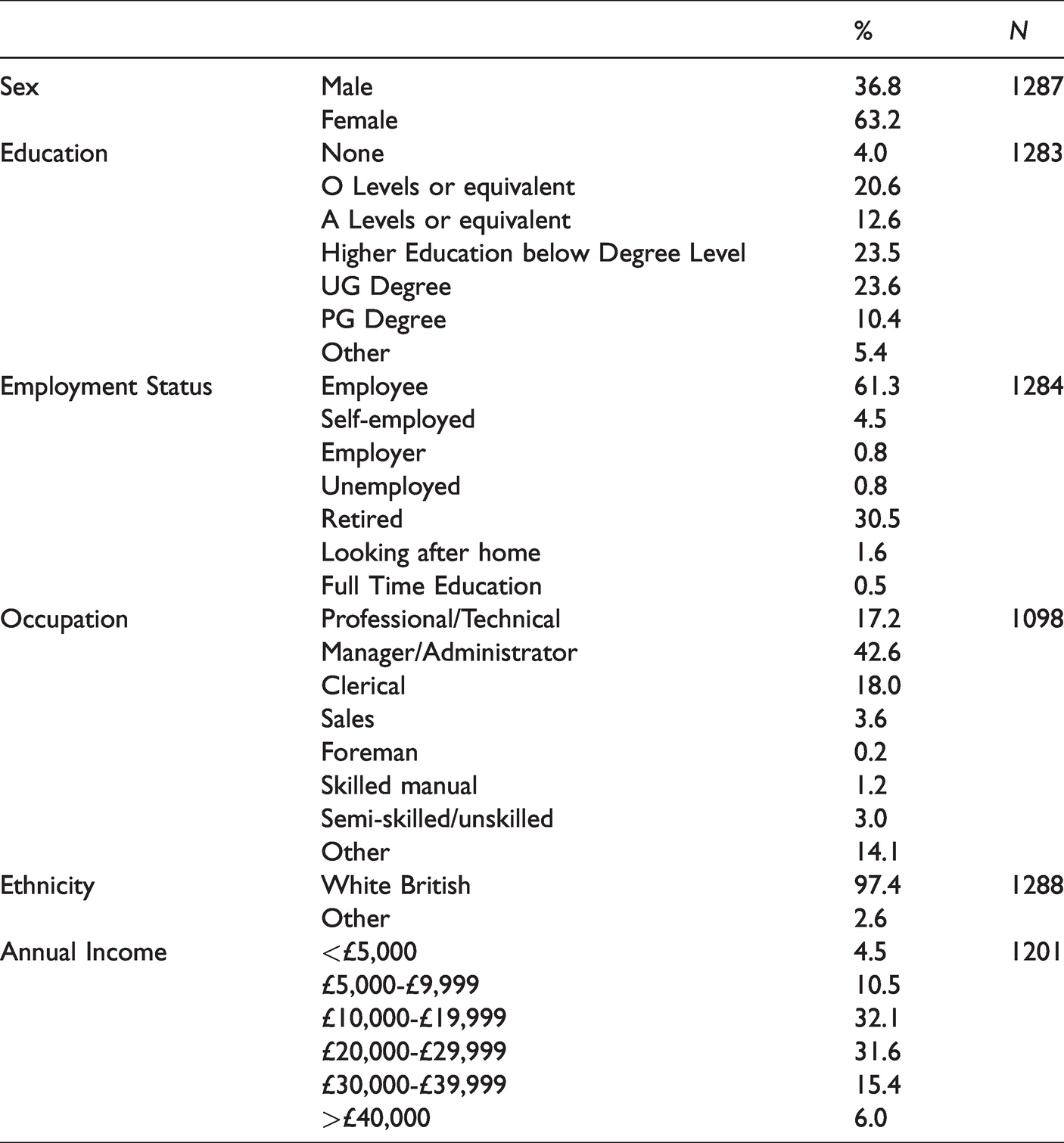
Analysis begins with a brief outline of the socio-economic characteristics of poll workers. The average age of poll workers was 53.3, with an age range of between 20-82. Table 1 indicates that the expectation, derived from both the poll worker and the stipended volunteer literatures, that women would be most likely to volunteer is born out, with over three-fifths of poll workers being women. This is a relatively well-educated workforce, with 57.5% experiencing post-school education. More than three-fifths were employed, while a further 30.5% were retired, almost double the 16-17% of people of retirement age in the 2011 UK census. Moreover, 52.3% had to take time off work to work on polling day. Most worked in some form of routine technical or administrative role. This is a group which appears around average in terms of earnings, with just over 30% earning either between £10,000-19,999, or £20,000-29,999. This compares with a median income in Britain of roughly around £20,100 before tax in 2012-13, with median income for the North East £19,400 and for Norfolk £18,100. Finally, as King and Barnes (2019) noted in their American study, ethnically this was a predominantly white group of volunteers, although caution is necessary since major multi-cultural cities were not part of this sample but would be required to provide a more definitive answer regarding ethnicity.
Socio-economic status of poll workers.
To try to measure respondents’ motivations for volunteering, the survey deployed a battery of questions asking for poll workers’ reasons for working on polling day. These tap into all aspects of the motivations set out above. The responses are outlined in Table 2. The first point to note is that, contrary to what might be expected from research on poll workers elsewhere, money does play a role in motivating many to work on polling day in the British case. Thus, to 89.5% of respondents, making some extra money from working at the election was either somewhat or very important. In two local authorities in the North East, the most responsible position of Presiding Officer in the 2015 general election was paid a fee of £195 with travel expenses and a small training allowance covered. Those local authorities paid their polling clerks a fee of £115, again with travel covered. One local authority paid a little more; £285 for presiding officers, and £185 for polling clerks, which included a training payment. In this council, the fee is reduced by £35 if a standalone election is held. Given that this is roughly a sixteen hour day at work with few breaks, this equated to between £12.18-£17.80 per hour for Presiding Officers and £7.19-£11.56 for polling clerks. As might be expected from the stipended volunteers concept, poll workers are not therefore necessarily making a lot of money when providing this crucial civic duty. The amount paid to polling clerks was close to the legal minimum wage in some local authorities when the whole day is taken into consideration. Yet, it still seems to be an important factor. Given that most are paid around the median wage to begin with, such additional income may well be an important supplement.
Reasons for working on polling day (%).
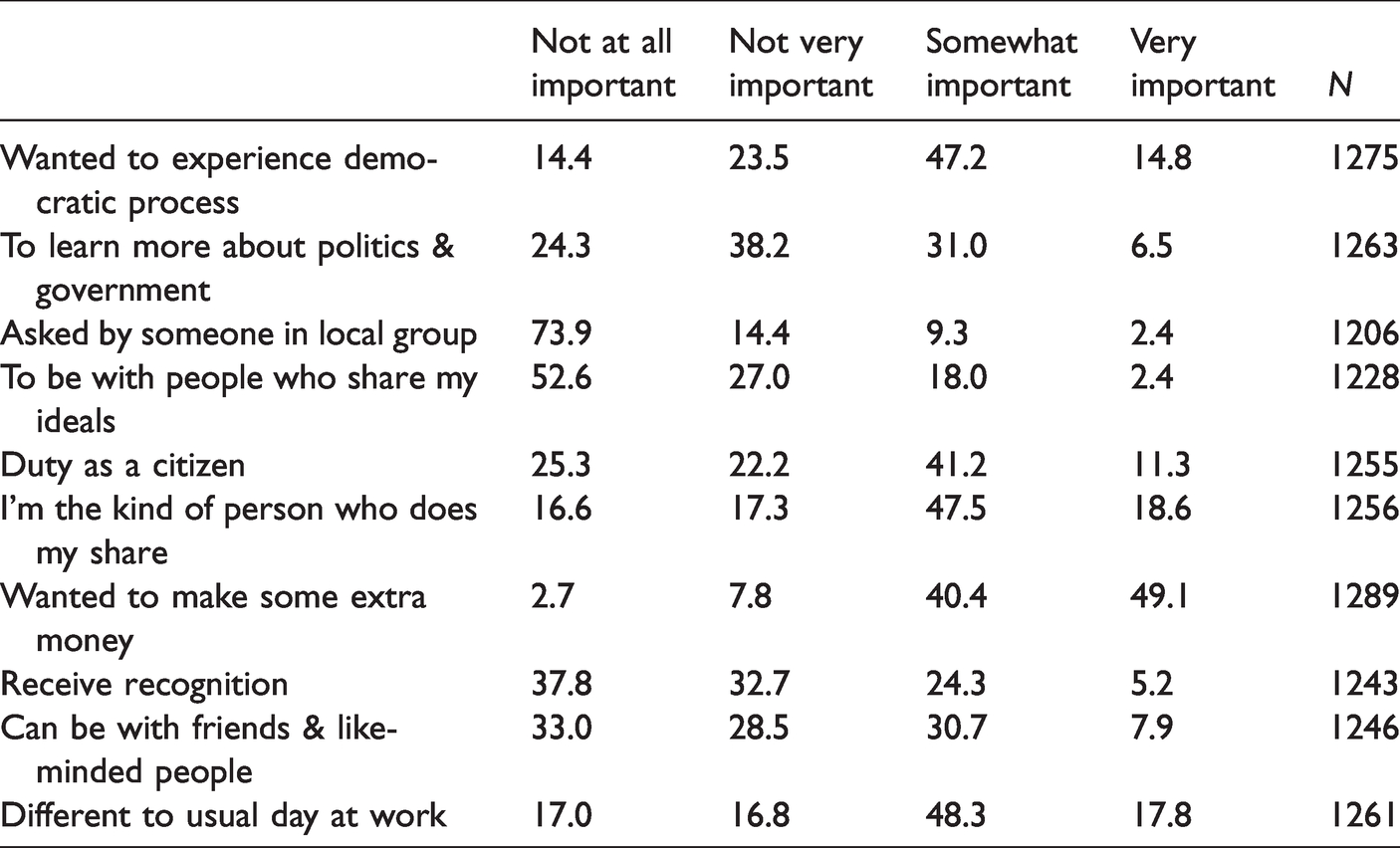
Other explanations are clearly important, however. To two thirds, it was different from the usual day at work. This is suggestive of Tschirhart’s (2001: 426) identification of avoidance and escaping boredom as motivating factors in volunteering. Altruistic motivations were clearly also important to some; two thirds claimed to be the kind of person who does their share. Similarly, 62% wanted to experience the democratic process, potentially indicating both altruistic and more intrinsic self-development motivations. The 37.5% indicating they wanted to learn more about politics and government also appear to have had some form of intrinsic motivation. Some social explanations appear to have been of mid-range importance, such as it being a civic duty, or being with friends and like-minded people. Other social explanations seemed of less importance. The lowest ranking in terms of importance were wanting to be with people who share their ideals and, at 11.7%, being asked by someone in a local group they attend. Self-esteem also seemed to motivate some poll workers, with 29.5% stating that receiving recognition was somewhat or very important.
Associational activity has always been a crucial indicator of social capital. It was this, for instance, that Putnam (2000) used to set the scene in his famous Bowling Alone study. Poll workers were therefore asked how many civic organisations they belonged to, and given examples such as the National Trust, Royal Society for the Protection of Birds, Parent Teacher Associations, religious organisations or other such groups to guide them. At 46.5%, just under half of respondents belonged to no civic association, while 38.3% belonged to either one or two associations, 11.6% belonged to three or four and the remaining 3.7% to five or more. For comparison, the 2011-12 Understanding Society panel survey found that 47% were members of some form of association, equivalent to the results found in the poll workers survey. 8
Table 3 shows that there is some variation in terms of satisfaction with democracy. Indeed, 48.4% report being satisfied to some extent with how British democracy works generally, while 23.6% report being dissatisfied and 28.1% are neither satisfied nor dissatisfied.
Satisfaction with democracy (%).
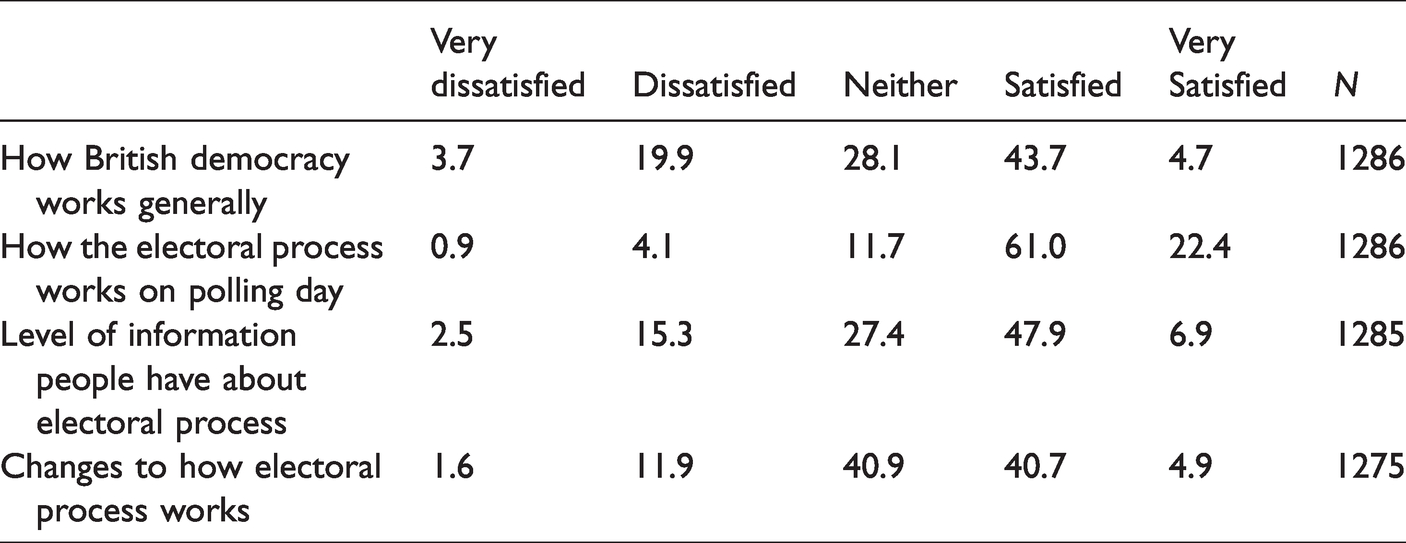
On the electoral process itself, 83.5% were either satisfied or very satisfied with how the electoral process works on polling day. Over half (54.8%) were satisfied with the level of information people had about the electoral process, although 27.8% were dissatisfied and 27.4% neither satisfied or dissatisfied. Finally, 45.6% were satisfied with changes to how the electoral process worked, 13.5% were dissatisfied and 40.9% neither satisfied nor dissatisfied.
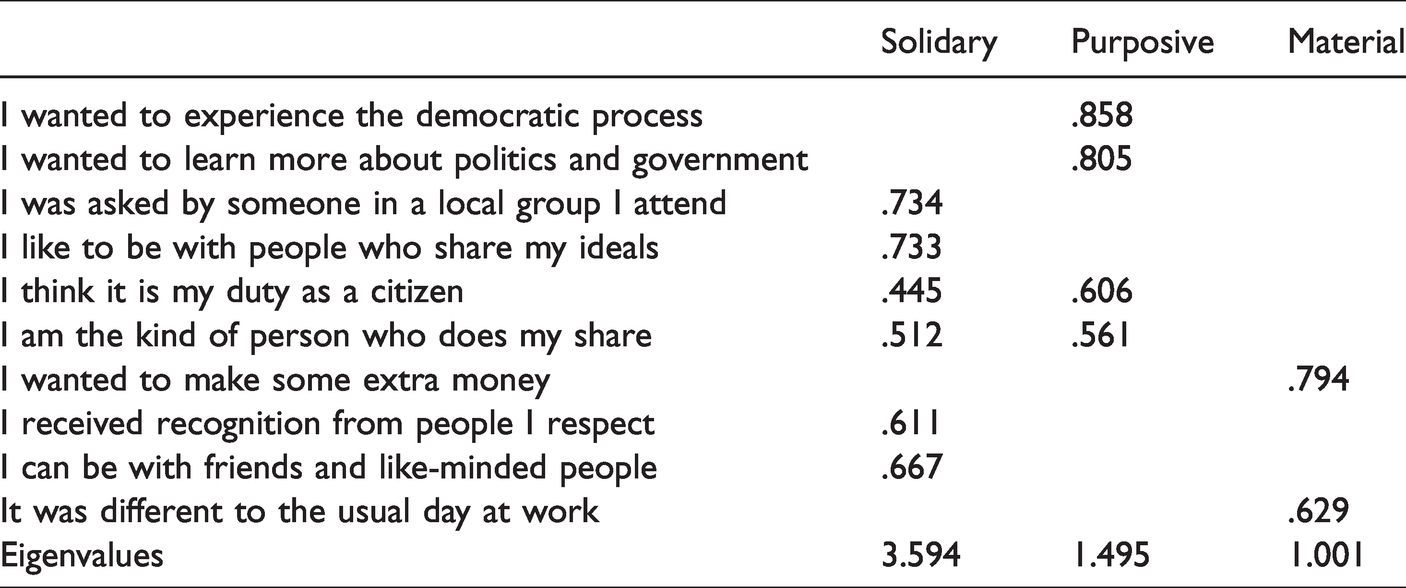
More can however be done with the data to both understand the structure of poll workers’ motivations, and to provide data through which more advanced analysis can be undertaken. A factor analysis conducted on the battery of motivations questions provides a clearer sense of the cluster of reasons which may motivate participation as a poll worker. Table 4 presents a principal components analysis with varimax rotation of reasons for working on polling day. Three main factors were identified, which together identify 60.9% of variance in the data. Broadly, they rotate around the solidary, purposive and material incentives that Clark and Wilson (1961) set out in their influential framework. The set of motivations or incentives with the highest factor loading are social or solidary, and include being asked by someone in a local group to work on polling day, being with people who share ideals, it being a civic duty and wanting to do their share, receiving recognition and being with friends and like-minded people. On its own, this was the most important factor loading accounting for 35.9% of variation. The second group of motivations related to purposive issues, experiencing the democratic process, learning more about politics and government, and, in an overlap with solidary motivations, being a civic duty and wanting to do their share. This accounted for 14.9% of variance. Finally, a smaller group, accounting for 10% of variance, albeit with a strong factor loading on the question about payment, remained motivated by material aspects.
Principal components analysis of reasons for working on polling day.
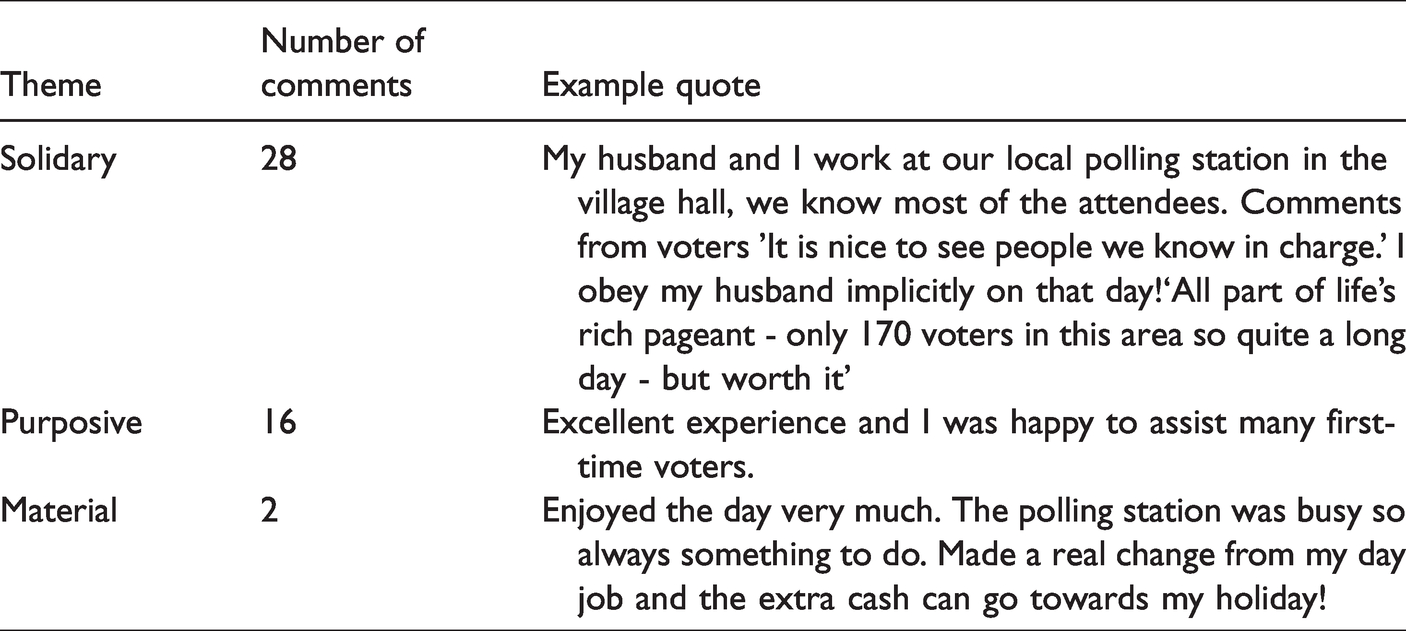
This structure of poll worker motivations can be triangulated with qualitative evidence. Poll workers were asked to provide qualitative information about their experience in a free text format at the end of the survey. This provides additional information about motivations by identifying the aspects of the job that they enjoyed. Sixty four comments explained how poll workers experienced the day. Those which provided sufficient information to judge whether it was for solidary, purposive or material reasons are summarised in Table 5. Solidary themes were most cited in qualitative responses. It was notable, however, that it was engaging with the public as much as with fellow co-workers that was as often stated as being important. As one put it: ‘We got on really well as a team and the electors were very pleasant and friendly. It made for an enjoyable if very tiring day!’ Echoing the factor analysis, purposive themes were the second most frequent and material themes were hardly stated at all.
Free-text comments.
Saving the results as factor scores means that more can be done to understand how socio-economic characteristics might impact upon the motivations of polling station workers. Factor scores can take either positive or negative form, are standardised around zero and provide an indication of the extent to which respondents most emphasise material, purposive or solidary incentives. Thus a negative value indicates a respondent is below the average on that particular incentive scale, while a positive value indicates that they are stronger than average on a particular scale. Figure 1 shows the distribution of the three factor scores. These are each used as separate dependent variables in two sets of exploratory ordinary least squares regressions to initially try and establish if any particular socio-economic characteristics are associated with different types of motivations, and then to examine the relationships with social capital and satisfaction with democracy.
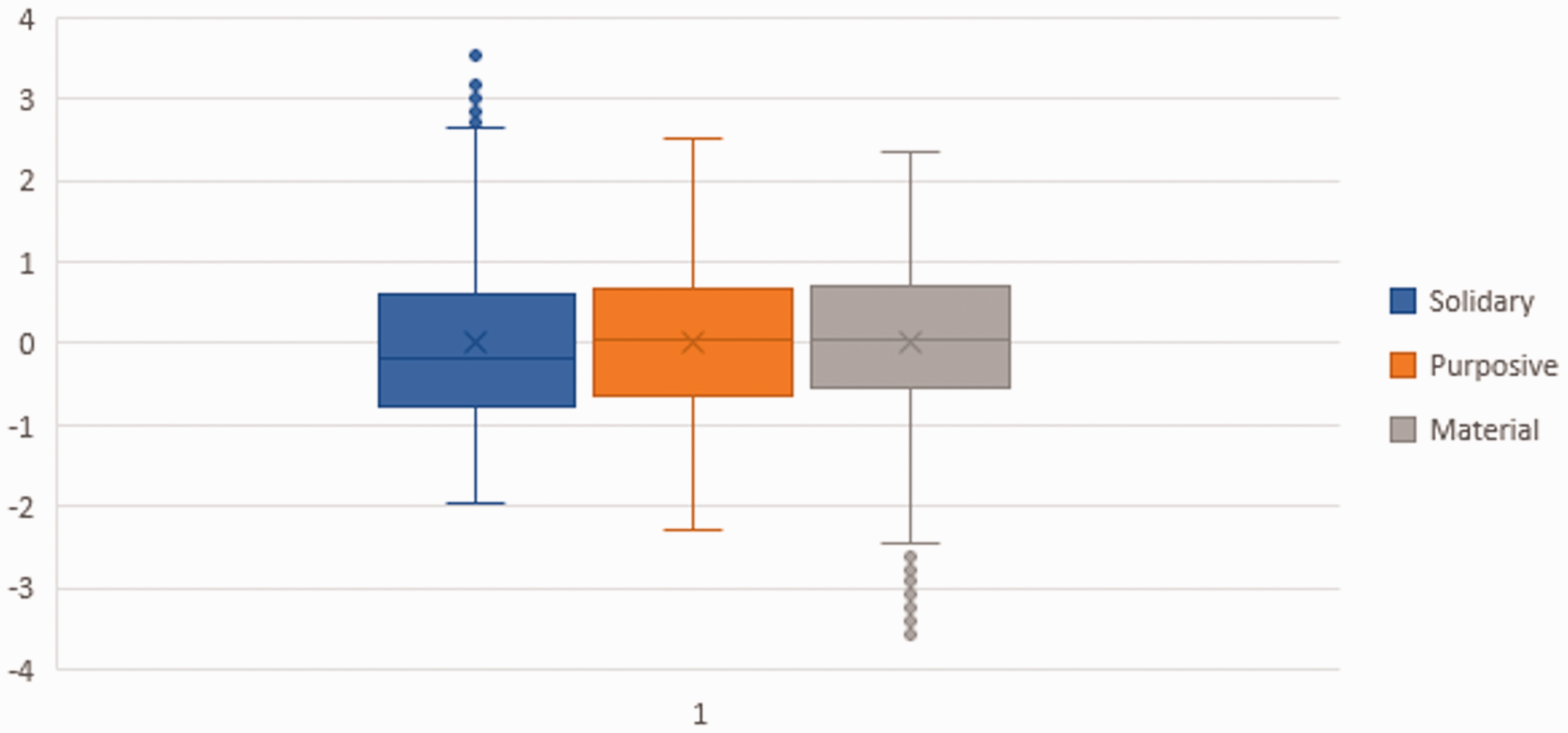
Distribution of factor scores.
The independent variables utilised in the analyses revolve around the descriptive socio-economic responses outlined in Table 1 above, albeit with some modifications. Age is entered into the models as a scale-level variable. Income and education are both effectively ordinal variables. While use of ordinal variables in regression analysis is not ideal, doing so is nonetheless widely deployed in social science research. Thus, both income and education are entered into the regressions unmodified. Respondent sex is converted to dummy variables, with male being the reference category.
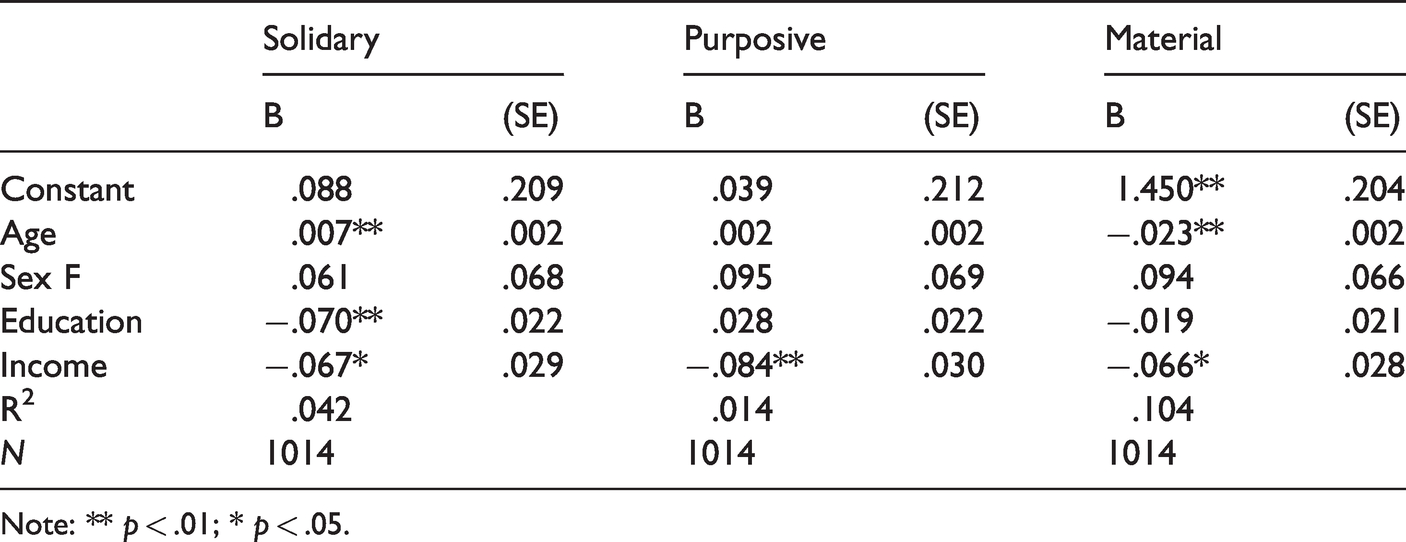
Table 6 reports the results of the initial ordinary least squares regressions of socio-economic characteristics on each of the solidary, purposive and material factor scores. 9 It is important to note at the outset that the overall effects appear small, while the R2 model fit for each analysis is weak. Nonetheless, the regressions are suggestive of some interesting findings. To take the solidary analysis first, age has a statistically significant (p < .01) but weak positive relationship with solidary incentives. In other words, the older a poll worker is, the more likely they are to be motivated by solidary issues to volunteer on polling day, providing some confirmation of H1. Interestingly, education has a negative relationship with solidary incentives which is statistically significant at the p < .01 level, thereby confirming part of H2. This suggests that while more highly educated poll workers are less likely to have solidary motivations, those with lower level qualifications might be more motivated by solidary incentives. Contrary to H2’s conceptualisation, income also has a negative relationship (p < .05) to solidary motivations, meaning that poll workers that earn more were less likely to be motivated by such incentives, but that those who earn less were more likely to be motivated by solidary reasons.
OLS Regressions: Socioeconomics and poll worker motivations.
Note: ** p < .01; * p < .05.
With the second regression on purposive incentives, it is only income that is statistically significant (p < .01), but in a direction contrary to H2. With the third regression on material incentives, both age and income have negative relationships with material incentives, contradicting H1 but conforming H2. With age, this suggests that older poll workers are less likely to be motivated by material incentives or stipends for working on polling day, but that younger poll workers are more likely to be so. Similarly, with income, this suggests that those who earn more are less motivated by material incentives, but that those with lower incomes are more likely to be encouraged to volunteer to become a poll worker by the stipends offered for working on polling day. This suggests that there may be a particular pool of younger, low-income poll workers who are motivated by additional income.
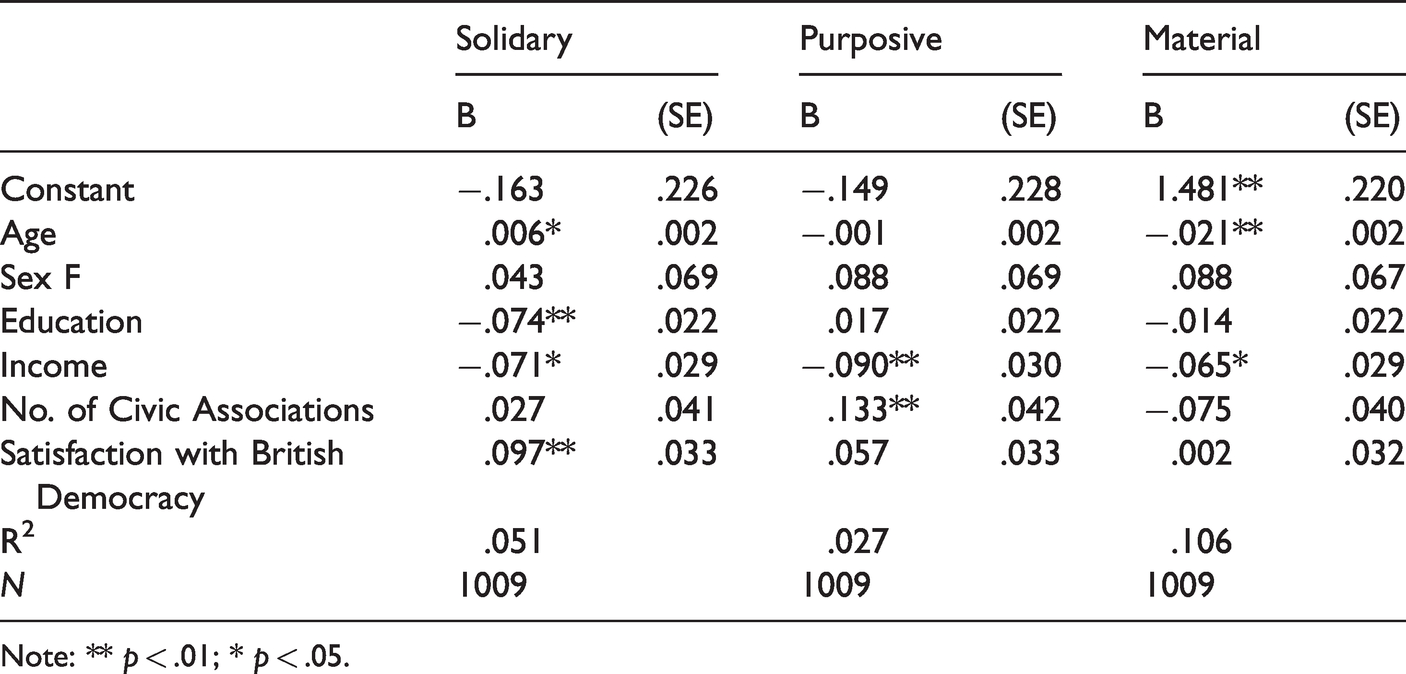
Table 7 reports the second set of regressions on the solidary, purposive and material factor score dependent variables. In these, social capital explanations are examined using as a proxy the number of civic associations that the respondent belongs to. This was an ordinal variable with response categories of none, 1-2, 3-4, and 5 or more. Satisfaction with democracy is measured by poll workers’ responses to a question asking their level of satisfaction with how British democracy works generally, as reported in Table 3 above.
OLS Regressions: Civic Association and satisfaction for democracy and motivations.
Note: ** p < .01; * p < .05.
With solidary motivations, the age, education and income variables remain statistically significant and with the same directionality as the model looking solely at socio-economic profile. The number of civic associations that poll workers are members of has no independent and statistically significant effect, contradicting H3 on solidary motivations. However, satisfaction with British democracy shows a positive relationship with being motivated by solidary reasons. Although the relationship is not especially strong, this is nevertheless statistically significant at the p < .01 level and supports H4. In other words, the more satisfied a respondent with British democracy, the more likely they were to volunteer as a poll worker for solidary motivations.
With the second model, the negative relationship between income and volunteering for purposive reasons remains when satisfaction with democracy and social capital measures are introduced. While satisfaction with democracy has no statistically significant effect, there is a positive and statistically significant relationship (p < .01) between the number of civic organisations a poll worker is a member of, and their placement on the purposive motivations score, confirming H3 on the purposive scale. As Putnam (2000) might have predicted, this means that among a key group of individuals volunteering to work as poll workers on election day, social capital is clearly linked to support for democracy.
Finally, the third model relating to material incentives shows little difference to the model run with just socio-economic profile. Neither social capital, nor satisfaction with democracy have an independent statistically significant effect on material incentives for working on polling day.
Conclusion
People are crucial to the successful delivery of elections. Yet, recruitment of poll workers is a serious difficulty in many jurisdictions, and ultimately for democracies. This article has provided a vital intervention into this public administration problem by putting the question of what motivates poll workers to volunteer at the forefront. Applying the stipended volunteers concept to poll workers is an original approach to the topic. Through an innovative survey of English poll workers, the findings have either challenged conventional insights, or added important evidence to this debate to inform both academic discussions around it, and, equally importantly, inform electoral administrators’ efforts to staff their polling stations.
Key findings are that, for many poll workers, the stipend they receive is an important part of what induces them to volunteer. This is contrary to most existing poll worker and stipended volunteer research to date. Motivations can also be extrinsic and intrinsic, and appear structured around solidary, purposive and material incentives. Age, education, income, and levels of both social capital and democracy satisfaction all seem to have independent impacts on the different incentive structures, even if these impacts may be limited and sometimes contrary to expectations. What does this mean in practice? This will be very interesting and useful information for all electoral administrators who employ poll workers to work on election day. It could be used to inform their appeals for volunteers to act as poll workers. While earning some extra money would most likely be one aspect of this, also emphasising the solidary and purposive benefits to certain groups may also be fruitful. A final point is noteworthy. Given that this is a single country study, in two regions of England, further research around poll worker motivations is clearly necessary both in the UK and in other jurisdictions where poll workers volunteer for service on election day.
Footnotes
Acknowledgements
We are grateful to all eight participating local authorities, the poll workers who completed a questionnaire, and Michael Watson and Judy Murray for data entry assistance. We have benefited from comments on earlier drafts at PSA and EPOP Conferences in 2016, and the pre-APSA ‘Building Better Elections’ conference at MIT in 2018, for which we are grateful. The usual disclaimer applies.
Declaration of conflicting interests
The author(s) declared no potential conflicts of interest with respect to the research, authorship, and/or publication of this article.
Funding
The author(s) disclosed receipt of the following financial support for the research, authorship, and/or publication of this article: This work was supported by the British Academy and Leverhulme Trust (Grant number SG140099).
