




Abstract
Public environmental organisations face a Herculean task: to be responsive to public and executive expectations for decentralisation, integration, increasing accountabilities and efficiency savings plus, contemporaneously, managing increasingly complex nature–society systems as exemplified by the water–energy–food nexus. The public-agency innovation literatures and contingency theory offer partial explanations for this challenge. However, this article, which sits at the intersection of public administration and organisational theory, proposes a new analytical framework for framing public-agency responses to nexus complexity. It first outlines the framework and then tests it on the case of Natural Resources Wales, the Welsh national natural environment agency. This case identifies six distinct innovations that have adopted to meet complex nexus pressures. This leads us to characterise the case as an example of a multi-scalar, hybrid, adhocratic organisation designed to meet nexus challenges. These findings have wider impact for the international community of public agencies with socio-environmental remits facing similar nexus pressures and challenges in the 21st century.
Introduction
Society faces many pressing and wide ranging local and global environmental sustainability challenges including climate change, biodiversity loss, air and water pollution and rapid urbanisation to name but a few (Steffen et al., 2018; Tittensor et al., 2014; UN-HABITAT, 2016). These issues are highly complex, frequently context dependent and often seemingly intractable, with their genesis and persistence involving multiple overlapping social, economic, political, historical and environmental drivers of change that operate within nested social–ecological systems (Sterner et al., 2019). The water–energy–food (WEF) nexus represents one particular framing of these issues that keenly exemplifies these complexities (Cairns and Krzywoszynsk, 2016), describing highly inter-connected cross-sectoral systems (e.g. natural, human, built capital) that range over a number of socially and ecologically influential policy domains such as agriculture, land and water basin management and energy production and provision (Albrecht et al., 2018; Zhang et al., 2018). The ‘nexus’ is not just a physical description of a ‘system’; however, but also a critical conceptual approach (or lens) to appraise challenges and problems from an integrated and holistic perspective (Weitz et al., 2017; Wiegleb and Bruns, 2018). As such, the nexus represents a suite of multi-layered biophysical, socio-economic and governance systems and ways of thinking that demonstrate core properties of complex systems such as non-linear dynamics, feedbacks, emergence, self-organisation and uncertainty (Endo et al., 2018; Mobus and Kalton, 2014; Pahl-Wostl, 2019).
Implementing and coordinating governance activities across these complex nexus systems falls largely to national governments and ‘environmental’ public agencies (George and Schillebeeckx, 2018; Head, 2018; Wiegleb and Bruns, 2018). In the face of overwhelming evidence describing the seriousness of the global climate and environmental crisis (Díaz et al., 2019; Masson-Delmotte et al., 2019), national governments have started to consider more acutely the international and domestic problems and challenges of dealing with complex nexus systems. This dynamic is evidenced by the growing number of nations increasingly engaging with global environmental governance through international agreements, such as the Paris Climate Agreement and the Sustainable Development Goals (e.g. UN, 2020). At national-level, whilst this has been slow to occur, in the UK for instance, there has been some movement by government to respond accordingly through attempting to develop more systemic policy responses aligned towards nexus issues (UK Government, 2019). Nevertheless, it is frequently the smaller semi-autonomous environmental public agencies that are the key actors responsible for ensuring the delivery and implementation of the complex management and governance of these nexus systems (George and Schillebeeckx, 2018). For example the nexus project at the French national environment agency ADEME (Debizet et al., 2014).
Arguably, environmental public agencies have always had to deal with the complexity of managing complex social–ecological systems but have frequently done so in a tacit and ad hoc way (Kirsche and Newig, 2017). However, nexus complexity recognises that the socio-ecological landscape in becoming increasingly complex and inter-connected (George and Schillebeeckx, 2018: 76–78). Simultaneously, whilst seeking to effectively manage and govern these systems as their primary function, environmental public agencies in recent years have experienced significant executive and public pressures to take on additional roles such as advocates, provisioners of services and innovators (Etzion, 2007; Peters, 2010). This is a global trend with cases from the EU (e.g. Thomann et al., 2017), the United States (Castellano, 2015), Japan (Yamamoto, 2003) and others. Responding substantively to the nexus challenge, and to this additional bureaucratic burden, represents an existential risk to be managed in the interests of hedging against organisational decay (Samuel, 2011; Schwartz, 1989), whilst also applying a selective pressure for public agencies to become more complexity-orientated (George and Schillebeeckx, 2018: 76–78). However, as noted by Nilson and Eckerberg (2009) and Head (2018), public agencies are not naturally disposed towards the interdisciplinarity and complexity posed by nexus thinking. Some possible explanations to support this observation are described in the change management literature (Fernandez and Rainey, 2012). For example, Russel and Benson (2014) argue that disciplinary siloing within public agencies is rational where it enhances transparency, specialisation and accountability reporting, whilst Peters (2010) emphasises the limits and diminishing capacity of executive accountability and oversight in agencies managing increasingly complex roles and responsibilities. This might be considered a contemporary re-articulation of the great debate between Carl Friedrich and Herman Finer in the 1940s about the best model of ensuring accountability in the bureaucracy. Ultimately, as Nilson and Eckerberg (2009) rightly conclude, integrating complex WEF nexus concerns into the activities of public agencies is an important area of enquiry in contemporary public administration research.
Despite this, there is a dearth of studies exploring how public agencies are responding to the WEF nexus imperative. That said, the wider public administration literature offers two theoretical paradigms which we argue might help explain how agencies are responding. The first paradigm, echoed in the work of De Vries et al. (2016), has sought to address how public agencies have tended to respond to growing complexity with innovation in their outputs (e.g. their actions) (Miles, 2012), and complexes of outputs (Torugsa and Arundel, 2014). This has included innovations to meet complexity through collaboration (Ansell and Torfig, 2014; Sørensen and Torfig, 2011) or digital technology and e-government (e.g. Bygstad and Lanestedt, 2009). Innovations in service delivery, competencies and organisation are politically popular (Waldorf and Kristensen, 2014) as they hold out the promise of maintaining executive accountability best practices whilst also meeting growing complexity. Nonetheless, whilst innovation in the public sector holds significant promise for designing and delivering outputs and services that increasingly meet nexus complexity, the notion of innovation for its own sake is problematic where there might be a tendency to rising complexity as another challenge to reconcile within pre-existing organisational paradigm. The second paradigm, based on contingency theory (e.g. Rollinson, 2008) would suggest that agencies need to fundamentally re-structure to suit their operational environments – including contemporary nexus challenges. However, such re-structuring is contingent upon their internal and external settings (Donaldson, 2001; Hinings et al., 2007) and/or the complex systems they seek to manage (Eppel and Rhodes, 2018; Klijn, 2008). In short, agency responses to the challenge posed by the WEF nexus might come through innovations in outputs aligned towards complexity, or they might involve the structural reconstruction of the agencies in ways that are dependent upon the specific conditions of complexity encountered. The limited literature exploring the consequences of WEF nexus thinking for public service provision has thus far avoided critical inquiries into how public agencies might innovate and/or re-structure themselves to meet these challenges (Leck et al., 2015; Scott et al., 2014). This is problematic, as it fails to engage with the significant scale of the challenge posed by WEF nexus considerations on the bureaucracy and ignores the significant body of public administration theory providing explanations of how public agencies might respond.
In this article, we address this knowledge gap by advancing a theoretically informed conceptual model that accounts for both contingency theory-orientated structural responses and responses in innovation. The rest of the article is structured as follows. The next section outlines the development of our conceptual analytical model. Then, we describe the case of Natural Resources Wales (NRW), the Welsh national environmental management agency, as a test case for our model. Then the qualitative methods employed in exploring the parameters of the model’s assumptions are described, followed by a discussion of the model’s findings as applied to NRW. The final section offers conclusions on the research and proposes how this research might be further developed in the future.
Developing a conceptual model
To reiterate, the public organisational innovation literature points towards responses in outputs framed towards WEF-style complexity dynamics (e.g. inter-sectoral collaborations). In contrast, the more structuralist contingency theory perspective might argue that to meet the scale of WEF nexus challenge agencies need to fundamentally re-structure themselves. To help address these two perspectives, we have developed a conceptual and analytical model with the capacity to capture both structural and innovation responses. This model is informed by Schein’s model of organisational culture (1990): a well-developed and utilised model for exploring and describing the multi-faceted nature of private and public organisations (Parker and Bradley, 2000). This model has been applied, adapted and repurposed in a number of different contexts including within the public administration literature (e.g. Howard, 1998; Parry and Proctor-Thompson, 2002; Sinclair, 1991), echoing the historical cross-fertilisation of theory and models from organisational theory to public administration (Bozeman, 1981, 1982; Joiner, 1961; March et al., 2000; Olsen, 2007). Cognizant with this tradition we have repurposed a version of Schein’s model (Figure 1) where it offers the potential to capture both structural responses to complexity as well as changes through innovation.
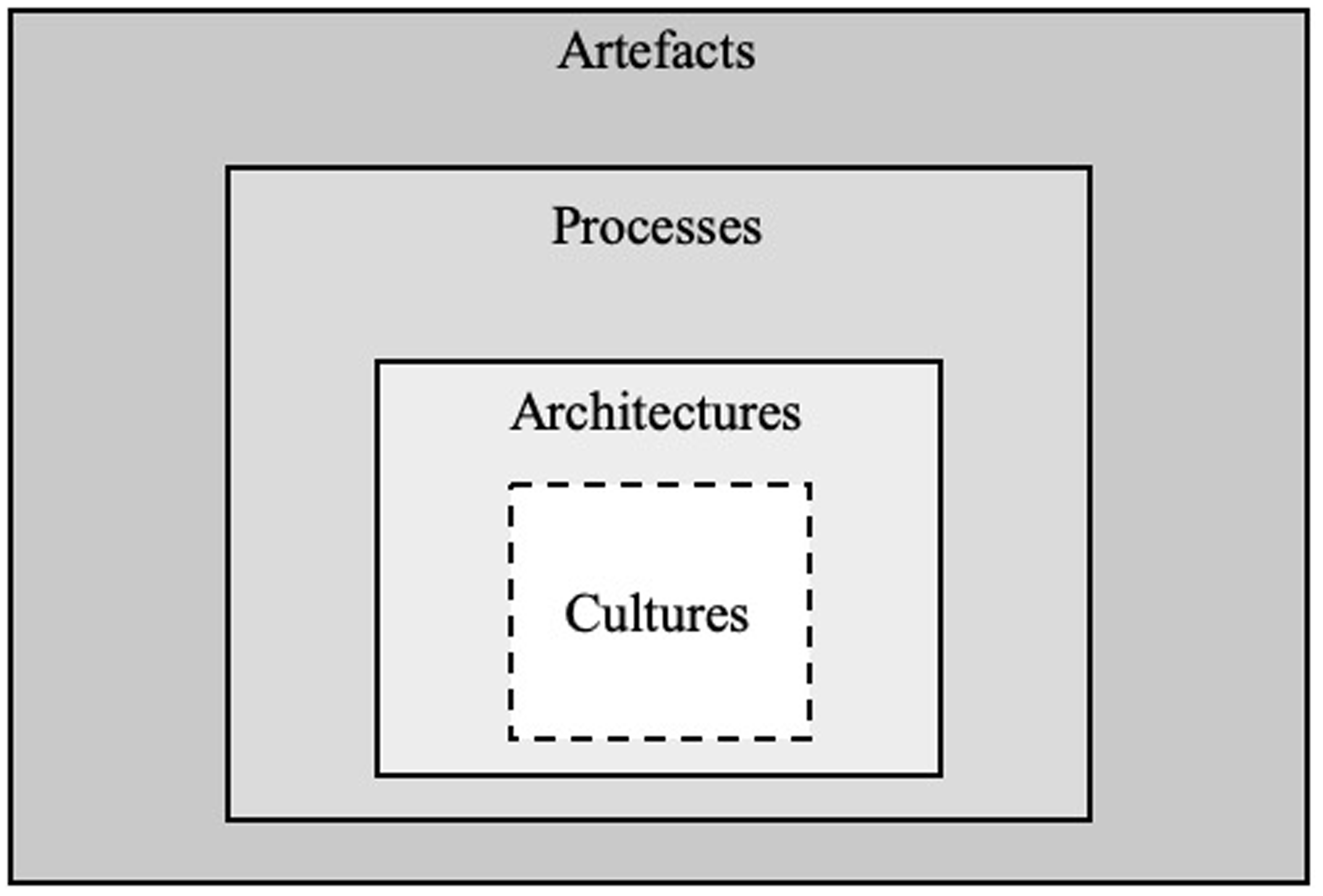
Dimensions for organisational institutionalisation.
Figure 1 represents both a conceptual model of the four key dimensionalities through which change(s) and responses might occur and an analytical structure to frame empirical inquiries into such phenomena. In Table 1, we build on Figure 1 by highlighting how the four dimensions (artefacts, processes, architectures and cultures) operate in a processive, sequential and/or simultaneous order; with increasing complexity the ‘deeper into the onion’ the activity being undertaken.
Descriptions of the four dimensions of institutionalisation by design.
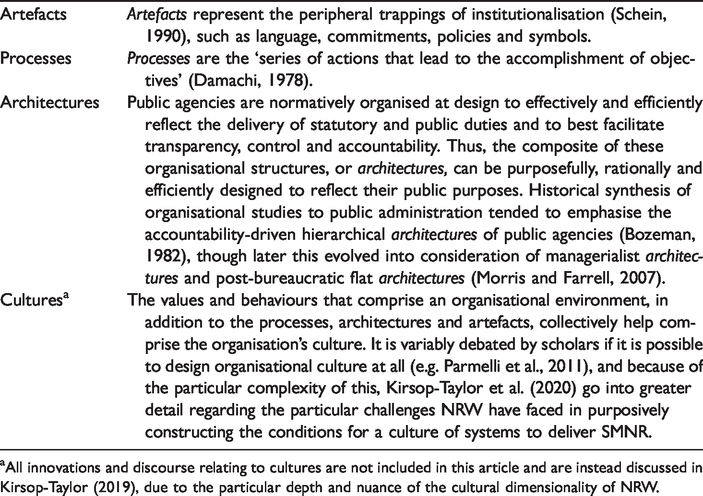
aAll innovations and discourse relating to cultures are not included in this article and are instead discussed in Kirsop-Taylor (2019), due to the particular depth and nuance of the cultural dimensionality of NRW.
Case study: NRW
Origination of NRW
Wales is a devolved nation within the United Kingdom (UK). Following the initial phase of devolution (Government of Wales Act, 1998), 1 the natural environment became a fully reserved competency of the newly formed Welsh Assembly. Until 2006, Welsh national environmental policy closely mirrored that of the UK (and by extension the European Union – EU), but as a consequence of missing both its EU and Global biodiversity targets in 2010 (Welsh Sustainability Committee, 2011), the Welsh Government consulted on a proposed new legislative framework. The result was the ‘Sustaining a Living Wales’ Green Paper (2012) which argued that Welsh national environmental policy and governance needed to be better integrated and decentralised. As a direct consequence, the ‘Natural Resource Management’ programme (2013) was articulated for the creation of a new public environmental agency that consolidated the disparate responsibilities of three existing agencies. It suggested that this ‘new’ agency – NRW – should be designed around an innovative new form of integrated and decentralised environmental management, based on the ecosystem approach (EA) from the Convention on Biological Diversity (CBD) (Jenkins et al., 2015). The EA is a framework integrated natural resource management which has had a very wide global impact as a heuristic device for framing integrated approaches to managing complexity (see Ahmed et al., 2017; Asakura et al., 2015; Bunch, 2016; Charland, 2011; Falkner et al., 2018; Kurshan and McManus, 2017; Waltner-Toews, 2001).
Innovating a complexity-appropriate public agency
The CBD first conceptualised and promoted the EA as a ‘strategy for the integrated management of land, water and living resources that promotes conservation and sustainable use in an equitable way’ (CBD, 1998). This strategy sought to provide a framework for integrated approaches to natural resource management. The CBD asked that all the decisions of its conference of parties should be implemented in ways congruent with an EA (Scott et al., 2014) and that national governments seek opportunities to transpose an EA into domestic policy (Waylen et al., 2014). Adopting an EA is described through 12 principles of integrated natural resource management best practice (the ‘Malawi principles’) supported by six points of guidance for operationalising the EA (Figure 2) (Waylen et al., 2014). Although the UK Government made some initial attempts at implementing an EA, these were largely unsuccessful, and it was never codified into UK legislation (Waylen et al., 2014). Consideration for the EA’s transposition instead reverted to the devolved nations of the UK (Kirsop-Taylor, 2019). The Welsh Government transposed an EA through a legislative and policy framework set out in the ‘natural resources management’ programme (2013) and the Environment (Wales) Act (2016). This transposed an EA into a legislative mandate under the new ‘sustainable management of natural resources’ (SMNR) programme for Wales. This established a new public environmental agency –NRW – that would be accountable for both delivering an operationalised form of the SMNR/EA as well as being designed around the SMNR/EA principles itself. In one sense, NRW was not a strictly ‘new’ agency, as it was crafted and consolidated out of three extant agencies (i.e. the Forestry Commission, Environment Agency Wales and the Countryside Council for Wales), though its creation is symbolic of the concept of ‘emergence’ in complex systems.
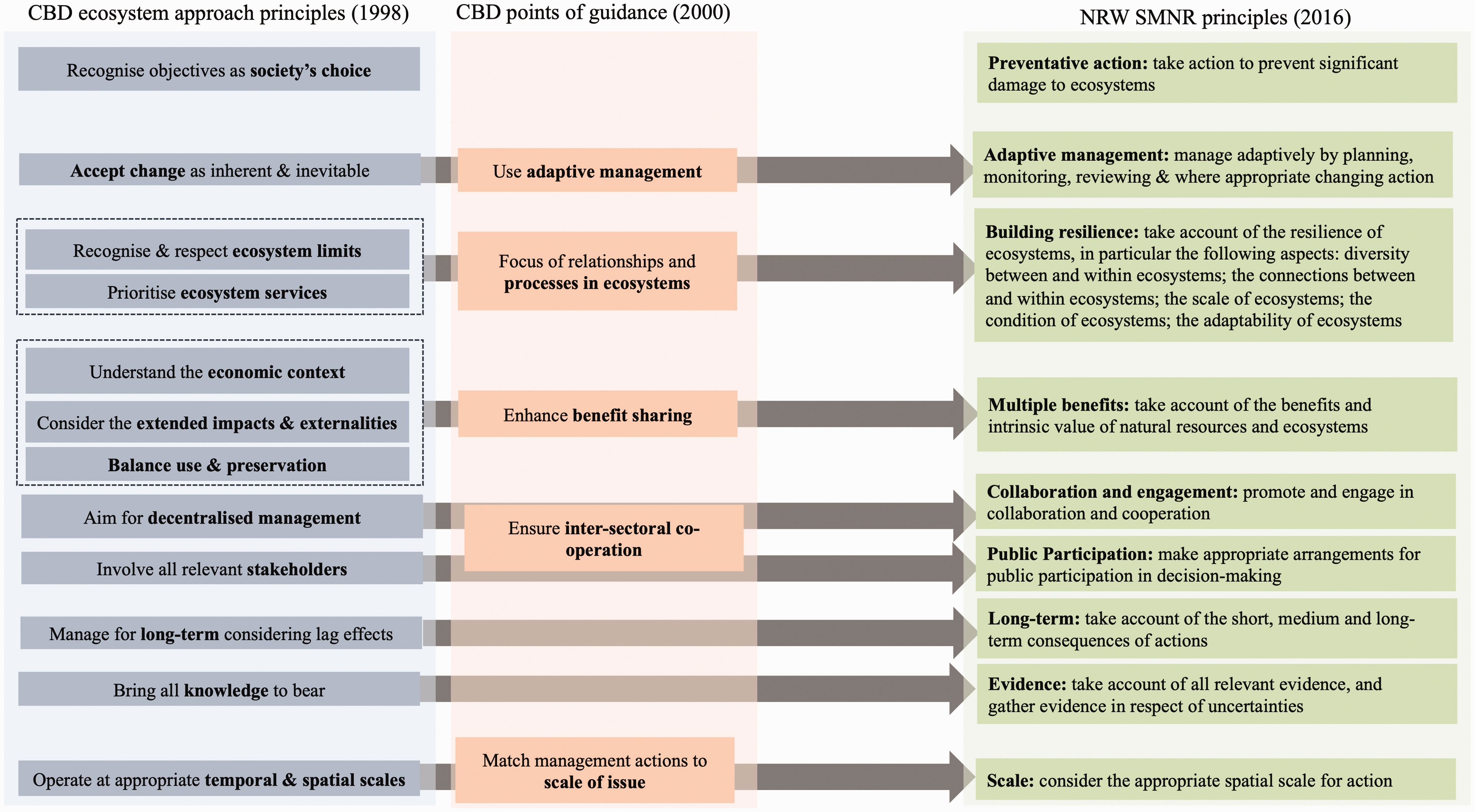
From the ecosystem approach to the sustainable management of natural resources.
Institutionalising an EA into an agency at inception is a challenging undertaking (McFadden and Barnes, 2009), and far more difficult at the outset than allowing an agency to develop through time towards a closer alignment with an EA (Scott et al., 2014; Smith and Maltby, 2003). That said, this approach also offers significant benefits in terms of embedding nexus considerations into the structural dimensions of the agency. The principal guiding action for NRW was the distillation, by the Welsh Government, of a Welsh-iteration of the EA principles (and points of guidance) from the CBD into the new SMNR principles (Figure 2).
Figure 2 highlights the synergies and alternative interpretations between the CBD EA and the principles that guide the SMNR programme. The SMNR transposition adopts a more pragmatic operationalised version of the CBD EA principles (Kirsop-Taylor, 2019) in which its abstract notions (e.g. Fish and Saratsi, 2015) have been transformed into signals for organisational action. However, CBD EA principles 4 and 10 have not been directly transposed into the SMNR principles. It might be argued that balancing use and conservation is an implicit macro-objective of the SMNR approach. The omission of a clear signal regards understanding economic contexts in decision-making is striking considering the UK Government’s decisive shift towards more economics-orientated approaches to natural resource management (Department for Environment, Food and Rural Affairs, 2018). This is reflective of a wider political tension between the Welsh and UK Governments over devolved policy making and legislation-setting (Kirsop-Taylor, 2019). What can be discerned from Figure 2 is that the SMNR approach is reflective of a particular reading of the EA principles being patronised and endorsed in a uniquely Welsh, or ‘dragonised’ approach to policy-making (St.Deny, 2016) and natural resource management (as per the Welsh dragon – the national emblem and flag).
Locating SMNR in Welsh policy landscape
Previous research by Waylen et al. (2014) has shown how the EU first attempted to place an EA on a statutory footing through its Marine Strategy Framework Directive (2008). Following this, though not necessarily because of it, Wales was the first state-level actor in the EU to adopt the EA as a framework for managing nexus complexity. And, following its establishment, NRW became the first public environment agency to institutionalise the EA within their organisational design. Specifically, the Environmental (Wales) Act (2016) provided SMNR with a regulatory mandate, and the Welsh Government gave the proto-NRW statutory purposes to innovate in its new design. NRW was mandated with using the SMNR principles to guide both the ‘ends’ and ‘means’ of the new agency. In other words, from inception, NRW was designed to achieve an end point based on integrated, decentralised, resilient, inclusive, adaptive and knowledge-driven practices in ways that also reflected these values. However, mindful of the organisational challenges and complexities inherent in structuring a new agency around the SMNR principles, the Environment (Wales) Act (2016) and Welsh policymakers afforded the senior management team at NRW a degree of political ‘space’ to design – as they deemed most appropriate – an agency-scale operationalisation of SMNR (as per Peters, 2010). This afforded the senior management of NRW a temporally bounded loosening of executive accountabilities to facilitate innovation and experimentation in institutionalising SMNR.
Method
Testing the new conceptual model through the case of NRW required highly detailed, specialist and exclusive information. This methodological mandate enjoined us towards qualitative elite semi-structured interviews with members of the senior management team in NRW. Semi-structured interviews were utilised due to the requirements for specific issues to be discussed, whilst also presenting elites with ‘space’ to insert expert opinions and perspectives. A common format of 12 theory-informed interview questions was used to structure each interview. The interview sample comprised members of the senior management team (n = 3), departmental heads (n = 4), team leaders (n = 2) and senior members of the change management team (n = 3) (see Supplemental Material for further information). The sample included representatives from each of the three legacy agencies that comprised NRW, and from former members of Welsh Government now working in NRW. Interviews were initially secured through a single organisational gatekeeper, followed by snowball sampling leading to 12 interviews conducted remotely through Skype for business. Participant informed consent was obtained in early spring 2018, and the interviews conducted in the summer of 2018. Interviews were transcribed through GoTranscribe and coded against a pre-existing and iterative code framework in Nvivo 11.
Results
NRW design innovations to deliver SMNR: An institutional perspective
The interviewee discourse identified six core innovations that NRW had designed to specifically support their delivery of SMNR to meet nexus challenges. These were the Area statements, the State of Natural Resources Report (SoNaRR), public service boards, place-based area teams, digital communications and training. These emerged at the interface of discourse about the artefacts, processes and architectures through which NRW was operationalising the SMNR mandate and EA principles (Table 2).
Displays a matrix of key NRW innovations designed to meet SMNR principles (left-hand column) classified according to Schein’s four institutional design dimension (top row).
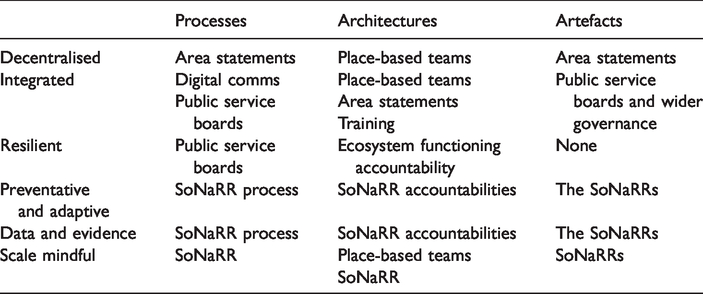
As noted in Table 2, the results pertaining to organisational culture are addressed in the sister publication of Kirsop-Taylor et al. (2020). Each of these six key innovations is discussed below in descending order of subjective importance based upon interviewee discourse.
State of Natural Resources Report
The Environment (Wales) Act (2016) mandated NRW to gather data and deliver a four-yearly SoNaRR, collating national and regional-scale qualitative and quantitative information about the state of Welsh national natural resources. Whilst other UK devolved natural resource management agencies have institutional reporting programmes (Kirsop-Taylor, 2019) none have the same breadth and ambition mandated in legislation as SoNaRR. This statutory, standardised and regular requirement for SoNaRR enables longitudinal and comparative analyses and helps NRW co-deliver and obtain co-benefits across a broad range of mandated SMNR principles. Interviewees considered that constructing SoNaRR(s) has forged an evidence-based imperative into the processes of NRW as well as into the structures and architectures which have been designed to facilitate it. Additionally, the SoNaRRs also act as visible and tangible artefacts that can be used to inform, support and evidence multi-scale decision-making, including engaging with meeting public expectations and accountabilities on the natural environment. The four-yearly nature of the SoNaRR cycle coupled to its plural and partnered data collection processes and its position in meeting statutory executive accountabilities drives adaptability, and more generally, in managing nexus complexity over time, potentially acts as an iterative and adaptive feedback system facilitative of an agile yet consistent approach to changing and exacerbating circumstances and requirements.
Place-based regional agency
Interviewees suggested that NRW had been designed as a nested multi-scalar agency explicitly constructed with nexus challenges in mind. Interviewees conceptualised this multi-scalar form as an NRW national office in Cardiff (the Capital city of Wales) which manages central functions (e.g. HR, finance and leadership) and 15 place-based area teams within six geographical and administratively cognate regions. Each inter-disciplinary team comprises a mixed group of experts and specialists, so that disciplinary silos can be broken down by encouraging place-based, multi-team co-produced solutions to complex multi-faceted problems. For example, Interviewee 6 noted that each of these regions ‘houses a team of mixed professionals representing each of the legacy agencies that comprise NRW’. By entrusting place-based teams with significant decision-making responsibilities and accountabilities, it opens the opportunity for scale-appropriate decision-making. This offers the co-benefit of driving greater local public engagement with decision-making processes through the visible and engaging place-based teams, and, if these teams’ function correctly, it is hoped will lead to increased plural public participation in local-scale natural resource decision-making. Interviewee 4 discussed how these values have been built into the processes and to a lesser extent the architecture of the place-based teams, and that perhaps more importantly that ‘these teams have been given a lot of scope to make decisions, but also to make mistakes’. This speaks to the conundrum of accountability inherent in facilitating place-based decision-making.
Area statements
A key function of the place-based teams will be their statutory duty to produce ongoing Area Statements to help drive the delivery of Welsh national environmental policy at local-scales. Area statements evaluate place-based metrics of natural resource management for standalone, comparative and cumulative purposes (in SoNaRR). As Interviewee 12 commented: ‘the area statements are the building blocks that the state of natural resources reports will be built on’. Like SoNaRR, constructing and delivering Area Statements drives an evidence-based approach into the processes of the place-based teams and also helps to form the architectures of the place-based teams. These statements are mandated as integrated place-based evaluations, reinforcing the impetus for integrated place-based teams. This has the potential co-benefit of breaking down any residual silos that might linger within the place-based teams based on disciplinary bias and/or legacy path dependencies. Area Statements also have the potential to act as powerful artefacts evidencing to citizens and stakeholders the place-based, integrated and public nature of NRW. Both SoNaRR and the Area Statements will act as tangible and regular artefacts that will evidence to multiple accountability-holders the fulfilment of NRW’s accountabilities in managing the Welsh natural environment.
Public service boards
Several participants considered NRW as part of a wider Welsh national political project to reframe the role of the state in the welfare it delivers to citizens. Two interviewees discussed how the Environment (Wales) Act (2016) was the second piece of legislation in a two-part legislative suite that also comprises the Wellbeing of Future Generations (Wales) Act (2015) (WBFG). The WBFG Act enshrines in law and in institutions a new integrated and multi-disciplinary framework for national wellbeing and the provision of welfare services to citizens. One facet of the WBFG Act is a consideration of the natural environment as a constituent of citizen wellbeing. As such, the activities of NRW in delivering the SMNR programme through the statutory SoNaRR and Area Statements become a prime concern of the agents of delivery for the WBFG. The prime ‘agent’ being the Welsh Wellbeing Commissioner who mediates and mandates the deliverables of the WBFG Act through regional Public Service Boards. These are inter-disciplinary committees based on the same regional geographies and composed of the key agents with responsibilities for delivering aspects of citizen wellbeing in that place, such as representatives from the UK National Health Service, the Fire Service and NRW. These interviewees offered their perspective on the nature of ‘integration by design’ by highlighting how NRW’s statutory engagement with Public Service Boards had been designed into the processes and indeed even the architecture of the place-based area teams.
Digital communications
Discussions emphasised how the potential to deliver a truly integrated service by design was facilitated by the institutionalisation of the Skype for Business instantaneous digital communications system. Interviewees suggested that this technology enabled integrated processes and decision-making on a scale not seen in legacy agencies. This was designed into NRW as a means of facilitating quick and efficient audio and video communications from desktop settings in any location, helping to increase agency-wide and stakeholder-inclusive engagement and plurality of decision-making. It also offers the co-benefits of engaging colleagues and stakeholders who are geographically inaccessible or have limited availability for face-to-face meetings. This seeks to operationalise the SMNR values of participation, engagement and inclusivity through a by-design agency-standard digital communications system. Two participants raised the challenges of using this system with Mackintosh operating systems, but overall the introduction of this was considered positive.
Training
To facilitate collaboration at the individual scale, NRW’s design included a time-limited learning, development and training process. This comprised a dedicated HR staff resource to deliver training on integrated public environmental management to national and regional-scale teams. It was designed as mandatory training for all members of the NRW family, and it leads to a new recognised industry qualification for integrated public environmental management.
Discussion
In this article, we have sought to create a single model that reconciles innovations in response to WEF nexus complexity as well as agency structural reforms. The case study offered an empirical example of an agency responding to an executive legislative mandate towards complexity through six innovations and structural reforms.
NRW’S innovations to meet WEF nexus complexity
The SoNaRR and Area Statements were the innovations most discussed by interviewees, and clearly regarded by them as key to enabling NRW to meet nexus challenges through SMNR. The combination of these two innovations means that the processes of the NRW teams are now largely focused around delivering these reports in an effective, efficient and SMNR-aligned manner. Interviewees did not consider these innovations as their primary mode of accountability to the public in fulfilling expectations around meeting WEF nexus challenges. Instead, they regarded them as being on an equal footing with their other legal-statutory duties for environmental protection. However, interviewees did suggest that SoNaRR and Area Statements were the prime innovations building integration into the architecture of NRW; its processes were designed towards integration through its external engagement with Public Service Boards and internally through the institutionalisation of Skype for Business; its artefacts reflected integration through its position on the Public Service Boards and through the engaged and participatory nature of the place-based Area teams.
This represents a concerted effort to develop a flexible, multi-scalar spatial organisational operation (Cepiku, 2013; Ongaro et al., 2015; Trondal, 2007). Yet, whilst there is an increasingly significant literature detailing the advantages of nested multi-scalar environmental governance configurations to meet contemporary nexus challenges (e.g. Lyle, 2015; Morrison, 2007; Mwangi and Wardell, 2012), there have been few accounts of public environment agencies actually being purposely designed (in terms of their architectures and processes) as multi-scalar organisations to mirror nexus complexities and considerations. Nevertheless, it has been suggested that a multi-scalar approach might meet public-agency accountability-deficits (Cargnello and Flumian, 2017) alongside increasing responsiveness (Cepiku, 2013). However, the ‘resilience’ element of SMNR (see Figure 2), as noted by three interviewees, continues to be a difficult aspect for NRW to institute in a multi-scalar manner.
Our results suggest that institutionalising SMNR involves a dual set of processes, in which some innovations are engineered into the design of the agency whilst others emerge and develop iteratively, indicating a more nuanced dualism of continuous design and development. This may suggest that the most efficacious route for new public environment organisations to operationalise complexity across their organisation is via a pathway that borrows from both design and development camps. In NRW’s case, many aspects of the ‘architectures’ and ‘processes’ were instituted via design, for instance, SoNaRR, Area Statements and place-based teams, whilst other elements that were ‘not known’, ‘not anticipated’, or simply ‘no one has done this before’ gradually developed over time.
Innovating also implies risk taking. For instance, interviewees noted that being, in their view, a global first mover significantly reduced opportunities for inter-organisational shared learning and knowledge exchange. Similarly, others discussed how opportunities for organic development represented a ‘space’ that diminished with increased accountability layering and executive expectations (as per Peters, 2010). An additional insight was the criticality of the state (read the executive) and/or legislation as the incepting agent of new public agencies. Specifically, how the state can offer variable forms and degrees of political patronage to support such new agencies, patronage that can wane with time as expectations and accountabilities increase. That is not to suggest that there is an inexorably diminishing ‘space’ for agency development activities in general; most agencies continue to be afforded some space for innovation and development, but rather as new agencies mature the opportunity space for further development reduces.
NRW’s structuring to meet WEF nexus complexity
Simplistic characterisations of complex and large-scale multi-functional public organisations ought to be avoided (Christensen et al., 2007). Nevertheless, meaningful observations can be made, and it is clear that the organisational structure of NRW was consciously constructed and not the product of ad hoc, disparate and dissociated decisions. This suggests a normatively structured organisational form. In characterising its structural form, addressing NRW’s multi-scalar nature is critical.
Three interviewees described the administrative scales of NRW, suggesting they displayed different organisational structural forms. At the national scale, most interviewees considered NRW to have a traditional Weberian structured bureaucratic hierarchy composed of clear lines of accountability. However, the issue of an organisational ‘flattening’ imperative was voiced by a few interviewees. In contrast, the place-based area teams were discussed as being designed with values of agility, integrated problem-solving, public participation/engagement and adaptivity in their structure. These principles have been designed into the team structures. Teams have been populated from inter-disciplinary experts and loosely structured with the potential to self-organise to meet specific problems as they emerge.
Interviewees were keen to stress that this was the theoretical vision for the place-based teams, and that issues of accountabilities, auditing and responsibilities would naturally have to be reconciled with the vision for how NRW wanted the teams to operate. However, we discerned that NRW senior leaders had a vision for the place-based teams to be structured congruent with the form of a public adhocracy (Bennis, 1969). This is important because, as noted by Desveaux et al. (1994), Desveaux (2007) and Kürzdörfer (2016), there are very few empirical examples of public agencies organising as adhocracies. This is largely due to the pressures of executive short-termism, public accountability and the intrinsically hierarchical nature of Weber’s ideal bureaucracy (1922) which still has significant influence on the design of public organisations.
Overall, our findings suggest that given the opportunity to design a new agency to meet complex nexus challenges the leadership at NRW had the vision for adhocratic, integrated, place-based management teams. One insight to draw from this is that, in response to the intense complexity of nexus challenges, public agencies might have to empower bureaucrats at the street level to self-organise reflective of those challenges. As suggested by the public administration literature (e.g. Thomann et al., 2017), this is clearly not a straightforward task as requirements for public and executive accountability exert significant organisational pressures towards hierarchical structures that engender accountability and due process.
Conclusion
In this article, we have offered a novel analytical model for evaluating public agencies responded to WEF nexus complexity and explored the use of model through an exploration of the case of NRW. The analytical framework developed and the approaches being taken to meeting rising nexus complexity by NRW have global generalisability. The concepts behind the six innovations, and the mandate for greater organisational structural plasticity (as per the adhocratic design), could be replicated in other international settings as a response to increasing nexus complexity in public natural resource agencies. Furthermore, considering how an EA can be used as a heuristic device for inter-disciplinary complexity in many other fields of policy and public administration such as health (Asakura et al., 2015; Bunch, 2016; Waltner-Toews, 2001), education (Charland, 2011; Falkner et al., 2018; Kurshan and McManus, 2017), social work (Ahmed et al., 2017) and other fields (e.g. Brown, 2006; Heft, 2012) could have ramifications for public agencies facing complexity beyond the WEF nexus complexity setting presented here.
The challenges of meeting rising WEF nexus complexity shed new light on a classic dilemma in public administration – the servicing increasing complexity drives the need for looser executive accountability and increased bureaucratic discretion, balanced against executive demands for stricter bureaucratic control through management and political influence. We have suggested how the case of NRW offers a contemporary perspective on this discourse. They have been gifted political latitude by the Welsh executive to innovate and self-organise towards nexus complexity. However, this political latitude is likely a time-limited commodity. Whilst the Environment (Wales) Act (2016) offers the initial latitude to innovate it does not guarantee bureaucratic latitude in perpetuity (subject to the changing nature of the political priorities). That said, NRW still represents an agency that, in the words of Interviewee 6 ‘is near the end of the start of the journey’, and so monitoring and reporting on NRW’s ongoing experiences of reconciling these competing imperatives will remain an area of keen academic interest. We suggest that future research should focus around the long-term institutionalisation of the six innovations and adhocratic structures in the face of creeping executive retrenchments. It should also prioritise explorations of opportunities for further agency development and innovations within this setting including efforts at establishing international policy learning and sharing initiatives.
Supplemental Material
sj-pdf-1-ppa-10.1177_0952076720921444 - Supplemental material for Designing public agencies for 21st century water–energy–food nexus complexity: The case of Natural Resources Wales
Supplemental material, sj-pdf-1-ppa-10.1177_0952076720921444 for Designing public agencies for 21st century water–energy–food nexus complexity: The case of Natural Resources Wales by Nick A Kirsop-Taylor and Adam P Hejnowicz in Public Policy and Administration
Footnotes
Declaration of conflicting interests
The author(s) declared no potential conflicts of interest with respect to the research, authorship, and/or publication of this article.
Funding
The author(s) disclosed receipt of the following financial support for the research, authorship, and/or publication of this article: This study was funded by The Centre for the Evaluation of Complexity across the Nexus, an ESRC large centre [ES/N012550/1].

Supplemental Material
Supplemental material for this article is available online.
Note
References
Supplementary Material
Please find the following supplemental material available below.
For Open Access articles published under a Creative Commons License, all supplemental material carries the same license as the article it is associated with.
For non-Open Access articles published, all supplemental material carries a non-exclusive license, and permission requests for re-use of supplemental material or any part of supplemental material shall be sent directly to the copyright owner as specified in the copyright notice associated with the article.
