




Abstract
This paper analyses the relationship between modes of governance at local level and the adoption of user and community co-production approaches in community safety and social care services, based on a German case study. The findings draw on a series of intensive focus groups with managers and staff of public services in four different regions in Germany, exploring existing levels of co-production and its potential in social care and community safety services, with particular focus on older and young people. The paper provides the first clear research evidence on how approaches to co-production are specific to the modes of governance within which they take place. The paper concludes with policy conclusions, both in the two programme areas concerned and in local public services more generally.
Introduction
This paper identifies some key differences in the adoption of and approach to co-production between different modes of governance, as exemplified in local social care and public safety services, based on focus group research in Germany, as part of a wider co-production research project into the implications of major demographic change, which was commissioned by the Bertelsmann Foundation. This paper analyses the qualitative research element of the project, based on discussions in focus groups. Other elements included a citizen survey and international case studies on citizen co-production at the local level. Both authors were responsible for the design, delivery and analysis of the focus group discussions, conducted with professionals working in the selected public services.
The conventional view is that co-production is associated with the New Public Governance model, characterised by networks, inter-organisational relationships and multi-actor policy-making at different levels of government. However, some local public service sectors such as public safety are less hallmarked by strong inter-organisational networks and collaborative working, which raises the question of whether co-production approaches can also be implemented in contexts which are characterised by other modes of governance such as hierarchies or markets, or in ‘layered’ modes of governance, where several modes of governance co-exist (Rhodes, 1997). This question is especially relevant for this case study, as Germany is characterized by a strong administrative law tradition (Voorberg et al., 2017: 367), in which the hierarchical mode of governance is still relatively dominant in many public services.
The research in this paper focuses on co-production of social services and public safety at local government level. In an administrative law country such as Germany, all public services are shaped by the constraints of the ‘law and order state’; however, this is not the whole picture – historically, personal social services have also been shaped by the opportunities offered by the strong focus on subsidiarity in the ‘social welfare state’ (Wollmann, 2018: 416). This research therefore builds on and extends the research by Voorberg et al. (2017) on the importance of state and governance traditions for the institutionalisation of co-creation. However, whereas Voorberg et al. (2017) compare four selected countries with different governance traditions, this paper accepts that different services in a country can be characterised by different modes of governance, and contrasts the scope for and adoption of co-production approaches both in coercive contexts such as public safety, and in redistributive contexts such as welfare services.
The paper starts with a literature review, from which is developed a theoretical and conceptual framework. This generates a number of research propositions about co-production in different modes of governance, which are then subjected to empirical confirmation/disconfirmation through a set of focus groups. Two of the three propositions are shown to be fully supported, and one is partially supported, providing the first clear research evidence on how approaches to co-production are specific to the modes of governance within which they take place. The paper concludes with a discussion of policy implications in these three service areas and for public services more generally, and with suggestions for further research.
The concept of user and community co-production in local public services
In the past decade there has been an explosion of academic research on co-production between citizens and professionals working in public services, although this has encompassed a wide variety of definitions of co-production (Brandsen and Honingh, 2016). The definition of co-production used in our focus group research emphasises the contributions of service users and/or local communities and, as the prefix ‘co-’ indicates, the engagement of staff working in public services, yielding the following definition of user and community co-production as ‘professionals and citizens making better use of each other’s assets, resources and contributions to achieve better outcomes or improved efficiency’ (Bovaird and Loeffler, 2013: 23).
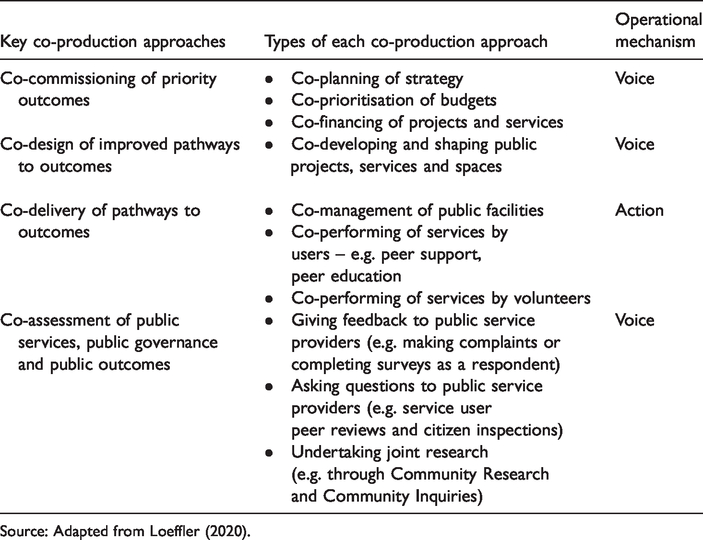
Co-production can be considered as an intense form of citizen engagement which covers situations where the inputs made by citizens to improve services or public outcomes are substantial (Loeffler and Bovaird, 2018). More precisely, the concept of co-production can be unpacked further into the four key dimensions of co-commissioning, co-design, co-delivery and co-assessment – see Table 1 (Bovaird and Loeffler, 2013; Brix et al., 2017; Nabatchi et al., 2017). Three of the four Co’s rely on ‘citizen voice’, while co-delivery relies on ‘citizen action’ (Loeffler, 2020). This typology constitutes a reworking of the Hirschman (1970) ‘exit, voice and loyalty’ framework for analysing service user response to failing organisations. In public services where service users consider their voice for change is ineffective, exit is often not an option, as alternative providers are rarely available. While loyalty is always available, it represents for dissatisfied service users a clearly sub-optimal strategy. The extension of Hirschman’s typology through the new category of ‘citizen action’, i.e. co-delivery, presents the possibility of a much more positive strategy, in which citizens get actively involved in the delivery of a service, so that it conforms more closely to their wishes.
A typology of co-production approaches – the four Co’s.
Source: Adapted from Loeffler (2020).
Theoretical framework: Co-production within changing modes of governance
In the co-production and public governance literature, most typologies of administrative paradigms suggest that the role of citizens as co-producers is mainly compatible with new public governance, rather than traditional ‘old public administration’ (OPA) or New Public Management (NPM) (Meijer, 2016: 599; Pestoff, 2012: 377–378; Sicilia et al., 2016: 11) (although Sorrentino et al. (2018: 279–280) point out that authors from the Ostroms’ Bloomington circle had already demonstrated in the OPA era that the inputs of the citizens were vital to the success of public services). However, the literature does not provide systematic empirical evidence on the extent to which co-production can and does take place within different modes of governance and, in particular, in public service contexts more characterised by hierarchies and markets. This paper addresses this gap in the literature with empirical evidence and also develops the conceptual framework of public governance modes and co-production further.
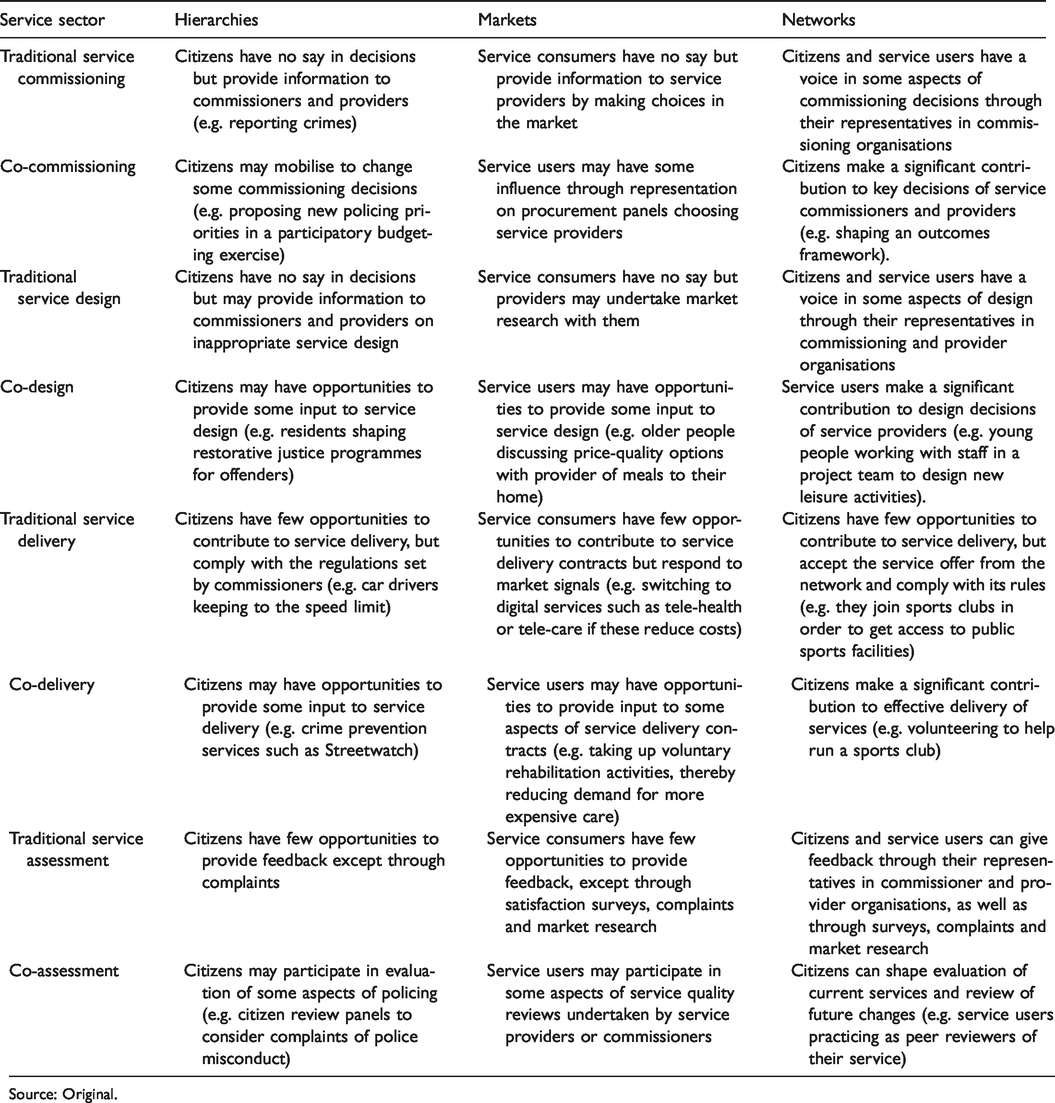
In Table 2, by focusing on the characteristics of these different modes of governance, we explore how user and community co-production could fit within each mode, rather than assuming a priori that it only works under conditions of network governance. We distinguish between a traditional, narrow conception of each mode of governance and a more analytical approach, which demonstrates how each of the four Co’s might play a greater role within each mode of governance.
Modes of governance and potential role of co-production.
Source: Original.
In hierarchy, citizens are often considered to have a purely passive role – providing information rather than contributing to decisions made in relation to commissioners and simply complying with provider requirements – from this perspective, all four Co’s are relatively weak. The public governance literature has neglected, however, to explore how some citizen contributions can enhance service design decisions made in hierarchical systems, where the professional ‘experts’ lack the knowledge accumulated by citizens in their role of ‘experts by experience’. Moreover, citizens, by using their voice, can influence service commissioning decisions to a limited extent. The same applies to co-assessment. Citizens are mainly likely to contribute to some delivery aspects of services, e.g. in prevention services, where community inputs can complement professional inputs.
In markets, service users are considered as consumers rather than as citizens or collaborators. In this role, they have may have useful information to give to providers and therefore may be active to some extent in co-design and, in particular, co-assessment. In co-delivery they can help improve the efficiency of providers, e.g. by accepting a self-service approach. Their role in co-commissioning is likely to be weak, since providers make strategic decisions based on the market behaviour of service users, rather than on their voice (although commissioners, by contrast, may give weight to service user voice).
In networks, citizens are seen as collaborating with service commissioners and providers as co-producers (Pestoff, 2012: 365), not simply as passive citizens or narrow consumers. Here, all four Co’s are likely to be stronger than in either the ideal types of markets or hierarchies.
In practice, policy fields are likely to be characterised by the co-existence of different modes of governance, which change over time and across different localities. As Rhodes (1997) suggests, it is the mix that matters. Similarly, Skelcher and Smith (2015) highlight that many organisations involved in the public domain are ‘hybrids’, conceptualized as entities that are carriers of multiple institutional logics. The opportunities for co-production are therefore likely to be influenced by the actual mix of governance modes which is observed in specific contexts. The empirical part of this study has sought to explore how these layers of the governance mix have influenced the development of co-production in the context of one specific country case study.
Co-production within changing modes of governance: The case of the German ‘welfare’ and ‘law and order’ states
As a context in which to explore the influence of modes of governance on user and community co-production, the case study of Germany has a number of strong advantages. First, the spread of co-production has been significantly slower and less generalised than in those English-speaking countries where there has recently been such a revival of interest. Although in the late 1990s the Schröder Government introduced a new vision of the state as ‘activating state’ (Jann, 2003: 111–113), this did not trigger the development of a co-production movement. At the local level, the concept of the ‘citizen council’ (Bürgerkommune) became popular. The Bürgerkommune aimed at strengthening local democracy, increasing the legitimacy of local government decisions and efficiency of public services through effective involvement of citizens (Bogumil et al., 2002: 25). While this might have meant that the role of citizens as co-producers could have become a key element of the Bürgerkommune, in practice the focus was mainly on less intensive forms of citizen engagement. However, there has recently been an awakening of interest by German academics in co-production research, in particular on the output legitimacy of co-production (Freise, 2012), its ambiguous role in health care (Ewert, 2019) and its potential for developing innovation in the social welfare mix (Evers, 2014; Evers and Ewert, 2020).
Second, German public services are characterised by a significantly different mix of governance modes than in the English-speaking world – in particular, the German public administrative system is still strongly influenced by a public law tradition (Jann, 2003) and this influence remains particularly strong in policing and public safety initiatives. However, the German governance system differs markedly between its ‘welfare state’ and its ‘law and order state’ manifestations. The German ‘welfare state’ has traditionally been characterised by a corporatist tradition and the principle of subsidiarity. The ‘general existential risks’ in relation to unemployment, health care and accidents, as well as pensions, are covered through an insurance system. At the local level, the German tradition of local self-government has meant that local authorities deal with many social issues in cases where the insurance system breaks down. Moreover, and usefully for the purposes of comparative research, the governance systems in social care differ quite markedly between social services for older and for young people, providing a further source of comparison.
Local social policies include so-called ‘voluntary responsibilities’, where local councils have flexibility in whether and how to provide (Grohs and Reiter, 2014: 9), e.g. social services for older people (Altenhilfe) and general social services for young people (offene Jugendarbeit). There are also mandatory local self-government responsibilities, financed through local government budgets, where local councils can only decide how (not whether) to provide – these include social services for young people in need (Jugendhilfe) and also transfer payments to older people in need (Sozialhilfe). Finally, there are devolved responsibilities (and funding) from federal and state levels of government, where local authorities have very little autonomy e.g. assessment and payment of housing benefits to people in need (Grohs and Reiter, 2014: 9).
Traditionally in Germany, powerful welfare associations were prime providers of social services (Grohs and Reiter, 2014: 10). However, the new social insurance scheme in the mid-1990s meant a reduced role for both welfare associations and local authorities as providers of social services for elderly people with care needs (Bönker et al., 2010). This legislation implied an increasing role of private providers and partly replaced the old corporatist structures by more market-like contracts (Wollmann, 2018: 419). However, traditional corporatist structures remained more resilient in childcare and other services for children and young people (Grohs, 2010) so that, ‘despite all the attempts to create a level playing field, the welfare associations kept their strong voice in local decision-making’ (Bönker et al., 2016: 78). This contrast in governance systems can be expected to be reflected in the way in which co-production is practised.
More recently, the increasing demand for statutory social services has left many local authorities, particularly those economically weak (Geißler, 2015), with little space to design proactive or preventative social policies, which could support self-help by service users and local communities. However, as Evers (2005) argues, personal social services often draw from the contributions of civil society: ‘It is the impact of the social capital of civil society, which makes itself felt not only by resources such as grants, donations, and volunteering, but as well by networking and social partnerships’ (Evers, 2005: 737). In this way, network forms of governance have recently become more important.
Turning to public safety, in Germany, the states (Länder) are responsible for most legislation and services to ensure public safety and order. Each state has its own police force. The coercive services of public safety and order are shared between the police and the Agency for Law and Order (Ordnungsamt) at local level. Fire and emergency services are provided in cities over 100,000 inhabitants by a fire brigade of paid professionals (von Lennep, 2012: 12). These agencies exhibit traditional hierarchical governance structures and practices.
However, there are some less hierarchical elements to public safety provision. Recently, police forces have become more active in crime prevention, often through local public safety partnerships (Ordnungspartnerschaften) between local authorities, police, third sector organisations and citizens. They were first introduced in the 1990s and have grown to about 2000 partnerships (von Lennep, 2012: 5), although this is only 1 in 6 of local authorities in Germany. However, not all such local partnerships necessarily practice effective network governance (Freise, 2012: 277). Fire brigades, too, have unpaid volunteers in all smaller local authorities in Germany, making up over 97% of all firefighters in Germany (see http://www.feuerwehrverband.de/statistik.html). In addition, a number of aid organisations providing emergency and civil protection support work with volunteers, such as the German Red Cross. These institutionalised forms of co-production in public safety are embedded in the principle of subsidiarity (von Lennep, 2012: 14). Consequently, the predominantly hierarchical mode of governance in public safety is mixed with some network governance elements.
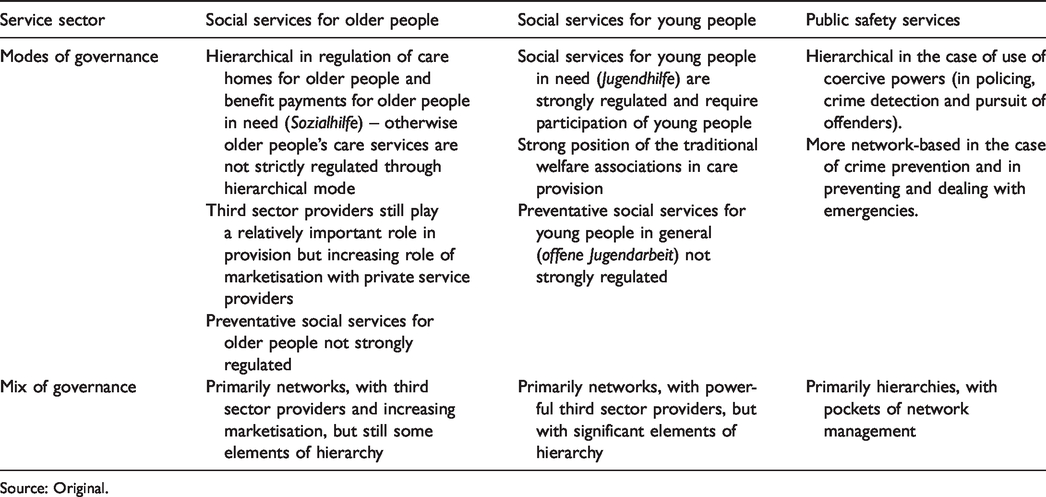
In Table 3 we set out the changing modes of governance, and the current governance mix, which have characterised the public services relevant to our empirical study. This did not cover the full spectrum of public safety services in Germany, as outlined by Lange (2018) and the increasing range of social policies and services (Grohs and Reiter, 2014). To keep the study within practical bounds, we confined the study to social services for young and older people and, in public safety services, to co-production in the prevention and detection of crime and anti-social behaviour.
Modes of governance and mix of governance in local social services for older people, young people and local public safety services in Germany.
Source: Original.
From Table 3 we see that the hierarchical mode of governance is still important in Germany, particularly given the coercive nature of most public safety services, where it seems likely that German citizens will have fewer opportunities to make a contribution. Even where local public safety partnerships have a formal network structure, they may still be dominated by hierarchical modes of operation, as the research by Freise (2012) in North-Rhine Westphalia shows.
In the case of social services for young people in Germany, the network governance mode is stronger. While many local municipalities collaborate with some welfare associations, commissioning them to deliver specified services to their clients on a contract basis (Zuwendungsbescheid), many local authorities have also recognised the need to coordinate social services between the stakeholders involved. This may involve regular meetings between all parties concerned but sometimes more formal networks have emerged. Furthermore, regulations at the federal level and state level require local authorities to ensure participation of children and young people, in particular those in need, in key decisions affecting their quality of life (Heeke, 2014). These regulations clearly create opportunities for co-production with young people in order to put legal requirements into practice. For example, paragraph 11 of the Social Law Book VIII demands ‘that the offers of young people services are based on the interests of young people and that they can be co-determined and co-designed by young people’ (Bundesministerium für Familie, Senioren, Frauen und Jugend, 2015: 34 [Translation by the authors]). Co-commissioning approaches with young people (for example, through participatory budgeting within schools) would also be supported by the Bürgerkommune vision, mentioned earlier, which has been adopted by an increasing number of German local authorities.
At the same time, the NPM paradigm has also been strongly promoted at the local government level in Germany since the 1990s (Reichard, 1996). In Germany, this emphasis on marketisation is particularly evident in long-term care services for older people. According to Pestoff (2012: 378), a welfare reform policy inspired by NPM that emphasizes economically rational individuals who maximise their utilities and provides them with material incentives to change their behaviour tends to play down values of reciprocity and solidarity, collective action, co-production and third sector provision of public services.
Three propositions arise directly from this analysis of the governance frameworks in German public services, as set out in Table 3:
Services characterised by governance modes with strong elements of network working are likely to enable a wide range of co-production approaches, including co-commissioning, co-design, co-delivery and co-assessment. Therefore, we can expect a wider range of co-production approaches in social services for young people and older people than in public safety services, where network governance tends to be much weaker. The governance mode of marketisation gives providers an incentive to involve customers in design, delivery and, in particular, assessment. Therefore, there may be a wider range of these co-production approaches in social services for older people than in social services for young people, which have not experienced the same degree of marketisation. The more hierarchical regulation of statutory services for young people in Germany, and particularly for young people in need, provide young people with rights to participate in decision making concerning the pathways to improve their personal outcomes, so that wider forms of co-commissioning are likely to exist than in the case of social services for older people.
Research design and methodology
In order to compare how the governance context of co-production influences the forms of co-production, the authors developed a research design based on a qualitative study of the perceptions of a wide range of participants working in public and third sector organisations in three different service sectors exhibiting different governance modes. We ran focus groups which included a wide variety of managers and staff from different levels of the organisational hierarchy of both public sector and third sector organisations, in order to provide multiple perspectives on the issues discussed. Specifically, the focus groups involved both public officers of local authorities (and other relevant public agencies) and paid staff employed by non-profit organisations (but not elected politicians or service users).
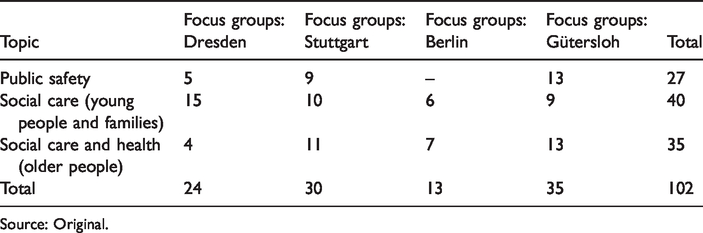
Over 100 participants took part in 11 focus groups in 2014, convened in four major urban areas of different German states (Länder) to ensure wide geographic coverage:
Stuttgart, the capital of Baden-Württemberg in the south-west of Germany; Gütersloh and other local councils in North Rhine-Westphalia; Berlin – Germany’s capital, and Dresden, the capital of Saxony in the east of Germany.
In each location, except Berlin where the focus group on public safety did not take place, three focus groups were convened, each of which focussed on one of the following topics:
Public safety services, with representatives of police and third sector organisations focused on crime prevention. Social services for young people and families, with representatives from local government and third sector organisations focused on young people and families. Social care and health, with representatives from local government and third sector organisations providing social services and preventative health services to older people.
The choice of the three topics was based, as described above, on the desire to differentiate between co-production taking place within the different modes of governance. Public safety has a distinctively different mode of governance, based strongly on hierarchy. The choice of social services, both for older and young people, allowed services to be explored in which network modes of governance were more dominant but where marketisation was also important (services for older people) and where hierarchy remained important (services for young people). Moreover, as social services for young and older people have similar service characteristics but a rather different mix of governance modes, the contrast between them allows us to explore the specific influence of governance modes on co-production attitudes and behaviour, as distinct from the influence of service differences. This choice of services therefore allowed us to explore how co-production varied across modes of governance. The distribution of focus group participants is shown in Table 4.
Number of focus group participants.
Source: Original.
Before attending the focus groups, each participant got a briefing note, explaining the concept of co-production and outlining key questions to be discussed. Each session started with an exercise allowing participants to express views on seven ‘warm-up’ statements about co-production. Each session lasted approximately 1.5 hours, using a semi-structured template to focus on the research questions (derived from the three research propositions):
Which co-production approaches (with respect to co-commissioning, co-design, co-delivery or co-assessment) are common in your service sector (giving examples)? What are the drivers for and barriers to putting co-production into practice in each sector? To what extent do you consider these four co-production approaches effective in improving the quality of life of citizens? What is the potential for future development of co-production in general, and the 4 Co’s in particular, in your service?
This paper focuses specifically on responses to the first two questions above. (The third and fourth questions provided context and also gave rise to some extra propositions, which were used in framing subsequent research, not further considered here.) Throughout the sessions, participants were encouraged to discuss the role of the mode of governance in influencing the forms of co-production which they described in their service(s).
Each session was recorded (with consent of the participants) and summaries of the discussions were fed back to participants for quality control. Participants also received the final research report (Löffler et al., 2015).
The strengths of this research design were threefold. First, it enabled in-depth exploration of the co-production experiences of experts involved in German local public services, who provided relevant examples of co-production and critiqued each other’s examples. In this way, participants from almost 100 different public service organisations could provide a very rich picture of the current state of co-production in the selected services. Second, general comparisons could be made between (and, indeed, within) the three different services, across a wide range of different geographical and organisational contexts. Third, detailed comparisons could be made between the different governance systems within which these services were embedded, which was the main focus of this study. Taken together, these strengths meant that the focus group evidence allowed the three research propositions to be investigated in depth, so that they could be disconfirmed if they were out of line with the evidence (Flyvberg, 2004). Clearly, limitations of the design were that discussion was not easily amenable to quantification and it was not possible to judge the relative merits of contrasting responses (Morgan, 1997). However, quantification was not part of the research design and the discussion below notes where participants expressed contrasting views.
Findings and discussion from the focus group evidence
Here we outline the findings in relation to the co-production initiatives detailed by the focus group participants – each section reports separately on one of the four Co’s.
Co-commissioning
The focus groups identified some co-commissioning initiatives involving co-planning and co-prioritisation in social services for young and social services for older people but none in public safety. Indeed, one focus group participant suggested: Traditional youth work had changed a lot. While in the past the local authority or third sector provider used to decide which young people’s projects should be implemented, we now involve young people – for example, through an ideas workshop, in the development of new projects … . This not only increases the commitment of young people to engage in the delivery of the project but also helps them to understand the perspectives of other stakeholders.
Focus groups had more divided views on experiences with participatory budgeting at local level. While some thought that it has provided local authorities with a useful forum to engage citizens in dialogue, others thought that the distribution of competencies across levels of government made it difficult to put citizens’ proposals resulting from participatory budgeting into practice. Several participants suggested that prioritisation of budgets is still considered to be ‘a genuine responsibility of the local council’. The focus group discussions highlighted that participants considered institutionalised forms of co-commissioning such as Youth Parliaments or personal budgets (in the case of older people in need) to be rather ineffective.
Moreover, there was no hint that more co-commissioning by young people was considered a priority for future development. Indeed, one focus group participant even questioned: ‘why is more involvement of young people [in need] beyond the formal requirements necessary?’ It seems that, although co-commissioning might give citizens more voice in budget priorities, it is still seen as unattractive to the German public sector.
This provides further evidence that the hierarchical mode of governance still exerts a strong influence on all German public services, in line with the characterisation of Germany by Voorberg et al. (2017) as having ‘a strong orientation towards laws and protocols, with a strict and formal distribution of responsibilities’ (p. 369). As one focus group participant suggested ‘The bureaucratisation which can be found in Germany can be considered as a barrier to young people, as they require space for their development’.
Co-design
Participants identified a number of significant co-design approaches in both services for young and older people. The widest range of co-design initiatives reported occurred in services for older people, relating to social services and wider public services, e.g. the co-design of palliative care plans with patients and their care-givers and Round Tables (Seniorenkonferenzen) at the local level to gather suggestions from older people on how to improve public services. There were also a small number of intergenerational co-design initiatives, involving both older and young people, such as the co-design of social and leisure services in multi-generation houses.
There was also a substantial number of co-design initiatives in activities specifically for young people, although more restricted than for older people. However, it was striking that the co-design approaches with young people did not involve co-design of public services but mainly public spaces or projects – for example, the co-design by young people of a soccer and basketball field for the local council.
In relation to public safety, there were only a few small scale co-design approaches.
Co-delivery
The focus groups identified a wide range of co-delivery initiatives involving volunteers in all three service sectors – this is a longstanding form of co-production in German local public services. In social services this included volunteers supporting the development of young people as ‘education mentors’ and older people volunteering to co-deliver projects and activities in leisure clubs at neighbourhood level supported by the local authority. In a number of cases, the co-performing of public services by volunteers involved inter-generational approaches. Furthermore, focus groups provided a number of examples of peer support provided by both young people and older people. In public safety, examples included older people being trained by the local police as volunteers to advise others on how to stay safe and young people volunteering to help in the emergency of the Elbe floods. This suggests that co-delivery is the form of co-production which varies least between modes of governance.
It emerged from the focus group discussions that the volunteers and service users typically involved in this form of ‘citizen action’ were generally different from those most often involved in the ‘citizen voice’ initiatives comprising the other three Co’s. Moreover, in most local public services, the staff dealing with volunteers are different from the staff dealing with citizen voice initiatives and they tend to have rather different skills, so that the scope for integrating and harnessing the contributions of citizens across the four Co’s was limited.
Apart from volunteering, there were considerably fewer initiatives involving co-delivery of services or projects by users in social services for young and older people (apart from self-help groups). One example was a local authority organising a local camp, where young people co-delivered new creative projects with other young people. However, within public safety services there were no forms of user co-delivery, as opposed to voluntary activity in the community.
Co-assessment
Finally, the focus group discussions highlighted that co-assessment was still very rare in all of the service sectors studied. While we expected little reference to co-assessment in the case of public safety, with its predominantly hierarchical mode of governance, it was striking that there was no reference to co-assessment in the focus groups on social services for young people, in spite of claims that their views are now much more important than previously. Some focus group participants mentioned how much young people used social media but they admitted that it was still rather uncommon for local public services in Germany to use social media, even to gather feedback from service users or other citizens. Given that young people in Germany are just as active social media users as elsewhere, this seems an area ripe for development.
In the case of social services for older people, specific co-assessment approaches targeted at older people included a project to identify gaps in the service offer for older people and an evaluation of the success of a regeneration project and the quality of life in a deprived neighbourhood. Again, it was striking that these co-assessment initiatives generally did not give older people the opportunity to assess their existing social services or the outcomes they experienced from these services. This is surprising, given the competitive market which many providers face in services for older people.
A number of focus group participants suggested that co-production was especially likely to be important in prevention of social problems and regretted the lack of ‘hard numbers’ which would provide feedback on the impact of co-production. They suggested that many local authorities did not take health prevention seriously, and therefore did not pursue co-assessment of health interventions – as one participant suggested ‘This could only change when we can show that prevention really counts – but we are still lacking the numbers’.
Implications for co-production approaches in different governance modes
Comparing the co-production initiatives involving co-commissioning, co-design, co-delivery and co-assessment of public services and outcomes, it is striking that the two welfare sectors across the four locations show a much wider variety of co-production approaches than public safety. In the case of public safety, co-production is mainly restricted to different co-delivery approaches in prevention services – there are very few co-design initiatives and the focus groups were not able to identify a single form of co-commissioning or co-assessment. Indeed, most focus group participants were sceptical about whether the more hierarchical mode of governance in public safety provides scope for co-production, whereas in the social services for both young and older people many focus group participants had set up inter-organisational networks to provide a more holistic service offer, which also enabled a wider variety of co-production with local communities and service users. This is fully in line with our Research Proposition 1.
Research Proposition 2 stated that social services for older people are likely to focus more on forms of co-design, co-delivery and co-assessment than social services for young people, which have not experienced the same degree of marketisation. This is supported by the discussions in the focus groups (although the evidence was not strong). In particular, most focus groups participants thought that seeking user feedback was still uncommon in the case of social services for young people, especially those in need.
Research Proposition 3 stated that wider forms of co-commissioning are likely to exist in social services for young people, particularly those in need, than in the case of social services for older people. While co-commissioning was indeed more common in social services for young people, in general, it is striking that the focus group participants did not identify any co-commissioning initiatives which specifically involved young people in need. The focus groups did identify co-commissioning initiatives which targeted young people in general, such as a suggestion scheme in Saxony which involves young people in the prioritisation of ideas and the much more common Youth Parliaments and Pupils’ Councils in schools. However, a number of participants commented critically that Youth Parliaments had not been effective in their local council and had therefore been discontinued. Therefore, Research Proposition 3 is only partially supported by the evidence from the focus groups.
These findings therefore support the arguments developed from our theoretical framework that governance mixes characterised by networks enable wider forms of co-production with service users and local communities, including both citizen voice (co-commissioning, co-design and co-assessment) as well as citizen action (co-delivery), than do service sectors which are characterised by governance mixes with stronger hierarchical forms of governance, such as public safety at the local level in Germany.
However, some of the findings go beyond what is suggested by our theoretical framework. First, some co-delivery approaches have been put into practice in public safety. Although a number of focus group participants were very sceptical about the role of citizens as co-producers in this sector, the majority of participants considered that, while co-production is not possible in the averting of danger, which is an exclusive responsibility of the police, the engagement of citizens as volunteers plays an important role in the delivery of emergency and preventative services. This finding therefore suggests that German public services managers and staff are becoming more aware of how their own contributions to even hierarchical services often rely for their effectiveness on the inputs of citizens, in line with the international literature, that the police needs communities to fight crime as much as the community needs the police (Loeffler, 2018; Parks et al., 1981). A further important implication of this finding is that co-delivery is the aspect of co-production which varies least between modes of governance.
The findings also highlight the silo nature of co-production in most cases – very few organisations suggested that their co-production covered all four Co’s or that it was embedded in their overall policies and practices. However successful they thought co-production had been in the services they discussed, only a small number of participants claimed that it was firmly embedded in even those services. From our research propositions, it might be expected that embedding of co-production across services would be most prevalent in more network-based services, particularly services for older people – but even here the incidence was relatively small. This highlights how co-production, even where it is enthusiastically adopted, tends to occur in pockets rather than as organisational strategy.
Conclusions
The discussions in the focus groups on co-production showed that it is still a relatively new concept for most local government managers and other public service providers in Germany. Nevertheless, most participants highlighted that they were already using some co-production approaches and becoming increasingly interested in the potential of co-production. Consequently, while the results partly support the findings by Voorberg et al. (2017) that the Rechtsstaat tradition in Germany constrain citizen co-production, they also demonstrate that even within the Rechtsstaat tradition there is scope for co-production. This is a lesson which is clearly important for public services in other administrative law countries.
The authors are currently actively involved in co-production research in Germany, particularly with young people, through which it has become clear that the results in this paper have powerful messages for public services today, particularly to explain why co-production in Germany is still relatively slow to expand through the public sector (Loeffler, 2020). At the same time, the results we report here demonstrate that there are no fundamental barriers to co-production becoming more prevalent, where there is a will.
Our research propositions were developed on the basis of a theoretical framework which highlighted the different modes of governance related to the different service sectors explored in the empirical study. Two of our three research propositions were supported by the evidence from the study groups, while one was partially supported. The paper therefore provides the first clear research evidence on how approaches to co-production are specific to the modes of governance within which they take place.
In public safety, the service sector most characterised by the coercive tradition of the ‘Rechtsstaat’ and hierarchical governance, the focus groups demonstrated that co-production is still a controversial approach, giving rise to conflicting practices and opinions. There is still much open scepticism and concern among police and local authorities about its appropriateness. Nevertheless, some experiences with co-delivery of crime prevention activities with citizens were reported and had been valued by focus group participants.
Governance mixes involving more network-based governance, as in social services, were shown to be more consistent with citizen co-production than the public safety governance mix, with its strong emphasis on hierarchy.
It is clearly significant that the key co-production approach identified as most significant in all focus groups was co-delivery. This suggests that local authorities and other local service providers continue to put their co-production focus more on citizen action and less on citizen voice. This is not surprising in public safety, since hierarchical modes of governance are less likely to favour giving a role to external stakeholders in decision making. It is more surprising in the cases of social services for young and for older people, where the major focus was also typically on ‘citizen action’ through co-delivery.
However, the focus groups findings suggest that network modes of governance are also encouraging new forms of citizen voice, especially in service co-design. A wide range of such co-design initiatives was reported in services for older people, and, to a more limited extent, for young people. However, it is striking that the extensive focus group discussions provided little evidence of effective co-commissioning with young or older people. This even applied to young people in need, to whom, according to legal regulations, providers should give a voice in shaping their own pathways to outcomes. It was clear from the focus groups that many local authorities have left this field to powerful third sector service providers, which often manage these services according to their own priorities, with limited attention to the potential of co-production. Finally, in relation to citizen voice, it was remarkable that the focus groups provided so few examples of co-assessment, especially in this digital age. Taken together, the evidence from the focus groups suggests the paradox that in German local public services there is more talk than action about ‘citizen voice’– and more action than is often talked about in relation to citizen action.
A number of important areas for further research emerge from this study. First, we should not assume that networks per se are conducive to co-production with service users and communities. More research is required, based on a more differentiated taxonomy of networks, to identify which kinds of networks are more likely to promote and enable co-production.
Second, further research is required to identify how to grow co-production within hierarchical modes of governance, since these still characterise many public safety services at the local level in Germany, and to some extent, social services for young people in need. The findings of this study demonstrate that co-production is both possible and, in some cases, valuable in services characterised by this governance mode. However, there is a need for research on how co-production can be embedded within the specific legal and regulatory frameworks which apply to public services in administrative law countries.
It was clear from the focus group discussions that there is still very limited evidence about the impacts of co-production in Germany – evaluation of the initiatives highlighted in this study would bring a valuable extra dimension to the discussion of the potential role of co-production. It would also highlight the extent to which co-production could have unintended negative effects – for example, some participants in the public safety focus groups voiced concerns about potentially adverse effective of co-production where citizens were seen to ‘take the law into their own hands’.
Finally, there is a key question germane to the central research issue addressed in this paper. Rather than simply asking ‘does mode of governance affect co-production?’, we also need to explore the extent to which co-production changes the governance framework itself. While we did not ask this question directly in the focus groups, it was clear from much of the discussion that many of those participants who had most experience of co-production initiatives believed that their experience had shown them a different way of conceiving of the relative roles, responsibilities and potential contributions of service users, communities and public service organisations. Whether this can develop into a fully-fledged new mode of governance based on co-production remains to be seen.
Footnotes
Declaration of conflicting interests
The author(s) declared no potential conflicts of interest with respect to the research, authorship, and/or publication of this article.
Funding
The author(s) received no financial support for the research, authorship, and/or publication of this article.
