



Abstract
Behavioural interventions are much more than ‘just another policy tool’. Indeed, the use of behavioural science has the potential to lead to a wide-ranging reassessment of policymaking and public administration. However, Behavioural Public Policy remains a policy paradigm ‘under construction’. This paper seeks to contribute to this development process by investigating the conceptual features of advanced Behavioural Public Policy that go beyond the now familiar notion of nudging individual behavioural change. It thus seeks to provide more illumination in a debate which currently seems to have become stuck on the pro and cons of nudging citizens’ individual behaviours. In reality, Behavioural Public Policy should be seen as a pluralist, non-deterministic and multipurpose approach that allows the application of behavioural insights ‘throughout the policy process’ and in combination with regulatory policies. The paper’s line of argument unfolds in three steps. First, it explores the policy rationales that have driven nudge techniques and also summarises the conceptual, methodological, ethical and ideological criticisms that have made of it. In a second step, state-of-the-art Behavioural Public Policy, which claims to be more substantial and wide-ranging than today’s nudge techniques, is empirically examined through interviews conducted with global thinkers (academics and practitioners) in the field of behavioural insights. Finally, there is a discussion of whether advanced Behavioural Public Policy could be better suited to withstand the criticisms that have been directed at nudge techniques.
Keywords
Introduction
Behavioural Public Policy (BPP) has become established as a new strand in public policy research and policymaking. Alongside this process, the initial question of whether policymakers should use behavioural insights has been replaced by the more practical questions of where, when and how they should be used in the policy process. As it turns out, these questions are no less controversial than the former since they open up the debate on the actual focus, scope and scale of BPP. For example, while proponents of BPP argue that behavioural science has the potential for a ‘wide-ranging reassessment of public administration’ (Sanders et al., 2018: 4), some political scientists call more modestly for ‘a dialogue about a behavioral approach to public administration’ (Grimmelikhuijsen et al., 2017: 54). Above all, such a dialogue requires a shared understanding of how the policy process should be informed by behavioural insights and how behavioural approaches correspond to existing policies (Kuehnhanss, 2018). In addition, an understanding has to be reached on the policy objectives of BPP. Notwithstanding these questions, scholars have pointed out that BPP is more far-reaching than most of the existing uses of behavioural insights and nudges (Straßheim and Beck, 2019), even if ‘nudging’ tends to dominate the understanding of BPP in the public debate.
This paper will argue that BPP, defined as ‘as a policy intervention that is directly inspired by, and designed on, the principles of behavioral research’ (Galizzi, 2014: 27), can be regarded as a potentially pluralist, non-deterministic and multipurpose approach that differs significantly from recent behavioural change interventions in public policy. Advanced BPP (i.e. BPP that moves beyond the present notion of the term) can complement and refine existing policymaking rather than be a stand-alone concept. Moreover, behavioural insights could be used not only to change individual behaviours but also collective and organisational behaviours (Feng et al., 2018) and to inform conventional policymaking by providing evidence about policy problems and the expected behavioural implications of (particular combinations of) policy tools (Gopalan and Pirog, 2017). When understood in these broad terms and not (mis-)used in an ideological or politicised manner, an advanced version of BPP may lead to the revival of a more nuanced and sophisticated debate on behavioural insights in public policy, which had been overshadowed by the ‘nudge revolution’ (Graf, 2019). In this respect, evidence emanating from the ‘pre-history of nudge’ (Vallgårda, 2012: 201), such as the debate on ‘ecological approaches to human behaviour’ (Halpern et al., 2004: 15), are an underexploited source. While nudges are restricted to insights from behavioural economics and psychology, utilising the abundance of insights from behavioural and social sciences may contribute to a deeper understanding of behavioural patterns. This includes, for example, knowledge on how behaviours are embedded in social contexts and shaped by social interactions.
Against that backdrop, the following research question will be pursued in this paper: What are the conceptual features and guiding rationales of advanced BPP that go beyond the notion of nudging individual behaviour change? Answers to this question will contribute to the theoretical discourse on behavioural policymaking (John, 2018; Oliver, 2015, 2017) and its critical reflection (Feitsma, 2019; Jones et al., 2013; Leggett, 2014). The use of behavioural insights in public policy should be more than a synonym for nudging people towards desired behaviour change: this has surely been the lowest common denominator in the lively recent debate on BPP (Straßheim and Beck, 2019). For example, Sanders et al. (2018: 14) state that behavioural interventions could also be ‘a tool to improve the way government itself functions’, while according to a report from the OECD (2017: 49), ‘the application of behavioural insights to change organisational behaviour within and outside government’ must be intensified. Likewise, Lourenço et al. (2016: 42) argue that behavioural science ‘represent[s] an input to the policy process’ that has so far remained largely untapped. This paper contributes to such ambitious proposals for the future of BPP by leaving the well-trodden paths of behavioural insights and nudges. However, it will also argue that the vehement criticism of nudging will not disappear just because a behavioural lens is applied more frequently to the standard approaches of public policy and administration (Loewenstein and Chater, 2017; Moynihan, 2018). While it is assumed that advanced BPP could fix some of the most obvious shortcomings of nudging (e.g. the narrow focus on individual behaviour), the constraints and barriers that are expected to bar the way to a broader application of behavioural insights are also identified.
This paper unfolds in three steps: first, the essence of nudging – i.e. its driving policy rationales and assumptions – will be briefly introduced, followed by a recapitulation of the conceptual, methodological, ethical and ideological strands of criticism that nudge policies have provoked. Second, the latest thinking on BPP will be examined empirically on the basis of findings from an interview study with leading academics and practitioners in the field of behavioural insights. Thus, the paper sets out to develop a broader understanding of how using behavioural insights could lead to modified forms of applications in public policy and administration. In a third step, based on an analysis of the interview data, the conceptual features and guiding rationales of an advanced form of BPP will be identified, and there will also be a discussion of whether advanced BPP may be better able to withstand criticism than the nudge approach. Finally, there will be a brief conclusion.
The essence of Nudge and its criticism
More than 10 years after Thaler and Sunstein published Nudge (2008), behavioural insights are in frequent use in public policy around the world (Whitehead et al., 2019). While the initial debate on nudging revolved mainly around rather banal modifications of human behaviour – ‘low-hanging fruits’ (Sanders et al., 2018: 19), such as rearranging supermarket food displays or the design of anti-spatter urinals – behavioural insights are increasingly seen as a lens by which to give a ‘scientific foundation to the policy development process’ (Lunn and Robertson, 2018: 24). As such, the debate may be returning to a more holistic notion of behavioural insights and their use in public policy (Halpern et al., 2004), which, as one reviewer of this paper noted, was ‘side-lined and narrowed’ by the publication of Nudge. In the following paragraphs, I will first briefly summarise the essence of nudge interventions as they emerged from Thaler and Sunstein’s (2008) bestselling book, and second, I will recall the conceptual, methodological, ethical and ideological criticism that nudges have provoked.
Nudge – A selectively applied policy approach
According to nudge theory, knowledge of ‘what drives human behaviour and how to change it for the common good’ (John, 2016: 113) should improve attempts at redesigning public policy. This includes a systematic way of applying evidence on human behaviour that is produced through scientific experiments based on randomised control trials (RCTs) (Haynes et al., 2012). The behavioural insights derived from such experiments allow policymakers to develop an understanding of people’s bounded rationality that is largely framed by environmental cues (e.g. people stick to a certain behaviour unless they are externally prompted to behave differently). By definition, nudges seek ‘to alter people’s behaviour in a predictable way, without forbidding any options or significantly changing their economic incentives’ (Thaler and Sunstein, 2008: 6). As a guiding principle, ‘nudge theory goes with the grain of human nature instead of trying to change it’ (Vlaev et al., 2016: 552). In recent years, nudging has become a synonym for a range of techniques designed to influence human behaviour such as norms, defaults and salience (Dolan et al., 2012).
So far, most nudges have addressed the individual behaviour of users, consumers and citizens, but in theory, behavioural insights could also be applied to change the collective behaviour of organisations and/or the behaviour of policymakers and public servants. Furthermore, some authors state that behavioural insights could ‘also be used in a way that supplements regulation which tackles systemic issues’ (MacKay and Quigley, 2018: 14). Such a perspective has less in common with the prevailing understanding of nudges and underscores the need to distinguish carefully between behavioural insights as a principle to be applied in policy design and their actual area of application. While the former is universal – behavioural insights may inform all stages and stakeholders of the policy process – the latter depends heavily on policymakers’ underlying assumptions (Ewert, 2019a).
Reassessing four major criticisms of nudge theory
Despite being labelled as a ‘quiet revolution’ (John, 2016: 113) that has enjoyed support from across the political spectrum, behavioural insights have also provoked a good deal of criticism. For the purpose of this paper, the conceptual, methodological, ethical and ideological strands of criticism of the use of nudges (see also Feitsma, 2019; John, 2018; Leggett, 2014) are theoretically differentiated, although in practice these strands often overlap and reinforce one another. As we shall see, much of the criticism of the use of nudges stems from its narrow scope as a policy approach and the insufficient extent to which behavioural insights are related and intertwined with existing policy approaches and tools.
According to the conceptual strand of criticism, nudges are an inappropriate method of addressing complex policy problems adequately (Bhargava and Loewenstein, 2015). In essence, there are doubts over whether nudges have the potential to remedy the more distal causes of policy problems, i.e. their economic, social and spatial dimensions first and foremost. If we consider, for example, a major public health issue such as obesity, there are serious objections to the proposed usefulness of behavioural interventions in tackling the causes of the causes of obesity, i.e. the complex interplay of a powerful food industry, poverty, inequality and social deprivation (Chaufan et al., 2015). While most critics do not doubt the effectiveness of behavioural policies overall, they do question the scope and scale of nudging as a remedy. Thus, nudging is perceived as a concept of ‘limited range’ (see also John, 2018: 88–91) that fails to take account of the social context in which individual behaviour is embedded (Brown, 2012; Leggett, 2014; MacKay and Quigley, 2018). Moreover, nudges are deemed to be an inherently technocratic, top-down and elitist approach (John, 2018; Room, 2016). They are technocratic because behavioural interventions are perceived as a government-controlled roll-out of one-fits-it-all nudges that offer ‘merely technocratic tweaks’ (Hansen, 2018: 191) in response to complex policy problems. They are top-down because nudges are likely to be conceived and designed by ‘choice architects’ employed by governments while citizens and other civil society stakeholders, for example, have little input concerning their content and design. Finally, such policies are criticised as an elitist project that draws exclusively on scientifically gathered behavioural evidence and expertise but marginalises lay knowledge and everyday wisdom. According to this strand of criticism, people’s situated behaviours, such as their eating habits during lunch breaks at work, can scarcely be replicated in controlled scientific experiments since such behaviours depend on personal experiences and social and cultural factors that cannot be standardised (Ewert, 2017).
The methodological strand of criticism regards nudges as an unsuitable route by which to address the deeper causes of policy problems. As mentioned, behavioural techniques are geared to promoting individual behaviour change based on positivist evidence, based predominantly on RCTs that are conducted in laboratory settings. Due to this methodological monism, current behavioural interventions seem insufficiently capable of reflecting the diversity of people’s life-worlds (Spotswood and Marsh, 2016). For example, RCT-driven experiments with nudging citizens to become organ donors do not ‘adequately engage with the complex and often fraught context in which family decision-making about organ donation takes place immediately following the loss of a loved one’ (Quigley and Farrell, 2019: 197). In addition, methodological bias limits the areas in which behavioural insights can be applied from the outset. Hence, it is stated that BPP requires the whole range of scientific disciplines and methods (van Bavel and Dessart, 2018) to conduct more far-reaching experiments that can be pre-tested and piloted before becoming mainstream policies (Lunn and Robertson, 2018). As this criticism suggests, the methods that underpin most nudges cannot adequately address the ‘actual “thorny” behavioural problems that traditional policies often seem to get wrong from the beginning’ (Hansen, 2018: 192).
Furthermore, there is fierce debate about the ethics and the political morality of nudges (Bovens, 2009; Selinger and Whyte, 2011). In essence, nudges are perceived as ethically problematic because modified choice architectures systematically override people’s own interests (White, 2013). Thus, critics rebut nudgers’ claims that they are merely influencing people’s behaviour in directions ‘as judged by their own preferences’ (Thaler and Sunstein, 2008: 10). There are serious doubts over whether citizens would actually agree to well-intentioned nudges that claim simply to be promoting reasonable and rational behaviours. As mentioned previously, nudges reflect ‘the behaviour [that policymakers’] want to see’ (White, 2013: 101) rather than engaging with citizens’ actual preferences in any meaningful way. For example, in contrast to what behavioural policymakers assume, people may have good personal reasons to wish to continue smoking, eating unhealthily or deciding against a medical treatment (White, 2016). So according to ethicists, nudging undermines people’s autonomy, self-government and dignity and actively exploits their bounded rationality in order to further the agenda of the policymakers. Such ethical reservations are aggravated by the fact that many nudges work covertly (Oliver, 2015), influencing people’s behaviour without ever revealing the normative goals and motivations that lie behind the nudges in a transparent way.
The ideological criticism classifies nudges as a ‘political project’ (Quigley and Farrell, 2019) and a ‘strategic neoliberal project’ (Jones et al., 2011: 488). According to this strand of criticism, nudge theory has become a tremendously powerful policy paradigm (Béland and Cox, 2013) to be seen as an instant – though incomplete – remedy to neoliberalism’s vexing social problems. According to this strand of criticism, nudging focuses exclusively on the micro-level, i.e. the governance of individual behaviours, while ignoring the more distal (e.g. socio-economic) factors that underlie such behaviours. It is also claimed that the use of behavioural insights leads to an asymmetric relationship between the omnipotent ‘choice architects’, who design and implement behavioural interventions, and the infantilised policy targets who comply with policy goals unconsciously by adapting their behaviour in the anticipated manner (Jones et al., 2013). As a consequence, the ‘nudgees’ risk being made into domesticated citizens whose active participation has been stealthily restricted (Button, 2018; Ewert, 2019b). It is also argued that nudges, as a welcome and easy-to-apply alternative to regulatory forms of governance, ensure the continuation of ‘neoliberal governmentality’ (Jones et al., 2013) and, by extension, the hegemony of the neoliberal economic model. Accordingly, the success of nudges relies on their convenience as ‘as a form of light-touch, low-cost regulation’ (Quigley, 2013: 599) which involves little political risk for policymakers. Where nudges prove to be effective, they reinforce the political capacity to act in neoliberal times. Where nudges fail, policymakers will hardly get the blame because, in contrast to costly investments in hardware, infrastructure or subsidy programmes, nudging is a form of intervention that disappears as soon as it has been applied. By comparison, more comprehensive and costly (in terms of time and resources) policy approaches that combine behavioural, regulatory and financial tools do not provide the same opportunistic advantage for policymakers and also involve a significant risk of failure.
As we will demonstrate in the next section, behavioural insight experts are well aware that the current use of nudges falls well short of the opportunities that a more mature version of BPP could create for policymakers.
Under construction: Experts’ views on BPP
If BPP is something more substantial than nudging people towards predefined policy goals, the question is: what exactly should it be? This section presents the results of qualitative interviews with experts on behavioural insights. The empirical material generated allows us, as will become clear in the subsequent section, to distil certain conceptual features of and guiding rationales for advanced BPP and also to identify potential weaknesses and unresolved issues in the suggested framework.
Methodology
In order to put flesh on the bones of a broader concept of BPP, semi-structured ‘helicopter interviews’ (Hajer, 2006) with global thinkers – i.e. distinguished academics, policy advisers and/or practitioners – on behavioural informed policymaking were conducted. As a qualitative method, helicopter interviews can provide a multi-perspective overview of a phenomenon or discourse (in this case, behavioural insights) within an emerging field (in this case, BPP) (Hajer, 2006). To capture a wide range of knowledge and expertise on behavioural policymaking, the interviewees were selected based on systematic internet research. The following selection criteria were applied: interviewees should have ‘expert’ status as demonstrated by high-ranking publications and/or a senior position in a Behavioural Insights Team (BIT) or academia (ACA). Due to the ‘helicopter’ nature of the interviews, not only advocates of behavioural insights and BIT employees were identified but also critical allies and observers who have experienced the assumed behavioural turn in public policy at first hand. Here, steps were taken to ensure a balanced view on BPP, which, nota bene, was approached as a policy paradigm under construction or in the making. It was thus possible to study both the inherent dynamism and the potential pitfalls of the development of BPP.
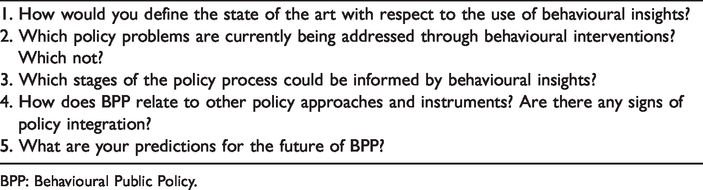
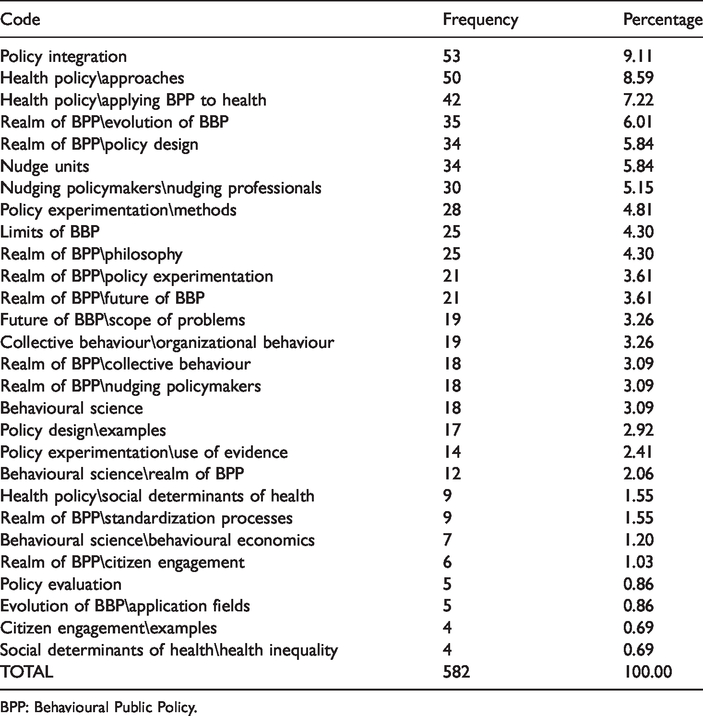
A total of 20 experts – 11 from BITs and 9 from academia – were approached by e-mail. Ten experts – five from academia including two hybrids conducting behavioural experiments in an academic setting but maintaining close contacts with BITs and five from BITs including one hybrid with close contacts with academia – agreed to be interviewed. The interviewees were distributed across various geographical regions: four came from the UK, three from continental EU member states, two from Australia and one from the US. Using a semi-structured format (see Table 1), interviews (Intw1–10) took place either face-to-face (four) or using Skype technology (six). The interviews lasted between 31 and 65 minutes and were fully recorded, transcribed and anonymised. The interview data were examined through an iterative analysis process using the coding software MAXQDA. First, all the transcripts were read carefully. Second, the main codes such as ‘evolution of BPP’, ‘policy experimentation’ or ‘nudge units’ were defined based on the interview content compiled. Third, single interview sections – which were restricted to one paragraph – were assigned to one or multiple codes. Furthermore, where necessary to interpret the content more accurately, sub codes were assigned such as ‘underlying philosophy’ for the main code ‘evolution of BPP’. During this process, two additional main codes – ‘limits to BPP’ and ‘policy integration’ – were added to take account of the finding that many interviewees only saw merits in behavioural approaches if they were combined with other policy tools. The final coding framework (see Table 2) resulted from four rounds of reading and selective coding. The following section summarises the results of the interview analysis divided into three recurring themes (see sections Adopting a behavioural lens: ‘We don’t just do nudges’; Moving on to bigger problems and ‘a wider range of behaviours’; and Implications for policymaking: ‘the holy grail is to integrate better’). In order to facilitate the allocation of the interview quotations, the experts’ respective field of work is indicated (e.g. Intw4_ACA).
Key interview questions.
BPP: Behavioural Public Policy.
Coding framework and frequency of codings.
BPP: Behavioural Public Policy.
Adopting a behavioural lens: ‘We don’t just do nudges’
Frequently used vocabulary served as an initial indicator in determining how behavioural policymaking has been developed in recent years. While the terms ‘behavioural science’ and ‘behavioural insights’ were used spontaneously in relation to behavioural policymaking, the interviewees did not use the fairly academic term ‘Behavioural Public Policy’ (Oliver, 2017) to describe a ‘landscape which is evolving very quickly’ (Intw2_BIT). Nor was the term ‘nudge’ used as a synonym for the application of behaviourally informed policies. Respondents admitted that Thaler’s and Sunstein's (2008) magic formula has accelerated and amplified the ‘systematic and rigorous application of behavioural insights into the policymaking process’ (Intw3_BIT). But while ‘nudge 2008 gave it a big push’ (Intw3_BIT), nudging was primarily seen as ‘rhetoric’ (Intw4_ACA) that is only suitable for a limited range of purposes. Nudge’s initial strength as a catchy, intuitive and simple concept was considered to be somewhat obtrusive with respect to the further evolution and maturation of BPP, which needs to ‘understand complex behaviours’ (Intw10_BIT). Interviewees from BITs also took the same position, stating that in most cases ‘small nudges aren’t going to solve the entire problem’ (Intw8_BIT).
While nudging is perceived as ‘a narrow subset of one way of applying behavioural insights’ (Intw3_BIT), a broader version of behavioural policymaking was framed as the application of a ‘behavioural lens’ (Intw8_BIT) to the entire policy process. Ideally, behavioural insights ought to be ‘part of the way every policymaker thinks about policy’ (Intw1_ACA). One interviewee, who specialises in public health and was somewhat sceptical of recent nudge policies, illustrated this claim by stating that ‘behavioural sciences are the sewage system of the 21st century’ (Intw7_BIT), by which he/she meant a basic prerequisite for achieving societal progress. By and large, the interview data reinforces Oliver’s (2017: 174) conclusion that BPP remains ‘somewhat nebulous and ill defined’ so far. According to the BIT employees, state-of-the-art behavioural policymaking requires, above all, a specific attitude or mind-set rather than a predefined set of criteria that constitutes BPP. Hence, behavioural policymakers ought to be free of assumptions and prejudgments, ‘starting with a clean sheet and going after what is the real issue they want to solve (…) what are the best tools to solve the issue’ (Intw2_BIT). Although this view remains controversial – there are good reasons to argue that policymaking is, by definition, driven by underlying assumptions that preclude non-judgemental attitudes from the outset (Ewert, 2019a) – it does reflect practitioners’ pragmatic notion of BPP, which always starts by ‘asking what the problem is’ (Intw8_BIT). Following this line, advanced BPP is constituted as the complete opposite of technocratic tweaks, i.e. a ‘whole-systems approach (…) being applied across whichever model you want to think about’ (Intw7_BIT). Hence, every policy issue could be examined through a behavioural lens. Taking this claim seriously means shifting attention from individual choice architectures to a wider range of ‘behavioural connections’ (Intw9_ACA) perceived as each and every stakeholder interaction throughout the policy process. According to this line of thinking, providing evidence-based information on behavioural connections which go beyond economic insights (i.e. heuristics and biases) would allow a more ‘radical use of behavioural science’ (Intw5_ACA). Thus, BPP is ‘always more than just nudge (…) it’s about an understanding of how people actually behave and practice to improve how policy is made’ (Intw8_BIT).
If we accept such a broad notion of BPP as a starting point, clarifying its methodological foundation comes next. Most respondents argued for ‘methodological diversity’ (Intw5_ACA) even if RCTs remain, as reiterated by one BIT member, the ‘gold standard of evaluation methods’ (Intw8_BIT). In contrast to the methodological criticism of nudges, BPP is labelled as a creative ‘try and test approach’ (Intw9_ACA) with an ‘affinity to mixed methods’ (Intw1_ACA). Qualitative methods in particular allow us ‘to zoom in particular contexts’ (Intw3_BIT) in order to investigate whether a policy problem has a ‘behavioural component to be engineered with behaviour levers’ (Intw1_ACA). As a rule of thumb, it is advisable ‘to match your method to the research questions’ (Intw5_ACA). In particular, addressing more difficult policy problems – say the behavioural impact of urban environments on childhood obesity (Guy’s and St Thomas’ Charity, 2018) – calls for ‘robust evaluation’ (Intw8_BIT) based on mixed methods. When it comes to childhood obesity, policy evaluation in advance may reveal ‘what the behavioural impact of different kinds of interventions might be’ (Intw8_BIT). All being well, further ‘embedding [of] behavioural insights into the policymaking process’ (Intw3_BIT) could facilitate an impartial selection of policy instruments – ‘like a regulation or a directive, but not necessarily a nudge’ (Intw3_BIT).
Moving on to bigger problems and ‘a wider range of behaviours’
Almost subconsciously, behavioural policymaking ‘started off with the sort of simpler problems’ (Intw8_BIT) such as choice architectures in canteens or default settings in pension schemes. One interviewee who regularly advises behavioural policymakers remarked on this choice by stating that ‘there’s no point in going in with something incredibly risky (…) unless you’ve built a long-term relationship with policymakers’ (Intw9_ACA). Hence, the time needs to be ripe in order to address ‘questions that are a bit more difficult’ (Intw8_BIT). Shifting the focus to ‘more complex behaviours’ (Intw8_BIT) – on which there was an unspoken consensus among all interviewees – will require context-specific behavioural interventions. For example, if schools are located in deprived neighbourhoods, students’ eating habits will not be changed through modified choice architectures alone but will depend on multiple ‘environmental pressures that are driving behaviour’ (Guy’s and St Thomas’ Charity, 2018). Accordingly, major problems such as social inequality and poverty can only be tackled by ‘using behavioural insights in tandem’ (Intw10_BIT) with other approaches (see section Implications for policymaking: ‘the holy grail is to integrate better’). Drawing from the richness of behavioural science could reveal various aspects of a particular policy problem by distinguishing ‘what is behavioural, what is systemic’ (Intw2_BIT): ‘People tend to be couch potatoes, which is a behavioural aspect, but it might be the case that there are no footpaths where you can walk, that will be a systemic problem’ (Intw2_BIT).
The interviewees repeatedly stated that BPP has not yet been fully rolled out and continues to be stuck in a prolonged pilot phase: the application of behavioural science ‘across the spectrum’ (Intw7_BIT) is still pending. Most respondents concurred with the conceptual criticism that, so far, behavioural interventions have been directed almost exclusively at changing the individual behaviour of citizens and consumers. Some interviewees referred to ideological motives for this, stating that in ‘the neoliberal world space, the behaviourist turn is incredibly strong’ (Intw4_ACA). Accordingly, the current use of behavioural insights represents just ‘another piece of government policy that privileges individual-level change’ (Intw10_BIT). Similarly, one interviewee strongly criticised a recent decision by an Australian commission for health and medical research stipulating that ‘nudge units’ should be the only stakeholder outside the healthcare system to receive funding for providing health prevention: ‘Nudge is the closest thing for someone who has a limited understanding of how you could change societal structures’ (Intw6_ACA).
In contrast to this narrow interpretation of the potential of behavioural insights, the interviewees suggested additional objectives and forms of BPP.
First, policy efforts to change individual behaviour should not be limited to the micro-level but also encompass behavioural biases that occur at the meso- and macro-levels, i.e. changing the behaviour of policymakers and public servants. What is academically termed ‘Behavioural Public Administration’ (Grimmelikhuijsen et al., 2017) and ‘Behavioural Government’ (BIT, 2018) are as yet untapped variants of BPP: ‘We wouldn’t be logically consistent if we were eager to apply behavioural insights for everybody but not to policymakers themselves’ (Intw3_BIT). Given the fact that policymakers have to constantly ‘weigh up the pros and cons of incredibly complex situations’ (Intw5_ACA), their decision-making processes would be likely to benefit from behavioural insights. For example, the regular use of ‘reference base cases’ (Intw2_BIT) that inform policymakers ‘what happened in other contexts that are similar to their own context’ (Intw2_BIT) were deemed valuable in arriving at the best possible decisions. Moreover, the respondents expect a further push towards BPP if behavioural insights are applied thoroughly at the level of public servants and welfare professionals. Building a robust ‘infrastructure informed by behavioural science’ (Intw7_BIT) at the level of policy implementation and delivery was seen as a prerequisite to further establishment and standardisation of the use of behavioural science. Furthermore, public administrations and professional associations could also apply behavioural insights to improve their own affairs, e.g. ‘to de-bias recruitment procedures’ (Intw2_BIT) or to ‘make it easier for professionals to adhere to guidance’ (Intw7_BIT). In addition, mandatory ‘behavioural science training’ (Intw1_ACA) for service-delivery staff was deemed indispensable to supporting behavioural change on the side of service users.
Second, it is advisable to apply behavioural insights to the shaping of collective and organisational behaviour. To ‘actually influence organisational choice[s]’ (Intw4_ACA) in public policy would require the utilisation of the largely unexploited ‘empirical science of how groups make decisions’ (Intw5_ACA). Organisational behaviour, although composed cumulatively of individual human behaviours, deviates significantly from individual behaviour in that it is more structured, long-term oriented and less impulsive. Adopting Kahneman’s (2011) phraseology, this means that you ‘do not see a lot of system 1 thinking’ (Intw3_BIT) in organisations. Nonetheless, interviewees claimed that ‘there are behaviours within an organisation that you can change’ (Intw3_BIT) through behavioural interventions. In the face of serious organisational failures, such as planning fallacies due to over-optimism when estimating construction times or costs, advanced BPP could provide benefits by taking greater account of ‘our old field of organisational psychology’ (Intw3_BIT). Drawing from insights from this subfield of behavioural science could enable us to ‘make government work in a coordinated and joined up way’ (Intw2_BIT) and to ‘change the culture of organisations’ (Intw3_BIT). Likewise, behavioural insights could lead to a more constructive attitude towards the errors that occur within organisations. If used to design indicators that incentivise rather than prevent risk management and reporting, ‘you can have a big impact on employees (…) but also more widely on the organisation itself’ (Intw2_BIT).
To summarise, policymakers have only just started to think about ‘how to translate what has been done for individuals to organisations’ (Intw1_ACA). However, this is precisely where interviewees see the most potential for expanding the future application of BPP. But this would require the disconnection of behavioural policymaking from individuals in the first place – a decisive step that has not yet been taken. After all, behavioural evidence can refer to several subjects, including collective stakeholders such as policy departments and government agencies. Since these stakeholders have the power to massively shape people’s lives and society as a whole (Room, 2016), it is deemed more effective to look at targeting collective and organisational behaviour rather than merely nudging individuals (Feng et al., 2018).
Implications for policymaking: ‘the holy grail is to integrate better’
Much of the fuss and controversy about the current use of behavioural insights in public policy stems from the misleading assumption that nudging is a stand-alone concept. Nonetheless, state-of-the-art thinking on policy design argues that behavioural insights are an additional layer to the policymaking process, i.e. that existing policy instruments are either complemented by behavioural tools or affected by a ‘behavioural spin’ (Loer, 2019). In particular, it is stated that policy responses to complex behaviours require ‘a mix of policy tools to be deployed’ (Howlett, 2018: 116).
As it turns out, policy integration – i.e. using behavioural insights in tandem with conventional policy tools in order maximise the effectiveness of public policy that focuses on individual and structural aspects of policy problems – remains BPP’s unfinished business. Cited as the ‘most promising frontier’ (Intw1_ACA) of BPP, the interviewees virtually unanimously recommended the application of a behavioural lens to the policy design process in order to clarify ‘what sort of problems […] you have’ (Intw9_ACA). Characterised as a frequently ‘overlooked phase when designing policies’ (Intw2_BIT), problem scoping could benefit greatly from behavioural evidence. In this regard, the strict observance of the task sequence ‘Target, Explore, Solution, Trial and Scale (TEST)’ (Intw8_BIT) would allow policymakers ‘to explore a problem and come up with possible solutions’ (Intw5_ACA) in a more systematic way. As such, behavioural insights are described as a lever to ‘really make sure that we’re asking the right questions’ (Intw8_BIT).
Thus far, behavioural interventions have too often been ‘not dressed up with something else’ (Intw10_BIT) but presented as the only solution available to tackle policy problems. Hence, the theoretical assumption that ‘combinations of interventions probably have a synergy effect’ (Intw4) is scarcely reflected in policymaking practice. The UK’s current obesity policy, which applies behavioural insights in combination with other policy tools such as the ‘sugar tax’ is described as a rare exception in this regard (see also Smith and Topprakkiran, 2018). Nonetheless, the respondents assessed the quest for ‘comprehensive tools and frameworks’ (Intw7_BIT) in behavioural policymaking differently. Some BIT members stated that regulations and financial incentives could be applied in tandem with behavioural interventions to ‘structure attacks in order to have the maximum impact’ (Intw8_BIT). Other respondents doubted that such a smooth and seamless combination of behavioural and non-behavioural policy instruments and approaches would be feasible due to the very different ‘ideological and dogmatic beliefs’ (Intw4_ACA) in which they are rooted. Generally speaking, advocates of behavioural and structural policy interventions often work in different silos of government and ‘do not talk to each other’ (Intw4_ACA). As a result, developing a coherent vision for BPP across sectors is highly unlikely to occur of its own accord. There would need to be a political desire and close monitoring by governments in order for this to happen. Policy integration would be more likely to succeed if teams of mixed representatives from different policy camps – directly ‘accountable to the executive’ (Intw4_ACA) – were established in order to develop comprehensive policy approaches. The fear is that persistent ideological narratives – i.e. governments’ attitude of ‘tell[ing] people to change their behaviour and everything will be absolutely fine’ (Intw10_BIT) – may mean that the need to pursue cross-sectoral cooperation in practice goes unmet.
Finally, the interviewees repeatedly stressed that behavioural insights are no ‘extra grade panacea’ (Intw10_BIT) and no substitute for ‘stricter interventions – sanctions, legislation, spending money’ (Intw4_ACA). Referring to health policies, one critical observer of the work that is done by BITs stressed that behavioural interventions may be ‘one component but only if public health gets adequately funded’ (Intw4_ACA). It was also pointed out that there is the real risk that behavioural science could ‘oversell its efficacy’ (Intw1_ACA) and create ‘false expectations’ (Intw2_BIT) among policymakers, who are all too willing to ‘buy into that sort of stuff’ (Intw10_BIT). This is especially true in relation to complex policy problems that are ‘not very intuitive, not easily articulated and don’t capture political and public attention’ (Intw10_BIT). In sum, there was a good deal of scepticism regarding whether advanced BPP will become as prominent and powerful a paradigm as nudge practices have become in recent years, since it is neither easy to communicate nor offers immediate remedies to policy problems.
Towards advanced BPP
A key finding to be drawn from the interviews is that while nudging has become mainstream, BPP remains a provisional concept that is still in the making (see also Feitsma, 2019: 224–227). While there is broad consensus that BPP goes much further than nudging and individual behaviour change, the conceptual features and guiding rationales of advanced BPP remain unclear and require further specification. Building on the analysis of the interview data, this section will sketch out the characteristics of advanced BPP, and go on to discuss whether advanced BPP might be better able to withstand the criticism that has been directed at the use of nudge tactics.
Using behavioural insights throughout the policy process
As shown in the previous section, experts on behavioural insights wish to see a more flexible and practical application of BPP. Indeed, those experts who have been working with behavioural insights since the pre-nudge age (Graf, 2019) are particularly dissatisfied with the excessively narrow notion of how behavioural insights should be applied, as illustrated by one revealing quotation from the interviews: I’m probably one of the people who is less sold on the core impulsion to behavioural insights than some of my colleagues because, everything I see that comes from the behavioural insights unit, which used to be part of government, and is not independent, allegedly, looks to me just like not dressed up with something else. And I think for me that’s a challenge to behavioural insights people, to say or to prove that there is more to behavioural insights than nudging people. (Intw10_BIT)
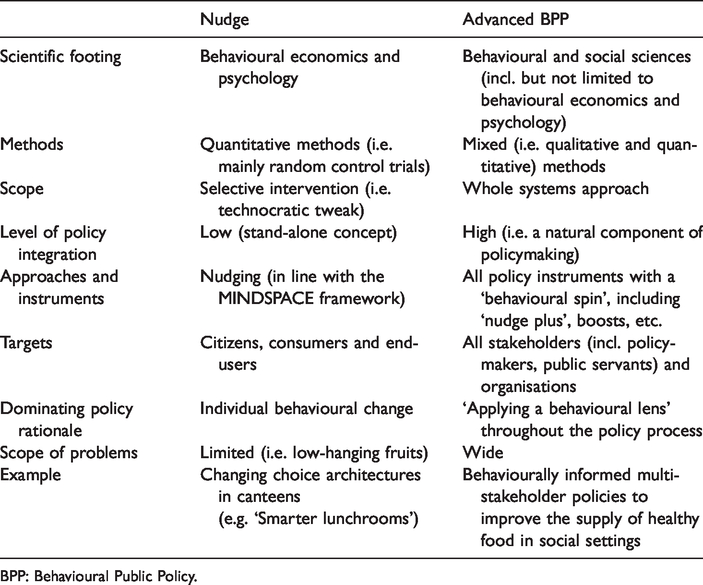
Characteristics of nudge versus advanced BPP.
BPP: Behavioural Public Policy.
With regard to its scientific footing, the nudge approach emerged from behavioural economics and psychology (which are strands of the social sciences), while advanced BPP draws more broadly from ‘behavioural and social sciences, including decision making, psychology, cognitive science, neuroscience, organisational and group behaviour’ (OECD, 2017: 3). However, the elements of BPP that come from beyond behavioural economy and psychology have remained significantly underutilised; this chiefly concerns insights that explain how behaviours are embedded in and shaped by environments and people’s life worlds. For instance, social identity theory – a social-psychological approach – offers a much more detailed explanation of lasting behavioural change that is based on the internalisation of social norms, rather than the strategic exploitation of social norms. Mols et al. (2015: 94) state that ‘nudgers’ neither ‘engage with people’s social psychology’ nor ‘tap into people’s social identities’ – a conclusion that would lend credence to calls for a more holistic (i.e. multidisciplinary) concept of behavioural policymaking. Moreover, insights from anthropology and social marketing could be used to understand the sociocultural and environmental reasons for certain behaviours. For example, Al-mosa et al. (2017: 14) adopt a behavioural ecological framework to study the ‘complex interplay between individual, social, and environmental factors’ that lead to littering behaviour in public parks. Without ignoring individual responsibility, they conclude that a ‘combination of structural modifications and turning the focus toward actors within the system’ fits best when seeking to prevent littering behaviour. This leads us to the methodological basis of advanced BPP. As suggested in the interviews, ideally this would seek to combine quantitative and qualitative research in a mutual reinforcing way. While RCTs are deemed indispensable to conducting large-scale experiments, qualitative methods – interviews, participatory observation or focus groups – allow for a fuller exploration of the social context in which BPP should be applied (van Bavel and Dessart, 2018). Defined as a multi-disciplinary and multi-methodological approach, advanced BPP seems to be superior to the nudge’s individual-centred conceptual design.
Another conceptual feature concerns the scope of behavioural policymaking. Nudge tactics are criticised as selective interventions suited exclusively to use during the stage of policy implementation; by contrast, advanced BPP would suggest the use of behavioural insights as a kind of universal means throughout every stage of the policy process – from problem scoping and definition, through policy design and implementation to policy evaluation. Thus the application of a ‘behavioural lens’ to improve the policy process as a whole is seen as a key rationale for advanced BPP. Behavioural policymaking could take different forms and have different uses: problem scoping and definition may benefit from qualitative studies of people’s behaviour in situated actions and social contexts (rather than when prompted in experiments); behaviourally informed policy design, meanwhile, would require evidence on human behaviour for the purpose of ‘matching policy tools and their targets’ (Howlett, 2018). While nudges may be deployed to facilitate policy implementation, other behavioural approaches such as ‘budges’ (Oliver, 2015) and ‘boosts’ (Hertwig and Grüne-Yanoff, 2017) could play a vital role too at this particular stage of the policy process. Ultimately, it would be up to behaviourally informed policy evaluation to examine what works and what not; in other words, to provide evidence on the effectiveness of policy interventions.
Behavioural insights could be also used to achieve a wider range of policy aims. Thus, rather than being restricted to achieving individual behaviour change, advanced BPP may be suited to multiple purposes (e.g. using behavioural insights to inform the selection of policy tools). Linked to this rationale, there is an extension of the targets of behavioural interventions: advanced BPP seeks to influence the behaviour of every stakeholder in the policy process, including policymakers, public servants and organisations. Advanced BPP could also contribute to tackling more complex policy problems. Smarter lunchrooms (Wansink, 2014: 101) designed to nudge students towards healthier meal choices will have a limited overall impact if, for instance, schools are located in ‘food deserts’ (Shaw, 2014) that preclude access to healthy food – a factor that may have a much greater impact on students’ health than school meals (Ewert, 2017). Nonetheless, it is in social settings like schools where behavioural insights could become a valuable component of wider policy strategies. Evidence on people’s food preferences and shopping habits are a good starting point for designing behaviourally informed interventions that work in combination with conventional policy tools, such as the regulation of food producers and retailers or subsidies for healthy foods.
Advanced BPP – A more participatory, more ethical and less ideological policy paradigm?
Since advanced BPP is still in its formative phase, statements about whether the concept is an adequate response to the major criticisms levelled at nudges (see section Reassessing four major criticisms of nudge theory) can only be of a provisional nature. However, it can be concluded that while some of the conceptual and methodological reservations regarding nudging may be addressed by advanced BPP, other criticisms will doubtless persist or new ones emerge.
In responding to conceptual criticisms of nudges (i.e. too narrow, technocratic, elitist and top-down), efforts to broaden and ground BPP have emerged. In this regard, the recent concept of ‘nudge plus’ (John, 2018; John and Stoker, 2019) reads like a manual of good practice by ‘recognis[ing] that effective nudges work alongside other influences (…), not as a standalone policy, but rather as mechanism for helping deliver behaviour change alongside other tools of government’ (John and Stoker, 2019: 217). John’s (2018: 132) claim for ‘long-term relationships between the individual and the public agency’, allowing reflection and feedback from the side of the citizens as a basis for BPP, may also placate critics. On the other hand, there is little empirical evidence on ‘nudge plus’ interventions yet. While Feitsma (2019) discusses some inspiring nudge initiatives from the Netherlands that are being developed and owned by citizens, the overall picture looks less rosy (Whitehead et al., 2019). By and large, behavioural insights are, and will presumably remain, a tool of those who govern and not those who are governed. It is therefore very likely that conceptual criticisms may grow louder if behavioural insights are applied more frequently throughout the policy process. One could legitimately conclude that anyone who has conceptual concerns about nudge tactics will be even more worried by ‘a whole systems approach’ (Intw7_BIT) that provides many more opportunities to apply behavioural science in policymaking. As a result, the need for citizen control and participation in behavioural policymaking may rather increase than decrease as a result of advanced BPP.
In principle, methodological criticisms of nudging may be mitigated by advanced BPP. Qualitative methods could complement and revitalise experimentation in behavioural policy (Lunn and Robertson, 2018). These are particularly relevant to developing a nuanced understanding of social settings and the behaviour of certain groups, and may therefore help policymakers to deploy context-sensitive BPP rather than adopting a ‘shotgun approach’ (Hansen, 2018: 195). However, given the general imbalance between quantitative and qualitative research in academia, breaking the supremacy of RCTs in BPP would seem to be a mammoth task, especially if one considers BITs’ enormous expertise and capacity to apply these techniques in the most efficient way. To phrase this somewhat more provocatively: how likely is it that BITs will be infiltrated by critical sociologists or anthropologists in near future? And, if this were to happen, would those voices be valued by leading behavioural economists? Because to put an end to the current methodological bias of BPP practise, listening to both sets of voices would be essential.
Reconciling advanced BPP with ethical concerns would also seem difficult. It is no coincidence that advocates of BPP have recently published a ‘Bill of Rights for Nudging’ (Sunstein and Reisch, 2019: 128) and a ‘Behavioural Insights Toolkit and Ethical Guidelines for Policy Makers’ (OECD, 2018). There is a consensus that if BPP is to become a standard component in mainstream policymaking, basic agreement on its ethical foundations needs to be reached. But the debate on ethics in BPP, which goes far beyond the debate that has already been conducted around nudging, has just begun (see, by way of an introduction, Lepenies and Małecka, 2019). For now, we can conclude that the sheer variety of ways of applying behavioural insights to different sectors of public policy demands ethical standards that are sensitive to context and case. From this perspective, the OECD's (2018) basic toolkit is a laudable step since it suggests practical ethical considerations (e.g. ‘demonstrate the necessity of experimentation’ and ‘monitor for long-term and side effects’) in relation to each stage of the BPP process; nevertheless, BPP might be better accepted if those guidelines had been formulated by an independent and civil society-based agency that was not itself a vocal proponent of behavioural policymaking.
Finally, the ideological strand of criticism needs to be revisited in the light of advanced BPP. In this regard, ‘separating the normative from the positive aspects of behaviourally informed policy design’ (Kuehnhanss, 2018: 19) seems important. Most interviewees are dissatisfied with the politicised and partly ideological zeal with which behavioural insights have been adopted in public policy in recent years. Accordingly, the mere existence of a behavioural intervention may make policymakers feel like ‘they do not have to do anything else’ (Intw1_ACA), especially when we take into account the fact that policymakers tend to be wary of more onerous policy interventions based on regulation (Ewert, 2019a). It is unlikely that policymakers’ general appetite for easy-to-communicate behavioural solutions will suddenly switch to an attitude that regards behavioural approaches as one component within a mixed and balanced policy strategy. As a first step, the debate on behavioural insights needs to be depoliticised and the unrealistic expectations that have accompanied BPP need to be countered. Besides evidencing what BPP can achieve and what it cannot, citizen-owned examples of behavioural interventions (nudge plus), tested and promoted by non-governmental organisations (Feitsma, 2019), have the potential to revitalise public policy by making it more responsive and better tailored to public needs. A less ideological notion of BPP could also draw on past debates on how to approach behavioural change. For example, long before nudge theory captivated the debate on behavioural change, Halpern et al. (2004: 4) concluded that ‘[t]o be effective and acceptable, such approaches need to be built around co-production and a sense of partnership between state, individuals and communities.’ Rather than a political project to increase individual responsibility, at that time behavioural change was perceived as a common endeavour to be achieved through co-production – a civic-minded policy paradigm to renew state-citizen relations and public service delivery through a strong emphasis on participation and dialogue (Brandsen et al., 2018). Since co-production concerns the design and implementation of social services, this could serve as a blueprint for the joint development of atypical behavioural interventions behind the scenes of BPP (Feitsma, 2019). Reconciling both these policy paradigms – behavioural insights and co-production – and their academic and practice communities could strengthen the legitimacy and ideological foundations of advanced BPP.
As has become clear, advanced BPP is by no means a silver bullet when it comes to the vehement criticisms that have been directed at nudge practices. Indeed, BPP may be the target of the same criticisms, or give rise to new ones. However, the real value of advanced BPP lies in the attempt to incorporate behavioural insights into public policy in a more versatile and non-deterministic manner than has been done under the nudge paradigm. Whether or not this process of maturation will actually lead to a more participatory, more ethical and less ideological form of behavioural policymaking is an empirical question that will need to be answered in future studies.
Conclusion
Since behavioural insights were first systematically applied in public policy more than a decade ago, the results have been mixed. On the one hand, even critics of behavioural approaches would acknowledge that ‘[p]roof of concept has definitely occurred’ (John and Stoker, 2019: 210). On the other hand, despite the global proliferation of nudge units, ‘why behavioural insights have not become more deeply integrated into public policy’ (Hansen, 2018: 191) remains an open question. This paper has argued that a narrow and opportunistic understanding of the role of behavioural insights in public policy – expressed in the dictum of nudging individual behaviour – has prevented both the full unfolding of behavioural insights in policymaking and serious efforts at policy integration. In contrast to this one-sided and one-dimensional use of nudge tactics, an advanced version of BPP has been outlined based on the findings of an interview study. Behaviourally informed policymaking could thus be defined as a potentially pluralist, non-deterministic and multipurpose approach that requires, above all, the adoption of a behavioural lens with respect to the policy process. Such a view could extend the scope of BPP significantly, since each phase and every aspect of the policy process could be disassembled into its behavioural components. As a consequence, not only the behaviour of citizens but also that of public administrators and entire organisations could be addressed by BPP. Likewise, advanced BPP seems more suited to responding to complex problems that involve behavioural and structural dimensions. However, in order to restore the confidence that has been lost in the age of nudge tactics, advanced BPP must also engage seriously with the sustained criticism of the use of behavioural insights. Anchoring advanced BPP as a multi-disciplinary and multi-methodological concept that is jointly owned and shaped by multiple stakeholders would be a key prerequisite in this regard.
Footnotes
Acknowledgments
I would like to kindly thank the editors of Public Policy and Administration and four anonymous reviewers for their comments and most useful guidance in developing this paper. Moreover, my thinking and writing on BPP has been stimulated by participating in the panel Varieties of Behavioural Public Policy: Modes, Manifestations and Political Consequences of a Global Discourse, organized by Holger Strassheim, at the 4th International Conference on Public Policy (ICPP) in Montréal (26--28 June 2019).
Declaration of conflicting interests
The author(s) declared no potential conflicts of interest with respect to the research, authorship, and/or publication of this article.
Funding
The author(s) received no financial support for the research, authorship, and/or publication of this article.
